Daniel 8:20
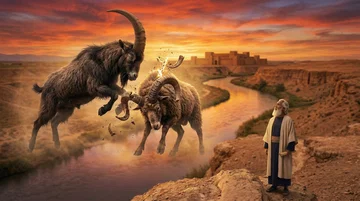
The ram which thou sawest having two horns are the kings of Media and Persia.
Translations
The ram which you saw having two horns are the kings of Media and Persia.
King James Version, KJV Cambridge Paragraph Bible, Webster Bible
The ram which thou sawest having two horns are the kings of Media and Persia.
The ram which thou sawest that had the two horns, they are the kings of Media and Persia.
The ram which thou sawest, that had the two horns, they are the kings of Media and Persia.
'The ram that thou hast seen possessing two horns, [are] the kings of Media and Persia.
The ram that thou sawest having the two horns: they are the kings of Media and Persia.
The ram which thou sawest, having the two horns, representeth the kings of Media and Persia;
Berean Standard Bible, Majority Standard Bible
The two-horned ram that you saw represents the kings of Media and Persia.
The ram which you saw, that had the two horns, they are the kings of Media and Persia.
The sheep which you saw with two horns, they are the kings of Media and Persia.
The ramme which thou sawest hauing two hornes, are the Kings of the Medes and Persians.
Douay-Rheims (Challoner revision)
The ram, which thou sawest with horns, is the king of the Medes and Persians.
Pictures
Cross-references 20 of 24
- Daniel 8:3-4
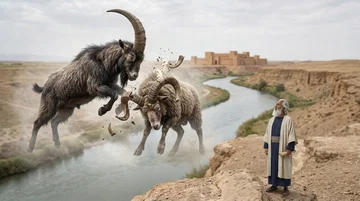
Then I lifted up mine eyes, and saw, and, behold, there stood before the river a ram which had two horns: and the two horns were high; but one was higher than the other, and the higher came up last.
Describes the two-horned ram and its conquests.
- Daniel 8:16
And I heard a man’s voice between the banks of Ulai, which called, and said, Gabriel, make this man to understand the vision.
Gabriel is commanded to explain Daniel’s vision, including the ram.
- Daniel 8:5-7
And as I was considering, behold, an he goat came from the west on the face of the whole earth, and touched not the ground: and the goat had a notable horn between his eyes.
The goat defeats the ram, identified as Media and Persia, marking Greece’s rise.
- Daniel 11:2
And now will I shew thee the truth. Behold, there shall stand up yet three kings in Persia; and the fourth shall be far richer than they all: and by his strength through his riches he shall stir up all against the realm of Grecia.
Names Persian kings and foretells one stirring up Greece.
- Daniel 7
In the first year of Belshazzar king of Babylon Daniel had a dream and visions of his head upon his bed: then he wrote the dream, and told the sum of the matters.
Its prophetic line parallels Daniel 8.
- Daniel 2:39
And after thee shall arise another kingdom inferior to thee, and another third kingdom of brass, which shall bear rule over all the earth.
The image’s second kingdom represents Medo-Persia, followed by Greece.
- Daniel 8:9
And out of one of them came forth a little horn, which waxed exceeding great, toward the south, and toward the east, and toward the pleasant land.
The little horn follows the kingdoms of Media-Persia and Greece and is identified as Rome.
- Daniel 8:3
Then I lifted up mine eyes, and saw, and, behold, there stood before the river a ram which had two horns: and the two horns were high; but one was higher than the other, and the higher came up last.
The two-horned ram’s unequal horns are identified as the kings of Media and Persia.
- Daniel 9:22-23
And he informed me, and talked with me, and said, O Daniel, I am now come forth to give thee skill and understanding.
Gabriel returns to give Daniel understanding of the earlier vision.
- Daniel 7:17
These great beasts, which are four, are four kings, which shall arise out of the earth.
Both identify prophetic beasts as kings or kingdoms.
- Daniel 5:28
PERES; Thy kingdom is divided, and given to the Medes and Persians.
Names the Medes and Persians as the power that took Babylon.
- Daniel 8:14
And he said unto me, Unto two thousand and three hundred days; then shall the sanctuary be cleansed.
The ram belongs to the vision whose 2300 days end with the sanctuary’s cleansing.
- Daniel 5:31
And Darius the Median took the kingdom, being about threescore and two years old.
Darius the Median took the kingdom as the Medes and Persians succeeded Babylon.
- Daniel 8:1
In the third year of the reign of king Belshazzar a vision appeared unto me, even unto me Daniel, after that which appeared unto me at the first.
Dates the vision in which the ram appears.
- Daniel 2:32
This image’s head was of fine gold, his breast and his arms of silver, his belly and his thighs of brass,
The image’s silver breast and arms represent Medo-Persia.
- Daniel 9:1
In the first year of Darius the son of Ahasuerus, of the seed of the Medes, which was made king over the realm of the Chaldeans;
Darius’s first year dates the later vision after Babylon’s fall.
- Daniel 10:1-11
In the third year of Cyrus king of Persia a thing was revealed unto Daniel, whose name was called Belteshazzar; and the thing was true, but the time appointed was long: and he understood the thing, and had understanding of the vision.
The vision in chapters 10 and 11 further explains Daniel 8’s vision.
- Isaiah 45:1
Thus saith the LORD to his anointed, to Cyrus, whose right hand I have holden, to subdue nations before him; and I will loose the loins of kings, to open before him the two leaved gates; and the gates shall not be shut;
Cyrus is linked to opening Babylon’s gates.
- 2 Chronicles 36:23
Thus saith Cyrus king of Persia, All the kingdoms of the earth hath the LORD God of heaven given me; and he hath charged me to build him an house in Jerusalem, which is in Judah. Who is there among you of all his people? The LORD his God be with him, and let him go up.
Persian rule after Babylon
- Daniel 10:20
Then said he, Knowest thou wherefore I come unto thee? and now will I return to fight with the prince of Persia: and when I am gone forth, lo, the prince of Grecia shall come.
angel leaves Persia for Grecia
Commentary
Each commentary is drawn from primary sources: the writings of Ellen G. White and Adventist pioneers and periodicals. Each commentary is separate. Its own words are not a quotation; follow the references to read the source passages.
Ellen G. White
5 sources
The ram with two horns is the kings of Media and Persia.LS 42.2–44.1LS 45.2–3 Its two horns are the two divisions of that empire, with the Persian division becoming the greater and rising up later.LS 42.2–44.1 The ram was a recognized emblem of the Medes and Persians, whose kings wore a gold diadem shaped like a ram's head.LS 42.2–44.1
The verse belongs to the wonderful prophecies of Daniel 7-12, a vision received directly from God as revelation of the mysteries of ages to come.PK 547.1Ms 142, 1901, par. 6 Even Daniel himself did not fully understand it, and not all of the divine purpose in it was given for him to understand.PK 547.1 Its words were to be shut up and sealed until the time of the end, because the vision was given especially for the last days.PK 547.1Ms 142, 1901, par. 6 Its foretold events are now being fulfilled and will soon come to pass.Ms 142, 1901, par. 6
Daniel 8 is connected with prophetic periods whose historical and chronological reckoning begins in 457 B.C.GC 687.4 Since the ram's symbol was already explained in chapter 8, the later explanation in chapter 9 concerns the time period left unexplained, not the ram.LS 45.2–3 Daniel was given assurance that at the end of the days, in the closing period of this world's history, he would rest and stand again in his lot and place.PK 547.1
Sources
Pioneers and periodicals
143 sources
The ram with two horns is the kings of Media and Persia, the Medo-Persian kingdom, empire and power.RH Oct 6, 1863ST Aug 8, 1878ST Its two horns are the two nationalities, elements and divisions united in one government under one king at a time, not hostile divisions under different rulers and not successive individual kings such as Cyrus and Darius.ST Dec 22, 1881ST Oct 4, 1877RH Aug 9, 1870 The higher horn that came up last is Persia rising later to dominance after the Medes first held ascendancy, when after Darius the Mede first held royal power Cyrus inherited Media and united both under Persian rule.RH Oct 6, 1863RH Dec 30, 1915 The meaning was given by Gabriel in plain language not parable, leaving no room for mistake, speculation or human conjecture.RH Dec 23, 1852ST Oct 4, 1877RH Aug 9, 1870 It stands as the second universal empire after Babylon and before Grecia and Rome, the same power as the silver breast and arms in Daniel 2 and the bear raised up on one side in Daniel 7.ST Aug 2, 1877RH Apr 30, 1857ST Sep 21, 1882
Ram and Horns Identified
The ram with two horns are the kings of Media and Persia, the Medo-Persian kingdom, empire and power.RH Oct 6, 1863ST Aug 8, 1878STST May 11, 1876RH Nov 12, 1908 It is the first empire in the vision's succession of earthly powers, about to succeed Babylon as the world empire and succeeding it in 538 B.C. after the two kingdoms united to conquer Babylon.ST Aug 8, 1878STST May 11, 1876RH Nov 12, 1908RH Dec 23, 1852 The 2300-year period begins with the vision during the height of that power.RH Dec 23, 1852
The two horns are the two nationalities, elements and divisions that composed the empire, the Medes and the Persians united in one government under one king at a time.ST Dec 22, 1881ST Oct 4, 1877RH Aug 9, 1870ST Jan 22, 1880RH Feb 15, 1870 They signify the union of the two nationalities that made up the Persian Empire and its distinguishing feature, not a divided power nor hostile divisions under different rulers.ST Dec 22, 1881ST Oct 4, 1877RH Aug 9, 1870ST Sep 29, 1881 They are not successive individual kings such as Cyrus and Darius, but two powers united under one government, corresponding to the two arms of the image in Daniel 2 and to the bear raised up on one side in Daniel 7.RH Feb 15, 1870ST Sep 29, 1881
The higher horn that came up last is Persia, the greater and leading division, rising later to dominance and to higher eminence after the Medes first held ascendancy.RH Oct 6, 1863RH Dec 30, 1915ST Nov 17, 1881ST Jan 22, 1880 The lower horn represented Media, for Darius the Mede initially took the united kingdom after Babylon was conquered and held the royal power and reigned two years while Cyrus led the combined armies.ST Feb 20, 1912ST Jan 22, 1880RH Nov 26, 1857 When Darius died Cyrus the Great came to the throne, inherited Media and united both kingdoms under his rule and elevated the empire to its commanding position, the Persian element from being at first simply an ally of the Medes becoming the leading division.ST Feb 20, 1912ST Jan 22, 1880RH Nov 26, 1857RH Jun 21, 1870
The ram was a familiar and well-known emblem of the Medes and Persians, and the use of the ram is most appropriate.LS 42.2–44.1ST Feb 20, 1912RH Nov 26, 1857ST Jan 24, 1878 Persian kings wore a gold diadem shaped like a ram's head or a jeweled ram's horn of gold instead of a diadem.LS 42.2–44.1ST Feb 20, 1912RH Nov 26, 1857ST Jan 24, 1878 Sculptures at Persepolis show a ram's head with two horns one higher than the other, and the Hebrew word for ram springs from the same root as Elam, or Persia.ST Feb 20, 1912RH Sep 13, 1915
Pushing westward, northward and southward portrays the directions in which the Medes and Persians carried their conquests, and the vision therefore commences with them at the height of their power.RH Dec 23, 1852ST Nov 17, 1881ST Feb 20, 1912RH Nov 26, 1857RH Feb 15, 1870 The movement was chiefly westward from Persia toward Babylonia, Mesopotamia, Syria and Asia Minor, northward over Armenia to the Caspian Sea, and southward where Judea, Egypt, Ethiopia and India submitted to Persian arms.ST Feb 20, 1912RH Nov 26, 1857 No earthly power could stand before it while God was bringing it to its appointed position, and it did according to its will and became great.RH Dec 23, 1852ST Nov 17, 1881RH Jun 21, 1870 This was fulfilled when in the days of Ahasuerus it extended from India to Ethiopia over 127 provinces, reaching its highest elevation under Darius Hystaspes and then declining from Xerxes onward through its succession of kings to Darius III the last monarch, so that history even exceeds the description, until overthrown by the power that succeeded it.RH Dec 23, 1852ST Nov 17, 1881ST Feb 20, 1912RH Jun 21, 1870
Vision Date and Setting
The vision belongs to the third year of Belshazzar, reckoned as 538 B.C. in the last year of the Babylonian monarchy and the last days of Babylon, which was also the first year of Darius the Median.ST Dec 24, 1894RH Mar 21, 1912RH May 12, 1910ST Mar 11, 1889 It was written down on the parchment scroll at Shushan as a disclosure of the future, declaring generations beforehand the course of history that would be fulfilled before men's eyes two hundred years later.ST Dec 24, 1894RH Mar 21, 1912 Belshazzar was Nabonadius's son and joint ruler, so his third year fell after Nabonadius had reigned alone fifteen years, placing the vision in the third and last year of Belshazzar and at the beginning of the reign of Darius the Median.ST Mar 11, 1889RH Nov 25, 1902 The vision of Daniel 9, given in the first year of Darius, followed less than two years later and may have occurred in the same year, and its timing connects it closely as explaining the time brought to view in Daniel 8.ST Dec 24, 1894ST Mar 11, 1889 As the opening of a vision of the great apostasy to come in later times, it stands first in a succession of world dominions shown like moving pictures upon a screen, one power doing its work and then giving place to the next.RH Mar 28, 1912
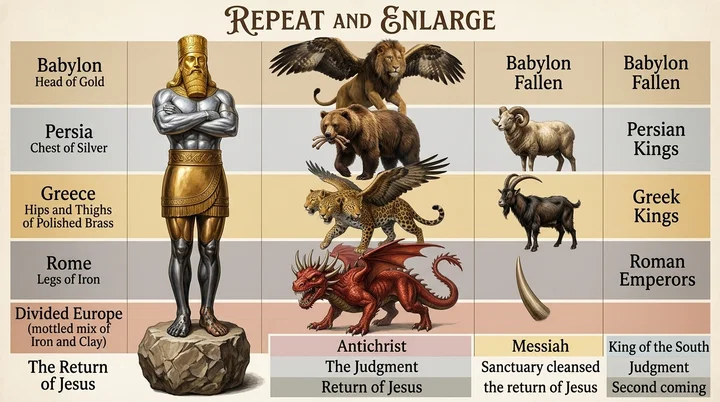
Babylon is left out of this vision's sequence altogether because it was then history and not prophecy, destined to fall in Daniel's day.ST Aug 14, 1893RH May 12, 1910 It was passing away and soon to fade with its dominion, diadem, scepter and blade, while Medo-Persian power was just at hand and about to succeed it as world empire.RH May 12, 1910 Thus the prophecy begins with Medo-Persia at the height of its power and standing first in the field of view, the first of three great dynasties portrayed in Daniel 8 and 9 and the second of four successive universal empires foretold in Daniel 2, 7, and 8.ST Aug 14, 1893ST Aug 2, 1877RH Apr 30, 1857 The ram represents the same empire as the silver breast and arms in Daniel 2 and the bear in Daniel 7, and its plain identification by name fortifies those parallel prophecies and gives certain ground for making known the coming of Jesus Christ.RH Apr 30, 1857ST Jun 30, 1914 The line then continues through Grecia and Rome till earth's empire is broken without hand, pointing to Messiah, His earthly ministry, His priesthood, and His entrance in 1844 upon the closing work of that priesthood in the justifying of the heavenly sanctuary or investigative judgment.ST Aug 14, 1893ST Aug 2, 1877
The chapter stands in the Hebrew portion of the book, which runs from the eighth chapter to the close.RH Nov 25, 1873 Hebrew is used from this point because the restoration of the Jews and God's future dealings with them are the subjects of record, for which native Hebrew is best suited.RH Nov 25, 1873 It was addressed not to learned Jews at a later date but to the common people during the Babylonian captivity.RH Nov 25, 1873 The eighth chapter contains Daniel's formal presentation of himself, which accounts for Chaldee being continued through the seventh chapter despite its close similarity in subject to the second chapter.RH Nov 25, 1873
Empires Before and After
The ram stands first in the vision's succession of earthly powers, opening a sequence that runs from the rise of the Persian Empire through Grecia and Rome to a power that puts saints to death, stands up against the Prince of princes, and is to be destroyed without human hand at the end.ST Aug 8, 1878ST May 11, 1876RH Mar 10, 1874ST Oct 22, 1874RH Oct 6, 1863 That final destruction of Rome, represented by the little horn grown exceedingly great, was still future when the prophecy was traced, and the scope from Persia to that end gives conclusive proof of the meaning of the vision.RH Mar 10, 1874RH Oct 6, 1863RH Dec 11, 1856 Medo-Persia is the second of four successive universal empires after Babylon and before Grecia and Rome, with Babylon, Medo-Persia, Grecia, and Rome successively arising as foreshown and only the closing specifications and God's everlasting fifth kingdom still impending.ST Aug 2, 1877RH Apr 30, 1857ST Sep 21, 1882RH Nov 21, 1854RH Apr 25, 1912 It is the same power as the silver breast and arms in Daniel 2 and the bear in Daniel 7, the silver shining where Babylonian gold had dazzled and the bear taking the domain of the defeated lion.ST Aug 2, 1877RH Apr 30, 1857ST Sep 21, 1882RH Nov 21, 1854RH Feb 17, 1853 The bear raised up on one side and the two arms match its twofold character of Medes and Persians, and its two horns correspond to those two arms and to the bear raised on one side, while it is also pictured as a wolf in Jeremiah.RH Apr 30, 1857RH Nov 21, 1854RH Feb 17, 1853
The goat overthrows the ram and takes its place, showing that Grecia succeeded Medo-Persia as ruling world power and that Media and Persia followed Babylon as a world power.ST Jul 7, 1887ST Sep 17, 1885ST Oct 29, 1885 That successor Greece is represented by the goat, and the exceedingly great little horn is Rome taken as a whole, corresponding to the fourth kingdom of the other visions, following Greece in the order Persia great, Grecia very great, Rome exceeding great.ST Mar 11, 1903RH Jan 28, 1858RH Apr 4, 1912 Rome conquered Macedonia in 168 B.C., and the prophecy depicts the little horn as coming from the Macedonian horn, continuing until the cleansing of the sanctuary at the end of the 2300 days and changing from paganism, the continual desolation by which Satan opposed the cause of Jehovah from the days of the Assyrian kings, to papacy.ST Mar 11, 1903RH Jan 28, 1858 Gabriel's outline makes Medo-Persia succeeded by Greece, then by Rome as the fourth great empire, then by the great apostasy with its deceptive workings.RH Apr 4, 1912 After Alexander the Great, first king of united Grecia and its first notable horn, his kingdom was divided in 301 B.C., twenty-two years after his death when all his house had perished.ST Feb 27, 1912 The division was among Ptolemy in the south with Egypt, Libya, Arabia and Palestine, Seleucus in the east with Syria to the Indus, Lysimachus in the north with Thrace, Bithynia and smaller provinces of Asia Minor, and Cassander in the west with Macedon and Greece, giving definite particulars of territory and time to locate the little horn. The four succeeding horns stand for the kingdoms of Macedon, Asia Minor and Thrace, Egypt, and Syria begun by Cassander, Lysimachus, Ptolemy, and Seleucus, after which comes another horn, another power.ST Feb 27, 1912
Medo-Persia was about to succeed Babylon as world empire and stands at the beginning of the sequence because world supremacy was passing from Babylon to Medo-Persia in 538 B.C.STST Dec 24, 1894ST Sep 2, 1913 It succeeded Babylon when Cyrus captured the city and Belshazzar was slain, Babylon having no symbol in Daniel 8 because it was passing under Medo-Persian control, and it remained supreme until its overthrow in 331 B.C., existing from 538 to 331 B.C.ST Nov 28, 1895ST Jun 11, 1896ST May 30, 1911 Persia's final king was defeated by Alexander at Arbela, and Greece succeeded Persia in world dominion in 331 B.C. when the Medes and Persians who had conquered Babylon fell in turn to the Grecians led by Alexander, who died at the height of his worldly greatness.ST Nov 28, 1895ST Jun 11, 1896ST May 30, 1911 Three Persian kings after Cyrus were Cambyses, Smerdis, and Darius Hystaspes, and the fourth was Xerxes, famed for his riches and wealth and for leading a vast unsuccessful campaign against Greece.ST Apr 6, 1882 Under Xerxes Persia as a world-molding empire reached its riches, and when Persia met Grecia its power as a world-molding empire was destroyed, the prophecy leaping over centuries straight to Alexander of Grecia in the same kind of long leap later made past the Syrian kings of the north through Antiochus III and IV until Rome becomes the molding power of earth.ST Apr 23, 1912ST Apr 6, 1882
The two high horns mean a twofold power of Medes and Persians named by historic name to assure that Babylon would fall to its besiegers, and the one horn higher and coming up last means the Persians, weakest at first, gained the upper hand when Cyrus the Persian succeeded Cyaxares, or Darius the Mede.ST Jul 27, 1915 Before Cyrus was born, when Astyages king of the Medes ruled and the Persians were in subjection to the Medes, that higher horn had not yet arisen.ST Jan 20, 1914 The higher horn therefore represents Persia, which rose later and became dominant, while the Medes ruled first and then the Persians became the stronger element.ST Nov 28, 1895ST Jun 11, 1896ST Jul 27, 1915
Symbols Explained, Time Reserved
Gabriel was commanded to make Daniel understand the vision, and came swiftly while Daniel was praying to give the divine interpretation of the ram and the goat and the horn in plain language without parable.ST Oct 4, 1877RH Aug 9, 1870ST Feb 7, 1884ST Jun 26, 1907ST The meaning of the ram with two horns as Media and Persia was thus made known by divine command and is clear and easily understood, with the goat as Greece and the little horn as Rome the kingdom succeeding Greece forming the symbolic context for ascertaining the beginning and end of the twenty-three hundred days.RH Dec 23, 1852ST Feb 7, 1884ST Jun 26, 1907 The two horns denote the distinguishing feature of the Persian Empire, the union of the two nationalities, elements and divisions of Media and Persia in one government, so the vision does not begin with Babylon but commences with the Medes and Persians at the height of their power prevailing westward and northward and southward until overthrown by the power that succeeded it.RH Dec 23, 1852ST Oct 4, 1877RH Aug 9, 1870 This definiteness leaves no room for mistake, speculation or human conjecture, unlike the less definite description of the little horn, and the declaration that the vision is for the time of the end belongs to the same fulfillment of the command to make Daniel understand.ST Feb 7, 1884ST
The symbols were explained while the time was left unexplained, for Daniel understood the ram and the he-goat and the little horn as Medo-Persia and Greece and Rome with no difficulty and no wrong ideas.RH Aug 23, 1870ST Jul 28, 1909ST Oct 18, 1877RH Jul 21, 1863ST The perplexity was not over those kingdoms but over the chronological element, the twenty-three hundred days and the cleansing of the sanctuary, which was misunderstood in relation to the ending of the seventy-year captivity and the repairing of the sanctuary lying in ruins.RH Aug 23, 1870ST Oct 18, 1877RH Jul 21, 1863 Therefore Daniel fainted and was sick certain days and was astonished with none understanding it, remaining anxious to understand that part of the vision.RH Aug 23, 1870ST Jul 28, 1909ST Gabriel appears there for the first time and is commanded there to make Daniel understand, yet Daniel ends that chapter without understanding, showing the mission was not fulfilled, and Gabriel returned a few months later after Belshazzar and Babylon fell and Darius the Mede began to reign to complete what was lacking, the instruction in Daniel 9 completing the explanation of the vision at the beginning named in Daniel 9:21.RH Aug 23, 1870RH Feb 6, 1900ST
Daniel 9 completes Daniel 8, the two prophecies being inseparably joined in a fundamental standard interpretation settled beyond doubt, never invalidated and never disproved, still good today and retained after the passing of the time in 1844 when the idea that the earth is the sanctuary was given up.RH Aug 4, 1868RH Aug 23, 1870RH May 26, 1853 The seventy weeks are cut off from the twenty-three hundred days and both periods begin together with the decree to restore and rebuild Jerusalem in 457 B.C. in the seventh year of Artaxerxes fulfilled in Ezra 7, the longer period extending 1810 years beyond the shorter one.RH Jun 4, 1857RH May 26, 1853RH Jan 7, 1858 Sixty-nine weeks or 483 years reach to the manifestation of the Messiah at His baptism about A.D. 27 when He preached that the time is fulfilled, seventy weeks reach to A.D. 34 with the turning to the Gentiles, and 1810 or 1817 more years complete the whole 2300 to the fall of 1844.RH May 26, 1853ST Feb 7, 1884RH Feb 21, 1856 Only 400 years belonged to the first covenant and 1810 reach to the cleansing, whose termination marking the commencement of the cleansing of the sanctuary is known only by the termination of the period with the Bible as lamp and light upon it.RH Feb 21, 1856 That ending is as fixed as the termination of the sixty-nine weeks for the commencement of Christ's ministry and the sixty-nine and a half weeks for the death of Christ, so to insert twelve years between the end of the period in Daniel 8 and the event predicted at its end would be as fatal as adding twelve years to the periods in Daniel 9 would prove either Daniel false or Jesus not the true Messiah, and the twenty-three hundred days do not cover every event in the vision since the little horn's breaking does not occur at that ending but is still future.RH Jun 4, 1857RH Feb 21, 1856
The twenty-three hundred days are not solar days of twenty-four hours but year-days, each day for a year, because they occur in symbolic vision with beasts for governments and the vision's symbols represent governments and empires including Persia and Greece and Rome.RH Dec 29, 1863ST Feb 7, 1884RH Jan 7, 1858ST Aug 8, 1878 That span as literal days would be too short to cover even one of these empires and too short to span those empires together, so they represent twenty-three hundred years, and the seventy weeks cut off from that period therefore represent 490 years as weeks of years, which fixes the days of the vision as years.ST Feb 7, 1884RH Jan 7, 1858 The Persian and Grecian and Roman empires together lasted between two thousand and three thousand years, so representing them as beasts living for thousands of years would be absurd while representing them as living and acting for that many days would not, and the chapter's time periods tied to symbolic events are not literal spans of days.RH Dec 29, 1863ST Aug 8, 1878 The prophecy portrays nations in their opposition to the gospel and shares its ground and powers with the other prophetic lines, its prophetic periods using days to represent years to reveal events connected with God's work and pointing to Christ's second coming and the everlasting kingdom.ST Aug 9, 1910
Chapters 10 to 12 were given after Daniel set his heart to understand with three weeks of prayer and fasting as a supplementary comment, explanation, development and further filling up of chapters 8 and 9, covering the same ground and dealing with the same powers beginning with Medo-Persia and reaching the same end.ST Apr 9, 1912RH Jul 18, 1871ST Apr 9, 1912ST Jul 27, 1882 Daniel 8, though it shows the great apostate power broken without hand, left Daniel sad and perplexed without clear assurance of the eventual triumph of the Prince and the host, and Daniel 9 added only God's power to foretell with the cutting off of Messiah and the destruction of Jerusalem, so Daniel prayed for more light on the ultimate issue and the later vision was given before Babylon's fall concerning the period when Medo-Persia succeeded Babylon as a world power.ST Apr 9, 1912ST Apr 9, 1912 Chapter 11 explains in mostly plain literal language without symbols, beginning with future Persian kings and Persia's conflict with Greece. That larger vision as carried out and explained contains four prophetic periods, the 2300 and 1260 and 1290 and 1335 days, with the 2300 days as the principal and longest period and the others as intermediate parts and subdivisions of it, and the end of the days when Daniel stands in his lot points to the end of the principal period which terminated in 1844 and brought the cleansing of the sanctuary and the casting of the lot assigning places in the heavenly inheritance.RH Jul 18, 1871ST Jul 27, 1882
The verse stands in the vision of the ram and he-goat dated to 538 B.C. in the final year of Babylon's supremacy when Medo-Persia conquered Babylon, closely connected with Daniel 9 whose vision explains the time brought to view in Daniel 8.ST Dec 24, 1894 It belongs in prophetic sequence arranged alongside the visions of Daniel 2 and 7 with the sanctuary and twenty-three hundred days, as the third of four distinct but parallel supplementary lines with Daniel 2 and Daniel 7 and Daniel 10 to 12, all covering the same great field of Babylon and Media and Persia and Grecia and Rome and the eternal kingdom of God and closing at the same time at the second coming of Christ and the resurrection.RH Oct 8, 1908ST Apr 9, 1912ST Jul 27, 1882 Its predictions given with divine interpretation can be compared with history, and their fulfillment bears witness to the reliability of prophecy.RH Mar 8, 1915 The vision is the second of three visions explained in chapter 9, one of Daniel's successive visions with attention to when it was given and to the interval between it and the visions in chapters 7 and 10, and the interval between chapters 8 and 9 is not material to the connection through the seventy weeks and twenty-three hundred days.RH Dec 15, 1868RH Feb 27, 1900
History Foretells and Proves
The declaration was made about 538 B.C. in the last year of the Babylonian monarchy, written down beforehand to show the course of history generations in advance in plain language and not as a blind oracle.RH Mar 21, 1912 It was fulfilled before the eyes of men two hundred years later when Alexander of Macedonia, first king of united Grecia, came swiftly from the west with his fleet goat power as if his feet did not touch the ground.RH Mar 21, 1912ST Feb 5, 1880 He won the decisive victories of Granicus and Issus, laid Persia prostrate, broke its two horns, cast it to the ground and trampled Medo-Persian power underfoot with none able to stand or deliver.RH Mar 21, 1912ST Feb 5, 1880RH Feb 15, 1870 With thirty-five thousand men against five times as many he flew with victory swifter than others could travel, pursuing enemies day and night and marching near forty miles a day for eleven days together in pursuit of Darius.ST Feb 5, 1880 He came upon enemies before they were aware and conquered them before they could resist, passing through Arbela and subjecting all lands from the Adriatic Sea to the Ganges in twelve and a half years, and Greece succeeded Persia in world dominion in 331 B.C. to bear rule in its stead.RH Sep 22, 1874ST Feb 5, 1880RH Feb 15, 1870
When Alexander approached Jerusalem the book of Daniel was shown him declaring that one of the Greeks should destroy the empire of the Persians, and he supposed himself to be the person intended and bowed before the God of heaven who had borne witness to him.RH Mar 21, 1912 In conquering the world he was cooperating with the testimony of Jesus spoken through the spirit of prophecy and therefore could conquer easily, while in trying to resurrect Babylon from heaps of ruins he was fighting against that same testimony and could not build a single city.ST Feb 13, 1912 That testimony cannot be broken but will stand fast though earth and hell combine to break it.ST Feb 13, 1912 The spread of Greek belongs in the same prophetic setting as a means by which God bore witness to salvation through Christ's death and resurrection.ST Mar 20, 1907
The delineation belongs to the main prophetic portion given hundreds of years before the Christian era, taking up after Babylon had passed off the stage the three kingdoms still to follow by naming Medo-Persia by name.ST Nov 24, 1914ST Jun 30, 1914 It is a definite prophecy that can be depended upon, fulfilled with minute accuracy in every specification reached so far, with history even exceeding the description.ST Nov 24, 1914ST Jun 27, 1878 It presents history beforehand and proves supernatural insight, giving absolute certainty about the outcome of the world and the future existence of the human race and answering whence humanity has come, what is the future of existence as individuals, and what is the fate of the world.ST Nov 24, 1914 Its plain identification fortifies the parallel prophecies of Daniel 2 and Daniel 7 and gives certain ground for making known the coming of Jesus Christ.ST Jun 30, 1914 What remains concerns closing events, including the breaking of the exceeding great horn without human agency.ST Jun 27, 1878RH Dec 13, 1853
The great prophetic symbols of Daniel 7, 8 and 9 with the line of Daniel 11 and 12, the seven churches, seals and trumpets of Revelation, and the events of Revelation 12, 13 and 14 form an unbroken chain from Christ's day to the close of time showing the last generation has been reached and the opening heavens will disclose the coming of the Son of man in power and glory in the lives of many now living.RH Aug 28, 1913 The rise and fall of nations foretold here is fulfilled in history.ST Mar 1, 1905 The divine interpretation of the ram symbol was applied correctly by William Miller in his application of the prophetic symbols of Daniel and John, as sustained by Protestant expositors generally.RH Mar 11, 1875
The leading place in the vision belongs not to the ram but to the little horn, which is Rome in both its phases, pagan and papal, corresponding to the fourth kingdom of the other visions.RH Jan 28, 1858RH Jul 31, 1900 It is the same power as the little horn of Daniel 7 with the ten horns and the woman of Revelation 17, namely ecclesiastical and papal Rome divinely named Babylon the Great, arising during and among the ten kingdoms into which Rome was divided and having sovereignty over the sovereigns of the earth.RH Jul 31, 1900 It takes away the daily, continues until the cleansing of the sanctuary at the end of the 2300 days, and changes from paganism, the continual desolation by which Satan opposed the cause of Jehovah from the days of the Assyrian kings, to papacy.RH Jan 28, 1858 The outline runs from Daniel's day to the end of the world, sketched again in detail in Daniel 11 up to the invasion of Grecia, then followed by the Grecian kingdom until Rome enters to establish the vision, proving Rome the great subject in Daniel 7 and 8 and in the last half of the book as Babylon is in the first half.RH May 29, 1900ST Feb 19, 1894 To make the central figure Antiochus Epiphanes, with 1150 literal days fulfilled in about 55 days, is rejected as wrongly explaining the vision and breaking the chain of evidence, since the greatness of Persia, of Grecia under Alexander, and of Rome to whom Antiochus paid tribute far exceeds Antiochus.RH May 1, 1856
Those who held otherwise made the vision about Antiochus Epiphanes, his persecution of the Jews and his desecration of the temple, rather than about Christ's coming or God's everlasting kingdom.RH May 15, 1856 Others made the little horn of Daniel 8 Mahometanism, distinct from the little horn of Daniel 7 as the Roman Catholic hierarchy, the difference proved by respective places of origin and spheres of influence, with the cleansing of the sanctuary belonging to affairs on earth at the destruction of Mahometanism.RH Apr 15, 1873 The little horn does not point to Napoleon III and does not belong to the Franco-Prussian conflict, and applying it there overturns a settled chain of fulfilled prophecy about other actors and other scenes.RH Jan 10, 1871
Daniel's divinely inspired clear-cut prophetic picture of the Papacy is fulfilled by papal utterances speaking great things and blasphemies, exposing the mystery of iniquity and warning the church against all deceivableness of unrighteousness.RH May 15, 1913RH May 29, 1913RH Sep 13, 1915 The pagan religious systems of Babylon, Medo-Persia and Greece are combined in the composite beast from the sea and continued in the Papacy disguised under Christian forms and names.RH Apr 10, 1916 The Pope as head of the Roman priesthood continues the Pontifex Maximus of the ancient pagan religions, taking away the mediation of Christ and substituting a system of human mediation in its place.RH Apr 10, 1916 Diplomatic relations between Persia as the ram power and Greece as its companion nation ended in 491 B.C. when Darius sent heralds to Athens to demand Greek submission to his sovereignty, with no diplomatic intercourse for 2,393 years until resumed.ST Dec 10, 1902 Media stands among nations that rose and prospered then declined into ruin as wealth gave way to luxury, indolence, intemperance and degeneracy, the silver shining where Babylon's gold dazzled and the bear taking the domain of the defeated lion, taking the throne from Babylon and shedding the blood of its monarch and nobles, then itself softened by ease and made weak by plenty and falling beneath the sword of Greece.ST Sep 21, 1882ST Jul 16, 1896
Judgment Sanctuary and Kingdom
The vision reaches its climax in the cleansing of the sanctuary at the end of the 2300 years in autumn 1844, when Christ entered the most holy place in the heavenly sanctuary to begin the investigative judgment and the finishing of the mystery, judging the dead and then the living before the first resurrection.ST Aug 14, 1893ST Jun 20, 1916ST Sep 14, 1882 That ending is as fixed as the termination of the sixty-nine weeks for the commencement of Christ's ministry, the sixty-nine and a half weeks for His death, and the seventy weeks for the turning to the Gentiles, so to insert twelve years between the end of the period and the event predicted at its end would be as fatal as adding twelve years to the periods in Daniel 9 would prove either Daniel false or Jesus not the true Messiah.RH Feb 21, 1856 The ram is Medo-Persia as the first of three great dynasties portrayed, Babylon being omitted because it was then history not prophecy and destined to fall in Daniel's day, followed by Grecia and Rome continuing till earth's empire is broken without hand, forming a line pointing to Jesus as Messiah, His earthly ministry, His priesthood, and His entrance in 1844 upon the closing work of that priesthood, the justifying of the heavenly sanctuary.ST Aug 14, 1893 The symbols are described as fulfilled except that the little horn still awaits destruction without human agency, the prophetic days have ended, and the sanctuary's cleansing has been under way and may soon be complete, immediately before Christ's coming.ST Sep 14, 1882 After the expected coming did not occur in 1844, further study showed that the sanctuary was not the earth and that the 2,300-day period understood alongside Daniel 9 and Revelation 10 and 14 pointed to that entrance upon the investigative judgment.ST Jun 20, 1916
The course of empires in Daniel 2, 7 and 8 shows from fulfilled specifications that the God of heaven is about to set up His everlasting kingdom, the stone-kingdom crushing earthly rule.RH Jan 15, 1867RH May 7, 1867RH Jun 18, 1867RH Mar 10, 1868 The ram as Media and Persia is one empire in that chain, named among the four empires traced, proving the Second Advent is near.ST Oct 10, 1878RH Mar 10, 1868 All is fulfilled except the crowning event, the coming of the Son of man, with Christ's coronation as coming King the next and last event.ST Oct 10, 1878 The prophecy closes not with world conversion but with violence followed by Michael's reign.ST Nov 28, 1900
The vision centers on the continual and the sanctuary against an apostasy that takes away continual mediation through Christ, casts truth to the ground, obscures the heavenly sanctuary and sets up an earthly priesthood.RH Nov 25, 1902RH Oct 29, 1903RH Jun 6, 1912ST Oct 13, 1909RH Sep 23, 1902 That power, the same lawless power described in 2 Thessalonians 2, exalts himself against the Prince of princes, and the threefold message restores what was taken away by giving Christ and God in Christ their true place.RH Oct 29, 1903 The continual comprehends the entire sanctuary service ordained by God — the morning and evening sacrifices offered every day of the year for the whole congregation, the showbread, the burning lamps, the perpetual incense, and the high priest bearing the judgment of Israel before the Lord continually.ST Oct 13, 1909 That service in the earthly sanctuary in the wilderness was a type or figure of the heavenly sanctuary made after its pattern, so the term applies with equal force to the ministry above, and the entire force of the prophecy applies there because the earthly sanctuary with its priesthood had ended its operations before the later power began its work.ST Oct 13, 1909 When that power would arise and take away the continual service in God's temple, the shekinah glory would depart and the house become desolate.RH Nov 25, 1902 The prophecies of Daniel 7 and 8 thus give the basis for studying the judgment, the cleansing of the sanctuary, and other prominent features of present truth, together with the fourth kingdom and the little horn, modern Babylon, the perversion of Christianity in modern Babylon, the kingdom of Antichrist, changing the law of the kingdom of God, taking away the real presence, and the two mysteries, timely in view of the rapid advance of Roman Catholicism.RH Sep 23, 1902
Knowing the ram's identification alone is not the chapter's central practical experience; its teaching about the sanctuary and its cleansing brings peace, life and light and helps embrace and remain faithful to the Sabbath.RH Oct 27, 1904 Understood together with Daniel 9, it points out distinctly the commencement and termination of the 2300 days, shows what the sanctuary is and the nature of its cleansing, and explains the disappointment of the Advent people in regard to time and the true position of those now waiting for their Lord.RH Jun 12, 1856RH Jul 10, 1856RH Jun 19, 1856
The lines stretch far into the future to Christ's first advent to suffer and second advent in glory, in a series of visions showing the world's career from Daniel's own time to the time when God shall set up His everlasting kingdom.RH Mar 27, 1866ST Dec 1, 1909 The book was sealed until the time of the end when opened by fulfillment except what prepares for the Son of man; then many run to and fro searching Scripture, knowledge increases, the path shines, the book once sealed is made plain upon tables so he that reads may run, and it is now unsealed with new light dawning upon it and upon the revelation of Jesus Christ to John.RH Dec 9, 1873 Nearly all concerning probation has become history, and the time-of-end section is among the prophecies whose periods reach their endings during the time of the end, giving a prophetic period pointing to about the time of Christ's second coming and contributing to the evidence that earthly rule is nearing its end.ST Nov 28, 1900RH Mar 27, 1866 It was also included among the prophetic outlines said to be fulfilled in the generation addressed.RH Feb 6, 1855
The chapter belongs with persecutions upon the righteous in tribulation such as never was, distinct from the time of trouble upon the wicked.ST May 7, 1912 The ram is Persia, the kingdom that follows Babylon and dominated and persecuted the Jewish nation.RH Sep 11, 1900 Persia rejected light and was destroyed, and God's dealings with the nations then continued with Grecia.RH Sep 11, 1900
Rules for Interpretation
The two horns are the kings of Media and Persia, and therefore a horn used symbolically stands for a kingdom or nation.ST Jan 6, 1887 The same identification establishes the rule for horns left unexplained elsewhere, that a horn means a ruling power, whether civil or ecclesiastical.RH Mar 21, 1854RH Jul 2, 1857RH Mar 19, 1857 Horns can also denote distinct elements united under one government rather than a divided power, as with the two national elements joined in one Medo-Persian rule, which supplies the comparison for the two horns of the lamb-like beast.RH Feb 4, 1862ST Aug 7, 1879 Beasts in the same visions stand for earthly governments and kingdoms, and king can stand for kingdom, so that days of a king can mean the time of a kingdom.RH May 8, 1916
Prophecy was given to disclose future events, not to hide them, and its key is found in the Bible itself by comparing Scripture with Scripture rather than by human imagination.RH Sep 2, 1909 With Daniel 2, Daniel 4, Daniel 5, Daniel 7, Revelation 1 and Revelation 17, Daniel 8 is one of seven prophecies given in symbols and afterward fully interpreted, furnishing a basis for general prophetic interpretation that opens Scriptures otherwise closed and prevents fanciful exposition.RH Sep 2, 1909 Later presentations repeat the same powers, each adding features or further information, and must be combined together in order to be understood.RH Feb 18, 1873RH Oct 30, 1866 Daniel 11 is literal prophecy using no symbols, in contrast to the symbolic prophecies that teach by symbols together with Daniel 2, Daniel 7, Daniel 8 and Daniel 9.RH Dec 28, 1911
The ram is an object lesson that makes a future kingdom clear and easy to understand.ST May 27, 1908 The chain of ram, he-goat and little horn is given in pictures because more is received through the eye than through the other senses, and impressions made on the mind through the eye are deeper and more lasting.ST Jan 17, 1884 By such pictures the mind is impressed with divine things and taught what will come to pass in the last days.ST Jan 17, 1884
The meaning is definite and plain inside the vision itself, leaving no room for mistake or speculation.ST Jun 30, 1914ST Jun 30, 1914 It belongs to the main prophetic portion given hundreds of years before the Christian era, fulfilled with minute accuracy through the long list of centuries since, and therefore gives absolute certainty about the outcome of the world, whence humanity has come, the future of existence as individuals, and the fate of the world.ST Nov 24, 1914 That plain identification of Medo-Persia as the next power after Babylon fortifies the parallel prophecies of Daniel 2 and Daniel 7 and gives certain ground for making known the power and coming of Jesus Christ, showing prophecy is not cunningly devised fables.ST Jun 30, 1914ST Jun 30, 1914 Such symbols are fitting, for people still speak of the lion for Great Britain, the bear for Russia, the crescent for the Turkish Empire, and the eagle for Germany, as John does in Revelation.RH May 8, 1916
Sources