Daniel 5:10
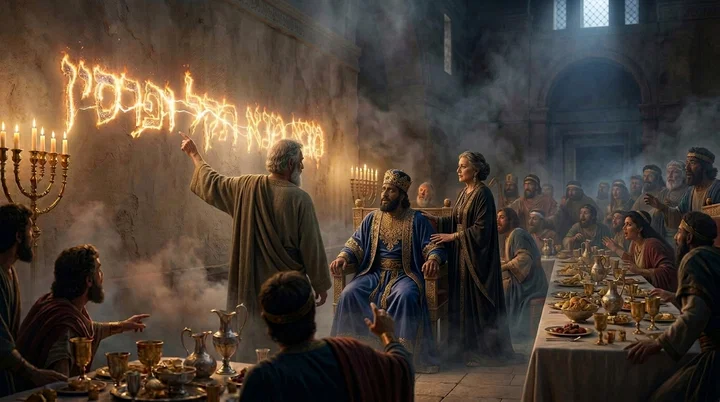
Now the queen, by reason of the words of the king and his lords, came into the banquet house: and the queen spake and said, O king, live for ever: let not thy thoughts trouble thee, nor let thy countenance be changed:
Translations
Now the queen by reason of the words of the king and his lords came into the banquet house: and the queen spoke and said, O king, live for ever: let not your thoughts trouble you, nor let your countenance be changed:
Now the queen, by reason of the words of the king and his lords, came into the banquet house: and the queen spake and said, O king, live for ever: let not thy thoughts trouble thee, nor let thy countenance be changed:
Now the queen, by reason of the words of the king and his lords, came into the banquet house: and the queen spake and said, O king, live for ever: let not thy thoughts trouble thee, nor let thy countenance be changed.
Now the queen by reason of the words of the king and his lords came into the banquet house: and the queen spoke and said, O king, live for ever: let not thy thoughts trouble thee, nor let thy countenance be changed:
Now the queen by reason of the words of the king and his lords came into the banquet house: the queen spake and said, O king, live for ever; let not thy thoughts trouble thee, nor let thy countenance be changed:
Now the queen by reason of the words of the king and his lords came into the banquet house: the queen spake and said, O king, live for ever; let not thy thoughts trouble thee, nor let thy countenance be changed.
The queen, on account of the words of the king and his great men, to the banquet-house hath come up. Answered hath the queen, and said, 'O king, to the ages live; let not thy thoughts trouble thee, nor thy countenance be changed:
— The queen, by reason of the words of the king and his nobles, came into the banquet-house. The queen spoke and said, O king, live for ever! let not thy thoughts trouble thee, neither let thy countenance be changed.
The queen, by reason of the words of the king and his nobles, into the house of banqueting, entered,—the queen spake and said, O king! for ages, live! Let not thy thoughts, terrify thee, and, as for thy bright looks, let them not be changed.
Berean Standard Bible, Majority Standard Bible
Hearing the outcry of the king and his nobles, the queen entered the banquet hall. “ O king, may you live forever!” she said. “Do not let your thoughts terrify you, or your face grow pale.
The queen by reason of the words of the king and his lords came into the banquet house. The queen spoke and said, “ O king, live forever; don’t let your thoughts trouble you, nor let your face be changed.
The queen, because of the words of the king and his lords, came into the house of the feast: the queen made answer and said, O King, have life for ever; do not be troubled by your thoughts or let the colour go from your face:
Now the Queene by reason of the talke of the King, and his princes came into the banket house, and the Queene spake, and sayd, O King, liue for euer: let not thy thoughtes trouble thee, nor let thy countenance be changed.
Douay-Rheims (Challoner revision)
Then the queen, on occasion of what had happened to the king, and his nobles, came into the banquet house: and she spoke and said: O king, live for ever: let not thy thoughts trouble thee, neither let thy countenance be changed.
Pictures
Cross-references
- Daniel 5:1-4
Belshazzar the king made a great feast to a thousand of his lords, and drank wine before the thousand.
The poem invokes Belshazzar’s feast as an image of civic wrongdoing.
- Daniel 5:30-31
In that night was Belshazzar the king of the Chaldeans slain.
same feast ends with Belshazzar slain
- Daniel 5:26-28
This is the interpretation of the thing: MENE; God hath numbered thy kingdom, and finished it.
The writing announces that God has judged and ended the king’s kingdom.
- Daniel 4:28-37
All this came upon the king Nebuchadnezzar.
Nebuchadnezzar’s humiliation and restoration taught Belshazzar that God rules human kingdoms.
- Daniel 5:6
Then the king’s countenance was changed, and his thoughts troubled him, so that the joints of his loins were loosed, and his knees smote one against another.
The king’s terror troubles his thoughts and changes his countenance.
- Daniel 5:22-23
And thou his son, O Belshazzar, hast not humbled thine heart, though thou knewest all this;
Belshazzar is condemned for failing to humble himself and honor God.
- Daniel 5:1
Belshazzar the king made a great feast to a thousand of his lords, and drank wine before the thousand.
Introduces the feast where the writing appeared.
- Daniel 5:16
And I have heard of thee, that thou canst make interpretations, and dissolve doubts: now if thou canst read the writing, and make known to me the interpretation thereof, thou shalt be clothed with scarlet, and have a chain of gold about thy neck, and shalt be the third ruler in the kingdom.
Daniel’s promised rank as third ruler fits Babylon’s co-rulers.
- Daniel 5:5
In the same hour came forth fingers of a man’s hand, and wrote over against the candlestick upon the plaister of the wall of the king’s palace: and the king saw the part of the hand that wrote.
same hand writing destiny on wall
- Daniel 7:1
In the first year of Belshazzar king of Babylon Daniel had a dream and visions of his head upon his bed: then he wrote the dream, and told the sum of the matters.
It identifies Belshazzar as the king mentioned in Daniel 5.
- Daniel 2:31-45
Thou, O king, sawest, and behold a great image. This great image, whose brightness was excellent, stood before thee; and the form thereof was terrible.
Daniel had explained Nebuchadnezzar’s dream of the great image.
- Daniel 4:9
O Belteshazzar, master of the magicians, because I know that the spirit of the holy gods is in thee, and no secret troubleth thee, tell me the visions of my dream that I have seen, and the interpretation thereof.
Nebuchadnezzar likewise testified that Daniel had the Spirit of God.
Commentary
Each commentary is drawn from primary sources: the writings of Ellen G. White and Adventist pioneers and periodicals. Each commentary is separate. Its own words are not a quotation; follow the references to read the source passages.
Ellen G. White
14 sources
The queen-mother entered the banquet hall after hearing the distress of the king and his lords over the mysterious writing, greeted Belshazzar with honor, urged him not to let his thoughts trouble him or his face show fear, and directed him to Daniel as one with wisdom to interpret difficult things.Lt 51a, 1897, par. 17–18PK 527.2Lt 8, 1893, par. 14–15 She came in the midst of an idolatrous and sacrilegious feast, where in drunken revelry Belshazzar and his lords drank from the vessels consecrated to God while praising gods of gold and silver, until a bloodless hand traced awful characters on the wall and terror seized king and princes.5T 244.4–5SLP 10.1–13.1Lt 40a, 1878, par. 6–12 Though the revelers had forgotten God, He had not forgotten them but was present as unseen witness, tracing their destiny on the wall and weighing motives, character, and life in the balances of His sanctuary.SLP 10.1–13.1Lt 40a, 1878, par. 6–12 Belshazzar had known the lessons of Nebuchadnezzar's humiliation and restoration, but he let pleasure and self-glorification erase them and neglected what he knew, and that neglect brought judgment in the very hour of feasting when Babylon fell.PK 522.2Lt 201, 1899, par. 3–4 That sudden fall while men feasted pictures the end of the world, warning those living in this momentous time not to say the Lord delays His coming but to be prepared like wise virgins with oil in their vessels to meet the Bridegroom.Ms 168, 1898, par. 1–3
Banquet House Setting
Daniel 5:10 stands near the end of Daniel's life, after Nebuchadnezzar's death, when Babylon was ruled by his successors and was gradually falling into dissolution.PK 522.1 Belshazzar ruled then as an absolute monarch with the property of lords and nobles at his command, with princes as servants and his will as law.Lt 40a, 1878, par. 6–12 Yet he was void of self-control, hasty, violent, molded by flattery, ferocious when opposed, self-indulgent, gluttonous, drunken, and corrupt at heart.Lt 40a, 1878, par. 6–12
The banquet house held his idolatrous and sacrilegious feast with music and dancing, feasting, sparkling wine, blasphemy, and flames of idolatrous sacrifice rising in insult to God.Lt 40a, 1878, par. 6–12 Belshazzar led king and lords and princes in drinking from the vessels consecrated to Jehovah while praising gods of gold and silver.SLP 10.1–13.1Lt 40a, 1878, par. 6–12 He thus desecrated what had been dedicated by holy consecration, applying it to profane and licentious purposes after reason was beclouded and gone under wine and reverence departed.SLP 10.1–13.1Lt 40a, 1878, par. 6–12 The king and his lords in this way profaned God's sacred vessels.5T 244.4–5
In the midst of revelry when God was forgotten and carnal senses were inflamed, a bloodless hand traced living characters of awful significance on the palace wall.SLP 10.1–13.1 Terror rushed through every soul, the king's countenance was changed and his thoughts troubled him, and fear and alarm took hold on king and princes.SLP 10.1–13.1 A hand wrote on the palace wall, and the king and his courtiers heard their doom announced by God's servant.5T 244.4–5
The verse belongs to the fall of Babylon, which came in an hour of feasting and revelry in the banquet house.PK 522.2Ms 47a, 1898, par. 2–5Lt 109a, 1898, par. 5–8 Belshazzar's feast is the account to which it belongs, and his failure to heed what he knew preceded that fall.PK 522.2
Queen's Reassuring Counsel
The woman who entered was the queen-mother, the queen of Belshazzar's grandfather, who came into the palace banquet hall by reason of the words of the king and his lords after hearing their distress over the mysterious writing.Lt 51a, 1897, par. 17–18PK 527.2Lt 8, 1893, par. 14–156MR 391.1–3 She spoke to Belshazzar with respectful address, O king, live for ever, urging him not to let his thoughts trouble him, not to be distressed, and not to let his countenance or face or appearance be changed.Lt 51a, 1897, par. 17–18PK 527.2Lt 8, 1893, par. 14–156MR 391.1–3 She remembered Daniel's God-given wisdom and understanding and skill in interpreting difficult matters that had made him known in Nebuchadnezzar's court, and she recommended him as able to explain the writing and urged the king to summon him.Lt 51a, 1897, par. 17–18PK 527.2Lt 8, 1893, par. 14–156MR 391.1–3 In doing so she pointed to a source of counsel amid the presumption of the feast and its forgetfulness of God.PK 527.26MR 391.1–3 Thus the verse places Daniel before Belshazzar during the feast that preceded Babylon's fall.Lt 201, 1899, par. 3–4
Judgment and Last-Day Warning
Belshazzar had received opportunities to learn God's will, including the light given in Nebuchadnezzar's humiliation and restoration, but he let pleasure and self-glorification erase those lessons.PK 522.2Lt 201, 1899, par. 3–4 He neglected the means of learning truth, disregarded what he knew, and failed to practice God's lessons, and that neglect brought judgment and preceded the fall of Babylon.PK 522.2Lt 201, 1899, par. 3–4 Babylon's rulers brought the kingdom to ruin by forgetting God and giving to human achievement the honor and glory due to Him.RH Feb 6, 1900
Although the revelers had forgotten God, God had not forgotten them, but was present as an unseen and uninvited witness hearing the praises and seeing the desecration.SLP 10.1–13.1Lt 40a, 1878, par. 6–12 He was making a history to testify to the close of time, tracing destiny in characters on the wall.Lt 40a, 1878, par. 6–12 Afterward He weighs motives, character, life, and soul in the balances of His sanctuary and pronounces the wanting soul wanting, as He pronounced Belshazzar wanting.Lt 40a, 1878, par. 6–12
The sudden fall while men feasted and reveled pictures the end of the world.Ms 168, 1898, par. 1–3 Those now living are in a time of peculiar momentous importance, called to work away from the customs and appointments of the world's great counselors.Ms 168, 1898, par. 1–3 They are not to take the position that the Lord delays His coming and all things remain as from the beginning of creation, but like wise virgins to be prepared with oil in their vessels with their lamps to go forth to meet the Bridegroom.Ms 168, 1898, par. 1–3 The same Witness is present when men and women engage in man-and-woman worship.SLP 10.1–13.1 Those living in these last days, upon whom the ends of the world are come, are far more guilty than was Belshazzar when, after vows of consecration to devote soul, body, and spirit to God's service, they desecrate God-given powers to unholy purposes, turn pure devotion and affections due to God to worship a human being, utter praises and adoration belonging alone to God, and bestow solemnly dedicated powers upon lust, which is idol worship of the most degrading kind and ruins the actors.SLP 10.1–13.1
Sources
Pioneers and periodicals
59 sources
The queen-mother came into the banquet hall after hearing of the alarm of the king and his lords over the writing on the wall, greeting Belshazzar with a wish for his long life and urging him not to let his thoughts trouble him or his face show fear.RH May 11, 1869ST Sep 10, 1885ST Jan 23, 1912RH Jan 9, 1900RH Nov 26, 1857 By her entrance she turned the night toward Daniel, commending him as one able to explain mysteries because light and wisdom and the Spirit of God were in him from the days of Nebuchadnezzar.ST Sep 10, 1885ST Jan 23, 1912RH Jan 9, 1900RH Jun 5, 1900ST Jun 28, 1899 The setting was Belshazzar's drunken feast to his lords, where the sacred vessels from Jerusalem were profaned in praise to idols until a hand wrote doom on the plaster: numbered and finished, weighed and found wanting, divided and given to the Medes and Persians.ST Feb 4, 1886ST Jan 15, 1880ST Nov 26, 1912ST Mar 18, 1903ST Apr 23, 1912 That same night of reckless security the city was entered by the emptied river channel through its unguarded gates, Belshazzar was slain, and the kingdom passed to Darius the Mede for Medo-Persia.ST Jan 15, 1880STST Sep 17, 1885ST May 20, 1897RH Sep 2, 1909 The account stands as proof that God is Judge over proud kingdoms, and its sentence reaches beyond Belshazzar to warn every reader weighed in the balances of moral worth lest he be found wanting.ST Jan 15, 1880ST Apr 23, 1912ST Mar 5, 1912ST Aug 13, 1902
Words and Setting
The queen came into the banquet house because of the words of the king and his lords, after the news of their alarm and consternation over the writing on the wall reached her.RH May 11, 1869ST Sep 10, 1885ST Jan 23, 1912RH Jan 9, 1900RH Jun 5, 1900 She had heard the troubled words of the king and his lords in distress, and she entered the banquet room and hall to quiet the trouble.ST Sep 10, 1885ST Jan 23, 1912RH Jan 9, 1900RH Jun 5, 1900RH Nov 26, 1857 Her coming after God interfered in the revelries provides the step by which Daniel became connected with the events of that evening for his conversation with Belshazzar.ST Sep 10, 1885RH Jan 9, 1900RH Jun 5, 1900
She greeted Belshazzar with O king, live for ever, and spoke to reassure him.RH Jan 9, 1900ST Oct 29, 1885ST Sep 17, 1885RH Mar 8, 1915 She urged him not to let his thoughts trouble him and not to let his countenance be changed, not to be distressed or look fearful and show fear and distress, and not to be visibly afraid.RH Jan 9, 1900RH Nov 26, 1857ST Sep 17, 1885RH Mar 8, 1915 She addressed the king respectfully in this form while the king and his lords were troubled and alarmed by the writing.RH Nov 26, 1857ST Oct 29, 1885ST Sep 17, 1885RH Mar 8, 1915
The queen was the queen-mother, the dowager and the king's mother, the widow of Nebuchadnezzar.RH May 11, 1869ST Oct 18, 1905ST Jun 28, 1899ST Feb 4, 1886 In her memory the wonderful part Daniel had acted in Nebuchadnezzar's reign was still fresh and vivid, with his extraordinary wisdom shown on earlier occasions.RH May 11, 1869ST Oct 18, 1905ST Jun 28, 1899 She counseled and supported Belshazzar while he governed Babylon during his father's absence, helping him direct the city's affairs and defense.RH May 11, 1869ST Jun 28, 1899
The scene is Belshazzar's palace in Babylon, described as the glory of kingdoms and the beauty of the Chaldees' excellence.ST Feb 4, 1886ST Jan 15, 1880STST Jan 15, 1880ST Feb 22, 1877 It was during his great feast to a thousand of his lords, an annual festival when the whole city was given up to mirth and drunken revelry and dissipation in the most apparent security.ST Jan 15, 1880STST Jan 15, 1880ST Feb 22, 1877ST Sep 5, 1911 That reckless carelessness in the midst of feasting, drunkenness and revelry was the source of danger on the night Babylon fell, when Cyrus had turned the Euphrates aside and sent soldiers up its emptied channel and the revelers left the great brass two-leaved river gates open and unguarded so the Persians entered unseen and marched to the palace.ST Jan 15, 1880STST Jan 15, 1880ST Feb 22, 1877ST Sep 5, 1911
Nebuchadnezzar is called Belshazzar's father after the custom of calling any paternal ancestor father, though he was really his grandfather.RH May 11, 1869 Knowledge of Daniel had been lost from the court and palace, for Nebuchadnezzar was succeeded by kings that knew not Daniel.RH May 11, 1869ST Jan 15, 1880RH Oct 7, 1902 On this night all the king's wise men and astrologers called in haste failed to read and interpret the writing, as they had failed on Nebuchadnezzar's dream, when they could not render the required service, so Daniel was brought in after a delay to explain it.RH May 11, 1869ST Jan 15, 1880ST Sep 17, 1885RH Oct 7, 1902 The verse belongs to the story of Daniel the prophet in the last years of the Babylonian kingdom under its last king Belshazzar, when Babylon under Belshazzar had become weak and pusillanimous.ST May 3, 1877RH Jul 2, 1901
Queen Points to Daniel
Her entrance with words of reassurance is the step by which Daniel was brought into the events of that evening and into conversation with Belshazzar.RH Jan 9, 1900ST Jun 28, 1899 She came in after the king and his lords were alarmed and troubled by the writing on the wall, and her calming address opened the way for Daniel to be summoned to interpret the inscription.RH Jan 9, 1900ST Jun 28, 1899ST Jan 30, 1912 What she heard of their consternation moved her to enter the banquet hall and speak peace to the king so that the interpreter could be found.RH Jan 9, 1900ST Jun 28, 1899
She directed Belshazzar to Daniel as the man who could read the troubling message and make known its meaning.ST Sep 10, 1885ST Jan 23, 1912RH Jun 5, 1900 She urged the king not to be distressed and not to let his expression show change, and then pointed him to Daniel to be called for the writing.ST Jan 23, 1912RH Jun 5, 1900ST Oct 29, 1885ST Sep 17, 1885 She commended him as able to explain mysteries and difficult matters and to give the interpretation the wise men had failed to give.ST Sep 10, 1885RH Jun 5, 1900RH May 14, 1914ST Oct 29, 1885ST Sep 17, 1885
She recalled him as already known for wisdom and understanding, for light and extraordinary ability proved on earlier occasions.ST Sep 10, 1885RH Jun 5, 1900ST Oct 18, 1905ST Jun 28, 1899 That reputation reached back to the days of Nebuchadnezzar, in whose reign such wisdom like the wisdom of God was found in him.RH Jun 5, 1900RH Oct 7, 1902 She described him as having in him the spirit of the holy gods, the Spirit of the holy God, the Spirit of God, and as the aged prophet whose understanding could explain what troubled the king.ST Sep 10, 1885RH May 14, 1914ST Oct 18, 1905RH Oct 7, 1902 Her confidence rested on faith that his power to reveal hidden things was taught by the Spirit of God, a faith real yet lesser than should belong to those who see still later predictions fulfilled.PGGC 96.1
Daniel then read the inscription and gave its interpretation, and for that work Belshazzar had promised the place of third ruler in the kingdom.ST May 20, 1913RH Jul 6, 1868 Though the reading pronounced the doom of Babylon, Belshazzar commanded that Daniel be clothed with purple with a chain of gold about his neck and proclaimed him third ruler.ST May 20, 1913RH Jul 6, 1868 That third rank was the highest that could be given to a subject, because Belshazzar himself held only second place while his father Nabonadius, or Nabonidus, shared the rule with him as first.ST May 20, 1913RH Jul 6, 1868ST May 20, 1913
History Confirmed by Records
Belshazzar was a real historical king of Babylon, not a mythical character, the son and eldest son and heir of Nabonidus, the offspring of his heart, associated with his father upon the throne about B.C. 540.ST Jul 23, 1885ST Dec 24, 1894ST May 20, 1913RH Aug 17, 1905ST Oct 23, 1901 Nabonidus stood as first ruler and Belshazzar as second ruler under him, which is why Belshazzar could offer Daniel only the place of third ruler in the kingdom.ST May 20, 1913ST May 20, 1913 While Nabonidus gave his last years to worship of the gods and temple building and campaigned against Cyrus, he left his son Belshazzar in command of the city.ST Jul 23, 1885ST May 20, 1913 This arrangement exactly confirms the account of Belshazzar's rule and Babylon's capture, and so supports the accuracy and date of Daniel.ST Jul 23, 1885
Contemporary records exhumed by archaeological discovery concur with the Word and confirm this disputed history.ST Jul 23, 1885ST May 20, 1913 Those witnesses include Babylonian inscriptions, an external record of Belshazzar's death confirming the account of his feast and the fall of Babylon, and a cuneiform cylinder of Nabonidus from about 556-539 containing his prayer to the moon-god for himself and for Belshazzar his son.RH May 13, 1909ST May 20, 1913ST May 20, 1913 That cylinder gives a twofold, non-collusive witness concurring with Daniel and proving the record true.ST May 20, 1913 For more than two thousand years the Bible alone preserved the record of Belshazzar.ST Aug 13, 1902 Daniel's account of the events in Babylon on the night the city fell presents the situation in the city alongside the historical record.
The events fall in B.C. 538, in Belshazzar's third year, which was the last year of his reign and the last year of Babylon's supremacy.ST May 20, 1897ST Dec 24, 1894 That night his doom was pronounced before the city fell, he was slain, and his kingdom passed to the Medes and Persians under Darius and Cyrus.ST May 20, 1897ST Dec 24, 1894 That year coincides with the first year of Darius who succeeded Belshazzar, so the feast and the visions of Daniel 8 and Daniel 9 fall in the same year, only a few months apart.ST Dec 24, 1894
Babylon Judged and Fallen
That night Belshazzar and his lords openly rejected God and the gospel of the kingdom and his protection, and destruction followed as the fruit of their own actions.RH Feb 6, 1900RH Jun 5, 1900ST Jun 21, 1883ST Aug 13, 1896 They continued in sin after seeing how God had punished the Jews.RH Jun 5, 1900ST Jun 21, 1883 They failed to learn from the lessons of Nebuchadnezzar's life.RH Jun 5, 1900ST Jun 21, 1883ST Aug 13, 1896 They brought the kingdom to ruin by forgetting God and giving to human achievement the honor and glory due to him.RH Feb 6, 1900RH Jun 5, 1900
They offered deliberate insult to the worship of the King of Heaven, in contrast with the healing messages earlier given to Babylon.ST Jan 15, 1880ST Nov 26, 1912ST Apr 23, 1912 In riotous, impious feasting Belshazzar used the holy vessels of gold and silver that Nebuchadnezzar had taken from the temple at Jerusalem.ST Jan 15, 1880ST Nov 26, 1912ST Mar 18, 1903ST Apr 23, 1912 Heated with wine, he commanded them to be brought so that the king and his princes, his wives and his concubines might drink therein.ST Jan 15, 1880ST Apr 23, 1912 While drinking from vessels dedicated to the only true God, they praised gods of gold and silver and brass and iron and wood and stone.ST Jan 15, 1880ST Apr 23, 1912
Belshazzar was the weak, dissolute, sacrilegious king named after the great Nebuchadnezzar, under whom Babylon reached her zenith and under whom the empire came to an end.ST Mar 5, 1912ST Aug 13, 1902ST He was a bold, blasphemous king who set himself against God and was utterly broken, as one dashed against the Rock of Ages.ST Mar 5, 1912ST Aug 13, 1902 Instead of driving away his foes like a lion, he cowardly shut himself up in the city feasting and drinking with his lords until he was killed and the kingdom was given to the Medes and Persians.ST Mar 5, 1912ST Aug 13, 1902RH Feb 8, 1870 The lion with eagle's wings means Babylon in rapid conquest and ruling power under Nebuchadnezzar, and the wings plucked and a man's heart given to it means Babylon under Belshazzar, made weak and pusillanimous.RH Feb 8, 1870ST May 3, 1877
In that hour the visible hand of an otherwise invisible agent wrote upon the plaster of the palace wall over against the candlestick, pronouncing doom before the city fell.ST Jan 15, 1880ST Apr 23, 1912 MENE meant God hath numbered thy kingdom and finished it; TEKEL meant thou art weighed in the balances and art found wanting; PERES meant thy kingdom is divided and given to the Medes and Persians.ST Jan 15, 1880ST Apr 23, 1912 The theme of the account is that God is the Judge.ST Mar 5, 1912ST Aug 13, 1902 He cast Babylon down from its great height, broke down its mighty walls, and opened its invulnerable gates.ST Mar 5, 1912
Destruction came suddenly unawares in the midst of greatest security and reckless revelry, for the feast was an annual festival when the whole city was given up to mirth, drunken revelry and dissipation.ST Jan 15, 1880STST Jan 15, 1880ST Apr 23, 1912 Cyrus had turned the Euphrates aside and sent soldiers up its emptied channel, and in the confusion the revelers left the great brass two-leaved river gates open and unguarded so the Persians entered unseen.ST Jan 15, 1880STST Jan 15, 1880RH Nov 11, 1862 The two-leaved gates were opened and were not shut, and the mighty men of Babylon forbore to fight, remained in their holds, lost their might, and became as women.STST Jan 15, 1880RH Nov 11, 1862 The Persians marched to the palace, Belshazzar was slain fighting in his palace that same night, and Darius the Median took the kingdom for Medo-Persia.ST Jan 15, 1880STST Sep 17, 1885ST Apr 23, 1912
The destruction is a signal proof of Jehovah's displeasure against a rich, proud, luxurious government that captured the posterity of Jacob, kept them in bondage, triumphed over the Hebrews, and treated God's righteous praying people with cruelty.ST Apr 23, 1912 By that memorable transfer of power the Almighty opened the way for the restoration of his chosen people to liberty and religious privileges.ST Apr 23, 1912 The doom was pronounced before the city fell, and that night he was killed and his kingdom passed to the Medes and Persians in 538 B.C., the predicted overthrow following quickly and reckoning the day of the world power from certain dominance to decline.ST May 20, 1897RH Sep 2, 1909RH Jun 27, 1878ST Mar 5, 1912ST May 19, 1898 Daniel is prophecy written partly in Hebrew and partly in Aramaic, narrative interspersed with prophecy showing the world's career from Daniel's time to the time when God shall set up his everlasting kingdom, and the historical fall of ancient Babylon serves as a prophetic outline of the fall of modern Babylon, with the writing on the wall coming after Nebuchadnezzar's proclamation within the prophecies beginning with the captivity of Judah.ST Dec 1, 1909RH Oct 11, 1915ST May 24, 1910
Warning and Present Application
The night Babylon fell Belshazzar made a great feast to a thousand of his lords and drank wine from the vessels of gold and silver taken from the temple at Jerusalem while praising gods of gold and silver, when a man's hand wrote on the wall and the king's countenance changed and his knees smote together.ST Jan 15, 1880 The astrologers called in haste failed to interpret as they had failed on Nebuchadnezzar's dream, so Daniel was called to explain MENE, God hath numbered thy kingdom and finished it, TEKEL, thou art weighed in the balances and art found wanting, PERES, thy kingdom is divided and given to the Medes and Persians, while the Medes and Persians poured through the opened two-leaved river gates and met at the palace and slew the king that night and Darius the Median took the kingdom.ST Jan 15, 1880 That sentence applies not to Belshazzar alone but warns every reader weighed in the scales by which God estimates moral worth lest he be found wanting.ST Jan 15, 1880
When all the king's wise men cannot render the required service of reading the handwriting on the wall, the queen comes into the banquet house greeting Belshazzar with wishes for his everlasting life and telling him not to let his thoughts trouble him nor his countenance change.RH Oct 7, 1902 She points to Daniel as a man in whom is the spirit of the holy God, in whom in the days of Nebuchadnezzar light and understanding and wisdom like the wisdom of God was found.RH Oct 7, 1902 Daniel's wisdom is the indwelling presence of God as power and wisdom for service, and Daniel is able to render the best service because he is the temple of the living God and the service of the true God is carried forward in that temple.RH Oct 7, 1902 Every man from king to lowliest is a servant of God and owes first and highest service to God, which is the gospel of the kingdom of God taught here.RH Oct 7, 1902
The king whose thoughts trouble him and whose countenance is changed by the dread handwriting pictures guilty conscience telling its tale with tragic horror.RH Aug 9, 1864 Bad actions are brought forth into review and late remorse is awakened to reason's call, holding up reflection's glass until the mind starts, heaves a heartfelt groan, and hates the form it knows to be its own.RH Aug 9, 1864 The account of the fall of Belshazzar, the last of the kings of rich, proud, luxurious, voluptuous Babylon, is a most striking lesson of the past written for learning and profitable to study.ST Aug 25, 1914ST It is preeminently applicable today and gives a present lesson from the past as truth for today, including its warning that Belshazzar's Babylon, a city thought safe behind its mighty walls, was ultimately brought down.ST Aug 25, 1914STST
Belshazzar's feast in Chaldea illustrates that strong drink can help bring a nation to ruin through intemperance.ST Feb 20, 1901 Its writing and its interpretation serve as a sign of impending doom applied to the liquor business.ST Jul 13, 1915 The same feast is invoked as an image of a city's wrongdoing and God's judgment, as the destruction of San Francisco witnesses that God sees injustice and acts against it.RH Feb 20, 1908 Judgments that do not lead to repentance harden people and invite greater judgments.RH Feb 20, 1908
Sources