Translations
American King James Version, King James Version, KJV Cambridge Paragraph Bible, Webster Bible, Darby Translation
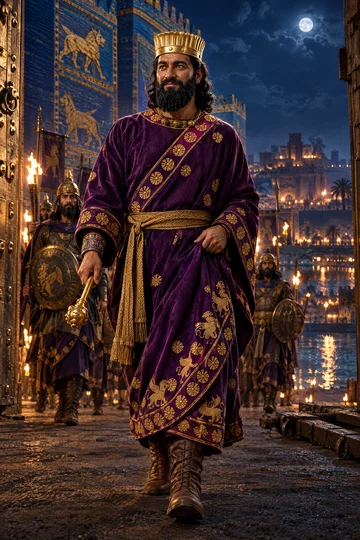
In that night was Belshazzar the king of the Chaldeans slain.
Revised Version, American Standard Version
In that night Belshazzar the Chaldean king was slain.
In that night Belshazzar king of the Chaldeans is slain,
In that night, was slain—Belshazzar, the king of the Chaldeans.
Berean Standard Bible, Majority Standard Bible
That very night Belshazzar king of the Chaldeans was slain,
In that night Belshazzar the Chaldean King was slain.
That very night Belshazzar, the king of the Chaldaeans, was put to death.
The same night was Belshazzar the King of the Caldeans slaine.
Douay-Rheims (Challoner revision)
The same night Baltasar the Chaldean king was slain.
Pictures
Cross-references 20 of 46
- Daniel 5:1-4
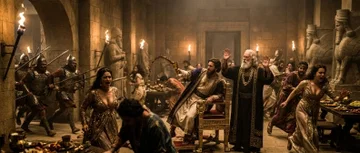
Belshazzar the king made a great feast to a thousand of his lords, and drank wine before the thousand.
Belshazzar profanes the temple vessels at his feast before his death.
- Isaiah 45:1-2
Thus saith the LORD to his anointed, to Cyrus, whose right hand I have holden, to subdue nations before him; and I will loose the loins of kings, to open before him the two leaved gates; and the gates shall not be shut;
God foretells Cyrus’s conquest and the opening of Babylon’s gates.
- Daniel 5:22-23
And thou his son, O Belshazzar, hast not humbled thine heart, though thou knewest all this;
Belshazzar’s pride and failure to honor God explain his death and the kingdom’s fall.
- Jeremiah 51:57
And I will make drunk her princes, and her wise men, her captains, and her rulers, and her mighty men: and they shall sleep a perpetual sleep, and not wake, saith the King, whose name is the LORD of hosts.
Foretells Babylon’s rulers falling into a perpetual sleep.
- Jeremiah 25:12
And it shall come to pass, when seventy years are accomplished, that I will punish the king of Babylon, and that nation, saith the LORD, for their iniquity, and the land of the Chaldeans, and will make it perpetual desolations.
Babylon’s king is punished when the appointed seventy years end.
- Daniel 2:38-39
And wheresoever the children of men dwell, the beasts of the field and the fowls of the heaven hath he given into thine hand, and hath made thee ruler over them all. Thou art this head of gold.
Babylon’s fall fulfills the prophecy that another kingdom would follow it.
- Daniel 5:5
In the same hour came forth fingers of a man’s hand, and wrote over against the candlestick upon the plaister of the wall of the king’s palace: and the king saw the part of the hand that wrote.
The writing on the palace wall announces the doom fulfilled that night.
- Jeremiah 51:39
In their heat I will make their feasts, and I will make them drunken, that they may rejoice, and sleep a perpetual sleep, and not wake, saith the LORD.
Foretells Babylon’s drunken revelers sleeping a perpetual sleep as the city falls.
- Daniel 4:32
And they shall drive thee from men, and thy dwelling shall be with the beasts of the field: they shall make thee to eat grass as oxen, and seven times shall pass over thee, until thou know that the most High ruleth in the kingdom of men, and giveth it to whomsoever he will.
Nebuchadnezzar’s humiliation warned Belshazzar of God’s sovereignty, but Belshazzar disregarded the lesson.
- Isaiah 13:19
And Babylon, the glory of kingdoms, the beauty of the Chaldees’ excellency, shall be as when God overthrew Sodom and Gomorrah.
Babylon’s foretold overthrow was fulfilled that night.
- Jeremiah 50:1-3
The word that the LORD spake against Babylon and against the land of the Chaldeans by Jeremiah the prophet.
It foretells Babylon’s fall to an invading nation.
- Isaiah 47:11
Therefore shall evil come upon thee; thou shalt not know from whence it riseth: and mischief shall fall upon thee; thou shalt not be able to put it off: and desolation shall come upon thee suddenly, which thou shalt not know.
It predicts Babylon’s sudden destruction.
- Daniel 4:17
This matter is by the decree of the watchers, and the demand by the word of the holy ones: to the intent that the living may know that the most High ruleth in the kingdom of men, and giveth it to whomsoever he will, and setteth up over it the basest of men.
Belshazzar’s downfall illustrates God’s rule over earthly kingdoms.
- Daniel 5:7
The king cried aloud to bring in the astrologers, the Chaldeans, and the soothsayers. And the king spake, and said to the wise men of Babylon, Whosoever shall read this writing, and shew me the interpretation thereof, shall be clothed with scarlet, and have a chain of gold about his neck, and shall be the third ruler in the kingdom.
Belshazzar offers Daniel the position of third ruler in the kingdom.
- Daniel 8:1
In the third year of the reign of king Belshazzar a vision appeared unto me, even unto me Daniel, after that which appeared unto me at the first.
Dates the vision to Belshazzar’s third year and portrays the kingdom succeeding Babylon.
- Daniel 6:1-3
It pleased Darius to set over the kingdom an hundred and twenty princes, which should be over the whole kingdom;
Daniel remains in a chief position under Persian rule after the kingdom changes hands.
- Daniel 5:16
And I have heard of thee, that thou canst make interpretations, and dissolve doubts: now if thou canst read the writing, and make known to me the interpretation thereof, thou shalt be clothed with scarlet, and have a chain of gold about thy neck, and shalt be the third ruler in the kingdom.
Belshazzar offers Daniel the third place in the kingdom because he is a co-ruler.
- Jeremiah 51:31-32
One post shall run to meet another, and one messenger to meet another, to shew the king of Babylon that his city is taken at one end,
Foretells Babylon’s sudden capture and the seizure of its waterways.
- Daniel 5:1
Belshazzar the king made a great feast to a thousand of his lords, and drank wine before the thousand.
Belshazzar’s feast is the setting for his death.
- Daniel 7:1
In the first year of Belshazzar king of Babylon Daniel had a dream and visions of his head upon his bed: then he wrote the dream, and told the sum of the matters.
The vision is dated to Belshazzar’s reign, before his death.
Commentary
Each commentary is drawn from primary sources: the writings of Ellen G. White and Adventist pioneers and periodicals. Each commentary is separate. Its own words are not a quotation; follow the references to read the source passages.
Ellen G. White
23 sources
In that night Belshazzar was slain in the midst of his sacrilegious feast while the Medes and Persians diverted the Euphrates and entered unguarded Babylon, ending his life and rule and the Chaldean dominion as Darius the Mede took the kingdom.COL 258.3Lt 51a, 1897, par. 21ST Jul 1, 1908PK 531.1–3PK 523.1 God had witnessed his defiant desecration, weighed his motives and life and found him wanting, and that judgment stood written for the final accounting.Ms 50, 1893, par. 7–95T 244.4–5SLP 10.1–13.1 In pride and love of pleasure he reckoned without God and ascribed the glory of the kingdom to human achievement, ignoring the light given through Nebuchadnezzar and through Daniel's exalting of Jehovah.PK 522.2PK 501.3Ms 47a, 1898, par. 2–511MR 98.3–99.3 He and his kingdom filled the measure of guilt and his probation ended, so protection was withdrawn and sentence was suddenly executed as the result of his chosen course.Lt 51a, 1897, par. 21PK 524ALt 65, 1895, par. 6–7 The fall thus fulfilled divine prophetic warning in that same generation, and its sudden judgment in the midst of careless reveling shows how it will be at the end of the world for those who neglect God's lessons instead of practicing them unto reform.Ms 50, 1893, par. 7–9PK 531.1–311MR 98.3–99.3Ms 168, 1898, par. 1–3Lt 201, 1899, par. 3–4
Babylon's Final Night
The night of the verse fell while Cyrus was besieging Babylon with his combined Medo-Persian armies, yet Belshazzar felt secure behind massive walls and brass gates, with the Euphrates and abundant provisions seeming to make the city impregnable, and gave himself to revelry.PK 523.1 While hostile armies approached, he held his final feast with his nobles and his thousand lords in drunken, idolatrous mirth, drinking from the sacred vessels of Jehovah and praising idols and gods of gold and silver.Lt 51a, 1897, par. 215T 244.4–5SLP 10.1–13.1Lt 40a, 1878, par. 6–12 In the midst of that mirth a bloodless hand traced mysterious characters upon the palace wall, and terror filled the king and courtiers as their doom was pronounced and their consciences recognized judgment against them.5T 244.4–5SLP 10.1–13.1Lt 40a, 1878, par. 6–12
While the feast went on, the Medes and Persians diverted the Euphrates and entered the unguarded city.Lt 51a, 1897, par. 21PK 531.1–3 In that same night Belshazzar was slain suddenly in the midst of feasting and revelry.COL 258.3Lt 51a, 1897, par. 21ST Jul 1, 1908Lt 109a, 1898, par. 5–8 No display of Babylonian power, wealth, palace, defenses, and confidence in its own greatness could keep doom out or save him.COL 258.3ST Jul 1, 1908Lt 109a, 1898, par. 5–8 His life and rule were ended that night, Chaldean rule fell, and Darius the Mede, an alien and foreign monarch, took the kingdom, when in 538 B.C. the great empire passed under the weaker rule of Nabonadius and his son.COL 258.3Lt 51a, 1897, par. 21ST Jul 1, 1908PK 531.1–3
Why Belshazzar Was Slain
In that night Belshazzar was slain because God Himself had witnessed the king's defiant desecration at his sacrilegious feast.Ms 50, 1893, par. 7–95T 244.4–5SLP 10.1–13.1 While he and his thousand lords in drunken, idolatrous mirth profaned the golden vessels of Jehovah and praised gods of gold and silver, the God whom they defied looked on the unholy scene.Ms 50, 1893, par. 7–95T 244.4–5SLP 10.1–13.1 In the midst of their revelry a bloodless hand traced mysterious characters upon the palace wall, terror seized the king and courtiers, their consciences recognized judgment, and they heard their doom pronounced by the servant of the Most High.5T 244.4–5SLP 10.1–13.1 God weighed his motives, character, life and soul and found him wanting, and that judgment stood written as a record for the final accounting.Ms 50, 1893, par. 7–9Lt 40a, 1878, par. 6–12 His fate warns that sacred things and powers dedicated to God must not be devoted to lust or human worship and self-exaltation toward earthly pleasures.5T 244.4–5SLP 10.1–13.1
The same witnessing God who marked making light of what He had chosen as sacred marks slander and falsehood against the servants of Christ.5T 244.4–5 Such acts are worse than profaning soulless vessels, because they profane the character of those whom Christ purchased by His blood.5T 244.4–5 The hand that wrote on Belshazzar's wall keeps faithful record of every act of injustice or oppression committed against God's people.5T 244.4–5 Belshazzar's folly and weakness, pride, love of pleasure and self-glorification led him to reckon without God.PK 522.2Lt 65, 1895, par. 8–9 In prosperity he and the rulers of Babylon regarded themselves as independent of God, forgot God, and ascribed the glory and honor of the kingdom to human achievement.PK 522.2PK 501.3RH Feb 6, 1900
By following his own judgment as though he possessed all wisdom he received the result of his folly.Lt 65, 1895, par. 8–9 He ignored the lessons and opportunities God had given him and disregarded the light given through Nebuchadnezzar.PK 522.211MR 98.3–99.3Lt 201, 1899, par. 3–4 That light had come through Daniel's interpretation exalting Jehovah above earthly kings, which Nebuchadnezzar had perverted into idolatrous self-exaltation in the golden image.Ms 47a, 1898, par. 2–5 By rejecting that heaven-sent instruction Belshazzar lost the benefits obedience could have brought, illustrating that when God's lessons given to lead to reform are neglected instead of received and practiced, judgment follows.11MR 98.3–99.3Lt 201, 1899, par. 3–4
He and his lords had filled the measure of their guilt, and the Chaldean kingdom had filled the measure of its guilt.PK 524ALt 23a, 1890, par. 9–10 His evil works had reached their full measure and his probation ended, so God's sentence was suddenly executed that night.Lt 51a, 1897, par. 21Lt 65, 1895, par. 6–7Lt 23a, 1890, par. 9–10 God's protection and restraint were withdrawn, he was no longer shielded from the consequences of his chosen course, his kingdom passed into other hands, and he fell.Lt 51a, 1897, par. 21Lt 65, 1895, par. 6–7Lt 23a, 1890, par. 9–10 His death was the result of his actions, not an arbitrary act, showing that God warns and seeks to correct but leaves men free and does not miraculously prevent every harmful choice.Lt 65, 1895, par. 6–7 His presumptuous defiance while feasting and forgetting God reached its limit, illustrating that God's forbearance has boundaries where judgment ends insolence and disobedience.Lt 65, 1895, par. 6–76MR 391.1–3
Prophecy and Warning
That night records the fall of proud Babylon as the literal fulfillment in the history of nations of the divine prophetic warnings against Babylon and other kingdoms presented through Daniel.PK 531.1–3PK 501.3Ms 47a, 1898, par. 2–5 The judgment pronounced upon the king and his kingdom was fulfilled after his sacrilegious feast, when the Medes and Persians diverted the Euphrates and entered the unguarded city while he and his nobles profaned the sacred vessels and praised their gods.Ms 50, 1893, par. 7–9PK 531.1–3 Babylon was at last shattered and broken and passed away because in prosperity its rulers regarded themselves as independent of God and ascribed the glory of their kingdom to human achievement.PK 531.1–3PK 501.3 The light given through Daniel's interpretation exalting Jehovah above earthly kings had been perverted by Nebuchadnezzar into idolatrous self-exaltation in the golden image, and the fall came in an hour of feasting and revelry.Ms 47a, 1898, par. 2–5 It came in the same generation in which its revelation and warning had been given, when in 538 B.C. the great empire passed under the weaker rule of Nabonadius and his son and an alien monarch took the throne.PK 531.1–3PK 496.3
Belshazzar's power and wealth, his palace and defenses, could not save him or keep doom out.COL 258.3ST Jul 1, 1908 He was slain that very night after feasting and praising idols while hostile armies approached his palace, and his life and rule were ended when a foreign ruler took his throne.COL 258.3ST Jul 1, 1908 His fate illustrates the ruin that comes to those who choose earthly gain and selfish gain over spiritual life and who trust in earthly treasure.COL 258.3ST Jul 1, 1908
Belshazzar with his thousand lords profaned the golden vessels of Jehovah and praised the idols of Babylon in sacrilegious mirth, turning worship toward himself and earthly pleasures, but the God whom they defied was a witness of the unholy scene of defiant desecration.Ms 50, 1893, par. 7–95T 244.4–5SLP 10.1–13.1 In the midst of their mirth a bloodless hand traced mysterious characters upon the palace wall, and filled with terror the king and courtiers heard their doom pronounced by the servant of the Most High, while their consciences recognized judgment against them.5T 244.4–5SLP 10.1–13.1 His death that night warns that sacred things and powers dedicated to God must not be devoted to lust or human worship and self-exaltation.5T 244.4–5SLP 10.1–13.1 He had reckoned without God and received the result of his folly, showing that those who follow their own judgment as though they possess all wisdom reap the consequences of their course.Lt 65, 1895, par. 8–9 The same witnessing God who marked making light of what He chose as sacred marks slander and falsehood against the servants of Christ, which is worse than profaning soulless vessels because it profanes the character of those whom Christ purchased by His blood, and the hand that wrote on the wall keeps faithful record of every act of injustice or oppression committed against God's people.5T 244.4–5
The calamity came upon Babylon after Belshazzar disregarded the light God had given through Nebuchadnezzar, rejecting heaven-sent instruction and losing the benefits obedience could have brought.11MR 98.3–99.3Lt 201, 1899, par. 3–4 Neglecting God's lessons instead of receiving and practicing them to lead to reform brings judgment.11MR 98.3–99.3Lt 201, 1899, par. 3–4 The fall came at an hour of feasting and reveling, when sudden judgment struck in the midst of careless celebration, and so will it be at the end of the world.Ms 168, 1898, par. 1–3 In the present period of peculiar momentous importance, students of God's Word must work away from the customs and appointments of the world's great counselors, must not say the Lord delays His coming nor that all things remain as they were since the fathers fell asleep from the beginning of creation, and must be like the wise virgins prepared with oil in their vessels with their lamps to go forth to meet the Bridegroom.Ms 168, 1898, par. 1–3
Sources
Pioneers and periodicals
149 sources
In that night Belshazzar was slain on that very night, the night of his feast and of the handwriting that his kingdom was finished and given to the Medes and Persians.RH Jan 9, 1900ST Jun 28, 1899ST Sep 20, 1905 He was the king of the Chaldeans, the last Babylonian king, the eldest son of Nabonidus and grandson of Nebuchadnezzar, associated with his father as second ruler, which is why the highest reward he could offer was third ruler in the kingdom.ST Nov 27, 1884ST Jan 11, 1916ST May 17, 1883 Cyrus took the city by diverting the Euphrates into a lake and trench until the channel was fordable, so his soldiers marched up the dry riverbed into the heart of the city while the brass river gates were left open in the drunken confusion.ST Sep 20, 1905ST Sep 20, 1905ST Jul 3, 1879ST Feb 22, 1877 His death that night was the immediate execution of the sentence MENE, God hath numbered his kingdom and finished it, TEKEL, he was weighed in the balances and found wanting, PERES, his kingdom was divided and given to the Medes and Persians, because though he knew how God had humbled Nebuchadnezzar he did not humble his heart but lifted himself against the Lord of heaven by drinking from the vessels of God's temple while praising idols.ST Oct 18, 1905RH Jun 19, 1900ST Sep 17, 1885ST Aug 13, 1896ST Oct 18, 1905 His death ended Chaldean rule and the first of the four world empires and began the Medo-Persian kingdom, standing as the type of the fall of modern and mystical Babylon and a lesson that pride and apparent security end in sudden destruction.ST Sep 6, 1899ST Feb 11, 1886ST Sep 21, 1882RH Jun 23, 1910
Night Feast and Death
In that night Belshazzar was slain, on the very night of his feast and of the handwriting and of the judgment that his kingdom was finished and given to the Medes and Persians.RH Jan 9, 1900ST Jun 28, 1899ST Sep 20, 1905ST Jun 28, 1899RH Jan 9, 1900 His reign ended that night in fulfillment of what had been predicted concerning the Babylonian Empire, with Babylon taken while the banquet was still underway.RH Jan 9, 1900ST Jun 28, 1899ST Sep 20, 1905RH Jan 9, 1900ST Feb 13, 1907 The death came as God's judgment fell and the kingdom came to its end, and the Medes and Persians then received the kingdom.ST Jun 28, 1899ST Sep 20, 1905ST Jun 28, 1899
He was killed in Babylon as the invaders entered the city and reached the palace.RH Mar 8, 1915STRH May 11, 1869ST Sep 17, 1885ST Dec 9, 1897 Cyrus's forces came through the diverted Euphrates and its emptied river channel, finding the river gates and the two-leaved gates left open and unguarded in the confusion and reckless revelry, and marched up the bed into the heart of the city.RH Mar 8, 1915STRH May 11, 1869ST Dec 9, 1897ST Feb 22, 1877 The guard opened the palace gates on hearing the uproar without, and the soldiers rushed in with drawn swords, seized the palace amid the confusion, and slew the king.RH Mar 8, 1915ST Jan 15, 1880STRH May 11, 1869ST Dec 9, 1897 Frightened by the writing on the wall, he could not stop the attackers, and his death ended the Chaldean kings' rule and the city's kingdom and freedom.RH Mar 8, 1915STST Sep 17, 1885 His death came while the hand was writing doom on the palace wall and Daniel was declaring its meaning, so having just been warned by God of his doom he was hardly surprised when they found him.RH May 11, 1869
The feast was drunken revelry in which he made a great feast to a thousand lords, and he with his princes, wives, and concubines drank wine from the gold and silver vessels taken from the temple of God at Jerusalem.ST Jan 15, 1880ST Jan 23, 1912ST Apr 23, 1912ST Aug 24, 1904ST May 22, 1907 While drinking they praised gods of gold and silver, brass, iron, wood, and stone, and thus profaned the sacred vessels in a feast honoring idols.ST Jan 15, 1880ST May 20, 1913ST Jan 23, 1912ST Apr 23, 1912ST Aug 24, 1904 The writing on the wall announced his doom as MENE, God hath numbered his kingdom and finished it, TEKEL, he was weighed in the balances and found wanting, PERES, his kingdom was divided and given to the Medes and Persians, seen too late to save him.ST Jan 15, 1880ST Jan 23, 1912ST Apr 23, 1912ST Aug 24, 1904ST May 22, 1907 While the sentence was being written before him the Medes and Persians were pouring in, and when the guard opened the gates to learn the cause of the uproar without they rushed in and slew the king.ST Jan 15, 1880 Feasting and crying peace while judgment is already written ends in sudden destruction, and his kingdom passed away with him.ST May 20, 1913ST May 22, 1907
He was slain while vainly fighting to defend his rule against Cyrus's soldiers.ST Feb 22, 1877RH Feb 9, 1869 His death closes the feast and marks the fall of Babylon.ST Feb 22, 1877RH Feb 9, 1869 He remained shut inside the city feasting and drinking instead of driving away his enemies, showing cowardice and the loss of Babylon's former strength and courage.RH Feb 17, 1874RH Apr 23, 1857ST Oct 22, 1885RH Feb 3, 1853ST Jul 23, 1874 In Daniel's vision Babylon is the lion with eagle's wings, where the lion represents the kingdom's glory and the wings its rapid conquests and its monarchs' pride, and the wings being plucked may represent Nebuchadnezzar's humiliation or Belshazzar's cowardice and failure to confront the enemy.RH Feb 17, 1874RH Apr 23, 1857RH Feb 3, 1853ST Jul 23, 1874RH Feb 8, 1870 Rather than confronting his foes while they approached, weak and fearful, he stayed inside drinking with his lords until he was killed, and with his death the kingdom passed to the Medes and Persians.RH Feb 17, 1874RH Apr 23, 1857ST Oct 22, 1885ST Jul 23, 1874RH Feb 8, 1870
The taking came at midnight on a night of an annual festival given up to feasting, drunkenness, revelry, mirth, and crowded banquets in apparent security.RH Nov 26, 1857ST Jan 15, 1880ST May 20, 1880ST Apr 20, 1882ST Sep 10, 1885 The feast coincided with the fourteenth day of Tammuz, a festival day when women joined the men in rites and orgies celebrating Tammuz and Ishtar.RH Nov 26, 1857ST Jan 15, 1880ST Nov 27, 1884ST Sep 10, 1885 Babylon alone still held out in the East after a siege of nearly two years, in the beginning of Belshazzar's sixteenth year, trusting in apparent security while the capital was given up to mirth.RH Nov 26, 1857ST Jan 15, 1880ST Apr 20, 1882 The city was taken by stratagem, the Euphrates that ran through the city between walled banks with brass gates at every crossing street being diverted into an artificial lake west of the city and a trench dug around the city until its channel was almost dry and fordable.RH Nov 26, 1857ST Jan 15, 1880 Soldiers stationed where the river entered and left the city rushed in through its bed into the heart of the city through the brass river gates in the river walls that were left open, the Persian coming mingling among the crowd and entering at her open gates while her river proved false and her gods of stone gave no help.RH Nov 26, 1857ST Jan 15, 1880ST May 20, 1880 Prophet voices had warned in her festal halls and angel fingers wrote her doom upon the palace walls, and that same night Belshazzar the Chaldean king was killed and Babylon was gone.ST Nov 27, 1884ST May 20, 1880
Who Belshazzar Was
He was the king of the Chaldeans, the king of Babylon, the last Babylonian king and monarch, a real historical person and not a mythical character invented for the account of the fall.RH Mar 8, 1915ST May 20, 1913RH Dec 31, 1914RH Aug 17, 1905ST Jul 12, 1899 His slaying that night marked the fall of Babylon and the end of its rule, when the kingdom passed to the Medes and Persians under Cyrus and Darius the Mede took the kingdom.RH Mar 8, 1915ST May 20, 1913RH Dec 31, 1914ST Jul 12, 1899ST Aug 25, 1914 Though he trusted the city's mighty walls and laughed at the besieging forces, he was killed and Babylon was reduced to ruins.ST May 20, 1913ST Aug 25, 1914
He was the eldest son, offspring and heir of Nabonidus, also called Nabonadius or Nabonedus, and grandson of Nebuchadnezzar.ST Nov 27, 1884ST Jan 11, 1916ST May 17, 1883ST May 20, 1913RH Sep 21, 1905 While Nabonidus was away with the army he acted as king and regent, associated with his father upon the throne as second ruler with his father as first ruler, sharing the throne for three years and left as viceroy in charge of Babylon in his third year alone.ST Nov 27, 1884ST Jan 11, 1916ST May 17, 1883ST Jun 22, 1904ST May 20, 1913 This is why the highest reward he could offer and then give for reading the writing was to be made third ruler in the kingdom, to be clothed with purple with a gold chain on the neck and so proclaimed.ST May 20, 1913ST May 20, 1913 Nabonidus was a devout temple builder who gave the last part of his life to worship of the gods and building of temples, repairing the tower temple to the moon at Ur of the Chaldees, and therefore left grave affairs to Belshazzar.ST May 20, 1913RH Sep 21, 1905 The commemorative cylinders placed in its corners each close with a prayer to the moon-god for Nabonidus and for Belshazzar his son, and other inscriptions and tablets naming Bel-shar-usur speak of him in familiar terms as joint-ruler, a twofold witness agreeing with the Bible account.ST May 20, 1913RH Sep 21, 1905 Records uncovered at Babylon confirm both accounts true, vindicating that Belshazzar was present in Babylon and slain there that night while Nabonidus himself was absent at Borsippa and was captured alive rather than killed after Belshazzar had failed to stop the invasion.ST Nov 27, 1884ST Jun 22, 1904
Those who held the other reckoning identified him as Nabonadius himself, also called Nabonnedus, Nabonnidochus, Labynetus and Naboandelus, son of Evilmerodach and grandson of Nebuchadnezzar.RH Mar 11, 1873ST May 3, 1877ST Feb 22, 1877 On that reckoning he followed Nebuchadnezzar's forty-three years, Evilmerodach's two years, Neriglissar's four years and the nine-month reign of Neriglissar's son, Laborosoarchod, with a seventeen-year reign.RH Mar 11, 1873ST May 3, 1877ST Feb 22, 1877 His death as Babylon's last king ended the Chaldean monarchy that reached its glory under Nebuchadnezzar, and immediately afterward the kingdom passed to the Medes and Persians in retribution for oppression of God's people and iniquities calling for retribution from heaven.RH Mar 11, 1873ST May 3, 1877ST Feb 22, 1877
He reigned jointly with his father Nabonadius during the last three years of the empire, which came to its end in 538 B.C., placing Daniel's vision in Belshazzar's first year about 541 B.C.ST Dec 30, 1903ST Jan 23, 1912 His rule is placed from 549 or from 540 to 538 B.C., in his third and final year and in his sixteenth year after a siege of nearly two years.ST Dec 30, 1903ST Jan 23, 1912 He was not sole king but ruled alongside his father, who spent his last days in religious devotions and temple-building and worshiping at heathen shrines while leaving affairs of state and empire in the hands of his inexperienced, pleasure-loving and lust-loving son, the grandson of Babylon's mightiest king Nebuchadnezzar.STST Jan 23, 1912ST Feb 20, 1912 By then Babylon had run a pitiful career since Nebuchadnezzar laid down the scepter, Cyrus had taken the outposts in the greater part of Chaldea leaving practically only the city untouched behind impregnable walls, and its citizens laughed at the foe in false security.ST Feb 20, 1912 He was slain in the attack on Babylon in which Gobryas shared, only a few months at most after Daniel's vision, marking the ignominious end after a brief career of about sixty-eight years of the great universal kingdom and the overthrow of the glory of kingdoms, the beauty of the Chaldees' excellency.ST Feb 20, 1912ST Oct 5, 1904 With Nabonadius absent from the capital and Belshazzar dead, and his father then a prisoner and no longer king, Daniel as appointed third ruler was left the first man of the vanished kingdom and the chief official available to enter negotiations and help reorganize the state, to the advantage of God's captive people, and the united kingdom of Medo-Persia passed at once to Darius the Mede, who reigned two years.ST Sep 13, 1899ST Feb 20, 1912ST Oct 5, 1904
How Babylon Was Taken
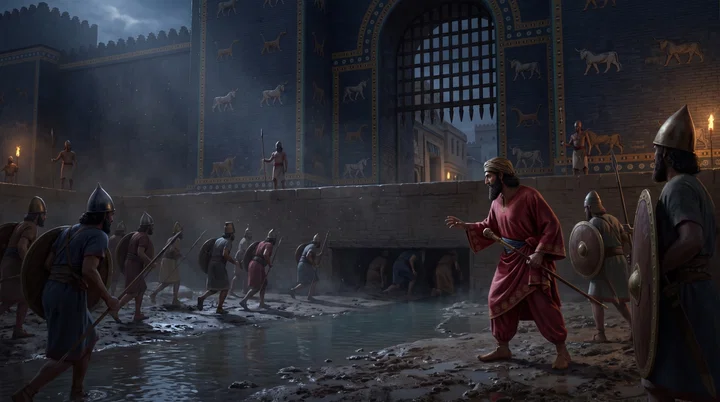
Cyrus turned aside the Euphrates that ran through the city into an artificial lake west of the city and into a trench dug around it, until the channel was left almost dry and fordable.ST Sep 20, 1905ST Sep 20, 1905RH Oct 11, 1915ST Feb 4, 1886 Soldiers stationed where the river entered and left the city then marched up its dry bed into the heart of the city.ST Sep 20, 1905ST Sep 20, 1905ST Feb 4, 1886 Those who held the bayou account teach that the inner fortress stood not on the Euphrates itself but on both sides of a bayou or shallow side-branch running from it, whose mouth above the fortress was dammed while its channel below where it entered the Euphrates was deepened, so that in a few hours the bed was left dry.ST Jul 3, 1879 In that night Belshazzar was slain as Cyrus entered and took Babylon, on the very night his kingdom was judged and while the Babylonians were absorbed in festival revelry.ST Sep 20, 1905ST Sep 20, 1905ST Jul 3, 1879RH Oct 11, 1915ST Feb 4, 1886
The brass river gates in the walled banks at every crossing street were left open and unguarded in the confusion and reckless debauch.ST Feb 22, 1877 Their being left open in the midst of the feast opened the way to the palace and to the killing of the king, for debauchery led to the gates being neglected while Cyrus's army entered the city and reached the palace.ST Feb 22, 1877 The city was taken though strongly defended and well provisioned, because God had decreed the downfall of the proud and wicked city amid its war with the Medes and Persians in Belshazzar's sixteenth year, when Cyrus besieged Babylon.ST Feb 22, 1877
The fall came suddenly while the king felt secure, slain on the very night he celebrated his gods in revelry and on the night Babylon's revelers felt secure.ST Sep 20, 1905ST Nov 28, 1900ST Mar 16, 1915ST Sep 20, 1905RH Feb 8, 1912 Babylon trusted in mighty walls three hundred and fifty feet high and eighty-seven feet thick with solid brass gates and twenty years of provisions, laughing at besiegers from behind impregnable defenses.ST Feb 22, 1877 The blasphemous feast was held while the besieging army was at the gates, displaying contempt for enemies and confidence in gods, with Belshazzar and his lords expressing confidence in the permanence of the kingdom.RH Feb 8, 1912RH Oct 11, 1915ST Sep 5, 1911 That apparent height of power and glory did not make the nation secure, for corruption brings a nation down, the empire's defenses crumbled, the city and the Babylonian empire fell together, and the kingdom passed to Darius the Mede.ST Nov 28, 1900ST Mar 16, 1915RH Feb 8, 1912ST Sep 5, 1911
End and Succession of Kingdoms
In that night Belshazzar was killed, and with his death Chaldean rule came to its end and the Babylonian Empire as a power was overthrown to never recover its former glory.ST Sep 6, 1899ST Feb 11, 1886ST Sep 21, 1882ST Oct 23, 1901RH Jun 20, 1854 This was the termination of Babylon's allotted career after it had been weighed and found wanting, coming near the time the captive Jews would return to Jerusalem.ST Sep 6, 1899ST Oct 23, 1901 It was the end of the first kingdom in the succession of four world empires, when Babylon gave way to Medo-Persia, the kingdom represented by silver and by the bear in Daniel's visions.ST Sep 21, 1882RH Jun 20, 1854 Under the kings who succeeded Nebuchadnezzar Babylon had become so corrupt that it could no longer stand, and the slaying of Belshazzar proved the dream certain and the interpretation thereof sure.ST Aug 17, 1904
That same night the kingdom passed to the Medes and Persians, as the invaders entered Babylon and carried out the sentence against his kingdom.RH Nov 26, 1857RH Oct 30, 1856RH Dec 31, 1914ST Oct 29, 1885 Darius the Mede took the kingdom, about sixty-two years old, before Cyrus later succeeded him.RH Nov 26, 1857ST Feb 11, 1886 Daniel 5:28, 30-31 names the power that succeeded Babylon as Medo-Persia, recording the name of the second kingdom in Nebuchadnezzar's dream.ST Oct 29, 1885ST Feb 24, 1887 The slaying thus marked the end of the seventy years of Babylonian servitude as the punishment of Babylon foretold through Jeremiah, though not meaning that Judea's desolation ended with the seventy years.RH Apr 28, 1853
The event ended the head of fine gold in Nebuchadnezzar's image and began the breast and arms of silver, the second universal kingdom.ST Jun 6, 1916ST May 3, 1877ST Aug 17, 1904ST Oct 13, 1909ST May 3, 1877 It marked the transfer of world empire from Babylon to the Medo-Persian kingdom and completed the first division of the great image and the first part of the prophetic dream that another kingdom inferior to Babylon would arise.ST Jun 6, 1916ST Apr 9, 1896 It was the end of Babylon's dominion over the earth and the first of the three overturnings foretold after the crown was removed from Zedekiah, by which dominion passed from Babylon to Persia on the way to the kingdom being given to Christ at His second coming.ST Jan 1, 1894
The fall is dated to 538 B.C., when Babylon was conquered by Medo-Persia under Darius and Cyrus and Belshazzar was slain during his drunken feast.ST May 20, 1897ST Dec 24, 1894ST Apr 2, 1894RH Jun 27, 1878ST Apr 9, 1896 This was Belshazzar's third and final year as king, at the expiration of the seventy years of captivity when Daniel stood prominent at the Persian court.RH Nov 26, 1857ST Dec 24, 1894 Babylon had continued 139 years from 677 B.C., and the Medo-Persian kingdom that succeeded it lasted 207 years until 331 B.C.ST May 3, 1877 Babylon was weighed in the balances of God's righteous purposes and found wanting because its rulers took all glory to themselves, showing that the Most High rules in the kingdom of men and gives it to whomever He will, and that rulers who no longer serve His purpose have their days numbered.ST Oct 11, 1905ST Apr 9, 1896
Prophecy Fulfilled in History
In that night the capture of Babylon literally fulfilled what Isaiah had spoken concerning Cyrus, who was called by his name more than two hundred and sixty years beforehand though he knew it not, that the loins of kings would be loosed before him and the two-leaved gates would be opened and not shut.RH Nov 11, 1862 The feast night on which Belshazzar was slain was the night Cyrus destroyed Babylon, and the opening of the gates gave him entrance into the city.RH Nov 11, 1862ST Mar 6, 1907 At the same time Jeremiah's words were fulfilled that night, that the mighty men of Babylon would forbear to fight, remain in their holds, have their might fail them, and become as women.RH Nov 11, 1862ST Mar 6, 1907 That fall of Babylon, when Belshazzar was slain and the kingdom was taken by the Medes and Persians, came before the release of Judah's captives and the rebuilding of Jerusalem and the temple, fulfilling Isaiah's prophecies that Babylon would fall and that Cyrus would free the captives and see the city and temple rebuilt.ST Feb 11, 1886
The overthrow ended the seventy-year Babylonian servitude and captivity, when Belshazzar died on the night Babylon fell to the Medes and Persians.RH Mar 14, 1865ST Nov 29, 1899ST Jan 13, 1888 God overthrew Babylon for His people at the expiration of the seventy years of captivity, in 536 B.C., when Daniel stood prominent at the Persian court.ST Dec 19, 1892 After God had used Babylon to carry out His purposes against Israel, its kingdom was punished, its haughty rule fell, its oppression ended, and way was made for Israel's return.ST Dec 19, 1892RH Mar 14, 1865 The slaying of Belshazzar and the passing away of the kingdom's glory fulfilled the final warning given during the sacrilegious feast, ruining those who had long rejected God's warnings.RH Jan 23, 1855 For the exiles who mourned Zion, Babylon's defeat was a pledge of deliverance, liberty, and restoration, and the captives by the Euphrates felt amid Babylon's revelry that their chains were breaking and that God's call to release His people was being fulfilled.RH Jan 23, 1855RH Aug 21, 1856 That overthrow, together with Daniel's association with Cyrus, led Cyrus to recognize the true God as a great God over all others and moved him to issue his proclamation for the return, bringing the captivity toward its end and preparing the way to release the Jewish captives and rebuild Jerusalem and the temple.ST Dec 19, 1892ST Jan 13, 1888
The slaying in that night shows the judgment on Babylon, in which God numbered the kingdom and finished it, divided it and gave it to the Medes and Persians.ST Jan 23, 1912RH Nov 21, 1854 God set aside a nation that could no longer serve His glory and raised up another in its place, and when a state will not be used by God He casts it down from its great height, breaks down its mighty walls, and opens its invulnerable gates.ST Jan 23, 1912ST Mar 5, 1912 Babylon had reached her zenith under Nebuchadnezzar, and Belshazzar is the one king named after him, weak, dissolute and sacrilegious, under whom the empire came to an end.ST Mar 5, 1912 The overthrow, in which Belshazzar was slain and the throne of conquered Babylon passed to a ruler whose birth had occurred while Nebuchadnezzar planned an enduring empire, shows that human plans for lasting dominion can be set aside by God's plans.ST Jan 30, 1912 God's declared overthrow of ancient Babylon came to pass in the death of its king that night, demonstrating that God fulfills His promises and will overthrow earthly nations and restore dominion to the people.RH May 1, 1913
Cause of Divine Judgment
That night carried out the sentence written on the wall, for MENE meant God had numbered the kingdom and finished it, TEKEL meant weighed in the balances and found wanting, and PERES meant divided and given to the Medes and Persians.ST Sep 17, 1885ST Aug 13, 1896ST Oct 18, 1905RH Feb 27, 1900ST While an army lay encamped outside Babylon, the king was slain and Babylon's royal power ended that very night.ST Sep 17, 1885ST Oct 18, 1905RH Feb 27, 1900 He had taken his last step and crossed the hidden boundary beyond which there is no returning, and his death that night was the immediate execution of that judgment, with Babylon passing to her conquerors.ST Aug 13, 1896ST Oct 18, 1905ST His defiance had ignored the knowledge of God, and after being weighed and found wanting and judged he was slain with the fall of Babylon and the loss of its kingdom to Medo-Persia.ST Oct 18, 1905RH Feb 27, 1900 The end came at the close of the seventy years of the captivity of Jerusalem, at the time God was to punish the king of Babylon as promised through Jeremiah, and feeling secure within impregnable walls and triumphing over what he took for the failure of prophecy, he directly insulted the God of heaven by drinking wine from the consecrated vessels taken from the temple at Jerusalem while praising gods of silver and gold, brass, iron, wood and stone.ST Aug 13, 1896ST That verified the prediction to the letter and proves the triumphing of the wicked is short, for any man who throws himself into the opposite scale against the God of the Bible is sure to be found wanting.ST Aug 13, 1896ST
He knew how God had taught and humbled Nebuchadnezzar's pride until he learned that God rules over human kingdoms and that kings owe Him homage, yet he forgot that teaching and power and did not humble his heart.ST Oct 18, 1905RH Jun 19, 1900ST Aug 13, 1896STRH Nov 20, 1900 Though the gospel of the kingdom had been fully revealed with clearness and power in God's dealings with Nebuchadnezzar, and though Belshazzar knew all this and was without excuse, he lifted himself against the Lord of heaven and did not glorify the God in whose hand his breath was and whose were all his ways, and that was sufficient for his condemnation.RH Jun 19, 1900ST Aug 13, 1896STRH Nov 20, 1900 No one perished in the fall except by his own choice, and the history is being repeated now so the story must be made known as the distinct message for this time.RH Jun 19, 1900 After Nebuchadnezzar had been brought to acknowledge and worship the true God through Daniel's preaching in Babylon, the city after his death relapsed into idolatry, and the relapse became complete and hopeless apostasy when Belshazzar drank the wine of Babylon from the sacred vessels of the house of God while worship was offered to false gods of gold, silver, brass, wood and stone that are no gods.RH Apr 10, 1916ST Aug 13, 1896ST In that same night of complete apostasy he was slain and the kingdom was taken by Darius the Median at about sixty-two years old, marking the fall of ancient Babylon and standing as the type of the fall of modern Babylon because she made all nations drink the wine of the wrath of her fornication.RH Jun 19, 1900RH Apr 10, 1916 His refusal to follow the light ended in judgment with his house losing the kingdom, whereas had he followed the instruction given to Nebuchadnezzar he could have retained both kingdom and life.ST Oct 18, 1905
He was the last king of proud Babylon, grandson of Nebuchadnezzar, reigning jointly with his father Evil Merodach while his father was absent from the city when Babylon fell.RH Apr 10, 1916ST Aug 13, 1896 He had the privilege of knowing God's dealings with Nebuchadnezzar as public record, that the God of heaven gave him his kingdom as declared in Daniel's interpretation of his dream, that the attempt to force God's loyal servants to worship the great golden image on the plain of Dura failed with the death of the warriors who executed the sentence and the miraculous preservation of the servants in the furnace of fire, and that the proud monarch was humbled for exalting himself against God with seven years of insanity and exile until his restoration and acknowledgment that the God of Israel does according to His will in the army of heaven and among the inhabitants of earth and that those who walk in pride He is able to abase, yet he did not take these lessons to heart.ST Aug 13, 1896STST Aug 13, 1896 Having knowingly refused to humble himself and failed to honor the God who held his life in His hands, judgment was announced during his feast and doom came suddenly that very night.ST Aug 13, 1896STRH Nov 20, 1900 He took his last step and crossed the hidden boundary beyond which there is no returning when he directly insulted God, profaned God's holy things and holy vessels at a riotous feast, and praised lifeless idols, bringing Babylon's iniquity to its fullness.ST Aug 13, 1896ST Mar 18, 1903RH Mar 25, 1873STST May 2, 1916 His use of the holy vessels made him a conspicuous example of presumption judged by God, and after praising idols of gold, silver, bronze, iron, wood and stone he was slain that same night, fulfilling the destiny announced by the writing.ST Mar 18, 1903RH Mar 25, 1873ST May 2, 1916 His profaning of the holy vessels taken from Jerusalem's temple marked the moment he crossed the limit and faced personal judgment as Babylon's national judgment arrived and Babylon fell to Medo-Persia that very night.RH Apr 10, 1916RH Mar 25, 1873ST May 2, 1916
The chapter presents God as Judge who estimates moral worth, rules in the kingdom of men and gives it to whomever He will, and that night God publicly announced by the handwriting that Babylon as a nation had crossed the line of probation.ST Jul 16, 1912RH Sep 11, 1900ST Dec 1, 1914 Babylon was weighed in the divine balances of justice and found wanting, and its ruler faced the judgment of God the Judge and was slain, ending Babylon's rule as the head of gold in Daniel 2 and giving place to Medo-Persia as the next kingdom.ST Jul 16, 1912RH Sep 11, 1900ST Dec 1, 1914 He and his subjects had rejected prophetic warnings and dishonored the worship of God, and Babylon's refusal of God's healing message brought its destruction when the foretold judgment came suddenly.RH Sep 11, 1900ST Nov 26, 1912RH Jun 19, 1900 His kingdom was broken because he rejected God and exalted himself against the Lord, while in contrast Daniel survived the fall and became a ruler in the land where he had been a captive, illustrating that the wicked perish while the meek inherit the kingdom.ST Nov 26, 1912RH Jun 19, 1900 Being weighed therefore applies not to Belshazzar alone but to all, for rulers who take all glory to themselves have their days numbered.ST Jul 16, 1912RH Sep 11, 1900ST Dec 1, 1914RH Jun 19, 1900
History Confirmed and Connected
Babylonian inscriptions confirm that Belshazzar was present in Babylon and was slain there on the night it was taken, while Nabonidus was captured alive elsewhere.ST Jul 23, 1885RH May 13, 1909RH Sep 7, 1905ST Oct 23, 1901 The cylinder of Cyrus and the cuneiform account of Nabonidus tell the same capture of Babylon, and the reading of that Babylonian writing makes known the history and courses of those rulers and their own contact with God's chosen people.RH Sep 7, 1905 Nabonidus had left his eldest son Belshazzar in command of the city, and commemorative cylinders from Ur closing with a prayer to the moon-god for Nabonidus and for Belshazzar his son, with tablets naming Bel-shar-usur as joint-ruler, vindicate the account.ST Jul 23, 1885ST May 20, 1913ST Oct 23, 1901
Though the interpretation pronounced the doom of Babylon, Belshazzar kept his promise for the reading of the writing by commanding Daniel to be clothed with purple with a gold chain about his neck and proclaimed third ruler in the kingdom.ST May 20, 1913ST May 20, 1913 He was second ruler with his father as first, which is why the reward could only be third ruler, and before the capture he had made Daniel the first man of the empire after the two kings.ST May 20, 1913 When the city was taken, Belshazzar slain, and his father taken captive, Daniel was left the first man of the vanished kingdom in his scarlet robe with the chain of gold, the chief official available to help reorganize the state.ST Sep 13, 1899 Darius and Cyrus found him intelligent in all its affairs, immediately took him into their council and gave him the chief place in the reorganization, and when Cyrus thus met Daniel, Daniel showed him the word of the Lord written to him by Isaiah one hundred and seventy-four years before, so direct and personal and plain and indisputable that Cyrus accepted and acknowledged God as the Lord God of heaven.
The sudden overthrow and death that night is the historical event behind the taunt against the king of Babylon in Isaiah 14 and his descent to sheol.ST Jun 23, 1881RH May 5, 1874RH Mar 28, 1865 The language of the dead rising, meeting, conversing, and mocking him is figurative rather than a literal account of conscious dead people.ST Jun 23, 1881RH May 5, 1874ST Mar 15, 1877 The verse is thus cited alongside Jeremiah's prophecies against Babylon and Isaiah's taunt over the fallen king to show the figurative portrayal.ST Mar 15, 1877
It concerns the same Belshazzar king of Babylon in whose first year Daniel received the dream and visions of Daniel 7:1, so the vision of chapter 7 chronologically follows chapter 4 and comes before the night he was slain.ST Apr 5, 1877 Chapters 1 to 6 stand together as the historical part of the book and chapters 7 onward as the prophetical part, chronological order being set aside to keep history unbroken and prophecy uninterrupted.ST Apr 5, 1877 His killing that night placed his death before Darius the Mede and before Cyrus, in whose third year Daniel received the vision of Daniel 10-12, and Daniel's personal history extends a few years beyond that transfer to the Medes and Persians.ST Jan 18, 1877 Belshazzar passed away with the Babylonian empire and Darius the Mede began his reign in Babylon within a few months after Daniel fainted and was sick and astonished at the vision whose symbols of ram, goat, and horn had been explained but whose time had not been understood, before Gabriel came again to explain the time.ST The capture closes a distinct and connected history running from the first dawn of creation, leaving no ages of uncertainty, no regions of fable, no chasm, and no period merged in fabrication and conjecture, but filling more than two thousand of the earliest years with events whose effects remain widely extended and visible to the present hour.RH Jul 1, 1902RH Jul 15, 1862
The brief mention that in that night Belshazzar was slain and Darius the Mede received the kingdom is almost the whole basis used for dividing the Medo-Persian power into two distinct empires, a Median second kingdom and a Persian third kingdom, leaving the Grecian as the fourth.ST That division is made so the prophecies of Daniel can be confined to past history down to Maccabean times instead of sketching history from Daniel's time down to the second coming of Christ.ST In Daniel's refusal to obey the law of the Medes and Persians the civil government had overstepped the bounds of authority set by God, and Daniel was exonerated in refusing obedience, because duty to God is paramount to duty to man.ST Apr 14, 1898 The fall associated with Cyrus's coming belongs first in the sequence of the times' endings, and Cyrus's name, Greek Kuros, is to be distinguished from the Greek word for Lord, Kurios.RH Apr 1, 1873
Type and Present Warning
Belshazzar's slaying that night was the fall of ancient Babylon to Cyrus, and that fall is the prophetic object lesson for the later fall of mystical Babylon.RH Jun 23, 1910 The future ruin will surpass the ancient fall as the world exceeds a city and empire, and stands as the sure example of the coming end of the wicked kingdoms of the world and the establishment of Christ's everlasting kingdom of righteousness.RH Jun 23, 1910
The fall of Belshazzar, the last king of rich, proud, luxurious, voluptuous Babylon, is a most striking lesson written aforetime for present learning and profitable to study, pre-eminently applicable today.STRH Jul 31, 1900ST He was not sole king but reigned jointly with his father Nabonadius, who spent his last days in religious devotions and temple-building and left grave affairs of state to the pleasure-loving Belshazzar, grandson of Babylon's mightiest king Nebuchadnezzar.ST Babylon's overthrow came that very night, its glory passing away in fulfillment of the final warning given during the sacrilegious feast, showing that apparent security and pride do not prevent a kingdom's fall.RH Jan 23, 1855RH Jul 31, 1900 Those who had long rejected God's warnings were ruined while the exiles who mourned Zion saw the defeat as a pledge of deliverance, liberty and restoration, for feasting and crying peace while judgment is already written ends in sudden destruction.RH Jan 23, 1855
Wealth, palace, power and defenses could not protect him from judgment or keep the messengers of doom from reaching him, for Babylon's king was slain that night while hostile armies approached his palace and feasting and praising idols, and a foreign alien monarch took his throne.ST Jul 1, 1908RH Nov 21, 1907 Living to gain for oneself and trusting earthly treasure ends in ruin, illustrating the ruin that comes to those who live for selfish gain.ST Jul 1, 1908RH Nov 21, 1907 He was a bold, blasphemous king who set himself against God and dashed himself against the Rock of Ages and was utterly broken, proving that the rock of God's enemies is not as the true Rock, even enemies themselves being judges of this, and that the triumphing of the wicked is short.ST Aug 13, 1902 For more than two thousand years the Bible alone told of him, and he is known only because of his opposition to the work of God, now dead and gone and known only by dead works.ST Aug 13, 1902
Babylon sank in ruin by intemperance on that night of drunken lascivious feasting, when the succession of world empire passed to the Medes and Persians.ST Feb 3, 1904ST Feb 10, 1904ST Feb 20, 1901 The Medes and Persians were a strictly temperate people built up through self-discipline and hardships of sterile surroundings, living on plain frugal bread and water without wine and luxury, and they knew Babylon's soft, effeminate, enervated intemperance was working her undoing and calculated upon that intemperance as a chief element in Cyrus's plans for conquering Babylon.ST Feb 3, 1904 Old Babylon had prospered and grown strong, then declined into ruin as wealth brought luxury, ease, plenty, indolence, intemperance and moral degeneracy that weakened its rulers and people and left it vulnerable, with strong drink costing Chaldea under Belshazzar its national existence.ST Jun 22, 1915ST Feb 20, 1901ST Sep 21, 1882ST Jul 16, 1896
God signally punished the king of Babylon for continuing in sin despite seeing how God punished the Jews, after Nebuchadnezzar had returned to the worship of God and later kings turned back to apostasy so that the empire died apostate.ST Jun 21, 1883ST Jul 6, 1915 The fall came amid the war between the Babylonians and the Medes and Persians, in Belshazzar's sixteenth year when Cyrus besieged Babylon whose strong defenses and ample provisions made its people feel secure, yet God had decreed the proud and wicked city's downfall after using it to carry out His purposes against Israel and then ending its oppression to make way for Israel's return.ST Feb 22, 1877RH Mar 14, 1865 The setting was Belshazzar's feast in Babylon's royal audience hall with the message of doom on the plaster-covered wall, conjectured to have been the palace built by Nebuchadnezzar where Cyrus was later enthroned, on the night Babylon was captured by Cyrus of Persia and Belshazzar king of the Chaldeans was killed.RH Oct 29, 1908ST Nov 4, 1897 Calamity can thus expose injustice yet harden the unrepentant, picture sudden loss of health when health laws are violated, present Daniel's faithful service as the worker God wants in the closing act, and show defenders defying from the walls, a successor's greater disaster after opposing Moses, and the distinction between Cyrus, Greek Kuros, and Lord, Greek Kurios.ST Jun 21, 1883ST Jul 6, 1915ST Feb 22, 1877RH Oct 29, 1908RH Mar 14, 1865
Sources