Daniel 2:31
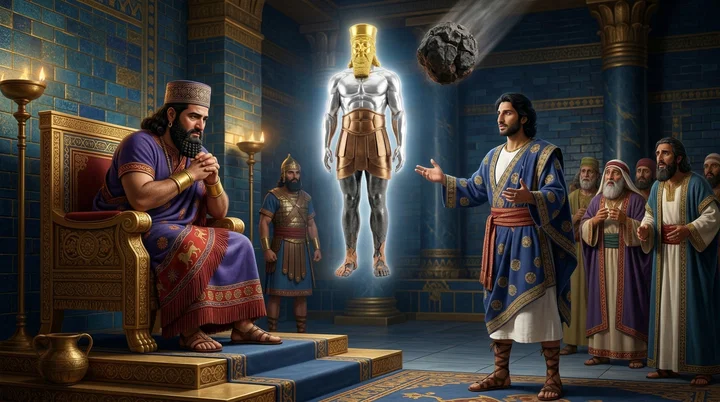
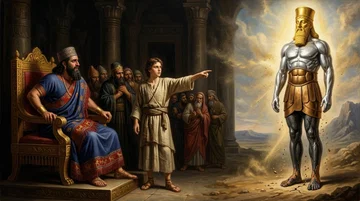
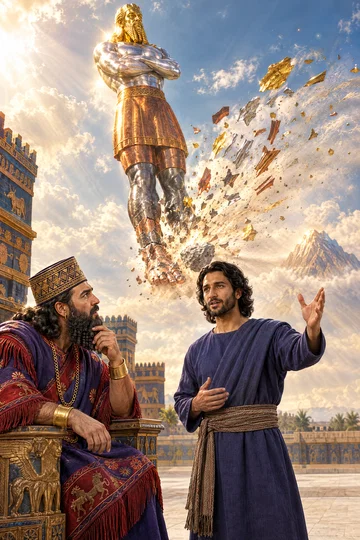
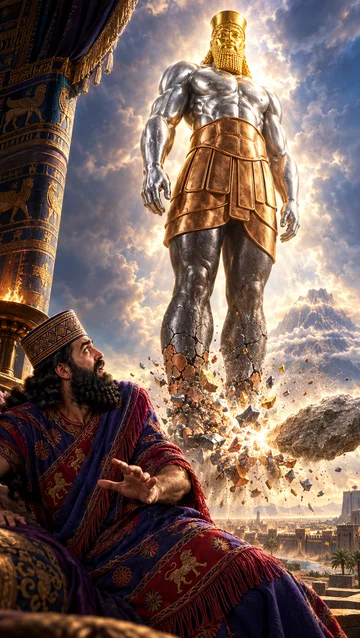
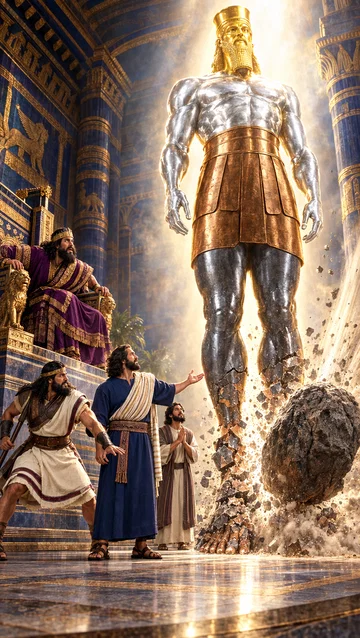
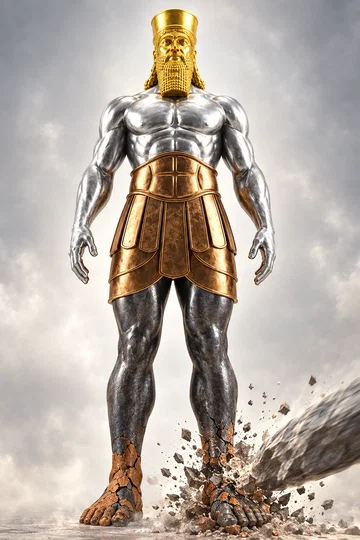
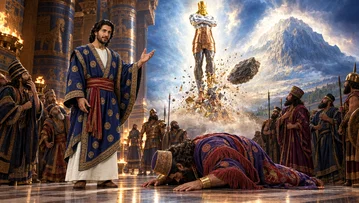
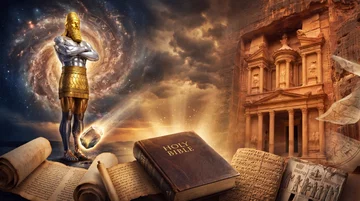
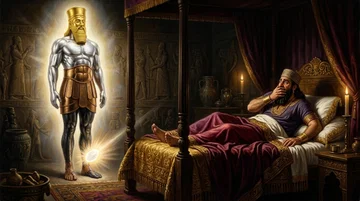
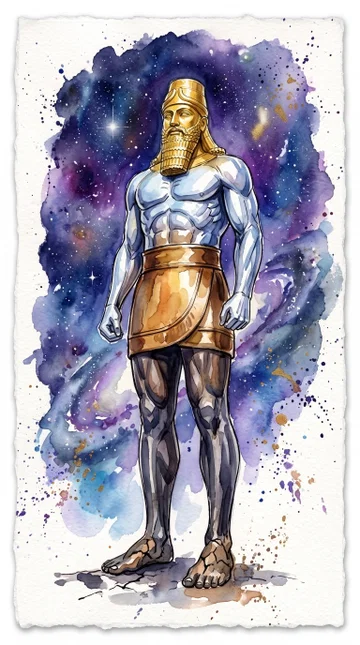
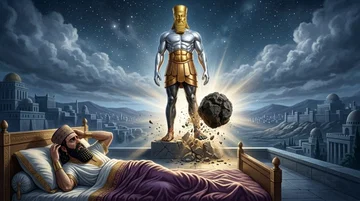
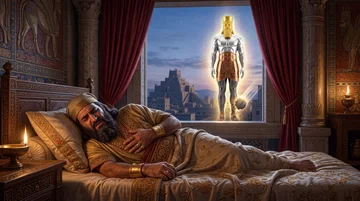
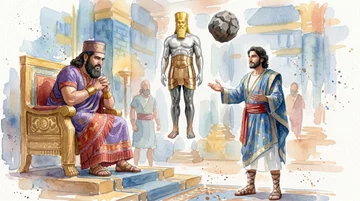
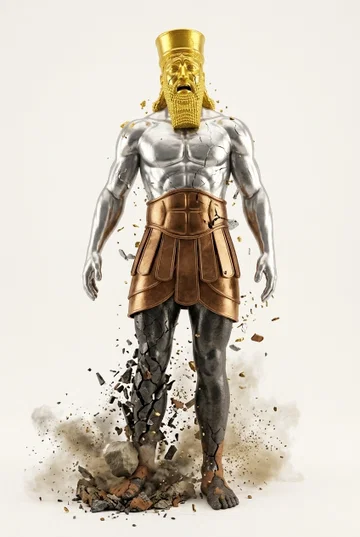
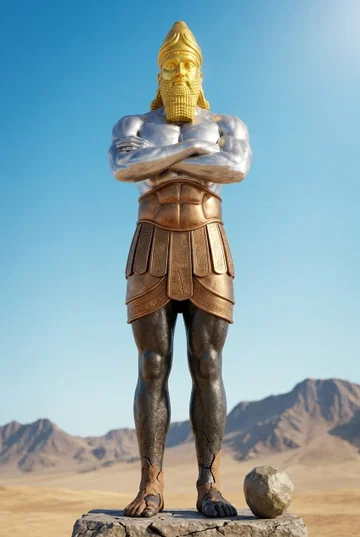
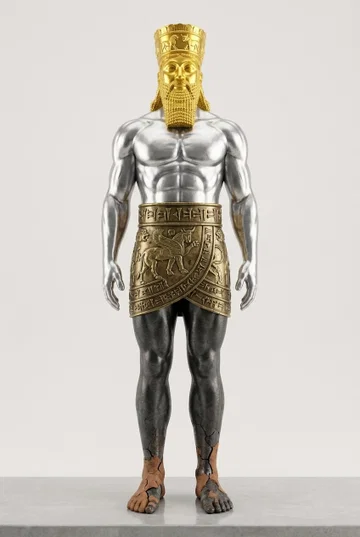
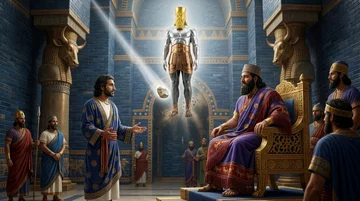
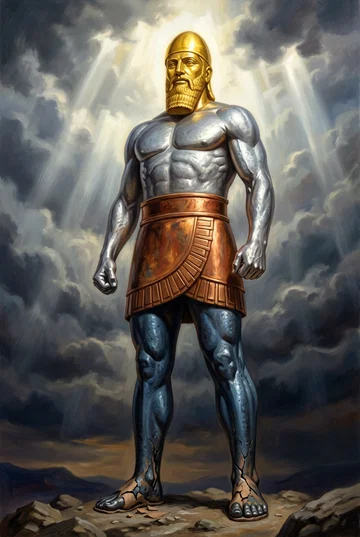
Thou, O king, sawest, and behold a great image. This great image, whose brightness was excellent, stood before thee; and the form thereof was terrible.
Translations
You, O king, saw, and behold a great image. This great image, whose brightness was excellent, stood before you; and the form thereof was terrible.
King James Version, KJV Cambridge Paragraph Bible
Thou, O king, sawest, and behold a great image. This great image, whose brightness was excellent, stood before thee; and the form thereof was terrible.
Thou, O king, sawest, and behold a great image. This great image, whose brightness was excellent, stood before thee; and its form was terrible.
Thou, O king, sawest, and behold a great image. This image, which was mighty, and whose brightness was excellent, stood before thee; and the aspect thereof was terrible.
Thou, O king, sawest, and, behold, a great image. This image, which was mighty, and whose brightness was excellent, stood before thee; and the aspect thereof was terrible.
'Thou, O king, wast looking, and lo, a certain great image. This image [is] mighty, and its brightness excellent; it is standing over-against thee, and its appearance [is] terrible.
Thou, O king, sawest, and behold, a great image. This image was mighty and its brightness excellent; it stood before thee, and its appearance was terrible.
As for thee, O king, thou wast looking, when lo! a great image, this image, being mighty, and the brightness thereof surpassing, was standing before thee,—and, the appearance thereof, was terrible.
Berean Standard Bible, Majority Standard Bible
As you, O king, were watching, a great statue appeared. A great and dazzling statue stood before you, and its form was awesome.
“ You, O king, saw, and behold, a great image. This image, which was mighty, and whose brightness was excellent, stood before you; and its appearance was terrifying.
You, O King, were looking, and a great image was there. This image, which was very great, and whose glory was very bright, was placed before you: its form sent fear into the heart.
O King, thou sawest, and beholde, there was a great image: this great image whose glory was so excellent, stood before thee, and the forme thereof was terrible.
Douay-Rheims (Challoner revision)
Thou, O king, sawest, and behold there was as it were a great statue: this statue, which was great and high, tall of stature, stood before thee, and the look thereof was terrible.
Pictures
Cross-references 20 of 49
- Daniel 2:44-45
And in the days of these kings shall the God of heaven set up a kingdom, which shall never be destroyed: and the kingdom shall not be left to other people, but it shall break in pieces and consume all these kingdoms, and it shall stand for ever.
The image’s successive kingdoms give way to God’s everlasting kingdom.
- Daniel 7:3-7
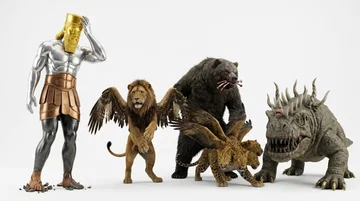
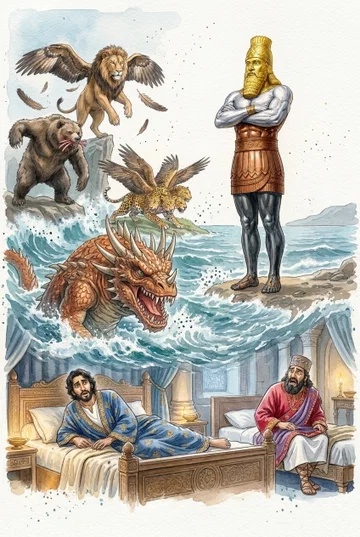
And four great beasts came up from the sea, diverse one from another.
The four beasts portray the kingdoms represented by Daniel 2’s image.
- Daniel 2:37-38
Thou, O king, art a king of kings: for the God of heaven hath given thee a kingdom, power, and strength, and glory.
Identifies Nebuchadnezzar and Babylon as the image’s head of gold.
- Daniel 7:17-18
These great beasts, which are four, are four kings, which shall arise out of the earth.
The beasts represent successive kingdoms, while the saints receive an everlasting kingdom.
- Daniel 2:41-43
And whereas thou sawest the feet and toes, part of potters’ clay, and part of iron, the kingdom shall be divided; but there shall be in it of the strength of the iron, forasmuch as thou sawest the iron mixed with miry clay.
explains feet and toes of iron and clay
- Daniel 8:20-22
The ram which thou sawest having two horns are the kings of Media and Persia.
Identifies Media-Persia and Greece within the succession of kingdoms portrayed in Daniel 2.
- Daniel 3:1
Nebuchadnezzar the king made an image of gold, whose height was threescore cubits, and the breadth thereof six cubits: he set it up in the plain of Dura, in the province of Babylon.
Nebuchadnezzar sets up an all-gold image echoing the dream image.
- Daniel 7:3
And four great beasts came up from the sea, diverse one from another.
The four beasts portray the same four Gentile kingdoms as the image.
- Daniel 2:40
And the fourth kingdom shall be strong as iron: forasmuch as iron breaketh in pieces and subdueth all things: and as iron that breaketh all these, shall it break in pieces and bruise.
Identifies the image’s iron kingdom as Rome, strong enough to break the earlier kingdoms.
- Daniel 7:23-24
Thus he said, The fourth beast shall be the fourth kingdom upon earth, which shall be diverse from all kingdoms, and shall devour the whole earth, and shall tread it down, and break it in pieces.
The fourth kingdom and its ten kings correspond to the image’s divided kingdom and toes.
- Daniel 2:39
And after thee shall arise another kingdom inferior to thee, and another third kingdom of brass, which shall bear rule over all the earth.
Identifies the silver and brass kingdoms that follow the image’s first kingdom.
- Daniel 7:14
And there was given him dominion, and glory, and a kingdom, that all people, nations, and languages, should serve him: his dominion is an everlasting dominion, which shall not pass away, and his kingdom that which shall not be destroyed.
Both visions point to the kingdom given to the Son of man.
- Daniel 2:35
Then was the iron, the clay, the brass, the silver, and the gold, broken to pieces together, and became like the chaff of the summer threshingfloors; and the wind carried them away, that no place was found for them: and the stone that smote the image became a great mountain, and filled the whole earth.
The stone destroys the image’s kingdoms like chaff and fills the earth.
- Daniel 7:4
The first was like a lion, and had eagle’s wings: I beheld till the wings thereof were plucked, and it was lifted up from the earth, and made stand upon the feet as a man, and a man’s heart was given to it.
The lion corresponds to the image’s gold portion and Babylon.
- Daniel 8:3-8
Then I lifted up mine eyes, and saw, and, behold, there stood before the river a ram which had two horns: and the two horns were high; but one was higher than the other, and the higher came up last.
The ram and goat parallel kingdoms represented in the image.
- Daniel 2:41
And whereas thou sawest the feet and toes, part of potters’ clay, and part of iron, the kingdom shall be divided; but there shall be in it of the strength of the iron, forasmuch as thou sawest the iron mixed with miry clay.
The clay and iron signify weakened cohesion in Rome’s divided phase.
- Daniel 2:1
And in the second year of the reign of Nebuchadnezzar Nebuchadnezzar dreamed dreams, wherewith his spirit was troubled, and his sleep brake from him.
Nebuchadnezzar’s troubling dream begins the revelation of the symbolic image.
- Daniel 2:19
Then was the secret revealed unto Daniel in a night vision. Then Daniel blessed the God of heaven.
God reveals the secret to Daniel after he and his companions seek his help.
- Daniel 7:27
And the kingdom and dominion, and the greatness of the kingdom under the whole heaven, shall be given to the people of the saints of the most High, whose kingdom is an everlasting kingdom, and all dominions shall serve and obey him.
The saints receive the everlasting kingdom succeeding the image’s earthly empires.
- Daniel 7:5
And behold another beast, a second, like to a bear, and it raised up itself on one side, and it had three ribs in the mouth of it between the teeth of it: and they said thus unto it, Arise, devour much flesh.
The bear represents the same Medo-Persian kingdom as the image’s silver section.
Commentary part 1 of 2
Each commentary is drawn from primary sources: the writings of Ellen G. White and Adventist pioneers and periodicals. Each commentary is separate. Its own words are not a quotation; follow the references to read the source passages.
Ellen G. White
53 sources
The king saw standing before him a great image of excellent brightness and terrible form, made of different metals with iron mixed with clay, which would afterward be struck by a stone and destroyed in events reaching to the end of time.PK 497.1–3ST Apr 29, 1897 The dream deeply troubled him yet he could not recall its details, and when the magicians, astrologers and Chaldeans confessed that no man on earth could tell it, God revealed both the dream and its meaning to Daniel in a night vision to make known what shall be in the latter days.STE 13.2PK 491.1PK 491.2–3Lt 151, 1904, par. 3–5Ms 8, 1896, par. 22–23 The image represents the kingdoms of the world as four world-moulding empires, Babylon the head of gold followed by Medo-Persia, Greece, and Rome strong as iron to break in pieces all nations, growing progressively less pure and valuable as they separated farther from God.Ms 39, 1899, par. 5–8RH Feb 6, 1900PK 495.3–496.2PK 535.1ED 176.4 It shows that God rules over history, directs the course of kingdoms and removes and establishes kings, while earthly power and glory are temporary and must pass away and Christ's kingdom alone is eternal and will fill the earth.PK 495.1PK 495.21MR 49.1–27T 161.1Ms 36, 1896, par. 3 Instead of learning that his kingdom would not last, the king in pride took the image magnifying Babylon and himself as authority to set up an entirely golden image on the plain of Dura to be worshiped as eternal and supreme, turning a symbol given to reveal God's purpose into an idolatrous test of allegiance.12MR 218.2–220.113MR 63.1–3PK 505.213MR 60.1–61.2Ms 15, 1896, par. 10–12
Dream Setting and Description
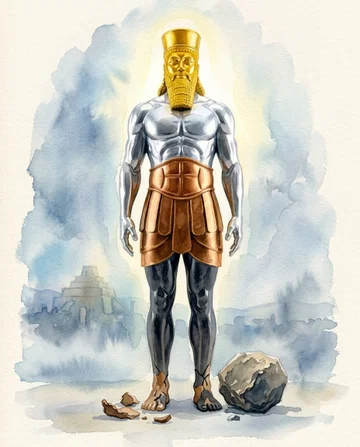
What the king saw standing before him was a great image of excellent brightness and terrible form.PK 497.1–3ST Apr 29, 1897 It was composed of different metals with iron mixed with clay, and it was afterward struck by a stone and destroyed.PK 497.1–3 The dream in which it appeared presents events reaching to the end of time.PK 497.1–3ST Apr 29, 1897
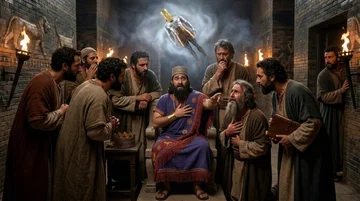
The dream deeply troubled the king, and after waking he could not recall its details.PK 491.1PK 491.2–3 He demanded that the Babylonian wise men tell him both the dream and its interpretation, but they had no light to reveal it.STE 13.2 The magicians, astrologers, sorcerers and Chaldeans confessed that no man on earth could tell it.ST Apr 29, 1897
God then revealed the dream and its meaning in a night vision to Daniel and his companions, to make known what shall be in the latter days.ST Apr 29, 1897Ms 8, 1896, par. 22–23 The revelation was given when the king's wise men could not reveal the dream, and it spared their lives.Ms 85, 1910, par. 41–44 Its interpretation revealed heavenly glory to the Hebrew captives who depended on God rather than being captivated by Babylon's splendor, while exposing the Babylonian wise men's inability and showing the superior wisdom of those who worship Him.Lt 151, 1904, par. 3–5
God Himself employs pictures and symbols to teach lessons for the people.HSFM 211.5–212.4 The great image is prophetic history presented in symbol, appealing to the understanding through the sense of sight so it could be better understood than if given in any other way.HSFM 211.5–212.4 It was to be represented plainly upon tables that he who reads might understand.HSFM 211.5–212.4 The prohibition of image worship does not prohibit this divinely appointed use of pictures.HSFM 211.5–212.4
The dream's figures and symbols represent remarkable events in prophetic history and in the history of the world through the close of time.FE 410.1–411.1PK 484.3 They showed Nebuchadnezzar the part he was to play in world history and how his kingdom related to the kingdom of heaven.PK 503.1 Its events mattered to Nebuchadnezzar, but its lessons were given for later times.PK 503.1 Those figures portray historical events leading to the close of earth's history, and they fulfill prophecy in order and mark the course of prophetic history.Ms 31, 1896, par. 1–2
Daniel made known the forgotten dream together with its interpretation many years before Belshazzar's feast.CTBH 20.1–21.2 That revealing took place more than half a century before it was later recalled as evidence of his wisdom and ability in explaining difficult matters.PK 527.2
Kingdoms Foretold in Symbol
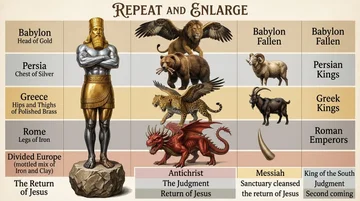
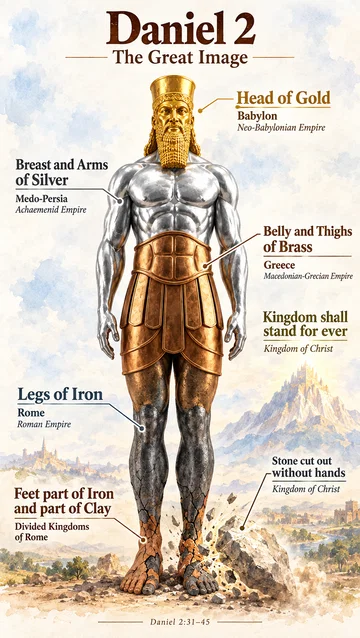
The great image is the kingdom of man, the kingdoms of the world shown as four world-moulding empires that would arise before human rule ends: Babylon, Medo-Persia, Greece, and Rome.PK 495.3–496.2PK 535.1ED 176.4 The sequence begins with Babylonia at the height of its glory under Nebuchadnezzar, an empire that profoundly shaped the world and stood as a center and starting point of civilization.PK 495.3–496.2 Each empire was given a place and a period of testing to show whether it would fulfill God's purpose and exalt the true God, and each failed, lost its glory and power, and gave way to another.PK 535.1ED 176.4
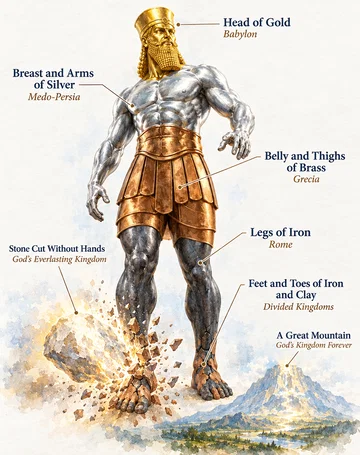
Its parts are successive kingdoms foretold by God: Babylon the head of gold, the breast and arms of silver, the sides of brass, and the feet and toes of iron mingled with clay.Ms 39, 1899, par. 5–8RH Feb 6, 19001MR 49.1–2 Babylon would pass away and be followed by a second kingdom, then a third, then a fourth more fierce, determined and powerful than any before, strong as iron to subdue and break in pieces all nations and ruling over nations.Ms 39, 1899, par. 5–8RH Feb 6, 1900Ms 36, 1896, par. 3 Their rise and fall were appointed as tests of obedience, showing that God rules the affairs of the world, directs the course of kingdoms, and removes and establishes kings.1MR 49.1–2Ms 36, 1896, par. 3 The metals grow progressively less pure and valuable from gold to silver to brass to iron mingled with clay, showing that the kingdoms deteriorated in value as they separated farther from God.Ms 39, 1899, par. 5–8RH Feb 6, 1900Ms 15, 1896, par. 4–613MR 60.1–61.2 Men grow weak morally and spiritually in proportion as they forget God, and as power and glory declined so religion and morality among their peoples deteriorated.Ms 39, 1899, par. 5–8Ms 15, 1896, par. 4–61MR 50.1
That decreasing value means moral and religious deterioration from making void the law of God, trampling it underfoot, forgetting God in prosperity, and ascribing honor and prosperity to human achievement.Ms 39, 1899, par. 5–8Ms 39, 1899, par. 9–11RH Feb 6, 1900 From this came increasing immorality, wickedness, blasphemy and corruption, by which sin ruins nations.Ms 39, 1899, par. 5–8Ms 39, 1899, par. 9–11RH Feb 6, 1900 Babylon passed away because in prosperity she forgot God, Medo-Persia was visited by wrath because the law was trampled underfoot, the kingdoms that followed sank lower and lower in moral value, and the vast empire of Rome, strong as iron to subdue and break in pieces all nations, finally crumbled into pieces.Ms 39, 1899, par. 9–11RH Feb 6, 1900 The image also fitly represents deterioration of religion, seen when the church of Rome keeps people in ignorance of the will of God and when those claiming to be Protestants leave the old landmarks of purity, piety, meekness, lowliness and obedience and depend on forms, ceremonies and outward display.Ms 39, 1899, par. 9–11RH Feb 6, 1900
Babylon was then a universal empire that seemed so strong and far-reaching that no foe could take its scepter, and the image magnified its king.Ms 39, 1899, par. 5–8Ms 15, 1896, par. 4–613MR 60.1–61.2 Yet it would not stand forever but would fall and be followed by other kingdoms, passing away under Nabonadius and Belshazzar in 538 B.C., in the same generation the revelation was given.Ms 39, 1899, par. 5–8PK 514.1PK 496.3 The message is that earthly kingdoms and human power and glory are temporary and must pass away, while Christ's kingdom alone is eternal.PK 495.1PK 495.2Lt 57, 1896, par. 4–7 That everlasting kingdom will replace all earthly powers, will never pass away or be destroyed, and will fill the earth, and the king was meant to trace the image's course to that end.PK 514.1Lt 57, 1896, par. 4–712MR 218.2–220.1Ms 15, 1896, par. 10–12
Certainty and Divine Sovereignty
The great image stands as a symbol of the kingdoms of the world, with its successive parts representing Babylon followed by other kingdoms, including a second, then a third, then a fourth strong as iron and ruling over nations.1MR 49.1–2Ms 36, 1896, par. 3 Its rise and fall were foretold by God, showing that He rules over history and over all kingdoms, directs the course of kingdoms, removes and establishes kings, and fulfills His purpose.1MR 49.1–27T 161.1Ms 36, 1896, par. 3 He is more powerful than earthly rulers, and on Nebuchadnezzar was flashed light from the throne of God to show that the God of heaven is Ruler over all monarchs and kings of earth, whose name was to go forth as God over all gods.7T 161.1Lt 32, 1899, par. 6–11 Through the Hebrew captives He made Himself known to idolatrous Babylon and gave that nation knowledge of the kingdom He would establish and by His power maintain against all the power and craft of Satan, with Daniel chosen to see in vision the light of truth and reflect it upon the proud kingdom.Lt 32, 1899, par. 6–11 Each kingdom was given its period of power as a test of obedience concerning whether its people exalted the one true God, and their obedience or disobedience accompanied their rise and fall, while their history shows God bringing down human pride and glory through the rise and fall of states and their rulers.1MR 49.1–2Ms 36, 1896, par. 3Ms 142, 1901, par. 5
The prophecy has been fulfilled in the record of history with remarkable and wonderful exactness, providing evidence for the inspiration of the Scriptures.GC88 364.2GC 364.2–3 That exact fulfillment gives an anchor of faith against rationalism and skepticism and shows that the coming of the Lord is at hand, a solemn and important truth to be brought before the people.GC 364.2–3 It is not an unknowable mystery that cannot be understood but can be understood so clearly that even children can understand and explain it, despite the popular claim that Daniel's prophecies are mysteries.GC 364.2–3GC88 364.3–365.1 Studying the prophecy helped lead to the belief that the Lord's coming was near.GC88 364.3–365.1
The great image was made known to Daniel by angels and by Christ Himself to reveal things that must shortly come to pass, as part of the sure word of prophecy given to guide all who want to know the will of their Maker.GC 521.3 Important matters concerning salvation in it were not left in mystery to perplex and mislead the honest seeker after truth, but were revealed plain so that he may run that reads.GC 521.3 The word is plain to all who study it with a prayerful, humble, teachable heart, and every truly honest soul seeking truth as for hid treasure will come to the light of its truth.GC 521.3 Its historical events mattered to Nebuchadnezzar, but its lessons were given by God for people living in later times.FE 412.1
The dream was taken away so that the wise men were kept from imposing a false interpretation through their claimed understanding of mysteries.FE 412.1 Their inability to tell it represents people who lack knowledge from God and therefore cannot understand prophecy.FE 412.1 Through Daniel's interpretation God's instruction benefited the great men of Babylon.16MR 336.2 Daniel and his companions remained faithful to God rather than mixing their faith with Babylonian religion, and God upheld and honored them.16MR 336.2
Misreading and Golden Idol
By providence Daniel was brought into reasoning relation with the idolatrous king while faithfully doing his work as statesman in Babylon without doing anything against God.Lt 109a, 1898, par. 5–8Ms 47a, 1898, par. 2–5 Through the dream about Babylon and the other kingdoms light was given to Nebuchadnezzar, and by its interpretation Jehovah was exalted as more powerful than any other kingdom and than earthly kings.Lt 109a, 1898, par. 5–8Ms 47a, 1898, par. 2–5 On Nebuchadnezzar was flashed light from the throne of God to show that the God of heaven is Ruler over all monarchs and kings of earth, that His name was to go forth as God over all gods, and that rulers of earthly kingdoms have a Ruler in the heavens.Lt 32, 1899, par. 6–11 Through the Hebrew captives God thus made Himself known to idolatrous Babylon and gave that nation knowledge of the kingdom He was to establish and through His power maintain against all the power and craft of Satan, with Daniel chosen to see in vision the light of truth and reflect it upon the proud kingdom.Lt 32, 1899, par. 6–11
The dream image was interpreted in the light of the Scriptures, and Daniel taught that dreams are to be read by the living oracles and that no king or subject is to read the Scriptures and God's providences by dreams, fancies and ambitions.Ms 168, 1898, par. 1–3Ms 47a, 1898, par. 2–5 Nebuchadnezzar instead read the interpretation in the light of his own idolatrous mind and human understanding, with its dreams, fancies and ambitions, rather than reading his dream in the light of the living Oracles.Lt 109a, 1898, par. 5–8Ms 47a, 1898, par. 2–5 The significance God revealed through Daniel was that Babylon would not be an eternal empire, despite the king's ambition to make it supreme and everlasting.Ms 168, 1898, par. 1–3PK 504.3
The king took the great image representing the excellence and glory of Babylon and more particularly himself as head of gold as authority to set up a golden image to convert all nations to its worship.Lt 109a, 1898, par. 5–8Ms 47a, 1898, par. 2–5 God had given his kingdom its prosperity for God's glory and meant him to trace the image's course to the end of earthly kingdoms and the establishment of God's everlasting kingdom, but he turned the warning against himself by pursuing proud ambition instead of considering that end.13MR 63.1–3Ms 15, 1896, par. 10–12 Pride led him to seek a greater and more powerful empire and to imagine his kingdom as an image entirely of gold, and his counselors flattered him to regard Babylon's place in the image as reason to magnify himself and demand worship.13MR 60.1–61.2Ms 15, 1896, par. 10–12 Instead of learning from the dream that his kingdom would not last, he therefore focused on being the head of gold and made a great image of gold to represent his kingdom and be worshiped.Ms 163, 1898, par. 5–11
The golden statue on the plain of Dura was similar in general features to the dream image but differed in material, being made entirely of gold in imposing size and splendor to represent Babylon's glory and power.12MR 218.2–220.1PK 505.2 It was made entirely of gold to symbolize the claim that Babylon would be eternal, indestructible, all-powerful and supreme over every other kingdom, in contrast to the dream image of different materials representing earthly kingdoms that would not last before the kingdom of heaven would fill the earth.12MR 218.2–220.1PK 504.1–2 His golden statue imitated the dream image in order to take God's place, becoming an object of idolatrous worship and a test of allegiance to God.12MR 218.2–220.1ST Oct 19, 1882 That self-exaltation ended with the fall of Babylon in an hour of feasting and revelling.Lt 109a, 1898, par. 5–8
The great image was a symbol God gave to reveal His purpose for the nations and important future events, and its meaning was to communicate divine truth.PK 505.1 Yet the symbol could be misinterpreted and used to glorify human power, promote men's plans, and hinder people from learning what God wanted the world to know.PK 505.1
Sources
Pioneers and periodicals
201 sources
Nebuchadnezzar saw in his dream on his bed a great image of excellent brightness and terrible, fearsome form standing before him in colossal human shape.ST Jun 29, 1882 The image outlines world history from his day to the end, its head of gold Babylon, breast and arms of silver Medo-Persia, belly and thighs of brass Greece, legs of iron Rome, and feet and toes of iron mixed with clay divided Rome, struck by the stone cut without hands.RH Apr 22, 1862ST Dec 24, 1912RH Nov 6, 1916 The metals descending in value show each succeeding kingdom inferior in glory and the age growing weaker until ripe for doom, not a future golden age to come.ST Dec 24, 1912ST May 3, 1877RH Jun 24, 1873ST Dec 16, 1880ST Jul 29, 1897 The stone is Christ and His everlasting kingdom set up by God in the days of the divided kings, which first utterly destroys all earthly kingdoms together like chaff and then becomes a great mountain filling the whole earth.ST May 3, 1877ST Dec 16, 1880ST Aug 4, 1881ST Feb 15, 1883 All has been literally fulfilled step by step to divided Rome, proving divine foreknowledge, and the world now lives far down in the feet and toes with the stone's blow next and Christ's coming close at hand.ST Aug 2, 1877RH Nov 26, 1914ST Oct 14, 1889ST Jun 13, 1878RH May 6, 1873
Dream Appearance and Setting
Nebuchadnezzar saw in his dream on his bed a great image standing before him, colossal in human form with ordinary human shape including ten toes, towering and splendid yet terrifying, of excellent striking brightness and terrible fearsome awe-inspiring aspect marking great earthly power.ST Jun 29, 1882RH Apr 3, 1900ST Aug 13, 1902 The vision opened with this dazzling figure whose exceptional brightness suggested outward splendor and whose terrible form inspired awe and fear, and it went on to show parts of different metals destroyed by a stone not made by hands that grew to fill the earth, concerning what would happen in the latter days after the king's reign.RH Apr 3, 1900RH Nov 3, 1910 The word for image denotes a physical form with real shape, as with images made by human hands elsewhere in the Bible.RH Jan 5, 1860ST Aug 23, 1877 Here it is a God-given symbolic object-lesson in prophecy, not an image made for worship, showing that the command against making images does not forbid making them for other purposes.RH Apr 18, 1907ST Aug 23, 1877
The dream was given in the second year of Nebuchadnezzar's sole reign, about 603-604 B.C. and about six centuries before Christ, three years after he was associated with his father in 606 B.C., while he lay on his bed pondering the future and whether his empire would endure after his death.RH Nov 6, 1916RH Nov 3, 1910ST May 20, 1897 It made a deep and wonderful impression on his mind, yet after waking he forgot it and could recall no portion of it, and demanded that the wise men tell both the dream itself and its interpretation.RH Nov 6, 1916ST May 20, 1897ST Sep 10, 1885 The forgotten dream was made known to Daniel in a night vision in answer to prayer, after Daniel and his three companions together fasted and earnestly prayed seeking wisdom from above with implicit faith, having been as it were in the audience-chamber with God.RH Nov 6, 1916ST May 20, 1897ST Jun 3, 1913 Daniel then told and interpreted it before the king without softening the message despite the king's power and possible cost, disavowing his own wisdom and giving God glory as the God of gods, Revealer of secrets and Ruler of kings who works through Gentile kings and Abraham's seed to make truth known.RH Nov 11, 1902ST Nov 24, 1898RH Oct 22, 1901ST Jan 28, 1886RH Mar 14, 1865
The future was shown as a human-shaped idolatrous image because the king's thoughts centered on human power and earthly wealth, glory and government, and as an idolater and worshiper of images such a form at once commanded his attention and respect and suited his high esteem for earthly kingdoms.RH Sep 11, 1900ST Aug 4, 1881ST Feb 15, 1877ST Oct 11, 1905ST Nov 28, 1895 With a mind unenlightened and unprepared to put a true estimate on earthly pomp, the kingdoms were presented to him in precious admirable form matching his own valuation, adapted also to show him and all men their utter emptiness and worthlessness, that earthly greatness would break and vanish like a bubble and like worthless chaff blown away.ST Aug 4, 1881ST Feb 15, 1877 The same kingdoms were afterward shown to Daniel as cruel ravenous wild beasts, a form more fitting to reveal their true character, confirming the dream while bringing out new features and movements that metals are little adapted to express, since the first revelation to a heathen king is introductory and does not begin in the religious excitement of a Jewish believer.ST Feb 15, 1877ST Oct 11, 1905
The verse stands in the Aramaic or Chaldee part of Daniel, which begins with the answer of the Chaldeans in Daniel 2:4 and continues until the close of chapter 7, after a Hebrew introduction.RH Nov 25, 1873 Chaldee is used there because the passage belongs to speeches at court and proceedings there, given in the language spoken at court and understood by the Jews generally and suited to the common people during the Babylonian captivity.RH Nov 25, 1873 Its subject is greatly similar to that of chapter 7, and the continuing of Chaldee through chapter 7 fits that similarity and the formal introduction of Daniel in chapter 8, where Hebrew is resumed as best adapted for Daniel's personal introduction and for the restoration of the Jews and God's future dealings with them.RH Nov 25, 1873 The chapter contains ten technical words mostly Greek in form, once cited as evidence that Daniel was written during the Maccabean period, but most have been explained by the cosmopolitan character of the Babylonian court known from tablets and inscriptions, leaving only two still disputed.
The events were about twenty years before chapter 3, during which Nebuchadnezzar's kingdom grew rapidly by conquest, administration and building.ST Dec 3, 1912 A short time afterward he erected the all-gold image on the plain of Dura to declare his kingdom perpetual and universal and required its worship, outwardly acknowledging God's revealing power yet rejecting the foretold succession.RH Aug 6, 1908RH Nov 3, 1910ST Aug 24, 1904RH Apr 17, 1900ST Sep 6, 1899 That later image answered the dream by asserting that Babylon alone would rule the world and no kingdom would succeed it, a defiant counterclaim that his golden glory would endure forever without interruption, though ancient Babylon fell as history followed the dream's outline.ST Dec 3, 1912RH Aug 6, 1908RH Nov 3, 1910RH Apr 17, 1900ST Sep 6, 1899 God used the dream to lift up Daniel, a captive, and advance him to a position where he could help his companions in tribulation, showing that God can use seemingly unlikely events to bring deliverance and blessing to His people.ST Jan 21, 1889
Four Kingdoms Named
The great image is a prophetic symbol of successive earthly kingdoms outlining world history from Babylon to the end, beginning a consecutive chain from Daniel's day to the close of time and the setting up of God's kingdom.RH Apr 22, 1862ST Dec 24, 1912ST Jun 22, 1915ST May 8, 1907 It compresses that history into a few verses, showing a human kingdom changeable and deteriorating in value and ultimately crumbling in strength, whose meaning concerns what shall be in the latter days.ST Dec 24, 1912ST May 8, 1907 Its different metallic parts represent successive kingdoms, and the stone that destroys it and fills the earth represents the final outcome.ST May 8, 1907 It sets forth Babylon, Medo-Persia, Greece, Rome, and the fifth kingdom that follows them, with Rome the last world-wide kingdom followed by division into numerous smaller kingdoms continuing divided until Christ comes in person to overthrow all earthly rule and establish His everlasting reign.ST Jun 22, 1915ST Jun 23, 1914
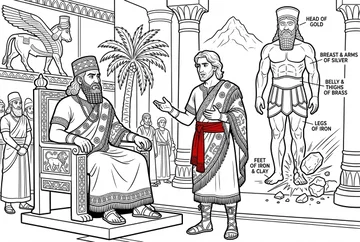
Its parts are Babylon as head of gold, Medo-Persia as silver breast and arms, Greece as brass belly thighs and sides, Rome as iron legs, divided Rome as iron mixed with clay feet and toes, followed by the stone cut without hands that strikes the feet and becomes a mountain filling the earth.ST Dec 24, 1912RH Nov 6, 1916ST Aug 2, 1877 The iron mixed with brittle clay is the divided Roman Empire, partly strong and partly broken, which remains divided until the end, and during that divided condition God sets up an everlasting kingdom that will have no successors.ST Dec 24, 1912RH Nov 6, 1916ST Jun 23, 1914 The four earthly kingdoms are Babylon or the Chaldeans, Medo-Persia or Persia, Grecia or Greece, and Rome or the Romans, four universal mortal kingdoms followed by a fifth immortal universal kingdom, five only.ST Jun 22, 1915ST Jun 23, 1914ST May 27, 1908ST Jun 13, 1878RH Jan 31, 1856 The image is God's object-lesson of four metals smitten by a stone, meaning four universal monarchies, Babylon followed by three others, all to utterly pass away, with the stone meaning the kingdom of God established in their stead.ST May 27, 1908ST Jun 13, 1878ST Oct 21, 1875 The decline from gold to silver to brass to iron shows each succeeding generation degenerating, and the iron mixed with miry clay shows the last divided condition of earthly governments just before the opening glories of the immortal kingdom.ST Dec 24, 1912ST Oct 21, 1875
The head of gold is Nebuchadnezzar himself as king of kings and his Babylonian or Chaldean empire, to whom God gave universal dominion over lands and living creatures, superior in glory, wealth and magnificence, with capital fitting its brightness.RH Nov 19, 1857RH May 30, 1854ST Jan 8, 1880ST Jan 8, 1880ST Feb 15, 1883 King and kingdom are used interchangeably, and he represents the empire not merely himself, since the silver kingdom was not developed till after his death.RH May 30, 1854ST Jan 8, 1880 Babylon began a succession of Gentile world kingdoms, and from then on the Jewish and Christian church had no independent government free from Gentile rule.RH May 30, 1854 The silver breast and arms are another, inferior united kingdom of the Medes and Persians that would conquer Babylon, the brass belly thighs and sides are a third kingdom under Alexander which would bear rule over all the earth, and the legs of iron are a fourth kingdom strong as iron that breaks in pieces and subdues all things.ST Jul 4, 1878ST Oct 29, 1885ST Jun 8, 1915ST Aug 26, 1889RH Apr 30, 1857 Greece succeeded Persia in world dominion in 331 B.C., the same power as the ram of Daniel 8 and the bear of Daniel 7, while the vision of the image begins with Babylon and the vision of Daniel 8 omits Babylon and commences with Media and Persia at the height of its power.ST Aug 26, 1889RH Apr 30, 1857RH Apr 30, 1857
Each new universal power rose outside its predecessor's proper seat by conquest and added fresh territory with supreme power over the whole, moving westward like the sun from Asia to Europe to the Atlantic.ST Jan 27, 1898RH Jan 16, 1908RH Mar 9, 1869 Babylon was swallowed by Persia, Persia by Greece, Greece by Rome, each ruling the earth because none could resist rather than by occupying all the earth, with other kingdoms tributary or yielding to it.ST Jan 27, 1898ST May 29, 1884RH May 27, 1875 Each successive metal denotes fresh territory added and transfer of supreme power over the whole image to that empire, the silver denoting territory added by Medo-Persia to Babylon with power over both transferred to it, and so with the brass, and the iron denoting the fresh territory of the Western Empire of Rome added to the eastern territories of the previous metals with supreme power over the whole transferred to Rome.RH Jan 16, 1908ST May 29, 1884 Since the ten toes belong to the iron portion, the kingdoms they symbolize are to be sought only in the part of the Roman Empire not included in the Babylonian gold or Persian silver or Grecian brass, that is only in the Western Roman Empire chiefly represented by modern Europe.RH Jan 16, 1908 When dominion passed the former powers were not annihilated; their dominion was taken away but their lives were prolonged, Persia and Greece remaining as small kingdoms and Babylon continuing its influence through ancient mythology, astro-theology, and secret divinations.ST Jan 27, 1898 Rome, the iron monarchy, successively broke them, and at the opening of the Christian era ruled a vast territory across Europe, Asia, and Africa, occupying substantially the same territory in the East with accessions from conquest and hereditary dominions, with Rome adding what it possessed in the West and holding every claim of ancient sovereignty to universal monarchy.ST May 29, 1884ST Aug 18, 1881
Prophetic history begins when powers connect with God's people, not at founding: Babylon arose in 747 B.C. but entered prophecy in 677 B.C. through Manasseh's captivity and Judah's subjection.RH Apr 22, 1862RH Apr 22, 1862 Rome, founded in 754 B.C., enters prophecy in B.C. 161 when it becomes connected with the people of God by its league with the Jews, also dated to B.C. 168 after Pydna and to B.C. 30 at the commencement of Roman ascendancy, lasting until its full division into ten kingdoms.RH Sep 22, 1863RH Apr 22, 1862ST May 10, 1877RH Jun 28, 1870ST Dec 30, 1903 In that shared sequence Grecia is followed by Rome as the fourth great power, parallel to the visions of Daniel 7 and Daniel 8, where the head of gold is the same as the lion-like first beast and the later part designates Rome, the mighty power that followed Greece.ST May 10, 1877RH Jun 28, 1870ST Dec 30, 1903 The dated succession is Babylon until 538 B.C., Medo-Persia from 538 to 331 B.C., Grecia from 331 to 168 or 161 B.C. later divided into four, and Rome as a unit thereafter.RH Oct 1, 1914ST Aug 26, 1889ST Jun 24, 1886ST Oct 22, 1885 Babylon is also dated from 625 or 603 to 538 B.C., Greece succeeding at Arbela in 331 B.C., and Rome universal at Christ's first advent when Luke 2:1 shows Caesar Augustus ruling a universal kingdom, with Imperial Rome until its breakup in the fourth century and the divisions thereafter, spanning from about 600 B.C. to a little beyond the present age.ST Aug 26, 1889ST Nov 28, 1895 Daniel focuses chiefly on the first and fourth kingdoms, mentioning the second and third briefly to connect them.RH Jul 31, 1900
Metals Mean Decline
The metals descend in value from gold through silver and brass to iron and to iron mixed with clay, showing deterioration and successive change and decline in earthly conditions.ST Dec 24, 1912ST May 3, 1877ST Aug 4, 1881 The four metallic parts are Babylon, Medo-Persia, Grecia, and Rome, and the iron mixed with brittle clay is divided Rome, partly strong and partly broken, which remains divided until the end.ST Dec 24, 1912RH Jun 24, 1873ST Dec 3, 1912 The golden head marks Babylon as the comparatively glorious age in glory, wealth, brilliance and magnificence, and the later ages are progressively less glorious down to iron mixed with clay, with the human race degenerating physically, mentally and morally until ripe for doom.RH Jun 24, 1873ST May 1, 1907ST Aug 4, 1881 The great, splendid, fearsome, gigantic bright image is a symbol of the human kingdom, changeable and deteriorating in value and ultimately crumbling in strength, and its form suited Nebuchadnezzar's idolatrous outlook and esteem for earthly power and wealth.ST Dec 24, 1912ST May 3, 1877ST Aug 4, 1881 The whole image is shattered and blown away like worthless chaff, showing earthly greatness and kingdoms are temporary and empty, while the stone that destroys it grows to fill the earth and replaces it with God's enduring, eternal, glorious order whose subjects live forever and which has no successors and no end.ST Dec 24, 1912ST May 3, 1877ST Aug 4, 1881
The image is also a picture of the civil phases of world empire, a prophecy of what will happen and not an arbitrary decree causing it.ST Dec 3, 1912 Its changing metals from gold to crumbling clay show the deterioration of human kingdoms, their changing forms of government, and their eventual failure, and earthly empires pass away through weakness and corruption while God's everlasting kingdom represented by the stone cut without hands endures because it is righteous.ST Dec 3, 1912 Nebuchadnezzar's all-gold image in Daniel 3 expressed his attempt to make Babylon eternal and to defy that prophecy.ST Dec 3, 1912 The image outlines events through history and occupies the earth until the stone strikes.ST May 3, 1877ST Aug 4, 1881
The declining condition from the gold head to the iron mixed with clay feet and toes reflects increasing immorality that follows when people make void God's law.RH Feb 6, 1900RH Feb 6, 1900 In prosperity rulers forgot God, made void His law, trampled it underfoot, and ascribed honor and glory to human achievement, bringing increasing immorality, wickedness, blasphemy, corruption and weakness.RH Feb 6, 1900 Reverence for God would give rulers wisdom and strength, but separation from Him leaves them unable to understand His warnings and dependent on God's faithful servants for insight.RH Feb 6, 1900 So Babylon passed away, the Medo-Persian kingdom was visited by wrath, the kingdoms that followed sank lower and lower, and the vast empire of Rome, strong as iron to subdue and break the nations yet fiercer and more powerful than those before it, crumbled into pieces.RH Feb 6, 1900RH Feb 6, 1900 The image fitly represents deterioration of religion as well, for men grow weak morally and spiritually just in proportion as they forget God, leaving the old landmarks of obedience for forms, ceremonies and outward display, with even religious leaders lacking a good conscience toward God and the church of Rome keeping people in ignorance of the will of God.RH Feb 6, 1900
The golden age was in the past in Babylon and the present time is the weakest age of iron mixed with clay, so the image does not predict a coming golden age on earth or world conversion.RH Jun 24, 1873ST Dec 16, 1880ST Dec 17, 1874 Its head of fine gold is Babylon, its breast and arms of silver are Persia, its sides of brass are Grecia, its legs of iron are Rome, and its feet and ten toes of iron and miry clay are the ten kingdoms into which Rome was divided, four great universal monarchies bearing rule on earth and decreasing in value.ST Dec 16, 1880 To place the golden age in the future turns the image upside down and puts darkness for light and light for darkness, turning it to stand on its head and topsy-turvy.ST Dec 16, 1880RH Dec 28, 1869RH Aug 15, 1865 To name the ages iron and brass and gold in reverse order and to add a closing age of corruption sets a crown of infamy upon it, yet even thus inverted, transposed and mutilated the image still publishes the omens of the last days and makes the signs of the times so plain that all are forced to see them.RH Dec 28, 1869 Expecting the present to become a golden age of universal peace, union and progress belongs to the false cry of peace and safety, for the golden age belongs to Babylon at the start and not to the last days.RH Aug 15, 1865 The prophecy contradicts the idea that history is gradually evolving into an earthly golden age and points instead to the consummation of earth's history and the coming of Christ, preceded by a work of preparation and warning.ST Dec 17, 1874
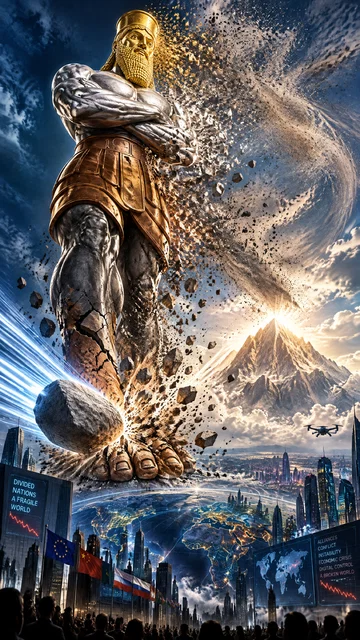
The stone smites the image upon the feet, and then the iron, brass, silver and gold are broken to pieces together, ground to powder, and become like the chaff of the summer threshing-floors that the wind carries away so no place is found for them, which is their utter destruction and not their conversion.RH Jun 24, 1873ST Dec 16, 1880ST Jul 29, 1897 This proves the world will not be converted and there is no hope of earthly glory or a future golden age for the church before the crash of earthly kingdoms.ST Dec 16, 1880 The monarchies are followed by a fifth glorious everlasting kingdom, the kingdom of the Lord and Saviour Jesus Christ set up on the new earth at His coming in the days of these kingdoms, which shall never be destroyed and shall stand forever and will replace the earthly kingdoms rather than arise through their conversion.ST Dec 16, 1880ST Jul 29, 1897
The prophetic emphasis is not on the anatomical parts but on the materials composing them, which symbolize the successive kingdoms represented by gold, silver, brass, iron, and iron mixed with clay.ST Dec 29, 1909STST Jan 2, 1912 The meaning is in the different metals, not in the anatomical parts, and the paired members are incidental to the human form and not objective symbols.STST May 8, 1907 The two arms do not indicate the union of two powers, any more than the two thighs indicate duality in Grecia, and the two legs do not indicate Eastern and Western Rome.RH Jun 9, 1868ST Rome was a unit for the greater part of its more glorious career and was not divided from the beginning where the legs begin, for the iron legs represent the Roman Empire while it was united and its stated division is into ten kingdoms.RH Jun 9, 1868ST The toes themselves do not separately represent ten divisions, but the division of the Roman kingdom is represented by the iron mixed with clay beginning in the feet.ST Nov 24, 1914 The iron and clay together represent Rome in its imperial unity and later division to the end, and their failure to mix shows that divided Rome will never be reunited despite human efforts.STST May 8, 1907 The image begins with Babylon, the golden kingdom whose splendor and power under Nebuchadnezzar made it the dominant empire of his age, showing Babylon was only the first in a succession of kingdoms and not an empire that would last forever.ST Jan 2, 1912
The human-shaped image presents the kingdom of man and human rule apart from God, whose metals symbolize its glory and lasting qualities, and Daniel 2 and Daniel 7 cover the same succession of dominant kingdoms.ST Nov 29, 1905ST Apr 11, 1911 The human form is fitting because man is proud of his capacities, allied to God, and the destined associate of angels, to mark the greatest events the world has or will witness. The head of gold is the Babylonian kingdom, the breast and arms of silver are the Medo-Persian kingdom, the belly and thighs of brass are the Grecian kingdom which followed in B.C. 331, the legs of iron are the fourth kingdom, and the feet and toes of iron mixed with potter's clay are its divisions including present proud nations.ST That vision corresponds completely with Daniel's vision of beasts and with John's vision in Revelation, even to the number of days when the vision should expire, and together teaches the near approach of Christ and the setting up of His kingdom. It shows all phases of human government from unlimited autocracy and imperialism down through limited monarchies until at last the divided condition of the world represented by the clay, manifest in Socialism, republicanism, democracy and government by the people.ST Dec 3, 1912ST Apr 15, 1913 All these kingdoms come to nothing because they do not have within them the elements of the divine life and hold within themselves the elements of destruction through selfishness, and no law or human organization can bring the ideal society until selfishness is taken out of human hearts by Christ.ST Apr 15, 1913 That kingdom only will stand forever whose subjects get right at heart through faith in Christ Jesus and the regenerating power of the divine life, when Christ represented by the stone strikes the feet and His kingdom then fills the whole earth.ST Apr 11, 1911ST Apr 15, 1913 The descent in value from gold to silver, brass, iron and clay illustrates humanity's degradation through selfishness even as pride mistakes that decline for progress.RH Nov 10, 1863 Its descending order to coarser metals serves as a picture of opportunity worsening with delay, where today is golden, tomorrow silver, and later days increasingly inferior until life ends in dust, warning to begin reforming life today rather than putting it off.RH Jun 26, 1855
Sources