Daniel 6:8
Now, O king, establish the decree, and sign the writing, that it be not changed, according to the law of the Medes and Persians, which altereth not.
Translations
Now, O king, establish the decree, and sign the writing, that it be not changed, according to the law of the Medes and Persians, which alters not.
King James Version, KJV Cambridge Paragraph Bible
Now, O king, establish the decree, and sign the writing, that it be not changed, according to the law of the Medes and Persians, which altereth not.
Now, O king, establish the decree, and sign the writing, that it may not be changed, according to the law of the Medes and Persians, which altereth not.
Revised Version, American Standard Version
Now, O king, establish the interdict, and sign the writing, that it be not changed, according to the law of the Medes and Persians, which altereth not.
Now, O king, thou dost establish the interdict, and sign the writing, that it is not to be changed, as a law of Media and Persia, that doth not pass away.'
Now, O king, establish the decree, and sign the writing, that it be not changed, according to the law of the Medes and Persians, which may not be revoked.
Now, O king! wilt thou establish the interdict, and sign the writing, that it may not be changed—according to the law of the Medes and Persians, which may not be abolished,
Berean Standard Bible, Majority Standard Bible
Therefore, O king, establish the decree and sign the document so that it cannot be changed— in accordance with the law of the Medes and Persians, which cannot be repealed.”
Now, O king, establish the decree and sign the writing, that it not be changed, according to the law of the Medes and Persians, which doesn’t alter.”
Now, O King, put the order in force, signing the writing so that it may not be changed, like the law of the Medes and Persians which may not come to an end.
Nowe, O King, confirme the decree, and seale the writing, that it be not changed according to the law of the Medes and Persians, which altereth not.
Douay-Rheims (Challoner revision)
Now, therefore, O king, confirm the sentence, and sign the decree: that what is decreed by the Medes and Persians may not be altered, nor any man be allowed to transgress it.
Pictures
Cross-references
- Daniel 6:16-22
Then the king commanded, and they brought Daniel, and cast him into the den of lions. Now the king spake and said unto Daniel, Thy God whom thou servest continually, he will deliver thee.
Daniel is cast into the lions’ den and preserved.
- Daniel 6:1-3
It pleased Darius to set over the kingdom an hundred and twenty princes, which should be over the whole kingdom;
Daniel’s high office under Darius prompted the decree.
- Esther 8:8
Write ye also for the Jews, as it liketh you, in the king’s name, and seal it with the king’s ring: for the writing which is written in the king’s name, and sealed with the king’s ring, may no man reverse.
A royal decree bearing the king’s name and seal could not be reversed.
- Daniel 6:14
Then the king, when he heard these words, was sore displeased with himself, and set his heart on Daniel to deliver him: and he laboured till the going down of the sun to deliver him.
Darius regrets the decree but cannot avert its consequences for Daniel.
- Daniel 6:4
Then the presidents and princes sought to find occasion against Daniel concerning the kingdom; but they could find none occasion nor fault; forasmuch as he was faithful, neither was there any error or fault found in him.
Jealous officials found no fault in Daniel, prompting the decree.
- Daniel 6:26-27
I make a decree, That in every dominion of my kingdom men tremble and fear before the God of Daniel: for he is the living God, and stedfast for ever, and his kingdom that which shall not be destroyed, and his dominion shall be even unto the end.
God’s enduring rule and power to rescue contrast with unalterable human law.
- Daniel 6:15
Then these men assembled unto the king, and said unto the king, Know, O king, that the law of the Medes and Persians is, That no decree nor statute which the king establisheth may be changed.
The officials remind Darius that the signed decree cannot be altered.
- Daniel 6:12
Then they came near, and spake before the king concerning the king’s decree; Hast thou not signed a decree, that every man that shall ask a petition of any God or man within thirty days, save of thee, O king, shall be cast into the den of lions? The king answered and said, The thing is true, according to the law of the Medes and Persians, which altereth not.
The king reaffirms that the decree cannot be changed.
- Ezekiel 14:20
Though Noah, Daniel, and Job, were in it, as I live, saith the Lord GOD, they shall deliver neither son nor daughter; they shall but deliver their own souls by their righteousness.
Daniel is named as an example of righteousness and faithfulness.
- Hebrews 11:33
Who through faith subdued kingdoms, wrought righteousness, obtained promises, stopped the mouths of lions,
Faithful people, including Daniel, stopped lions’ mouths.
Commentary
Each commentary is drawn from primary sources: the writings of Ellen G. White and Adventist pioneers and periodicals. Each commentary is separate. Its own words are not a quotation; follow the references to read the source passages.
Ellen G. White
18 sources
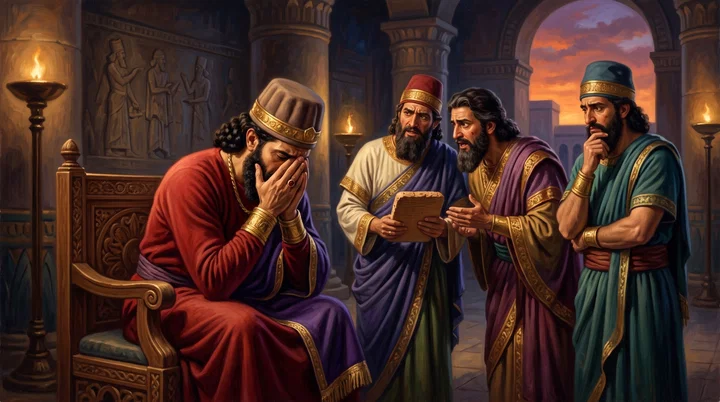
The conspirators persuaded Darius to establish and sign a decree forbidding anyone in the realm for thirty days to ask a petition of any god or man except the king on pain of being cast into the den of lions, and once signed it was fixed and unalterable according to the law of the Medes and Persians.ST Aug 14, 1884ST Apr 18, 1911BS 37.1PK 540.1–2ST Nov 4, 1889 It was aimed at Daniel after he was preferred over the princes and presidents because an excellent spirit was in him, yet being faithful and blameless they could find occasion against him only concerning the law of his God.PK 539.3PK 539.1PK 539.2 Though he knew it was signed to ruin him, he continued his accustomed open prayers three times a day with his windows open toward Jerusalem just as before.ST Aug 14, 1884ST Apr 18, 1911BS 37.2 No earthly power has the right to dictate whom a person may pray to, and even a decree that binds the king cannot come between a person and God, so faithfulness may require courageous deliberate choice even at the risk of death.BS 37.2ST Nov 4, 1889ST Nov 4, 1886 His faithful worship thus became a testimony that the God of heaven alone is the true God deserving worship, and God sent angels to be with him and delivered him from the power of the lions.ST Aug 14, 1884ST Apr 18, 19115T 453.1–4
Setting and Conspiracy
The time is when Darius the Median took the throne formerly occupied by the Babylonian rulers and at once reorganized the government.PK 539.1 He set one hundred and twenty princes over the kingdom and three presidents over them, of whom Daniel was first, so that the princes might give accounts to them and the king should have no damage.PK 539.1 Daniel was preferred above the presidents and princes because an excellent spirit was in him, and the king thought to set him over the whole realm.PK 539.1 His honors stirred jealousy among the leading men, yet he was faithful and blameless with neither error nor fault found in him, leaving his enemies no ground of complaint.PK 539.3PK 539.2 They therefore concluded they could find occasion against him only concerning the law of his God.PK 539.3
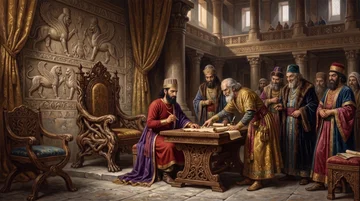
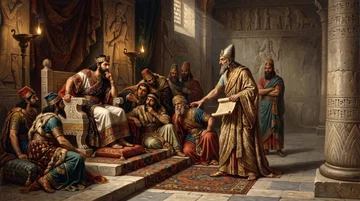
The request to establish and sign the writing belonged to a secret, underhanded plan by the very Babylonian wise men whose lives Daniel had pleaded to spare.2MR 319.5 They acted from jealousy because he found favor with kings and nobles and was honored as the greatest man in Babylon.2MR 319.5 The presidents and princes counseled together and prepared a decree for the king to establish and sign as a trap to destroy Daniel by directing prayer to himself.BS 37.1PK 540.1–2Ms 14, 1894, par. 24–25 They persuaded him by flattery and appeal to his vanity that carrying out the edict would add greatly to his honor and authority, and ignorant of their subtle purpose and animosity against Daniel and not realizing it would harm him, yielding to them he consented and signed.BS 37.1PK 540.1–2ST Nov 4, 1889Ms 14, 1894, par. 24–25
The decree forbade any person in the realm for thirty days to ask a petition of any god or man except of Darius the king.ST Aug 14, 1884ST Apr 18, 1911BS 37.1PK 540.1–2 Violation was to be punished by being cast into the den of lions.ST Aug 14, 1884BS 37.1PK 540.1–2 It was made legally unchangeable according to the law of the Medes and Persians, meaning once established and signed it was fixed and could not be altered or revised.ST Nov 4, 1889ST Nov 4, 1886Ms 82a, 1901, par. 108–112Ms 82, 1901, par. 94–107Ms 100, 1894, par. 15–16
Faithfulness and Its Lessons
Though the decree forbidding petition to any god or person except the king for thirty days had been signed under penalty of the lions' den, Daniel knew it had been signed and knew his enemies meant to ruin him, yet he continued his accustomed regular prayers openly and without fear, three times a day with his windows open toward Jerusalem, just as he had done before it was made.ST Aug 14, 1884ST Apr 18, 1911BS 37.2ST Nov 4, 1886 His firmness in faith despite the decree showed that its permanence made his continued prayer a deliberate choice to remain faithful despite known consequences.ST Aug 14, 1884ST Nov 4, 1886 Under that decree his one special duty was to keep close to prayer and not confine himself to the king's business but to keep communion with God, speaking with the King of kings and Lord of lords and praying aloud most earnestly.Ms 129, 1908, par. 12–15 His address to God was in the Lord's keeping before he was cast into the den.Ms 129, 1908, par. 12–15
No earthly power has the right to dictate whom a person may pray to, and faithfulness to God may require courage even when it risks death.BS 37.2 Even a decree made legally unchangeable under the law of the Medes and Persians, signed by flattery without understanding its device to destroy Daniel, could bind the king but could not rightfully come between Daniel and God.BS 37.2ST Nov 4, 1889ST Nov 4, 1886 The decree brought his faithful worship to the rulers' attention and gave him opportunity to testify that the God of heaven alone is the true God deserving worship, praise, and homage.5T 453.1–4 After he was cast into the den God sent angels to be with him and delivered him from the lions' power, demonstrating that his God is the living God.ST Aug 14, 1884ST Apr 18, 19115T 453.1–4Ms 14, 1894, par. 24–25
The history to which the unchangeable decree belongs is that of the Medo-Persian realm, which was visited by Heaven's wrath because God's law had been trampled underfoot.PK 501.3 As a fixed and unalterable decree once established and signed, it teaches for institutional management that no unchangeable rule can be made requiring a manager always to listen to the physician and carry out what the physician wants for the welfare of the guests.Ms 82a, 1901, par. 108–112 For sanitarium management it means managers must not bind themselves by an unchangeable decision to keep persons in the sanitarium who are not capable of doing the duties required of them.Ms 82, 1901, par. 94–107 For council and board meetings, conference presidents, and those who audit accounts, holding a signed decision fixed with no revision condemns making careless decisions about workers by impulse and selfish influence, treating men as inanimate objects and senseless instrumentalities, depriving them of responsibility and cutting wages without investigating their circumstances and situation, and then holding to those rules as unalterable.Ms 100, 1894, par. 15–16 This is not after the divine order, because men are finite and erring and their decisions require careful investigation beforehand and revision afterward.Ms 100, 1894, par. 15–16
Sources
Pioneers and periodicals
116 sources
The jealous rulers pressed the king to formalize the ban and put his name to it in writing, for signing with the royal signet gave it authority and made it binding and unalterable even by the king himself.RH Jan 9, 1900RH Jan 9, 1900RH Aug 6, 1861ST Feb 23, 1882 As signed it forbade any person for thirty days to ask a petition of any god or man except the king, on pain of being cast into the den of lions, with general wording that hid its real aim at Daniel's prayers.ST Jan 30, 1912RH May 18, 1869 Daniel knew the writing was signed and binding, yet he did not hide or change his custom but went to his house and with windows open toward Jerusalem kneeled three times a day and prayed and gave thanks as he had always done.ST Apr 18, 1911ST Oct 25, 1899ST Dec 20, 1899ST Sep 13, 1899 When a human statute stands in open conflict with God's plain requirement, obedience to God takes priority and disobeying the human decree is duty, borne by meekly suffering the penalty without violent rebellion.RH Feb 20, 1900ST Jul 24, 1884ST Jun 24, 1913RH May 4, 1911 God vindicated His faithful servant by sending angels to shut the lions' mouths and delivering him, giving hope that He will deliver all who remain loyal when civil law forbids faithfulness to Him, as will again be paralleled by the final prohibition against keeping the Sabbath.ST Dec 5, 1895RH Dec 29, 1859RH Aug 7, 1916RH Oct 21, 1862RH Oct 11, 1915
Setting and Legal Form
The request concerned the opening of the rule of Darius the Mede, a Median placed on the throne by Cyrus after Media and Persia succeeded Babylon when Belshazzar, the last Babylonian monarch, was slain by the Medo-Persian army under Cyrus.ST Jan 30, 1912ST Jul 12, 1899 It came in the second year of his reign at the beginning of his rule, standing in chronological order right after the vision of Daniel 8 given in the third and last year of Belshazzar, and it stands in direct relation to that vision of a power rising to take away the continual service centered in Christ so that the temple would be left desolate.RH Nov 25, 1902ST Jul 12, 1899 Daniel held high place at the courts of Nebuchadnezzar, Darius, and Cyrus despite malignant rivals, and under Darius he was first of three presidents over one hundred and twenty princes over the provinces, practically next to the king and distinguished by an excellent spirit as prime minister.ST Dec 1, 1909ST Jul 12, 1899 Darius intended to set him over the whole realm, which aroused envy and opposition because he was one of the exiled Jews and led to conspiracy against him.ST Jul 12, 1899ST Apr 19, 1910 Darius wisely divided the responsibility of the empire and sagaciously chose Daniel, yet his character blended strength with weakness in yielding through vanity to flattery from favor-seeking rulers to his own discomfiture and disgrace.ST Jul 12, 1899ST Oct 30, 1901
Able to find no error or fault in Daniel's faithful, unselfish administration, the jealous presidents and princes could find occasion against him only concerning the law of his God.RH Jun 26, 1900ST Oct 19, 1904ST Dec 5, 1895 They assembled to the king with oriental flattery in the highest degree setting him above all gods, the same supreme distinction Nebuchadnezzar had sought with the image of gold, falsely claiming unanimous agreement and concealing their real aim of stopping Daniel's prayers to God.RH May 18, 1869ST Oct 19, 1904 It was a double trap aimed primarily at Daniel and secondarily at inveigling the unwitting aged king into becoming party to an envious political scheme in which law interfered with religious conviction.RH Jan 9, 1900RH Jan 9, 1900ST Oct 19, 1904 They urged the king to establish the decree and sign the writing; to establish meant to formalize the interdict, and signing gave it royal authority and made it binding, equivalent to sealing it.RH Jan 9, 1900ST Jan 30, 1912RH Apr 10, 1916ST May 1, 1879 The signature could be affixed with a signet ring bearing the king's name or mark, and the king's name could give a law validity and authority even without a literal seal.RH Apr 10, 1916ST May 1, 1879
Under the law of the Medes and Persians a royal decree had to be a written document signed by the king to be established and unchangeable, which distinguishes a formal decree from mere spoken words, verbal permission, or letters to governors.RH May 23, 1854RH Feb 22, 1870ST Feb 23, 1882RH Jul 28, 1863RH Sep 13, 1870 This identifies the written authorization to Ezra in the seventh year of Artaxerxes, which had the required form, rather than the later verbal permission to Nehemiah, as the single decree from which the seventy weeks are dated.RH Feb 22, 1870ST Feb 23, 1882RH Jul 28, 1863 The decree barred anyone for thirty days from asking a petition of any god or man except the king, on pain of being cast into the den of lions; its general wording concealed the conspirators' real aim and its legal force put human law in conflict with God's law.ST Jan 30, 1912RH Jun 26, 1900ST Jan 13, 1898 Once signed under the law of the Medes and Persians the decree could not be changed, even by the king himself after he had signed and sealed it, so its consequences had to follow against Daniel even when the king wished to rescue him.RH Aug 6, 1861ST Jan 13, 1898ST Dec 20, 1899ST Jan 13, 1898 Its irrevocability was used to give double assurance that the plot would succeed, turning the king's royal authority against Daniel.
God Vindicates and Delivers
Daniel 6:8 belongs to the account set at the beginning of the rule of Darius the Mede, and the chapter presents God as the Vindicator who rises up for His children when they are willing to do His will whatever the consequences.ST Jan 30, 1912 In that account Daniel holds his high place in the court despite the plots of malignant rivals, and his faithfulness even when the unchangeable Medo-Persian decree threatened him for worshiping God leads to God's vindication of him.ST Dec 1, 1914 That vindication sets the faithful minority against the majority, for the unchangeable law stood as a mighty earthly power against one faithful man who stood alone in loyalty to God and for that loyalty was condemned to die in the lions' den.ST Jun 13, 1916ST Jun 25, 1912 God vindicated the minority against the majority by sending an angel from heaven to stop the lions' mouths and protect His loyal servant, proving that one man with one angel from God is a majority over the most powerful kingdom on earth.ST Jun 13, 1916 Daniel was saved and delivered because he was right and innocent before God, while the ruling power was defeated and humiliated because it was wrong, showing that majority or ruling power does not determine religious truth.ST Jun 13, 1916ST Jun 25, 1912
In this chapter God is revealed as Deliverer and Preserver to the Persian rulers as He had been to the Babylonian rulers.ST Jul 16, 1912 He makes His truth known through Gentile kings as part of His effort to carry the gospel to the whole world.RH Nov 11, 1902 The deliverance from the den is evidence that God can deliver those who trust Him, including deliverance from sin.RH Aug 15, 1907 Deciding duty by convenience would have led Daniel to stop praying, but he remained faithful and God delivered him from the lions' den.ST Feb 3, 1881
Under the unchangeable law a royal decree once signed could not be altered, and Daniel was cast into the lions' den under that decree when for thirty days no one could ask a petition of any god or person except the king.ST Aug 14, 1884ST Apr 18, 1911RH Aug 7, 1916 He continued his regular prayers openly and without fear, and though he knew the writing was signed he kneeled three times a day with his windows open toward Jerusalem as he had done before it was made.ST Aug 14, 1884ST Apr 18, 1911 The legal penalty was being cast into the den, but the decree did not require the lions to kill him.ST Oct 26, 1904 The Lord heard his prayer and sent His angel to shut the lions' mouths, and angels protected and delivered him from the lions' power.ST Aug 14, 1884ST Apr 18, 1911RH Aug 7, 1916ST Nov 11, 1886 This shows prayer as the key that unlocks the treasure-house of heaven to bring rich blessing on the humble believing suppliant, giving strength to overcome the world, the flesh and the devil so the weak can stand strong, and with faith moving nations.ST Nov 11, 1886
Daniel stood alone among deadly enemies and was cast into the den, and his rescue is presented as the result of believing in God.RH Dec 29, 1859 He disregarded the royal decree that prohibited serving any god except the king, and God delivered him from the punishment imposed by his persecutors.ST Apr 24, 1893 The account therefore teaches that God approves loyalty to Him even when civil law conflicts with His commands, and gives hope that He will deliver those who remain loyal.ST Apr 24, 1893 That assurance holds whether deliverance comes in this world or in the world to come for those who firmly obey and honor God.RH Oct 21, 1862
Under the law of the Medes and Persians a decree signed by the king could not be changed, and Darius was flattered into signing the decree against Daniel, whose irrevocability reflects Persian custom.ST Jan 30, 1912 Unlike fallible human rulers, only God can rightly make infallible laws, so when a human law brings harm rather than good people should be willing and able to change it.ST Jan 30, 1912 In contrast with the unalterable human law stands the living God, who is steadfast forever and whose kingdom endures to the end.ST Mar 11, 1908 The decree's permanence cannot compare with God's enduring rule and power to rescue and deliver, even when men intend to destroy.ST Mar 11, 1908
Through loyalty in this life-and-death crisis God was glorified until the nations recognized Him as the God of gods.ST Jun 13, 1916 Daniel's deliverance proved one man with one angel greater than the most powerful kingdom, which was defeated and humiliated for condemning the innocent.ST Jun 13, 1916
Daniel's Faithful Prayer
Daniel knew the writing was signed and therefore binding and unalterable under the law of the Medes and Persians, yet he did not change his established practice.ST Apr 18, 1911ST Nov 4, 1886ST Oct 25, 1899ST Sep 13, 1899 The decree had been invented by jealous presidents and princes who pretended love for the king and care for the state in order to destroy Daniel, flattering Darius into establishing a royal statute forbidding petition to any god or man for thirty days except the king on pain of the lions' den, and once Darius signed it it became the law of the land.ST Dec 20, 1899ST Sep 13, 1899 Its permanence made continued prayer a deliberate choice to remain faithful despite known consequences, for obeying it would have cost more than life itself, since God was his only strength.ST Nov 4, 1886RH Sep 23, 1909 His example shows the importance of acting promptly according to conscience rather than letting concerns about personal safety or usefulness interrupt a faithful habit, because no law of earthly power can of right have anything to say about service to God, so that for the one who fears God such a law is as no law at all and all things remain as aforetime.ST Oct 25, 1899ST Sep 13, 1899
When he knew the writing was signed he went to his house and with his windows open toward Jerusalem kneeled three times a day and prayed and gave thanks before his God as he did aforetime.ST Apr 18, 1911ST Sep 13, 1899RH Oct 21, 1862ST Apr 14, 1909 He did not throw responsibility on the government and neglect prayer, nor close his window, lower his voice, hide from personal enemies to pray in secret, or vary his custom even in appearance, though the ban would expire after thirty days and he could have prayed in secret.ST Dec 20, 1899RH Oct 21, 1862 He treated that daily prayer toward Jerusalem as so important that rather than compromise it he accepted the lions' den, disregarding the conflicting human law, and God delivered him from his enemies' plot.ST Dec 20, 1899 The weight of teaching holds that the decree was designed to stop his customary prayer or entrap him, while those who held otherwise taught that it was general and touched his faith only incidentally, as shown by the king being sore displeased with himself and laboring till the going down of the sun to deliver him.ST Dec 20, 1899RH Oct 21, 1862
Those thrice-daily petitions carried earnest prayer with supplication and fasting and sackcloth and ashes.ST Feb 9, 1882 Prayer is the key that unlocks the treasure-house of heaven to bring rich blessings on the humble believing suppliant, giving strength to overcome the world, the flesh, and the devil so the weak can stand strong in Christ, and with faith moves nations, as shown when the Lord heard Daniel despite the signed decree forbidding all to call upon any other being except the king and sent His angel to shut the lions' mouths.ST Nov 11, 1886 The conflict set a stark choice between renouncing God and facing the lions, and Daniel could have sought a way around its consequences but would not seek evasion or compromise obedience.ST Dec 20, 1899ST Aug 26, 1889 He understood that obeying would mean sacrificing more than life, so he remained loyal despite religious pressure and accepted the consequences of his choice.RH Sep 23, 1909RH May 4, 1911
His later trial at the close of his life was a still severer test than the one he faced when young at the beginning of his public career.ST Sep 10, 1894ST Sep 10, 1894 His integrity and steadfast adherence to true principles in the face of apparent danger, under shrewd designing politicians who created circumstances in which he had to preserve his integrity, shows that character and faithfulness are developed when disobedience is possible and obedience faces opposition.ST Jun 20, 1906 His life under earthly monarchs illustrates that Christian principles can be practiced in business and public affairs, and his faith when he faced the den serves as an example of the courage needed to hold to a message despite the threat of death.RH May 18, 1905ST Mar 7, 1878 His enemies could find no fault in him except concerning the law of his God, and their testimony is evidence that people besides Christ kept God's law.RH Sep 3, 1872 His refusal to escape the unchangeable royal decree through political means gave him the chance to remain faithful when the nation's rulers made a law against his worship, and thereby to make God's name known throughout the Median king's realm.RH Mar 20, 1879
Limits of Civil Authority
Civil authority must not usurp the place of conscience or God, for rulers hold only a defined temporal sphere as servants answerable to the King of heaven for the conduct of temporal affairs, with no right to legislate in spiritual affairs, direct worship, or regulate when men worship.ST Apr 23, 1912RH Sep 27, 1906RH Feb 1, 1906 The decree forbidding petition to any god or man except the king for thirty days on pain of the lions' den put human authority in God's place and made service to God secondary, leaving its proper realm to interfere with religion and religious convictions, since politics and religion are two distinct ideas each with its own sphere.RH Sep 27, 1906RH Jul 3, 1900ST Sep 5, 1895 Daniel refused to let rulers regulate when he worshiped and disobeyed the law of the state, and God showed approval by delivering him, proving that conscience in matters of faith stands above state authority and that duty to obey God takes precedence over such commands.RH Jul 3, 1900ST Sep 5, 1895 When the earthly king disregarded his responsibility to the heavenly King he was made to know that the power which ordained civil government must be reckoned with in the administration of that government.RH Feb 1, 1906 Allegiance to God and patriotism are not synonymous, for piety can be separated from patriotism, and a man is a Christian and a child of God while disobeying laws of the land when politics seeks to control religion, while one who seeks to unite them is not a Christian citizen.ST Sep 5, 1895
The account teaches total separation of religion and the state to all kings and all people unto the end of the world, for union of church and state is wrong in principle and always produces persecution regardless of what church or religion is established by law.ST Sep 13, 1899ST Dec 12, 1895 Men hostile to Daniel's service to God got a religious matter fixed in the law of the land so that it could not be changed, with the heathen religion united to the Medo-Persian government to enforce religion and punish faithfulness to God.ST Sep 13, 1899ST Dec 12, 1895 No religious or ecclesiastical institution or rite, such as Sunday observance which is a religious institution and a church affair only, has any right to any place in law, and when against right it is put into the law it gains no force whatever from that and is to receive no respect nor recognition whatever.ST Sep 13, 1899 The claim that it is not a question of religion at all and that all that is asked is respect for the law of the land, throwing upon the dissenter the odium of lawlessness and disrespect for constituted authority while its promoters pose as champions of law and order and conservators of the state and the stay of society, is exactly the course of the conspirators against Daniel.ST Sep 13, 1899
The state had no right to enact such a religious requirement and no right to enforce it, for enforcing it shows religious tyranny, intolerance, and oppression, with government using religious legislation to prevent obedience to conscience and exercise of the right to worship.ST Mar 6, 1893RH Sep 27, 1906ST Nov 8, 1905 Darius was persuaded to take God's place, and Medo-Persia was thus used as an instrument of satanic government and a satanic beast system, under whose unchangeable law Daniel was cast into the lions' den for refusing to submit, while Christ delivered him.ST Nov 19, 1896ST Jun 27, 1911ST Nov 8, 1905 The conflict was presented not only as a religious issue but also as defiance of the ruler's word, a charge used to justify persecution.ST Oct 1, 1896 The decree made praying to God a crime for thirty days, and Daniel was sent to the lions solely because he obeyed God's law.ST Mar 6, 1893ST Nov 8, 1905
When a human statute stands in open conflict with the plain requirement of the Bible, the sacred rights of conscience, and the plainest laws of God, obedience to God takes priority and disobeying the human decree is duty.ST Jul 24, 1884RH May 12, 1868 Obedience to the law of the land is right when it does not conflict with God's law, for civil authority governs outward affairs, but God's children are not bound to obey it when it acts contrary to God's will, and God's people have a duty to worship God even when the king's law opposes that worship.RH Feb 20, 1900ST Oct 3, 1895 Romans 13:1 does not require Christians actively to do all that pagan governments require and to abstain from all they forbid.ST Jul 24, 1884 Such refusal is passive violation while meekly suffering the penalty, suffering wrong under oppressive government without doing wrong, without taking up arms in violent rebellion or mob violence, yet remaining loyal to God and accepting the consequences of the choice.ST Jul 24, 1884ST Jun 24, 1913RH May 4, 1911 Daniel accepted the law's penalty but could not obey a statute that would make him disloyal to God, for their appeal to uphold the law concealed jealousy, not true concern for justice.ST Jun 24, 1913
Obeying the decree would have been sin against God, while disobeying it made Daniel a criminal under human law but not a sinner.ST Jan 23, 1912ST Jun 11, 1912ST Jan 20, 1898 The king's decree formally established as unchangeable forbade worship of anyone but the king for thirty days and made asking anyone but the king for a petition a crime, so the government condemned Daniel as a criminal for continuing to worship God, though his obedience to God was not sin and forsaking worship would have been sin.ST Jan 23, 1912ST Jan 20, 1898ST Jul 23, 1912 Civil law can forbid what obedience to God requires and can criminalize an outward act without making it transgression of God's law, for praying to God was not sinful though Persian law made it a crime, and being called a criminal by human authorities does not make a person a sinner, since sin is departure from God's principles of right.ST Jun 11, 1912ST Aug 6, 1896ST Jun 24, 1897
Daniel's established practice of praying to God was a God-given individual right he could not surrender in obedience to the decree, because yielding would concede that rulers could regulate or forbid worship and would make him untrue to God.ST May 21, 1912ST Jun 6, 1916ST Sep 10, 1894 He had the right to dissent from a law contrary to religious liberty, and his persecution followed from his worship, not from wrongdoing, after jealous rulers finding no fault in his public administration framed the decree to trap him through his religion and watched his private devotions rather than his public acts.ST Sep 10, 1894ST Nov 24, 1898 He did not parade his religion but at his usual hour opened his window and kneeled with his face toward Jerusalem to pray to the God of Abraham, Isaac, and Jacob as the captive Israelites did, and true principle required him not to change one iota, since worship of the Creator as he saw right harmed neither the king nor anyone else.ST Nov 24, 1898 The decree forbidding petition to any God or man for thirty days touched his faith only incidentally in the view of those who held it general and not directly aimed, as shown by the king being sore displeased with himself and laboring till the going down of the sun to deliver him, yet even an incidental requirement such as a draft law touching Sabbath-keepers must be met by openly honoring God without throwing responsibility on the government, closing the window, lowering the voice, or hiding to pray in secret.RH Oct 21, 1862 Those who held it personally aimed taught the opposite on this detail, that his enemies finding no fault except concerning the law of his God introduced the decree in direct opposition to God's law and the king signed in ignorance of its real design, in widest contrast with a military draft to put down rebellion which is not directed to establish idolatry, Sunday-keeping, or any system opposed to God's law.RH Oct 21, 1862 An intentional government requirement to cease worship of the true God must be disobeyed, since magistrates are to be obeyed only so far as their requirements do not contravene God's law, which is widely different from incidental demands that contravene God's law without distinction of religious sentiments, out of necessity and without design for persecution.RH Oct 14, 1862
Daniel's prosecution under the laws of Persia for faithfulness to God, in which the state legislated upon a solely religious question and God vindicated him in disobedience and put the rulers to confusion, stands as the same kind of case as indictment for quiet work on Sunday while sacredly keeping the seventh-day Sabbath of the fourth commandment as the Lord's day and laboring six days in obedience to the higher authority by which all men will be judged, including working on Sunday when Sunday laws conflict with God's law.ST Feb 16, 1882RH Jan 31, 1907 The lesson of religious liberty and deliverance applies in every age.ST Aug 9, 1910 Religious tyranny pushing into government to secure an unchangeable decree for which the king was afterward sorry was bad enough then, but doing the same in an enlightened age in face of all the evil results of such acts in the past is worse, yet those who do it do not know what they have done.ST Feb 12, 1894 Sinful rulers misuse God-given authority and insist statutes must be obeyed because men are enjoined to be subject to the higher powers, treating human law as infallible and unalterable to punish faithfulness, but duty is refusal because man's first duty and prime allegiance is to God who is a still higher power than any earthly power, and no agency may intervene between a person and God's law.ST Oct 19, 1904ST Oct 19, 1904 The same spirit works today when men professing Christianity, even ministers, combine to secure secular laws oppressing those who conscientiously reject human traditions and defend those unjust laws by perverting the command to be subject to the higher powers, which claims infallibility for human lawmakers.ST Oct 19, 1904
Prophecy of Final Persecution
Medo-Persia by unchangeable law exalted the king to the throne of Deity, demanding worship in the form of service and obedience to its laws even when those laws were contrary to God's laws.ST Oct 7, 1913 Refusal to obey meant death in the lions' den, making that kingdom one historical instance of the beast power's demand for false worship.ST Oct 7, 1913 The decree forbade worship of any god but the king himself, placing the government in God's place and forcing a choice between compliance and faithfulness to God.RH May 14, 1914RH Sep 18, 1913 Daniel's refusal under that test illustrates the test faced by those who refuse worship imposed by the state.RH May 14, 1914RH Sep 18, 1913
The law was made unchangeable under the law of the Medes and Persians and was passed under a pretext to entrap Daniel, a worshiper of the true God.ST Jul 13, 1915 It illustrates how the Babylonish system laid the foundation for persecution, as one stage in the succession of world powers that opposed God's people.ST Jul 13, 1915ST Sep 8, 1914 It stands cited as an example of Medo-Persia's persecution of the righteous Daniel.ST Mar 30, 1915
The verse belongs to the prophecy of Daniel, covering in a series of visions the world's career from Daniel's own time to the time when God shall set up His everlasting kingdom.ST Dec 1, 1909 Daniel means judge of God, one who judges in God's name, who held a high place at the courts of Nebuchadnezzar, Darius, and Cyrus in spite of the plots of malignant rivals, and who stands with Noah and Job as an exemplar of wisdom and righteousness.ST Dec 1, 1909 The book is written partly in Hebrew and partly in Aramaic, narrative interspersed with prophecy.ST Dec 1, 1909 It is cited as one of several prophetic chapters whose fulfillment is to be studied for how much remains to be fulfilled.RH May 2, 1907
Daniel's experience reveals the principle of continual service in the temple of God centered in Jesus Christ.RH Nov 25, 1902 It took place under Darius the Median at the beginning of his reign, coming in chronological order right after the vision of Daniel 8 given in the third and last year of King Belshazzar.RH Nov 25, 1902 It stands in direct relation to that vision, in which Daniel saw a power rise that would take away the continual service, so that for a time the continual service would cease in the temple of God, the shekinah glory would depart, and the house would be left desolate.RH Nov 25, 1902
Because no error or fault could be found in Daniel, his enemies could find occasion against him only concerning the law of his God, so they persuaded Darius to establish a royal statute and firm decree that whoever asked a petition of any god or man for thirty days except the king would be cast into the den of lions, made unchangeable according to the law of the Medes and Persians, which Darius signed.ST Dec 5, 1895 That civil law criminalizing faithfulness to God forms part of the attempt to destroy Daniel.RH Oct 11, 1915 Persecution through laws in ancient Babylon is a pattern of persecution by modern Babylon, and it will be paralleled by the final prohibition against keeping the Sabbath.ST Dec 5, 1895RH Oct 11, 1915
Under the law of the Medes and Persians a royal decree had to be put in writing and signed by the king to be established and unchangeable.RH Jul 28, 1863 Verbal permission alone and letters to provincial governors did not constitute a decree, which distinguishes a formal decree from Nehemiah's verbal commission.RH Feb 22, 1870ST Feb 23, 1882RH Jul 28, 1863RH Sep 13, 1870 This distinction identifies Artaxerxes' written authorization to Ezra in his seventh year, which had the required form, rather than his later verbal permission to Nehemiah, which did not, as the single decree from which the seventy weeks are dated, since the prophecy contemplates one decree.RH Feb 22, 1870ST Feb 23, 1882RH Jul 28, 1863RH Sep 13, 1870
The same unalterable character of Persian and Median law meant that the decree ordering the Jews' massacre remained in force, with its appointed day drawing nearer.ST Apr 23, 1902 The decree stopping the temple work was secured through false representations and was illegal, while Cyrus's original decree authorizing the work could not lawfully be reversed by another Medo-Persian decree.ST Apr 9, 1902
Scripture Parallels and Illustrations
As the statutes of the Medes and Persians admitted no change once enacted, so the commands of God admit no alteration.RH Jan 10, 1916RH Mar 24, 1903 They stand in full perfection, neither abrogated nor moderated to accommodate human helplessness, and deliverance from their condemnation comes by another method than lowering them.RH Jan 10, 1916 Unlike those human statutes, which passed away together with the thrones that issued them, the will of Jehovah and His moral law are everlasting and cannot be set aside.RH Oct 12, 1905 No later authority has superseded the fourth commandment or instituted another Sabbath, for Christ came not to destroy the law but to do the Father's will.RH Jan 8, 1861
The decree against Daniel, made legally unchangeable, had to exact its penalty even when the king desired to release the offender, and so illustrates how a just and inexorable law makes an atonement necessary in order to uphold the law while granting release.RH Aug 27, 1861RH Aug 6, 1861 Once the law had been enacted its consequences had to follow, even though it had been contrived to ruin an innocent man whom the ruler wished to rescue.RH Aug 6, 1861 That same unchangeable human law pictures the decree of Heaven and of the intelligent universe, which likewise cannot be changed.ST Mar 12, 1885 It is the fixed decree that without holiness no one shall see the Lord, that the soul that sins shall die, that the wages of sin is death, and that as a man sows so he must reap, so that the sinner receives his proper pay and brings death upon himself by his own course, deserving to die with none to take his part against God, not by arbitrary punishment but as wages, the necessary end of the road he travels.ST Mar 12, 1885
God's dealings have one fixed price, with no special bargains or reductions, like the unchangeable Medo-Persian law.ST May 12, 1914 Honesty, purity, justice, patience and holiness cost self-denial, sacrifice and tears, and their cost remains the same, the cost paid by the Son of God.ST May 12, 1914 The same figure of unalterableness is applied to other fixed things.STST Jan 7, 1886STST Apr 23, 1885RH Oct 20, 1863 It contrasts Persia's former reputation for unalterable law with emerging constitutional concessions to popular demands, and it describes prohibitory laws still remaining on statute books yet become ineffective.STRH Oct 20, 1863 It describes Roman Catholicism and papal decrees as unchanged and unchangeable, comparing papal infallibility with the supposed wisdom and stability of Medo-Persian law, and it describes an association rule that its anti-missionary position should not be annulled.ST Jan 7, 1886ST It expresses absolute unchangeableness in the principle that a teachers' meeting, to succeed, must furnish teachers something worth attending for which cannot be so well gained, if at all, by private study, and it measures inexorable doom, backed by divine omnipotence in heaven's judgment upon the Mamelukes, as even more unchangeable, just as advertised subjects are presented regardless of attendance and a leader's ruling stops discussion.ST Apr 23, 1885RH Mar 20, 1913
By contrast, unlike the Medes and Persians who treated a signed decree as unchangeable, later workers may revise policies after trial and judgment of their value, showing that human regulations need not be treated as unalterable.RH Jun 29, 1916
Sources