Daniel 6:12
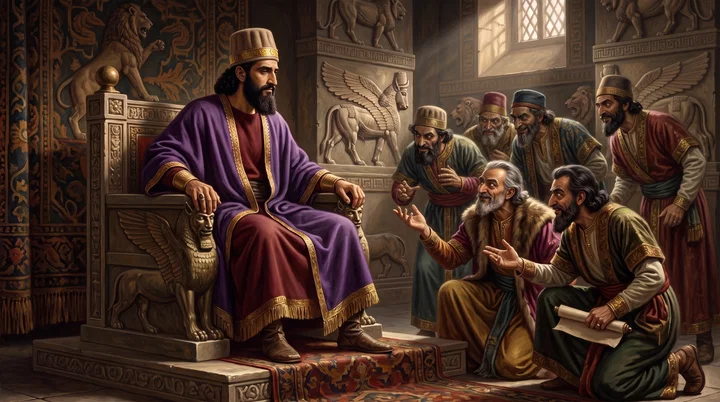
Then they came near, and spake before the king concerning the king’s decree; Hast thou not signed a decree, that every man that shall ask a petition of any God or man within thirty days, save of thee, O king, shall be cast into the den of lions? The king answered and said, The thing is true, according to the law of the Medes and Persians, which altereth not.
Translations
Then they came near, and spoke before the king concerning the king’s decree; Have you not signed a decree, that every man that shall ask a petition of any God or man within thirty days, save of you, O king, shall be cast into the den of lions? The king answered and said, The thing is true, according to the law of the Medes and Persians, which alters not.
King James Version, KJV Cambridge Paragraph Bible
Then they came near, and spake before the king concerning the king’s decree; Hast thou not signed a decree, that every man that shall ask a petition of any God or man within thirty days, save of thee, O king, shall be cast into the den of lions? The king answered and said, The thing is true, according to the law of the Medes and Persians, which altereth not.
Then they came near, and spoke before the king concerning the king's decree; Hast thou not signed a decree, that every man that shall ask a petition of any God or man within thirty days, save of thee, O king, shall be cast into the den of lions? The king answered and said, The thing is true, according to the law of the Medes and Persians, which altereth not.
Then they came near, and spake before the king concerning the king’s interdict; Hast thou not signed an interdict, that every man that shall make petition unto any god or man within thirty days, save unto thee, O king, shall be cast into the den of lions? The king answered and said, The thing is true, according to the law of the Medes and Persians, which altereth not.
Then they came near, and spake before the king concerning the king’s interdict: Hast thou not signed an interdict, that every man that shall make petition unto any god or man within thirty days, save unto thee, O king, shall be cast into the den of lions? The king answered and said, The thing is true, according to the law of the Medes and Persians, which altereth not.
then they have come near, yea, they are saying before the king concerning the king's interdict: 'Hast thou not signed an interdict, that any man who seeketh from any god and man until thirty days, save of thee, O king, is cast into a den of lions?' Answered hath the king, and said, 'The thing [is] certain as a law of Media and Persia, that doth not pass away.'
Then they came near, and spoke before the king concerning the king's decree: Hast thou not signed a decree, that every man that shall ask [anything] of any god or man within thirty days, except of thee, O king, shall be cast into the den of lions? The king answered and said, The thing is true, according to the law of the Medes and Persians, which may not be revoked.
Then drew they near, and began to speak before the king, concerning the royal interdict, Didst thou not sign, an interdict, that, any man who should petition of any God or man, for thirty days, save of thee, O king, should be cast into the den of lions? The king answered and said, Certain is the thing—according to the law of the Medes and Persians, which may not be abolished.
Berean Standard Bible, Majority Standard Bible
So they approached the king and asked about his royal decree: “Did you not sign a decree that for thirty days any man who petitions any god or man except you, O king, will be thrown into the den of lions?”The king replied, “According to the law of the Medes and Persians the order stands, and it cannot be repealed.”
Then they came near, and spoke before the king concerning the king’s decree: “Haven’t you signed a decree that every man who makes a petition to any god or man within thirty days, except to you, O king, shall be cast into the den of lions?”The king answered, “This thing is true, according to the law of the Medes and Persians, which doesn’t alter.”
Then they came near before the king and said, O King, have you not put your name to an order that any man who makes a request to any god or man but you, O King, for thirty days, is to be put into the lions' hole? The king made answer and said, The thing is fixed by the law of the Medes and Persians which may not come to an end.
So they came and, spake vnto the King concerning the Kings decree, Hast thou not sealed the decree, that euery man that shall make a request to any god or man within thirtie dayes, saue to thee, O King, shall be cast into the denne of lyons? The King answered, and sayd, The thing is true, according to the Lawe of the Medes and Persians, which altereth not.
Douay-Rheims (Challoner revision)
And they came and spoke to the king concerning the edict: O king, hast thou not decreed, that every man that should make a request to any of the gods, or men, for thirty days, but to thyself, O king, should be cast into the den of the lions? And the king answered them, saying: The word is true according to the decree of the Medes and Persians, which it is not lawful to violate.
Pictures
Cross-references
- Daniel 6:22
My God hath sent his angel, and hath shut the lions’ mouths, that they have not hurt me: forasmuch as before him innocency was found in me; and also before thee, O king, have I done no hurt.
God sends an angel to preserve Daniel from the lions.
- Acts 5:29
Then Peter and the other apostles answered and said, We ought to obey God rather than men.
It states the rule Daniel illustrates: obey God rather than human authorities when commands conflict.
- Daniel 3:16-18
Shadrach, Meshach, and Abed-nego, answered and said to the king, O Nebuchadnezzar, we are not careful to answer thee in this matter.
The Hebrews refuse a royal decree that conflicts with their duty to God.
- Daniel 6:16
Then the king commanded, and they brought Daniel, and cast him into the den of lions. Now the king spake and said unto Daniel, Thy God whom thou servest continually, he will deliver thee.
Daniel is cast into the lions’ den under the decree, and the king trusts God to deliver him.
- Acts 4:19
But Peter and John answered and said unto them, Whether it be right in the sight of God to hearken unto you more than unto God, judge ye.
God must be obeyed when human commands conflict with his law.
- Daniel 6:26-27
I make a decree, That in every dominion of my kingdom men tremble and fear before the God of Daniel: for he is the living God, and stedfast for ever, and his kingdom that which shall not be destroyed, and his dominion shall be even unto the end.
Darius responds to Daniel’s deliverance by proclaiming God’s power and eternal rule.
- Daniel 3:8-12
Wherefore at that time certain Chaldeans came near, and accused the Jews.
Both accounts show officials accusing faithful worshippers of defying the king’s decree.
- Daniel 6:5
Then said these men, We shall not find any occasion against this Daniel, except we find it against him concerning the law of his God.
Daniel’s enemies devise the decree as a snare through his faithfulness to God’s law.
- Hebrews 11:33
Who through faith subdued kingdoms, wrought righteousness, obtained promises, stopped the mouths of lions,
Faith is linked with stopping the mouths of lions.
- Daniel 6:4
Then the presidents and princes sought to find occasion against Daniel concerning the kingdom; but they could find none occasion nor fault; forasmuch as he was faithful, neither was there any error or fault found in him.
Daniel’s blameless conduct left no other charge, forcing his enemies to trap him by decree.
- Daniel 3:6
And whoso falleth not down and worshippeth shall the same hour be cast into the midst of a burning fiery furnace.
parallel heathen-state persecution of the three Hebrews
- Daniel 6:1-3
It pleased Darius to set over the kingdom an hundred and twenty princes, which should be over the whole kingdom;
Shares the setting leading to the decree.
- Daniel 6:23
Then was the king exceeding glad for him, and commanded that they should take Daniel up out of the den. So Daniel was taken up out of the den, and no manner of hurt was found upon him, because he believed in his God.
Daniel is found unharmed because he believed in God.
- Daniel 6:28
So this Daniel prospered in the reign of Darius, and in the reign of Cyrus the Persian.
Identifies Daniel as prominent under Persian rule.
- Romans 13:5
Wherefore ye must needs be subject, not only for wrath, but also for conscience sake.
Subjection to civil authority is limited by obedience to God’s law.
Commentary
Each commentary is drawn from primary sources: the writings of Ellen G. White and Adventist pioneers and periodicals. Each commentary is separate. Its own words are not a quotation; follow the references to read the source passages.
Ellen G. White
19 sources
The conspirators came before the king to remind him that he had signed a decree forbidding any petition to God or man except the king for thirty days on pain of the lions' den, and he answered that it stood firm by the unchangeable law of the Medes and Persians.ST Apr 18, 1911BS 38.1–2 Envious leaders had devised it because Daniel's blameless faithfulness gave no ground for accusation, so they sought occasion against him concerning the law of his God by stopping his prayers, and the flattered king had consented after setting Daniel first over the reorganized realm for his excellent spirit.PK 539.1PK 539.3PK 539.2Ms 14, 1894, par. 24–25 Though he knew of the decree, Daniel did not hide but kept his established custom of praying three times a day with his windows open toward Jerusalem, refusing to obey a command dishonoring God even at the cost of death.ST Apr 18, 19115T 453.1–4ST Nov 18, 1886 God was with him by angels and delivered him from the lions and vindicated him, proving that earnest prayer is answered and turning his persecution into testimony throughout Babylon that the God he served continually is the true and living God above all earthly power.ST Apr 18, 1911DA 28.3ST Nov 18, 1886Ms 14, 1894, par. 24–25Ms 2b, 1895, par. 25–26 The verse therefore teaches integrity and allegiance to God above earthly power, that God protects in the path of duty while conformity to the world leads to falling, and that Daniel's steadfast stand alone is the pattern for all who will dare to be a Daniel.ST Nov 4, 1886MYP 27.4–28.1Lt 2, 1901, par. 12–14GC 509.16MR 268.1–269.3
Setting and Decree
The verse belongs to the lions' den account after Darius the Median took the throne formerly held by the Babylonian rulers and reorganized the government, setting 120 princes over the kingdom and three presidents over them with Daniel first because an excellent spirit was in him, intending to set him over the whole realm.PK 539.1 Honors bestowed on Daniel stirred the envy of jealous leading men, and because his conduct and management were blameless and faithful with no error or fault to be used against him, they resolved to find occasion against him concerning the law of his God.PK 539.3PK 539.2Ms 14, 1894, par. 24–25 To carry out that resolve they devised a decree to stop his prayers to God by requiring petitions to be offered to the king, to which the flattered king consented.Ms 14, 1894, par. 24–25
The decree forbade every man for thirty days to ask a petition of any God or man save the king, on pain of being cast into the den of lions.ST Apr 18, 1911BS 38.1–2DA 28.3ST Nov 18, 1886 When the officials came near and reminded the king of it, asking whether he had not signed such a decree, the king answered that the thing is true.ST Apr 18, 1911DA 28.3 He confirmed that the decree was binding and valid according to the law of the Medes and Persians, which altereth not and cannot be changed.ST Apr 18, 1911BS 38.1–25T 453.1–4ST Nov 18, 1886 Because the law was unchangeable, Daniel's enemies used it to prevent the king from rescuing him once he was accused.BS 38.1–2
Faithfulness and Witness
Daniel knew the decree had been signed, yet he did not hide or abandon his purpose but continued his established, customary practice of praying to God three times a day with his windows open toward Jerusalem as he had done before.ST Apr 18, 19115T 453.1–4ST Nov 18, 18865T 42.2–43.2Ms 40, 1890, par. 92–94 He refused to obey a human command that dishonored God, choosing death rather than dishonoring God.SLP 297.310MR 90.1–91.2MYP 27.4–28.1 His faithfulness through earlier trials had strengthened him to remain true even with the lions' den before him.5T 42.2–43.2 Prayer and adherence to right principles enabled him to stand firm against pressure and temptation, showing that prayerful trust in God gives strength to resist evil.ST Nov 4, 1886 Firm religious principle in him could withstand even the fear of death.5T 42.2–43.2
God was with Daniel through angels in the den and delivered him out of the power of the lions.ST Apr 18, 1911ST Nov 18, 1886Ms 14, 1894, par. 24–25Ms 40, 1890, par. 92–94 God preserved, honored, and vindicated him for remaining faithful to prayer despite the threat.ST Apr 18, 191110MR 90.1–91.2Ms 2b, 1895, par. 25–26 This proves the value of communion with God and that earnest prayer is answered.ST Apr 18, 1911ST Nov 18, 1886 The decree made his continued worship grounds for persecution and brought him before rulers.DA 28.35T 453.1–4 It drew the rulers' attention to him and gave him opportunity to testify that the God of Heaven alone deserves worship and praise.DA 28.35T 453.1–4
His rescue showed monarchs and their people that the God he served continually is the true and living God.DA 28.35T 453.1–4Ms 2b, 1895, par. 25–26 His steadfastness spread knowledge of the true God throughout Babylon and showed God's supremacy above earthly power.DA 28.35T 453.1–4Ms 2b, 1895, par. 25–26 His refusal to obey a human command that dishonored God demonstrates integrity and allegiance to God above earthly power, and God honored him before people.MYP 27.4–28.1GC 509.1 When trial comes in the path of duty God will protect, whereas choosing association with the servants of Satan and conformity to worldly customs places one under temptation and leads to falling sooner or later, because familiarity with sin makes it appear less repulsive and causes fear of Satan's mastery to cease.MYP 27.4–28.1GC 509.1
Daniel's daring to stand alone and his steadfast witnessing under great pressure is the pattern for all who will dare to be a Daniel.ST Nov 4, 1886Lt 2, 1901, par. 12–146MR 268.1–269.3 That pattern includes refusing pressure to receive and publish literature that unsettles faith in Christianity and sows doubt and unbelief.ST Nov 4, 18866MR 268.1–269.3 For all who will so dare is the blessed experience of being enriched while imparting the riches of heaven's grace to others, of being a channel through which God and ministering angels communicate heavenly treasures, and of reaching the highest stage of mental and moral development by cooperating with Jesus Christ, learning His methods, accepting His Holy Spirit, and laboring together with Him.Lt 2, 1901, par. 12–146MR 268.1–269.3
Sources
Pioneers and periodicals
102 sources
The conspirators come before the king and first get him to affirm in general that he signed an unalterable Medo-Persian decree that for thirty days no petition may be asked of any God or man except the king on pain of the lions' den, so they can then turn his admission against Daniel.ST Apr 9, 1912ST Jul 12, 1899RH May 18, 1869ST Oct 19, 1904 Envious rulers who could find no fault in Daniel except concerning the law of his God flattered Darius into exalting himself as God and misrepresented all the officers as agreeing, while Daniel was never consulted, in order to interrupt his fellowship with God and be rid of him.RH Jan 9, 1900RH Oct 7, 1902ST May 19, 1914 Daniel knew the writing was signed yet calmly set God's service above every other consideration, kneeling openly three times a day toward Jerusalem as always, because when human law conflicts with God's law and the first commandment believers must obey God rather than men.ST Oct 25, 1899RH Oct 7, 1902ST May 21, 1912ST Jun 6, 1916 The decree puts the state in God's place and forbids worship of the true God, showing that civil government leaves its rightful sphere over outward civil acts when it commands in religion and touches conscience, and that such a religious law gains no force by being made law.ST Sep 6, 1899ST Jun 27, 1911ST Nov 19, 1896ST Apr 23, 1912 That test by forbidden worship of the true God will come again in the last days against those who refuse false worship laws, as with Sunday enforcement against Sabbathkeepers, but God vindicates those who do His will at any cost by sending His angel to shut the lions' mouths and deliver His trusting servant.ST Sep 6, 1899ST Feb 26, 1880ST Sep 10, 1885RH Oct 11, 1915ST Sep 5, 1895
Decree Words Confirmed
The officials came near before the king and asked him to confirm his signed decree that for thirty days no one might ask a petition of any God or man except the king himself, on pain of being cast into the den of lions.ST Apr 9, 1912RH May 18, 1869ST Jul 12, 1899RH Jan 9, 1900 The king answered that the thing was true, according to the law of the Medes and Persians, which altereth not, affirming the decree as genuine, valid and binding and unchangeable.ST Apr 9, 1912RH May 18, 1869ST Jul 12, 1899 The incident illustrates laws that interfere with religious conviction and impose penalties for disobedience.RH Jan 9, 1900
The accusers pressed the matter cautiously, first getting the king to affirm the decree in general without naming Daniel, asking whether every man who petitioned any god or man except the king for thirty days should be cast into the den of lions.ST Jul 12, 1899ST Sep 13, 1899ST Mar 11, 1908 Having secured that admission that the thing was true according to the unchangeable law of the Medes and Persians, they then used it to accuse Daniel of disregarding the king.ST Oct 30, 1901ST May 19, 1914ST Mar 11, 1908 Having lain in wait and found Daniel praying and making supplication before his God exactly as expected, they hurried to the king to press the signed law in order to force his punishment and be rid of him.ST Oct 19, 1904ST Sep 13, 1899ST May 19, 1914 The report sprang the trap against Daniel, for the decree had been secured by officials hostile to the Hebrew faith through fraudulent representation that all officers agreed when Daniel the premier had not been consulted at all, and was aimed at Daniel alone under a pretext different from its real purpose.ST Oct 19, 1904ST May 19, 1914
Because Medo-Persian law cannot be changed, the king was trapped by his own law and left powerless to undo the plot or deliver Daniel from the prescribed punishment.RH Jul 3, 1900ST Apr 19, 1910ST Oct 30, 1901 He realized he had been duped into making a law touching service to God, with no remedy remaining once the unalterable law was invoked as the conclusive argument forcing punishment.ST Jan 30, 1912ST Sep 13, 1899 He was sore displeased with himself for allowing himself to be used as a tool for their wicked design, yet Daniel had to be sent to the lions' den.ST Jan 30, 1912ST Apr 19, 1910 Daniel's refusal to secure release through political means left opportunity for Jehovah's name to be made known throughout the realm, and his continued prayer showed God remained supreme and would not give the king precedence in worship.RH Jul 3, 1900
The events belong under Darius the Mede, in whose reign the chapter begins and in which God is revealed as Deliverer, Preserver and Vindicator to the Persian rulers as He had been to the Babylonians.ST Jan 30, 1912ST Jul 16, 1912ST Jan 30, 1912 They stand in the Aramaic portion of Daniel running from 2:4 through the end of chapter 7, which though narrative also has prophetic character giving rulers and nations practical lessons for life.ST Oct 21, 1908 Chronologically they come after the vision of Daniel 8 given in the third and last year of Belshazzar at the beginning of the reign of Darius the Median, and the order shows their relation as the lived illustration of the taking away of the continual service centered in Christ foretold in Daniel 8.RH Nov 25, 1902 Through them God made His truth known through Gentile kings to the new rulers, and Daniel's association helped lead Cyrus to recognize God and proclaim the Jews' return as Babylon fell.ST Jul 16, 1912ST Dec 19, 1892RH Nov 11, 1902
Darius combined strength with weakness, being wise in governing yet yielding to flattery from men seeking favors, to his discomfiture and disgrace.ST Oct 30, 1901
Envious Plot Against Daniel
Envious presidents and princes could find no fault in Daniel except concerning the law of his God, and so they schemed to interrupt his continual fellowship with God through prayer and praise and to trap him over his faith.RH Jan 9, 1900RH Oct 7, 1902RH Sep 3, 1872 The signed decree forbidding for thirty days any petition to any God or man except the king, on pain of being cast into the den of lions, was their device, perverting the king's authority to threaten a faithful servant of God.RH Jan 9, 1900ST Dec 20, 1899 Its unchangeable standing under the law of the Medes and Persians made it a means of persecution, used to entrap a worshiper of the true God under a pretext different from its real purpose.RH Jan 9, 1900ST Jul 13, 1915ST Dec 20, 1899 Daniel would not compromise obedience to God's law even temporarily but disregarded the decree, and his continued regular worship placed God's service above every other consideration.RH Oct 7, 1902ST Dec 20, 1899
By flattery they induced the king to exalt himself as God for thirty days and to issue the decree that he should be so worshiped.ST May 19, 1914 By misrepresentation and fraudulent representation they assured him that all his officers and all the officers of state had agreed to it, whereas Daniel the premier and prime minister had not been consulted at all.ST May 19, 1914 The decree was aimed at Daniel alone, a specimen of cunning to gain religious control of men by legislation, using the civil power to persecute him for obeying the law of God in preference to the law of the land.ST May 19, 1914
Having lain in wait, they assembled and found Daniel praying and making supplication before his God exactly as they expected, kneeling with open windows and giving thanks as he always had.ST Oct 19, 1904RH Dec 3, 1901ST Sep 13, 1899 They then hurried to the king to press the signed thirty-day law, reminding him of his own decree and of its unalterable force in order to force Daniel's punishment and be rid of him.ST Oct 19, 1904RH Dec 3, 1901ST Sep 13, 1899 They used his regular prayers as grounds for accusing him and enforcing the decree by casting him into the lions' den.RH Dec 3, 1901ST Sep 13, 1899
They had counted on his faithfulness, for Daniel at not less than ninety years of age still held amid the pomp of Babylon the principles of faith and temperance he had shown as a youth in refusing to defile himself with the king's food and wine.ST Oct 19, 1904 He knew the writing was signed yet deliberately would not obey the mandate.ST Oct 19, 1904 The principles followed in that early test over food prepared him to endure this still more severe trial at the close of his life, for true temperance rests on the same unswerving principles.ST Oct 19, 1904ST Sep 10, 1894
Daniel's Faithful Prayer Life
Daniel knew the writing was signed, yet he calmly ignored it and deliberately went to his house to kneel three times a day with windows open toward Jerusalem to pray and give thanks exactly as he always had.ST Apr 18, 1911ST Nov 18, 1886ST Oct 25, 1899ST Oct 19, 1904 He counted that prayer so important that rather than compromise the privilege to obey the thirty-day ban on asking a petition of any God or man save the king, on pain of the den of lions, he accepted being cast into the den of lions.ST Apr 18, 1911ST Nov 18, 1886RH Oct 7, 1902ST Oct 19, 1904 He continued his regular worship rather than break fellowship with God, placing God's service above every other consideration.ST Apr 18, 1911ST Nov 18, 1886ST Oct 25, 1899RH Oct 7, 1902
His prayer was private communion with God, continued alone despite the decree, and directed in part toward his people's deliverance from Babylon.RH Jul 3, 1900ST Nov 24, 1887RH Sep 11, 1913 It was prayer toward Zion, and he prayed even from the lions' den where God delivered him.RH Jul 3, 1900ST Nov 24, 1887RH Sep 11, 1913 The only path of safety lay in immediate determination and execution without a moment's hesitation or a hair's breadth of deviation, taking counsel of conscience only and not leaving out one appointed season of prayer.ST Oct 25, 1899 Bringing in expediency and personal advantage and questions about avoiding open disobedience, periling usefulness, or praying only in the heart for a month brings bewildering complexity and leads to succumbing if there is faltering, for it is harder to resume an interrupted habit than to go on without a break, and to cease just this once while the storm lasts gives an inch for the devil to take an ell, since suspended habits of goodness are terribly apt to be choked by being suspended.ST Oct 25, 1899
His established daily practice beforehand — his praying "aforetime" — gave him strength to stand firm and come through the den unharmed, so that readiness for crisis is formed beforehand through a steady life of trust in God.ST Nov 18, 1886ST Nov 4, 1886RH May 31, 1906RH Nov 11, 1873 Prayer and adherence to right principles enabled him to stand firm against pressure and temptation, and prayerful trust in God gives strength to resist evil.ST Nov 4, 1886RH May 31, 1906RH Nov 11, 1873 He knew the power of prayer and dared to pray before his open window in the face of his enemies, fearing neither the king's counselors nor the lions' jaws because he trusted in the living God, giving an example of prevailing prayer surpassed only by the greater example of Christ.ST Nov 18, 1886RH May 31, 1906RH Nov 11, 1873 This proves the value of communion with God and that earnest prayer is answered, for the God whom he served continually delivered him out of the power of the lions.ST Nov 18, 1886ST Nov 4, 1886RH Nov 11, 1873
The episode illustrates integrity, devotion to duty, and steadfastness in holding to true principles despite apparent danger amid shrewd politicians.RH Feb 15, 1912RH Jan 9, 1913 It teaches courage, with Daniel standing as the unmatched example of courage whose simple life story is God's best method for teaching courage.RH Jul 21, 1874RH Feb 15, 1912 His goodness was not merely the result of a favorable environment, for he remained loyal to God despite the threat of death under an adverse decree.RH Jul 21, 1874RH Feb 15, 1912RH Jan 9, 1913 Though his faithfulness made him unpopular in Babylon, his separation from the world did not prevent God from using him, and his faithfulness outlasted the other men of his time.RH Feb 15, 1912RH Jan 9, 1913ST Oct 22, 1896RH Mar 6, 1900 He stood alone for God and trusted God with the consequences, with a strong faith needed to face a severe test and risk being condemned by others, so that his faithfulness made kings tremble before the word of the Lord.RH Feb 15, 1912RH Jan 9, 1913ST Oct 22, 1896RH Mar 6, 1900
Church-State Union Persecutes
The verse displays a union of church and state that bars open worship of the true God for thirty days, setting Darius in the place of God and exacting worshipful allegiance to the king alone on pain of the lions' den.ST Sep 6, 1899ST Jun 27, 1911ST Nov 19, 1896ST Dec 12, 1895 The decree forbids asking any petition of any God or man except the king, exalting the king by law to the throne of Deity, and Daniel's casting to the den for refusal exposes a prophet of God refusing to submit to that power opposed to God.ST Jun 27, 1911ST Nov 19, 1896ST Oct 7, 1913 Medo-Persia stands here as the second head of the beast, the abnormal satanic system of church-and-state government perverted to satanic ends, with heathen religion joined to government in a persecuting decree confirmed by the king as true and unalterable according to the law of the Medes and Persians.ST Jun 27, 1911ST Nov 19, 1896ST Dec 12, 1895 As with the three Hebrews under Babylon, this union of church and state in principle produces persecution, moving at last toward a plan to destroy God's people entirely by one stroke.ST Dec 12, 1895
Worship in this setting means service, obedience to its laws even when those laws are contrary to God's laws. The thirty-day decree is therefore an instance of the beast power always demanding such service, with death for refusal, making refusal to worship the king a capital offense binding under unalterable Medo-Persian law.ST Jun 27, 1911ST Oct 7, 1913 Civil government is ordained only for temporal and outward civil acts to keep men civil, to regulate civil matters alone.ST Apr 23, 1912ST Nov 24, 1898 When it makes religious practice a matter of law, commands in religion, and touches conscience and soul, it oversteps the limit God set for it, leaves its legitimate sphere of temporal authority, intrudes into spiritual affairs belonging wholly between man and God, and invades the relation between God and the individual where God alone reserves authority to Himself.RH Sep 27, 1906RH Feb 1, 1906ST Sep 5, 1895ST Nov 24, 1898
The government had no right to enact that law or to condemn Daniel for refusing it, and its power to enforce the law depended on a right it did not have.RH Sep 27, 1906 The earthly king in disregarding the heavenly King who ordained civil government disregarded his responsibility to Him, and is made to know that the power that ordained his government must be reckoned with in administering it.RH Feb 1, 1906 Politics and religion are two distinct ideas, each with its own sphere, and when politics seeks to interfere with a man's religion and religious convictions the king has left his own realm and has no business there.ST Sep 5, 1895 Refusal of such a command is vindicated as right by God in delivering Daniel from the lions, proving disobedience was not lawlessness, and the required stand remains to obey God rather than men, to be duplicated by true followers in all ages when governments legislate upon religious questions and seek to coerce conscience.ST Sep 5, 1895ST Nov 24, 1898
A religious requirement put into civil law gains no force from being made law and is to receive no respect nor recognition.ST Sep 13, 1899 The plea of regard for law, respect for the law of the land, law and order, and defense of the State and society is used to cover enforcement of religion and to throw upon the dissenter the odium of lawlessness and disrespect for constituted authority.ST Sep 13, 1899 That same work appears in modern efforts to fix Sunday, a religious institution and church affair only, in the law with penalties and then demand obedience, teaching that no religious or ecclesiastical institution or rite has any right to any place in the law and that total separation of religion and the State must hold.ST Sep 13, 1899 The chapter presents another deliverance teaching religious liberty applicable in every age, namely that civil rulers must not control religious worship and that individuals remain responsible to God in matters of faith and conscience.ST Aug 9, 1910ST Aug 9, 1910ST Sep 13, 1899ST Jun 18, 1912
The conspirators press the settled law upon the king as conclusive argument leaving no remedy, exposing that Darius was duped into making a law touching service to God in order that the new rulers of empire be taught the separation of religion and the State.ST Sep 13, 1899ST Sep 13, 1899 The episode belongs to the succession of world powers opposing God's people, showing persecution under Medo-Persian rule and Medo-Persia's persecution of the righteous.ST Sep 8, 1914ST Mar 30, 1915ST Nov 8, 1905 Envious, idolatrous officials carry out religious persecution through a decree of civil authority, with the king's officials treating defiance rooted in religious practice as a civil offense even though the conflict arose from prayer.ST Oct 1, 1896RH Jun 8, 1916RH Oct 22, 1908 The state thus acts as an agent of religious intolerance, restricting prayer, giving the king's authority precedence over worship, and interfering by civil law with religious practice.ST Nov 8, 1905RH Oct 22, 1908
Obey God Rather Than Men
The decree barred petition to any God or man except the king for thirty days on pain of the lions' den, and as confirmed under the unchangeable law of the Medes and Persians it directly conflicted with the law of God and the first commandment.ST May 21, 1912RH Feb 20, 1900ST Oct 3, 1895ST Feb 25, 1889RH Sep 8, 1910 Daniel therefore rejected it and continued his daily practice of prayer and worship of God alone, holding God's law paramount to every contravening authority.ST May 21, 1912ST Jun 6, 1916RH Feb 20, 1900ST Oct 3, 1895RH Sep 8, 1910 To give up that worship would have conceded that rulers could regulate or prohibit service to God, and Daniel could not surrender that right and duty without being untrue to God.ST Jun 6, 1916RH Feb 20, 1900 His refusal was right because obedience to the decree would have meant disobedience to God, and the rulers' punishment did not make his conduct wrong.ST Oct 3, 1895ST Feb 25, 1889 The church may not at man's bidding disobey a plain enactment of heaven, but must obey God rather than men.RH Sep 8, 1910
His violation was a crime under human law but not a sin before God, while obeying the decree by withholding worship from God would have been sin.ST Jan 23, 1912ST Jun 11, 1912ST Jan 20, 1898ST Jun 24, 1897ST Jul 23, 1912 The civil law treated his worship as criminal and barred public worship of any being but the king for thirty days, yet praying to God was not sin though Persia's law made it a crime.ST Jun 11, 1912ST Jan 20, 1898ST Aug 6, 1896 He could avoid the crime only by disobeying God, since the signed decree was legally unalterable.ST Jan 20, 1898ST Jun 24, 1897 Civil law can thus condemn conduct that is good and remains right in God's sight, while sin is departure from God's principles of right.ST Aug 6, 1896ST Jun 24, 1897 The decree placed human authority above God, so keeping it would have been sinful and breaking it was not.ST Jan 23, 1912ST Jul 23, 1912
Christians for conscience' sake ought to obey the law of the land only when it does not conflict with the law of God, and when it does they ought to obey God rather than men even if disobedience disturbs the peace and brings persecution, imprisonment, and death.ST Oct 3, 1895ST Sep 10, 1885ST Mar 19, 1896 Daniel illustrates passively violating such a conflicting civil decree and accepting its penalty, not taking up arms against the authorities.ST Jul 24, 1884ST Mar 19, 1896 He was a faithful servant who left no civil duty unperformed, yet paid no attention to the edict that interfered with duty to God, honoring the king with all respect possible but honoring God more.ST Sep 10, 1885 In forced disregard he has a conscience void of offense toward God and man and is more faithful in service to rulers than time-serving politicians who profess respect for laws of men while despising God's authority.ST Sep 10, 1885 The mistaken earthly law is to be honored by bearing its punishment meekly without resistance, leaving vindication to the Lord, and by seeking its amendment and repeal by constitutional means.RH Sep 8, 1910ST Mar 19, 1896
The standing rule for all time is always to obey civil government unless such obedience involves disobedience to the law of God.ST May 14, 1896ST Jul 17, 1907ST Mar 19, 1896 Civil authority has no jurisdiction over obedience to God in matters of religion and conscience, and subjection to the powers that be is limited to civil things.ST May 14, 1896ST Jul 17, 1907ST May 14, 1896 When rulers command in matters of conscience they usurp authority, and refusal to submit when submission would conflict with duty to God is right.ST May 14, 1896ST Jul 17, 1907 Fidelity to God may therefore require disobeying human laws that oppose God's law, as shown when Daniel and the three Hebrews refused to submit to human laws that opposed God and God honored their faithfulness.RH Aug 13, 1908 Even though the ruler bears the sword unto death as God's minister against evil, obedience to God comes before obedience to men.ST May 14, 1896
Human law does not excuse disobedience to God even when obedience brings danger or suffering, and the same principle applies to keeping the seventh-day Sabbath when human laws favor Sunday.ST Feb 26, 1880ST Sep 10, 1885 God sanctioned Daniel's disobedience to the state law, which gives divine right to oppose coercive Sunday legislation that presumes to tell what day to keep holy and makes it criminal to do secular work on Sunday.ST Sep 10, 1885ST Jan 23, 1901 His violation did no hurt to the king, proving such disobedience is no derogation of civil duty.ST Jan 23, 1901 The civil power punishing a man willing to obey God and refusing an evil law will return when power preserves Sunday, the day of the majority, as the so-called Christian Sabbath by law.ST Sep 5, 1895 Then all who refuse the day set aside by civil power and keep the seventh day as the Sabbath of the Lord will be punished as Daniel was, except instead of being given to the lions they will be sought to be exterminated with the sword.ST Sep 5, 1895
The confirmed decree that under Medo-Persian law could not be changed illustrates an inexorable law whose penalty must stand.RH Aug 27, 1861 By analogy God's just law requires the death of the transgressor and cannot itself justify or save the sinner, showing the need for an atonement.RH Aug 27, 1861 The law of the Medes and Persians bound only while that government remained in force and ceased to bind when it was overthrown, whereas God's law has not been superseded and the fourth commandment therefore remains in force.RH Jan 8, 1861 The majority and the power of the state do not determine religious truth, and right may stand alone before it triumphs.ST Jun 25, 1912 Daniel's life was threatened because he refused to worship Baal and he was thrown into the lions' den, but God sustained him as an example of true religion opposed by false religion.RH Mar 10, 1868
Prophecy for Last Days
Daniel 6:12 records a union of church and state commanding Daniel to refrain for thirty days from openly worshiping the true God on pain of the lions' den.ST Sep 6, 1899 The test here is not by forced worship of a false god but by forbidden worship of the true, and this test with its counterpart will come again to God's people in the last days.ST Sep 6, 1899 God honors and preserves those who stay loyal under it, and through such loyalty the knowledge of the true God was carried throughout the Babylonian and Medo-Persian empires, proving that faithfulness in a little thing of truth can accomplish much.ST Sep 6, 1899
The history in Daniel 1-6 leading up to the fall of ancient Babylon is itself a prophecy of modern Babylon.RH Oct 11, 1915 That history includes the attempt to destroy Daniel himself, which stands for the final attempt to destroy the people of God.RH Oct 11, 1915 The verse shows ancient Babylon persecuting one who would not worship according to her laws, with the king set above God by forbidding prayer to any God or man except himself, and modern Babylon repeats that course against those who refuse her dogmas and worship laws.RH Oct 11, 1915
Daniel's experience under Darius the Median concretely reveals the principle of continual service in the temple of God centered in Jesus Christ.RH Nov 25, 1902 That experience comes chronologically after the vision of Daniel 8, which was given in the third and last year of Belshazzar at the beginning of the reign of Darius the Median, and the order shows their relation.RH Nov 25, 1902 Daniel 8 foretold that a power would rise to take away the continual service, so that for a time the continual service would cease in the temple of God, the Shekinah glory would depart, and the house would be desolate, and Daniel 6 gives the lived illustration of that taking away.RH Nov 25, 1902
The verse shows heathen religion united to the Medo-Persian government in a persecuting decree that forbids asking any petition of any God or man for thirty days except of the king, on pain of being cast into the den of lions, with the king confirming the decree as true and unalterable according to the law of the Medes and Persians.ST Dec 12, 1895 That union of church and state in principle produces persecution, with Daniel persecuted under Medo-Persia as the three Hebrews were persecuted under Babylon, leading at last to a plan to destroy God's people entirely by one stroke.ST Dec 12, 1911ST Dec 12, 1895 Daniel's sentence to the lions was part of a test of whether Babylon's gods or the Creator worshiped by the Hebrews had greater power, illustrating how religious domination served the state's drive for world rule.ST Dec 12, 1911
The verse shows Daniel caught in a testing decree where his enemies appeal to the unalterable law of the Medes and Persians to condemn his prayer to God.RH Nov 26, 1861 God tried Daniel's real character as He tried Abraham, Moses, David, and the three Hebrews, and Daniel was not ashamed to own his faith openly before a scoffing multitude and persecuting kings.RH Nov 26, 1861 That same kind of open test of character must come just before Christ comes quickly, so believers must be tested likewise, even unto blood if former trials have not sufficed.RH Nov 26, 1861
God Vindicates and Delivers
God vindicates His children when they are willing to do His will whatever the consequences, and in this chapter He is revealed as Deliverer, Preserver, and Vindicator of Daniel His faithful servant.ST Jan 30, 1912ST Jul 16, 1912ST Dec 1, 1914 The events begin under the rule of Darius the Mede, and here God is made known as a deliverer to the Persian rulers as He had been to the Babylonians.ST Jan 30, 1912ST Jul 16, 1912 The Medo-Persian decree against petitioning anyone but the king was treated as unchangeable, yet Daniel dared to worship God despite it.ST Dec 1, 1914ST Feb 25, 1889 His refusal was right because obeying the decree would have meant disobeying God, and the rulers' punishment did not make his conduct wrong.ST Feb 25, 1889
The decree required the legal penalty of the lions' den but did not require the lions to kill him.ST Oct 26, 1904 Daniel continued praying to the God of heaven, submitted to the penalty without resistance for daring to obey the first commandment, and God showed approval of his course by sending His angel and delivering His faithful servant.RH Jan 19, 1911ST Nov 11, 1886 Angels shut the lions' mouths when Daniel was cast into their den, and prayer led to his being saved.RH Jan 19, 1911RH Aug 7, 1916ST Nov 11, 1886 While the state enforced a decree that restricted prayer and gave the king's authority precedence over worship, acting as an agent of religious intolerance, Christ delivered Daniel from the lions.ST Nov 8, 1905
Daniel was rescued because he believed in God and trusted Him, standing alone in a heathen land while deadly enemies sought his life.RH Dec 29, 1859RH Jan 10, 1871 The confirmation of the binding, unchangeable decree sets the danger he faced, yet he continued his regular worship and dared to worship despite the threat.ST Dec 1, 1914RH Jan 10, 1871 His faithfulness through earlier trials strengthened him to remain true even with the lions' den before him, illustrating that people should obey God and trust Him to care for them when obedience brings danger or difficulty.RH Jan 10, 1871 His refusal to secure release through political means left him faithful to God and gave opportunity for Jehovah's name to be made known throughout the Median realm.
Through such loyalty the knowledge of the true God was carried throughout the Babylonian and Medo-Persian empires, proving that faithfulness in a little thing of truth can accomplish much.ST Sep 6, 1899 Daniel's association with Cyrus helped lead Cyrus to recognize the true God and issue the proclamation that allowed the Jews to return, as part of God making His truth known through Gentile kings.ST Dec 19, 1892RH Nov 11, 1902 The account shows God's care for His children in persecution and that God is able and willing to deliver those who trust Him, including deliverance from sin.ST Aug 26, 1913RH Aug 15, 1907 God was with Daniel in the lions' den, present to protect and comfort him in imprisonment for obedience, and the same presence is with believers imprisoned for faith, comforting them so that songs and Bible verses speak directly to them; his preservation is an example of the divine power that sustains people who remain faithful under trial.RH Dec 19, 1907ST Sep 10, 1894
The trap that hatred set by securing an unchangeable royal decree put Daniel in the lions' den, yet Daniel lives through it like one raised from death while his haters die, proving how short the triumph of haters and persecutors is. The majority and the power of the state do not determine religious truth, and right may stand alone before it triumphs.ST Jun 25, 1912 Daniel's example shows that a person may have to face danger for doing right, and that God gives strength when the hard trial comes.ST Nov 19, 1894 Duty to God is not decided by convenience or circumstances, for he would have stopped praying if convenience were the rule, but he remained faithful and God delivered him from the lions; though his faithfulness made him unpopular, his separation from the world did not prevent God from using him, and his faithfulness outlasted the other men of his time.ST Feb 3, 1881ST Oct 22, 1896
Sources