Daniel 6:14
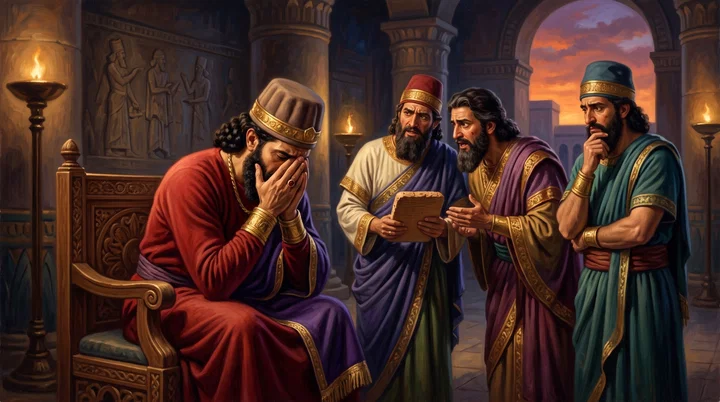
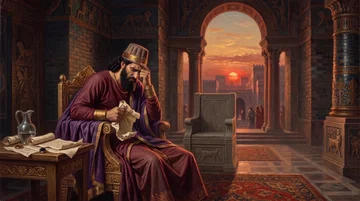
Then the king, when he heard these words, was sore displeased with himself, and set his heart on Daniel to deliver him: and he laboured till the going down of the sun to deliver him.
Translations
Then the king, when he heard these words, was sore displeased with himself, and set his heart on Daniel to deliver him: and he labored till the going down of the sun to deliver him.
King James Version, KJV Cambridge Paragraph Bible
Then the king, when he heard these words, was sore displeased with himself, and set his heart on Daniel to deliver him: and he laboured till the going down of the sun to deliver him.
Then the king, when he heard these words, was much displeased with himself, and set his heart on Daniel to deliver him: and he labored till the setting of the sun to deliver him.
Then the king, when he heard these words, was sore displeased, and set his heart on Daniel to deliver him: and he laboured till the going down of the sun to rescue him.
Then the king, when he heard these words, was sore displeased, and set his heart on Daniel to deliver him; and he labored till the going down of the sun to rescue him.
Then the king, when he hath heard the matter, is greatly displeased at himself, and on Daniel he hath set the heart to deliver him, and till the going up of the sun he was arranging to deliver him.
Then the king, when he heard these words, was sore distressed thereby, and set his heart on Daniel to save him; and he laboured till the going down of the sun to deliver him.
Then, the king, when he heard, the matter, was sorely displeased with himself, and, upon Daniel, set his heart, to deliver him,—and, until the going in of the sun, was striving to rescue him.
Berean Standard Bible, Majority Standard Bible
As soon as the king heard this, he was deeply distressed and set his mind on delivering Daniel, and he labored until sundown to rescue him.
Then the king, when he heard these words, was very displeased, and set his heart on Daniel to deliver him; and he labored until the going down of the sun to rescue him.
When this thing came to the king's ears, it was very evil to him, and his heart was fixed on keeping Daniel safe, and till the going down of the sun he was doing everything in his power to get him free.
When the King heard these wordes, hee was sore displeased with himselfe, and set his heart on Daniel, to deliuer him: and he laboured till the sunne went downe, to deliuer him.
Douay-Rheims (Challoner revision)
Now when the king had heard these words, he was very much grieved, and in behalf of Daniel he set his heart to deliver him and even till sunset he laboured to save him.
Pictures
Cross-references
- Daniel 6:10
Now when Daniel knew that the writing was signed, he went into his house; and his windows being open in his chamber toward Jerusalem, he kneeled upon his knees three times a day, and prayed, and gave thanks before his God, as he did aforetime.
Daniel continued his customary prayers despite the decree.
- Daniel 6:22
My God hath sent his angel, and hath shut the lions’ mouths, that they have not hurt me: forasmuch as before him innocency was found in me; and also before thee, O king, have I done no hurt.
God preserves Daniel from the lions, vindicating his faithfulness.
- Daniel 6:5
Then said these men, We shall not find any occasion against this Daniel, except we find it against him concerning the law of his God.
Daniel’s enemies find no charge except in his worship of God.
- Daniel 6:8
Now, O king, establish the decree, and sign the writing, that it be not changed, according to the law of the Medes and Persians, which altereth not.
The decree is unalterable under the law of the Medes and Persians.
- Daniel 6:3
Then this Daniel was preferred above the presidents and princes, because an excellent spirit was in him; and the king thought to set him over the whole realm.
Daniel’s promotion provoked the plot and explains the king’s effort to deliver him.
- Daniel 3:16-18
Shadrach, Meshach, and Abed-nego, answered and said to the king, O Nebuchadnezzar, we are not careful to answer thee in this matter.
Both accounts show faithful servants refusing the king’s command despite threatened death.
- Daniel 6:7
All the presidents of the kingdom, the governors, and the princes, the counsellors, and the captains, have consulted together to establish a royal statute, and to make a firm decree, that whosoever shall ask a petition of any God or man for thirty days, save of thee, O king, he shall be cast into the den of lions.
The decree banning prayer leads to Daniel’s condemnation.
- Daniel 6:20
And when he came to the den, he cried with a lamentable voice unto Daniel: and the king spake and said to Daniel, O Daniel, servant of the living God, is thy God, whom thou servest continually, able to deliver thee from the lions?
The king anxiously hopes God has delivered Daniel from the lions.
- Hebrews 11:33
Who through faith subdued kingdoms, wrought righteousness, obtained promises, stopped the mouths of lions,
Daniel’s deliverance from the lions is included among acts accomplished through faith.
- Daniel 6:23
Then was the king exceeding glad for him, and commanded that they should take Daniel up out of the den. So Daniel was taken up out of the den, and no manner of hurt was found upon him, because he believed in his God.
Daniel is found unharmed because he believed in God.
- Daniel 6:26-27
I make a decree, That in every dominion of my kingdom men tremble and fear before the God of Daniel: for he is the living God, and stedfast for ever, and his kingdom that which shall not be destroyed, and his dominion shall be even unto the end.
Darius proclaims God's greatness after Daniel is delivered.
- Daniel 6:4
Then the presidents and princes sought to find occasion against Daniel concerning the kingdom; but they could find none occasion nor fault; forasmuch as he was faithful, neither was there any error or fault found in him.
faithful character behind rescue effort
- Daniel 6:18
Then the king went to his palace, and passed the night fasting: neither were instruments of musick brought before him: and his sleep went from him.
The king spends the night praying and fasting.
- Daniel 6:24
And the king commanded, and they brought those men which had accused Daniel, and they cast them into the den of lions, them, their children, and their wives; and the lions had the mastery of them, and brake all their bones in pieces or ever they came at the bottom of the den.
envious accusers judged after Daniel was saved
- Daniel 6:28
So this Daniel prospered in the reign of Darius, and in the reign of Cyrus the Persian.
shows Daniel prominent at Persian court
- Ezekiel 14:14
Though these three men, Noah, Daniel, and Job, were in it, they should deliver but their own souls by their righteousness, saith the Lord GOD.
Names Daniel with Noah and Job as an exemplar.
Commentary
Each commentary is drawn from primary sources: the writings of Ellen G. White and Adventist pioneers and periodicals. Each commentary is separate. Its own words are not a quotation; follow the references to read the source passages.
Ellen G. White
20 sources
When the king understood that jealousy and not loyalty had moved his officers to obtain the ban on prayer, he blamed himself for signing it rashly and worked until sunset to find a way to free Daniel, but the law of the Medes and Persians could not be altered.PK 543.1–2BS 38.1–25T 453.1–4 Daniel had purposed from the first to make God's law his rule and had grown strong by faithfulness in smaller trials, so when the decree left the lions' den open before him he kept his regular prayers openly and would not save himself by praying in secret or bending to human law.ST Apr 18, 1911ST Nov 18, 1886SLP 297.310MR 90.1–91.2 He chose to risk his life rather than dishonor God, showing that danger must not lead God's people to abandon principle or hide their worship.ST Apr 18, 1911ST Nov 18, 188610MR 90.1–91.2 God vindicated His servant who served Him continually, sending angels into the den to deliver Daniel and honoring before men the one who would not obey an earthly command that dishonored God.ST Apr 18, 1911ST Nov 18, 188610MR 90.1–91.2 That deliverance set the true and living God before a heathen ruler and led the king to proclaim His supremacy, and the same unyielding integrity is required now of all who will keep God's commandments and honor before them, daring to stand alone as Daniel stood.DA 28.35T 453.1–410MR 90.1–91.2Ms 2b, 1895, par. 25–26Lt 2, 1901, par. 12–14
Context and King's Remorse
Daniel 6:14 takes place under Darius the Median after he took the throne formerly occupied by the Babylonian rulers and reorganized the government with a hundred and twenty princes under three presidents, with Daniel made first because an excellent spirit was in him and with the king intending to set him over the whole realm.PK 539.1 Daniel's blameless conduct and faithfulness provoked jealousy after the honors bestowed on him, so the leading men sought occasion of complaint against him but could find none because he was faithful and neither error nor fault was found in him except in the law of his God.PK 539.3PK 539.2 Because no fault could be found in his conduct, his enemies arranged a decree aimed against his prayers, and the king consented to it.Ms 14, 1894, par. 24–25
The decree forbade prayer to any god except the king.5T 453.1–4 When the king heard the complaint against Daniel his eyes were at once opened to the snare his enemies had set.PK 543.1–2ST Oct 26, 1882 He saw that jealousy rather than concern for his honor had prompted the decree.PK 543.1–2 He blamed himself for rashly passing it and was sore displeased and deeply troubled with himself over his own role in the injustice.PK 543.1–2BS 38.1–2ST Oct 26, 1882 He labored till the going down of the sun and spent the rest of the day working to devise a plan and find a way by which Daniel might be rescued and delivered.PK 543.1–2BS 38.1–2ST Oct 26, 1882 But his effort could not overcome the law his enemies invoked, for the established law he had rashly made could not be changed or undone.PK 543.1–2BS 38.1–25T 453.1–4
Faithful Prayer and Deliverance
Daniel was a Hebrew captive serving as prime minister under a heathen king, where great obstacles stood against fidelity to God. From the very beginning of his career he had determined that whatever opposed him, the law of God would be his rule of action. By steadfastness amid the lesser daily trials of court life he grew stronger in faith, courage and firmness, so that when the royal decree forbidding supplication to his God went forth, with the den of lions open before him, he was able to stand true to principle and to God.SLP 297.3 Because he had not yielded in the first test over the king's table, he did not yield in this second test over open prayer.10MR 90.1–91.2
He continued his regular daily prayers openly as before, repairing openly to worship though a gaping lion's den stood before him.ST Apr 18, 1911ST Nov 18, 188610MR 90.1–91.25T 42.2–43.2Ms 40, 1890, par. 92–94 He refused to make faith convenient by accommodating to circumstances or to human law coming between him and God, and refused to pray in secret to save himself.10MR 90.1–91.2Ms 40, 1890, par. 92–94 He placed himself to lose his life rather than dishonor the God of heaven.10MR 90.1–91.2 This shows the value of communion with God even when obedience brings danger, and that danger must not make God's people abandon principle or conceal worship.ST Apr 18, 1911Ms 40, 1890, par. 92–94
God delivered from the lions the man who served Him continually.ST Apr 18, 1911ST Nov 18, 1886 His angels were present with Daniel in the den, working for his deliverance and vindicating His servants.10MR 90.1–91.2Ms 14, 1894, par. 24–25 Because of that strict integrity God let His blessing rest on Daniel in remarkable degree and honored him with wisdom and understanding above all.10MR 90.1–91.2 God thus honored before people the one who remained faithful rather than submit to an earthly mandate that dishonored God.10MR 90.1–91.2MYP 27.4–28.1Ms 40, 1890, par. 92–94 Prayer and adherence to right principles enabled him to remain firm, showing that prayerful trust in God gives strength to resist temptation and stand for what is right.ST Nov 4, 1886
Witness and Call to Stand
Daniel's steadfast loyalty, even when obedience to the king would have meant surrendering principle at the risk of death, brought a heathen ruler face to face with the power of God.DA 28.3Ms 2b, 1895, par. 25–26 The king was deeply troubled when the snare was exposed and labored until sunset to rescue Daniel, yet his effort could not undo the decree against prayer to any god except himself.DA 28.35T 453.1–4 The ordeal and deliverance that followed gave opportunity to testify that the God of heaven is the true and living God.5T 453.1–4Ms 2b, 1895, par. 25–26 That testimony helped lead the king to proclaim God's supremacy, and as God vindicated His servants their steadfastness helped spread knowledge of the true God.DA 28.35T 453.1–4Ms 2b, 1895, par. 25–26
As God's representative Daniel kept the living God exalted as the giver of wisdom and power and showed all whence came his strength.10MR 90.1–91.2 He refused to make faith convenient by accommodating to circumstances or to human law coming between him and God, refusing to pray in secret to save himself but repairing openly to worship though a gaping lions' den stood before him, placing himself to lose his life rather than dishonor the God of heaven.10MR 90.1–91.2 Because he had not yielded in the first test over the king's table he did not yield in this second test over open prayer, and because of that strict integrity God let His blessing rest on him in remarkable degree, honored him with wisdom and understanding above all, and worked for his deliverance.10MR 90.1–91.2 The same strict integrity without lowering the standard to meet convenience is required now, for the same test is coming to all who would enter the city of God whether they will keep God's commandments and His honor before them or serve the powers that be, and God will work for them as He did for Daniel.10MR 90.1–91.2
The verse calls all to dare to be a Daniel and dare to stand alone in Jesus Christ, a course open to all.Lt 2, 1901, par. 12–14 Those who follow become vessels and channels through which God imparts grace.Lt 2, 1901, par. 12–14 When the mind is centered not on self but on enriching poverty-stricken souls the treasure of God's love, the golden oil from the two olive trees, is poured into the heart.Lt 2, 1901, par. 12–14 Those who impart heaven's riches are themselves enriched, ministering angels long to communicate heavenly treasures through them, and by cooperating with Jesus Christ they reach the highest stage of mental and moral development.Lt 2, 1901, par. 12–14
Daniel was brought into trial in the king's court while in the way of duty, and sure divine protection belongs to those brought into trial in that way.GC 509.1 That protection belongs to duty, not to self-chosen association with temptation.GC 509.1 Choosing the society of Satan's servants removes fear of their master and ends in falling.GC 509.1
Sources
Pioneers and periodicals
94 sources
When the king learned that Daniel had broken the thirty-day interdict by praying to God, he was deeply grieved and displeased with himself for enacting it, seeing at last that envious conspirators had flattered and tricked him into signing it.ST Jul 12, 1899RH May 18, 1869ST May 19, 1914 He set his heart to rescue Daniel and labored the rest of the day until the going down of the sun to find a way to save him, even trying to have the law changed or set aside.ST Jul 12, 1899RH May 18, 1869ST Jan 30, 1912 All his efforts were of no avail, for the sealed law of the Medes and Persians could not be changed, and regret and friendship could not pardon the offender.ST Jul 12, 1899ST Jan 30, 1912ST Sep 13, 1899 Daniel had done nothing wrong in disobeying, for obeying the decree would have been sin against God, and he could avoid the human charge only by sinning against God.ST Jan 23, 1912ST Jun 11, 1912ST Jan 20, 1898ST Jul 12, 1899 The king's powerlessness to deliver him shows human power trapped by its own bindings and not divine, while God vindicated His loyal servant by sending His angel to shut the lions' mouths.ST Sep 6, 1899ST Jan 30, 1912ST May 21, 1912ST Mar 11, 1908ST Oct 30, 1901
Historical Setting and Background
The verse stands at the beginning of the rule of Darius the Mede, who was placed on the throne after Babylon fell to Media and Persia under Cyrus.ST Jan 30, 1912RH Nov 25, 1902 Darius, meaning coercer, with conservator being a title, was the Median king of that transition. Its setting follows immediately after the vision of Daniel 8 given in the third and last year of Belshazzar, and the experience in Daniel 6 is the concrete revelation of the principles of the continual service seen there, where a power would rise to take away the continual service so that for a time it would cease in the temple of God, the shekinah glory would depart, and the house would be left desolate.RH Nov 25, 1902
In the first year of Cyrus in 536 B.C., at the expiration of the seventy years of captivity, Daniel was a prominent man at the Persian court in God's working for His people in the overthrow of Babylon.ST Dec 19, 1892 Through his association with Cyrus and through what God had done for His people, Cyrus was led to recognize the true God, not perhaps as God alone, but as a great God over all others.ST Dec 19, 1892
Darius was a blending of weakness and strength.RH Jan 9, 1900ST Oct 30, 1901 He showed wisdom in his large division of the empire and sagacity in choosing Daniel, an aged Hebrew captive faithful through all the years of Babylonian court life, as one of the three presidents and then distinguishing him above the others for his excellent spirit to set him over the whole realm.ST Oct 30, 1901 He yielded to the temptation of flattery from favor-seekers and men seeking favors in signing the interdict, to his own discomfiture and disgrace, and his being sore displeased with himself and laboring till the going down of the sun to deliver Daniel is the fruit of that yielding.RH Jan 9, 1900ST Oct 30, 1901
Daniel, meaning judge of God, one who judges in God's name, held high place at the courts of Nebuchadnezzar, Darius, and Cyrus in spite of the plots of malignant rivals.ST Dec 1, 1909RH Dec 3, 1901 He was placed alone over the princes as prime minister and counselor and royal counselor, an exemplar of wisdom and righteousness whose education and wisdom far excelled his fellows both in his school course in the university of Borsippa and in his position as one of the king's counselors.ST Dec 1, 1909RH Dec 3, 1901 Having determined from the very beginning of his career that whatever opposed him he would make the law of God his rule of action, and having grown stronger in faith, courage and firmness by steadfastness amid the lesser daily trials of the court, he was able when the royal decree went forth to stand true to principle and to God.
The decree was a thirty-day law forbidding petition to or public worship of or calling upon anyone but the king, any God or man save the king, demanding worship of the king and exalting him by law to the throne and place of Deity.ST May 19, 1914ST Jan 20, 1898ST Oct 7, 1913ST Nov 11, 1886 It was obtained by falsely claiming all state officers agreed when Daniel the prime minister had not been consulted, and was passed under a pretext different from its real purpose to entrap Daniel, a worshiper of the true God and prime minister of the kingdom.ST May 19, 1914ST Jul 13, 1915 When Daniel was watched and found worshiping and praying to God as usual and this was reported, the king first grasped what the decree really meant.ST May 19, 1914 Daniel disobeyed that human law to obey God; the law counted him a criminal, but his act was not sin, and he could avoid the human charge only by sinning against God.ST Jan 20, 1898 Refusal to give that worship meant death in the lions' den, showing the persecuting character that has always marked such demands and illustrating how the Babylonian system laid the groundwork for persecution.ST Jul 13, 1915ST Oct 7, 1913
Those who held the other position taught that the edict forbidding petition to any God or man for thirty days was not directed specially against Daniel, though Darius embodied the supreme power in himself and constituted the government.RH Oct 21, 1862 On that view it touched Daniel only incidentally in regard to his faith, as a draft law touches Sabbath-keepers, and when the king learned that the law so touched Daniel he was sore displeased with himself for letting the wicked courtiers circumvent him and labored till the going down of the sun to deliver him.RH Oct 21, 1862
King's Remorse and Efforts
When the king heard the report and accusation that Daniel had broken the interdict by praying to God, he was sore displeased with himself, deeply distressed and grieving over the consequences of the law he had enacted.ST Jul 12, 1899ST Jul 12, 1899ST Jan 30, 1912 He at once grasped what the decree really meant, his eyes opened to the snare laid for Daniel.RH May 18, 1869ST May 19, 1914ST Oct 19, 1904 He recognized he had been tricked, duped and circumvented by envious conspirators, had let himself without realizing it become their tool, and had yielded to flattery in passing a foolish decree obtained by falsely claiming all officers agreed when Daniel had not been consulted.RH May 18, 1869ST May 19, 1914ST Oct 19, 1904ST Jan 13, 1898 The weight of the testimony holds that the edict was aimed to entrap Daniel the worshiper of the true God, while those who held the other position taught that it touched him only incidentally in regard to his faith.ST May 19, 1914ST Jan 30, 1912
He set his heart on Daniel to deliver him, determined to rescue him, and labored till the going down of the sun, spending the rest of the day and hours trying to find a way to save him.ST Jul 12, 1899ST Oct 26, 1904 His effort likely included trying to persuade the conspirators to relent, to devise another plan, or to have the law repealed or changed.RH May 18, 1869ST Jan 30, 1912ST Sep 13, 1899 But the conspirators persistently frustrated everything he proposed by the conclusive argument that no decree nor statute which the king establishes may be changed.RH May 18, 1869ST Jan 30, 1912ST Sep 13, 1899 All his efforts were of no avail because he was bound by the unchangeable and sealed law of the Medes and Persians.ST Jul 12, 1899ST Jan 30, 1912ST Oct 19, 1904RH Aug 27, 1861
Regret did not undo the decree, and friendship and sense of justice could not pardon the offender, for the princes insisted the law be enforced.ST Oct 19, 1904RH Aug 6, 1861RH Aug 27, 1861 Unlike Nebuchadnezzar, who became furious when the three Hebrews disobeyed his command to worship the image, Darius recognized his decree was foolish, was displeased with himself rather than with Daniel, and knew Daniel was faithful and had done nothing wrong.ST Jan 30, 1912ST Jul 12, 1899 Though wanting to deliver him, the king ordered Daniel cast into the lions' den, and Daniel submitted without resistance.RH Oct 7, 1902RH Dec 3, 1901 The king's confidence that Daniel's God would deliver him reflected his recognition of Daniel's continual service to God, hoping God would deliver him though the decree's legal penalty was carried out when Daniel was hurried to the fierce hungry lions and thrown into the dark den closed with a great stone.RH Oct 7, 1902RH Dec 3, 1901ST Oct 26, 1904RH Feb 1, 1906
The king's powerlessness to protect Daniel from an unwise decree or to pardon one who had broken the law shows he was not divine and shows how human power can be trapped by its own bindings.ST Mar 11, 1908ST Oct 30, 1901 His own unchangeable law had trapped him, warning that people can make bindings they cannot undo and that each present moment carries eternal possibilities.ST Mar 11, 1908ST Oct 30, 1901
Daniel's Loyalty and Deliverance
Daniel counted praying three times a day with his face toward Jerusalem of such importance that he continued as before, openly before his open window, rather than compromise that privilege, even with the den of lions open before him.ST Apr 18, 1911ST Nov 18, 1886RH Sep 11, 1913RH Nov 11, 1873 Praying toward Zion was forbidden on pain of being cast into the lions' den, yet the decree did not stop his faithful communion with God, and he dared to pray in the face of his enemies, fearing neither the king's counselors nor the lions' jaws because he trusted in the living God.ST Nov 18, 1886RH Sep 11, 1913RH Nov 11, 1873 His faithfulness under the royal decree shows the value of communion with God even when obedience brings danger, and his example points to one greater than Daniel, Christ the pure and sinless Exemplar who spent whole nights alone on the mountainside communing with the Father, proving how much more frail, short-sighted children of the dust need to pray.ST Apr 18, 1911RH Nov 11, 1873 Though compelled to hurry Daniel to the fierce hungry lions and throw him into the dark den closed with a great stone, the king remained good toward him and anguished over him, rising in the morning as soon as it was day to cry whether his God had delivered him.RH Dec 3, 1901
Having determined from the very beginning of his career that whatever opposed him he would make the law of God his rule of action, and having grown stronger in faith, courage and firmness by steadfastness amid the lesser daily trials of the court, he was able when the royal decree went forth forbidding supplication to stand true to principle and to God. His enemies could find no fault in him except in connection with the law of his God, which identifies him as a faithful servant of the living God and as an example of someone who kept God's law.RH Sep 3, 1872 He was a faithful servant of the king who left no duty unperformed, yet when a decree interfered with his duty to God he paid no attention to it.ST Sep 10, 1885 Even in his forced disregard of the edict he honored the king with all the respect possible, but much as he honored the king he honored God more, proving that men who dare to obey God in spite of laws and threats are more faithful in the service of rulers than time-serving politicians who profess respect for human laws while despising God's authority.ST Sep 10, 1885
His disobedience to an evil human law by continuing to pray to God was a crime under that law, but it was not a sin; obeying the decree would have been sin.ST Jan 23, 1912ST Jan 20, 1898ST Aug 6, 1896 His worship of God was treated as a crime under human law, but was not a sin against God's law, so a person can be guilty under civil law without being a sinner in God's sight when the law criminalizes obedience to God.ST Jun 11, 1912ST Aug 6, 1896 He could avoid the human charge only by sinning against God, for the law counted him a criminal though his act was not sin.ST Jan 20, 1898 The king sought to deliver him, while those who sought to punish him were wrong to treat obedience to God as wrongdoing, and the king regretted the decree's effect and tried until sunset to save him though the conduct remained a crime under civil government but not a sin against God.ST Jun 11, 1912ST Jun 24, 1897
The verse belongs to the account of God as Vindicator, who rises to vindicate those willing to do His will whatever the consequences, and as Deliverer to the Persian rulers as He had been to the Babylonians.ST Jan 30, 1912ST Jul 16, 1912ST Aug 26, 1913 It shows God honoring and preserving the loyal, standing by Daniel in his refusal to obey a law forbidding prayer after the king tried to deliver him from liability to the den, and carrying the knowledge of the true God throughout the Babylonian and Medo-Persian empires through loyalty in a little thing.ST Sep 6, 1899ST May 21, 1912 Daniel stood alone among deadly enemies and was cast into the den, trusting God and rescued without harm, which is the lesson of God's care for His children in persecution.RH Dec 29, 1859ST Aug 26, 1913 God delivered him from the lions, locking the lions' mouths and rescuing him from death by sending His angel to close their mouths by His power.RH Dec 3, 1901
Though the decree's legal penalty was carried out when Daniel was cast into the den, it did not require the lions to kill him; the king hoped Daniel's God would deliver him, while Daniel trusted God whether or not he was delivered.ST Oct 26, 1904 Drawn unhurt from the den because God in mercy sent a bright angel to close the lions' mouths by His power, he lived through the death prepared for him as one resurrected from death, proving how short is the triumph of haters and persecutors.RH Dec 3, 1901 The princes who accused him were thrown to the lions and had their bones broken before reaching the floor, while e'en thus the Lord saves His people who delight in His counsel today, the workers of evil shall not always triumph, for He will soon come and no longer delay.RH Dec 3, 1901 God vindicated His aged servant before the rulers of the Medo-Persian dynasty, vindicated the man who served Him continually, and brought the rulers to confusion, showing Daniel was right to refuse a human command conflicting with God's law.ST Nov 18, 1886ST Dec 1, 1914ST Feb 25, 1889 Christ delivered Daniel from the lions, rebuking both the religious system that prompted the persecution and the state for acting as its agent, when Daniel was punished solely for obeying God's law after the king tried to save him.ST Nov 8, 1905
Church State and Conscience
The lions' den story is a lesson in union of church and state, where the servant of God is asked simply to refrain from openly worshiping the true God, in contrast to the earlier test that required outward deference to a false god, and both tests will come to God's people in the last days.ST Sep 6, 1899RH Jun 8, 1916ST Dec 12, 1895 The law was framed under a pretext different from its real purpose, to entrap Daniel as a worshiper of the true God and prime minister of the kingdom, and so the Babylonian system laid the groundwork for persecution.ST Sep 6, 1899ST Jul 13, 1915 It is an instance of persecution caused by uniting heathen religion with the Medo-Persian government, under which united power Daniel was persecuted for daring to pray to the God of heaven as the wicked persecute the righteous.RH Jun 8, 1916ST Dec 12, 1895 Loyalty to truth even in a little thing in this setting carried the knowledge of the true God throughout the empires.ST Sep 6, 1899
Medo-Persia succeeded Babylon as the second head of the beast system of government of Revelation 13:1-2, perverted by Satan to his own ends, the second phase after Babylon in a sevenfold antagonism extending to the time of the end.ST Jun 27, 1911ST Sep 8, 1914 Darius was persuaded to put himself in the place of God and to be exalted by law to the throne of Deity, demanding worship of the king and demanding service and obedience even when contrary to God's laws.ST Jun 27, 1911ST Apr 23, 1912 Daniel was cast into the den because he would not submit to that beast-power, that wicked satanic system of government formed by union of the religious system with the civil power.ST Jun 27, 1911ST Sep 8, 1914 That casting was also an act of the basic principle of domination in worship and religious matters, testing the gods against the Creator whom Daniel worshiped, since world dominion in religion lay at the foundation of spreading state dominion everywhere.ST Dec 12, 1911
Civil powers are ordained of God only to regulate outward civil things like protecting life and property and can never touch conscience and soul, so politics and religion are two distinct ideas each with its own sphere.RH Sep 27, 1906ST Sep 5, 1895 The king had gone out of his proper realm by forbidding prayer to God for thirty days, having no business interfering with religion and religious convictions, and he had no right to enact the religious command or to condemn Daniel for refusing it.RH Sep 27, 1906ST Sep 5, 1895 When civil government tries to govern a person's relationship with God, forbid prayer, compel religious obedience, or punish for following conscience, it exceeds its rightful limits and its religious laws are unjust.RH Sep 27, 1906ST Nov 24, 1898ST May 21, 1912 God's authority over that relationship is supreme, and no earthly ruler can excuse disobedience to God, whose commands require individual obedience.ST Nov 24, 1898ST May 21, 1912
When human statutes are in open conflict with the rights of conscience and the plain laws of God, the law of God is paramount and must be obeyed rather than men, as shown by Daniel and by his three companions refusing the golden image.ST Jul 24, 1884RH Feb 20, 1900ST Oct 3, 1895 Daniel's prayer was not sin though the Persian law made it a crime, for the law counted him a criminal while his act was not sin, and he could avoid the human charge only by sinning against God.ST Jan 20, 1898ST Aug 6, 1896 A person can therefore be guilty under civil law without being a sinner in God's sight when the law criminalizes obedience to God, and Romans 13:1 does not command active obedience to all that pagan governments require.ST Jul 24, 1884ST Aug 6, 1896 In such conflict passive violation is justified when the penalty is meekly suffered, suffering wrong without doing wrong, while violent rebellion and mob violence remain forbidden.ST Jul 24, 1884
Daniel honored even the mistaken earthly law by meekly bearing its penalty and by seeking its amendment and repeal by constitutional means, not resisting the civil power but submitting to consequences and leaving vindication to the Lord.RH Sep 8, 1910ST Mar 19, 1896 He did not use political influence to escape the law, yet when the decree interfered with duty to God he paid no attention to it, leaving no duty to the king unperformed and honoring the king with all possible respect while honoring God more.ST Sep 10, 1885ST Mar 19, 1896 The collision between the law of God and the law of the state when prayer was inhibited shows the law of God paramount to every contravening authority, and the church may not at man's bidding disobey a plain enactment of heaven.RH Sep 8, 1910ST Sep 10, 1885 Men who dare to obey God in spite of laws and threats of kings are more faithful in service of rulers than time-serving politicians who profess respect for human laws while despising God's authority.ST Sep 10, 1885
The persecutors pressed the king to condemn Daniel on the ground that the decree was law and must be enforced, using the force of the enacted law to secure condemnation for worship of God and treating refusal as defiance of the state.ST Oct 1, 1896ST Nov 28, 1895 Their conduct is that of those who promote religious rules through civil law and portray dissenters as lawless while claiming to defend order.ST Oct 1, 1896ST Sep 13, 1899 The same argument is used by advocates of Sunday enforcement who first secure the unjust religious law they want and then demand obedience only because it is law, but a human law forbidding worship of God has no right to exist and must be disobeyed in obedience to God.ST Nov 28, 1895
Daniel's refusal to obey the law commanding worship of no god except the king shows that a Christian for conscience' sake ought to obey the law of the land when it does not conflict with God's law, but when it does must obey God rather than men.ST Oct 3, 1895 That stand condemns yielding to Sunday laws persecuting seventh-day Sabbath-keepers to avoid jail, fines, or disturbing the peace.ST Oct 3, 1895 The king punished Daniel with the lions for refusing a civil law interfering with religion and worship, doing no hurt to the king and no failure of civil duty, and God sanctioned the disobedience by deliverance.ST Sep 5, 1895ST Jan 23, 1901 The same treatment will fall on all who refuse the enforced first day, who will be punished as Daniel was punished except by seeking extermination with the sword, since the Bible teaches the seventh day is the Sabbath of the Lord, commanding rest on that identical day and work in the six days including the first, giving conscientious keepers divine right to oppose state Sunday laws that command first-day observance and criminalize Sunday work.ST Sep 5, 1895ST Jan 23, 1901
The chapter presents Daniel's deliverance as a lesson in religious liberty that applies in every age.ST Aug 9, 1910 The king recognized Daniel's innocence and labored till sunset to deliver him, yet efforts could not overcome the decree, showing Daniel was right while Persia was wrong and religious truth is not made right or wrong by majority or civil power.ST Aug 9, 1910ST Jun 25, 1912 The king's struggle after ordering Daniel to the den for prayer against the decree illustrates that civil rulers are accountable to the King of heaven and must reckon with the divine authority that established civil government.RH Feb 1, 1906
Prophecy and Scriptural Links
The lions' den trial asked the servant of God only to refrain from openly worshiping the true God, in contrast to the earlier trial that demanded outward deference to a false god, and both of those tests will come to God's people in the last days.ST Sep 6, 1899 The attempt to destroy Daniel belongs among the events leading to the fall of ancient Babylon, and it stands as a prophecy of modern Babylon's persecution of those who refuse its doctrines and laws.RH Oct 11, 1915 Daniel's experience under Darius the Median at the beginning of his reign came immediately after the vision of Daniel 8 given in the third and last year of Belshazzar.RH Nov 25, 1902 That experience is the concrete revelation of the principles of the continual service, standing in direct relation to what was seen in Daniel 8, where a power would rise to take away the continual service so that for a time it would cease in the temple of God, the glory would depart, and the house would be left desolate.RH Nov 25, 1902
The verse belongs to fulfilled history rather than to unfulfilled prophecy, for of the twelve chapters of Daniel little remains to be fulfilled until the events during the day of the Lord.RH May 2, 1907 Nearly all that applies to human probation has already become history, leaving only a little prophecy to be fulfilled before Christ comes.RH May 2, 1907 Daniel's stand is the same as the refusal of his three companions to bow to Nebuchadnezzar's golden image.ST Oct 3, 1895 Together with their deliverance, his deliverance shows that God can deliver those who trust in Him, and that He is just as able and willing to deliver people today, including from their sins, when they trust in Him.RH Aug 15, 1907
The king grieved over the consequences of the law he had enacted and labored earnestly until sunset to save Daniel from its penalty, moved by friendship, sense of justice, and regret at being deceived, yet the law and the rule that it could not be altered left him unable to pardon him.RH Aug 6, 1861 The case illustrates the conflict between an inflexible law and a ruler's desire to show mercy, and the need for an arrangement that upholds the law while allowing the offender to be released.RH Aug 6, 1861RH Aug 27, 1861 A just, inexorable law demands the transgressor's penalty, so the law itself cannot justify or save the sinner, and an atonement is needed to uphold the law while fulfilling the ruler's desire to release the offender.RH Aug 27, 1861 A law also remains in force unless a valid authority supersedes it, which applies to God's law, which Christ did not abolish and for which no replacement of the fourth commandment was established.RH Jan 8, 1861
The verse belongs to the proof that Romans 13:1 does not command active obedience to all that pagan governments require or abstinence from all that they forbid.ST Jul 24, 1884 When human statutes are in open conflict with the rights of conscience and the plain laws of God, passive violation is justified when the penalty is meekly suffered, suffering wrong without doing wrong, while taking up arms in violent rebellion and mob violence remain forbidden.ST Jul 24, 1884 A civil power here attempted to exercise authority in matters of conscience where only God is supreme, Daniel refused to obey or submit because submission would conflict with duty to God, and God rebuked the power that commanded it and vindicated Daniel's refusal.ST Jul 17, 1907 Subjection to earthly powers is therefore limited the same as their jurisdiction, namely to civil things, and does not require obedience when rulers usurp authority over conscience.ST Jul 17, 1907
Faithful Example for Believers
Daniel's regular prayer is held up as the pattern of faithfulness in private and family devotion, continued openly as before even when obedience brought danger.ST Apr 18, 1911 That communion with God is shown to give strength to overcome the world, the flesh and the devil, to resist temptation and to stand for what is right.ST Nov 4, 1886ST Nov 11, 1886 Prayer is the key that unlocks heaven's treasure-house, bringing rich blessing on the humble but believing suppliant, and with faith moves nations.ST Nov 11, 1886 His deliverance, when the Lord heard and sent His angel to shut the lions' mouths, is God's answer to that faithfulness.ST Nov 11, 1886
His established habit of prayer gave him strength and power with God to stand unhurt among the lions.RH May 31, 1906 Preparation for crisis must therefore happen beforehand, by making the Lord a daily refuge and strength.RH May 31, 1906 He prayed alone in his chamber, and he continued in earnest supplication even in the den, so that the den itself became a place of private, personal communion where God meets the one who waits on Him and pleads with Him with special blessing.ST Nov 24, 1887ST Nov 24, 1887
His daring to pray before his open window in the face of enemies, fearing neither the king's counselors nor the lions' jaws because he trusted the living God, points to One greater than Daniel.RH Nov 11, 1873 Christ, the pure and sinless Exemplar, spent whole nights alone on the mountainside communing with the Father, proving how much more frail, short-sighted children of dust need to pray.RH Nov 11, 1873 The simple story is God's own best method for teaching courage, with no treatise like it.RH Jul 21, 1874 Doing right may require courage, and strength is needed when such trial comes, and Daniel standing alone among deadly enemies illustrates courage to stand firm for truth despite opposition.ST Nov 19, 1894RH Nov 11, 1873
The verse marks the still severer trial at the close of his public career.ST Sep 10, 1894ST Sep 10, 1894 The noble stand taken at fourteen to twenty years old in refusing the king's meat and wine fitted him to endure this later trial.ST Sep 10, 1894 True temperance calls for the same unswerving principle and temperance at the end as was shown at the beginning.ST Sep 10, 1894 His integrity, devotion to duty, and steadfast adherence to true principles in apparent danger, and his loyalty despite adverse environment, show that true character does not depend on favorable conditions.RH Jan 9, 1913 Kept through trials by God's power, he trusted God with consequences and continued the work he was called to do, remaining faithful and useful with an influence that endured beyond other men of his time.ST Sep 10, 1894ST Oct 22, 1896
His willingness to go into the den rather than abandon faith is an example of strong faith that ventures on God's truth even when it brings testing and public scorn.RH Feb 15, 1912ST Mar 7, 1878 It was a test that tries and reveals true character, the same kind of open trial of faith and patience believers must endure after probation closes, owning faith openly before scoffers and persecutors even at cost of life.RH Nov 26, 1861 His standing alone for God made kings tremble before the word of the Lord.RH Mar 6, 1900 God was with him in imprisonment for obedience, as He is with believers in prison to comfort and sustain them amid hardship, and He is just as able and willing to deliver those who trust Him today, even from sins.RH Aug 15, 1907RH Dec 19, 1907 So the Lord still saves His people who delight in His counsel, drawing them unhurt from death by sending His bright angel to close the lions' mouths by His power, while accusers perish; workers of evil shall not always triumph, for He will soon come without delay.RH Aug 15, 1907RH Dec 3, 1901
His regular prayer was both his right and his duty, and to abandon it would have conceded that rulers can regulate or forbid worship and would have made him untrue to God.ST Jun 6, 1916 He did not use political influence to escape the law, but his faithful stand gave the Median kingdom opportunity to hear of Jehovah. Loyalty to truth in even a little thing carried the knowledge of the true God throughout the Babylonian and Medo-Persian empires, while God honored and preserved the loyal.ST Sep 6, 1899 His continued prayer in defiance of the law made him the model of standing faithfully for principle despite threat of death, keeping integrity while shrewd, designing politicians opposed him.RH Feb 28, 1907ST Jun 20, 1906 His trust in God is thus the example for those who must obey God despite practical difficulties.RH Jan 10, 1871
Sources