Daniel 6:7
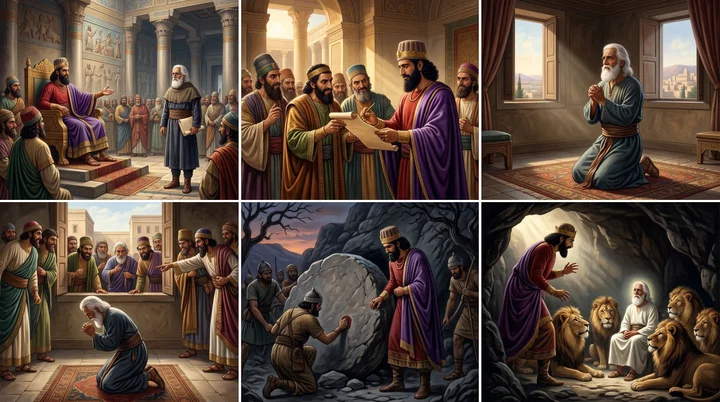
All the presidents of the kingdom, the governors, and the princes, the counsellors, and the captains, have consulted together to establish a royal statute, and to make a firm decree, that whosoever shall ask a petition of any God or man for thirty days, save of thee, O king, he shall be cast into the den of lions.
Translations
All the presidents of the kingdom, the governors, and the princes, the counsellors, and the captains, have consulted together to establish a royal statute, and to make a firm decree, that whoever shall ask a petition of any God or man for thirty days, save of you, O king, he shall be cast into the den of lions.
All the presidents of the kingdom, the governors, and the princes, the counsellors, and the captains, have consulted together to establish a royal statute, and to make a firm decree, that whosoever shall ask a petition of any God or man for thirty days, save of thee, O king, he shall be cast into the den of lions.
All the presidents of the kingdom, the governors, and the princes, the counsellers and the captains, have consulted together to establish a royal statute, and to make a firm decree, that whosoever shall ask a petition of any God or man for thirty days, save of thee, O king, he shall be cast into the den of lions.
All the presidents of the kingdom, the governors, and the princes, the counselors, and the captains, have consulted together to establish a royal statute, and to make a firm decree, that whoever shall ask a petition of any God or man for thirty days, save of thee, O king, he shall be cast into the den of lions.
Revised Version, American Standard Version
All the presidents of the kingdom, the deputies and the satraps, the counsellors and the governors, have consulted together to establish a royal statute, and to make a strong interdict, that whosoever shall ask a petition of any god or man for thirty days, save of thee, O king, he shall be cast into the den of lions.
Taken counsel have all the presidents of the kingdom, the prefects, and the satraps, the counsellors, and the governors, to establish a royal statute, and to strengthen an interdict, that any who seeketh a petition from any god and man until thirty days, save of thee, O king, is cast into a den of lions.
All the presidents of the kingdom, the prefects, and the satraps, the counsellors, and the governors have consulted together to establish a royal statute, and to make a firm decree, that whosoever shall ask a petition of any god or man for thirty days, except of thee, O king, he shall be cast into the den of lions.
All the ministers of the kingdom, the nobles and satraps, the near friends and the pashas, have consulted together, to establish a royal statute, and to confirm an interdict,—That, whosoever shall ask a petition of any God or man, for thirty days, save of thee, O king, shall be cast into the den of lions.
Berean Standard Bible, Majority Standard Bible
All the royal administrators, prefects, satraps, advisers, and governors have agreed that the king should establish an ordinance and enforce a decree that for thirty days anyone who petitions any god or man except you, O king, will be thrown into the den of lions.
All the presidents of the kingdom, the deputies and the local governors, the counselors and the governors, have consulted together to establish a royal statute and to make a strong decree, that whoever asks a petition of any god or man for thirty days, except of you, O king, he shall be cast into the den of lions.
All the chief rulers of the kingdom, the chiefs and the captains, the wise men and the rulers, have made a common decision to put in force a law having the king's authority, and to give a strong order, that whoever makes any request to any god or man but you, O King, for thirty days, is to be put into the lions' hole.
All the rulers of thy kingdome, the officers and gouernours, the counsellers, and dukes haue consulted together to make a decree for the King and to establish a statute, that whosoeuer shall aske a petition of any god or man for thirtie dayes saue of thee, O King, he shalbe cast into the denne of lyons.
Douay-Rheims (Challoner revision)
All the princes of the kingdom, the magistrates, and governors, the senators, and judges have consulted together, that an imperial decree, and an edict be published: That whosoever shall ask any petition of any god, or man, for thirty days, but of thee, O king, shall be cast into the den of lions.
Pictures
Cross-references
- Daniel 6:22
My God hath sent his angel, and hath shut the lions’ mouths, that they have not hurt me: forasmuch as before him innocency was found in me; and also before thee, O king, have I done no hurt.
God sends an angel to protect Daniel and deliver him from the lions.
- Acts 5:29
Then Peter and the other apostles answered and said, We ought to obey God rather than men.
Both show that God must be obeyed when human authorities demand otherwise.
- Acts 4:19
But Peter and John answered and said unto them, Whether it be right in the sight of God to hearken unto you more than unto God, judge ye.
Peter and John put obedience to God above conflicting human commands.
- Daniel 6:3
Then this Daniel was preferred above the presidents and princes, because an excellent spirit was in him; and the king thought to set him over the whole realm.
Daniel’s promotion provoked envy behind the decree.
- Daniel 3:6
And whoso falleth not down and worshippeth shall the same hour be cast into the midst of a burning fiery furnace.
Both decrees threaten death for refusing the ruler’s command in matters of worship.
- Daniel 6:16
Then the king commanded, and they brought Daniel, and cast him into the den of lions. Now the king spake and said unto Daniel, Thy God whom thou servest continually, he will deliver thee.
Daniel is cast into the lions’ den as the decree’s penalty for disobedience.
- Daniel 6:14
Then the king, when he heard these words, was sore displeased with himself, and set his heart on Daniel to deliver him: and he laboured till the going down of the sun to deliver him.
Darius learns the decree’s effect on Daniel and tries to save him.
- Hebrews 11:33
Who through faith subdued kingdoms, wrought righteousness, obtained promises, stopped the mouths of lions,
Faith stopped the mouths of lions.
- Daniel 3:18
But if not, be it known unto thee, O king, that we will not serve thy gods, nor worship the golden image which thou hast set up.
The Hebrews refuse a royal decree requiring disobedience to God.
- Exodus 20:3
Thou shalt have no other gods before me.
The decree forbids worship of the true God, contrary to the first commandment.
- Daniel 6:15
Then these men assembled unto the king, and said unto the king, Know, O king, that the law of the Medes and Persians is, That no decree nor statute which the king establisheth may be changed.
The king is told the decree cannot be changed to save Daniel.
- Daniel 6:20
And when he came to the den, he cried with a lamentable voice unto Daniel: and the king spake and said to Daniel, O Daniel, servant of the living God, is thy God, whom thou servest continually, able to deliver thee from the lions?
The king asks whether God can deliver Daniel from the lions.
- Daniel 6:24
And the king commanded, and they brought those men which had accused Daniel, and they cast them into the den of lions, them, their children, and their wives; and the lions had the mastery of them, and brake all their bones in pieces or ever they came at the bottom of the den.
The decree’s accusers suffered its penalty themselves.
- Daniel 6:23
Then was the king exceeding glad for him, and commanded that they should take Daniel up out of the den. So Daniel was taken up out of the den, and no manner of hurt was found upon him, because he believed in his God.
Daniel was unharmed in the lions’ den because he believed in God.
- Esther 1:19
If it please the king, let there go a royal commandment from him, and let it be written among the laws of the Persians and the Medes, that it be not altered, That Vashti come no more before king Ahasuerus; and let the king give her royal estate unto another that is better than she.
A royal decree is described as unchangeable under Persian custom.
- Daniel 6:11
Then these men assembled, and found Daniel praying and making supplication before his God.
Daniel’s enemies catch him praying despite the decree.
- Esther 8:8
Write ye also for the Jews, as it liketh you, in the king’s name, and seal it with the king’s ring: for the writing which is written in the king’s name, and sealed with the king’s ring, may no man reverse.
The king’s written decree cannot be revoked.
- Daniel 3:28
Then Nebuchadnezzar spake, and said, Blessed be the God of Shadrach, Meshach, and Abed-nego, who hath sent his angel, and delivered his servants that trusted in him, and have changed the king’s word, and yielded their bodies, that they might not serve nor worship any god, except their own God.
Both texts concern a decree restricting worship, and deliverance from its consequences.
- Daniel 9:3
And I set my face unto the Lord God, to seek by prayer and supplications, with fasting, and sackcloth, and ashes:
Daniel remained faithful in prayer despite the ban.
- Romans 13:1
Let every soul be subject unto the higher powers. For there is no power but of God: the powers that be are ordained of God.
Earthly rulers hold authority, yet God remains the higher power.
Commentary
Each commentary is drawn from primary sources: the writings of Ellen G. White and Adventist pioneers and periodicals. Each commentary is separate. Its own words are not a quotation; follow the references to read the source passages.
Ellen G. White
17 sources
The decree records a false unanimous counsel, in which jealous officials who had secretly prepared it came tumultuously to claim all had agreed to forbid any petition to any God or man except the king for thirty days on pain of the lions' den, and by flattery secured the king's signature making it an unalterable law of the Medes and Persians.ST Apr 11, 1911ST Aug 14, 1884ST Nov 4, 1886ST Oct 26, 1882 It arose after Darius set one hundred twenty princes over the kingdom with three presidents over them and Daniel first, and because an excellent spirit was in him purposed to set him over the whole realm.PK 539.1 His enemies could find no error or fault in him, so they determined to make his faithfulness concerning the law of his God the ground of his destruction, stirred by Satan and evil angels who feared his influence and worked through men jealous of the favor he had found.ST Apr 11, 1911PK 539.3PK 539.2ST Oct 26, 18822MR 319.5 The king did not suspect their hatred or discern that the statute was meant to trap Daniel, but yielding to vanity and flattery that it would honor him and add to his authority, he granted it to the triumph of its makers.ST Apr 11, 1911ST Nov 4, 1886ST Oct 26, 1882 Daniel knew it aimed at his ruin yet refused to be deterred, continuing openly three times a day to pray to the God of heaven with his windows open, for which he was cast in but was protected and delivered by angels, proving that no earthly power has right to come between a person and God and showing that the God he worshiped is the true and living God whose law brings wrath when trampled.ST Aug 14, 1884ST Apr 18, 1911ST Oct 26, 18825T 453.1–4BS 37.2
The Plot Against Daniel
Darius the Median had just taken the throne formerly occupied by the Babylonian rulers and at once reorganized the government, setting 120 princes over the kingdom and three presidents over them with Daniel first, so that the princes would give accounts to them and the king would suffer no loss or damage.PK 539.1 Because an excellent spirit was in Daniel he was preferred above all the presidents and princes, and the king intended to set him over the whole realm.PK 539.1 His conduct in office was blameless and faithful, with no error or fault found in him upon close watching.ST Apr 11, 1911PK 539.3PK 539.2 His jealous enemies were therefore forced to acknowledge they could find no occasion for complaint against him except concerning the law of his God, and they determined to make his faithfulness the ground of his destruction.PK 539.3PK 539.2ST Oct 26, 1882Ms 14, 1894, par. 24–25
Behind the human plot was a deeper enmity, for Satan sought to make Daniel's faithfulness to God the cause of his ruin, and evil angels fearing his influence over the king and the kingdom stirred the presidents and princes to envy.ST Apr 11, 1911 The work was carried on through the very Babylonian wise men whose lives Daniel had earlier pleaded to spare, who moved in secret and underhanded counsel because Daniel found favor with kings and nobles and was honored as the greatest man.ST Apr 11, 19112MR 319.5 Jealous over the honors bestowed on him, they devised a murderous scheme to put an end to his life by securing a royal statute aimed at his worship.PK 539.2ST Oct 26, 18822MR 319.5
The presidents, princes, counsellors and other leading men counseled together to accomplish his destruction, prepared the decree themselves, and then came tumultuously to the palace with the false united claim that all had consulted together.ST Apr 11, 1911PK 540.1–2ST Nov 4, 1889 By flattery they persuaded the king that it would greatly honor him and add to his honor and authority to establish the statute, appealing to his pride and vanity.ST Apr 11, 1911ST Oct 26, 1882PK 540.1–2BS 37.1ST Nov 4, 1889 Darius was ignorant of their subtle purpose and hatred toward Daniel, did not discern their animosity revealed in the decree, and did not suspect or understand that it was meant as a snare to injure Daniel and trap God's servant.ST Nov 4, 1886ST Oct 26, 1882PK 540.1–2BS 37.1ST Nov 4, 1889 Yielding to their flattery and with his pride flattered, he granted their request and signed the decree prepared and presented for his signature, making it one of the unalterable laws of the Medes and Persians.ST Apr 11, 1911ST Nov 4, 1886PK 540.1–2 Its makers rejoiced over the snare laid, with Satanic triumph at the success of their plot.ST Oct 26, 1882BS 37.1
The statute they secured forbids anyone in the whole realm for thirty days to ask a petition of any God or man save the king alone.ST Apr 11, 1911ST Aug 14, 1884ST Nov 4, 1886ST Apr 18, 1911ST Oct 26, 1882 It barred prayer to any god or person other than Darius, so that Daniel's continued prayers to the God of heaven would expose him to accusation as a crime against the realm.ST Nov 4, 18865T 453.1–4Ms 14, 1894, par. 24–25 Violation was to be punished by casting the offender into the den of lions.ST Apr 11, 1911ST Aug 14, 1884ST Nov 4, 1886ST Apr 18, 1911ST Oct 26, 1882 The decree went forth as law throughout the kingdom, and Daniel knew its purpose was his ruin.ST Oct 26, 1882
Faithful Witness and Deliverance
Daniel knew the decree was aimed at his ruin, yet he refused to let it deter him and continued his established practice of praying to the God of heaven aloud three times a day with his windows open.ST Aug 14, 1884ST Apr 18, 1911ST Oct 26, 1882BS 37.2 He kept close in prayer and communion with the King of kings rather than confining himself to the king's business, maintaining his customary regular prayers despite knowing of the decree.ST Apr 18, 19115T 453.1–4Ms 14, 1894, par. 24–25Ms 129, 1908, par. 12–15 For this steadfast continuance he was thrown into the lions' den.ST Aug 14, 1884ST Apr 18, 1911Ms 14, 1894, par. 24–25 But God sent angels to protect him there and delivered him from the lions.ST Aug 14, 1884ST Apr 18, 19115T 453.1–4Ms 14, 1894, par. 24–25 His address to God was kept in the Lord's keeping even before he was cast into the den.Ms 129, 1908, par. 12–15
His refusal proves that no earthly power has the right to come between a person and God and dictate to whom prayer or worship may be offered.ST Oct 26, 1882BS 37.2 His continued prayer brought his case to the rulers' attention and gave occasion to testify that God alone should be worshiped.5T 453.1–4 His deliverance from the lions showed that the God he worshiped is the true and living God.5T 453.1–4 A decree that so tramples God's law brings divine wrath upon the realm because His law is disregarded.PK 501.3
Sources
Pioneers and periodicals
98 sources
The officials proposed a royal statute forbidding any petition to any god or man except the king for thirty days, on pain of being cast into the den of lions.ST Jan 30, 1912RH Jan 9, 1900RH Jan 9, 1900 Envious presidents, princes and other officials sought occasion against Daniel concerning the law of his God because he was faithful with no error and was to be set over the whole realm, falsely claiming that all had consulted together and flattering the king into signing unalterable law.ST Apr 11, 1911RH May 18, 1869RH Jun 26, 1900ST Oct 19, 1904 The trap was laid to stop his customary prayer to the God of heaven and destroy him, though those who held the other position taught that the edict touched his faith only incidentally.ST Jan 30, 1912RH May 18, 1869RH Oct 21, 1862RH Oct 21, 1862 Though he knew the writing was signed, he continued as aforetime to kneel three times a day with windows open toward Jerusalem, praying and giving thanks, refusing to compromise, hide, or yield even once, and meekly submitting to the penalty.ST Oct 25, 1899ST Mar 12, 1896ST Dec 20, 1899ST Sep 13, 1899 When human law commands what is contrary to God's law, faithfulness to God takes precedence and disobedience is duty, for civil government is limited to temporal affairs between man and man and oversteps when it commands worship and conscience that lie wholly between man and God.ST Jun 11, 1912RH May 12, 1868RH Feb 1, 1906RH Sep 27, 1906 God approved his course by sending His angel to shut the lions' mouths and preserve him alive because he trusted in Him, a deliverance that illustrates the coming prohibition against keeping the Sabbath when worship will again be enforced by law.ST Jan 23, 1901ST Dec 5, 1895RH Aug 15, 1907RH Feb 9, 1860
Decree Terms and Penalty
The decree forbade asking a petition of any god or person except the king for thirty days, on pain of being cast into the den of lions.ST Jan 30, 1912RH Jan 9, 1900RH Jan 9, 1900RH Jun 8, 1916 It was engineered by the other rulers as an envious political scheme to overthrow Daniel, interfering with religious conviction and imposing punishment for disobedience.RH Jan 9, 1900RH Jan 9, 1900 It barred Daniel from praying to the true God, so he rejected it and continued his daily practice, and it was religious and persecuting because it barred worship of the true God in direct violation of the first commandment.ST May 21, 1912RH Jun 8, 1916 The officials used the decree to target Daniel because of his faithfulness to God, and the king signed it as an unchangeable law, turning royal authority toward attacking that faithfulness.ST Jan 30, 1912 His fidelity under an intolerant government decree upheld the individual right to follow religious conviction.ST May 21, 1912
The proposal was for a royal statute made firm by the king's signed writing, becoming unalterable law of the Medes and Persians.ST Apr 11, 1911RH Jun 26, 1900ST Oct 19, 1904RH May 23, 1854RH Dec 3, 1901 Darius intended to set Daniel over the whole realm because Daniel's faithful, unselfish service rendered as to God contrasted with the merely selfish policy of the other leaders, and the unfaithful presidents and princes, unwilling that character should give one the place of leadership, sought occasion against him concerning the kingdom and found none, for he was faithful with neither error nor fault found in him.ST Apr 11, 1911RH Jun 26, 1900 They therefore determined to find occasion against him concerning the law of his God, driven by envy and jealousy because Darius had set Daniel the Hebrew captive of Judah over them, and having watched him closely they came tumultuously with the false united claim that all the presidents, governors, princes, counselors and captains had consulted together.ST Apr 11, 1911RH Jun 26, 1900RH Dec 3, 1901 The request was flattery in the highest degree, setting the king above all gods, the same supreme distinction Nebuchadnezzar had sought as king of Babylon when he set up the image of gold for universal worship, and the king's pride was flattered so that the ignorant, unwitting, aged king, caught by his counselors and not knowing the mischief purposed against Daniel, granted their request and signed the writing and the decree.ST Apr 11, 1911ST Oct 19, 1904 Once sealed it could not be changed while in force under the law of the Medes and Persians that altereth not, though it would expire after thirty days.ST Oct 19, 1904RH Dec 3, 1901ST Dec 20, 1899 It was designed as a double trap aimed primarily at Daniel to stop his customary prayer to God three times every day with his face toward Jerusalem, and secondarily at inveigling the king into becoming a party to it.ST Oct 19, 1904RH Dec 3, 1901ST Dec 20, 1899
The decree exalted the king to the place of God by commanding that prayer and petitions be directed to the king alone for thirty days.ST Jan 23, 1901ST Jun 27, 1911ST Apr 23, 1912ST Nov 19, 1896 It stood directly against the law of God, Thou shalt have no other gods before Me, illustrating the limit of human authority, which must not take the place of God or rule over conscience.ST Jan 23, 1901ST Apr 23, 1912 Medo-Persia as the second head of the beast was perverted by Satan to his own ends, persuading Darius to put himself in God's place and demanding worship with the king exalted by law to the throne of Deity.ST Jun 27, 1911ST Nov 19, 1896ST Oct 7, 1913 In that system the beast power demands service and obedience to its laws even when those laws are contrary to God's laws, claiming the worship due to God alone, with refusal punished by death in the lions' den, as it has always demanded.ST Jun 27, 1911ST Oct 7, 1913 Daniel would not submit to that satanic government in place of God but decided to obey the law of God rather than the law of the land, and was cast into the den of lions for it.ST Jan 23, 1901ST Jun 27, 1911ST Nov 19, 1896
Plot Against Daniel
Darius meant to set Daniel over the whole realm because Daniel was faithful with no error or fault found in him, his unselfish service rendered as to God contrasting with the merely selfish policy of the other leaders, and the presidents, princes and other officials, fearing his influence and unwilling that character should give one the place of a leader, were stirred to envy.ST Apr 11, 1911RH Jun 26, 1900ST Oct 19, 1904RH May 3, 1870ST Mar 30, 1915 Having watched him closely and found no occasion against him concerning the kingdom or his official administration, they determined to find occasion against him concerning the law of his God, seeking to make his faithfulness to God the cause of his destruction.ST Apr 11, 1911RH Jun 26, 1900ST Oct 19, 1904RH Sep 3, 1872 The scheme to forbid petition to any god or man except the king for thirty days on pain of the lions' den was flattery in the highest degree, setting the king above all gods with the same supreme distinction once sought in Babylon by the setting up of the image of gold for universal worship.ST Apr 11, 1911RH Jun 26, 1900ST Oct 19, 1904
They came tumultuously to the king with the false united claim that all the presidents, governors, princes, counselors and captains had consulted together to establish a royal statute and firm, unchangeable decree, when Daniel had not been consulted and had been deliberately excluded.ST Apr 11, 1911RH May 18, 1869RH Jun 26, 1900 By exalting the king to be worshiped as God and by pretending loyalty while concealing their real aim, they flattered his pride and vanity and misrepresented the agreement of his officers.RH May 18, 1869ST Jul 12, 1899ST Oct 30, 1901 The ignorant, unwitting, aged king, caught by the flattery of his counselors and not understanding the mischief purposed against Daniel, granted their request and signed the writing, making it unchangeable according to the law of the Medes and Persians.ST Apr 11, 1911ST Oct 19, 1904ST Jul 12, 1899ST Oct 30, 1901ST Oct 30, 1901
The decree turned the king's authority toward attacking Daniel's faithfulness to God, presented as a measure to honor the king but using a deceptive pretext to establish persecution.ST Jan 30, 1912RH Aug 6, 1861ST Jul 13, 1915 Its concealed aim was to prevent Daniel from praying to the God of the Hebrews, to stop his customary prayer and thereby destroy him, with Daniel becoming its first offender.ST Jan 30, 1912RH May 18, 1869RH Aug 6, 1861ST Jul 13, 1915 It was a double trap, aimed primarily at Daniel and secondarily at inveigling the unwitting king into becoming a party to it.RH Jun 26, 1900ST Oct 19, 1904
Those who held a different position taught that the edict was not aimed specially at Daniel but touched his faith only incidentally, the king embodying the government having been circumvented by wicked courtiers and being sore displeased with himself when he learned the law condemned Daniel, laboring till sundown to deliver him.RH Oct 21, 1862 In that teaching the case stands in widest contrast with a direct religious persecution and with laws that secure worship, as with a military draft to put down rebellion and uphold a government that secures the right to worship, giving a parallel for Sabbath-keepers touched incidentally by a draft law.RH Oct 21, 1862RH Oct 21, 1862RH Oct 14, 1862 Against this, others taught that the decree was aimed personally at Daniel in direct opposition to the law of his God, introduced to Darius and signed by him in ignorance of its real design, a direct requirement to cease the worship of the true God done with design for religious persecution where civil magistrates must not be obeyed.RH Oct 21, 1862RH Oct 14, 1862
Daniel's Faithful Response
Though he knew the writing was signed and had become unalterable law, Daniel continued just as aforetime to kneel three times a day with his windows open toward Jerusalem, praying and giving thanks to the God of heaven.ST Aug 14, 1884ST Oct 25, 1899ST Dec 20, 1899ST Sep 13, 1899 The decree forbade petition of any God or man except the king for thirty days on pain of the den of lions, and was designed to stop that customary prayer or to trap him in it.ST Mar 12, 1896ST Dec 20, 1899 He calmly ignored the ban without turning a hair's breadth from his usual practice and without hesitating what to do, refusing to let it deter him.ST Aug 14, 1884ST Oct 25, 1899ST Sep 13, 1899 He was found guilty of opposition to the powers that be and was cast into the den, and God miraculously delivered him from harm because he trusted in Him.ST Aug 14, 1884ST Mar 12, 1896 His course proves that rulers must not be obeyed when they command transgression of the Creator's law.ST Mar 12, 1896ST Sep 13, 1899
He would not compromise, omit even one appointed season, change his usual manner, hide, close his window, lower his voice, pray only secretly or in the heart, use political influence to escape, or yield just this once while the storm lasted.ST Oct 25, 1899ST Dec 20, 1899ST Sep 13, 1899ST Nov 24, 1898 To plead avoiding open disobedience, protecting usefulness, or praying only in the heart for a month would have been faltering and succumbing, and to have varied his custom in deference to the decree would have shown lack of real principle and integrity.ST Oct 25, 1899ST Nov 24, 1898 Safety lay in immediate determination and action without omitting even one appointed season, because an interrupted habit is harder to resume than to continue unbroken.ST Oct 25, 1899ST Sep 13, 1899 Yielding just this once lets the adversary take an ell when given an inch, and suspending habits of goodness chokes them by suspending them.ST Oct 25, 1899 The road is plain when conscience alone is consulted, while considerations of expediency and personal advantage bring bewildering complexity.ST Oct 25, 1899
He openly honored God, refused to throw responsibility on the government, and meekly submitted to the penalty without resistance, accepting the den rather than betray God.ST Mar 12, 1896ST Jun 24, 1913ST Oct 26, 1904 His refusal was loyalty to God, not treason against the state nor anarchy, and he stands as a noble example for all Christians.ST Mar 12, 1896ST Sep 5, 1895ST Jun 24, 1913 He honored civil law as premier of the empire and refused only this religious mandate, for the king had gone out of his proper realm and had no business to interfere with religion and religious conviction.ST Sep 5, 1895 Politics and religion are two distinct ideas each with its own sphere, and allegiance to God and patriotism are not synonymous, so disobedience was right and God vindicated it by delivering him from the lions.ST Sep 5, 1895
His steadfast, principled integrity at the close of life was prepared by earlier faithfulness, including the stand he took for temperance when he was young.ST Sep 10, 1894ST Sep 10, 1894ST Apr 14, 1909 That earlier victory over temptation strengthened him to endure this more severe trial, for faithfulness to God is developed and proved amid opposition rather than by removing every opportunity for disobedience.ST Sep 10, 1894ST Apr 14, 1909ST Jun 20, 1906 He held to true principles and to duty even when doing so brought apparent danger among shrewd, designing politicians, showing the kind of faith required to act despite danger and the risk of being judged foolish or mad.ST Mar 7, 1878ST Jun 20, 1906
Divine Deliverance and Vindication
God showed His approval of Daniel's course by sending His angel to stand by him in the den and shut the lions' mouths, preserving him alive and unhurt so that Darius found him alive in the morning and drew him from the den because he trusted in Him.ST Jan 23, 1901RH Aug 15, 1907ST Mar 12, 1896RH Dec 3, 1901 That deliverance was miraculous, for Daniel had been found guilty of opposition to the powers that be and cast to fierce hungry lions in a dark cavern closed with a great stone, yet no harm came to him.RH Aug 15, 1907RH Aug 7, 1916RH Mar 30, 1916ST Mar 12, 1896RH Dec 3, 1901 Angels shut the lions' mouths when he was cast into their den, and his preservation applies to believers as proof that God is still able and willing to deliver those who trust in Him, even to deliver from sin.RH Aug 15, 1907RH Aug 7, 1916RH Mar 30, 1916
The lords and princes who accused him were then themselves thrown to the lions, who overmastered them and broke their bones before they reached the floor.RH Dec 3, 1901 Daniel came alive out of the den as one resurrected from death, while his haters themselves died, so the triumph of hatred was very short and workers of evil shall not always triumph.RH Dec 3, 1901
The chapter belongs at the beginning of the rule of Darius the Mede, immediately after the preceding chapter, and in it God reveals Himself as Vindicator, Deliverer and Preserver to Persian rulers as He had earlier to Babylonian rulers, in the great practical affairs of life pertaining to a people and a nation.ST Jan 30, 1912ST Jul 16, 1912ST Dec 19, 1892 It is a revelation showing personal responsibility to Him, with adherence to these principles making a people great, a nation strong, and rulers wise.ST Jan 30, 1912 It shows His care for His children in persecution and presents another deliverance teaching a lesson about religious liberty applicable in every age.ST Aug 9, 1910ST Aug 26, 1913 It shows God as the Vindicator of the good and just who vindicated Daniel when he dared to worship God despite the unchangeable decree, and it shows how God worked for His people through Daniel and the overthrow of Babylon, with Daniel's association with Cyrus helping lead the king to recognize the true God as great above other gods.ST Dec 1, 1914ST Dec 19, 1892
God vindicated Daniel in his disobedience and put the rulers to confusion, proving Daniel was right and a follower of God.ST Jan 23, 1901ST Sep 5, 1895ST Feb 16, 1882 His regular devotion and spiritual nourishment strengthened him to do God's will, and God approved and blessed him for it.RH Sep 26, 1907 He still saves today the souls who delight in His counsel and will deliver them without delay.RH Dec 3, 1901
Duty to Obey God
A human decree that forbids what God requires is not to be obeyed, for when human law commands what is contrary to God's law faithfulness to God takes precedence and disobedience to the human law is duty.ST Jun 11, 1912RH May 12, 1868RH Feb 9, 1860 The thirty-day bar on petitioning any god or person except the king placed obedience to God in direct conflict with obedience to human rulers, and to have obeyed it by ceasing worship would have been sin.RH May 12, 1868ST Oct 3, 1895RH Feb 9, 1860 Daniel continued praying to God as usual despite the decree and was delivered, showing that God's children are not required to obey civil powers when those powers act contrary to God's will but must obey God rather than men.ST Jun 11, 1912ST Oct 3, 1895RH Feb 9, 1860 The same principle applies to those threatened with death for refusing to obey the image of the beast.RH Feb 9, 1860
The decree set the law of the land against the law of God by commanding prayer to the king alone and barring worship of the true God.RH Jun 8, 1916ST Jan 23, 1901 It stood directly against the commandment, Thou shalt have no other gods before me, exalting the king to be worshiped as God.RH Jun 8, 1916ST Jan 23, 1901 Daniel decided to obey the law of God rather than the law of the land, continuing to pray to the God of heaven as usual and submitting to the penalty without resistance when reported, and was cast into the den of lions for it.ST Jan 23, 1901 God approved Daniel's disobedience by miraculous deliverance, sending His angel to shut the lions' mouths, proving Christians have divine authority to disobey a law of the land when it commands what is contrary to the law of God.ST Jan 23, 1901
Christians must obey the laws of the land when they do not conflict with God's law, for first duty and prime allegiance is to God as the still higher power above every earthly power.ST Jul 24, 1884ST Oct 3, 1895ST Aug 13, 1912ST Oct 19, 1904 Obedience to civil government does not require actively doing all that governments require and abstaining from all they forbid, and politics and religion are two distinct ideas each with its own sphere, so allegiance to God and patriotism are not synonymous.ST Jul 24, 1884ST Sep 5, 1895 Daniel honored civil law as premier of the empire and refused only this religious mandate, proving rulers must not be obeyed when they command transgression of the Creator's law, and he stands as a noble example for all Christians, not an anarchist.ST Jul 24, 1884ST Mar 12, 1896ST Sep 5, 1895 Violation of such a law is to be passive, remaining loyal to God and continuing to do what is right while meekly suffering its penalty in the den of lions without violent rebellion against civil authorities, which is no wrong against the ruler and allows wrong to be suffered under oppressive government without doing wrong.ST Jan 23, 1901ST Jul 24, 1884ST Aug 13, 1912ST Oct 19, 1904
Daniel was right to remain faithful to God while the kingdom was wrong, though Persia's rulers joined to establish the decree.ST Jun 25, 1912 A majority, even when backed by religious or civil authority, does not make a position right.ST Jun 25, 1912 Religious truth may stand with a few and still triumph.ST Jun 25, 1912
Limits of Civil Authority
Civil government is ordained for temporal affairs between man and man, and an earthly king oversteps its legitimate sphere when he interferes in spiritual affairs of faith, worship and conscience that lie wholly between man and God.RH Feb 1, 1906RH Sep 27, 1906RH Sep 27, 1906ST Sep 5, 1895 The thirty-day ban on petitioning any god or man except the king regulated when worship could be offered, and Daniel refused to let the state or its officials control the time of his worship because of religious conviction.RH Sep 27, 1906ST Sep 10, 1894 Politics and religion are two distinct ideas, each with its own sphere, so allegiance to God and patriotism are not synonymous, and the king had no business to interfere with religion and religious conviction.ST Sep 5, 1895 The government therefore had no right to enact a law invading religious liberty and no right to condemn for disobeying it, and refusal to obey such a religious decree was right.RH Sep 27, 1906RH Sep 27, 1906ST Sep 5, 1895 Daniel honored civil law as premier of the empire but disobeyed only this religious mandate by continuing to pray to God, and God vindicated him by deliverance from the lions, showing disobedience in such a case does not encourage general violation of law.ST Sep 5, 1895 His stand was for a God-given right to dissent from a law violating religious liberty, with the persecution that followed for his manner of worship and not because he deserved punishment, and it remains a lasting lesson to rulers that conscience in matters of faith stands above state authority.ST Sep 10, 1894
The decree illustrates religious tyranny securing the aid of the civil power for persecution, heathen religion united with government, and church and state united producing persecution.RH Feb 20, 1900ST Oct 1, 1896 It was obtained by flattery exalting the king to be worshiped as God and by misrepresentation falsely claiming all the officers agreed when Daniel had not been consulted, setting the law of the land against the law of God, specifically the commandment, Thou shalt have no other gods before me. It made a crime for thirty days to pray to God or ask any person for a favor on pain of the lions' den, prohibiting worship according to conscience and unjustly taking away an inalienable right.ST Mar 6, 1893 The teaching is total separation of religion and the state: the children of God must worship God even when the law forbids it, for God gave that truth to Israel from Abraham to teach the nations, but Israel rejected it and united church and state like the nations, so in captivity He used scattered Israel to teach it to the heathen.RH Feb 20, 1900 No religious or ecclesiastical institution or rite has any right to any place in the law, and when wrongly put there it gains no force from that and is to receive no respect nor recognition whatever.ST Sep 13, 1899 Religious conspirators get a matter of service to God fixed in civil law with penalties and then demand obedience simply as obedience to law, throwing upon the dissenter the odium of lawlessness and disrespect for constituted authority while posing as champions of law and order and conservators of state and society, crying that it is not a question of religion at all but only respect for the law of the land, a course repeated in efforts to fix Sunday, which is a religious institution and church affair only, in the law with penalties and enforce it as civil law.ST Sep 13, 1899 Daniel obeyed God in preference to the land by continuing to pray to the God of heaven as usual and submitted to the penalty without resistance when reported, becoming a shining example of maintaining religious liberty against religious coercion, while his condemnation shows persecution can be presented as loyalty to the state rather than religion alone.ST Oct 1, 1896
Medo-Persia as the second head of the beast was perverted to Satan's ends by persuading Darius to put himself in the place of God, forbidding petition to any god or man for thirty days except to the king.ST Jun 27, 1911ST Nov 19, 1896 The king was exalted by law to the throne of Deity, demanding service and obedience to its laws even when contrary to God's laws and claiming the worship due to God alone, with refusal punished by death in the lions' den, as the beast power has always demanded.ST Oct 7, 1913 Daniel was cast in because he would not submit to that beast-power, that wicked system of satanic government in place of God.ST Jun 27, 1911ST Nov 19, 1896 His deliverance shows rebuke both of the Babylonian religious system and of a state that serves it.ST Nov 8, 1905 The episode was a test of the power of Babylon's gods against the Creator worshiped by the Hebrews, showing religious domination serving the state's aim of ruling people everywhere.ST Dec 12, 1911
By disregarding responsibility to the King of heaven who ordained civil government, Darius was made to know that the power that ordained it must be reckoned with in administering it.RH Feb 1, 1906 The king later regretted signing the restriction on petitions to any god or person except himself.ST Feb 12, 1894 Officials who meant to use the decree against Daniel alone falsely claimed it had the support of all the kingdom's leaders, manipulated the king into issuing a general law for their private purpose, then invoked the law and the kingdom's traditions to keep him from undoing the trap, illustrating how rulers can enforce laws against the innocent under the appearance of strict respect for law.RH Jul 3, 1900 The deliverance that put the rulers to confusion teaches to all kings and all people to the end of the world the total separation of religion and the state.ST Sep 13, 1899
Sin Versus Crime
The royal proposal forbade anyone for thirty days to ask a petition of any god or man except the king, on pain of being cast into the den of lions.ST Jan 23, 1912ST Jun 11, 1912ST Jan 20, 1898ST Jul 23, 1912 Daniel broke that human decree by continuing to pray and give thanks to God, and his disobedience was an offense against human law but not sin against God.ST Jan 23, 1912ST Jun 11, 1912ST Jan 20, 1898ST Aug 6, 1896ST Jul 23, 1912 He could avoid the human crime only by committing sin, for to have obeyed the decree by ceasing worship would itself have been sin.ST Jan 23, 1912ST Jun 11, 1912ST Jan 20, 1898ST Jul 23, 1912 He was therefore condemned as a criminal by men but not as a sinner by God, and when human law usurps God's authority loyalty to God requires disobeying it.ST Jan 23, 1912ST Jun 11, 1912ST Jun 24, 1897ST Jul 23, 1912
Civil law could punish Daniel's outward act of prayer, yet it could not make his obedience to God sinful.ST Jan 20, 1898ST Aug 6, 1896ST Jun 24, 1897ST Jul 23, 1912 A government can make even a good practice illegal, while sin is departure from God's principles of right.ST Aug 6, 1896ST Jun 24, 1897 The decree's civil penalty did not make faithful worship wrong, so people must obey God rather than human authorities when the two conflict.ST Jan 23, 1912ST Jun 11, 1912ST Jul 23, 1912
Crafty counselors secured the unalterable royal law with Daniel's fall in view, and Daniel became its first offender.RH Aug 6, 1861RH Aug 27, 1861 The inflexible law thus trapped an innocent person and left a ruler who wished to show mercy unable to release him while upholding the law.RH Aug 6, 1861RH Aug 27, 1861 A law that could not simply be set aside but demanded the transgressor's death illustrates the need for an atonement that upholds the law while permitting release.RH Aug 6, 1861RH Aug 27, 1861
Prophecy and Future Parallels
The thirty-day ban on asking any petition of any god or man except the king, on pain of the lions' den, was laid to catch Daniel by his faithfulness after no fault could be found in him except concerning the law of his God, and it parallels the coming prohibition against keeping the Sabbath when God's people will be required to disregard the Sabbath of the fourth commandment and honor the first day.ST Dec 5, 1895RH Feb 9, 1860ST Feb 26, 1880 Daniel continued praying to God as usual despite the decree and God delivered him, showing that when human law demands disobedience to God faithfulness to God takes precedence, and the same principle applies to those threatened with death for refusing to obey the image of the beast.RH Feb 9, 1860RH May 14, 1914ST Feb 26, 1880 By accepting a decree making the king as ruler the only one people could worship, the king was put in God's place, and Daniel's refusal of worship enforced by the state met the conditions of the third angel's message, with those who refuse such worship to be saved by God's power.ST Dec 5, 1895RH Feb 9, 1860RH May 14, 1914 Human law and danger do not excuse disobedience to God, so as Daniel disobeyed a law contrary to the law of God because obeying it would have violated the law of God, working on Sunday against human law is right when human law conflicts with God's law, and God vindicated Daniel in his disobedience and put the rulers to confusion.ST Feb 26, 1880ST Feb 16, 1882RH Jan 31, 1907 The state legislated upon a solely religious question, putting loyalty to human law against faithfulness to God and leaving the accused only an ecclesiastical plea, and this stands as the same kind of prosecution as indictments for quiet work on Sunday where a Sunday law prohibits free exercise of keeping the seventh-day Sabbath of the fourth commandment and laboring six days as God's higher law requires.ST Feb 26, 1880ST Feb 16, 1882RH Jan 31, 1907
The historical account of the attempt to destroy Daniel is a prophecy in outline of modern Babylon's attempt to destroy God's people.ST Sep 8, 1914RH Oct 11, 1915 The decree against Daniel illustrates how Babylon persecutes those who refuse to obey its religious laws, repeated by modern Babylon which sets its authority above God and seeks to impose its system.RH Oct 11, 1915 Persecution of God's people under Medo-Persia is one stage in a succession of antagonistic world powers and apostasy, forming part of the pattern that ends in Babylon's fall.ST Sep 8, 1914RH Oct 11, 1915
The prophecy of Daniel is narrative interspersed with prophecy showing the world's career from Daniel's time to the time when God shall set up His everlasting kingdom.ST Dec 1, 1909 The first six chapters are commonly classed as narrative and belong to the Aramaic portion of Daniel, yet like the rest of the book the chapter has a prophetic character and gives practical lessons to earthly rulers and nations.ST Dec 1, 1909ST Oct 21, 1908 Daniel means judge of God, one who judges in God's name, and he held high place at the courts of Nebuchadnezzar, Darius and Cyrus in spite of malignant rivals' plots.ST Dec 1, 1909 He is named in Ezekiel 14 along with Noah and Job as an exemplar of wisdom and righteousness, with education and wisdom far excelling his fellows both in his school course in the university of Borsippa and in his position as one of the king's counselors.ST Dec 1, 1909 His being thrown into the lions' den was a test of the power of Babylon's gods against the Creator worshiped by the Hebrews, showing religious domination serving the state's aim of ruling people everywhere.ST Dec 1, 1909ST Dec 12, 1911
Lessons for Faith and Prayer
Daniel's customary prayer three times a day with his face toward Jerusalem was treated as so important that the thirty-day ban on petitioning any god or man except the king could not interrupt it, and he kept praying rather than compromise the privilege even though disobedience appeared to mean death in the lions' den.RH Nov 25, 1902 His continual worship and service to God cannot be separated, so to obey the ban would have interrupted that continual service, and he chose disobedience rather than let human authority take it away.RH Nov 25, 1902RH Nov 25, 1902 Giving up that customary prayer would have conceded to human rulers the power to forbid worship and would have been unfaithfulness to God, since his right to worship included continuing as aforetime despite the king's command.ST Jun 6, 1916 The daily petition he offered in defiance of the decree in the first year of Darius was the burden of the prayer he later sought with fasting and sackcloth and ashes in Daniel 9, offering his petition to the Lord three times a day in disregard of the human law.ST Feb 9, 1882 His test connects with the vision of Daniel 8, which had prepared him for the taking away of the continual service, contrasting the apparent death threatened by the decree with the eternal death that would follow abandoning worship.RH Nov 25, 1902
Trust in God means obeying Him even when doing so brings danger, and perceived threats need not keep people from doing their duty.RH Jan 10, 1871 Daniel continued his regular devotion even when the lions' den awaited him, because he knew his strength was in God and that obeying the ban would mean sacrificing more than life.RH Sep 26, 1907RH Sep 23, 1909 His spiritual nourishment strengthened him to do God's will, and God approved and blessed him for it.RH Sep 26, 1907 Standing alone in a heathen land among deadly enemies, he was cast into the den of lions, and his rescue shows that faith in God sustained him through the danger created by the decree.RH Dec 29, 1859 The officials used the law forbidding petitions to any god or person other than the king for thirty days to test his faithfulness, and he remained loyal rather than compromising or stopping his prayers.RH Sep 23, 1909RH Mar 20, 1879ST Mar 7, 1878
The road is plain when conscience alone is consulted, while considerations of expediency and personal advantage bring bewildering complexity.ST Oct 25, 1899 Daniel knew the writing was signed yet calmly ignored it without turning a hair's breadth from his usual practice and without hesitating what to do, since the decree born from base intrigue degraded worship into flattery and set a trap to catch a devout soul.ST Oct 25, 1899 To plead avoiding open disobedience, protecting usefulness, or praying only in the heart for a month would have meant faltering and succumbing.ST Oct 25, 1899 Safety lay in immediate determination and action without omitting even one appointed season of prayer, because an interrupted habit is harder to resume than to continue unbroken, and yielding just this once while the storm lasts lets the devil take an ell when given an inch and chokes suspended habits of goodness by suspending them.ST Oct 25, 1899 Giving up customary prayer on such pleas would concede rulers power to forbid worship and be unfaithfulness.ST Oct 25, 1899ST Jun 6, 1916
God delivered His servant when he trusted in Him, approving his loyalty in refusing to obey the royal ban on prayer to any god but the king and delivering him from the punishment imposed by his persecutors.RH Aug 15, 1907ST Apr 24, 1893 That deliverance applies to believers, showing God is still able and willing to deliver people from sin when they trust Him.RH Aug 15, 1907 His example teaches that God will deliver those who remain loyal to Him when human commands conflict with His authority.ST Apr 24, 1893
Daniel's life illustrates that Christian principles can be practiced in business dealings and under the authority of earthly rulers.RH May 18, 1905 He is presented as a man of integrity and steadfast devotion to duty, holding to true principles even when doing so brought apparent danger under the decree that threatened him for remaining faithful. People faithful to God can be misunderstood and endangered because of their faithfulness, facing hatred and jealousy from presidents and princes who plotted against them, showing the danger sincere service to God may bring from opposers.ST Oct 20, 1914
The law was made for the definite purpose of interfering with the worship of those who fear God, meaning the children of God must worship God even when the law forbids it.RH Feb 20, 1900 It teaches religious liberty and true separation of religion and the state, a truth given to Israel from the days of Abraham to teach to the nations, but when Israel rejected it and united church and state like the nations, God in captivity used scattered Israel to teach that same truth to the heathen.RH Feb 20, 1900RH Nov 11, 1902 Daniel's refusal to escape the decree through political influence gave him opportunity to remain faithful under its threat and to make Jehovah known throughout the Median kingdom, as part of making truth known through Gentile kings when Israel did not carry out its mission.RH Nov 11, 1902
Sources