Deuteronomy 14:23
And thou shalt eat before the LORD thy God, in the place which he shall choose to place his name there, the tithe of thy corn, of thy wine, and of thine oil, and the firstlings of thy herds and of thy flocks; that thou mayest learn to fear the LORD thy God always.
Translations
And you shall eat before the LORD your God, in the place which he shall choose to place his name there, the tithe of your corn, of your wine, and of your oil, and the firstborn of your herds and of your flocks; that you may learn to fear the LORD your God always.
And thou shalt eat before the LORD thy God, in the place which he shall choose to place his name there, the tithe of thy corn, of thy wine, and of thine oil, and the firstlings of thy herds and of thy flocks; that thou mayest learn to fear the LORD thy God always.
And thou shalt eat before the Lord thy God, in the place which he shall choose to place his name there, the tithe of thy corn, of thy wine, and of thine oil, and the firstlings of thy herds and of thy flocks; that thou mayest learn to fear the Lord thy God always.
And thou shalt eat before the LORD thy God, in the place which he shall choose to place his name there, the tithe of thy corn, of thy wine, and of thy oil, and the firstlings of thy herds and of thy flocks; that thou mayest learn to fear the LORD thy God always.
And thou shalt eat before the LORD thy God, in the place which he shall choose to cause his name to dwell there, the tithe of thy corn, of thy wine, and of thine oil, and the firstlings of thy herd and of thy flock; that thou mayest learn to fear the LORD thy God always.
And thou shalt eat before Jehovah thy God, in the place which he shall choose, to cause his name to dwell there, the tithe of thy grain, of thy new wine, and of thine oil, and the firstlings of thy herd and of thy flock; that thou mayest learn to fear Jehovah thy God always.
and thou hast eaten before Jehovah thy God, in the place where He doth choose to cause His name to tabernacle, the tithe of thy corn, of thy new wine, and of thine oil, and the firstlings of thy herd, and of thy flock, so that thou dost learn to fear Jehovah thy God all the days.
And thou shalt eat before Jehovah thy God, in the place which he will choose to cause his name to dwell there, the tithe of thy corn, of thy new wine, and of thine oil, and the firstlings of thy herds and of thy flocks; that thou mayest learn to fear Jehovah thy God continually.
And thou shalt eat before Yahweh thy God—in the place which he shall choose to make a habitation for his name there,—the tithe of thy corn thy new wine and thine oil, and the firstlings of thy herd and of thy flock,—that thou mayest learn to revere Yahweh thy God all the days.
Berean Standard Bible, Majority Standard Bible
And you are to eat a tenth of your grain, new wine, and oil, and the firstborn of your herds and flocks, in the presence of the LORD your God at the place He will choose as a dwelling for His Name, so that you may learn to fear the LORD your God always.
You shall eat before the LORD your God, in the place which he chooses to cause his name to dwell, the tithe of your grain, of your new wine, and of your oil, and the firstborn of your herd and of your flock; that you may learn to fear the LORD your God always.
And make a feast before the Lord your God, in the place which is to be marked out, where his name will be for ever, of the tenth part of your grain and your wine and your oil, and the first births of your herds and your flocks; so that you may have the fear of the Lord your God in your hearts at all times.
And thou shalt eate before the Lord thy God (in the place which he shall chose to cause his Name to dwell there) the tithe of thy corne, of thy wine, and of thine oyle, and the first borne of thy kine and of thy sheepe, that thou maiest learne to feare the Lord thy God alway.
Douay-Rheims (Challoner revision)
And thou shalt eat before the Lord thy God in the place which he shall choose, that his name may be called upon therein, the tithe of thy corn, and thy wine, and thy oil, and the firstborn of thy herds and thy sheep: that thou mayst learn to fear the Lord thy God at all times.
Pictures
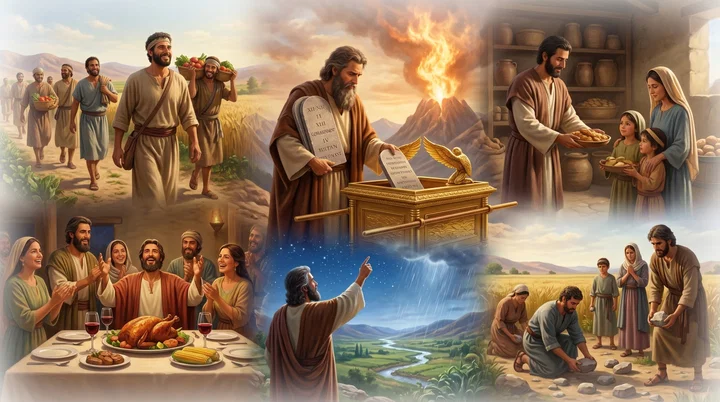
Cross-references 20 of 21
- Numbers 18:21
And, behold, I have given the children of Levi all the tenth in Israel for an inheritance, for their service which they serve, even the service of the tabernacle of the congregation.
Assigns the tithe to the Levites for their tabernacle service, distinct from Deuteronomy’s festival tithe.
- Leviticus 27:30
And all the tithe of the land, whether of the seed of the land, or of the fruit of the tree, is the LORD’s: it is holy unto the LORD.
Both identify the tithe of produce as belonging to the Lord.
- Deuteronomy 14:28-29
At the end of three years thou shalt bring forth all the tithe of thine increase the same year, and shalt lay it up within thy gates:
third-year tithe eaten at home contrasted
- Deuteronomy 12:17-18
Thou mayest not eat within thy gates the tithe of thy corn, or of thy wine, or of thy oil, or the firstlings of thy herds or of thy flock, nor any of thy vows which thou vowest, nor thy freewill offerings, or heave offering of thine hand:
Specifies that the tithe is eaten before God at the chosen place.
- Deuteronomy 26:12-13
When thou hast made an end of tithing all the tithes of thine increase the third year, which is the year of tithing, and hast given it unto the Levite, the stranger, the fatherless, and the widow, that they may eat within thy gates, and be filled;
Confirms the third-year tithe is distributed to Levites and the needy.
- Malachi 3:8-10
Will a man rob God? Yet ye have robbed me. But ye say, Wherein have we robbed thee? In tithes and offerings.
Tithes are brought to God’s house, and withholding them is robbing God.
- Nehemiah 10:38
And the priest the son of Aaron shall be with the Levites, when the Levites take tithes: and the Levites shall bring up the tithe of the tithes unto the house of our God, to the chambers, into the treasure house.
The tithe is brought for the Levites and the house of God.
- Leviticus 11
And the LORD spake unto Moses and to Aaron, saying unto them,
Both texts distinguish permitted and forbidden foods for Israel.
- 2 Chronicles 31:5-6
And as soon as the commandment came abroad, the children of Israel brought in abundance the firstfruits of corn, wine, and oil, and honey, and of all the increase of the field; and the tithe of all things brought they in abundantly.
Israel brought abundant tithes of produce, livestock, and holy things.
- Matthew 23:23
Woe unto you, scribes and Pharisees, hypocrites! for ye pay tithe of mint and anise and cummin, and have omitted the weightier matters of the law, judgment, mercy, and faith: these ought ye to have done, and not to leave the other undone.
Jesus affirms tithing while correcting the Pharisees’ neglect of weightier matters.
- Genesis 14:20
And blessed be the most high God, which hath delivered thine enemies into thy hand. And he gave him tithes of all.
Both describe a tithe given for religious service, with Abraham’s tithe preceding the law.
- Deuteronomy 12:6-7
And thither ye shall bring your burnt offerings, and your sacrifices, and your tithes, and heave offerings of your hand, and your vows, and your freewill offerings, and the firstlings of your herds and of your flocks:
Israel brings the tithe to God’s chosen place and eats there before him.
- Genesis 28:22
And this stone, which I have set for a pillar, shall be God’s house: and of all that thou shalt give me I will surely give the tenth unto thee.
Both texts connect giving a tenth to God with worship.
- Nehemiah 13:5
And he had prepared for him a great chamber, where aforetime they laid the meat offerings, the frankincense, and the vessels, and the tithes of the corn, the new wine, and the oil, which was commanded to be given to the Levites, and the singers, and the porters; and the offerings of the priests.
Both describe tithes of produce set apart for worship and religious service.
- Numbers 18:27
And this your heave offering shall be reckoned unto you, as though it were the corn of the threshingfloor, and as the fulness of the winepress.
Levites’ tithe is reckoned as grain and wine, like the people’s tithe.
- Hebrews 7:4-10
Now consider how great this man was, unto whom even the patriarch Abraham gave the tenth of the spoils.
Cited as apostolic teaching on the tithe.
- Luke 11:42
But woe unto you, Pharisees! for ye tithe mint and rue and all manner of herbs, and pass over judgment and the love of God: these ought ye to have done, and not to leave the other undone.
Cited as Jesus’ approval of tithing.
- Proverbs 3:9
Honour the LORD with thy substance, and with the firstfruits of all thine increase:
Both call for honoring God with the firstfruits of increase.
- Deuteronomy 14:27
And the Levite that is within thy gates; thou shalt not forsake him; for he hath no part nor inheritance with thee.
Adds that the Levite must not be neglected in sharing the tithe.
- Nehemiah 13:10
And I perceived that the portions of the Levites had not been given them: for the Levites and the singers, that did the work, were fled every one to his field.
The Levites’ portions were not provided, contrary to the prescribed tithe for their support.
Commentary
Each commentary is drawn from primary sources: the writings of Ellen G. White and Adventist pioneers and periodicals. Each commentary is separate. Its own words are not a quotation; follow the references to read the source passages.
Ellen G. White
5 sources
This instruction concerns the second tithe.PP 530.1–2MYP 305.2ED 44.2–3Lt 103, 1905, par. 17Ms 67, 1901, par. 12 That tithe — the tithe of grain, wine, and oil and the firstlings of herds and flocks — was to be eaten before the Lord at the place He chooses.PP 530.1–2MYP 305.2ED 44.2–3Ms 67, 1901, par. 12 Its stated purpose is that the people may learn to fear, honor, and reverence the Lord always.PP 530.1–2MYP 305.2ED 44.2–3Ms 67, 1901, par. 12
For two years it was to be brought to the sanctuary in kind or as its value in money.PP 530.1–2 After a thank-offering and a portion for the priest, the remainder was used for a religious feast at the yearly festivals.PP 530.1–2 That feast was shared with Levites, strangers, orphans, and widows.PP 530.1–2 It upheld worship and brought the people together with priests and Levites for instruction and encouragement in serving God.PP 530.1–2
The tithe of all increase, including produce, livestock, and the work of hand or mind, kept before the people that everything belonged to God and that they could serve as channels of His blessings.MYP 305.2ED 44.2–3 The second tithe was for the poor and other benevolent purposes.PP 530.1–2MYP 305.2ED 44.2–3 Together these tithing practices trained the people away from selfishness and toward generous, noble character.MYP 305.2ED 44.2–3
The second tithe should not be used to support schools by providing free tuition, while missionary work in new places offers abundant opportunities for its use.Lt 103, 1905, par. 17 The second tithe may also be used to support church-school work, including sustaining teachers.Ms 67, 1901, par. 12
Sources
Pioneers and periodicals
55 sources
The verse requires a second, festival tithe distinct from the first yearly tenth that belonged to the Levites for the ministry of the house of the Lord.ST Jul 18, 1911ST Feb 28, 1906ST May 4, 1915 It was to be eaten by the people themselves with their households in rejoicing before the Lord in the place He chose to place His name, where the tabernacle or temple stood at Jerusalem, and if the distance was too great it could be turned into money and laid out there for the feast.STRH Apr 21, 1903ST Nov 10, 1898ST Dec 11, 1928 The Levite, the stranger, the fatherless and the widow were to share in it and be provided for, while the priests and Levites gave instruction in God's service, so that by the shared meal they might learn to fear the Lord always.RH Aug 2, 1906RH Apr 21, 1903ST Mar 20, 1884 For two years this second tithe was brought to the place of worship, but in every third year it was used at home instead for entertaining the Levite and the poor as a fund for charity and hospitality.RH Aug 2, 1906ST May 4, 1915RH Aug 2, 1906 Tithing is a moral obligation of one tenth of all increase that did not begin with the Levitical law nor end with a change of dispensation, and laying aside regularly a second tenth for benevolent purposes such as general meeting expenses, help for the poor, and church schools is still pleasing to God.RH Mar 16, 1916RH Mar 11, 1873
Place and Occasion
The place God would choose to place His name, where Israel was to eat the tithe of corn and of wine and of oil and the firstlings of herds and flocks before Him, was where the ark was, in tabernacle or temple, at Jerusalem after coming into the land of promise and building of the temple.ST Nov 10, 1898ST Dec 11, 1928 If the distance was too great to carry the tithe in kind, it or its equivalent could be turned into money, carried to the sanctuary, and there laid out for what was needed for the feast.STRH Apr 21, 1903ST Dec 11, 1928RH Mar 11, 1873 The means could thus be converted when more convenient for a long journey, brought to the place God chose, and there spent on whatever was desired for the gathering.STST Dec 11, 1928RH Mar 11, 1873 There it was laid out for oxen and sheep and wine and other provision for the feast.ST Dec 11, 1928
For two years this tithe was brought to the place of worship where the sanctuary was established and God placed His name.RH Aug 2, 1906RH Aug 2, 1906 In every third year it was not brought to the sanctuary but was used at home instead.RH Aug 2, 1906RH Aug 2, 1906 Then it became at home a fund for charity and hospitality in entertaining the Levite and the poor.RH Aug 2, 1906RH Aug 2, 1906 This feast at the temple has no antitype now.ST Nov 10, 1898
Second Tithe Identified
The verse describes a second, festival tithe, distinct from the first yearly tithe of all increase that belonged to the Levites for the house of the Lord and the support of those who ministered there.ST Jul 18, 1911ST Feb 28, 1906ST May 4, 1915 It was to be eaten by the people themselves before the Lord in the place He chooses, using what was necessary for the great feast offerings, and not used as permission to spend the regular tithe as one pleases.RH Aug 2, 1906ST Jul 18, 1911ST Feb 28, 1906 For two years it was brought to the place of worship, while in the third year this same second tithe was distributed at home to those in need instead of being used for the sanctuary meals.RH Aug 2, 1906ST May 4, 1915 It was used in connection with the yearly gatherings, making provision for thank-offerings and feasts at the yearly festivals.RH Aug 2, 1906
The regular tithe belonged to the Levites, and the Levites' tithe in turn belonged to the priests.ST Feb 28, 1906 The yearly tithe of all the increase of the seed from the field was paid to the Levites, and the Levites in turn tithed it for the priests.ST Feb 28, 1906
The mention of the firstlings of herds and flocks shows that to those same gatherings were also to be taken all sacrifices and offerings along with the tithe, at the place God chose for worship.ST Feb 28, 1906ST Apr 28, 1909 There Israel ate before Him and learned to fear Him always, as a people called holy who were to distinguish clean from unclean.ST Feb 28, 1906ST Apr 28, 1909
The tithe distributed to the Levite, the poor, and the stranger every third year, eaten in the towns and cities at home, was a separate provision from the festival tithe eaten at Jerusalem.ST Feb 28, 1906ST Dec 11, 1928ST Mar 20, 1884RH Aug 19, 1873RH Apr 7, 1904 That festival tithe was carried to Jerusalem and eaten there at festival feasts, set apart for the Lord's feasts and sacrifices to be eaten by the people themselves before the Lord in the place He chooses to place His name.ST Dec 11, 1928ST Mar 20, 1884RH Apr 7, 1904 It consisted of grain, wine, oil, and firstborn livestock devoted to worship at the sanctuary, distinct both from the tithe allotted to the Levites for their support and from the additional tithe for the poor in every third year.ST Dec 11, 1928ST Mar 20, 1884RH Apr 7, 1904 Together with a third tenth for the poor every three years and other religious obligations, these requirements meant each household gave at least a fifth and perhaps a third, and not less than a fourth, of income.ST Jan 28, 1875RH Aug 19, 1873 Some count that third-year provision for the poor as a third tithe.ST Feb 28, 1906ST Jan 28, 1875RH Aug 19, 1873
All the tithe in verse 28 means all of this second tithe.ST May 4, 1915
How Festival Tithe Was Used
The tithe in this verse was eaten by the Israelites themselves with their households in sacred meals at the sanctuary, a sacred occasion of rejoicing before God.RH Aug 2, 1906ST May 4, 1915RH Apr 21, 1903ST Dec 11, 1928 It was the festival tithe of produce, with its value in money if needed, brought to the place God chose, distinct from the regular tithe given wholly to the Levites for their sanctuary service.ST May 4, 1915RH Apr 21, 1903ST Dec 11, 1928ST Mar 20, 1884 After presenting a thank-offering to God and giving a specified portion to the priest, the offerers used the remainder for the religious feast.RH Aug 2, 1906RH Aug 2, 1906 That provision made room for thank-offerings and feasts at the yearly festivals, including oxen, sheep, wine, or whatever they desired laid out at the sanctuary.ST Dec 11, 1928RH Aug 2, 1906
The Levite, the stranger, the fatherless, and the widow were to participate in the feast and be provided for.RH Aug 2, 1906ST Mar 20, 1884ST Mar 20, 1884RH Aug 2, 1906 The people were thus drawn into the society of the priests and Levites to receive instruction and encouragement in the service of God.RH Aug 2, 1906RH Aug 2, 1906 The shared meal also helped meet the needs of those attending the annual gathering.RH Apr 21, 1903 Every third year this same second tithe was not brought to the sanctuary but was used at home in entertaining the Levite and the poor, providing a fund for charity and hospitality.RH Aug 2, 1906ST May 4, 1915RH Aug 2, 1906 All the tithe in verse 28 means all of this second tithe so used at home.ST May 4, 1915
The shared meal and instruction were intended to teach reverence, that they may learn to fear the Lord always.RH Apr 21, 1903ST Mar 20, 1884RH Aug 2, 1906RH Mar 12, 1908 Unlike the Lord's tithe devoted to the priests, these tithes allowed the individual some choice in their use.RH Jan 9, 1913 They enabled Israel to attend the feasts, give free-will offerings, and help the poor.RH Jan 9, 1913 The second tithe was used in connection with the yearly gatherings, helping meet their expense and the needs of those attending, along with offerings to the Lord, care for the poor, and support for the Levite.RH Jan 9, 1913RH Oct 29, 1908
Clean Food and Drink
The division between clean and unclean rested on nature itself and was not arbitrary, as if equally wholesome animals had been put on opposite sides, for the unclean are unclean in their very nature while the clean are much more favorable for food, and science confirms the truth of God's classification, even absolutely forbidding on purely scientific grounds things He prohibited such as swine's flesh in sickness or convalescence.ST Jan 2, 1912ST Jun 11, 1912ST Aug 10, 1915 The law did not make the animals clean or unclean but recognized a difference already in the very nature of the beasts themselves, present at the Flood when seven pairs of the clean and one pair of the unclean were preserved, more than a thousand years before God's people were known as Jews, so it is not a Jewish restriction only and was not first created at the Exodus but already existed in Noah's time to direct God's people away from the unwholesome for their good.RH Nov 5, 1872ST Aug 10, 1915 Flesh is not the best food, as shown by God giving man no flesh at all in the beginning of his life on earth and by giving His children manna to eat instead of flesh foods, although the clean could be offered for sacrifice and their flesh could be eaten while it was an abomination to offer the unclean to the Lord.ST Jan 2, 1912
Permission to eat flesh and to eat what one desires is limited to clean animals as distinguished from unclean ones, giving no permission to use unclean animal foods under the prohibitions of Leviticus 11, and the definite instruction in Deuteronomy 14 limits the whatsoever of Deuteronomy 12:15 and governs the feast eating in that chapter.ST Jul 18, 1911ST May 24, 1905ST Apr 1, 1889ST Feb 13, 1896 The chapter repeats the instruction given in Leviticus 11, standing in one of only two chapters in the Bible that make the classification between clean and unclean meats.ST Mar 25, 1897ST Mar 18, 1913 Swine's flesh, shell-fish, rabbits, hares, hogs and dogs are among the forbidden and unclean, pronounced unclean by God and unfit for food, and hares are not considered among the best foods, while geese and ducks are not named among the forbidden fowls nor mentioned anywhere in the Bible.ST Mar 25, 1897ST Nov 24, 1909RH Nov 5, 1872ST Jan 30, 1901 Because swine are unclean, raising them for market to be eaten as food is wrong, and the money from them is contraband property that cannot be brought into God's house or tithed without sin, leaving the swine-raiser no right course except to stop keeping them.RH Nov 5, 1872
The ceremonial form of that law given to the Jewish nation alone passed away when Christ died on the cross, and it could not be bound upon converts from other nations who could not separate from the customs of their countries, though Gentile converts received certain restrictions and the principle to eat and drink to the glory of God. The prohibitions were lifted when the gospel went to the whole world and some people could not keep the Mosaic laws, and those dietary laws having had a reason were lifted as the gospel went to Gentiles who could not at first follow them.ST Jul 29, 1913ST Aug 13, 1912 The special dietary laws are no longer binding on Gentile believers, while the distinction between kinds of flesh food, some clean and others unclean and unfit to eat, still reflects facts about the animals.ST Aug 11, 1909 Yet the swine remains unclean and should be excluded from the diet, and God's people should heed what God says about clean and unclean food.ST Jul 29, 1913
The principle to eat and drink to the glory of God still holds, so just as far as is consistent and possible Christians should refrain from eating unclean and unwholesome food, studying not appetite but God's glory and their own best good for best service, since if refraining was better for ancient Israel it is better now. Eating and drinking is always governed by doing all to the glory of God, so the permission is broad but not absolute and does not include the unclean animals forbidden in the first part of the chapter.ST Jul 18, 1911 The word for longing does not mean sinful lust but what the soul desires, and those standing right before God will not desire anything wrong.ST Jul 18, 1911 The wine and strong drink allowed are only what will not intoxicate or lead to sin, and the strongest drinks known to Israel were remarkably mild compared with present poisonous liquors, though the law permitted buying wine, strong drink, and whatever the person desired.ST Jul 18, 1911RH Nov 12, 1908
Its worship gatherings for a people called holy, who were to distinguish clean from unclean and to eat the tithe meal with the firstlings of herds and flocks at the place God chose and there learn to fear Him always, were not permission for conduct or food contrary to God's word, and when Israel departed from God they neglected these appointed gatherings.ST Apr 28, 1909 God set apart the clean beasts to be eaten and forbade eating the unclean after Israel refused to obey Him and be kept free from disease, having lusted after flesh and chosen sickness with their desire granted in part, so flesh eating under that permission was not sinful but it was not an absolute necessity.ST Feb 17, 1904 Not every creature is appointed or fit or best for food; only what God created for food and plainly declared good for food is sanctified through the Word of God and may be asked His blessing upon and received with thanksgiving by those who believe and know the truth about what He has given, while other things are not so given and swine's flesh is not made food by every creature in 1 Timothy 4:4.ST Feb 10, 1898ST Jun 11, 1912ST Dec 5, 1895 God knew how to discriminate between foods and had a reason for His prohibition; it is best for people and should be accepted gladly, freely and hopefully, while any person left free to reject God's plan must take the consequences.ST Jan 30, 1901
Tithing Still Obligatory
The tithe is one tenth, the least portion to be given, and giving it is a moral obligation that did not begin with the Levitical law and was not ended by a change of dispensation.RH Mar 16, 1916 Tithing was God's uniform system from the beginning and not peculiarly Jewish or new with Israel, for the same tenth Abraham and Jacob already recognized as obligatory long before Moses was repeated as law to Israel after coming out of bondage and passing through the sea, and the rule was settled in the earliest ages of the race in patriarchal as well as Mosaic law.RH Mar 11, 1873RH Jan 2, 1913 Changed conditions between Abraham and Jacob and their descendants made no difference, and God's requirements in both periods were identical, since the plan was devised from the beginning for the good of all men and for the support of His work in the earth and was incorporated into Israel's service when they became a nation after deliverance from bondage in Egypt and settlement in the land promised to Abraham.RH Mar 11, 1873RH Jan 2, 1913
The requirement is a tenth of all increase, including crops, wine, oil, fruit, vegetables, flocks, herds, measured produce, livestock, and the firstborn of herds and flocks, besides vows and free-will offerings and gifts, involving every individual according to ability.RH Jan 6, 1863RH Mar 11, 1873RH Nov 23, 1869RH Jan 2, 1913 The proportion of means required for religious purposes under a regularly established system is one-tenth of increase, to be collected in kind but exchangeable into money if more convenient to carry a long distance.RH Mar 11, 1873 That requirement still stands for God's people now, with no less required of them because time is emphatically short and their means must accomplish the great work of giving the last merciful message to the world.RH Jan 6, 1863RH Nov 29, 1864 This requires those living near the end when probation is about to close to be at least as generous, denying self and ease and using all lawful means and full ability to advance present truth and save sinners instead of keeping a close and penurious spirit and lavishing time and strength on themselves.RH Oct 21, 1873
One-tenth of one's increase belongs of right to God and withholding it is robbery of God; it is a fixed due apart from charities and gifts of personal choice, like the poll-tax of a citizen of God's earthly kingdom, just as one-seventh of time is due for the Sabbath, and Christianity, which counts all possessions and time as the Lord's, does not license giving less into the Lord's treasury than the old law demanded. Together with the second tenth for feasts eaten before the Lord in the place He chose, a third tenth for the poor every three years, journeys to the temple, trespass offerings and other requirements, Israel gave at least a fifth and perhaps a third, not less than a fourth, of income, so no Christian with the light of God's word should be willing or dare to give less than one-tenth of all he receives to the Lord.ST Jan 28, 1875RH Aug 19, 1873 Its stated use for the Levite who has no part nor inheritance, and the stranger, and the fatherless, and the widow proves it was raised for religious and benevolent purposes and not for supporting civil government, so civil taxes for government stand entirely outside of it and cannot be deducted from the tithe owed to God.RH Mar 11, 1873
The specific obligations of the second tithe are not placed on the same basis as those of the first tithe.RH Oct 29, 1908 This specific Levitical requirement of eating the tithe before God at the place He chose, including permission to buy wine, strong drink, and whatever the person desired, is not legally binding today as special second-tithe law, though its underlying principle of systematic giving to God's work remains binding.RH Nov 12, 1908 The sanctuary tithe of grain, wine, oil, and firstborn livestock was part of the national and ritual provisions of the Mosaic law, distinct from the tithe allotted to the Levites for their support and from the additional tithe for the poor in every third year, unlike the general obligation of God's tenth, which belongs to all people.RH Apr 7, 1904 The second tithe remains binding because what did not in some way foreshadow the death of Christ was not taken away at His death, standing side by side with the first tithe as an equally perfect system. The first tithe is a tenth of income clearly required as a debt owed to God that must be paid honestly and faithfully with no excuse allowed, while duty to pay the second tithe rests on individual light, since some find no Scripture for it, but whoever holds it to be duty must pay it honestly, reckoned as a tenth of what remains after the first tithe is taken, so on ten dollars it is ninety cents after the one-dollar first tithe, and not found by dividing income by seven after the pattern of the seventh part of time.ST Aug 9, 1905
Second Tithe Today
Although the offering system has passed away, yearly gatherings and the expense connected with them still remain, as does the duty to support the poor, so it is pleasing to God for His children still to lay aside regularly a second tenth for benevolent purposes such as camp-meeting or other general meeting expenses, Sabbath-school donations, other contributions, and help for the poor. Ministers and people should study and adopt the second tithe in financial as well as spiritual matters, with the funds thus obtained to be used in educational, philanthropic, charitable, and missionary work.RH Jun 8, 1905 It is God's plan for meeting many calls, especially the support of church schools and the education of children, bringing exact equality to rich and poor so no one is unequally burdened and every child can attend.RH Aug 9, 1906
It is divided with two thirds sent to a central or conference treasury for paying teachers, who thus become conference employees, and one third retained at the home church for local needs, the poor, church expenses, repairs, and offerings.RH Aug 9, 1906RH Aug 1, 1907 One tenth of the conference portion is sent on as a thank-offering, surplus may from time to time be devoted to missionary work and places of greatest need, and funds may accumulate even when school is not in session.RH Aug 9, 1906 The plan stands side by side with the first tithe as an equally perfect system, the first tithe supporting the ministry at home and ministers sent to foreign fields, the second tithe paying teachers at home and teachers called to other fields. It is placed on record in Scripture for learning and gives a superior plan for the financial maintenance of church schools, calling for laying aside a second tithe distinct from the first tithe to be used for religious purposes for which the first tithe could not be used.RH Aug 1, 1907
The Bible instructor's salary is to be paid from the first tithe, while the other teachers' salaries the second tithe could pay, helping make education in higher conference schools accessible without tuition and keeping young people in church education as they advance to higher grades when worldly influences may draw them away. The second tithe is a tenth of what remains after the first tithe is taken and paid to the church treasurer, so on ten dollars it is ninety cents after the one-dollar first tithe.RH Aug 9, 1906ST Aug 9, 1905 It is not found by dividing income by seven after the pattern of the seventh part of time, a method that breaks down on other sums such as fourteen dollars.ST Aug 9, 1905
Faithful giving of tithe and second tithe to support the Lord's work is a blessed practice that can provide ample funds, and faithfulness in paying the second tithe for teachers and children is required and encourages faithfulness in paying the first tithe.RH Aug 9, 1906RH Mar 3, 1904RH Aug 26, 1909 The practice of giving the Lord a tenth is reflected with a further second tithe as an example.RH Aug 20, 1908 Conferences are to pay funds and furnish laborers to the union conference for advancing the work in regions beyond the local field and mission fields, and faithful obedience secures His continued blessing and prosperity on every department of the work.RH Oct 7, 1909
The second tithe is a present duty distinct from the first tithe for carrying on God's work, paid upward to support workers and meet the money needed for the coming year, and even farming believers with low wages can pay it in full and have surplus left over, with members also tithing their property to provide what is needed.RH May 4, 1905 The verse is cited among the instructions studied to support the use of a tithe distinct from the regular tithe for church-school and home missionary work, directing Israel to eat the tithe of crops and the firstborn of herds and flocks before God at the place He chose so the people would learn to fear Him always.RH Mar 12, 1908 It shows that a second tithe was to be eaten before God at the place He chose, and was used to support annual religious gatherings and the work beyond the support of the ministry.RH Oct 29, 1908
Sources