Hebrews 7:4
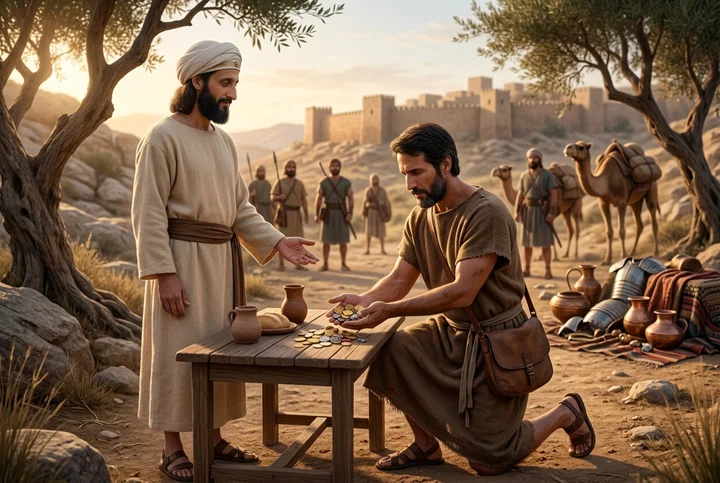
Now consider how great this man was, unto whom even the patriarch Abraham gave the tenth of the spoils.
Translations
American King James Version, Webster Bible
Now consider how great this man was, to whom even the patriarch Abraham gave the tenth of the spoils.
King James Version, KJV Cambridge Paragraph Bible
Now consider how great this man was, unto whom even the patriarch Abraham gave the tenth of the spoils.
Revised Version, American Standard Version
Now consider how great this man was, unto whom Abraham, the patriarch, gave a tenth out of the chief spoils.
And see how great this one [is], to whom also a tenth Abraham the patriarch did give out of the best of the spoils,
Now consider how great this [personage] was, to whom [ even] the patriarch Abraham gave a tenth out of the spoils.
Now consider, how great, this man was, to whom, a tenth, Abraham gave out of the choicest spoils, [Yea Abraham] the Patriarch.
Berean Standard Bible, Majority Standard Bible
Consider how great Melchizedek was: Even the patriarch Abraham gave him a tenth of the plunder.
Now consider how great this man was, to whom even Abraham the patriarch gave a tenth out of the best plunder.
Now see how great this man was, to whom our father Abraham gave a tenth part of what he had got in the fight.
Nowe consider how great this man was, vnto whome euen the Patriarke Abraham gaue the tithe of the spoyles.
Douay-Rheims (Challoner revision)
Now consider how great this man is, to whom also Abraham the patriarch gave tithes out of the principal things.
Pictures
Cross-references 20 of 24
- Genesis 14:20
And blessed be the most high God, which hath delivered thine enemies into thy hand. And he gave him tithes of all.
Abraham gives Melchizedek a tenth of the spoils.
- Hebrews 7:17
For he testifieth, Thou art a priest for ever after the order of Melchisedec.
Christ is declared a priest forever after Melchizedek’s order.
- Hebrews 8:1-2
Now of the things which we have spoken this is the sum: We have such an high priest, who is set on the right hand of the throne of the Majesty in the heavens;
Christ serves as the Melchizedek-order High Priest in the heavenly sanctuary.
- Hebrews 6:20
Whither the forerunner is for us entered, even Jesus, made an high priest for ever after the order of Melchisedec.
Christ is a priest forever after Melchizedek’s order.
- Psalms 110:4
The LORD hath sworn, and will not repent, Thou art a priest for ever after the order of Melchizedek.
God’s oath establishes Christ’s enduring priesthood after Melchizedek’s order.
- Hebrews 5:6
As he saith also in another place, Thou art a priest for ever after the order of Melchisedec.
Christ is named a priest forever after Melchizedek’s order.
- Leviticus 27:30
And all the tithe of the land, whether of the seed of the land, or of the fruit of the tree, is the LORD’s: it is holy unto the LORD.
Both identify the tithe as the Lord’s and holy to him.
- Numbers 18:21
And, behold, I have given the children of Levi all the tenth in Israel for an inheritance, for their service which they serve, even the service of the tabernacle of the congregation.
The tithe is assigned to the Levites for their sanctuary service.
- Genesis 28:22
And this stone, which I have set for a pillar, shall be God’s house: and of all that thou shalt give me I will surely give the tenth unto thee.
Jacob also vows to give God a tenth.
- Hebrews 7:21
( For those priests were made without an oath; but this with an oath by him that said unto him, The Lord sware and will not repent, Thou art a priest for ever after the order of Melchisedec:)
Christ is appointed priest forever after Melchizedek’s order.
- Malachi 3:8-10
Will a man rob God? Yet ye have robbed me. But ye say, Wherein have we robbed thee? In tithes and offerings.
Both teach faithfulness in tithing and warn that withholding tithes robs God.
- Hebrews 7:8
And here men that die receive tithes; but there he receiveth them, of whom it is witnessed that he liveth.
Contrasts mortal tithe-receivers with Melchizedek, witnessed to be living.
- Hebrews 7:12
For the priesthood being changed, there is made of necessity a change also of the law.
A change of priesthood requires a change in the law.
- Hebrews 7:23-25
And they truly were many priests, because they were not suffered to continue by reason of death:
Christ’s enduring priesthood contrasts with mortal priests and enables him to save and intercede.
- Hebrews 7:9-10
And as I may so say, Levi also, who receiveth tithes, payed tithes in Abraham.
Levi paid tithes through Abraham.
- Matthew 23:23
Woe unto you, scribes and Pharisees, hypocrites! for ye pay tithe of mint and anise and cummin, and have omitted the weightier matters of the law, judgment, mercy, and faith: these ought ye to have done, and not to leave the other undone.
Christ affirms tithing as a duty alongside justice, mercy, and faith.
- Genesis 14:18
And Melchizedek king of Salem brought forth bread and wine: and he was the priest of the most high God.
Abraham gave Melchizedek a tenth of the spoils.
- Hebrews 5:10
Called of God an high priest after the order of Melchisedec.
states Christ's calling after Melchizedek's order
- Hebrews 7:18
For there is verily a disannulling of the commandment going before for the weakness and unprofitableness thereof.
The disannulled commandment concerns the priestly order, not the Sabbath.
- Zechariah 6:13
Even he shall build the temple of the LORD; and he shall bear the glory, and shall sit and rule upon his throne; and he shall be a priest upon his throne: and the counsel of peace shall be between them both.
The Branch rules as king and serves as priest.
Commentary
Each commentary is drawn from primary sources: the writings of Ellen G. White and Adventist pioneers and periodicals. Each commentary is separate. Its own words are not a quotation; follow the references to read the source passages.
Ellen G. White
2 sources
Abraham honored the greatness of Melchizedek by giving him a tenth of the spoils, tithes of all that he possessed.Lt 44, 1876, par. 5–6DA 616.3–617.1 As the father of the faithful, his payment proves that the tithing system was ordained by God and had been observed from the earliest times.DA 616.3–617.1 His example shows that tithing remains a duty for those living under the Melchizedek priesthood, and the obligation itself remains.Lt 44, 1876, par. 5–6DA 616.3–617.1
Christ recognized the payment of tithes as a duty that ought to be done and should be performed and not left undone or neglected.DA 616.3–617.1 Yet paying tithes can never excuse neglect of the weightier matters of the law, which are judgment, mercy, and faith.DA 616.3–617.1
Sources
Pioneers and periodicals
81 sources
Consider how great Melchizedek was, proved by the fact that even the patriarch Abraham gave him a tenth of the spoils.ST Dec 9, 1889ST Jun 30, 1914RH Sep 28, 1905
He was a real human man, king of Salem and priest of the Most High God, who met Abraham returning from defeating the kings, blessed him, and received the tenth of all the captured goods that had come into his hands.ST Feb 16, 1915CO 93.5ST Jun 25, 1896ST Aug 13, 1885
He was greater than Abraham because he received tithes from him as homage to God's representative and blessed him, since the lesser is blessed by the greater, and since Abraham possessed the promises and was revered as father, this establishes his superiority in rank over Abraham and therefore over Levi and the Levitical priesthood.ST Dec 10, 1902ST Sep 5, 1895
This proves the superiority of Melchizedek's priesthood, which does not pass to another, over the Levitical priesthood and its earthly service, and thus the superiority and preeminence of Christ's priesthood after that order.ST Dec 9, 1889RH Jan 20, 1853ST Jul 1, 1908RH Sep 11, 1856RH Mar 1, 1870
Abraham's giving shows tithing was recognized and practiced under the Melchizedek priesthood centuries before the Levitical law, was transferred to Levi and at the end of the Aaronic priesthood returned to Christ's eternal priesthood, so it remains a continuing moral obligation of faith with Abraham as the example for his children.RH Jan 16, 1913RH Mar 9, 1905RH Aug 5, 1902RH Mar 16, 1916RH Jan 9, 1913
Christ is called of God a High Priest after that order not after a carnal commandment but after the power of an endless life, and He ever lives to make intercession in the true tabernacle in heaven itself, seated as Priest-King on His Father's throne.RH Aug 28, 1856RH Jul 29, 1858ST Nov 16, 1882RH Aug 20, 1901
Wording and Historical Setting
The verse calls for careful thought about how great Melchizedek was, and the proof given is that even Abraham the patriarch gave him a tenth of the spoils.ST Dec 9, 1889ST Jun 30, 1914RH Sep 28, 1905ST Jul 1, 1908 That act places Melchizedek above Abraham and magnifies the priestly order after which Christ was appointed.ST Dec 9, 1889ST Aug 30, 1905 It honors the greatness of Christ as Priest after Melchizedek's order, who is King of Righteousness and Prince of Peace.ST Jul 1, 1908 The priesthood thus brought into view involves righteousness, sonship, fatherhood, eternal life, and an everlasting priesthood. Abraham recognized that greatness and gave the tenth to Melchizedek as God's representative.ST Aug 30, 1905
The word man marks Melchizedek as a real human man, a priest of the Most High God.ST Jun 25, 1896ST Nov 15, 1905RH Jul 9, 1901RH Sep 7, 1869 He was king of the city of Salem in Abraham's time, and the greatness Abraham honored was the greatness of a fitting type of Christ in character, name, and city.ST Jun 25, 1896 Melchizedek means king of righteousness, foreshadowing Christ as the LORD OUR RIGHTEOUSNESS, and king of Salem means king of peace, foreshadowing Christ as peace, while priest of the Most High God foreshadows Christ as great High Priest.ST Jun 25, 1896 A priesthood with no predecessor, no successor, and no recorded genealogy foreshadows Christ's age-lasting priesthood that comes from no other and passes to no other and has no genealogy.ST Jun 25, 1896 The one who met Abraham bears Melchizedek as the title of a priestly order, not as a personal name.ST Nov 15, 1905
He was not Christ himself, because a type is distinct from Christ who is a king-priest after the order of Melchizedek.ST Jun 25, 1896 He was not the Holy Spirit, and the description of him as a man distinguishes him from an angel and from the human family whose members have beginnings and endings of life, with stated exceptions.ST Aug 26, 1913 He was not God the Father but a human priest of the Most High God, greater than Abraham because even the patriarch Abraham gave him the tenth of the spoils.RH Sep 7, 1869 Together with Melchizedek's blessing of Abraham, that gift establishes Melchizedek as greater than Abraham and makes him a representative of Christ, who is both king and priest.RH Jul 9, 1901 Adam, if he had not sinned, would have lived forever and would have been like Melchizedek in this respect, as priest or head of the human family and king of the earth.ST Aug 26, 1913
The title patriarch is applied to Abraham, showing that it is not restricted to the twelve sons of Jacob. The tenth of the spoils means a tenth of all, a tenth of all the captured goods and of the substance that had come into Abraham's hands.CO 93.5ST Aug 13, 1885 Abraham's tithe is an example supporting the teaching that the proportion given under earlier dispensations is no less under the gospel, and an example of dedicating a portion of one's substance to God.CO 93.5 Abraham met Melchizedek, king of Salem and priest of the Most High God, as he returned from defeating the five kings, was blessed by him, and gave him the tenth.ST Aug 13, 1885 He did so before returning the remaining goods to the king of Sodom, treating a tenth of what had come into his hands as belonging to the Lord.ST Feb 16, 1915
This plain identification answers who Melchizedek was and rules out that he was Shem or Christ.ST Aug 13, 1885 It shows that tithing was recognized under Melchizedek's priesthood, and because Christ is a priest forever in Melchizedek's order, the tithe is also recognized in Christ's priesthood.ST Feb 16, 1915 The verse belongs to the presentation of Christ as Priest after the order of Melchizedek and to the argument that establishes Melchizedek's place in that priestly order which Christ fulfills, including the argument about the change of priesthood from Aaron to Christ.ST Oct 13, 1909RH Feb 4, 1873 That subject was introduced in Hebrews 5:6 and is resumed in Hebrews 7 after a digression describing failure to improve opportunities and lack of preparation to appreciate weighty truths, solemnly admonishing of great danger and encouraging with the example of Abraham and the faithfulness and righteousness of God in keeping His promises, turning the hope resting on the promises made to Abraham toward the priesthood of Christ after the order of Melchizedek.ST Dec 23, 1889 Some treatments set the verse in that argument about priesthood without further explaining Abraham's tenth or the description of Melchizedek's greatness.ST Oct 13, 1909RH Feb 4, 1873
Identity of Melchizedek
Melchizedek was a real man who was king of the city of Salem in Abraham's time, and this plain identification is the answer to who he was.ST Jun 25, 1896ST Aug 13, 1885 He was neither Shem nor Christ himself, since a type is distinct from Christ who is a king-priest after the order of Melchizedek.ST Sep 14, 1882ST Jun 25, 1896ST Aug 13, 1885 The name of his order indicates that he had no predecessor in that priestly office.ST Sep 14, 1882
He was not the Holy Spirit, not an angel, and not God the Father, but a human priest of the Most High God.ST Aug 26, 1913RH Jul 9, 1901RH Sep 7, 1869 The word man distinguishes him from an angel and from the human family, whose members have beginnings and endings of life, with stated exceptions.ST Aug 26, 1913 Melchizedek is a title of a priestly order, not the personal name of the one who met Abraham.ST Nov 15, 1905
He was a good man of God whose priestly office is a likeness of Christ's, a preacher and teacher of righteousness who taught God's universal system founded on the unchanging principles of the Decalogue.RH Aug 17, 1876 He lived near Sodom as a representative of Christ, so the people there had access to the light of truth.ST Oct 4, 1883RH Jul 19, 1870 His greatness lay in his exalted office as both king and priest, not in his personal character and not in every respect, since Abraham as stranger and pilgrim, not a king, was doubtless not inferior in other respects.ST Oct 21, 1889ST Dec 9, 1889
His names foreshadow Christ: Melchizedek meaning king of righteousness foreshadows Christ as the LORD OUR RIGHTEOUSNESS, and king of Salem meaning king of peace foreshadows Christ as peace.ST Jun 25, 1896 Priest of the Most High God foreshadows Christ as great High Priest.ST Jun 25, 1896 Having no recorded pedigree, beginning or ending, predecessor or successor makes him a fitting type of Christ, whose age-lasting priesthood comes from no other, passes to no other, and has no genealogy.ST Jun 25, 1896 Like Melchizedek, Christ is a priest-king, king of righteousness and king of peace.
In one teaching, both Melchizedek and Christ held the same Melchizedek priesthood with Christ preeminent, and Melchizedek was not a shadow or figure of Christ.ST Oct 25, 1905 Unlike the Levitical priesthood, which served sinners' need for the putting away of sin, the Melchizedek priesthood in this teaching is suited to all conditions and times and is everlasting and royal.ST Oct 25, 1905 In another teaching, he was a visitor from another world and its head, the father and priest of another unfallen world holding the same relation to that world as Adam would have held to this world if he had not sinned.ST Dec 17, 1912ST Jun 11, 1912 His greatness, shown because even the patriarch Abraham gave him the tenth of the spoils as homage, means he was more than an ordinary man.ST Dec 17, 1912ST Jun 11, 1912
In yet another teaching, from the words man and without father, mother, pedigree, or beginning of days, he was created rather than born, like Adam created as a man in his prime, and was the first created being of another world.ST Jul 4, 1911ST Aug 26, 1913 Like him Adam if he had not sinned would have lived forever as priest or head of the human family and king of the earth.ST Aug 26, 1913
Superiority to Abraham and Levi
How great Melchizedek was is shown by the fact that even the patriarch Abraham gave him the tenth of the spoils as homage to God's representative.ST Sep 5, 1895ST Jun 11, 1912ST Aug 30, 1905ST Oct 4, 1883 Because Abraham was blessed by Melchizedek, and the lesser is blessed by the greater, Melchizedek is greater than Abraham and more than an ordinary man.ST Sep 5, 1895ST Jun 11, 1912 Since Abraham possessed God's promises and was revered as the father of Israel, his giving tithes and receiving blessing establish Melchizedek's superiority in rank even over Abraham.ST Dec 10, 1902 That superiority over Abraham is therefore superiority over Abraham's posterity, including Levi and the Levitical priesthood with Aaron and his descendants.ST Dec 10, 1902
The verse proves the superiority of Melchizedek's priesthood, which does not pass to another, over the Levitical priesthood and its earthly sanctuary service.RH Jan 20, 1853RH Sep 11, 1856RH Mar 1, 1870RH Mar 8, 1870 In this way it shows the superiority of Christ's priesthood after the order of Melchizedek over the Aaronic priesthood, and the superiority of Christ's priesthood over Aaron's priesthood under the new covenant.ST Dec 10, 1902ST Oct 25, 1877RH Aug 18, 1863 Abraham's act in giving the tenth magnifies the priestly order after which Christ was appointed.ST Dec 9, 1889 It honors the greatness of Christ as Priest after Melchizedek's order, who is King of Righteousness and Prince of Peace, and points to the preeminence of Christ's priesthood.ST Dec 9, 1889ST Jul 1, 1908 What is said of this greatness is literally true of Jesus alone and true of Melchizedek only in a secondary and metaphorical sense as a type.ST Dec 10, 1902
Melchizedek's priesthood supplies features missing from Aaron's, especially kingship, and stands higher than Aaron's as a type because Aaron's priesthood had no kingship.ST Sep 14, 1882ST Sep 20, 1883ST Dec 9, 1889 Aaron's priesthood and service give only a partial picture of Christ's sanctuary ministry, but Melchizedek's priesthood completes that picture, so that without Melchizedek it would have been an incomplete type of Christ's priesthood.ST Sep 14, 1882ST Sep 20, 1883ST Dec 9, 1889 His greatness in office as priest and king is not greatness in every respect, since Abraham as stranger and pilgrim, not a king, was doubtless not inferior in other respects.ST Dec 9, 1889 The greatness of this priest-king belongs to Christ himself, the pre-existent Son made flesh, to whom even Abraham gave the tenth.RH Oct 27, 1863 He is King of Peace only in His priestly office as Priest after the order of Melchizedek, because He is our peace, making peace for humanity with God on His Father's throne and obtaining eternal redemption by His own blood.RH Oct 27, 1863ST Dec 20, 1883RH Apr 14, 1874
Christ's Eternal Heavenly Priesthood
Christ is called of God a High Priest after the order of Melchizedek, a kingly priest who is King of Righteousness and Prince of Peace, now serving as minister of the sanctuary and of the true tabernacle which the Lord pitched and not man, set down with His Father upon His throne at the right hand of God after all power in heaven and in earth was given to Him following His resurrection.RH Aug 28, 1856ST Nov 16, 1882RH Apr 14, 1874RH Apr 1, 1873RH Nov 18, 1862 Melchizedek was both king and priest, unlike David who had no priesthood, and Jesus though of Judah and not Levi holds this everlasting priesthood, demonstrated great by Abraham's giving him a tenth of the spoils.ST Nov 16, 1882RH Apr 1, 1873RH Nov 18, 1862 He occupies the throne of the Majesty in heaven as priest, seated on His Father's heavenly throne until His enemies are made His footstool.ST Nov 16, 1882RH Apr 14, 1874RH Apr 1, 1873
Contrasted with Levitical priests who were dying men so the office had to pass to others, Christ was made priest not after the law of a carnal commandment but after the power of an endless life, as testified Thou art a priest forever after the order of Melchizedek.RH Aug 20, 1901 Having assumed the office it never passes to another, and He ever liveth to make intercession. The greatness shown by Abraham's tithe therefore establishes the duration of Christ's priesthood after that order.RH Aug 20, 1901
The Melchizedek priesthood involves righteousness, sonship, fatherhood, eternal life, and an everlasting priesthood, suited to all conditions and times and royal and unchangeable, in contrast to the Levitical priesthood which served the sinners' need for the putting away of sin.ST Oct 25, 1905 Those who hold that both Melchizedek and Christ held the same Melchizedek priesthood teach that Melchizedek was not a shadow or figure of Christ, with Christ preeminent.ST Oct 25, 1905 The Melchizedek order is superior to the Levitical order because its priesthood rests on endless life while Levitical priests died, bringing a better hope and perfection which the Levitical law could not bring.ST Oct 25, 1905RH Aug 20, 1901
The Levitical priesthood with its ordinances of divine service was superseded by the priesthood of the order of Melchizedek when the earthly sanctuary gave way to Christ's ministry in the heavenly sanctuary.RH Jan 20, 1853RH Mar 1, 1870RH Aug 20, 1872 That change took place at the termination of the seventy weeks cut off from the 2300 days, at the very point where the shadow of good things to come ceased, being nailed to the cross, where the offering of bulls and goats gave place to the great sacrifice, where the example and shadow of heavenly things was terminated by the more excellent ministry, and where the true holy places in heaven succeeded the holy places that were the figures of the true.RH Jan 20, 1853 The ceremonial law therefore ended at the cross as Christ became the center and substance of God's promises and the fulfillment of the Old Testament types and shadows, while the new covenant concerns the same law the Lord promises to put in hearts, with Christ ratifying the moral law every jot and tittle by His blood, distinct from the Levitical law given to Israel which was abolished, since God's law remains holy, just, good, absolute and perpetual.RH Jan 1851RH Apr 30, 1872RH Jul 4, 1854RH Aug 20, 1872
Christ's present priesthood is exercised in heaven itself in the true tabernacle, entered for us to do in heaven what Moses and Aaron did in the earthly pattern, with the anointing of the Most Holy at the end of the seventy weeks referring to this heavenly sanctuary not made by human hands.RH Jul 29, 1858RH May 8, 1856RH Feb 18, 1858 He ministers as Priest-King on His Father's throne in heaven, distinct from His own subordinate throne and kingdom and from David's earthly throne, proving He is not and will not be a Levitical priest on David's throne.RH May 29, 1856RH Dec 6, 1870 If He were on earth He would not be a priest, because earthly priests belonged to Levi while Jesus belonged to Judah, ministering in the heavenly sanctuary rather than the earthly one.RH Jul 29, 1858ST Jul 2, 1885 His offering on Calvary is distinct from the later atonement made by Him as High Priest in heaven, and His priestly rule and mediation continue while probation lasts until He receives His own throne.RH Jul 29, 1858RH May 29, 1856 His being seated until His enemies are made His footstool proves the kingdom future.ST Nov 16, 1882RH May 29, 1856RH Apr 1, 1873
As great High Priest in the heavenly sanctuary who has given His life for the world, He can save completely those who come to God through Him by His once-for-all offering of Himself as the sacrifice for sin in His unchangeable, everlasting priesthood.RH Dec 12, 1854RH Mar 28, 1854 Hebrews 7-10 gives the full account of the ministrations of the first and second covenants, with the Levitical priesthood performing the first covenant's ministry foreshadowed by the priests under the Mosaic dispensation and typifying the new, while Christ's more excellent ministry fulfills the second, mediating forgiveness for those who transgressed under the old.RH Mar 8, 1906RH Jan 20, 1874RH Feb 7, 1856 This proves the law of God distinct from its ministration and that only the typical ministration of condemnation was done away, with the ark of God's testament still in the heavenly tabernacle where Christ ministers as the foundation of the divine government, and the earthly sanctuary's two stages of service providing the pattern for studying His work.RH Mar 8, 1906RH Aug 10, 1916RH Aug 17, 1916
His Melchizedek priesthood gives splendid instruction concerning our High Priest, showing the wonderful encouragement God gives to His children and the certain fate of those who reject the means by which He saves men.ST Nov 3, 1909 His mediatorial work as great High Priest over Melchizedek and his priesthood stands at the heart of both the old and new dispensations.ST Nov 3, 1909
Tithing Before and After Law
Abraham's giving of a tenth of the spoils proves that tithing was recognized and practiced under the Melchizedek priesthood in the patriarchal age, centuries before the Jewish and Levitical law, and did not begin with that law.RH Mar 9, 1905RH Aug 5, 1902RH Mar 16, 1916RH Mar 18, 1873ST Aug 9, 1905 It was the tithing principle acknowledged under that priesthood, and the obligation belongs also to those in the Christian age who hope to be Abraham's children through Christ's priesthood.RH Mar 16, 1916ST Aug 9, 1905ST Sep 9, 1889 Receiving tithes belonged to the Melchizedek priesthood before the Aaronic priesthood existed and before Israel existed.RH Jan 16, 1913RH Jan 9, 1913 When God established Israel's sanctuary service He transferred the tithe to the Levitical priesthood rather than creating a new obligation, and when the Aaronic priesthood ended the privilege returned to the eternal priesthood of Christ.RH Jan 16, 1913RH Jan 9, 1913
Because Abraham paid tithe before the law of the Levitical priesthood, the change in priesthood law discussed in Hebrews 7 does not cancel the practice of tithing.ST Sep 3, 1912 Christ is a priest after the order of Melchizedek, so Abraham's example applies to the children of faith as the reason they should still pay tithe.ST Sep 3, 1912 Tithing therefore remains part of the gospel, founded on enduring moral principles, and the early tithe linked to the Melchizedek priesthood which continues alongside the gospel shows it is not limited to the Jewish law.RH Mar 9, 1905 It is a matter of faith belonging to the Melchizedek priesthood, a continuing moral obligation and the minimum portion given to God, with the proportion given under earlier dispensations no less under the gospel.CO 93.5RH Mar 16, 1916RH Mar 8, 1906
Abraham as father and representative of all believers is the example, and his children through Christ by faith do the works of Abraham.RH Aug 22, 1912ST Jan 28, 1875 As Abraham's seed under Christ's Melchizedek priesthood whose claims remain in force, believers should still pay tithe in the Christian era and Christian dispensation.ST Sep 3, 1912ST Aug 9, 1905 Abraham honored Melchizedek's greatness and priestly standing, recognizing him as the Lord's representative and as God's representative.ST Aug 30, 1905ST Aug 9, 1905ST Aug 9, 1905 His giving a tenth of the spoils is evidence of the honor due Melchizedek as a type of the great High Priest, and establishes the pattern of giving tithes to a priest of that order which represents Christ.RH Mar 18, 1873ST Jan 28, 1875
The tithe belongs to Christ the great High Priest for the support of those called to gospel ministry, His cause, servants and service.RH Mar 18, 1873RH Apr 8, 1909RH Dec 22, 1910 Tithes paid to the Lord's priest are received by Jesus Christ as High Priest, and Abraham's children through Christ give a tenth of income to support the gospel, with offerings according to ability.RH Aug 22, 1912 One-tenth of one's property, increase, income, or substance belongs to God, is set apart for Him and devoted to Him.RH Aug 22, 1912RH Apr 8, 1909ST Jul 24, 1884 Abraham treated a tenth of what had come into his hands as belonging to the Lord before returning the remaining goods to the king of Sodom, dedicating a portion of his substance to God, not as the inventor of tithing but as one who recognized its binding force older than the Mosaic law and continuing beyond Christ, and withholding what is holy is stealing.ST Feb 16, 1915RH Apr 8, 1909ST Oct 15, 1902ST Jul 24, 1884
Sources