Deuteronomy 21:4
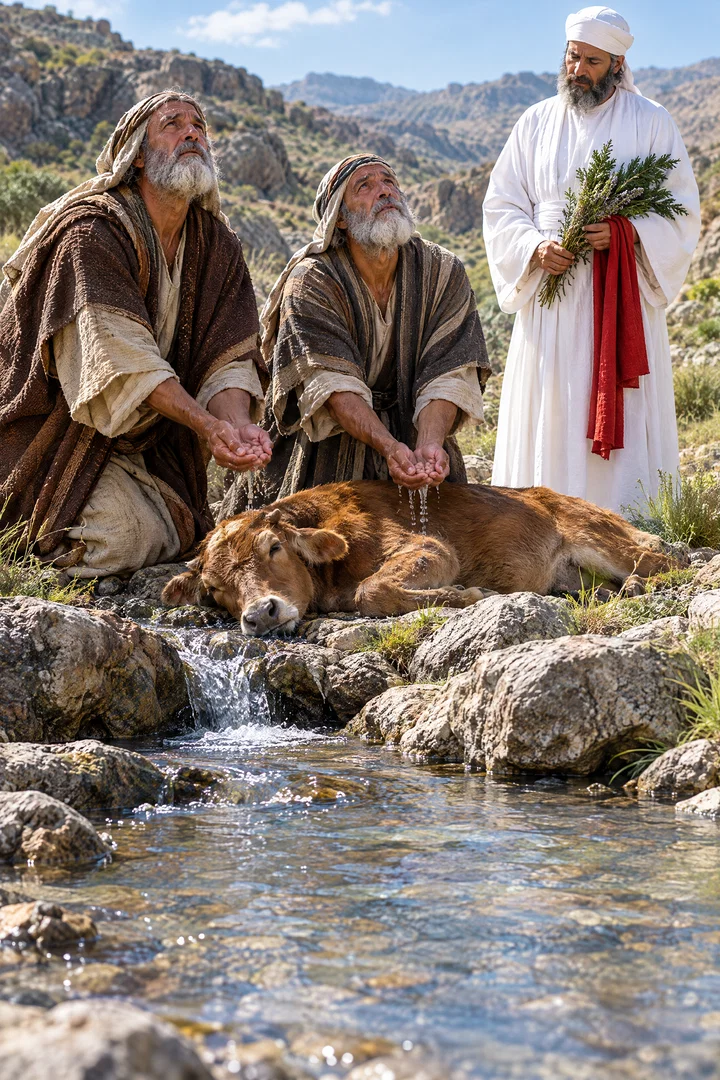
And the elders of that city shall bring down the heifer unto a rough valley, which is neither eared nor sown, and shall strike off the heifer’s neck there in the valley:
Translations
And the elders of that city shall bring down the heifer to a rough valley, which is neither eared nor sown, and shall strike off the heifer’s neck there in the valley:
And the elders of that city shall bring down the heifer unto a rough valley, which is neither eared nor sown, and shall strike off the heifer’s neck there in the valley:
and the elders of that city shall bring down the heifer unto a rough valley, which is neither eared nor sown, and shall strike off the heifer’s neck there in the valley:
And the elders of that city shall bring down the heifer to a rough valley, which is neither tilled nor sown, and shall strike off the heifer's neck there in the valley;
and the elders of that city shall bring down the heifer unto a valley with running water, which is neither plowed nor sown, and shall break the heifer’s neck there in the valley:
and the elders of that city shall bring down the heifer unto a valley with running water, which is neither plowed nor sown, and shall break the heifer’s neck there in the valley.
and the elders of that city have brought down the heifer unto a hard valley, which is not tilled nor sown, and have beheaded there the heifer in the valley.
and the elders of that city shall bring down the heifer unto an ever-flowing watercourse, which is not tilled, nor is it sown, and shall break the heifer's neck there in the watercourse;
and the elders of that city shall take down the heifer into a ravine with an everflowing stream, which is neither tilled nor sown,—and shall behead there the heifer in the ravine.
Berean Standard Bible, Majority Standard Bible
bring the heifer to a valley with running water that has not been plowed or sown, and break its neck there by the stream.
The elders of that city shall bring the heifer down to a valley with running water, which is neither plowed nor sown, and shall break the heifer’s neck there in the valley.
And they are to take the cow into a valley where there is flowing water, and which is not ploughed or planted, and there the neck of the cow is to be broken:
And let the Elders of that citie bring the heifer vnto a stonie valley, which is neyther eared nor sowen, and strike off the heifers necke there in the valley.
Douay-Rheims (Challoner revision)
And they shall bring her into a rough and stony valley, that never was ploughed, nor sown: and there they shall strike off the head of the heifer:
Pictures
Cross-references
- Hebrews 13:12
Wherefore Jesus also, that he might sanctify the people with his own blood, suffered without the gate.
Jesus suffered outside the gate, as the heifer was slain outside the camp.
- Numbers 19:3
And ye shall give her unto Eleazar the priest, that he may bring her forth without the camp, and one shall slay her before his face:
Both describe a heifer’s slaughter outside the camp or in a rough valley.
Commentary
Each commentary is drawn from primary sources: the writings of Ellen G. White and Adventist pioneers and periodicals. Each commentary is separate. Its own words are not a quotation; follow the references to read the source passages.
Ellen G. White
1 source
When a slain person was found and the killer was not known, the elders of the city nearest to the place were to take a heifer that had never been worked and lead it down to a rough valley that had never been plowed or planted.ST Jan 20, 1881 There in that uncultivated valley they were to break the heifer's neck in a solemn and public ceremony.ST Jan 20, 1881 The rite was appointed to compel the rulers to declare openly their abhorrence of murder.ST Jan 20, 1881 It was also to impress upon them their duty to search diligently for the criminal and bring him to justice.ST Jan 20, 1881 They were not to treat such a crime with indifference or carelessness, nor were they to shelter the guilty from punishment, for failure to act made them partakers in the evil and left guilt and defilement resting upon the land and its people.ST Jan 20, 1881
Sources
Pioneers and periodicals
6 sources
Deuteronomy 21:4 stands within Moses's repetition of the law before Israel crossed the Jordan into the promised land, rehearsing the wonderful things God had done for His people and some of the chief laws of Israel to recall the lessons of forty years of wilderness wandering and to impress the sacred importance of God's holy law and the necessity of keeping it.ST Mar 1, 1910 The verse requires the elders of the city nearest an unsolved murder to bring an unused heifer down to a rough valley which had neither been plowed nor sown, outside the cultivated land and the camp and away from the sanctuary court, and there in a solemn public ceremony to break its neck and shed its blood upon the ground.ST Jan 20, 1881RH May 16, 1912RH May 16, 1912RH May 16, 1912
The rite held cities and towns responsible for crime committed near them, requiring their rulers to show abhorrence of murder and diligent responsibility to seek the criminal rather than treating the crime with carelessness or shielding the guilty, since such neglect made them share in the evil and left a stain upon the land and its people.ST Jan 20, 1881ST Mar 11, 1908 The killing of the heifer in a rough valley outside the camp prefigures Christ suffering outside the gate so that He could sanctify the people with His blood.RH May 16, 1912
The unworked, unsown place chosen to receive the blood symbolizes Christ's sacrifice, showing that even lives wasted and made seemingly worthless by sin can be reached by His mercy when sinners turn toward the heavenly sanctuary and plead for forgiveness.RH May 16, 1912 The rocky, seemingly worthless valley represents even a wasted or deeply sinful life, teaching that no one is beyond the reach of Christ's saving mercy, and the heifer's blood sprinkled over its stones symbolizes Christ's blood offered for people of every nation to bring salvation to all who turn to God and seek mercy.RH May 16, 1912
Sources