Numbers 19:3
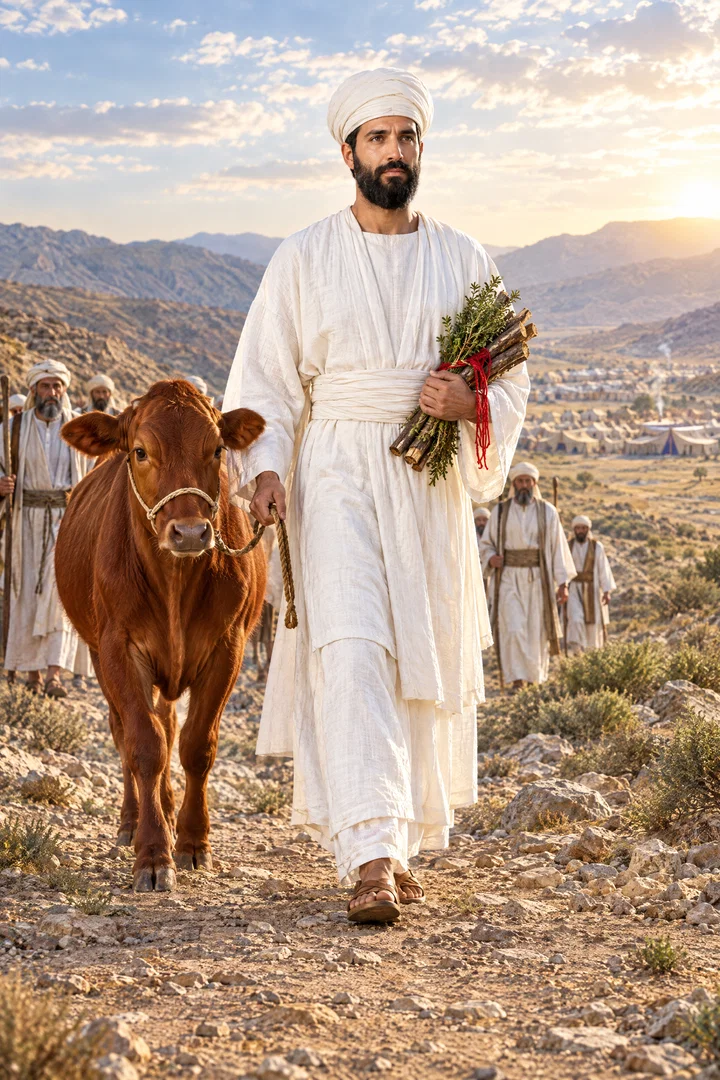
And ye shall give her unto Eleazar the priest, that he may bring her forth without the camp, and one shall slay her before his face:
Translations
And you shall give her to Eleazar the priest, that he may bring her forth without the camp, and one shall slay her before his face:
And ye shall give her unto Eleazar the priest, that he may bring her forth without the camp, and one shall slay her before his face:
and ye shall give her unto Eleazar the priest, that he may bring her forth without the camp, and one shall slay her before his face:
And ye shall give her to Eleazar the priest, that he may bring her forth without the camp, and one shall slay her before his face:
and ye shall give her unto Eleazar the priest, and he shall bring her forth without the camp, and one shall slay her before his face:
And ye shall give her unto Eleazar the priest, and he shall bring her forth without the camp, and one shall slay her before his face:
and ye have given it unto Eleazar the priest, and he hath brought it out unto the outside of the camp, and hath slaughtered it before him.
and ye shall give it to Eleazar the priest, and he shall bring it outside the camp, and one shall slaughter it before him.
Then shall ye give her unto Eleazar the priest, and he shall take her forth unto the outside of the camp, and she shall be slain before him;
Berean Standard Bible, Majority Standard Bible
Give it to Eleazar the priest, and he will have it brought outside the camp and slaughtered in his presence.
You shall give her to Eleazar the priest, and he shall bring her outside of the camp, and one shall kill her before his face.
Give her to Eleazar the priest and let him take her outside the tent-circle and have her put to death before him.
And ye shall giue her vnto Eleazar ye Priest, that hee may bring her without the hoste, and cause her to be slaine before his face.
Douay-Rheims (Challoner revision)
And you shall deliver her to Eleazar the priest, who shall bring her forth without the camp, and shall immolate her in the sight of all:
Pictures
Cross-references
- Hebrews 13:12
Wherefore Jesus also, that he might sanctify the people with his own blood, suffered without the gate.
Jesus suffered outside the gate, corresponding to the heifer slain outside the camp.
- Hebrews 9:13-14
For if the blood of bulls and of goats, and the ashes of an heifer sprinkling the unclean, sanctifieth to the purifying of the flesh:
The heifer’s ashes cleanse outwardly, while Christ’s offering cleanses the conscience.
- Hebrews 9:22
And almost all things are by the law purged with blood; and without shedding of blood is no remission.
Forgiveness requires bloodshed.
- Hebrews 10:22
Let us draw near with a true heart in full assurance of faith, having our hearts sprinkled from an evil conscience, and our bodies washed with pure water.
The heifer’s blood ritual connects with drawing near with hearts cleansed from an evil conscience.
- Leviticus 17:11
For the life of the flesh is in the blood: and I have given it to you upon the altar to make an atonement for your souls: for it is the blood that maketh an atonement for the soul.
Blood is given as life to make atonement.
- Leviticus 4:12
Even the whole bullock shall he carry forth without the camp unto a clean place, where the ashes are poured out, and burn him on the wood with fire: where the ashes are poured out shall he be burnt.
The sin offering is taken outside the camp and burned.
- Leviticus 16:27
And the bullock for the sin offering, and the goat for the sin offering, whose blood was brought in to make atonement in the holy place, shall one carry forth without the camp; and they shall burn in the fire their skins, and their flesh, and their dung.
The sin offering’s remains are burned outside the camp.
- Leviticus 4:21
And he shall carry forth the bullock without the camp, and burn him as he burned the first bullock: it is a sin offering for the congregation.
The sin offering is carried outside the camp and burned.
- Hebrews 13:13
Let us go forth therefore unto him without the camp, bearing his reproach.
each must individually go without the camp
- Hebrews 10:1-3
For the law having a shadow of good things to come, and not the very image of the things, can never with those sacrifices which they offered year by year continually make the comers thereunto perfect.
The sacrifices prefigure Christ’s atonement but cannot make worshippers perfect.
- Deuteronomy 21:4
And the elders of that city shall bring down the heifer unto a rough valley, which is neither eared nor sown, and shall strike off the heifer’s neck there in the valley:
Both describe a heifer killed outside the camp, in an uncultivated place.
- Hebrews 10:10
By the which will we are sanctified through the offering of the body of Jesus Christ once for all.
The sacrifice points to Christ’s once-for-all offering for sanctification.
- John 1:29
The next day John seeth Jesus coming unto him, and saith, Behold the Lamb of God, which taketh away the sin of the world.
Christ is presented as the one who takes away the world’s sin.
- Hebrews 9:23
It was therefore necessary that the patterns of things in the heavens should be purified with these; but the heavenly things themselves with better sacrifices than these.
Earthly purification is linked to the cleansing of heavenly things.
Commentary
Each commentary is drawn from primary sources: the writings of Ellen G. White and Adventist pioneers and periodicals. Each commentary is separate. Its own words are not a quotation; follow the references to read the source passages.
Ellen G. White
2 sources
The red heifer was to be led forth outside the camp and slain there.4T 120.2–121.14T 121.2–122.1 It was entrusted to Eleazar the priest and slain before his face as a sacrifice for the congregation's purification from ceremonial defilement.4T 120.2–121.1 Contact with death in this rite represented the pollution of sin, because death came as a consequence of sin.4T 120.2–121.1 The heifer itself represents Christ, the one great offering whose sacrifice redeems from sin.4T 120.2–121.1
Its slaying outside the camp prefigures Christ suffering outside Jerusalem, at Calvary outside the city's gates.4T 120.2–121.14T 121.2–122.1 This shows His death was for all mankind and not for the Hebrews alone, offering redemption and salvation to the fallen world.4T 120.2–121.14T 121.2–122.1
Sources
Pioneers and periodicals
17 sources
The heifer was to be given to Eleazar the priest, led entirely outside the camp to a rough uncultivated valley, and slain there before his face by another hand while he looked on and then sprinkled its blood seven times toward the sanctuary to provide ashes for purifying the defiled.RH May 16, 1912ST Feb 22, 1910RH May 16, 1912ST Jun 12, 1901RH Apr 11, 1871 It was to be a perfectly formed red heifer upon which a yoke had never been laid, chosen by all the people, its red color being divinely required and irreplaceable.ST Jun 12, 1901ST Apr 23, 1912ST Jan 1, 1885 Being brought forth without the camp and slain foreshadows Jesus brought before the high priest and suffering outside Jerusalem's gate to sanctify the people with His own blood.RH May 16, 1912ST Jun 12, 1901ST Jun 27, 1911 The service beyond the sanctuary points to a special phase of His atonement for all men, showing He suffered for the whole world and even for the most worthless and outcast.RH May 16, 1912ST Jun 12, 1901RH Apr 11, 1871ST Oct 29, 1912RH May 16, 1912 That sacrifice was made once for all, yet it did not automatically cleanse all Israel, but each defiled person had to individually use its provision by turning toward the sanctuary, confessing, and pleading for mercy, even as each sinner must singly enter into what Christ tasted for all.RH May 16, 1912ST Jun 12, 1901
Ceremony and Its Setting
The heifer was to be given to Eleazar the priest, who led her away from the sanctuary and entirely outside the camp of Israel, where she was slain before his face by another hand.ST Jun 12, 1901RH Apr 11, 1871ST Jan 1, 1885 That slayer is identified both as the elders acting together and as one chosen person selected for the act.RH May 16, 1912ST Jun 12, 1901 All the people united in selecting the animal from the flock before she was brought to the priest.ST Jun 12, 1901
The slaughter took place outside the camp in a rough, uncultivated valley, rather than at the temple.RH May 16, 1912RH May 16, 1912RH May 16, 1912 It therefore stood apart from the sanctuary's second apartment, belonging to a rite performed outside that inner place.RH Nov 11, 1909 The valley setting was rough and uncultivated, not a prepared sanctuary court.RH May 16, 1912RH May 16, 1912
The animal so chosen was to be perfectly formed, without blemish, and one upon which a yoke had never been laid.ST Jun 12, 1901ST Apr 23, 1912 Its red color was divinely specified and essential to the service, so that substituting an animal of another color or kind would violate the command.ST Jan 1, 1885 The priest then sprinkled its blood toward the temple seven times, even upon the rough stones of that outer place.RH May 16, 1912ST Oct 29, 1912 Its ashes became the standing provision for the purification of those defiled and unclean, used in cleansing from defilement and from sin.ST Feb 22, 1910ST Apr 23, 1912RH Nov 11, 1909
The red-heifer offering is named as an exception to the offerings described in the first chapters of Leviticus.ST May 19, 1914 It is likewise an exception to the typical law's general rule that things were purified by blood.ST Feb 17, 1890 Some purifications in Numbers 19 were performed without blood and concerned fleshly defilement rather than sin.ST Feb 17, 1890ST Feb 17, 1890 The ordinance was used continually even though it is not mentioned again from the Pentateuch to the close of the Old Testament, so that later silence does not show that observance had ceased.RH Aug 3, 1869
Type of Christ's Sacrifice
The ordinance shows Christ in the red heifer, pointing to faith in Him as the common Saviour for all and to a special phase of His atonement work for men.ST Jun 12, 1901RH Apr 11, 1871 All the people united in selecting from the flock a perfectly formed heifer having no blemish and upon which a yoke had never been laid, and brought her to the priest, who led her away from the sanctuary and entirely out of the camp of Israel, where one chosen person slew her before the priest's face.ST Jun 12, 1901 Her being handed to Eleazar, taken outside the camp, and slaughtered before him is the part of the ceremony that points to Christ.RH Apr 11, 1871
Her being brought forth without the camp and slain foreshadows Jesus suffering and dying outside the gate to sanctify the people with His own blood.RH May 16, 1912ST Jun 12, 1901ST Jun 27, 1911ST Apr 23, 1912 She was taken outside the camp and killed in a rough valley, and placed outside the camp where she was slain before Eleazar, with her ashes then used for purification from sin.RH May 16, 1912ST Apr 23, 1912 Her being brought forth without the camp and slain before his face means Christ suffering outside the camp and outside Jerusalem's gate, being delivered up and put to death.ST Jun 12, 1901ST Jun 27, 1911ST Apr 23, 1912
Giving her to Eleazar the priest signifies bringing Jesus to the high priest where the scribes and elders were gathered, as when Judas with the great multitude from the chief priests and elders brought Jesus there.ST Jun 12, 1901 Two lives are represented in the sin-offering, the innocent life of the victim and the imputed sinful life of the offerer, so that the same blood conveys defilement to the sanctuary and cleansing to the sinner.ST Jun 27, 1911 Thus even the priest who sprinkled her blood was made unclean, and the clean person who gathered the ashes and the one who sprinkled the ashes mingled with water had to wash his clothes and be unclean until evening, while the unclean person was cleansed by those same ashes.ST Jun 27, 1911 In this way Christ on the cross was made sin and suffered as the vilest of sinners, yet at the same time by virtue of His own pure life He cleansed sinners, as He cleansed the thief.ST Jun 27, 1911
Cleansing Provision for All
The leading outside the camp to a rough, uncultivated valley rather than to the temple, with the blood sprinkled toward the temple seven times even upon rough stones, shows a death for the whole world and not for the Hebrew people alone, with salvation offered to all nations and peoples.RH May 16, 1912RH May 16, 1912 The same place and blood hold out hope even to lives that seem wasted and to those sunk deeply in sin and heathen darkness, teaching a death even for the most worthless and outcast.RH May 16, 1912ST Oct 29, 1912RH May 16, 1912 No one is too worthless or sinful to be saved, but those who turn toward the heavenly sanctuary, confess their sins, and plead for mercy may receive the cleansing power the blood represents.RH May 16, 1912
The sacrifice was made once for all for the whole people, yet it did not automatically purify the whole house of Israel, but laid up a cleansing provision that each defiled person must individually use to be freed from personal impurity.ST Jun 12, 1901 In the same way death tasted for all does not of itself make each clean, but each person must singly enter into what was done for all.ST Jun 12, 1901 Since this rite whose ashes cleansed the defiled took place outside the sanctuary's second apartment, the earthly types included service beyond the work in the most holy place, showing a heavenly ministry that encompasses the sanctuary as a whole.RH Nov 11, 1909
Sources