Deuteronomy 27:13
And these shall stand upon mount Ebal to curse; Reuben, Gad, and Asher, and Zebulun, Dan, and Naphtali.
Translations
And these shall stand on mount Ebal to curse; Reuben, Gad, and Asher, and Zebulun, Dan, and Naphtali.
King James Version, Webster Bible
And these shall stand upon mount Ebal to curse; Reuben, Gad, and Asher, and Zebulun, Dan, and Naphtali.
and these shall stand upon mount Ebal to curse; Reuben, Gad, and Asher, and Zebulun, Dan, and Naphtali.
and these shall stand upon mount Ebal for the curse; Reuben, Gad, and Asher, and Zebulun, Dan, and Naphtali.
And these shall stand upon mount Ebal for the curse: Reuben, Gad, and Asher, and Zebulun, Dan, and Naphtali.
And these do stand, for the reviling, on mount Ebal: Reuben, Gad, and Asher, and Zebulun, Dan, and Naphtali.
And these shall stand upon mount Ebal to curse: Reuben, Gad, and Asher, and Zebulun, Dan, and Naphtali.
and, these, shall stand by the curse in Mount Ebal,—Reuben Gad and Asher, and Zebulun Dan and Naphtali.
Berean Standard Bible, Majority Standard Bible
And these tribes shall stand on Mount Ebal to deliver the curse: Reuben, Gad, Asher, Zebulun, Dan, and Naphtali.
These shall stand on Mount Ebal for the curse: Reuben, Gad, Asher, Zebulun, Dan, and Naphtali.
And these are to be on Mount Ebal for the curse: Reuben, Gad, and Asher, and Zebulun, Dan, and Naphtali.
And these shall stand vpon mount Ebal to curse: Reuben, Gad, and Asher, and Zebulun, Dan, and Naphtali.
Douay-Rheims (Challoner revision)
And over against them shall stand on mount Hebal to curse: Ruben, Gad, and Aser, and Zabulon, Dan, and Nephtali.
Pictures
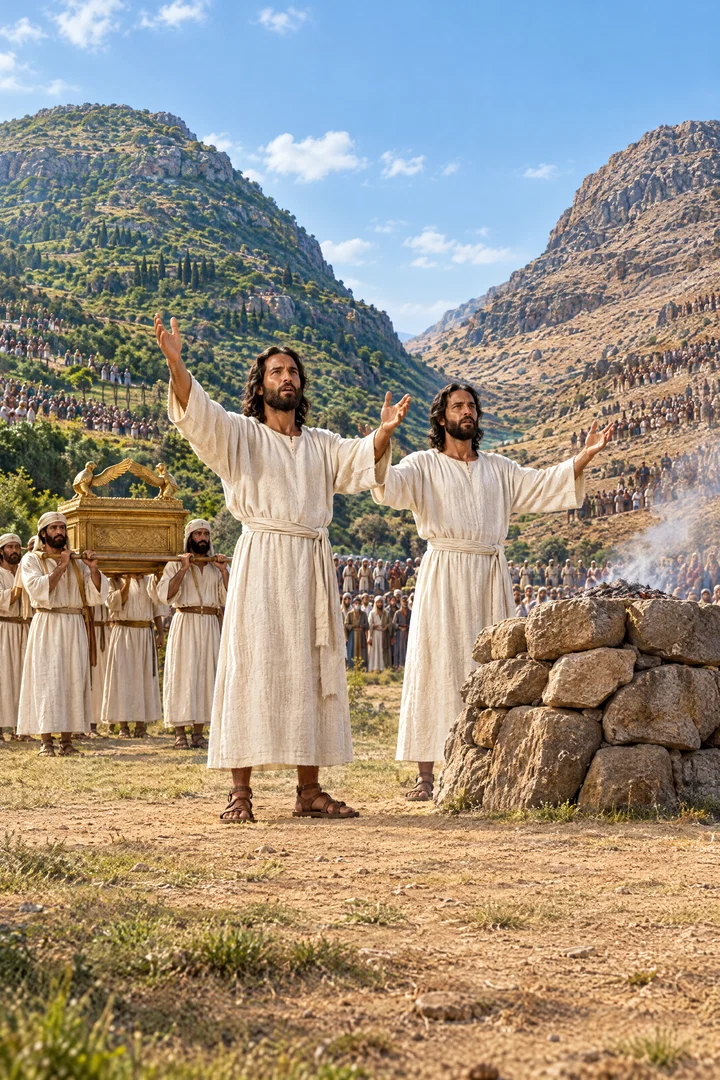
Cross-references
- Joshua 8:33-34
And all Israel, and their elders, and officers, and their judges, stood on this side the ark and on that side before the priests the Levites, which bare the ark of the covenant of the LORD, as well the stranger, as he that was born among them; half of them over against mount Gerizim, and half of them over against mount Ebal; as Moses the servant of the LORD had commanded before, that they should bless the people of Israel.
Israel stands between Ebal and Gerizim as Joshua reads the law’s blessings and curses.
- Deuteronomy 11:29
And it shall come to pass, when the LORD thy God hath brought thee in unto the land whither thou goest to possess it, that thou shalt put the blessing upon mount Gerizim, and the curse upon mount Ebal.
Designates Gerizim for blessing and Ebal for the curse.
- Deuteronomy 28
And it shall come to pass, if thou shalt hearken diligently unto the voice of the LORD thy God, to observe and to do all his commandments which I command thee this day, that the LORD thy God will set thee on high above all nations of the earth:
Sets out blessings for obedience and curses for turning from God.
- Joshua 8:30-32
Then Joshua built an altar unto the LORD God of Israel in mount Ebal,
Joshua carries out the command to build an altar and write the law on stones.
- Deuteronomy 27:2-4
And it shall be on the day when ye shall pass over Jordan unto the land which the LORD thy God giveth thee, that thou shalt set thee up great stones, and plaister them with plaister:
Israel is commanded to write the law on plastered stones after crossing the Jordan.
- Galatians 3:13
Christ hath redeemed us from the curse of the law, being made a curse for us: for it is written, Cursed is every one that hangeth on a tree:
Christ’s redemption from the law’s curse averts the wrath signified at Ebal.
- Deuteronomy 11:26-28
Behold, I set before you this day a blessing and a curse;
Sets out the blessing and curse pronounced on the tribes.
- Deuteronomy 27:26
Cursed be he that confirmeth not all the words of this law to do them. And all the people shall say, Amen.
Concludes the curses proclaimed in the ceremony.
Commentary
Each commentary is drawn from primary sources: the writings of Ellen G. White and Adventist pioneers and periodicals. Each commentary is separate. Its own words are not a quotation; follow the references to read the source passages.
Ellen G. White
9 sources
This direction belongs to the ceremony for the day Israel crossed the Jordan, when the consequences of blessing and curse were to be proclaimed from two prominent mountains.6MR 373.3–374.1Ms 7, 1904, par. 126–128Lt 162, 1900, par. 16–17 Six tribes — Reuben, Gad, Asher, Zebulun, Dan, and Naphtali — were to stand upon Mount Ebal to pronounce the covenant curses.Ms 68, 1900, par. 3–56MR 373.3–374.1PP 500.2ST May 12, 1881Ms 135, 1899, par. 7 Mount Ebal was the mount of curses for the disobedient, set opposite Mount Gerizim, the mount of blessings for the obedient, and from these two prominent positions the disadvantages of the curse and the advantages of the blessing were pronounced as a repetition.Ms 7, 1904, par. 126–128Lt 162, 1900, par. 16–17Ms 135, 1899, par. 7 The proclamation was joined with plastering a rock and writing the commandments of God upon it, and after each declaration the whole congregation was to assent to its specifications, thereby accepting solemn responsibility to fulfill the conditions.Ms 7, 1904, par. 126–128Lt 162, 1900, par. 16–17 The arrangement shows particular care over forgetful Israel to keep the requirements plainly before them and to make the law familiar and impressive, in order to deter from transgression and encourage obedience, revealing that God takes no pleasure in the death of the wicked but takes greatest pleasure when sinners turn from sin.Ms 7, 1904, par. 126–128Lt 162, 1900, par. 16–17
Together with the surrounding chapters in Deuteronomy 26 through 28, the direction gives a plain and specific statement of the principles of the law of the kingdom of God so that minds are not left in ignorance and uncertainty: disobedience brings a curse, while obedience brings prosperity and blessing.RH Dec 25, 1900Ms 67, 1907, par. 3Ms 68, 1900, par. 3–5 The words are not the voice of man but the voice of Christ from the enfolding pillar of cloud.RH Dec 25, 1900Ms 67, 1907, par. 3 They lay a never-ceasing obligation on all blessed with life, health, and temporal and spiritual advantages, to be read carefully and kept and done with all the heart and soul, and their claims remain as binding and fresh now as God's gifts are fresh and continual.RH Dec 25, 1900Ms 67, 1907, par. 3
The altar erected on Ebal signifies that by transgressing the law Israel had justly incurred divine wrath, but that wrath would not be visited because the sacrifices offered there represented Christ's atonement.PP 500.2 The curses warned of the consequences of disregarding the law, and Joshua later rehearsed them with the blessings for obedience before the people as Moses had commanded.ST May 12, 1881 Mount Ebal, opposite Gerizim, thus stood as witness to Israel's solemn vows when they entered Canaan, vows Joshua recalled at Shechem as the people renewed their commitment to God.ST May 12, 1881Ms 135, 1899, par. 7
Sources
Pioneers and periodicals
26 sources
Six tribes were appointed to stand on Mount Ebal to speak the curses while the other six stood on Mount Gerizim to speak the blessings, making Ebal the mount of cursing set over against Gerizim the mount of blessing in Israel's solemn assent to the law and its covenant consequences.ST Mar 11, 1908ST Aug 14, 1901ST Feb 20, 1896 The ark rested in the valley between them with the priests and Levites near it, who turned first toward Gerizim to recite each blessing and then toward Ebal to recite each curse, while the hosts answered with a loud Amen in fear and awe.RH Apr 29, 1875 The appointment belongs to the directions of Deuteronomy 26 through 28 that set forth plainly the blessings of obedience and the fearful curses of transgression, expressing not man's voice but Christ's voice from the cloud declaring the never-ceasing obligation of the law of God's kingdom.RH Dec 25, 1900RH Apr 30, 1867ST Mar 8, 1910 Every curse pronounced from Ebal is for breaking one of the Ten Commandments, showing that Ebal represents the consequence of rejecting God's word, so that promised blessings become curses when His counsel is disobeyed.ST May 12, 1881ST Sep 15, 1887RH Jul 9, 1867ST Aug 14, 1901 The two mountains therefore picture the choice still set before every person between holiness and sin, blessing and cursing, by which each day destiny is fashioned for all hereafter.ST Apr 4, 1911ST Jul 4, 1899ST Nov 29, 1899
Ceremony on Two Mountains
Reuben, Gad, Asher, Zebulun, Dan, and Naphtali were appointed to stand upon Mount Ebal to pronounce the curses, while the other six tribes stood upon Mount Gerizim to pronounce the blessings.ST Mar 11, 1908ST Aug 14, 1901ST Feb 20, 1896RH Jan 4, 1912 Ebal is the mount of cursing in contrast with Gerizim the mount of blessing.ST Aug 14, 1901RH Jan 4, 1912ST Jun 23, 1898 This division was part of Israel's solemn declaration of the law and its covenant consequences of blessings and curses when Israel entered the promised land.ST Mar 11, 1908ST Feb 20, 1896ST Jun 23, 1898
The setting was the valley of Sychar between the two high mountains after Israel had gained the promised land, with the ark of the covenant resting midway in the valley with the priests and Levites near it, radiant with cherubim and mercy-seat under the Lord's Shekinah.RH Apr 29, 1875 Those on Ebal were half the hosts, while those honored with Gerizim were the sons of Rachel's children with all of Leah's sons save Reuben and Zebulun.RH Apr 29, 1875 The priests turned first to Gerizim to recite each blessing and then northward to Ebal to recite each curse, beginning with blessing on the man who never makes a graven image and cursing on the man who makes a molten image.RH Apr 29, 1875 All the tribes on Ebal shouted a deep loud Amen with fear and awe in an imposing scene the listening children never forgot.RH Apr 29, 1875
The commands about stones belong to the commanded ceremony at Shechem between Ebal and Gerizim, carried out when Joshua built an altar and wrote on it after Israel passed over Jordan.ST Oct 16, 1884ST Feb 14, 1884 They do not supply the background for the ministration of death engraven on stones in 2 Corinthians 3:7.ST Oct 16, 1884 That description points instead to Moses coming down after forty days and forty nights communing with the Lord with the two tables of stone in his hands, his face shining with glory brought from the presence of the Lord so that the people could not look upon it and he put a veil over his face while talking with them, as recorded in Exodus 34.ST Oct 16, 1884
The blessings were read on Mount Gerizim, the Mount of Samaria, where Samaritan ancestors had worshiped for more than four hundred years before Christ.ST Sep 3, 1894ST Sep 3, 1894 The Samaritans claimed that mountain as the true place of worship against Jerusalem, which God had chosen, while the Jews claimed Jerusalem as the only place of worship.ST Sep 3, 1894ST Sep 3, 1894 When Jesus was revealed to the Samaritan woman as a prophet, doubt came into her mind about the true place of worship, and she thought that after all Jerusalem was to be preferred to Samaria.ST Sep 3, 1894
Law's Curse and Obligation
Deuteronomy 27:13 belongs to the directions in Deuteronomy 26 through 28 that state plainly the blessings of obedience.RH Dec 25, 1900 The words are not the voice of man but the voice of Christ from the infolding pillar of cloud.RH Dec 25, 1900 These directions express the principles of the law of the kingdom of God, made specific so that minds may not be left in ignorance and uncertainty.RH Dec 25, 1900 They present the never-ceasing obligation of all blessed with life and health and advantages in temporal and spiritual things.RH Dec 25, 1900 The message has not grown weak with age, for God's claims are just as binding now and just as fresh in importance as His gifts are fresh and continual.RH Dec 25, 1900
The chapter especially emphasizes the fearful curses of transgression.ST Mar 8, 1910 It shows the law pronouncing sentence of despair and condemnation upon sinners.RH Apr 30, 1867 It sets before God's children the blessings and the curses, showing what would come upon them if faithful to God or disobedient. In harmony with God setting a blessing before those who obey and a curse before those who disobey in Deuteronomy 27:11-14, every curse in Deuteronomy 27:15-26 is for breaking one of the Ten Commandments.ST Sep 15, 1887
The verse is part of the explicit conditions the Lord laid down in Deuteronomy 27 and 28 for Israel to keep possession of the territory promised to the literal seed of Abraham.ST Jul 22, 1913 From the days of Solomon onward the nation departed from God and utterly refused to meet those conditions, though God by every effort of Divinity sought through His messengers to move their hearts.ST Jul 22, 1913 Their mocking of the messengers and despising of His words brought Jehovah's wrath till there was no remedy.ST Jul 22, 1913 Then came the Babylonian captivity expressly foretold, even to its seventy-year period.ST Jul 22, 1913
The curses warn Israel of the consequences of disregarding God's law.ST May 12, 1881 Joshua later rehearsed these curses along with the blessings for obedience before the people as Moses had commanded.ST May 12, 1881 Mount Ebal is the mount of cursing in contrast with Mount Gerizim the mount of blessing, with the named tribes Reuben, Gad, Asher, Zebulun, Dan, and Naphtali assigned to Ebal for the pronouncement of the curses.ST May 12, 1881RH Jul 9, 1867ST Aug 14, 1901 Ebal represents the consequence of rejecting God's word, so that blessings may become curses when people disobey and reject God's counsel.ST Aug 14, 1901 The prospect of blessing or cursing is needed to move ancient and modern people to do what they know is right.RH Jul 9, 1867
Choosing Blessing or Cursing
Ebal stands as the mount of cursing opposite Gerizim as the mount of blessing, with bolts of cursing coming down from Ebal's cloudy crown just as dews of blessing come from starry Gerizim.ST Apr 4, 1911ST Jun 25, 1912ST Jul 4, 1899ST Nov 29, 1899ST Mar 19, 1896 The six tribes placed on Ebal to pronounce the curses stand in contrast with the tribes on Gerizim to pronounce the blessings.ST Jul 4, 1899ST Nov 29, 1899ST Dec 16, 1903ST May 5, 1898ST Mar 19, 1896 The two mountains picture the choice between blessing and cursing, holiness and sin.ST Apr 4, 1911ST Jul 4, 1899ST Nov 29, 1899ST Dec 16, 1903ST May 5, 1898 Even now each day every person fashions destiny for all hereafter by that choice, and by choosing holiness or sin calls down blessing or cursing upon themselves.ST Apr 4, 1911ST Jul 4, 1899ST Nov 29, 1899ST May 5, 1898ST Mar 19, 1896
A people at crisis must choose between holiness and sin, between Justice, Truth, and Freedom and triumphant evil and robber wrong, and by that choice calls blessing or cursing down upon itself.ST Jun 25, 1912 America now stands face to face with that same choice, fashioning destiny and spinning the web of fate for all hereafter by what is chosen this day.ST Jun 25, 1912 To choose the righteous side and reject church-and-state union keeps freedom and brings blessing, while to turn to the darkness of the past and let church-and-state principles crystallize into law brings cursing and spells ruin to the Government.ST Jun 25, 1912
The barren condition of Ebal and the state of the surrounding scene recall the literal fulfillment of those curses.ST Sep 8, 1898
Sources