Deuteronomy 27:14
And the Levites shall speak, and say unto all the men of Israel with a loud voice,
Translations
American King James Version, Webster Bible
And the Levites shall speak, and say to all the men of Israel with a loud voice,
King James Version, KJV Cambridge Paragraph Bible
And the Levites shall speak, and say unto all the men of Israel with a loud voice,
Revised Version, American Standard Version
And the Levites shall answer, and say unto all the men of Israel with a loud voice,
'And the Levites have answered and said unto every man of Israel — a loud voice:
And the Levites shall declare and say unto all the men of Israel with a loud voice:
Then shall the Levites respond and say unto every man of Israel with voice uplifted:—
Berean Standard Bible, Majority Standard Bible
Then the Levites shall proclaim in a loud voice to every Israelite:
With a loud voice, the Levites shall say to all the men of Israel,
Then the Levites are to say in a loud voice to all the men of Israel,
And the Leuites shall answere and say vnto all the men of Israel with a loude voyce,
Douay-Rheims (Challoner revision)
And the Levites shall pronounce, and say to all the men of Israel with a loud voice:
Pictures
Cross-references
- Joshua 8:33-35
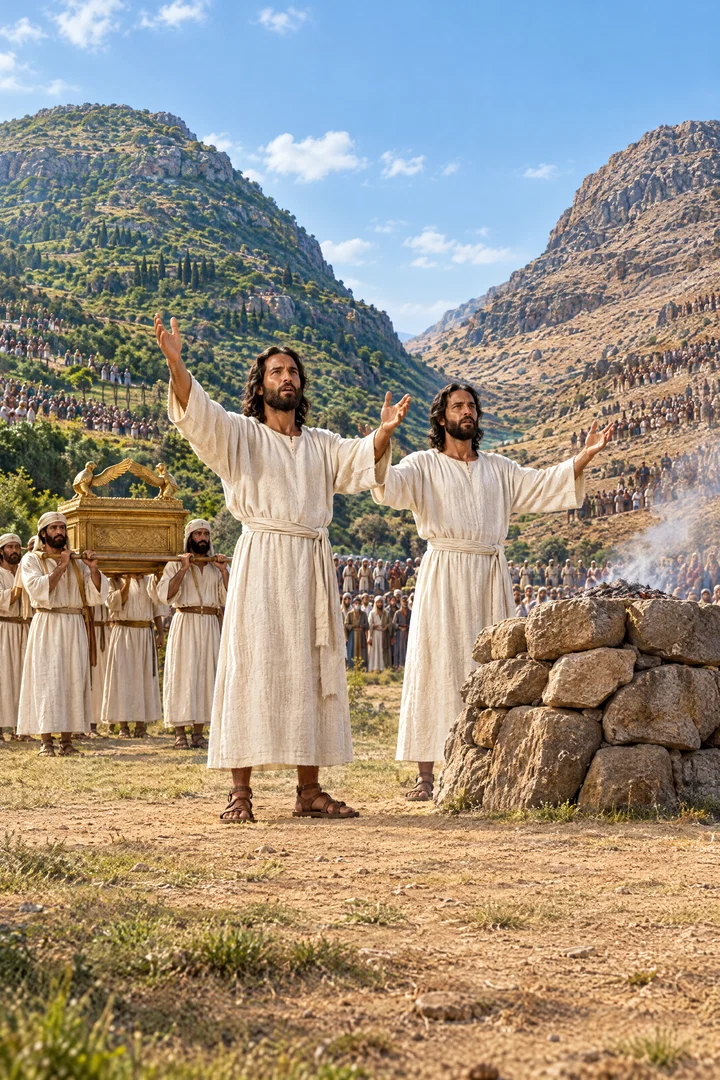
And all Israel, and their elders, and officers, and their judges, stood on this side the ark and on that side before the priests the Levites, which bare the ark of the covenant of the LORD, as well the stranger, as he that was born among them; half of them over against mount Gerizim, and half of them over against mount Ebal; as Moses the servant of the LORD had commanded before, that they should bless the people of Israel.
Israel gathers at Ebal and Gerizim to hear the law’s blessings and curses.
- Joshua 8:30-32
Then Joshua built an altar unto the LORD God of Israel in mount Ebal,
Joshua fulfills Moses’ command to write the law on stones after crossing the Jordan.
- Deuteronomy 27:2-4
And it shall be on the day when ye shall pass over Jordan unto the land which the LORD thy God giveth thee, that thou shalt set thee up great stones, and plaister them with plaister:
The law was to be written on plastered stones after Israel crossed the Jordan.
- Deuteronomy 28
And it shall come to pass, if thou shalt hearken diligently unto the voice of the LORD thy God, to observe and to do all his commandments which I command thee this day, that the LORD thy God will set thee on high above all nations of the earth:
Together they give blessings and curses for Israel’s obedience or departure from God.
- Deuteronomy 11:29-30
And it shall come to pass, when the LORD thy God hath brought thee in unto the land whither thou goest to possess it, that thou shalt put the blessing upon mount Gerizim, and the curse upon mount Ebal.
Commands Israel to pronounce blessing and curse at the two mountains.
- Deuteronomy 27:23
Cursed be he that lieth with his mother in law. And all the people shall say, Amen.
The incest prohibition is part of the continuing curse series.
- Deuteronomy 27:26
Cursed be he that confirmeth not all the words of this law to do them. And all the people shall say, Amen.
The people’s Amen seals the preceding curses as binding.
- Deuteronomy 27:24
Cursed be he that smiteth his neighbour secretly. And all the people shall say, Amen.
The secret assault is one of the curses pronounced by the Levites.
- Deuteronomy 27:25
Cursed be he that taketh reward to slay an innocent person. And all the people shall say, Amen.
The verse pronounces a curse for taking payment to kill an innocent person.
- Deuteronomy 11:26-28
Behold, I set before you this day a blessing and a curse;
It gives the blessing-and-curse injunction that the Levites fulfill.
Commentary
Each commentary is drawn from primary sources: the writings of Ellen G. White and Adventist pioneers and periodicals. Each commentary is separate. Its own words are not a quotation; follow the references to read the source passages.
Ellen G. White
8 sources
After the crossing of the Jordan God's commands were to be written on plastered stones, and then the outcomes of obedience and disobedience were to be repeatedly proclaimed in a loud voice from two prominent positions so that the advantage of blessing and the disadvantage of cursing were made clear.Ms 7, 1904, par. 126–1286MR 373.3–374.1 The blessings upon the obedient were to be pronounced from Mount Gerizim and the curses upon the disobedient from Mount Ebal, with the Levites speaking each specification with a loud voice to all the men of Israel and the congregation assenting to each declaration.Lt 162, 1900, par. 16–17Ms 135, 1899, par. 7 As Moses had commanded, Joshua assembled the people and rehearsed the blessings that follow obedience and the curses that follow disregard of God's law.ST May 12, 1881 The mountains witnessed the vows Israel made on entering Canaan, and the people later gathered at Shechem to renew those vows before Joshua's death.Ms 135, 1899, par. 7
The loud voice speaking to all Israel is not the voice of man but the voice of Christ from the enfolding pillar of cloud, uttered with His own voice lest the people forget.RH Dec 25, 1900Ms 67, 1907, par. 3Ms 68, 1900, par. 3–5 The directions express the principles of the law of the kingdom of God made specific so that minds are not left in ignorance and uncertainty, showing how particular God was to make His law familiar and impressive to forgetful Israel.RH Dec 25, 1900Ms 68, 1900, par. 3–5Lt 162, 1900, par. 16–17Ms 7, 1904, par. 126–128 Together with Deuteronomy 26 and 28, the verse belongs to a plain statement of the blessings of obedience and the curse of disobedience, commanding Israel to keep and do God's statutes and judgments with all the heart and soul, avouching the Lord to be their God and walking in His ways and hearkening to His voice, with obedience bringing prosperity for present and future good.RH Dec 25, 1900Ms 67, 1907, par. 3Ms 68, 1900, par. 3–5
The verse lays a never-ceasing obligation on all whom God has blessed with life and health and temporal and spiritual advantages to publicly acknowledge His special favor so His name is glorified as a testimony that His Word is verity and truth, and by accepting the conditions Israel placed itself under solemn responsibility to fulfill them under a government of personal responsibility where each must stand for himself.RH Dec 25, 1900Ms 68, 1900, par. 3–5Lt 162, 1900, par. 16–17 God gave the ceremony to deter from transgression and encourage obedience, for He takes no pleasure in the death of the wicked but takes greatest pleasure in those who turn from sin.Lt 162, 1900, par. 16–17 The message has not grown weak because of age; God's claims are just as binding now and just as fresh in importance as God's gifts are fresh and continual.RH Dec 25, 1900
Sources
Pioneers and periodicals
16 sources
The Levites were to address all Israel with a loud voice to announce the covenant blessings and curses and the explicit conditions laid down for them.ST Jul 22, 1913ST Feb 20, 1896RH Jan 4, 1912 It belongs to the solemn ceremony of blessings from Mount Gerizim and curses from Mount Ebal, setting before Israel the results of obedience or disobedience.ST Mar 11, 1908ST Mar 10, 1909 The verse begins the pronouncement of curses that runs to the end of the chapter, with blessing put upon Gerizim for obeying the commandments of the Lord and curse upon Ebal for disobeying and turning aside to other gods, so that the curses that follow are for violating the ten commandments.ST Sep 15, 1887ST Sep 15, 1887 Together with chapters 26 and 28 it states plainly the blessings of obedience and the never-ceasing obligation of all whom God has blessed, and its message has not grown weak with age but God's claims are just as binding now as His gifts are fresh and continual.RH Dec 25, 1900 Those who held that the curses from this verse to the end stand good without exception taught that none has passed away or was nailed to the cross, while those who attached them to the added law taught that Christ redeemed believers from them.ST Sep 15, 1887RH Jan 28, 1902
Setting and Public Ceremony
The verse belongs to the closing part of Deuteronomy, chapters 26 to 34, which bring to the close the life of Moses.ST Mar 12, 1912 It belongs to the record of the solemn blessings and curses spoken from Mount Gerizim and Mount Ebal, presenting the blessings and the curses that would come upon God's children for obedience or disobedience.ST Mar 11, 1908ST Mar 10, 1909 It directs the Levites to address all the men of Israel with a loud voice as they announce the covenant blessings and curses and the explicit conditions laid down for Israel.ST Jul 22, 1913ST Feb 20, 1896
The ceremony gathered the people between the mountains, with the blessings affirmed on Mount Gerizim with a great amen and the curse proclaimed from Mount Ebal, associating the Levites with faithful ministry in speaking the covenant blessings and curses aloud to all Israel.RH Jan 4, 1912 In that ceremony the Levites, with the priests and the sacred ark, stood midway across the valley of Sychar between Gerizim and Ebal, nearly a thousand feet below the tribes, with the mercy-seat and Shekinah glory between them.RH Apr 29, 1875 Turning first toward Gerizim and then northward toward Ebal, they solemnly recited with a loud voice every blessing and curse of the law, such as blessing on the one who never makes a graven image and cursing on the one who makes a molten image.RH Apr 29, 1875 Half of Israel was ranged on each mountain — Rachel's sons with all of Leah's sons except Zebulun and Reuben on Gerizim and all the rest on Ebal — and answered each word with a loud amen that might shake the mountain's foundations, in fear and awe that listening children would never forget to their dying day.RH Apr 29, 1875
The public proclamation belongs to the ceremony of blessings on Mount Gerizim, where the Samaritans' ancestors worshiped for more than four hundred years before Christ.ST Sep 3, 1894 The verse belongs to the command for Israel to hear the covenant blessings and curses publicly proclaimed, which Joshua carried out by assembling the people as Moses had commanded and rehearsing the blessings that followed obedience and the curses that followed disregard of God's law.ST May 12, 1881
Meaning and Lasting Force
The verse begins the pronouncement of curses that runs to the end of the chapter.ST Sep 15, 1887 The Levites' loud proclamation to all Israel carries out God's setting before Israel a blessing and a curse.ST Sep 15, 1887 The blessing was to be put upon Mount Gerizim for obeying the commandments of the Lord, and the curse upon Mount Ebal for not obeying the commandments and turning aside to other gods, so the curses pronounced after the verse are curses for violating the ten commandments.ST Sep 15, 1887
The chapter especially emphasizes the solemn responsibilities of transgression and the fearful curses that follow it.ST Mar 8, 1910 It presents the law as a sentence of despair that declares the sinner's condemnation, in contrast with the gospel's message of comfort and salvation.RH Apr 30, 1867 The voice in the verse is Christ speaking from the infolding pillar of cloud, not the voice of man, giving directions that express the principles of the law of the kingdom of God, made specific so that minds are not left in ignorance and uncertainty.RH Dec 25, 1900
Together with chapters 26 and 28, the verse states plainly the blessings of obedience and the never-ceasing obligation of all whom God has blessed with life and health and advantages in temporal and spiritual things.RH Dec 25, 1900 The message has not grown weak because of age, and God's claims are just as binding now, just as fresh in importance, as God's gifts are fresh and continual.RH Dec 25, 1900 All the curses from this verse to the end of the chapter stand good without exception; none of it has passed away, none of it was taken out of the way and nailed to the cross, and all these curses are in full force today.ST Sep 15, 1887
Those who held otherwise taught that the curses described in the passage from this verse through verse 26 are attached to the added law, and that Christ redeemed believers from those curses.RH Jan 28, 1902 The verse belongs to the explicit conditions God laid down for Israel's continued possession of the territory promised to the literal seed of Abraham.ST Jul 22, 1913 Israel's utter refusal to meet them from the days of Solomon onward brought God's repeated efforts to save His people through messengers sent early out of compassion for His people and His dwelling place, then, when the messengers were mocked and His words despised and His prophets scoffed at until there was no remedy, the wrath of God in the Babylonian captivity expressly foretold by Jeremiah and Ezekiel, even to the seventy years the Jews should remain captive to Babylon.ST Jul 22, 1913 The curses pronounced by the Levites loudly addressing all Israel from Mount Ebal were literally fulfilled in the condition of the land around Ebal.ST Sep 8, 1898
Sources