Deuteronomy 27:15
Cursed be the man that maketh any graven or molten image, an abomination unto the LORD, the work of the hands of the craftsman, and putteth it in a secret place. And all the people shall answer and say, Amen.
Translations
Cursed be the man that makes any graven or molten image, an abomination to the LORD, the work of the hands of the craftsman, and puts it in a secret place. And all the people shall answer and say, Amen.
Cursed be the man that maketh any graven or molten image, an abomination unto the LORD, the work of the hands of the craftsman, and putteth it in a secret place. And all the people shall answer and say, Amen.
Cursed be the man that maketh any graven or molten image, an abomination unto the Lord, the work of the hands of the craftsman, and putteth it in a secret place. And all the people shall answer and say, Amen.
Cursed be the man that maketh any graven or molten image, an abomination to the LORD, the work of the hands of the artificer, and putteth it in a secret place: and all the people shall answer, and say Amen.
Cursed be the man that maketh a graven or molten image, an abomination unto the LORD, the work of the hands of the craftsman, and setteth it up in secret. And all the people shall answer and say, Amen.
Cursed be the man that maketh a graven or molten image, an abomination unto Jehovah, the work of the hands of the craftsman, and setteth it up in secret. And all the people shall answer and say, Amen.
'Cursed [is] the man who maketh a graven and molten image, the abomination of Jehovah, work of the hands of an artificer, and hath put [it] in a secret place, — and all the people have answered and said, Amen.
Cursed be the man that maketh a graven or molten image, an abomination to Jehovah, a work of the craftsman's hand, and putteth it up secretly! And all the people shall answer and say, Amen.
Cursed, be the man that maketh an image—cut or molten—an abomination unto Yahweh the work of the hands of the craftsman and putteth it in a secret place. And all the people shall respond and say—Amen.
‘Cursed is the man who makes a carved idol or molten image—an abomination to the LORD, the work of the hands of a craftsman—and sets it up in secret.’
And let all the people say, ‘Amen!’‘Cursed is the man who makes a carved idol or molten image— an abomination to the LORD, the work of the hands of a craftsman— and sets it up in secret.’ And let all the people say, ‘Amen!’
‘Cursed is the man who makes an engraved or molten image, an abomination to the LORD, the work of the hands of the craftsman, and sets it up in secret.’All the people shall answer and say, ‘Amen.’
Cursed is the man who makes any image of wood or stone or metal, disgusting to the Lord, the work of man's hands, and puts it up in secret. And let all the people say, So be it.
Cursed be the man that shall make any carued or molten image, which is an abomination vnto the Lord, the worke of the hands of the craftesman, and putteth it in a secrete place: And all the people shall answere, and say: So be it.
Douay-Rheims (Challoner revision)
Cursed be the man that maketh a graven and molten thing, the abomination of the Lord, the work of the hands of artificers, and shall put it in a secret place: and all the people shall answer and say: Amen.
Pictures
Cross-references 20 of 21
- Joshua 8:34-35
And afterward he read all the words of the law, the blessings and cursings, according to all that is written in the book of the law.
Israel hears the law’s blessings and curses read aloud at Ebal and Gerizim.
- Galatians 3:13
Christ hath redeemed us from the curse of the law, being made a curse for us: for it is written, Cursed is every one that hangeth on a tree:
Christ redeems believers from the law’s curse.
- Exodus 20:4
Thou shalt not make unto thee any graven image, or any likeness of any thing that is in heaven above, or that is in the earth beneath, or that is in the water under the earth:
Restates the commandment against making graven images.
- Exodus 34:17
Thou shalt make thee no molten gods.
Both prohibit making molten gods.
- Leviticus 26:1
Ye shall make you no idols nor graven image, neither rear you up a standing image, neither shall ye set up any image of stone in your land, to bow down unto it: for I am the LORD your God.
Both prohibit making and worshipping images.
- Leviticus 19:4
Turn ye not unto idols, nor make to yourselves molten gods: I am the LORD your God.
Both forbid making molten gods or images.
- Deuteronomy 4:16-19
Lest ye corrupt yourselves, and make you a graven image, the similitude of any figure, the likeness of male or female,
Both prohibit making images and worshipping them.
- Deuteronomy 16:22
Neither shalt thou set thee up any image; which the LORD thy God hateth.
Both prohibit setting up and worshipping images.
- Revelation 22:3
And there shall be no more curse: but the throne of God and of the Lamb shall be in it; and his servants shall serve him:
The curse is removed in the restored creation.
- Deuteronomy 27:2-8
And it shall be on the day when ye shall pass over Jordan unto the land which the LORD thy God giveth thee, that thou shalt set thee up great stones, and plaister them with plaister:
Israel is commanded to write the law on plastered stones after crossing the Jordan.
- Isaiah 44:9-10
They that make a graven image are all of them vanity; and their delectable things shall not profit; and they are their own witnesses; they see not, nor know; that they may be ashamed.
Both condemn making graven or molten images.
- Deuteronomy 5:8-10
Thou shalt not make thee any graven image, or any likeness of any thing that is in heaven above, or that is in the earth beneath, or that is in the waters beneath the earth:
Both forbid making graven images as idolatry.
- Deuteronomy 4:23
Take heed unto yourselves, lest ye forget the covenant of the LORD your God, which he made with you, and make you a graven image, or the likeness of any thing, which the LORD thy God hath forbidden thee.
Both prohibit making graven images forbidden by the Lord.
- Psalms 97:7
Confounded be all they that serve graven images, that boast themselves of idols: worship him, all ye gods.
Both prohibit graven images and idolatry.
- Deuteronomy 27:23
Cursed be he that lieth with his mother in law. And all the people shall say, Amen.
equally still a sin and curse
- Deuteronomy 27:24
Cursed be he that smiteth his neighbour secretly. And all the people shall say, Amen.
example still a sin if done secretly
- Deuteronomy 27:26
Cursed be he that confirmeth not all the words of this law to do them. And all the people shall say, Amen.
The people affirm the curse on those who fail to obey the law.
- Deuteronomy 11:29-30
And it shall come to pass, when the LORD thy God hath brought thee in unto the land whither thou goest to possess it, that thou shalt put the blessing upon mount Gerizim, and the curse upon mount Ebal.
Names the mountains where the blessings and curses are to be proclaimed.
- Joshua 8:30-32
Then Joshua built an altar unto the LORD God of Israel in mount Ebal,
notes fulfillment of Deuteronomy 27 command
- Deuteronomy 28:15
But it shall come to pass, if thou wilt not hearken unto the voice of the LORD thy God, to observe to do all his commandments and his statutes which I command thee this day; that all these curses shall come upon thee, and overtake thee:
Both texts declare curses for disobedience to God’s commandments.
Commentary
Each commentary is drawn from primary sources: the writings of Ellen G. White and Adventist pioneers and periodicals. Each commentary is separate. Its own words are not a quotation; follow the references to read the source passages.
Ellen G. White
7 sources
This curse belongs to the directions in Deuteronomy 26 through 28 that state plainly the blessings of obedience and the curse that follows disobedience.RH Dec 25, 1900Ms 68, 1900, par. 3–5ST May 12, 1881 The voice speaking those directions was Christ's own voice from the enfolding pillar of cloud, not a human voice.RH Dec 25, 1900Ms 68, 1900, par. 3–5 Those directions express the principles of the law of God's kingdom, made specific so that minds are not left in ignorance and uncertainty.RH Dec 25, 1900Ms 68, 1900, par. 3–5 They were given as careful, exact instruction to impress a forgetful people and to make the law familiar because of its great importance, as a precaution and practical demonstration that obedience to God's commandments is for present and future good.Ms 68, 1900, par. 3–5Ms 7, 1904, par. 126–128Lt 162, 1900, par. 16–17
The verse pronounces a curse on making a graven or molten image, the work of a craftsman's hands, as an abomination to the Lord, and secretly setting it up, which is hidden idolatry.6MR 373.3–374.1Lt 162, 1900, par. 16–17Ms 135, 1899, par. 7 It was spoken as part of the solemn repetition of God's commandments and the consequences of obedience and disobedience after Israel crossed the Jordan.Ms 7, 1904, par. 126–1286MR 373.3–374.1Lt 162, 1900, par. 16–17 It was pronounced aloud from a prominent position on the mount of curses, Mount Ebal, set opposite the mount of blessings, Mount Gerizim, so that Israel heard from the two mountains the disadvantages of the curse and the advantages of the blessing.Ms 7, 1904, par. 126–128Lt 162, 1900, par. 16–17 Joshua rehearsed this law with its blessings and curses before Israel, where the people renewed their solemn vows.ST May 12, 1881Ms 135, 1899, par. 7
Blessings were pronounced from Gerizim upon the obedient and curses from Ebal upon the disobedient.Lt 162, 1900, par. 16–17 After each declaration the whole congregation assented with Amen, thereby accepting the conditions and placing themselves under solemn responsibility to fulfill them.6MR 373.3–374.1Lt 162, 1900, par. 16–17 The curse was given to deter transgression and encourage obedience, teaching that obedience brings prosperity while disobedience results in a curse.Ms 68, 1900, par. 3–5Lt 162, 1900, par. 16–17 It shows God takes no pleasure in the death of the wicked but takes greatest pleasure in those who turn from sin.Lt 162, 1900, par. 16–17
The verse reveals God's government as one of personal responsibility in which each person must stand for himself, no one can obey for a neighbor, and no one is excused for neglecting duty because a neighbor neglects it.Lt 162, 1900, par. 16–17 The Scriptures present a never-ceasing obligation on all whom God has blessed with life, health, and temporal and spiritual advantages.RH Dec 25, 1900Ms 68, 1900, par. 3–5 God's claims remain just as binding and fresh now as when given and have not grown weak with age, just as His gifts are fresh and continual.RH Dec 25, 1900Ms 68, 1900, par. 3–5 When He favors His people in a special manner He expects public acknowledgment glorifying His name as testimony that His Word is verity and truth.Ms 68, 1900, par. 3–5
Sources
Pioneers and periodicals
24 sources
Cursed is the man who makes any carved or cast image for worship, for such work of the craftsman's hands is hateful to the Lord even when hidden away in secret, and all the people were to affirm that curse with Amen.ST Sep 1, 1881RH Aug 1, 1871 It forbids making images to worship and adore, not the making of every likeness, picture or representation that has no connection with idolatry.ST Sep 1, 1881ST Oct 22, 1885RH Aug 1, 1871 It was one of the solemn curses to be spoken from Mount Ebal after Israel entered the land to possess it, set against the blessing on Mount Gerizim, publicly pronounced and accepted as God's setting before them blessing for obedience and cursing for turning aside to other gods.ST Sep 15, 1887ST Mar 11, 1908ST Feb 20, 1896 It is one of the curses for breaking the ten commandments, and making a graven image to worship brings a curse still in full force today, for the command has not passed away or been nailed to the cross.ST Sep 15, 1887ST Sep 15, 1887 Amen means so let it be, the ancient responsive utterance by which all the people confirmed the covenant curses, and God still requires that fervent, reverent response in public worship as evidence that hearers understand His word and are interested in it.ST Jun 24, 1886ST Feb 24, 1881RH Jan 4, 1912
Context and Ceremony
The verse stands in chapters 26 to 34 at the close of Deuteronomy and at the close of the life of Moses, within the section that renews the covenant.ST Mar 12, 1912RH Feb 24, 1916 It belongs to the directions in Deuteronomy 26, 27 and 28 that state plainly the blessings of obedience.RH Dec 25, 1900ST Mar 8, 1910 That chapter emphasizes the serious responsibilities of obedience and the fearful curses brought by transgression, showing what would come upon God's children if faithful to God or disobedient, with this verse stating a curse for disobedience.ST Mar 8, 1910 The voice speaking these directions is the voice of Christ from the enfolding pillar of cloud, not the voice of man, expressing the principles of the law of the kingdom of God made specific so that minds are not left in ignorance and uncertainty.RH Dec 25, 1900 They present the never-ceasing obligation of all whom God has blessed with life and health and advantages in temporal and spiritual things, and the message has not grown weak because of age, for God's claims are just as binding now and just as fresh in importance as God's gifts are fresh and continual.RH Dec 25, 1900
It is one of the solemn curses to be pronounced on Mount Ebal after Israel came into the land to possess it, with the blessing put on Mount Gerizim.ST Sep 15, 1887ST Mar 11, 1908RH Jan 4, 1912 This carries out God's setting before them a blessing if they obey His commandments and a curse if they disobey His commandments and turn aside to go after other gods.ST Sep 15, 1887 The blessings and curses were publicly pronounced from Mounts Ebal and Gerizim and accepted by the people in a covenant, the people answering the covenant curses with Amen, with Ebal's curses set against the blessings proclaimed from Gerizim.ST Feb 20, 1896RH Jan 4, 1912 The curse against making and secretly placing an image stands as part of those covenant warnings to Israel, and as part of the law's stated demands; the law was not meant to pardon breakers but to define duty and identify sin.ST Mar 11, 1908ST Feb 20, 1896
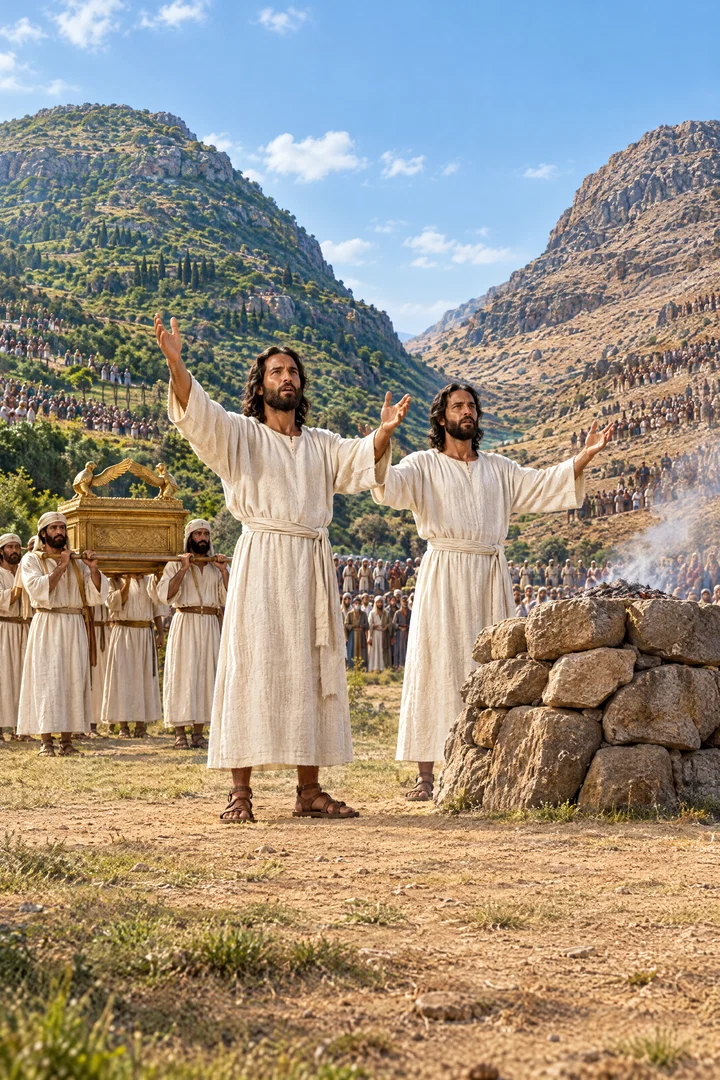
After Israel gained the land of promise the ceremony took place in the valley of Sychar between Mount Gerizim and Mount Ebal, with half of Israel ranged on each mountain and the ark with its mercy-seat, cherubim, and Shekinah glory standing in the valley.RH Apr 29, 1875 The priests turned northward toward Mount Ebal to chant the curse on the man that makes any graven or molten image, and all the tribes on Ebal shouted a deep and loud Amen.RH Apr 29, 1875 The same image-warning was turned toward Gerizim as a blessing on the man that never makes a graven image, answered with loud amens that might shake its foundations.RH Apr 29, 1875 The reciting of all the blessings and curses of Moses' law was done with fear and awe in an imposing array that the listening children gazing on it could never forget to their dying day, and that law whose blessings follow obedience and whose curses follow disregard was later rehearsed by Joshua with its blessings and curses before Israel.ST May 12, 1881RH Apr 29, 1875
The Mount Gerizim of the blessings is the Mount of Samaria, where the ancestors of the Samaritans had worshiped for more than four hundred years before Christ.ST Sep 3, 1894 The Samaritans claimed that mountain as the true place of worship against the Jews' claim for Jerusalem, and that reading underlies the doubt about the true place of worship when the Samaritan woman recognizes Jesus as a prophet and wonders if Jerusalem is to be preferred.ST Sep 3, 1894 Nothing commanded in Deuteronomy 27 is the engraving on stones spoken of in 2 Corinthians 3, and nothing commanded there is what Paul means by the ministration engraven on stones.ST Oct 16, 1884 Its stones are plastered stones for other laws, written on by Joshua in an altar after crossing Jordan, while the stones Paul means are the two tables of stone Moses brought down after forty days and forty nights communing with the Lord, with face shining so the people could not look on it and he put a veil over it.ST Oct 16, 1884
Idolatry and Curse
Cursed is the man who makes any graven or molten image, for such work of the craftsman's hands is an abomination to the LORD even when put in a secret place, and all the people are to affirm the curse with Amen.ST Sep 1, 1881RH Aug 1, 1871 It belongs with the other restatements of the second commandment and forbids the same sin as they do.ST Sep 1, 1881RH Aug 1, 1871 What is forbidden is the making of images for purposes of worship, not the making of every copy, likeness, picture, or representation for purposes having no connection with idolatry or adoration.ST Sep 1, 1881RH Aug 1, 1871 Keeping and venerating an image of Mary in a private oratory stands under this curse on anyone who makes a graven or molten image and hides it, as an abomination to the Lord.ST Oct 22, 1885
It is one of the curses for breaking the ten commandments, to be pronounced after coming into the land to possess it.ST Sep 15, 1887 Making a graven image to worship brings a curse that is still in full force today, for the command has not passed away and was not taken out of the way and nailed to the cross.ST Sep 15, 1887 To call it out of date would make Christ the minister of sin.ST Sep 15, 1887 It is as surely a sin now as marrying a mother-in-law, lightly esteeming father or mother, striking a neighbor secretly, or taking reward to slay an innocent person.ST Sep 15, 1887
The voice speaking these directions is the voice of Christ from the enfolding pillar of cloud, not the voice of man.RH Dec 25, 1900 These directions state plainly the blessings of obedience and express the principles of the law of the kingdom of God, made specific so that minds are not left in ignorance and uncertainty.RH Dec 25, 1900 They present the never-ceasing obligation of all whom God has blessed with life and health and advantages in temporal and spiritual things.RH Dec 25, 1900 The message has not grown weak because of age, and God's claims are just as binding now, just as fresh in importance, as God's gifts are fresh and continual.RH Dec 25, 1900
The curse against making a graven or molten image pronounces part of the curse of the law of God against all iniquity and every transgression, the same curse seen in the flying roll that goes forth over the face of all the earth against stealing and false swearing.ST Jan 14, 1889ST May 17, 1883 Idolatry is transgression of the first table of the law, written on one side of the roll under the commandment it breaks.ST Jan 14, 1889ST May 17, 1883 With theft, perjury, Sabbath-breaking, disobedience to parents, murder, adultery, and covetousness it goes forth to enter the house of every transgressor and abide there until it utterly consumes that house.ST Jan 14, 1889 The curse originated when God cursed Adam and the earth and remains upon the earth and upon sinners until it utterly consumes them by the fire of the last day, after which there will be no more curse.ST Jan 14, 1889
Deuteronomy 27 pronounces a sentence of despair and condemnation, declaring the guilt from which the gospel offers redemption and comfort.RH Apr 30, 1867 Its curses belong to the added law from which Christ redeemed believers.RH Jan 28, 1902 The law was not meant to pardon those who broke it, but to define duty and identify sin, publicly pronounced and accepted in covenant.ST Feb 20, 1896
Response and Fulfillment
Amen means so let it be, a responsive utterance of ancient origin to confirm what has been said, given when all the people answered the covenant curses.RH Jan 4, 1912 The covenant curses were proclaimed from Mount Ebal, set against the blessings proclaimed from Mount Gerizim, and the people answered them with Amen.RH Jan 4, 1912 Anciently God commanded that when His word was spoken all the people say Amen.ST Jun 24, 1886ST Feb 24, 1881 That fervent response belonged to the public worship of God in praise, prayer, and preaching, and was required as evidence that the hearers understood the word spoken and were interested in it.ST Jun 24, 1886ST Feb 24, 1881 Every follower of Christ should engage in such response rather than remain a cold and responseless listener.ST Jun 24, 1886
A reverential Amen from the heart of the sincere worshiper in the congregation is acceptable to God and adds to the impressiveness of His worship. That response is seldom heard in the churches of today except from the pulpit. The curse upon making and worshiping a graven image was one of the explicit conditions God laid down for Israel to continue possessing the territory promised to the literal seed of Abraham.ST Jul 22, 1913 Beginning in the days of Solomon Israel departed from God and utterly refused to meet these conditions in Deuteronomy 27 and 28, despite every effort of God to move their hearts to accept Him.ST Jul 22, 1913 That refusal brought the wrath of God with no remedy and the Babylonian captivity expressly foretold by the prophets.ST Jul 22, 1913
The curses pronounced from Mount Ebal were among those recalled by the scene around Shechem for how literally they were fulfilled.ST Sep 8, 1898
Sources