Ephesians 2:16
And that he might reconcile both unto God in one body by the cross, having slain the enmity thereby:
Translations
And that he might reconcile both to God in one body by the cross, having slain the enmity thereby:
And that he might reconcile both unto God in one body by the cross, having slain the enmity thereby:
and that he might reconcile both unto God in one body by the cross, having slain the enmity thereby:
And that he might reconcile both to God in one body by the cross, having by it slain the enmity:
Revised Version, American Standard Version
and might reconcile them both in one body unto God through the cross, having slain the enmity thereby:
and might reconcile both in one body to God through the cross, having slain the enmity in it,
and might reconcile both in one body to God by the cross, having by it slain the enmity;
And might fully reconcile them both, in one body, through means of the cross,—slaying the enmity thereby;—
and reconciling both of them to God in one body through the cross, by which He extinguished their hostility.
and reconciling both of them to God in one body through the cross, by which He put to death their hostility.
and might reconcile them both in one body to God through the cross, having killed the hostility through it.
And that the two might come into agreement with God in one body through the cross, so putting an end to that division.
And that he might reconcile both vnto God in one body by his crosse, and slay hatred thereby,
Douay-Rheims (Challoner revision)
And might reconcile both to God in one body by the cross, killing the enmities in himself.
Pictures
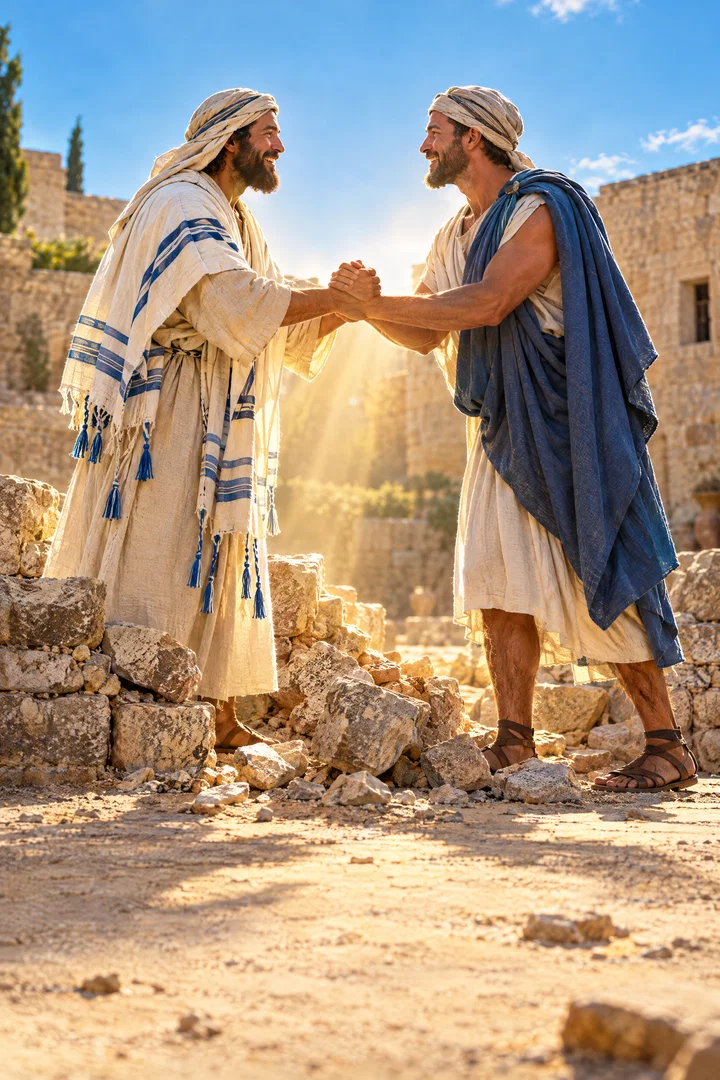
Cross-references 20 of 88
- Colossians 2:14
Blotting out the handwriting of ordinances that was against us, which was contrary to us, and took it out of the way, nailing it to his cross;
Christ nailed the ordinances that stood against us to the cross, removing the enmity.
- Ephesians 3:6
That the Gentiles should be fellowheirs, and of the same body, and partakers of his promise in Christ by the gospel:
Gentiles share the same body and promise in Christ.
- Romans 8:7
Because the carnal mind is enmity against God: for it is not subject to the law of God, neither indeed can be.
The carnal mind is the enmity Christ puts to death.
- Galatians 3:28
There is neither Jew nor Greek, there is neither bond nor free, there is neither male nor female: for ye are all one in Christ Jesus.
Jew and Gentile are reconciled as one in Christ, without division.
- Romans 11:17
And if some of the branches be broken off, and thou, being a wild olive tree, wert graffed in among them, and with them partakest of the root and fatness of the olive tree;
Gentiles are grafted into Israel’s olive tree and share its blessings.
- Ephesians 2:12
That at that time ye were without Christ, being aliens from the commonwealth of Israel, and strangers from the covenants of promise, having no hope, and without God in the world:
Gentiles’ former alienation from God and Israel is reversed by reconciliation.
- 2 Corinthians 5:19
To wit, that God was in Christ, reconciling the world unto himself, not imputing their trespasses unto them; and hath committed unto us the word of reconciliation.
God reconciles the world to himself through Christ.
- John 10:16
And other sheep I have, which are not of this fold: them also I must bring, and they shall hear my voice; and there shall be one fold, and one shepherd.
Jesus gathers Gentiles with his Jewish disciples into one flock under one shepherd.
- Colossians 1:20-22
And, having made peace through the blood of his cross, by him to reconcile all things unto himself; by him, I say, whether they be things in earth, or things in heaven.
Enemies alienated from God are reconciled through Christ’s death, making peace.
- Romans 5:10
For if, when we were enemies, we were reconciled to God by the death of his Son, much more, being reconciled, we shall be saved by his life.
Christ’s death reconciles those who were enemies to God.
- Colossians 3:11
Where there is neither Greek nor Jew, circumcision nor uncircumcision, Barbarian, Scythian, bond nor free: but Christ is all, and in all.
In Christ, distinctions such as Jew and Greek do not divide believers.
- Acts 10:28
And he said unto them, Ye know how that it is an unlawful thing for a man that is a Jew to keep company, or come unto one of another nation; but God hath shewed me that I should not call any man common or unclean.
Peter learns not to regard Gentiles as unclean, showing the barrier between Jews and Gentiles removed.
- Romans 5:1
Therefore being justified by faith, we have peace with God through our Lord Jesus Christ:
Christ’s cross reconciles believers to God, bringing peace through justification by faith.
- John 17:21
That they all may be one; as thou, Father, art in me, and I in thee, that they also may be one in us: that the world may believe that thou hast sent me.
Jesus prays that believers may be one in God.
- Hebrews 9:14
How much more shall the blood of Christ, who through the eternal Spirit offered himself without spot to God, purge your conscience from dead works to serve the living God?
Christ’s blood cleanses from sin and secures redemption.
- Romans 10:12
For there is no difference between the Jew and the Greek: for the same Lord over all is rich unto all that call upon him.
Both texts declare no distinction between Jew and Greek in salvation through the Lord.
- Acts 10:34-35
Then Peter opened his mouth, and said, Of a truth I perceive that God is no respecter of persons:
God accepts people from every nation without partiality.
- 1 Corinthians 12:13
For by one Spirit are we all baptized into one body, whether we be Jews or Gentiles, whether we be bond or free; and have been all made to drink into one Spirit.
Jews and Gentiles are united in one body by the Spirit.
- Acts 11:2-3
And when Peter was come up to Jerusalem, they that were of the circumcision contended with him,
Peter is challenged for associating with Gentiles, reflecting the removal of enmity between Jews and Gentiles.
- Hebrews 2:9
But we see Jesus, who was made a little lower than the angels for the suffering of death, crowned with glory and honour; that he by the grace of God should taste death for every man.
Christ tasted death for all, making reconciliation available to both.
Commentary
Each commentary is drawn from primary sources: the writings of Ellen G. White and Adventist pioneers and periodicals. Each commentary is separate. Its own words are not a quotation; follow the references to read the source passages.
Ellen G. White
46 sources
By the cross Christ puts to death the hostility between Jew and Gentile and reconciles both together to God in one body.Ms 189, 1903Lt 56, 1902, par. 19–20STMW9 75.1–2 His death breaks down the middle wall of partition that shut Gentiles out, so that those who accept the gospel share equally with Jewish believers as fellow-heirs without needing circumcision.7RED 59.1–60.13SP 347.3–43SP 326.3–328.1 Through Him both are brought near by His blood and have access to the Father by one Spirit, becoming fellow citizens, members of God's household, and a holy temple built on Christ as the chief cornerstone.Ms 189, 1903, par. 24–27Ms 109, 1899, par. 20–22RH Feb 18, 1909 In Him no nationality, race, caste, rank, or social standing divides, but all are joined in one common brotherhood and made equal before God.9T 190.4RH Dec 24, 1908ST Jun 9, 1914 This ending of enmity sends the gospel beyond custom and nationality to all the world, calling believers to lay aside division and labor together in peace as one.Ms 59, 1902, par. 10–11Ms 109, 1899, par. 25–26DA 403.1ST Jan 6, 1888
Meaning of Reconciliation
Ephesians 2:16 means that both Jews and Gentiles are reconciled to God in one body by the cross, where the enmity between them is put to death.Ms 189, 1903Lt 56, 1902, par. 19–20STMW9 75.1–22MR 185.1–2Ms 59, 1902, par. 10–11 Christ's death brings the divided groups together into one body and destroys the hostility that separated them.Ms 189, 1903Lt 56, 1902, par. 19–202MR 185.1–2Ms 109, 1899, par. 25–26Lt 51, 1901, par. 8–9 This reconciliation belongs to His abolition of the law of commandments contained in ordinances, whose sacrificial ceremonies prefigured His death and ended when type met antitype, while the enduring commandments, including the Sabbath, were not blotted out.Lt 51, 1901, par. 8–9 It is instruction and comfort joined to salvation by grace through faith and to Christ dwelling in the heart by faith, cherished as a beloved friend.STMW9 75.1–2 It is an instructive lesson for believers who are not working in harmony, calling them to lay aside division and strife and to live and labor together in peace and unity.Ms 59, 1902, par. 10–11
Both includes those who were far from God and those who were near, brought together as one people through the cross which destroys the enmity between them.RH Feb 18, 1909 Those afar off are brought near by the blood of Christ, sharing access to the Father through one Spirit and becoming fellow citizens in God's household, built together into a holy temple with Christ as its cornerstone.RH Feb 18, 1909 Even men in high positions of trust and influence, however exalted in this world, are in sin and under condemnation unless they accept Christ.Ms 74, 1900, par. 18 If they are in bondage to Satan, enemies of Christ, and under condemnation of the law of God, they can be reconciled to God by His blood, and to follow Christ by faith is the only path to true greatness and true honor.Ms 74, 1900, par. 18
Slaying the enmity establishes peace in which unity replaces dissension, so that divided people are reconciled to God in one body by the cross.2MR 185.1–2Lt 71, 1903, par. 13–14Lt 70, 1903, par. 20–21 In Christ believers are united rather than drawing apart, with unity and love brought about by the Holy Spirit.2MR 185.1–2Lt 71, 1903, par. 13–14Lt 70, 1903, par. 20–21 His cross is the center that unites believers, who must not separate but grow together as God's people.Ms 109, 1899, par. 25–26
Partition Wall Broken
Christ's death on the cross broke down the middle wall of partition between Jew and Gentile and reconciled both to God in one body.7RED 59.1–60.13SP 326.3–328.1AA 402.3ST Jan 6, 1888 That breaking let the Gentiles into the full privileges of the gospel, yet many believing Jews still had the veil untaken from their eyes and could not clearly discern to the end of that which was abolished.3SP 347.3–4ST Jun 12, 1879 Failure to recognize that the barrier had been removed hindered the gospel and led to attempts to bind Gentile believers to Jewish customs.AA 402.3 Christ's mercy in healing the afflicted Gentile woman in the coasts of Tyre and Sidon was an example to lead the disciples from Jewish exclusiveness and open their minds to labor among the Gentiles, and after his death, when the Jews turned from the disciples for declaring Jesus the Saviour of the world, that lesson directed them to work for others besides their own people.ST Jan 6, 1888
The exclusion broken through was that symbolized by the temple's dividing wall, when Jesus' welcome of the Gentiles brought them the salvation the Jews refused.2SP 149.1–3 It was every wall of partition thrown open in every compartment of the temple of His creation, so that every soul, Jew or Gentile, may have free access to the presence of God.Lt 29, 1898, par. 24–26 It was the wall formed by self-love and national prejudice, whose tearing down removes divisions between nations and social groups and teaches love for all people. It was the removal of every wall of separation between person and person, so that sanctified judgment makes all human distinctions one and binds men and women to Christ, to God, and to one another as one family.Ms 83, 1902, par. 10–11 The torn temple veil and the canceled partition walls and ordinances signify that access to God is opened through Christ, so that by faith Jews and Gentiles may share the living bread and fellowship with God.Lt 230, 1907, par. 17–20
With the barrier broken, heathen nations were made partakers equally with the Jews in the blessings and privileges of the gospel and the promises of God, and made fellow-heirs with the Israel of God.7RED 59.1–60.13SP 326.3–328.1AA 135.1–3ST Jun 12, 1879ST May 15, 1879 Gentiles who accepted the gospel were to share equally in its blessings with Jewish believers, without having to be circumcised.RH Apr 13, 1911 The division that had kept the Gentiles from the blessings of salvation was ended, joining both peoples to God in one body and expressing the worldwide reach of God's plan.AA 135.1–3ST Jun 12, 1879ST May 15, 1879
The wall still stood in the minds of the apostles, who excluded Gentiles from the privileges of the gospel, confined their labors to the Jews, and looked upon them as an unclean race excluded from the promises of God and shut out from God.7RED 59.1–60.13SP 326.3–328.1 Peter had to be divested of his settled prejudice against the Gentiles to comprehend the world-wide extent of God's plan, with the conversion of Cornelius as the first one of importance among the Gentiles.7RED 59.1–60.1 By the vision of the sheet he learned that Gentiles cleansed through Christ were no longer to be called common or unclean.3SP 326.3–328.1 This was proved when Peter became a messenger to the Gentiles, souls were converted, and the Lord sent His Holy Spirit upon Gentile believers, which Jewish believers found hard to believe and contended over in the church at Jerusalem until Peter rehearsed his experience with Cornelius.Ms 126, 1902, par. 30–31
Access Household and Temple
Through Christ both Jew and Gentile are brought near by His blood and reconciled in one body by the cross where their enmity is slain, and through Him both share peace and access to the Father by one Spirit.Ms 189, 1903, par. 24–27Ms 109, 1899, par. 20–22RH Feb 18, 1909 Those far from God and those near are thus made one people, with hostility destroyed and barriers removed so that nationality, race, caste, rank and religious background do not restrict approach to God.RH Feb 18, 1909ST Jul 6, 1915RH Dec 24, 1908 Every wall of partition is broken down and every compartment in the temple of creation is thrown open, so that every soul, Jew or Gentile, has free access to the presence of God.Lt 29, 1898, par. 24–26 The message brought from the Father is for the whole world, as universal as light, with no boundaries to grace and mercy toward all who seek Him with contrition, calling all to yoke with Christ to reach every caste and nation.Lt 29, 1898, par. 24–26
This unity makes the reconciled fellow citizens with God's people and members of God's household, brought into one spiritual fold, one church and one family.Ms 189, 1903, par. 24–27Ms 109, 1899, par. 20–22DA 821.1Lt 146, 1901, par. 10 True sanctified judgment in Christ makes all human distinctions one, binding men and women to Christ, to God and to one another, and pure religion is not proud, partial or exclusive but receives suffering humanity of all classes with full sympathy for the lowly.Ms 83, 1902, par. 10–11 Through Christ men and women are adopted into the divine family as sons and daughters of God and given every advantage of His power and redeeming love.Ms 83, 1902, par. 10–11
Together they are built upon the apostles and prophets with Christ Himself as the chief cornerstone, joined together into a holy temple and a habitation of God through the Spirit where God meets with His people.Ms 189, 1903, par. 24–27Ms 109, 1899, par. 20–22RH Feb 18, 1909 Believers themselves are the temple of the living God, so even the most splendid outward temple amounts to nothing if hearts are not right.Ms 49, 1886, par. 163MR 234.3–235.1 The greatest anxiety must therefore be over spiritual condition, shown in reverence on entering the house of God and in educating children to have their thoughts directed heavenward.Ms 49, 1886, par. 163MR 234.3–235.1
Through sin the world was separated from heaven by a deep and impassable gulf, but Christ with His own body bridged the gulf that sin had made and provided a way whereby fallen men may again be united with heaven. To every soul that desires to cross that gulf He gives help and strength, so that exiles are made prisoners of hope and placed on probation. This bringing of Jew and Gentile into one is the fulfillment of the covenant made with Abraham that in him all families of the earth would be blessed.Lt 146, 1901, par. 10 No outward privilege or position can secure the spiritual blessings of that covenant, and no outward disability can debar any man who complies with its conditions, for name or position is of no real value with God, but in every age he that fears God and works righteousness is accepted of Him.Lt 146, 1901, par. 10
Law Sacrifice and Salvation
The reconciliation belongs to Christ's abolishing of the law of commandments contained in ordinances, whose sacrificial ceremonies foreshadowed his death and came to an end when type met antitype at the cross, while the enduring commandments, including the Sabbath, were not blotted out.Lt 51, 1901, par. 8–9 The canceled ordinances and broken partition walls, signified by the torn temple veil, declare that access to God is opened through Christ, so that by faith Jews and Gentiles may share the living bread and fellowship with God.Lt 230, 1907, par. 17–20 Gentiles who accepted the gospel were therefore to share equally in its blessings with Jewish believers without having to be circumcised.RH Apr 13, 1911 They do not need circumcision or observance of the ceremonial law to enter the church or to be near God, and those who observe that law are not nearer to God than those who do not.SLP 121.1–122.1
Christ's sacrifice on the cross redeems people from transgression of the law and makes it possible for sinners to be reconciled to God and return to allegiance to His commandments.Lt 63, 1895, par. 39–41 He is the propitiation not only for our sins but for the sins of the whole world, and in facing death on the cross, central to His mission of bringing Jew and Gentile together, Jesus bore the guilt of fallen humanity and the Father's wrath because of sin.Lt 63, 1895, par. 39–41ST May 16, 1878 Though Satan caused Christ to be crucified, Christ rose from the grave and now serves in heaven as Advocate.ST Nov 19, 1896 He is a compassionate, tender High Priest who lovingly calls the weary and burdened to come to Him and find rest, and seeing what sin cost leads the sinner to hate the sins that wounded Jesus and to keep a contrite heart while looking to Christ.ST Nov 19, 1896Lt 63, 1895, par. 39–41
The gospel is the means ordained by God to restore His moral image in man and to stem the tide of hostility against His law.9MR 82.4 It is His remedy for universal disorganization and the power which draws men together in unity.9MR 82.4 The teaching that Christ reconciles both to God in one body through the cross, putting the enmity to death, is given as instruction and comfort, joined to salvation by grace through faith and to Christ dwelling in the heart by faith, cherished as a beloved friend.STMW9 75.1–2
Unity Without Distinction
The reconciliation in one body by the cross puts enmity to death so that no nationality, rank, or creed divides those Christ brings together, for His mercy and love are offered without exclusion.9T 190.4RH Dec 24, 1908ST Jun 9, 1914 The cross removes hostility and barriers so that nationality, race, and social status do not restrict access to God, but every soul may come to Him and all stand equal before Him.9T 190.4RH Dec 24, 1908ST Jun 9, 1914 This unity joins Jew and Gentile, black and white, free and bond, rich and poor in a common brotherhood, equal in God's sight, with Christ's love and saving work extended to every human being.7T 225.3STB 192.2Ms 83, 1902, par. 10–11 His religion makes no caste distinctions, treating neighbor and stranger, friend and enemy without partiality, and slaying enmity removes every wall of separation between person and person.STB 192.2Ms 83, 1902, par. 10–11 True sanctified judgment in Christ makes all human distinctions one, binding men and women to Christ, to God, and to one another as one family, adopted into the divine family as sons and daughters of God with every advantage of His power and redeeming love.Ms 83, 1902, par. 10–11
The message Christ brought from the Father is for the ears of the whole world, a blessing as universal as light, with no boundaries to God's grace and mercy to all who seek Him with contrition of soul.Lt 29, 1898, par. 24–26 He came to break down every wall of partition and throw open every compartment in the temple of His creation so that every soul, Jew or Gentile, may have free access to the presence of God.Lt 29, 1898, par. 24–26 All are called to yoke up with Christ to reach every caste and every nation and draw every soul to Him.STB 192.2Lt 29, 1898, par. 24–26 Pure and undefiled religion is not proud, partial, or exclusive toward a few, but receives suffering humanity of all classes, with the lowly given full sympathy.STB 192.2Ms 83, 1902, par. 10–11
The verse is an instructive lesson for believers who are not working in harmony, calling them to lay aside division and strife and to live and labor together in peace and unity.Ms 59, 1902, par. 10–11Ms 109, 1899, par. 25–26 His cross is the center that unites believers, who must not separate but grow together as God's people.Ms 59, 1902, par. 10–11Ms 109, 1899, par. 25–26 The cross of Christ is fully able to make the members of the church of God in every place act as one, blending in perfect union.Ms 147, 1902, par. 16 Consecrated to His service in body, soul, and spirit, with every addition to the church becoming one more agency for carrying on the great plan of redemption, the church becomes a living, active missionary agency moved and controlled by the Holy Spirit, and this oneness is a miracle accomplished for the good of an unbelieving world.Ms 147, 1902, par. 16
This unity applies across nationalities, so that separating German and Scandinavian believers into distinct organizations would build walls and hinder the spiritual development of God's work rather than advance it.9T 195.3 Christ tears down the wall of partition formed by self-love and national prejudice, removing divisions between nations and social groups and teaching love for all people.ST Jul 6, 1915 His followers are to treat every needy person as a neighbor and the whole world as their field. In Christ, people of every nationality, race, caste, and religious background are brought near by His blood and given access to God, and loving service to those in need can break down religious prejudice and draw people to God.ST Jul 6, 1915
Mission Beyond Israel
The death on the cross broke down the partition wall between Jews and Gentiles and reconciled both to God in one body with the enmity slain, so that gospel work is not restricted by custom or nationality but is to be carried to all the world beyond those limits.DA 403.1ST Jan 6, 1888Ms 126, 1902, par. 30–31 This was proved when Peter became a messenger to the Gentiles, souls were converted, and the Holy Spirit fell upon Gentile believers.Ms 126, 1902, par. 30–31 Jewish believers in Jerusalem found this hard to believe and contended over it until Peter rehearsed his experience with Cornelius.Ms 126, 1902, par. 30–31
The disciples had to learn that these barriers must be broken down rather than allowing Jewish pride to shut them off from the needs of others, bringing Jews and heathen together in sympathy.DA 400.1 Christ’s welcome of the Gentiles broke through the exclusion symbolized by the temple’s dividing wall and brought them the salvation the Jews refused to accept.2SP 149.1–3 His mercy in healing the afflicted Gentile woman in the coasts of Tyre and Sidon was the example given to lead the disciples away from Jewish exclusiveness and to open their minds to labor among the Gentiles.ST Jan 6, 1888
That lesson afterward directed them to work for others besides their own people when the Jews turned from them for declaring Jesus the Saviour of the world.ST Jan 6, 1888 Failure to recognize that the division had been removed hindered the gospel and led to attempts to bind Gentile believers to Jewish customs.AA 402.3
The broken wall let the Gentiles into the full privileges of the gospel and made this an important era for vigorous work among the Gentiles to strengthen the church by a great ingathering of souls.3SP 347.3–4 Many believing Jews still had the veil untaken from their eyes and could not clearly discern to the end of that which was abolished.3SP 347.3–4 The message of mercy is offered first to Israel and then to all nations, so that Jews and Gentiles can both be reconciled through Christ and gathered into one church, and all who believe may receive everlasting life.DA 821.1
Men in high positions of trust and influence, however exalted in this world, are in sin and under condemnation unless they accept Christ.Ms 74, 1900, par. 18 If they are afar off in sin they can be brought near by the blood of Christ, and if they are in bondage to Satan as enemies under condemnation of the law they can be reconciled to God by His blood.Ms 74, 1900, par. 18 To follow Christ by faith is the only path to true greatness and true honor.Ms 74, 1900, par. 18
Sources
Pioneers and periodicals
113 sources
Christ reconciles both Jews and Gentiles to God together in one body by the cross, where he slays the enmity between them and makes peace.ST Jul 31, 1884ST Sep 17, 1874RH Apr 14, 1910 The both are those nigh and those far off, the nigh being Jews and the far off being Gentiles who were aliens from the commonwealth of Israel, strangers from the covenants of promise, without God and without hope.ST Sep 5, 1895ST Sep 5, 1895ST Mar 11, 1875 The enmity slain is the carnal mind hostile to God and not subject to his law, identified with the law of commandments contained in ordinances, the middle wall of partition of circumcision and ceremonial observances that created national distinction.ST Jun 8, 1915ST Sep 17, 1874ST Sep 13, 1910ST Feb 22, 1883ST Jan 24, 1900 What was abolished and nailed to the cross is that Mosaic typical law of sanctuary services, feasts, ceremonial sabbaths and ritual distinctions, while the moral law of Ten Commandments including the seventh-day Sabbath was not abolished but vindicated and written in heart and mind.RH Mar 8, 1864RH Feb 1851RH Feb 3, 1852RH Feb 21, 1854 The one body in which both are reconciled is the church, Christ's living temple built on apostles and prophets with himself as chief cornerstone, where Gentiles made nigh by his blood are no longer strangers but fellow citizens with the saints, with equal access to the Father by one Spirit.ST Jul 31, 1884RH Apr 14, 1910RH Feb 7, 1856RH Aug 12, 1873ST Sep 16, 1897
Reconciliation by the Cross
Christ reconciles both Jews and Gentiles to God together in one body by the cross, where he slays the enmity between them and makes peace.ST Jul 31, 1884ST Sep 17, 1874RH Apr 14, 1910RH Apr 12, 1864ST Feb 22, 1883 Gentile believers are no longer separate or excluded from the covenants of promise but share with Jewish believers one standing in Christ, forming one new people and one Christian body rather than remaining separate as Jew and Gentile.ST Jul 31, 1884ST Sep 17, 1874RH Apr 14, 1910RH Apr 12, 1864ST Jan 30, 1879 They are brought near through Christ and become fellow citizens with the saints and members of God's household, sharing Israel's promises, blessings, access to the Father, and the kingdom of the eternal inheritance.ST Jul 31, 1884ST Sep 17, 1874RH Apr 14, 1910RH Apr 12, 1864ST Feb 22, 1883 The broken partition opens the way for Gentiles to share Israel's covenants and salvation, and this united people is spiritual Israel, the Israel of the inheritance; it does not mean that Jews leave their place to join the Gentiles in their former condition.ST Sep 17, 1874RH Apr 14, 1910RH Apr 12, 1864 The enmity put to death was the code of circumcision and ceremonial law and the law of commandments contained in typical ordinances that created national distinction, whose abolition in his flesh removes the barrier that kept Gentiles far from Israel's covenants and blessings.ST Sep 17, 1874ST Feb 22, 1883ST Jan 30, 1879
Both means those nigh and those far off together.ST Sep 5, 1895ST Sep 5, 1895ST Mar 11, 1875ST May 12, 1881ST Jun 10, 1880 The nigh are the Jews, those already the children of God, and Christians, and the far off are the Gentiles, including the unconverted, who were aliens from the commonwealth of Israel and strangers from the covenants of promise, without God and without hope.ST Sep 5, 1895ST Sep 5, 1895ST Mar 11, 1875ST May 12, 1881ST Jun 10, 1880 Those afar off are Gentiles in contrast with Jews, and strangers are those afar off, Gentiles not descended from Israel.ST Mar 11, 1875ST May 12, 1881ST Jun 10, 1880 The gospel was preached to both, and by this means Jews and Gentiles are made both one, the aliens united with the children of God into one by the blood of Christ.ST Sep 5, 1895ST Jun 10, 1880 The verse describes conversion or deliverance from evil as transformation by God's creative power that removes people from the influence of the prince of the power of the air into communion with the children of God and into covenant relation with him, where the enmity is slain and they have become obedient to righteousness.ST Sep 5, 1895ST Sep 5, 1895
Reconciliation is of sinners to God through Christ's blood, sacrifice, and death, not of God to human sinfulness.RH Oct 27, 1863ST Dec 20, 1883ST Sep 2, 1889ST Sep 9, 1930RH Apr 14, 1874 He makes peace by shedding his blood and giving his life, bringing those far off near through his blood and changing them from enmity with him to peace with him.RH Oct 27, 1863ST Dec 20, 1883ST Sep 2, 1889ST Sep 9, 1930RH Apr 14, 1874 The one who died was the pre-existent Son of God made flesh, who reconciles humanity by his own sacrifice and obtains redemption by offering his own blood.RH Oct 27, 1863ST Dec 20, 1883RH Apr 14, 1874 As King of Peace and High Priest he obtains redemption through his own blood, and for those who accept him as personal Saviour he officiates as Mediator before God's throne, effecting reconciliation by virtue of having paid sin's penalty by his death, with reconciliation belonging to the work of atonement alongside cleansing, forgiveness, justification, and redemption.RH Oct 27, 1863ST Dec 20, 1883ST Sep 9, 1930RH Apr 14, 1874RH Sep 16, 1852 He rises and intercedes, and atonement means at-one-ment that destroys enmity and unites feeling and purpose, as seen in the penitent thief.RH Oct 27, 1863ST Dec 20, 1883ST Sep 9, 1930
To destroy the enmity Christ took the same human, sinful flesh in which it was found, as it was after four thousand years of degeneracy, and abolished the carnal nature in his own flesh by crucifixion.ST Jun 8, 1915ST Sep 13, 1910RH Oct 2, 1900 The enmity is the carnal mind, hostile to God's law, which must be abolished for peace with God; Christ took human, sinful flesh, and the mind of the flesh was crucified in him.ST Jun 8, 1915ST Sep 13, 1910RH Oct 2, 1900 He slew the enmity in himself, in his flesh, where it existed.ST Jun 8, 1915ST Sep 13, 1910RH Oct 2, 1900 Carnal ordinances express the belief that human effort can win God's favor, overcome sin, or earn righteousness, and though the ceremonial law was originally an expression of faith, Jews had come to trust their own works for salvation; Christ swept away reliance on human effort, for his blood alone saves, and Jews and Gentiles who accept salvation in Christ are made one.ST Jun 8, 1915ST Sep 13, 1910
The reconciliation was accomplished at Christ's death on the cross, which began the new covenant.RH Mar 4, 1862RH Feb 18, 1873RH Dec 9, 1858 The new covenant dates from Christ's death, began with the Hebrews alone, and remained confined to them until the expiration of the seventieth week, when Gentiles were admitted to full equal participation with the Hebrews in its blessings in one body by the cross.RH Mar 4, 1862RH Dec 9, 1858 Under it God enters into covenant with individuals and not as a nation, putting his law in the heart, forgiving sins, so Gentiles are no longer outsiders and strangers but fellow members together with God's people.RH Mar 4, 1862RH Dec 9, 1858 Christ took the positive law of types out of the way by his death on the cross, ending its enmity and reconciling both to God in one body, and this abolition occurred at the crucifixion, not at Pentecost, and does not mean the moral law was abolished.RH Mar 4, 1862RH Feb 18, 1873RH Dec 9, 1858
The cross is the means of reconciliation and displays the power to lay down life and to take it again in self-giving love, and this power brings reconciliation between man and God.RH Aug 19, 1902RH Dec 3, 1857 The cross means a crucified Christ, displayed in the Saviour's love in giving himself for us.RH Aug 19, 1902 It is not a substitute for Christ himself to be prayed to as a symbol apart from the living Saviour, for treating the cross as though it were the one to pray to or come to can obscure the living Saviour behind the symbol.RH Aug 19, 1902RH Dec 3, 1857
Meaning of the Enmity
The enmity put to death on the cross is the carnal mind and carnal heart, hostile to God and not subject to His law, with its sin and its love of sin.ST Jun 8, 1915ST Sep 13, 1910ST Jan 24, 1900ST Jan 18, 1916ST Mar 25, 1913 That mind separates people from God and from one another, and peace with God requires its abolition through surrender, pardon purchased by blood, and giving up the carnal heart.ST Sep 13, 1910ST Jan 24, 1900ST Nov 1, 1905ST Jan 18, 1916ST Mar 25, 1913 Christ took human, sinful flesh as it was after four thousand years of degeneracy, yet His life had no carnal mind, and the mind of the flesh was crucified and abolished in His own flesh in His unselfish life and death.ST Jun 8, 1915ST Sep 13, 1910ST Nov 1, 1905ST Jan 18, 1916ST Mar 25, 1913 Those who accept Him receive His mind and Spirit in its place, so that the conflict is settled, those once far off are brought near, and the righteousness of the law is fulfilled in those who walk by the Spirit rather than by nationality, status, or human works.ST Jun 8, 1915ST Sep 13, 1910ST Nov 1, 1905ST Jan 18, 1916ST Mar 25, 1913
The same enmity is the law of commandments contained in ordinances, the code of circumcision and ceremonial law abolished in Christ.ST Sep 17, 1874ST Feb 22, 1883RH Mar 8, 1864RH Feb 1851RH Oct 14, 1873 It stood as the middle wall of partition and typical system that created national distinction, kept Gentiles far from Israel's covenants and blessings, pointed forward as a shadow to Christ's sacrifice, and became a burden and yoke when trusted for righteousness.ST Sep 17, 1874ST Feb 22, 1883ST Jul 20, 1882RH Feb 1851RH Oct 14, 1873 Its abolition at Christ's death broke down the dividing wall, ended the enmity between Jew and Gentile, and made of the two one new man in one body so as to make peace, distinct from the Ten Commandments and the moral law which remain binding.ST Sep 17, 1874ST Jul 20, 1882RH Mar 8, 1864RH Feb 1851RH Oct 14, 1873
Carnal ordinances express the belief that human effort can win God's favor, overcome sin, or earn righteousness by self-justification.ST Jun 8, 1915ST Jul 7, 1898ST Jul 7, 1898 The ceremonial law was originally an expression of faith, but it had come to be trusted as works for salvation, with prejudice and Jewish customs and traditions maintaining division, shutting out Gentiles, holding people in bondage and hindering the gospel.ST Jun 8, 1915ST Jul 7, 1898ST Jan 15, 1885 Christ by grace slays that enmity toward God and man and replaces it with love to God and man, breaks down the partition wall between sinner and God, takes away every means of self-justification, and sets before all the one sacrifice God accepts, the Lamb of God offered on Calvary's cross for the sins of all mankind, by whose blood alone those without hope and without God are made nigh.ST Jun 8, 1915ST Jul 7, 1898ST Jul 7, 1898 Unbelief itself creates enmity against God and divides people from one another, forming a wall of misunderstanding that can turn even good things into further separation, so reconciliation through the cross as mediator ends the enmity caused by sin by overcoming unbelief and destroying that barrier.ST Oct 10, 1906
Those who hold that the enmity slain is the carnal nature itself teach that it is not the ceremonial law, which only represented it, and that abolished means made thoroughly inactive, made powerless, made of none effect, in its strongest sense destroyed.ST Sep 5, 1895 In this teaching the abolition is not universal but limited by in His flesh, in Himself, where Christ with flesh like other men, even sinful flesh, had the carnal nature made powerless and destroyed by crucifixion, just as it must be destroyed in others before they can be children of God.ST Sep 5, 1895 Destroying the carnal nature reconciles to God and has a reflex action upon the law: it does not destroy the normal operation and force of the moral law, the law of commandments in ordinances, but disannuls its penal or abnormal force which is against the carnal nature and works wrath through it, so that when carnality is dead its penal power ceases and the transgressor is freed from its claims.ST Sep 5, 1895 Related to this, the verse refers to the ceremonial law only indirectly, through destruction of the carnal nature that misused it to seek justification by deeds of law, so that when that nature is destroyed ceremonial observances cease and pressuring converts to keep that system rejects salvation by faith in Christ as impossible justification by works.ST Sep 5, 1895 In disagreement with the weight of this teaching, one argument claims the enmity abolished could include the fourth commandment, on the ground that if the Sabbath precept remains binding people would have to put out fires and suffer, which is presented as enmity enough for a law to be abolished because it created enmity.RH Mar 8, 1864
Law Abolished and Upheld
What was nailed to the cross was the Mosaic positive and typical law, the handwriting of ordinances and law of commandments contained in ordinances belonging to the Jewish church, replaced by the ordinances of the Christian church.RH Feb 3, 1852RH Feb 21, 1854RH Jul 8, 1852 That included the sanctuary services with feasts, new moons, ceremonial sabbaths, yearly sabbaths and land sabbaths, the distinctions of clean and unclean meats and related ritual observances founded on Israel's national and sanctuary circumstances.RH Aug 5, 1852RH Jul 8, 1852 These ordinances and ceremonies had typified Christ's sacrifice, formed the middle wall separating Jews and Gentiles, stood contrary to the people and created enmity, and their types and shadows ceased and were abolished through Christ's death when the substance and promised reality came.RH Jul 8, 1852 Quoting a Mosaic commandment therefore does not prove its original law remains binding under the gospel.RH Feb 21, 1854
The enmity abolished in Christ was that law of commandments contained in ordinances, the Levitical ceremonial system and middle wall of partition that was a burden and a shadow pointing forward to Christ, not God's moral law of the Ten Commandments.RH Mar 8, 1864RH Feb 1851RH Oct 14, 1873ST Feb 1, 1905 The moral law was not abolished, relaxed or amended by the change of dispensation, for it applies to people as moral beings accountable to God, continues to guide moral character and to judge all people, and transgressors before and after the crucifixion look to Christ for justification through faith in His shed blood.RH Feb 1851RH Feb 3, 1852 Christ did not abolish the moral law but vindicated it by overcoming sin in the flesh and bearing sin's penalty on the cross, and through faith its righteousness is fulfilled in believers.ST Feb 1, 1905 The seventh-day Sabbath belongs to that moral law, made for humanity before the fall and before types were needed, and Christ's reconciling work did not overthrow it; it remains binding, to be kept on God's day in His manner, while the typical ceremonies including ceremonial sabbaths ended when their realities came and had become a yoke of bondage when trusted for righteousness.RH Oct 14, 1873RH Feb 3, 1852ST Feb 1, 1905
The wiping away of the law of commandments contained in ordinances is no reason to treat baptism or other scriptural duties as abolished.RH Feb 21, 1854ST Jun 1, 1882 Reconciliation restores obedience, for the New Covenant brings sinners into agreement with God by reconciling them through Christ's death and brings them back to obedience.ST Feb 15, 1899RH Apr 12, 1860 Human sin separates people from God, and the carnal mind is hostile to God and cannot submit to His law, but Christ restores what was broken, reunites what was separated, destroys the enmity and the carnal opposition at the cross, and gives access to God.ST Feb 15, 1899ST Feb 9, 1915ST Sep 16, 1913 His Spirit replaces the rebellious mind so that people are brought into harmony with God's eternal, unchanging law and government, with His law written in heart and mind and its righteousness fulfilled in those who walk by the Spirit, and the Ten Commandments stand forever as the basis of peace with God and of union in the one new people.ST Feb 15, 1899ST Feb 9, 1915ST Sep 27, 1910RH Apr 12, 1860ST Apr 15, 1886
The claim that the law was given to the Jews because they were wicked and withheld from the Gentiles because they were righteous reverses the truth.RH Aug 19, 1873 In Ephesians 2:12-22 new covenant and gospel are used as synonymous terms, so what is described is both new covenant and gospel.RH Feb 14, 1854
One People of God
The one body in which both are reconciled is the church, which is Christ's own body, the living temple and house of God built by Christ with himself as chief cornerstone on the foundation of the apostles and prophets, the commonwealth of Israel made one, the one new man, and the one flock under one Shepherd.RH Feb 7, 1856RH Aug 12, 1873ST Sep 16, 1897ST Apr 23, 1896RH Jan 6, 1853 The middle wall of partition between Jew and Gentile is broken down and the difference abolished to make of twain one new man, so making peace, and there is but one church as truly one as the hope of the calling.RH Feb 7, 1856RH Jan 6, 1853ST May 7, 1894 Because the church is God's temple built by Christ with those brought from far off, the temple in Paul's prophecy of the man of sin is the church where that power would establish rule.ST Apr 23, 1896ST May 7, 1894
Gentiles who were far off, aliens from the commonwealth of Israel and strangers from the covenants of promise, without Christ and without hope, are made nigh by the blood of Christ and are no more strangers and foreigners but fellow citizens with the saints and of the household of God, fellow heirs and of the same body.ST Jul 31, 1884RH Apr 12, 1864RH Jun 9, 1874RH Feb 7, 1856RH Aug 12, 1873 They are grafted in by faith to share Israel's covenants, promises, riches, name and blessings and to receive the blessings promised to the seed of Abraham through Christ, with one standing in Christ and equal access to God, and the broken partition opens the way for Gentiles to share Israel's promises rather than for Jews to leave their place to join the Gentiles in their former condition.ST Jul 31, 1884RH Apr 12, 1864RH Apr 12, 1864RH Jun 9, 1874RH Aug 12, 1873 True Israel includes both Abraham's descendants by birth and regenerated Gentiles, and believing Gentiles are fellow citizens with the saints of the entire household of God saved from all ages.RH Aug 12, 1873
This united people is spiritual Israel, the Israel of God and of the inheritance, entering the kingdom of the eternal inheritance through Christ and forming one new people rather than remaining separate as Jew and Gentile.RH Apr 14, 1910RH Feb 7, 1856RH Apr 28, 1868 Fleshly descent no longer gives special promises or privileges, and God's people are not identified by outward Jewish descent but include people of every lineage joined to Abraham's family by faith in Christ, Abraham's seed.RH Apr 28, 1868RH Jan 23, 1872RH Jun 27, 1865 There is no separate Gentile dispensation with exclusive or pre-eminent Gentile heirs, no such thing as a Gentile Christian separate from Israel, and no restoration of Israel to national pre-eminence, but one personal salvation by faith offered without difference to both, with every Christian an Israelite who must belong spiritually to one of the twelve tribes since there are only twelve.RH Jun 9, 1874RH Feb 7, 1856 Neither group is excluded from the gospel or made its exclusive heir, for they share one body and equal standing in Christ.RH Jun 9, 1874RH Feb 7, 1856
Gentiles as Gentiles have no promise of hope or salvation in all of God's Word except by becoming part of the house of Israel by faith, for salvation is of the Jews and comes through God's covenants with Israel, not apart from them.ST Aug 29, 1911ST May 16, 1911ST Oct 28, 1908ST Apr 19, 1910ST Jun 4, 1902 Coming to Christ brings those who were far away near by his blood, so both Jews and Gentiles are brought together to God as one people through the cross and believing Gentiles are no longer outsiders but full members with God's people in his household built on the apostles and prophets with Jesus Christ as chief cornerstone.ST Aug 29, 1911RH Oct 29, 1872 The blessings of the gospel belong to them only as naturalized strangers brought into Israel under the new covenant, blessed by taking hold of God's covenants with Israel.ST May 16, 1911RH Oct 29, 1872
As members of God's Israel by faith, believing Gentiles share the Sabbath, for Gentiles who accept Christ are no longer aliens from Israel's commonwealth or strangers from the covenants of promise but are adopted into God's family, and the true Sabbath of this Israel of God remains the seventh day.ST Oct 25, 1910ST Jul 26, 1910RH Sep 22, 1863 Converted Gentiles become part of the Israel of God and share in the covenant promises, and as members of God's people they are included in the obligation to keep the Sabbath, a holy day that only a holy, converted person can keep, kept as a delight.ST Jul 26, 1910RH Sep 22, 1863RH Sep 22, 1863 The admission of the stranger to the Sabbath keeping described in Isaiah 56:3,6-7 and the blessing promised to Gentiles who keep it in the gospel age when Gentiles are gathered with God's people prove both its universal obligation and that under the old dispensation the Gentile had no such right or privilege.ST Oct 25, 1910RH Jul 1, 1873RH Oct 15, 1872
In Christ there are no national distinctions, special favors, or barriers of race, condition, sex, color, creed, caste, rank or social status, for Christ gathers believers from all nations into one body regardless of birth or lineage as subjects of God's restored and everlasting kingdom.RH Dec 24, 1908ST Mar 12, 1912ST Jul 15, 1886ST Jun 25, 1896RH Sep 15, 1910 The gospel brings people of every race and condition to the same level before God and offers mercy equally, so no person is to be regarded as common or unclean and its good news and help are to be offered as readily to the most despised as to the most honored.ST Jul 6, 1915RH Dec 24, 1908ST Jul 15, 1886 Those who accept Christ are united in one fold without distinction based on nation or sex, with loving service breaking down religious prejudice to draw people to God.ST Jul 6, 1915ST Jun 25, 1896
Christ's work makes peace and brings those who were divided into one new humanity, making former enemies one body and replacing hatred with brotherly love that reaches across nations and disregards differences of color, creed, and caste.ST Jan 24, 1900RH Sep 15, 1910 Sin turns even brothers against one another, but any departure from God's covenant is out of harmony with him.ST Jan 24, 1900RH Sep 15, 1910
Prophecy and Promise Fulfilled
The Branch who bears that name builds the temple of the Lord, and those who are far off come and build in it, for the far off are the Gentiles brought in with Israel to be reconciled with Jews to God in one body by the cross.ST Apr 23, 1896 That temple is not a building of stone but a living temple, the house of God which is the church of the living God, built with Christ himself as chief cornerstone.ST Apr 23, 1896 It is the church against which the gates of hell can never prevail.ST Apr 23, 1896
Because the church is God's temple built by Christ with those brought in from far off, the temple spoken of in Paul's prophecy of the man of sin is the church, where that power would establish its rule.ST May 7, 1894 What is described fulfils Isaiah 54:1-56:8 and Isaiah 56:6-8, in which in the gospel age the stranger or Gentile shares in the promised favors as well as the Jew, both being reconciled to God together, and the eunuch also is admitted with the Jew.RH Oct 15, 1872 In that gospel setting the Sabbath remains in force, and blessing is promised to the gathered Gentiles who keep it.RH Jul 1, 1873 The admission of the stranger to the Sabbath keeping described in Isaiah 56:3,6-7 proves that under the old dispensation the Gentile had no such right or privilege and the Sabbath was not then given to Gentiles.RH Oct 15, 1872
There is to be no separate national restoration of fleshly Israel and no return of the ten tribes to Palestine as distinct tribes, for the age of distinct tribes ended long ago and tribal identity was obliterated through amalgamation with Gentile nations.ST Jan 30, 1901 Israel according to the flesh has no separate promise of restoration in either a national or individual sense, and Moab and Ammon can claim no more than Israel can claim, since the restoration or gathering of all is in the same sense and at the same time for all peoples.RH Mar 25, 1873 To give the promises to the carnal nation as a nation, or to restore national privileges under the old covenant, would rebuild the middle wall of partition which God has thrown down by the cross, for the gospel knows no man after the flesh.ST Jul 31, 1884RH Dec 27, 1853 None are heirs of the promises except those who come within the provisions of the new covenant by belief, by grace through faith, and the condition for the return of Jews or anyone to God is to join this one people of faith rather than to expect a separate national restoration.ST May 11, 1904RH Dec 27, 1853 The only return is in the immortal state for all who are worthy, Jew and Gentile alike.ST Jan 30, 1901
God did not cast off His people Israel though they fell away through unbelief. The Jew has as good a chance as the Gentile, and those who fell can be brought back and reunited with believing Gentiles if they do not remain in unbelief. Under the new covenant there are no national distinctions or special favors, and Jews can be saved in the present age on the same conditions as Gentiles without needing a future age of mercy to place them on equal terms.ST Jun 19, 1879 There is no such thing as a Gentile Christian separate from Israel, for every Christian is an Israelite, and Gentiles who become Christians become Israel and as such must belong spiritually to one of the twelve tribes, since there are only twelve. Being sealed of the tribes of Israel does not mean being Jews by natural birth, for true Israel is composed of overcomers gathered out from the nations of earth whether originally Jews or Gentiles, and every soul that enters the city of God enters as one of the tribes of Israel.ST Dec 4, 1901
Salvation Lived Out
Both Jew and Gentile are hopeless apart from Christ and have hope only in him, made one by first being united to him and sharing the righteousness and life received through faith.ST Mar 25, 1913ST Jan 18, 1916ST Mar 25, 1913 His blood alone saves, with no addition of human works, sufficient for all who avail themselves of it, sweeping away all reliance on Jewish status, ceremonial observances, and trust in one's own effort to win favor, overcome sin, or earn righteousness.ST Jun 8, 1915ST Jan 18, 1916 The enmity put to death is the carnal mind hostile to God's law, crucified in his sinless human flesh and replaced by his mind in those who accept him, so that divisions persist only where people shun the cross and refuse to let that enmity die.ST Jun 8, 1915ST Jan 18, 1916ST Mar 25, 1913 Through the cross those alienated from God receive peace and restored confidence toward him, and those thus reconciled to God are reconciled to one another in one body.ST Nov 19, 1896RH Feb 18, 1909
Through Christ both have equal access to the Father by one Spirit, the dividing ordinances and ceremonies being swept away so that salvation comes only through him.RH Apr 14, 1910RH Jun 28, 1864ST Jul 8, 1886 He preaches peace to those afar off and those nigh, aliens from the commonwealth of Israel and strangers from the covenants of promise without hope and without God now made nigh by his blood, no more strangers and foreigners but fellow citizens with the saints and of the household of God.RH Apr 14, 1910RH Oct 22, 1861ST Jul 8, 1886 That peace was purchased with his blood, abolishing the enmity in his flesh, and when people give up the carnal heart with its sin and love of sin, God gives pardon and peace.ST Jan 24, 1900ST Jan 23, 1893 His sacrifice conquers by faith the rebel who beholds it, as those who yield share that access through one Spirit.ST Jan 24, 1900ST Jan 23, 1893
Conversion is transformation by God's creative power, changing the hateful, hard, lustful, wrathful, disobedient life under the prince of the power of the air into obedience to righteousness and communion with the children of God.ST Jul 7, 1898ST Sep 5, 1895 It is passage from enmity to peace, from darkness and alienation from the life of God to light, with Christ dwelling in the heart as the source of wisdom, knowledge, power, righteousness, and the life of God exercised by faith.ST Mar 25, 1897ST Aug 10, 1904ST Sep 2, 1889 Those without Christ but receiving him are brought into life-union with him like head joined to body by bone and flesh and nerve and blood, a sanctification through truth bringing oneness of believers with Father and Son.ST Mar 25, 1897ST Aug 10, 1904 His unselfish life and death settle the conflict between the carnal mind and God, bringing near by his blood those once far off and leaving the choice of a home with the noble, princely, happy household of Jehovah.ST Jul 7, 1898ST Sep 5, 1895ST Nov 1, 1905
The chapter sets forth the work Christ does for those without Christ who receive him, the mystery of God and the oneness of his church.ST Nov 12, 1912 It sets forth God's plan of salvation in Christ Jesus as wrought out through the Spirit in human hearts, contrasting man's condition without Christ with man's condition in Christ for the faithful everywhere.ST Nov 25, 1908ST Nov 25, 1908 That reconciling power refashions a divided family into new unity and brings its children to new birth through the Spirit.RH Jan 9, 1900 It harmonizes East and West in one body, the land of rest, contemplation, and simple life with the land of action, progress, and the spirit of life, as the only hope saving the East from soulless Western materialism and brutality without Christ and saving the West from fruitless Oriental contemplation without Christ, so the West gives Christian civilization and the East gives back Christianized rest and contemplation.ST May 31, 1910 It brings rich and poor together at the feet of Jesus, and unites old faithful pilgrims with those newly learning truth in common joy when new souls follow Christ in baptism by the power of the gospel and efficacy of his blood.RH Feb 10, 1916RH Oct 15, 1872
The gospel work is therefore unrestricted by custom or nationality, since his death broke down the barrier and reconciled both in one body.ST Jan 6, 1888 His mercy in healing the afflicted Gentile woman in the coasts of Tyre and Sidon led the disciples from Jewish exclusiveness and opened their minds to labor among Gentiles, directing them after his death to work for others besides their own people.ST Jan 6, 1888 From the beginning of his ministry he broke down the partition by refusing Jewish customs and regulations, unreasonable prejudice, superficial morality, conceit, selfish seclusion, pride, bigotry, and hatred, mingling freely with despised Samaritans, accepting hospitality, sleeping under their roofs, eating food prepared by their hands, teaching in their streets, and encircling them with human sympathy while bringing by divine grace the salvation others refused, pictured by the literal temple wall that admitted Gentiles only to the outer court on pain of death.ST Jan 27, 1881 In him nationality, race, caste, rank, social status, and religious background do not restrict access to God but all are brought near by his blood, offered mercy equally, and loving service to those in need breaks down religious prejudice and gathers people from every nation, tribe, and people.ST Jul 6, 1915RH Dec 24, 1908ST Jun 9, 1914
Receiving his self-emptying mind, by which he abolished enmity in his flesh to make the two one and bring peace, causes selfishness to give way and God to be manifested in life, which is the only true self-government.RH May 20, 1902 Through sin the world was separated from heaven by a deep and impassable gulf, but with his own body he bridged the gulf sin had made to reunite fallen people with heaven, giving help and strength to every soul desiring to cross, so that exiles are made prisoners of hope and placed on probation. Jewish believers baptized under the gospel commission renounced all that separated them from Gentiles, both being reconciled in one body by the cross with the enmity slain.ST May 27, 1880
Sources