Ephesians 2:15
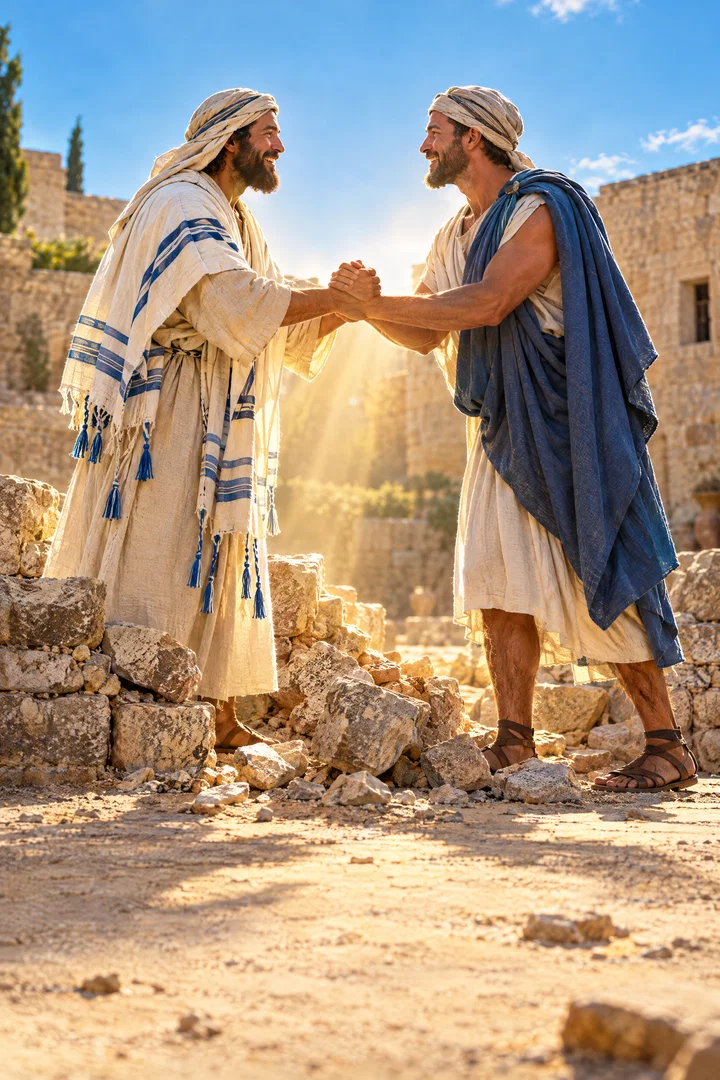
Having abolished in his flesh the enmity, even the law of commandments contained in ordinances; for to make in himself of twain one new man, so making peace;
Translations
Having abolished in his flesh the enmity, even the law of commandments contained in ordinances; for to make in himself of two one new man, so making peace;
Having abolished in his flesh the enmity, even the law of commandments contained in ordinances; for to make in himself of twain one new man, so making peace;
having abolished in his flesh the enmity, even the law of commandments contained in ordinances; for to make in himself of twain one new man, so making peace;
Having abolished in his flesh the enmity, even the law of commandments contained in ordinances: to make in himself of two one new man, so making peace;
having abolished in his flesh the enmity, even the law of commandments contained in ordinances; that he might create in himself of the twain one new man, so making peace;
having abolished in his flesh the enmity, even the law of commandments contained in ordinances; that he might create in himself of the two one new man, so making peace;
the enmity in his flesh, the law of the commands in ordinances having done away, that the two he might create in himself into one new man, making peace,
having annulled the enmity in his flesh, the law of commandments in ordinances, that he might form the two in himself into one new man, making peace;
The enmity, in his flesh—the law of commandments in decrees—bringing to nought,—that, the two, he might create in himself, into one man of new mould, making peace.
Berean Standard Bible, Majority Standard Bible
by abolishing in His flesh the law of commandments and decrees. He did this to create in Himself one new man out of the two, thus making peace
having abolished in his flesh the hostility, the law of commandments contained in ordinances, that he might create in himself one new man of the two, making peace,
Having in his flesh put an end to that which made the division between us, even the law with its rules and orders, so that he might make in himself, of the two, one new man, so making peace;
In abrogating through his flesh the hatred, that is, the Lawe of commandements which standeth in ordinances, for to make of twaine one newe man in himselfe, so making peace,
Douay-Rheims (Challoner revision)
Making void the law of commandments contained in decrees; that he might make the two in himself into one new man, making peace;
Pictures
Cross-references 20 of 164
- Colossians 2:14
Blotting out the handwriting of ordinances that was against us, which was contrary to us, and took it out of the way, nailing it to his cross;
Christ nailed the handwriting of ordinances to the cross and took it out of the way.
- Matthew 5:17-18
Think not that I am come to destroy the law, or the prophets: I am not come to destroy, but to fulfil.
Christ fulfills rather than destroys the law, while Ephesians distinguishes abolished ordinances from enduring law.
- Romans 3:31
Do we then make void the law through faith? God forbid: yea, we establish the law.
Faith establishes God’s law rather than abolishing it, contrasting with the ordinances abolished in Christ.
- Galatians 3:28
There is neither Jew nor Greek, there is neither bond nor free, there is neither male nor female: for ye are all one in Christ Jesus.
Believers in Christ are one across ethnic and social divisions.
- Romans 8:7
Because the carnal mind is enmity against God: for it is not subject to the law of God, neither indeed can be.
The carnal mind is enmity against God and cannot submit to his law.
- Hebrews 9:10
Which stood only in meats and drinks, and divers washings, and carnal ordinances, imposed on them until the time of reformation.
It is cited with the ordinances abolished through Christ.
- Hebrews 10:1
For the law having a shadow of good things to come, and not the very image of the things, can never with those sacrifices which they offered year by year continually make the comers thereunto perfect.
The ceremonial law’s sacrifices were shadows of good things fulfilled by Christ.
- Ephesians 3:6
That the Gentiles should be fellowheirs, and of the same body, and partakers of his promise in Christ by the gospel:
Gentiles become fellow heirs and members of the same body through the gospel.
- Romans 7:12
Wherefore the law is holy, and the commandment holy, and just, and good.
The law called abolished is distinguished from the law that remains holy, just, and good.
- Acts 15:10
Now therefore why tempt ye God, to put a yoke upon the neck of the disciples, which neither our fathers nor we were able to bear?
Peter calls the Mosaic requirements a yoke the disciples could not bear.
- Ephesians 2:19
Now therefore ye are no more strangers and foreigners, but fellowcitizens with the saints, and of the household of God;
Formerly divided believers become fellow citizens and members of God’s household.
- Hebrews 7:18-19
For there is verily a disannulling of the commandment going before for the weakness and unprofitableness thereof.
The former commandment is set aside as weak and unprofitable, and the better hope brings perfection.
- Colossians 2:16-17
Let no man therefore judge you in meat, or in drink, or in respect of an holyday, or of the new moon, or of the sabbath days:
Food and holy-day ordinances were shadows fulfilled in Christ.
- Exodus 20:8-11
Remember the sabbath day, to keep it holy.
The fourth commandment’s Sabbath requirement is distinguished from abolished ordinances.
- Romans 11:17
And if some of the branches be broken off, and thou, being a wild olive tree, wert graffed in among them, and with them partakest of the root and fatness of the olive tree;
Gentiles are grafted into Israel’s olive tree and share its root and blessings.
- Galatians 3:19
Wherefore then serveth the law? It was added because of transgressions, till the seed should come to whom the promise was made; and it was ordained by angels in the hand of a mediator.
The law was added because of transgressions until the promised Seed came.
- Hebrews 7:12
For the priesthood being changed, there is made of necessity a change also of the law.
A change in priesthood necessitates a change in the law.
- Acts 15:5
But there rose up certain of the sect of the Pharisees which believed, saying, That it was needful to circumcise them, and to command them to keep the law of Moses.
Some believers demanded circumcision and obedience to Moses’ law.
- John 10:16
And other sheep I have, which are not of this fold: them also I must bring, and they shall hear my voice; and there shall be one fold, and one shepherd.
Christ gathers Gentiles and Jews into one flock under one shepherd.
- Acts 11:2-3
And when Peter was come up to Jerusalem, they that were of the circumcision contended with him,
The dispute over eating with uncircumcised Gentiles illustrates the enmity associated with the ordinances.
Commentary part 1 of 2
Each commentary is drawn from primary sources: the writings of Ellen G. White and Adventist pioneers and periodicals. Each commentary is separate. Its own words are not a quotation; follow the references to read the source passages.
Ellen G. White
45 sources
His death abolished the law of ordinances governing sacrifices and offerings that pointed forward to him and ended at his death, not the enduring moral law of the Ten Commandments including the Sabbath.Lt 51, 1901, par. 8–9SG1 109.23SP 370.1–2 By his sacrifice and blood he broke down the middle wall of partition between Jews and Gentiles, ending Jewish exclusiveness and opening salvation and gospel work to all humanity without restriction of custom or nationality.2SP 149.1–3DA 403.1ST Jan 6, 1888 In himself he makes the two, those far off and those near, into one new man, reconciling both to God in one body by the cross and giving both access by one Spirit to the Father as fellow citizens built into one holy temple.Lt 56, 1902, par. 19–20Ms 59, 1902, par. 10–11RH Feb 18, 1909DA 821.1 This peace is unity and love wrought by the Holy Spirit that removes distinctions of nationality, race, rank, and caste in a common brotherhood, calling believers to remain united, receive all without partiality, and carry the universal gospel to every soul.Lt 71, 1903, par. 13–14Lt 70, 1903, par. 20–21ST Jul 6, 19159T 190.4Ms 83, 1902, par. 10–11
Law That Was Abolished
The enmity abolished in his flesh is the law of commandments contained in ordinances governing Jewish sacrifices and offerings.Lt 51, 1901, par. 8–9SG1 109.23SP 370.1–2 Those ceremonies and divinely appointed services specified the Hebrew manner of worship and all prefigured his death.Lt 51, 1901, par. 8–93SP 370.1–2 They lasted until type met antitype at his death, when they were rendered valueless and ceased.Lt 51, 1901, par. 8–9SG1 109.23SP 370.1–2
His death ended circumcision and the ceremonial law as any condition for joining his church, and his work embraces the whole world.RH Apr 13, 19113SP 370.1–2SLP 121.1–122.1 Gentile believers who accept the gospel share its blessings as equals with Jewish believers and are not farther from God because they do not observe those ordinances.RH Apr 13, 1911SLP 121.1–122.1 They are not required to observe circumcision, and the restrictions and ceremonies that kept the Jews distinct from all other people are not to be made obligatory upon Gentiles accepting faith.RH Apr 13, 19113SP 370.1–2SLP 121.1–122.1 Jewish believers may observe them, but they are not binding on Gentiles.SLP 121.1–122.1
The verse does not abolish the enduring moral law, the Ten Commandments, or the Sabbath commandment, and his death did not make the Ten Commandments die with him.Lt 51, 1901, par. 8–9SG1 109.2 By removing the enmity associated with the ordinances through his sacrifice and blood he makes peace and brings people back into allegiance to God's commandments, since transgression of the law made the blood of God's Son the price of redemption for the sins of the whole world.Lt 63, 1895, par. 39–41 His blood canceled the ordinances that stood as a partition between Jew and Gentile and opened access to God, so that through faith both groups can share the living bread and be brought into fellowship with God.Lt 230, 1907, par. 17–20 The gospel is thus God's ordained means to restore His moral image in man and to stem hostility against His law, His remedy for universal disorganization and the power that draws men together in unity.9MR 82.4
Partition Wall Removed
The enmity is pictured by the literal partition wall in the temple at Jerusalem that separated the outer court open to Gentiles from the inner enclosure lawful only for Jews on pain of death for pollution, for he who is the foundation and originator of that temple whose services and ceremonies pointed to his sacrifice as the Son of God encircled Gentiles with a human arm of sympathy and association while with a divine arm of grace and power he brought them the salvation the Jews refused.2SP 149.1–3 God's restrictions on Israel concerning association with idolaters were meant to keep Israel from adopting heathen practices, not to create a wall separating Israel from other nations, and the verse describes that enmity and separation being abolished so that the two could be made one and peace established.DA 29.1
He began breaking down the partition wall between Jew and Gentile at the very beginning of his ministry by rebuking Jewish pride, conceit, selfish seclusion, superficial morality, unreasonable prejudice and bigotry against Gentiles, and by not conforming to Jewish customs and regulations.2SP 149.1–3 He mingled freely with the despised Samaritans, accepting their hospitality, sleeping under their roofs, eating food prepared and served by their hands, teaching in their streets, and treating them with kindness and courtesy to preach salvation to the world and make of twain one new man.2SP 149.1–3 The barriers Jewish pride raised between Jews and heathen were to be broken down, and his work was to remove the division that kept even his disciples from sympathy with the heathen.DA 400.1
He illustrated the coming removal beforehand by relieving the afflicted woman in the coast of Tyre and Sidon to lead the disciples to be interested in working for others besides their own people when the Jews would turn from them for declaring Jesus the Saviour of the world.ST Jan 6, 1888 The arrival of Greeks seeking Jesus pointed to this opening of his mission beyond the Jews.ST May 16, 1878 His mission and death broke down the partition between Jews and Gentiles, making peace between them, removing the barrier that had restricted the gospel by custom or nationality, ending Jewish exclusiveness and making gospel work unrestricted.DA 403.1ST Jan 6, 1888AA 402.3ST May 16, 1878 Through his death he opened salvation to humanity and freed people from the power of evil, so that in him the gospel is open to all peoples and his representatives are to labor for both peoples.DA 403.1ST May 16, 1878
Through his death heathen nations are made partakers equally with the Jews in the blessings and privileges of the gospel and made fellow-heirs with the Israel of God, no longer an unclean race excluded from the promises of God, revealing the world-wide extent of the plan of God.7RED 59.1–60.13SP 326.3–328.1AA 135.1–3ST May 15, 1879 The vision of the sheet taught Peter that Gentiles were not to be treated as unclean or excluded, and that God's plan extended to the whole world.ST May 15, 1879 Although the breaking down was already accomplished by the time Paul and Barnabas were ordained at Antioch, letting the Gentiles into the full privileges of the gospel with a vigorous work among the Gentiles to follow that would strengthen the church by a great ingathering of souls, the wall still stood in the minds of the apostles, who confined their labors to the Jews, looked upon Gentiles as excluded, and had not yet preached the gospel to the Gentiles.7RED 59.1–60.13SP 326.3–328.13SP 347.3–4ST Jun 12, 1879 Peter had to be divested of settled prejudice and led to comprehend the world-wide extent of God's plan by the vision of the sheet and his experience with Cornelius, for God was tearing down the middle wall so the gospel was to be carried to all the world and his Holy Spirit would be sent to the uncircumcised as well as to Jews.3SP 326.3–328.1ST May 15, 1879Ms 126, 1902, par. 30–31 That truth caused contention in the church at Jerusalem until Peter rehearsed his experience, while many believing Jews still had a veil over their eyes and could not clearly discern to the end of that which was abolished by the Son of God.3SP 347.3–4ST Jun 12, 1879Ms 126, 1902, par. 30–31
One New Humanity Formed
In himself he makes the two groups — those who were far off and those who were near — into one new man and one new people, making peace.Lt 56, 1902, par. 19–20Ms 59, 1902, par. 10–11 Those far off were without God and without hope in the world, while those near stood within privilege, yet both are brought together in him.Lt 56, 1902, par. 19–20Ms 59, 1902, par. 10–11 Through his cross he reconciles both to God in one body.Lt 56, 1902, par. 19–20Ms 59, 1902, par. 10–11
With his own body he bridged the deep and impassable gulf that sin made between the world and heaven, providing the way by which separated men may again be united with heaven. Men left to themselves could not cross to reach the abode of bliss. He gives help and strength to every soul that desires to cross it, so that exiles are made prisoners of hope and placed on probation.
Through his cross and blood he reconciles both to God in one body, breaking down the dividing wall between those far off and those near.Lt 56, 1902, par. 19–202MR 185.1–2Ms 59, 1902, par. 10–11 Men in high positions of trust and influence, however exalted in this world, are in sin and under condemnation unless they accept him.Ms 74, 1900, par. 18 Though afar off, in bondage to Satan and as enemies under condemnation of God's law, they can be made nigh by his blood and reconciled, so that to follow him is the only path to true greatness and true honor.Ms 59, 1902, par. 10–11Ms 74, 1900, par. 18
Through him both have access by one Spirit unto the Father.RH Feb 18, 1909 They are no more strangers and foreigners but fellow citizens with the saints of the household of God, built upon the foundation of the apostles and prophets with himself as chief cornerstone, fitly framed together growing into a holy temple in the Lord.RH Feb 18, 1909 He brings believing Jews and Gentiles together as one church and into one spiritual fold, where the message of mercy offered first to Israel is then offered to all nations so that all who believe may be reconciled to God and receive everlasting life.RH Feb 18, 1909DA 821.1Lt 146, 1901, par. 10
This bringing of Jew and Gentile into one fulfills the covenant made with Abraham that in him all families of the earth would be blessed.Lt 146, 1901, par. 10 No outward privilege or position secures the spiritual blessings of that covenant, and no outward disability debars any person who complies with the conditions.Lt 146, 1901, par. 10 Everywhere and in all ages he that fears God and works righteousness is accepted with him, for name or position is of no real value with God.Lt 146, 1901, par. 10
The peace established is unity and love wrought by the Holy Spirit, with unity replacing dissension.Lt 71, 1903, par. 13–14Lt 70, 1903, par. 20–21 The cross fully accomplishes the miracle of perfect union among believers.Ms 147, 1902, par. 16 Church members are made to act as one and blend together with consecrated body, soul, and spirit as a living, active missionary agency moved and controlled by the Spirit to carry on the great plan of redemption for the good of an unbelieving world.Ms 147, 1902, par. 16
Unity Lived and Preached
In him those who were far off and those who were near are reconciled to God in one body by the cross through his blood, and in him believers are united and must not separate from one another.2MR 185.1–2Ms 59, 1902, par. 10–11 This oneness in him is an instructive lesson for those who are not working in harmony.Ms 59, 1902, par. 10–11
Pure and undefiled religion makes all who are children of God one family bound up with him in God.Ms 83, 1902, par. 10–11 He binds men to himself, to God, and to one another, so that true sanctified judgment makes all the human element in him one and builds no wall of separation between a man and his fellow.Ms 83, 1902, par. 10–11 Through him men and women are adopted into the divine family as sons and daughters with every advantage of his power and redeeming love.Ms 83, 1902, par. 10–11 This oneness is not proud, partial, and exclusive, favoring only a few while the lowly awaken little sympathy, but receives suffering humanity of all classes without distinction.Ms 83, 1902, par. 10–11
He removes the divisions and hostility that separated peoples and makes those who were divided into one family and one new humanity through redemption.ST Jul 6, 19159T 190.4RH Dec 24, 1908STB 192.2 In him people of every nationality, race, rank, creed, caste, status, condition, and relationship are linked in a common brotherhood and are equal before God.ST Jul 6, 1915ST Jun 9, 1914RH Dec 24, 1908STB 192.27T 225.3 His mercy, love, and care are not limited by those distinctions, and no group may claim heaven's gifts for itself while excluding others.9T 190.4ST Jun 9, 1914 No such distinction bars anyone from God, for all are brought near through his blood and given access to God.ST Jul 6, 1915RH Dec 24, 1908
This principle applies to church work among different nationalities, where separate organizations would build walls, hinder spiritual growth, and require later removal, while working together supports unity.9T 195.3 The gospel harmonizes the sinful race by making peace, bringing rich and poor together at the feet of Jesus rather than dividing and weakening them with too-strenuous requirements God has not required.RH Feb 10, 191612MR 177.2–3 He came to break down every wall of partition and throw open every compartment in the temple of his creation, so that every soul, Jew or Gentile, has free access to God's presence.Lt 29, 1898, par. 24–26 The message he brought from the Father is for the ears of the whole world, a blessing as universal as light, with no boundaries to grace, and mercy for those who seek him with contrition of soul.Lt 29, 1898, par. 24–26 He removes barriers including prejudice between nations and artificial distinctions in society by teaching love for all people, so that every needy person is a neighbor and the whole world is the field for his followers' mission, and this calls every soul to yoke up with him to reach and draw to him souls of every caste and every nation.Lt 29, 1898, par. 24–26 Loving service to people suffering because of religious differences can break down prejudice and draw them to God.ST Jul 6, 1915Lt 29, 1898, par. 24–26
Those who were far off without God and without hope in the world are made nigh by his blood when they receive faith and then preach the gospel they have received.RH Feb 18, 1909 Through him both have access by one Spirit unto the Father, are no more strangers and foreigners but fellow citizens with the saints of the household of God, and are built upon the foundation of the apostles and prophets with himself as chief cornerstone, fitly framed together growing into a holy temple in the Lord.RH Feb 18, 1909 This is the result to be seen by faith from faithful cooperation with God in saving souls and dispensing the gospel to every creature under heaven as stewards who must give an account, laboring for both peoples because his death broke down the partition between Jews and Gentiles and made gospel work unrestricted by custom or nationality.RH Feb 18, 1909 By breaking down barriers of nationality and position he made salvation available to the whole world and calls all people to acknowledge God as supreme.Lt 38, 1907, par. 15–17
Even a most splendid temple amounts to nothing if hearts are not right, so spiritual condition should be the greatest anxiety, and children must be taught that God meets with his people and their thoughts directed heavenward.Ms 49, 1886, par. 16 The gospel is his ordained means to restore his moral image in man and to stem hostility against his law, his remedy for universal disorganization and the power that draws men together in unity by making peace.9MR 82.4
Sources
Pioneers and periodicals
214 sources
Christ in his flesh abolished by his death and blood on the cross the law of commandments contained in ordinances, the ceremonial law of types and shadows, not the moral law of the Ten Commandments which remains binding and enduring.ST Mar 20, 1879ST Nov 11, 1897ST Jul 29, 1875 That enmity is the carnal mind, the fleshly sinful nature hostile to God that refuses submission to His law and separates humanity from God and from one another, and it is also that ceremonial system with its rites and human efforts to earn favor which burdened Israel and walled Jews off from Gentiles.ST Jun 24, 1913ST Nov 11, 1897ST Jun 8, 1915ST Jul 29, 1875RH Apr 14, 1874 By slaying that enmity He broke down the middle wall of partition and made of Jew and Gentile in Himself one new man, one body and one new people, so making peace and bringing those far off near with equal access to the Father in one Spirit.ST Jul 31, 1884ST Feb 22, 1883RH Apr 14, 1910RH Apr 14, 1910RH Feb 7, 1856 The seventh-day Sabbath of the fourth commandment was not part of what was abolished, for it is a memorial of creation made for humanity before the fall, part of the enduring moral law, while only the annual ceremonial sabbaths and shadows ended when offered.RH Oct 14, 1873ST Oct 2, 1884RH Jun 24, 1862RH Apr 9, 1872ST Jan 17, 1906 Gentiles who were aliens from Israel's commonwealth are thus brought near by His blood to become fellow citizens with the saints and members of God's household, sharing Israel's covenants and promises as spiritual Israel with no distinction of race.RH Apr 14, 1910ST May 30, 1878RH Apr 12, 1864
Meaning of Enmity
The enmity abolished in flesh is the carnal mind, the fleshly sinful nature hostile to God that refuses submission to His law, holds the mind in bondage to sin and love of sin, and stands as a wall of partition separating humanity from God and from one another.ST Jun 24, 1913ST Nov 11, 1897ST Sep 13, 1910ST Jun 16, 1898ST Jan 24, 1900 Christ took human flesh with the same tendencies toward sin as others, partaker of flesh and blood as Seed of the woman and seed of David, tempted as people are yet without sin, and by the Spirit's power through faith overcame those tendencies beginning where humanity fails, in the mind.ST Jun 24, 1913ST Jun 8, 1915ST Sep 13, 1910ST Mar 25, 1913ST Jun 16, 1898 That enmity comes from the human carnal mind through Adam's sin, not from God, and its removal by death in the flesh through blood of the cross brings pardon, peace, reconciliation and union, so that children of flesh become one with God by Christ living in them and dwelling in hearts by faith, and being reconciled to God are united whether Jew or Gentile.ST Nov 11, 1897ST Jun 8, 1915ST Sep 13, 1910ST Jun 16, 1898ST Jan 24, 1900
The enmity is also the law of commandments contained in ordinances itself, the ceremonial law with its rites and regulations and priestly ministrations, which burdened Israel and walled Jews off from Gentiles until Christ came.ST Jul 29, 1875RH Apr 14, 1874RH Mar 8, 1864 That law was a shadow pointing forward to Christ's sacrifice and priesthood, and when substance came its observances ceased and the yoke was lifted, while to continue them afterward imposes the yoke unnecessarily and to seek justification through them rejects Christ.ST Jul 29, 1875RH Apr 14, 1874 In the Ten Commandments there was no enmity, and the abolished ordinance-code does not refer to them.ST Jul 29, 1875RH Mar 8, 1864
The law of commandments contained in ordinances includes human rules and carnal efforts devised to improve the flesh or earn favor and establish self-righteousness, such as stated fasts and self-crucifixion, man-made dogmas and creeds, wicked works in principle, and religious observances and commands of human tradition taught as necessary for salvation, rooted in the carnal mind rather than God's command.ST Jun 24, 1913ST Jun 8, 1915ST Mar 25, 1913ST Feb 9, 1915ST Jun 4, 1902 The ceremonial services were originally forms expressing faith, but turned into a means of seeking salvation through works they became part of that reliance on human effort, and Christ swept it away, for only His blood saves.ST Jun 24, 1913ST Jun 8, 1915ST Mar 25, 1913ST Jan 18, 1916 Those in Him have the carnal mind crucified and displaced by the mind of Christ, faith writes God's moral law in the heart, ceremonies trusted for salvation are set aside, and the reconciled are enabled to keep God's law as Christ did in harmony with it.ST Jun 8, 1915ST Jan 18, 1916ST Feb 9, 1915ST Jun 4, 1902
The middle wall is the carnal nature itself, which the ceremonial law only represented and did not constitute, naturally separating converted from unconverted.ST Sep 5, 1895 Enmity creates a wall of misunderstanding between people and God and also separates people, nations and races, and can even twist what is good into part of these divisions.ST Sep 5, 1895 Christ in His flesh made that carnal nature thoroughly inactive and powerless and destroyed it by crucifixion, having the same sinful flesh other men have, as must be made powerless in other men before they can be children of God.ST Sep 5, 1895
Both and twain mean God on one side and man on the other, and to make in Himself of twain one new man means to make God and man one in Christ Jesus, so making peace.RH Jan 22, 1901RH Dec 4, 1900RH May 20, 1902 Christ, who was God, became man, and in Him both God and man are present meeting as one new humanity, the ideal divine-ideal God-man, the true man created to express the mind of God.RH Oct 10, 1907RH Jan 22, 1901RH Dec 4, 1900RH May 20, 1902 This is accomplished when self is emptied and annihilated by choosing the mind of Christ, so the false selfish self disappears, the true self appears, and God is manifest in the flesh in the man clothed and in his right mind.RH May 20, 1902 Believers together come into the one complete humanity represented by Christ and reveal the perfect Christ, an example of the creative work by which sinners are made righteous through faith, delivering from heredity's power by imparting divine nature.RH Oct 10, 1907RH Jan 22, 1901ST Oct 31, 1900 The living temple-church He builds with those far off, as the Branch building the temple with Himself as chief cornerstone, is the same union of head and body.ST Apr 23, 1896ST Aug 10, 1904
Those afar off are Gentiles not descended from Israel, not the lost ten tribes, and those nigh are the Jews.RH Jan 31, 1865ST Mar 11, 1875ST May 12, 1881 The passage was written to Gentile converts and the faithful everywhere to show their condition without Christ as aliens from Israel's commonwealth and strangers to the covenants of promise, separate from Christ, without hope and without God, alienated from the life of God, in darkness and subject to death.RH Jan 31, 1865ST Aug 10, 1904ST Mar 25, 1897 In Christ they are made nigh into life-union with Him like head and body joined by living bone and flesh and cord and tendon and muscle and nerve and vein and artery, a life-union and working union and sympathetic union, in whom dwell all treasures of wisdom and the fullness of the Godhead as the Christian's light and life.ST Aug 10, 1904ST Mar 25, 1897 The promise of the Holy Spirit extends to both, to those far off and to those addressed as you and your children, and Christ came preaching peace to all, both near and far, a proclamation already made before He preached in Judea.ST Mar 11, 1875ST Oct 21, 1897
Law That Was Abolished
The law abolished in the flesh is the ceremonial or typical law of commandments contained in ordinances, the law of types and shadows that pointed forward to Christ, not the moral law of the Ten Commandments which remains binding and enduring.ST Mar 20, 1879ST Jul 29, 1875ST May 30, 1878ST May 6, 1875 Its removal reconciles people to God by taking away sin and the typical services and symbols that pointed to sin and recalled it but could not remove it, while leaving the moral law unchanged.ST Nov 11, 1897 That abolished law is what had separated Jews and Gentiles as peoples, including circumcision, distinctions between clean and unclean things, washings and other ceremonies that kept Israel distinct until the Messiah came, whereas the moral law applied to Gentiles as well as Jews and created no such division.ST Jul 29, 1875ST May 30, 1878 The qualification contained in ordinances itself distinguishes the abolished ceremonial law from the moral law, and its removal made peace between the two peoples.ST Jul 29, 1875
The verse proves two distinct laws that must be distinguished by context: the first, original, moral, spiritual, royal law of God, the Ten Commandments, and the second, ceremonial or ritual law, the law of Moses, a carnal commandment.RH Sep 13, 1853 This distinction reconciles Scriptures that say the law is abolished with Scriptures that say Christ did not come to destroy the law and that not one jot or tittle shall pass from it.RH Sep 13, 1853 Paul's testimony about what was abolished belongs to the handwriting of ordinances and ceremonial regulations, while the commandments that convict of sin and remain the rule of moral conduct, defining righteousness, are still in force.RH Feb 17, 1852RH Jul 22, 1852ST Jun 28, 1877 The ordinances were given to Israel in sacrifices and offerings that pointed forward to Christ's one offering for transgression, and his death fulfilled their purpose, leaving the royal law and Decalogue in force.RH Jan 1851 The verse therefore concerns the ceremonial law of types and shadows that ceased when its purpose was fulfilled, not the Ten Commandments.RH Jun 17, 1862
The abolished ordinance-law is enmity and contrary to people, a carnal, shadowy, burdensome code, weak and unprofitable, a temporary system of carnal ordinances and shadows of things to come imposed only until the time of reformation and taken out of the way through Christ's death.ST Sep 21, 1876ST Sep 21, 1876RH Sep 13, 1853RH Mar 18, 1862ST Jan 6, 1881 Its sacrifices and ceremonies ended when Christ's sacrifice was made, having pointed forward to his work, and their end brought peace. It was secondary law, not primary moral law, a class of commandments resting only on Israel's national circumstances and connection with the earthly sanctuary, drawing all binding force from those temporary conditions and ceasing when they ended, covering sanctuary services with feasts, new moons, ceremonial sabbaths and related observances.RH Jul 30, 1861RH Nov 22, 1853 It had been added because of sin and because of transgression until the promised Seed should come, with ordinances imposed until the time of reformation, and Christ redeemed believers from its curses by taking it out of the way through his death on the cross.RH Jan 28, 1902 It was the rite of circumcision given to Abraham and afterward the whole ceremonial law given to his posterity, which walled Israel off to dwell alone as God's peculiar heritage to preserve knowledge of divine truth and worship of the Most High, and its removal broke down Jew-Gentile division into oneness in Christ.RH Dec 17, 1861RH Nov 22, 1853RH Mar 14, 1854 The system given especially in Exodus, Leviticus and Deuteronomy covered sanctuary and temple services, sacrifices and offerings including sin and meat and drink offerings, priesthood and Levitical regulations, purifyings and washings, circumcision, distinctions of clean and unclean and foods and drinks, feast days and three yearly feasts, new moons, yearly and ceremonial sabbaths, Passover, unleavened bread, Pentecost, sabbaths of the land, and the civil code of the Jewish theocracy.ST Oct 2, 1884RH Feb 3, 1852ST Dec 13, 1905ST Sep 16, 1930 It was peculiar to the Jews, consumed time, and was a yoke Gentiles could not bear, dealing with meat and drink offerings, feast days, new moons and ceremonial sabbaths distinct from the Lord's Sabbath in the Ten Commandments.ST Oct 2, 1884RH Feb 3, 1852
The Ten Commandments were spoken by God directly to all the people and written by God on stone tablets placed inside the ark, while the Mosaic precepts, judgments and ordinances were spoken to Moses, written by Moses in a book placed beside the ark as a witness and delivered to Moses to teach.ST Oct 2, 1884RH Apr 21, 1851 That law of Moses in a book was a grievous yoke, against and contrary to the people, nailed to the cross, unlike God's moral law which is holy, just and good and remains established.ST Feb 1, 1877RH May 7, 1867 The Jewish ceremonial law written by Moses pointed forward to Christ's sacrifice, and by abolishing the ordinances the barrier separating Jews and Gentiles was removed to make peace.RH Feb 1851 The seventh-day Sabbath of the fourth commandment is not part of this abolished law, and to keep that abolished law as binding now is to return to weak and beggarly elements where Christ's atonement profits nothing. The phrase contained in ordinances marks the abolished code as different from the ten precepts called the commandments of God, since the Ten Commandments are not made up of ordinances, are not enmity, and are not a shadow of things to come.ST Jul 29, 1875RH Mar 8, 1864RH Dec 28, 1869 Those who held otherwise taught that if the verse refers exclusively to one of two proposed laws it blots out the Ten Commandments, while still distinguishing abolishing a law from abolishing its underlying moral principle and noting the same law can be described differently by standpoint.RH Mar 4, 1873 Others taught that the forms, the commandment law and the law of Moses were given together at Sinai as one law of Moses with no law before Sinai and the whole abolished at Christ's death, or that Christ abolished the judicial part inflicting temporal death, or that the fleshly ordinances not intended for Gentiles after the reformation included the abstentions from food offered to idols, blood and strangled animals.RH Jul 8, 1862RH Apr 1, 1858RH Feb 21, 1854RH Feb 4, 1873
How Christ Abolished It
Christ abolished the enmity and the dividing ordinances in his flesh through his death and blood and cross, nailing them to the cross and taking them out of the way.RH Feb 21, 1854RH Jul 29, 1858RH Feb 18, 1873 The abolished ordinances were ceremonial shadows and types that pointed forward to his sacrifice and priestly ministry, and they ceased when shadow reached substance and the Antitype came, beginning with his offering as sacrifice and continuing in his work as High Priest.RH Mar 14, 1854ST Dec 13, 1905ST Mar 20, 1879RH Jan 10, 1916 Those rites had been given to teach faith in Christ, protect the church from heathen wickedness and draw others to blessing, but used in a selfish carnal way as a means of salvation they became a wall of separation contrary to purpose.ST Jun 24, 1913ST Oct 28, 1913ST Mar 25, 1913 The sanctuary services, sacrifices and offerings, temple services, foods and drinks, washings and purifyings could not make worshipers perfect in conscience, and once the great Sacrifice had been offered they were no longer needed and no longer require obedience.ST Dec 13, 1905ST Mar 20, 1879ST Dec 20, 1905 Not everything from the former dispensation was abolished, but the things fulfilled in his work as sacrifice and High Priest came to an end.RH Mar 14, 1854
He took the same human flesh and blood as those he saves, with its tendencies toward sin, partaker of flesh and blood as Seed of the woman and seed of David.ST Jun 24, 1913ST Sep 13, 1910ST Mar 25, 1913ST Mar 25, 1913ST Jun 16, 1898 In his own flesh he crucified, slew and made thoroughly inactive and powerless the carnal mind by the Spirit's power through faith, beginning in the mind where humanity fails rather than following its tendencies.ST Jun 24, 1913ST Mar 25, 1913ST Jun 16, 1898RH Oct 2, 1900ST Sep 5, 1895 Tempted as people are yet without sin, he had nothing answering temptation, and that enmity which is a wall of partition between God and man was thus abolished in himself to bring peace and union of two making one new man.ST Sep 13, 1910ST Jun 16, 1898RH Oct 2, 1900 Children of flesh become one with God by having him in them and the Father in him, by his living in them and dwelling in their hearts by faith, and when so reconciled to God there is union among men whether Jew or Gentile.ST Mar 25, 1913ST Jun 16, 1898
His abolition in his flesh and in himself is limited rather than universal in its first action.ST Sep 5, 1895RH Oct 2, 1900 He bore the sinner's sins in his body as substitute, not in his character, to abolish enmity in human beings as well, destroying sin's power at its source in the carnal heart.RH Oct 2, 1900ST May 28, 1896ST Oct 21, 1897ST Aug 23, 1899 Freedom from sin is thus offered to all who accept it by faith, removing the carnal mind's resistance to God's law and making keeping the law a work of love.ST May 28, 1896ST Oct 21, 1897 The Christian warfare is in the realm of thought, where his presence and power must put to death and cast out selfish evil imaginings and schemes so that those who obey him live in peace.ST May 28, 1896ST Aug 23, 1899
This directly disannuls the penal or abnormal force of the moral law that works wrath through carnality, as when a pardoned prisoner is freed from penalty while the law itself remains.ST Sep 5, 1895ST Sep 12, 1895 What is abolished is not the moral law engraved in stone but its ministration of death, the abnormal condemning action of divine law.ST Sep 5, 1895ST Sep 12, 1895 That ministration is abolished only by destruction of the carnal nature through crucifixion of the flesh, when the veil of blinding carnality is removed from the heart.ST Sep 5, 1895ST Sep 12, 1895 Then the ministration of the Spirit, the ministration of righteousness which is the law of the Spirit of life, the moral law in its normal operation as exemplified in his life, brings freedom.ST Sep 12, 1895 Only in an indirect way does this touch the ceremonial law, in that destruction of the carnal nature ends carnal efforts to seek justification by ceremonial observances.ST Sep 5, 1895
Those who held the opposing view taught that the verse does not mean he died to destroy the ceremonial law, for that system was part of grace for redemption and was not against anyone before his coming, since faith in him could only be shown by obedience to it.ST Sep 12, 1895 On that showing the ceremonial system ended by its own limitation at the first advent, not by abolition except in an accommodated sense.ST Sep 12, 1895 The verse then involves it only indirectly, because being crucified with him destroys the body of sin and the blind selfish carnal nature and so puts an end to every effort of the flesh to be justified by deeds of any law, moral or ceremonial, giving peace and triumph through crucifixion of the flesh over every misapplication and over all evil.ST Sep 12, 1895
The ceremonial law was entirely abolished at the cross and not partly retained in the gospel dispensation.ST Dec 20, 1905RH Feb 21, 1854 Its removal followed from his coming to die for humanity rather than being the purpose of his mission, and it was taken out of the way and nailed to the cross at crucifixion, not at Pentecost.RH Jul 29, 1858RH Feb 18, 1873 To keep it as binding now is to return to weak and beggarly elements where his atonement profits nothing. The abolished law is a second different law, the law of enmity contrary to men, the body written and placed in or by the side of the ark, unlike the law spoken, engraven on stone and placed inside the ark.RH Feb 18, 1873
He who was God became man, and in him both God and man are present meeting in peace.RH Jan 22, 1901RH Dec 4, 1900 By giving himself he broke down the wall of sin that had shut humanity away from heaven and bridged the impassable gulf sin made between world and heaven.RH Jan 22, 1901ST Jun 19, 1907 By his death he paid the penalty for sins committed, and by condemning sin in human flesh he delivers those who receive him from heredity's power, imparting divine nature and strength to raise and keep them above it.RH Oct 10, 1907RH Jan 22, 1901 As Prince and King of Peace, High Priest, Mediator and Shepherd he continues reconciliation, and as the Branch foretold in Zechariah 6:12-15 he builds the living temple-church with those far off, himself the chief cornerstone against which the gates of hell cannot prevail, creating sinners righteous through faith and gathering all believers together into the one complete humanity he represents.ST Apr 23, 1896RH Oct 10, 1907ST Oct 31, 1900ST Jun 19, 1907
Sources