Exodus 1:15
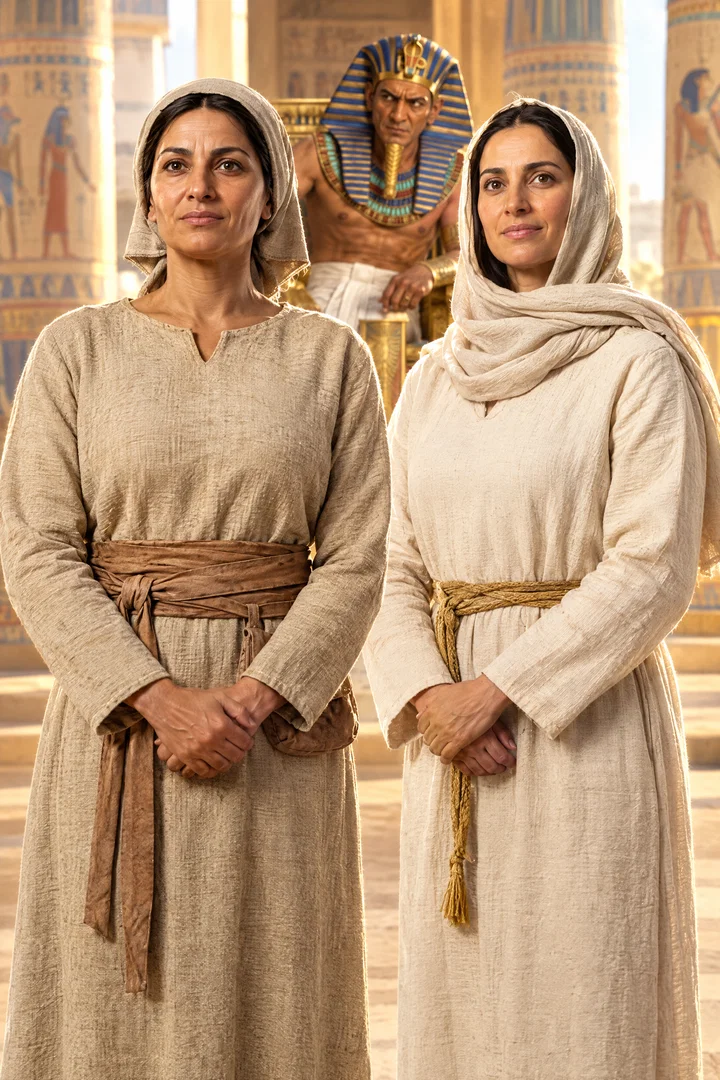
And the king of Egypt spake to the Hebrew midwives, of which the name of the one was Shiphrah, and the name of the other Puah:
Translations
And the king of Egypt spoke to the Hebrew midwives, of which the name of the one was Shiphrah, and the name of the other Puah:
King James Version, KJV Cambridge Paragraph Bible, Revised Version
And the king of Egypt spake to the Hebrew midwives, of which the name of the one was Shiphrah, and the name of the other Puah:
And the king of Egypt spoke to the Hebrew midwives (of which the name of one was Shiphrah, and the name of the other Puah:)
And the king of Egypt spake to the Hebrew midwives, of whom the name of the one was Shiphrah, and the name of the other Puah:
And the king of Egypt speaketh to the midwives, the Hebrewesses, (of whom the name of the one [is] Shiphrah, and the name of the second Puah),
And the king of Egypt spoke to the Hebrew midwives — of whom the name of the one was Shiphrah, and the name of the other was Puah —
Then said the king of Egypt to the Hebrew midwives,—of whom, the name of the one was, Shiphrah, and, the name of the other Puah;—
Berean Standard Bible, Majority Standard Bible
Then the king of Egypt said to the Hebrew midwives, whose names were Shiphrah and Puah,
The king of Egypt spoke to the Hebrew midwives, of whom the name of the one was Shiphrah, and the name of the other Puah,
And the king of Egypt said to the Hebrew women who gave help at the time of childbirth ( the name of the one was Shiphrah and the name of the other Puah),
Moreouer the King of Egypt commanded ye midwiues of the Ebrewe women, (of which the ones name was Shiphrah, and the name of the other Puah)
Douay-Rheims (Challoner revision)
And the king of Egypt spoke to the midwives of the Hebrews: of whom one was called Sephora, the other Phua,
Pictures
Cross-references
- Exodus 1:22
And Pharaoh charged all his people, saying, Every son that is born ye shall cast into the river, and every daughter ye shall save alive.
Pharaoh extends his order to kill Hebrew boys to all Egypt.
- Exodus 1:20-21
Therefore God dealt well with the midwives: and the people multiplied, and waxed very mighty.
God prospered the midwives for their faithful refusal.
- Hebrews 11:23
By faith Moses, when he was born, was hid three months of his parents, because they saw he was a proper child; and they were not afraid of the king’s commandment.
Moses’ parents hid him by faith and were not afraid of the king’s command.
- Matthew 2:16
Then Herod, when he saw that he was mocked of the wise men, was exceeding wroth, and sent forth, and slew all the children that were in Bethlehem, and in all the coasts thereof, from two years old and under, according to the time which he had diligently enquired of the wise men.
Both describe a tyrant’s Satan-inspired killing of male children.
- Acts 7:18
Till another king arose, which knew not Joseph.
Stephen tells same incident
- Matthew 2:13
And when they were departed, behold, the angel of the Lord appeareth to Joseph in a dream, saying, Arise, and take the young child and his mother, and flee into Egypt, and be thou there until I bring thee word: for Herod will seek the young child to destroy him.
Jesus is taken to Egypt for protection, echoing the preservation of Abraham’s seed there.
- Exodus 2:1-10
And there went a man of the house of Levi, and took to wife a daughter of Levi.
Recounts Moses’ survival as an infant.
- Genesis 15:13
And he said unto Abram, Know of a surety that thy seed shall be a stranger in a land that is not theirs, and shall serve them; and they shall afflict them four hundred years;
Foretells that Abraham’s descendants would be afflicted in a foreign land.
Commentary
Each commentary is drawn from primary sources: the writings of Ellen G. White and Adventist pioneers and periodicals. Each commentary is separate. Its own words are not a quotation; follow the references to read the source passages.
Ellen G. White
17 sources
The verse names Shiphrah and Puah as the two Hebrew midwives whom the king of Egypt addressed.PP 241.3–4STB 639.5–640.2STB 627.3–628.1 After hard labor failed to lessen Israel, Pharaoh ordered them to kill every Hebrew boy at birth.PP 241.3–4SG3 179.1PP 242.1 Satan was the mover behind the order, seeking to destroy the male children to defeat God's purpose to raise up a deliverer and rescue Israel from oppression.SG3 179.1 The midwives feared God and refused to murder the children, saving the male children alive, and God approved and prospered them for disobeying the king.PP 241.3–4SG3 179.1PP 242.1 When his command was disobeyed Pharaoh was very angry and made it more urgent and extensive, charging all his people to kill every newborn Hebrew son by casting him into the river while saving every daughter alive.SG3 179.1PP 242.1 The verse also establishes the appointed pattern of women attending women in childbirth, calling for women to be thoroughly trained, entrusted, and valued as midwives and physicians for childbirth and women's health.STB 639.5–640.2STB 730.4CH 395.2–3STB 627.3–628.1Ms 53, 1907, par. 20
Pharaoh's Command and Response
The verse names Shiphrah and Puah as the two Hebrew midwives whom the king of Egypt addressed.STB 639.5–640.2STB 627.3–628.1Lt 22, 1911, par. 6–89T 176.2–313MR 113.2 After hard labor failed to lessen Israel, Pharaoh hardened his heart and went further, ordering the midwives to kill every Hebrew boy at birth.PP 241.3–4SG3 179.1PP 242.1 Satan was the mover behind the order, knowing that a deliverer was to be raised up among the Hebrews and thinking that destroying the male children would defeat God's purpose to rescue them from oppression.SG3 179.1
The midwives feared God, dared not murder the children, refused the king's command, and saved the male children alive.PP 241.3–4SG3 179.1PP 242.1 God approved the midwives' course and prospered them because they disobeyed the king.PP 241.3–4SG3 179.1PP 242.1 When Pharaoh learned his command had not been obeyed, he was very angry and made it more urgent and extensive, charging all his people to keep strict watch to kill every newborn Hebrew son by casting him into the river while saving every daughter alive.SG3 179.1PP 242.1 This history of the Israelites is to be considered by God's people living in the last days.1MR 225.4–226.2
Precedent for Women's Work
The naming of Shiphrah and Puah as Hebrew midwives addressed by the king of Egypt establishes the biblical pattern of women attending women in childbirth.STB 639.5–640.2STB 730.4CH 395.2–3STB 627.3–628.1Lt 22, 1911, par. 6–8 Midwifery was women's appointed work of caring for women, with women in Bible times taking responsibility for the care of women in childbirth.STB 730.4CH 395.2–3STB 627.3–628.1Lt 22, 1911, par. 6–8Ms 53, 1907, par. 20 The account presents women serving at childbirth as the precedent for training women and entrusting them with midwifery and care for women during childbirth.STB 730.4CH 395.2–3STB 627.3–628.1Lt 22, 1911, par. 6–8Ms 53, 1907, par. 20 In that service of caring for women, the Lord worked with the women.Ms 2, 1911, par. 3–513MR 114.2
The example calls for women to be thoroughly trained and educated as midwives and physicians for women.STB 627.3–628.1Ms 53, 1907, par. 20Ms 2, 1911, par. 10–119T 176.2–3Ms 39, 1909, par. 10–11 They are to be entrusted with responsibility for childbirth, for women's private medical care, and for women's health and medical practice generally.Ms 53, 1907, par. 20Ms 2, 1911, par. 10–119T 176.2–3Ms 39, 1909, par. 10–11Ms 2, 1911, par. 3–5 Women are to be educated to handle childbirth cases and to provide skilled midwifery and medical care for other women.STB 627.3–628.1Ms 53, 1907, par. 20Ms 2, 1911, par. 10–119T 176.2–3Ms 39, 1909, par. 10–11 This practice of women attending women in childbirth should always be followed.STB 639.5–640.2
By this principle men should not perform this work.Lt 34, 1911, par. 7 Men physicians are to intervene in childbirth cases only when circumstances require it.Ms 2, 1911, par. 10–11 The work of women trained to care for women's health should be valued and paid in proportion to their service.Ms 53, 1907, par. 20
Sources
Pioneers and periodicals
31 sources
The king of Egypt spoke to the Hebrew midwives Shiphrah and Puah with orders to kill the male children at birth, beginning cruel measures against Israel after a new line of kings arose who knew not Joseph and reduced a once-prosperous people to bitter slavery in the iron furnace of bondage.ST Nov 14, 1906RH Mar 9, 1869RH Aug 11, 1863RH Dec 17, 1861 He acted to check their fruitful and exceedingly mighty increase that filled the land, fearing they would become more powerful than the Egyptians, and counseled to deal wisely with them by afflicting them with burdens and decreeing the death of every newborn son while saving the daughters alive.ST Nov 14, 1906RH May 14, 1901RH Aug 11, 1863ST Dec 22, 1898 The order was Satan's effort through Pharaoh to destroy the promised seed, to prevent Israel's return to the land of promise and to stop the deliverance and the line through which salvation would come.ST Dec 22, 1898ST Apr 30, 1894ST Nov 7, 1906ST When the king commanded what was contrary to God's law the midwives rightly disobeyed him, for obedience to rulers becomes sinful when it requires wrongdoing against God, and their fear of God shows Israel still retained knowledge and reverence for Him in Egypt.RH May 12, 1868RH Sep 24, 1872RH Jun 8, 1916 God overruled the decree and preserved Moses from birth as the chosen deliverer, the type of Christ, who after his training and call led the hosts out of bondage into the promised land.ST Nov 13, 1901ST Jan 20, 1909ST Mar 30, 1904RH Nov 28, 1912
Historical Setting and Oppression
Exodus 1:15 belongs to the opening history of Israel's oppression in Egypt, which leads into the birth and upbringing of Moses until he is called to be the deliverer of his people, and it is part of the account of Israel in bondage and the chosen deliverer connected with waiting, the call, and Aaron.RH Jan 20, 1916ST Jan 20, 1909 It belongs to the account of Israel's oppression in Egypt which the opening chapters describe alongside Israel's growth and Moses' birth and upbringing, and to the reading in Exodus 1 and 2 which continues the story of Joseph and God's providential dealings through him for the preservation of the lives of his relatives.ST Jan 20, 1909ST Jan 23, 1912 The book stands as the going out, referring to the departure of Israel from Egypt, and the verse stands within its history section in chapters 1 to 18.RH Jan 20, 1916 There Israel, grown more and mightier than the Egyptians, is in bitter bondage and oppression, showing Egyptian malice against Hebrew infants from which Moses was rescued in his infancy before his work as the chosen leader of Israel in their great deliverance into a nation with organization, leadership, laws, and worship.RH Jan 20, 1916
The verse introduces the Egyptian king's order to the Hebrew midwives, naming Shiphrah and Puah, and marks the beginning of his cruel measures against the Hebrew people, whose prosperity had given way to slavery and oppression.RH Mar 9, 1869ST Jul 21, 1881 It falls after a new king and new line of kings arose who knew not Joseph, under which Israel was treated as despised slaves, and it belongs to the record of the long and terrible oppression and bitter servitude that came upon the family of Abraham after it went down into Egypt following brief prosperity.RH Dec 17, 1861ST Jan 28, 1913 That servitude was the iron furnace foreshadowed to Abraham by the horror of great darkness and the smoking furnace seen in vision, and human persecution could not stop God from prospering them.RH Dec 17, 1861 The new king acted to check the fruitful, abundant, exceedingly mighty increase of Israel that filled the land, fearing they would become more powerful than the Egyptians.RH May 14, 1901 His speaking to the Hebrew midwives belonged to his counsel to deal wisely with them, which set taskmasters over them to afflict them with burdens, made them serve with vigor, made their lives bitter with hard bondage, increased burdens, and decreed the killing of male children and the casting of every newborn son into the river while saving every daughter alive.ST Nov 14, 1906RH May 14, 1901RH Aug 11, 1863 This was a dreadful reversal of when Joseph nourished Israel and they were given a possession in the best of the land.RH May 14, 1901
The king's dealing with Shiphrah and Puah was part of the national reaction under the nineteenth dynasty after the fall of Khu-n-Aten. After his religious reform and rule through Asiatic and Canaanite officials collapsed, Egypt became Egypt for the Egyptians, drove out or massacred foreigners, and reduced those who remained, including the Israelites in Goshen, to the condition of public slaves. The order to the midwives was part of the further decimation of Israel by the destruction of its male offspring. The account is true history, not fable or myth, and its accuracy is shown because Stephen tells of the same incident in Acts 7.ST Apr 13, 1904 It is part of the history told in Exodus 1-14, which has no direct mention in the historical records of Egypt because nothing was ever registered on the public monuments except successes and triumphs.RH Apr 23, 1908 The court historiographers refrained from all mention of the terrible plagues from which Egypt suffered during a whole year and the disaster of the Red Sea, and the monarch did not inscribe any account of them upon his edifices.RH Apr 23, 1908
The oppression is corroborated by forced labor in brickmaking and construction, including burdens imposed in brickmaking and the building of the store and treasure cities Pithom and Raamses, in which the Israelites were principally employed.RH Apr 23, 1908ST Aug 9, 1910ST Dec 14, 1915 Pithom is Pa-Tum uncovered at Tel-el-Maskoutah, a square town enclosed by a thick brick wall and filled with solid two-storied chambers entered by trap-door for storage, built almost entirely of brick laid with mortar in regular tiers, matching the labor in mortar.RH Apr 23, 1908 Raamses was built in part by Seti I but mainly by Rameses II, the Pharaoh of the oppression who built the treasure cities named in Exodus 1 and 12, one of which bore his own name Rameses, whose reign continued from 1564 to 1497 B.C. to within six years of Israel's exodus from Egypt.RH Apr 23, 1908ST Aug 9, 1910 Rameses II noted on an engraved stone monument that he collected Semites and made them build the city of Raamses-Mera-Amen on the eastern delta of the Nile, his name is stamped on bricks used in ancient houses at Pithom, pictures in palaces show slaves mixing straw and mud, and houses in Pithom are made with bricks generally containing straw while some are destitute of it, matching the making of bricks with straw until no straw was given and the workers were reduced to straits and compelled to make bricks without straw with still more rigorous oppression.ST Oct 21, 1930RH Apr 23, 1908 Points of the narrative that admit comparison with the records of the time are the employment of forced labor in Egypt at this period and the method of its employment, the inclusion of the Hebrews among the forced laborers, the construction of store-cities and the names of the cities, the military organization of the time, the untimely loss of a son by the king under whom the Exodus took place, and any indication in the records of exhaustion and weakness following the events related in Exodus.RH Apr 23, 1908 Notwithstanding hardships and oppressions, the people multiplied and grew, until instead of the threescore and fifteen who entered Egypt there were about three million who departed at the exodus.ST Aug 9, 1910
Assault on Promised Seed
The command to Shiphrah and Puah was Satan's effort through oppression and the killing of Hebrew male children to destroy the promised seed and thwart God's plan, and it marks one stage in that enemy effort which God overruled to preserve His people.ST Egyptian hatred went so far as to order the destruction of all the male Hebrew children in hope of destroying Israel itself.ST Apr 30, 1894 That order was Satan's plan to destroy the promised seed and so defer the plan of salvation, yet God was with His people and the tribulation worked out salvation for them.ST Apr 30, 1894
The decree to destroy the male children was an effort to prevent Abraham's promised seed from returning to the land of promise and to frustrate God's promise.ST Dec 22, 1898 It belonged to Egypt's effort to enslave or destroy the Israelites, the people through whom the promise would come, and despite that threat God's protecting power preserved the promised people.ST Dec 22, 1898ST Nov 7, 1906 Satan worked through Pharaoh to stop Israel's deliverance when the time was ripe for a deliverer to lead the hosts out of Egyptian bondage into the promised land.ST Mar 30, 1904 He caused the decree that all male children born to Israel should be put to death, and when the midwives were unwilling to become executioners the command was repeated and emphasized that every male child be thrown into the river.ST Mar 30, 1904
Satan meant that Israel should never leave Egypt and that Moses, the type of Christ who should lead God's people into the typical land of promise, should perish under Pharaoh's decree, but God preserved Moses and he led the people out.ST Mar 30, 1904 Pharaoh's order to the midwives and then to throw every male child into the Nile was meant to prevent Israel's deliverance from Egypt and the promised Messiah's line, but the midwives refused to carry out the command and God preserved Moses, who led Israel out of bondage.RH Nov 28, 1912 The decree was also an attempt to destroy the godly line and force its daughters to marry ungodly men, but God preserved the line by raising up Moses as a deliverer and leading the people out of bondage so that His eternal purpose could continue.ST Aug 3, 1915 In enslaving Joseph's descendants and ordering the killing of their infants, the Egyptians acted to conceal their wrongdoing.
Obedience, Faith, and Deliverance
When the king of Egypt commanded the Hebrew midwives to do what God's law forbade, they were right to disobey him.RH May 12, 1868 Obedience to civil rulers becomes sinful when their commands require wrongdoing and stand in conflict with obedience to God.RH May 12, 1868
The midwives' fear of God shows that Israel in Egypt still retained knowledge of Him and reverence toward Him.RH Sep 24, 1872 Their faith was not wholly forgotten before the Sabbath was made known at Sinai.RH Sep 24, 1872 At that time idolatrous Egyptians were persecuting the Hebrews, who worshiped the true God.RH Jun 8, 1916
Pharaoh's decree to kill the Hebrew boys was to be carried out through his order to Shiphrah and Puah.ST Nov 13, 1901 That decree threatened Moses' life from birth and threatened the lives of the children.ST Nov 13, 1901ST Nov 27, 1901 It was disregarded, and Moses' life was spared at birth.ST Nov 27, 1901 God overruled the decree for the training and education of Israel's future leader.ST Nov 13, 1901
By the king's law demanding his immediate death, Moses from birth became the special object of providential care. His loving, God-fearing parents were the instruments who devised a way to preserve the child from the king's tyranny. That saving of Moses the prophet of God from the decree to put the Hebrew males to death is like the saving of Matthias, born in Bethlehem, from the sword of Herod called the Great.ST Sep 27, 1910
The oppressed state surrounding this command shows that the Israelites could not have kept the Sabbath even if they had wished.RH May 16, 1854 Centuries of long bondage in Egypt left them unprepared to grasp the meaning of God's salvation and the character He required when He afterward delivered them.
Sources