Exodus 1:14
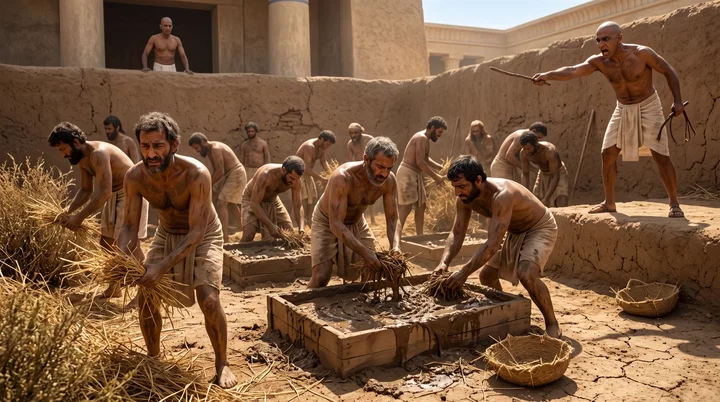
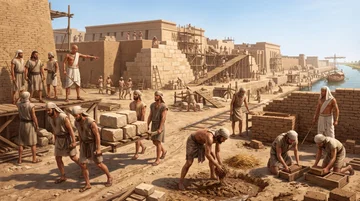
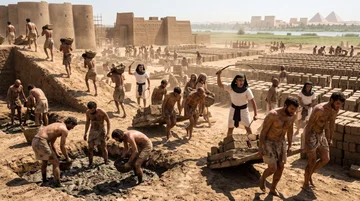
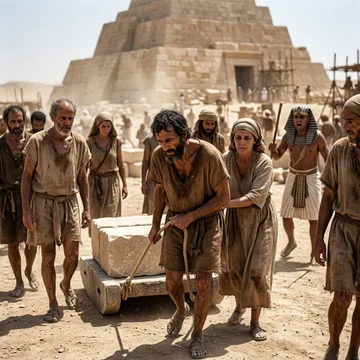
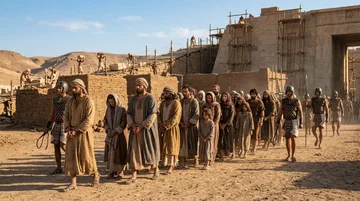
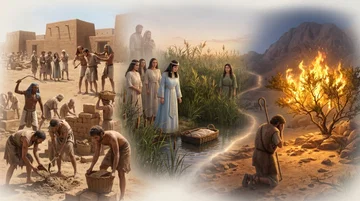
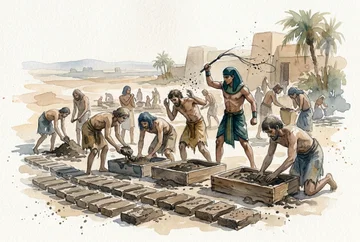
And they made their lives bitter with hard bondage, in morter, and in brick, and in all manner of service in the field: all their service, wherein they made them serve, was with rigour.
Translations
And they made their lives bitter with hard bondage, in mortar, and in brick, and in all manner of service in the field: all their service, wherein they made them serve, was with rigor.
And they made their lives bitter with hard bondage, in morter, and in brick, and in all manner of service in the field: all their service, wherein they made them serve, was with rigour.
and they made their lives bitter with hard bondage, in morter, and in brick, and in all manner of service in the field: all their service, wherein they made them serve, was with rigour.
And they made their lives bitter with hard bondage, in mortar, and in brick, and in all manner of service in the field: all their service in which they made them serve, was with rigor.
and they made their lives bitter with hard service, in mortar and in brick, and in all manner of service in the field, all their service, wherein they made them serve with rigour.
and they made their lives bitter with hard service, in mortar and in brick, and in all manner of service in the field, all their service, wherein they made them serve with rigor.
and make their lives bitter in hard service, in clay, and in brick, and in every [kind] of service in the field; all their service in which they have served [is] with rigour.
and they embittered their life with hard labour in clay and bricks, and in all manner of labour in the field: all their labour with which they made them serve was with harshness.
and embittered their lives with harsh service, in clay and in bricks, and in all manner of service in the field,—all their service, wherein they rigorously made them serve.
Berean Standard Bible, Majority Standard Bible
and made their lives bitter with hard labor in brick and mortar, and with all kinds of work in the fields. Every service they imposed was harsh.
and they made their lives bitter with hard service in mortar and in brick, and in all kinds of service in the field, all their service, in which they ruthlessly made them serve.
And made their lives bitter with hard work, making building-material and bricks, and doing all sorts of work in the fields under the hardest conditions.
Thus they made them weary of their liues by sore labour in clay and in bricke, and in al worke in the fielde, with all maner of bondage, which they layde vpon them most cruelly.
Douay-Rheims (Challoner revision)
And they made their life bitter with hard works in clay, and brick, and with all manner of service, wherewith they were overcharged in the works of the earth.
Pictures
Cross-references 20 of 23
- Exodus 5:6-19
And Pharaoh commanded the same day the taskmasters of the people, and their officers, saying,
Pharaoh withholds straw yet intensifies Israel’s brickmaking labor and keeps the quota unchanged.
- Exodus 3:7-10
And the LORD said, I have surely seen the affliction of my people which are in Egypt, and have heard their cry by reason of their taskmasters; for I know their sorrows;
God sees Israel’s affliction and commissions Moses to lead them out of Egypt.
- Genesis 15:13-14
And he said unto Abram, Know of a surety that thy seed shall be a stranger in a land that is not theirs, and shall serve them; and they shall afflict them four hundred years;
Foretells Israel’s oppression in a foreign land and their eventual deliverance.
- Exodus 12:31-33
And he called for Moses and Aaron by night, and said, Rise up, and get you forth from among my people, both ye and the children of Israel; and go, serve the LORD, as ye have said.
After the judgments, Pharaoh urges Israel to leave Egypt, ending their bondage.
- Deuteronomy 4:20
But the LORD hath taken you, and brought you forth out of the iron furnace, even out of Egypt, to be unto him a people of inheritance, as ye are this day.
Egypt is called an iron furnace, recalling Israel’s harsh bondage there.
- 1 Kings 8:51
For they be thy people, and thine inheritance, which thou broughtest forth out of Egypt, from the midst of the furnace of iron:
Both texts describe Egypt as an iron furnace of Israel’s bondage.
- Exodus 1:7
And the children of Israel were fruitful, and increased abundantly, and multiplied, and waxed exceeding mighty; and the land was filled with them.
fruitful increase that provoked oppression
- Exodus 2:23
And it came to pass in process of time, that the king of Egypt died: and the children of Israel sighed by reason of the bondage, and they cried, and their cry came up unto God by reason of the bondage.
Israel’s cry over bitter bondage comes before God.
- Exodus 1:8
Now there arose up a new king over Egypt, which knew not Joseph.
new king who began the bondage
- Exodus 6:9
And Moses spake so unto the children of Israel: but they hearkened not unto Moses for anguish of spirit, and for cruel bondage.
Their harsh bondage leaves the Israelites too anguished to hear Moses.
- Jeremiah 11:4
Which I commanded your fathers in the day that I brought them forth out of the land of Egypt, from the iron furnace, saying, Obey my voice, and do them, according to all which I command you: so shall ye be my people, and I will be your God:
Both describe Egypt as an iron furnace of bondage.
- Acts 7:34
I have seen, I have seen the affliction of my people which is in Egypt, and I have heard their groaning, and am come down to deliver them. And now come, I will send thee into Egypt.
God sees Israel’s affliction and hears its groaning.
- Exodus 6:6
Wherefore say unto the children of Israel, I am the LORD, and I will bring you out from under the burdens of the Egyptians, and I will rid you out of their bondage, and I will redeem you with a stretched out arm, and with great judgments:
God promises to bring Israel out from the Egyptians’ harsh bondage.
- Acts 7:19
The same dealt subtilly with our kindred, and evil entreated our fathers, so that they cast out their young children, to the end they might not live.
Israel is oppressed and its children are exposed to death.
- Exodus 2:24
And God heard their groaning, and God remembered his covenant with Abraham, with Isaac, and with Jacob.
God hears Israel’s groaning and remembers his covenant.
- Deuteronomy 5:15
And remember that thou wast a servant in the land of Egypt, and that the LORD thy God brought thee out thence through a mighty hand and by a stretched out arm: therefore the LORD thy God commanded thee to keep the sabbath day.
Sabbath observance is linked to Israel’s deliverance from Egypt.
- Acts 7:18
Till another king arose, which knew not Joseph.
Stephen recounts the rise of the king who oppressed Israel.
- Genesis 47:11-12
And Joseph placed his father and his brethren, and gave them a possession in the land of Egypt, in the best of the land, in the land of Rameses, as Pharaoh had commanded.
Israel’s earlier provision in Egypt contrasts with later bitter bondage.
- Exodus 1:22
And Pharaoh charged all his people, saying, Every son that is born ye shall cast into the river, and every daughter ye shall save alive.
The infanticide decree was part of the same oppression.
- Psalms 105:17-22
He sent a man before them, even Joseph, who was sold for a servant:
Joseph endured enslavement and imprisonment before helping preserve Israel in Egypt.
Commentary
Each commentary is drawn from primary sources: the writings of Ellen G. White and Adventist pioneers and periodicals. Each commentary is separate. Its own words are not a quotation; follow the references to read the source passages.
Ellen G. White
7 sources
A new king arose who no longer treated Israel as free, but ranked them with the class of slaves who had sold their flocks, their lands, and themselves.1SP 160.2–162.1 He set taskmasters over them to afflict them with burdens, and put them to building the treasure-cities Pithom and Raamses.1SP 160.2–162.1 Their lives were made bitter with hard bondage imposed with rigor and severity, in mortar and in brick and in every kind of service in the field.SG3 178.31SP 160.2–162.1SG3 191.1–21SP 193.2–194.1SG3 216.2–217.1 That severity included brickmaking and fieldwork and other labor exacted under harsh treatment.SG3 191.1–2
A fixed daily amount of labor was imposed upon them.1SP 160.2–162.1 Women also were compelled to work in the fields as slaves alongside the men.SG3 178.31SP 160.2–162.1 The labor was laid on to subdue them and crush out their independent spirit.SG3 178.31SP 160.2–162.1 By that hard labor Pharaoh intended to destroy them.1SP 193.2–194.1
Their forced labor enriched the Egyptians, who gave them only enough to sustain them.SG3 191.1–2 For work so exacted they were entitled to compensation.SG3 191.1–2 Yet the more they were afflicted the more they multiplied and grew, so their numbers continued to increase and did not decrease despite the oppression.SG3 178.31SP 160.2–162.1 The king and his rulers were grieved and angry at their increase, hardened their hearts, and moved further toward destroying the male children.1SP 160.2–162.1
Pharaoh later pretended special interest in their welfare and tender care for their wives, little ones, and families in refusing to let them go into the wilderness and in seeking to control their departure.1SP 193.2–194.1SG3 216.2–217.1 That profession was pretense to serve his own purpose of keeping them in Egypt.1SP 193.2–194.1 He argued that a God who required wives and little children to go on so dangerous an expedition should not be obeyed, claiming God would only lead them out to destroy them and leave their bodies in the wilderness.1SP 193.2–194.1
The Israelites later forgot this bitter, rigorous labor under bondage when they focused on the hardships of their journey after deliverance.ST Jun 12, 1884 This history of Israel in Egypt is an experience for the people of God living in the last days to consider as they choose to stand fully on the Lord's side.1MR 225.4–226.2
Sources
Pioneers and periodicals
93 sources
The verse describes a deliberate turn to harsh slavery after a new king arose who did not honor Joseph, making Israel's whole life bitter with crushing labor in mortar and brick and every kind of work in the field, all exacted with rigor that broke and crushed them.RH Jun 25, 1901ST Apr 30, 1894ST Nov 6, 1901RH May 14, 1901ST Apr 13, 1904 The work was forced labor for Pharaoh's treasure cities Pithom and Raamses and his monuments, done in gangs under cruel taskmasters with set daily tasks, beatings, withheld straw with the tale of bricks still demanded, and added toil in quarries, canals, brickyards and irrigated fields.RH Apr 23, 1908RH Aug 11, 1863ST Nov 6, 1901ST Apr 14, 1887ST Aug 27, 1902 The policy was meant from fear of Israel's increase to profit by their toil and break their spirit and keep them from leaving, yet it only increased their numbers and made them unwilling to remain until God delivered them.ST Apr 14, 1887RH Mar 9, 1869RH May 14, 1901ST Jul 21, 1881ST Apr 30, 1894 The bondage was permitted as chastening and training that humbled them, turned them to God in distress, and prepared them to receive His law and serve Him, while it also stood as persecution of God Himself in His people to destroy the promised seed.ST Jun 12, 1884ST Dec 25, 1901ST Dec 22, 1898RH Dec 30, 1858ST Dec 28, 1876 Under masters who controlled all their work they lost the rest and observance of the Sabbath, so that after the Exodus it had to be set forth and proved again.RH May 6, 1852RH Feb 3, 1852RH Dec 17, 1861RH Feb 3, 1852RH Jun 27, 1878
Historical Setting in Egypt
The verse belongs to the reversal that followed the rise of a new king who knew not Joseph, in sharp contrast with the earlier time when Joseph's memory was honored, his laws governed, Israel was fruitful and increased abundantly and multiplied and waxed exceeding mighty until the land was filled with them, was nourished by Joseph and given a possession in the best of the land, and knew no oppression.ST Nov 14, 1906RH May 14, 1901RH Jan 20, 1916ST Jan 28, 1913 The new king looked with jealous eye upon a family grown into a people more numerous and mighty than the Egyptians, feared they would become more powerful unless their increase was checked, said Come on, let us deal wisely with them, set taskmasters over them to afflict them with burdens, and with the charge to cast every newborn son into the river and save alive every daughter made their lot dreadful and wholly different from their former welcome as comfortable and prosperous sojourners.RH May 14, 1901RH Jan 20, 1916 Under a new Egyptian dynasty Israel was treated as despised slaves and subjected to bitter harsh labor in brickmaking and field work, and this oppression begins the history of their deliverance from Egypt and their formation as a nation.ST Apr 13, 1904RH Jan 20, 1916ST Jan 28, 1913
The hard service in mortar and brick and in the field with rigour was the deliberate policy of Rameses II, the Sesostris of the Greeks and third monarch of the nineteenth dynasty, toward the Hebrews and their related fellow-settlers in the northeast of Egypt, aimed at checking their increase from fear they would become more powerful, at utilizing their labor, and at breaking their spirit.ST Apr 14, 1887RH May 14, 1901ST Nov 23, 1904 The successive persecutions required a number of years under one long-continued reign of sixty-seven years from about eighteen or twenty years of age, so that the same king was still on the throne when Moses returned to Egypt after forty years in Midian, having been regarded as true king through his mother from birth and associated on the throne with his father from childhood, though his father was not of pure royal blood.ST Apr 14, 1887 It followed an interval of peace and independence after the death of Joseph whose length is only conjecture, and it was carried out in peacetime after Rameses' wars with the great Hittite Empire of Western Asia from his fourth to his twenty-first year ended in a treaty gladly made on both sides leaving peace on the Nile, because kings with defensive wars on their hands could not oppress the Hebrews lest they join the enemy.ST Apr 14, 1887
The Pharaoh of the oppression who built the treasure cities named in Exodus 1 and 12, one called Rameses after himself, reigned sixty-seven years from 1564 to 1497 B.C. to within six years of the exodus.ST Aug 9, 1910 The oppression included religious pressure when Amenophis IV tried to force the whole realm to worship only the sun-god, bringing affliction on faithful Israelites for refusing, afterward relieved by revolt and change of dynasty to Rameses I.ST Aug 9, 1910 Notwithstanding hardships and oppressions the people multiplied and grew, from seventy-five who entered to about three million who departed at the exodus.ST Aug 9, 1910 After the death of Khu-n-Aten the new nineteenth dynasty rose with the cry of Egypt for the Egyptians, drove out or massacred the Asiatic foreigners in power, reduced those who remained, like the Israelites in the land of Goshen, to the condition of public slaves, and further sought to decimate them by destruction of their male offspring.
Those who reckoned the chronology held that the bitter slavery under the new king began in 1573 B.C., three hundred forty-eight years after Abram left his father's house, that Moses was born two years after the bondage began, and that it ended when Moses led the children of Israel out in 1491 B.C., four hundred thirty years after Abraham left, so that Israel was in slavery only eighty-two years from 1573 to 1491 B.C.RH May 14, 1901 The verse opens the mainly historical first division of Exodus in chapters 1-18 and the history told in Exodus 1-14, beginning the deliverance story and the formation of the nation, leading to the birth and upbringing of Moses until his call, with a time of waiting, the call, and Aaron.RH Jan 20, 1916 The Egyptians forced Israel to serve with harsh rigor under cruel taskmasters long before Moses was born, and God had seen the long-continued affliction though deliverance awaited the appointed time.ST Nov 27, 1901
The Hebrews had entered Egypt regarded with great favor by the authorities, but were brought by a long system of gradually increasing oppression into ignorance and degradation at their deliverance.RH Oct 21, 1862 Egypt quickly forgot Joseph, Israel's deliverer, and cruelly treated his descendants, forcing them into brickmaking and other labor, ordering the deaths of their infants, and later charging that every newborn son be cast into the river.RH May 14, 1901RH Oct 21, 1862
Nature of Bitter Labor
The Egyptians made Israel's lives bitter with hard bondage in mortar and in brick and in all manner of service in the field, and all the service they exacted was imposed with rigor out of hatred.ST Feb 12, 1880RH Jun 25, 1901ST Apr 30, 1894RH Mar 9, 1869ST Dec 14, 1915 It was complete and harsh slavery, cruel and crushing labor under heavy burdens, with savage whipping, poor food, and suffering that could not be borne.ST Feb 12, 1880ST Nov 6, 1901RH Mar 9, 1869 The word rendered with rigor carries the sense of breaking or crushing.ST Nov 6, 1901ST Nov 6, 1901 It comes from a rare word rooted in breaking in pieces.ST Nov 6, 1901
The work drove the Hebrews into every kind of labor demanded, including being marched in gangs to quarries to cut huge blocks of granite and limestone and then dragging them to their destinations or shipping them on rafts and piloting them down the Nile.ST Apr 14, 1887 They dug canals and made bricks and mixed mortar for countless buildings always in progress.ST Apr 14, 1887 They painfully lifted Nile water into canals and over the land for irrigation by endless manual drawing under the burning sun, with field labor exacted in addition to all other labor.ST Apr 14, 1887 At its hardest this meant being worked like beasts of burden to drag huge stone masses along with almost no machinery, so that the strain lay wholly on human muscle until the workman's arms were utterly worn out.ST Apr 14, 1887
Gangs were placed under taskmasters and overseers armed with a stick applied freely to naked backs and shoulders on the slightest provocation, with a definite daily task required from each laborer.RH Apr 23, 1908ST Sep 2, 1886 The labor included brickmaking, stone-cutting, dragging blocks from the quarries, and erecting edifices.RH Apr 23, 1908 Food provided by the government was sufficient, but hard work and exposure to the burning Egyptian sun were exhausting in the extreme and made life a burden.RH Apr 23, 1908 They lived on vile mixed food and washed only once in a season, and at worst dragged for a month together over soft yielding garden soil a huge block ten cubits by six.ST Apr 14, 1887
Taskmasters increased burdens and withheld the straw needed for brickmaking while still demanding the required number of bricks.RH Aug 11, 1863 For part of the time double work was exacted without furnishing materials, yet the work was still required.RH Aug 11, 1863RH Mar 17, 1874 The affliction also included decrees ordering the male children killed.RH Aug 11, 1863
This labor was imposed in connection with building Pharaoh's store or treasure cities Pithom and Raamses in Goshen near Egypt's eastern frontier.ST Nov 6, 1901ST Aug 11, 1909 Their labor and suffering built his monuments and served his ambition for personal glory.ST Aug 27, 1902 The Israelites were beaten under it and eventually rebelled, and the enlargement of those cities is associated with the oppression.ST Aug 27, 1902ST Aug 11, 1909
The brickmaking used Nile mud mixed with chopped straw still clearly discernible in the body of ancient bricks.RH Apr 23, 1908RH Nov 27, 1866 That mud contained animal and vegetable matter and fragments of manufactured substances, and very ancient bricks preserve vast numbers of plants that grew in Egypt at that time.RH Nov 27, 1866 Pithom was built almost entirely of brick laid with mortar in regular tiers.RH Apr 23, 1908ST Nov 6, 1901 Its lower courses used well-made bricks mixed with chopped straw, while higher courses used longer and scantier straw and then sedges, rushes, and other water plants, and some bricks are destitute of straw, matching the account of making bricks with straw until straw was withheld.RH Apr 23, 1908ST Nov 6, 1901RH Aug 24, 1905
Historicity and Archaeological Witness
The verse describes real forced employment in Egypt at that period and the method of its employment, a matter that admits comparison with the records of the time.RH Apr 23, 1908 No direct mention of this history is to be expected in the historical records of Egypt or on the public monuments, where nothing was ever registered except successes and triumphs.RH Apr 23, 1908 Court historiographers would naturally refrain from all mention of defeats such as the terrible plagues from which Egypt suffered during a whole year and the disaster at the Red Sea.RH Apr 23, 1908 No monarch would inscribe any account of such defeats upon his edifices.RH Apr 23, 1908
The account of bitter oppression in brickmaking and field service fits the historical setting of Ramesses II's use of Semitic laborers to build Raamses.ST Oct 21, 1930 Archaeological findings of slave scenes mixing straw and mud and of bricks made without straw corroborate the account.ST Oct 21, 1930 Egyptian pictures and accounts of slaves making bricks illustrate the forced brick-making work described.ST Nov 20, 1884 A tomb painting of brickmakers with bodies splashed with clay and an overseer poised to compel them illustrates service exacted with rigor.ST Sep 2, 1886
An inscription of Pharaoh Merneptah mentions Israel in Egypt, providing historical confirmation of that setting.RH May 13, 1909 The chapter belongs to the Pentateuch's historically reliable account of Joseph and the exodus, corroborated by Egyptian inscriptions and monuments.ST Jul 30, 1885 Israel's slavery including the harsh labor imposed was a literal historical event.ST Jan 3, 1884 Physical evidences of the construction and field labor described still exist in definite localities that can be located geographically.RH Jan 20, 1916
The harsh forced labor belongs to the period when the Hebrews were captives in Egypt.RH Aug 4, 1910ST Aug 12, 1913 At that time Palestine was tributary to Egypt after a long time as a province of Babylonia and was in a greatly disturbed state.ST Aug 12, 1913 The Tel-el-Amarna letters show Palestine then politically disturbed, a condition that would later make it far more easily taken by the Hebrews under Joshua.RH Aug 4, 1910ST Aug 12, 1913 Among the enemies of the Canaanites was a people called Khabiri, the Babylonian equivalent of Hebrew and some part of the Hebrew race, while the name Jerusalem was already in use.ST Aug 12, 1913
The verse concerns the Israelites' forced labor in Egypt under Pharaoh, king of Egypt, not labor under Herod, since the Herods ruled in Syria much later. It belongs to the account of the conduct of the king who did not know Joseph.ST Apr 13, 1904 That chapter's account is corroborated by Stephen's account of Israel's oppression in Egypt.ST Apr 13, 1904
Divine Purpose in Affliction
Egypt's plan was shrewd and wicked but not wise, for it fought against God Himself.ST Apr 30, 1894 The very hardships made Israel stronger physically, and the Lord turned the oppression into the means of increasing their numbers.ST Apr 30, 1894 Severe bondage in brickmaking, mortar work, field labor and every kind of service did not prevent the fulfillment of the promise, for they continued to multiply and at last went out to freedom despite Pharaoh's power.RH Mar 2, 1916RH Oct 8, 1903 Affliction thus became a trial in which growth continued when God was recognized in every experience.RH Oct 8, 1903
The oppression followed a time of prosperity and was intended to keep Israel from leaving Egypt for Canaan, yet it worked to drive them toward return.RH Mar 9, 1869RH Mar 9, 1869 Cruel slavery and bitter lives made them unwilling to remain and helped prepare them to leave, even though the way led through a wilderness and required driving out its inhabitants.ST Jul 21, 1881RH Mar 9, 1869 Stripped of all rights an Egyptian was bound to respect, they were made willing to go.RH Mar 9, 1869 Their unwillingness to be content to remain led to the Exodus, and through the deliverance and history that followed the Messiah came.
The suffering was permitted so that in distress Israel might turn to God, choose His righteous and merciful government, and obey His requirements.ST Jun 10, 1880 It was the setting in which God appeared as Deliverer, and the memory of bitter bondage in mortar and brick and all field labor under harsh treatment heightened gratitude and love toward Him.RH Dec 30, 1858
The king meant harm, but God overruled the bitterness for good.ST Nov 6, 1901 The affliction served as chastening and as training for His kingdom, and as a means of preparing them for salvation, with His love and care at work even while their lives were bitter.RH Apr 18, 1907ST Nov 6, 1901 Their enslavement and grievous oppression through hard labor belonged to the long delay before inheriting the promised land, for they had to wait until the appointed time when the iniquity of the Amorites was full, and then God brought them out by His power.ST Dec 28, 1876
That bondage humbled them and prepared them to receive God's law and to build His sanctuary, though harsh servitude did not keep them from afterward rebelling against God.RH Oct 17, 1854 The long years of slavery left the people unprepared to grasp God's salvation and the character He required. Once delivered, they forgot the bitter rigorous labor when they fixed their minds on the hardships of the journey.ST Jun 12, 1884
Oppression of God's chosen people was persecution of God Himself, despite the evidence of His wisdom, goodness and power that Egypt had received, and the same spirit persists among those who have had even greater light.ST Dec 25, 1901 The hatred and tribulation aimed at destroying Israel was Satan's plan to destroy the promised seed and defer the plan of salvation.ST Apr 30, 1894 Egypt's king tried to prevent Abraham's promised descendants from returning to the land of promise by harsh slavery and the ordering of male children to be killed, threatening the people through whom the promise was to come and the line leading to Christ was to continue.ST Dec 22, 1898ST Nov 7, 1906 But God was with His people, preserved them, made tribulation work out salvation for them, and used that enslaved nation to preserve His truth for the world.ST Apr 30, 1894ST Feb 20, 1907
It was a time when Israel seemed forgotten by God, yet His hand was especially manifested in the increase of their number and the preservation of their lives under great trial.ST Jun 11, 1894 That providence appeared with special care at the birth of Moses under the tyranny of a law demanding his immediate death, when God-fearing parents devised a way to preserve the child through the ark of bulrushes, adoption by the king's daughter, and early instruction by his faithful mother before he was taken into the king's family.
God allowed Israel to remain for a time in that harsh condition of forced labor, but He did not sanction it.RH Oct 1, 1861 He demanded their release, judged the Egyptians when they refused, and brought Israel out of bondage.RH Oct 1, 1861
Sabbath Law and Covenant
The mortar and brick and all manner of field service with rigour made lives bitter under cruel and harsh servitude with heavy burdens and intolerable suffering, and under a ruler who denied knowledge of Jehovah such bondage left Israel unable to keep the Sabbath because masters controlled their work and deprived them of Sabbath rest.RH May 6, 1852RH Feb 3, 1852RH May 16, 1854RH May 27, 1852RH May 27, 1852 Their cries rose to heaven because of that bitter oppression, and God delivered them from the house of bondage so they could keep the Sabbath.RH May 16, 1854RH May 27, 1852ST Jun 25, 1902 He brought them out and placed them where everything was adjusted with reference to the Sabbath to prove whether they would walk in His law, restoring to them the holy Sabbath rest they had lost.RH Feb 3, 1852ST Jun 25, 1902
A century of cruel bondage could make observance of the Sabbath difficult if not impossible, and could cause even a known divine ordinance to fall into disuse without proving it was never known, as circumcision did in the wilderness.RH May 6, 1852RH Feb 3, 1852 That servitude was the iron furnace foreshadowed to Abraham by the horror of great darkness and the smoking furnace seen in vision, after brief prosperity in Egypt was followed by long and terrible oppression into abject servitude.RH Dec 17, 1861RH Feb 3, 1852 Therefore after the Exodus the Sabbath had to be solemnly set forth and enforced again.RH May 6, 1852RH Feb 3, 1852
During the enslavement the Sabbath ordinance, like the other divine ordinances, had fallen almost or altogether into disuse.RH Dec 11, 1856 The four hundred years of bondage are the period when Sabbath observance was lost while living among a people who counted time by tens rather than by sevens.ST Mar 17, 1887 Yet Israel observed the ancient Sabbath in the land of the Pharaohs in sight of the pyramids where Moses lived, and that same Sabbath is now being turned to again in that same land by a people preparing for the advent of Christ from heaven.RH Jun 27, 1878
The life of bondage never had to happen, for it came because Abraham's descendants did not keep the covenant marked by circumcision but were seduced into idolatry and did not keep God's law in mind.RH Jan 16, 1900 If they had kept the covenant they would never have suffered it, and they would have kept God's law in mind without need for it to be proclaimed from Sinai and engraved on tables of stone.RH Jan 16, 1900 In Egypt they became associated with heathen worship and largely lost knowledge of God and Christ.ST Mar 3, 1898 The Hebrews had entered Egypt regarded with great favor and were brought into bitter bondage in mortar and in brick and in all manner of field service with rigour only by a long system of gradually increasing oppression that left them in ignorance and degradation at their deliverance.RH Oct 21, 1862 Their service under that gradual oppression is not a parallel to Sabbath-keepers who with the clear light of present truth know that war violates God's holy law and yet enter the army and break the Sabbath, unless a man was converted after joining and stays only until he can get an honorable discharge.RH Oct 21, 1862
Types Symbols and Applications
The harsh oppression in mortar and brick and field work with rigor is a type of the labor troubles of the present age as its antitype, and it illustrates persecution and oppression of God's people, with its bondage and deliverance a type of events to transpire either under the gospel or at the close of this dispensation.RH Nov 24, 1904RH Sep 17, 1872
The rigorous bondage is a historical picture of bondage from sin from which people are delivered through faith in the power of the cross, for Egypt's bondage represents the world's bondage to sin with its resulting suffering, disease, and death, whose bitterness leads to groaning and prayer for deliverance.RH Apr 23, 1908ST Jan 15, 1902
Deliverance from Egypt is an object-lesson of salvation from sin through faith in God's saving power, the power of righteousness, and human power cannot deliver, as proved by Moses' failure to deliver by smiting the Egyptian.RH May 21, 1908
Salvation is only by God's mighty power made known in miracles through Moses and Aaron and received through faith, the same vital truth as the threefold gospel message as the only deliverance from sin.RH May 21, 1908
The harsh service contrasts with serving the Lord, who is good, gracious, and compassionate, for Israel was delivered to serve a different Master in a different way.RH Mar 4, 1902
The verse supplies comparison for worse bondages: surrendering mind and will to another person, the slavery of people needing liberation, bondage to Roman religious error and superstition contrasted with liberty of the gospel, and serfdom as bitter bondage.ST May 4, 1904RH May 12, 1903ST Oct 11, 1883ST Jul 2, 1896
The bitter bondage is compared with enslavement of Black people in the United States, with Moses as Israel's deliverer and Abraham Lincoln as the slaves' deliverer, described as equally galling, and the comparison to Pharaoh's treatment presents a plantation mistress as cruel.RH May 10, 1864STST Mar 11, 1880
It is also applied to forced labor on the Khedive's land in Egypt, including making bricks under the Pharaohs.RH May 1, 1879
The bondage illustrates the selfish love of slavery and the desperate measures the South would adopt to cherish the institution, holding slaves with Pharaoh-like grasp determined they shall not go.RH May 1, 1866
The Lord wrought by Moses and Aaron with miracles before Pharaoh to prove they were sent to bid him let Israel go, but Pharaoh hardened his heart and reasoned away the miracles, with his mighty men and counsellors explaining plagues as natural causes until the firstborn were slain from throne to lowliest, when he commanded departure then relented after burial of the dead.RH May 1, 1866
The dreadful system reduced human beings to brutes with seared consciences unchanged even if compelled to release slaves, looking impossible to end except as God alone wrenches the slave from the relentless oppressor, awaiting the next judgment.RH May 1, 1866
Pharaoh's rule was a military despotism making lives bitter with rigorous bondage in mortar and brick and field service, standing as the measure of tyrannical oppression; a despotism even worse can threaten a nation, and a just army standing between people and despotism protects law and common rights, so Christians sheltered by just government should not forsake their country in peril but support its army and submit to military duty.RH Sep 23, 1862
Pharaoh's rule was a despotism compelling obedience to his authority including in worship, which Moses resisted and from which God delivered the people.
Being subjects of Pharaoh for a long time did not bind the seed of Abraham to Pharaoh's religion, since true religion originates from God alone not princes who are often most ignorant of it, and if all Israel had taken Pharaoh's religion true religion would have been lost, though reverence is still commanded to princes.ST May 28, 1912
Pious people never become hostile to their government except through cruel treatment and unmerited affliction, making Israel's suffering the pattern for when God's people are driven to oppose rulers.ST Apr 23, 1912
The oppression is an example of the wicked persecuting true worshippers and of law enforced by those in power, associated with Pharaohs who set themselves against God's word.RH Jun 8, 1916ST Jul 15, 1908
Israel gave Egypt two hundred fifteen years of labor and received only bread with no lands or cities, though Egypt owed its existence, laws, policy, and opulence to Joseph whom it did not even furnish a grave, then enriched itself by uncompensated toil under rigor.RH Mar 17, 1874
For part of the time Israel did double work without materials furnished while the work was still exacted, so full wages with interest, doubled for double work, plus value of materials belong to Israel, and the jewels of silver and gold and costly plate taken at departure were not borrowed but demanded as a small installment of long-due wages, leaving Egypt still immensely in debt.RH Mar 17, 1874
Prisoners taken in Syrian wars were far too few for Rameses' building works more numerous than all other kings of Egypt for two thousand years, since men preferred death to slavery's horrors, so great slave-hunting raids to Ethiopia dragged thousands in chains to toil in brickfield, quarry, and temple precincts.ST Apr 14, 1887
All foreign Semitic tribes in the Delta including Hebrews were oppressed by forced labor and even natives suffered, with thousands dying under drivers' blows, privation, and toil too great for endurance.ST Apr 14, 1887
The bitterness and rigor meant being worked like beasts to drag huge stone masses with almost no machinery until arms were worn out, living on vile mixed food and washing only once in a season, and at worst dragging for a month over soft garden soil a block ten cubits by six, belonging to Egypt's age-long oppression of toiling thousands so known that cruelty to laborers was denied before the judge of the soul and continued until modern times when thirty thousand died digging the Mahmoudieh Canal by hand under pitiless taskmasters, like the groans of wretched fellahs starved and beaten looking to One above to punish oppressors.ST Apr 14, 1887
Sources