Exodus 15:19
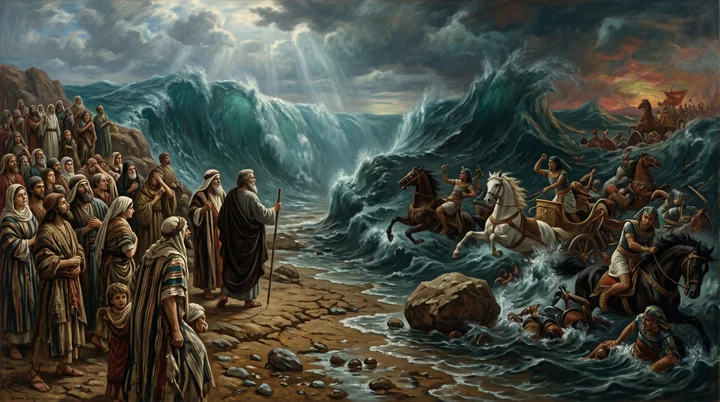
For the horse of Pharaoh went in with his chariots and with his horsemen into the sea, and the LORD brought again the waters of the sea upon them; but the children of Israel went on dry land in the midst of the sea.
Translations
For the horse of Pharaoh went in with his chariots and with his horsemen into the sea, and the LORD brought again the waters of the sea on them; but the children of Israel went on dry land in the middle of the sea.
King James Version, Webster Bible
For the horse of Pharaoh went in with his chariots and with his horsemen into the sea, and the LORD brought again the waters of the sea upon them; but the children of Israel went on dry land in the midst of the sea.
For the horse of Pharaoh went in with his chariots and with his horsemen into the sea, and the Lord brought again the waters of the sea upon them; but the children of Israel went on dry land in the midst of the sea.
For the horses of Pharaoh went in with his chariots and with his horsemen into the sea, and the LORD brought again the waters of the sea upon them; but the children of Israel walked on dry land in the midst of the sea.
For the horses of Pharaoh went in with his chariots and with his horsemen into the sea, and Jehovah brought back the waters of the sea upon them; but the children of Israel walked on dry land in the midst of the sea.
For the horse of Pharaoh hath gone in with his chariots and with his horsemen into the sea, and Jehovah turneth back on them the waters of the sea, and the sons of Israel have gone on dry land in the midst of the sea.
For the horse of Pharaoh, with his chariots and with his horsemen, came into the sea, and Jehovah brought again the waters of the sea upon them; and the children of Israel went on dry [ ground] through the midst of the sea.
For the horses of Pharaoh, with his chariots and his horsemen, entered into the sea, Then did Yahweh bring back upon them the waters of the sea,—But the sons of Israel, had gone their way on the dry ground through the midst of the sea.
Berean Standard Bible, Majority Standard Bible
For when Pharaoh’s horses, chariots, and horsemen went into the sea, the LORD brought the waters of the sea back over them. But the Israelites walked through the sea on dry ground.
For the horses of Pharaoh went in with his chariots and with his horsemen into the sea, and the LORD brought back the waters of the sea on them; but the children of Israel walked on dry land in the middle of the sea.
For the horses of Pharaoh, with his war-carriages and his horsemen, went into the sea, and the Lord sent the waters of the sea back over them; but the children of Israel went through the sea on dry land.
For Pharaohs horses went with his charets and horsemen into the Sea, and the Lord brought the waters of the Sea vpon them: but the children of Israel went on drie land in the middes of the Sea.
Douay-Rheims (Challoner revision)
For Pharao went in on horseback with his chariots and horsemen into the sea: and the Lord brought back upon them the waters of the sea: but the children of Israel walked on dry ground in the midst thereof.
Pictures
Cross-references
- Exodus 14:21-29
And Moses stretched out his hand over the sea; and the LORD caused the sea to go back by a strong east wind all that night, and made the sea dry land, and the waters were divided.
Israel crosses safely as the waters overwhelm Pharaoh’s pursuing army.
- Revelation 15:2-3
And I saw as it were a sea of glass mingled with fire: and them that had gotten the victory over the beast, and over his image, and over his mark, and over the number of his name, stand on the sea of glass, having the harps of God.
The delivered sing the song of Moses after victory over their enemies.
- Exodus 14:21-22
And Moses stretched out his hand over the sea; and the LORD caused the sea to go back by a strong east wind all that night, and made the sea dry land, and the waters were divided.
The sea divides, and Israel crosses on dry ground.
- Exodus 14:30-31
Thus the LORD saved Israel that day out of the hand of the Egyptians; and Israel saw the Egyptians dead upon the sea shore.
Israel is saved as the Egyptians are defeated, and the people believe the Lord.
- Hebrews 11:29
By faith they passed through the Red sea as by dry land: which the Egyptians assaying to do were drowned.
Israel passed through the sea by faith; the Egyptians drowned.
- Exodus 14:15
And the LORD said unto Moses, Wherefore criest thou unto me? speak unto the children of Israel, that they go forward:
Moses is commanded to lead Israel forward before the sea opens.
- Exodus 14:16
But lift thou up thy rod, and stretch out thine hand over the sea, and divide it: and the children of Israel shall go on dry ground through the midst of the sea.
God commands Moses to divide the sea so Israel can cross on dry ground.
- 1 Corinthians 10:11
Now all these things happened unto them for ensamples: and they are written for our admonition, upon whom the ends of the world are come.
Israel’s Red Sea deliverance and judgment serve as examples and admonition for God’s people.
- Genesis 15:14
And also that nation, whom they shall serve, will I judge: and afterward shall they come out with great substance.
Israel’s deliverance from Egypt fulfills the promised judgment and exodus.
- Exodus 14:23-25
And the Egyptians pursued, and went in after them to the midst of the sea, even all Pharaoh’s horses, his chariots, and his horsemen.
The Egyptians pursue Israel into the sea, and the Lord troubles them.
- Exodus 15:1
Then sang Moses and the children of Israel this song unto the LORD, and spake, saying, I will sing unto the LORD, for he hath triumphed gloriously: the horse and his rider hath he thrown into the sea.
Israel sings of the LORD’s triumph over Pharaoh’s horse and rider.
- Psalms 77:19-20
Thy way is in the sea, and thy path in the great waters, and thy footsteps are not known.
God led Israel through the sea by Moses and Aaron.
- Exodus 14:13
And Moses said unto the people, Fear ye not, stand still, and see the salvation of the LORD, which he will shew to you to day: for the Egyptians whom ye have seen to day, ye shall see them again no more for ever.
shows Moses believed and sang before the sea was crossed
- Revelation 15:2
And I saw as it were a sea of glass mingled with fire: and them that had gotten the victory over the beast, and over his image, and over his mark, and over the number of his name, stand on the sea of glass, having the harps of God.
The victorious people stand on the sea of glass after deliverance.
- Exodus 15:9
The enemy said, I will pursue, I will overtake, I will divide the spoil; my lust shall be satisfied upon them; I will draw my sword, my hand shall destroy them.
Discussed as another line in the same song of Moses.
- Exodus 15:3
The LORD is a man of war: the LORD is his name.
Both verses are lines in the song of Moses.
- Exodus 6:6
Wherefore say unto the children of Israel, I am the LORD, and I will bring you out from under the burdens of the Egyptians, and I will rid you out of their bondage, and I will redeem you with a stretched out arm, and with great judgments:
God promised to free Israel with a mighty hand.
- Exodus 14:11
And they said unto Moses, Because there were no graves in Egypt, hast thou taken us away to die in the wilderness? wherefore hast thou dealt thus with us, to carry us forth out of Egypt?
The Israelites complain before the sea is opened.
Commentary
Each commentary is drawn from primary sources: the writings of Ellen G. White and Adventist pioneers and periodicals. Each commentary is separate. Its own words are not a quotation; follow the references to read the source passages.
Ellen G. White
11 sources
Exodus 15:19 recounts the Red Sea deliverance in which Pharaoh's horses, chariots, and horsemen went into the sea in pursuit of Israel, the Lord brought the waters of the sea back over them, and the children of Israel went across on dry land in the midst of the sea.ED 162.11SP 210.1–212.1SG3 236.1–238.1ST Apr 1, 1880ST Feb 27, 1896 It contrasts Egypt's destruction with Israel's safe passage as the Lord's triumphant deliverance.ED 162.11SP 210.1–212.1SG3 236.1–238.1ST Apr 1, 1880ST Feb 27, 1896 The crossing was a work of God in which Jesus Christ led Israel in the pillar of cloud, and the cloud together with the Lord's angels protected the people, so that the Lord saved Israel from the Egyptians and the people saw his mighty work.Ms 21, 1897, par. 12–15
The verse belongs to and gives the reason for Israel's song of triumph and praise after the deliverance, in which the drowning of Pharaoh and his warriors and the safe crossing are celebrated.ED 162.11SP 210.1–212.1SG3 236.1–238.1ST Nov 2, 1915ST Apr 1, 1880 The people's voices rang out over the waters in praise when they sang of this triumph.Lt 49a, 1896, par. 2–4 The whole host of Israel joined together in this song of triumph at deliverance from Pharaoh's army.ST Nov 2, 1915
Singing this deliverance was used to fix precious lessons in the minds of the people as they journeyed through the wilderness, lifting thoughts from trials and difficulties of the way, soothing and calming the restless, turbulent spirit, implanting principles of truth in the memory, and strengthening faith.ST Nov 2, 1915 United singing taught order and unity through concerted action and brought the people into closer touch with God and with one another.ST Nov 2, 1915 The deliverance at the sea was made into a song as a memorial of God's mighty dealings, so that parents could teach these events to their children and later generations would remember God's power, providential care, and deliverance rather than let these works fade from memory.Lt 33, 1890, par. 7–9
This victory showed God's power to protect and deliver Israel and led to a song of triumph, yet the people soon murmured when they found bitter water at Marah.Ms 21, 1897, par. 16–17 Although the deliverance prompted Israel's song of praise, the later lack of gratitude at Elim shows that receiving God's mercy does not necessarily strengthen faith or lead people to keep acknowledging his care.Lt 49a, 1896, par. 5–6
Sources
Pioneers and periodicals
56 sources
Exodus 15:19 sums up the song of Moses, that Pharaoh's horse with his chariots and horsemen went into the sea in pursuit and the Lord brought the waters back over them to destroy them, while the children of Israel went on dry land in the midst of the sea and crossed safely.ST Feb 11, 1889RH Jan 20, 1916ST Jul 13, 1915 It shows God's glorious and complete deliverance of Israel from the strongest earthly power that menaced them, freeing the captives from bondage and ending pursuit in victory celebrated in song.ST Jul 30, 1894ST Aug 22, 1911ST Jul 13, 1915RH Aug 21, 1856 The victory belonged to faith that moves forward when escape by human means is impossible, for Moses believed God on both sides of the sea while the multitude believed only by sight after the trial was over.RH Apr 20, 1911ST Jul 21, 1898ST Jun 23, 1898RH Feb 24, 1916 That deliverance from Egypt is a pattern for the final deliverance of God's remnant from persecuting earthly powers, when those rescued by Christ from the beast will stand safely and sing the song of Moses and the Lamb.ST Aug 22, 1911ST Jan 18, 1916RH Feb 10, 1859RH Sep 29, 1863RH Dec 21, 1869 The song of Moses alone means triumph over earthly foes without victory over sin, and it will be joined with the song of the Lamb celebrating perfect triumph over every inward sin and over temporal and spiritual foes.ST Aug 22, 1911ST Jan 25, 1910RH Oct 22, 1914
Verse Context and Meaning
The verse belongs to the song of Moses in Exodus 15:1-21, which celebrates the march to the Red Sea, the miraculous crossing of Israel on dry land in the midst of the sea, and the destruction of the Egyptian host when the waters were brought back upon Pharaoh's horses, chariots and horsemen. It stands between that deliverance from Egypt and the journey onward to Sinai. That deliverance through the Red Sea follows the first Passover and the leading by fire and by cloud and issues in a song of triumph.RH Jan 20, 1916
The verse recounts the contrast at the Red Sea: Pharaoh's horse, chariots and horsemen went into the sea in pursuit, and the Lord brought the waters of the sea back over them to overwhelm and destroy them, while the children of Israel went on dry land in the midst of the sea and crossed safely.ST Feb 11, 1889ST Jul 13, 1915 It presents the destruction of the pursuing Egyptians and Israel's safe passage as the Lord's work and the Lord's victory, freeing the captives from their oppressor.ST Jul 13, 1915 Pharaoh and his host were lost when they tried to go across after Israel, while Israel reached the other shore safely and then sang a song of triumph over deliverance, ending pursuit and bondage.ST Apr 1, 1880RH Dec 31, 1861RH Aug 21, 1856
The verse shows the exercise of God's power dividing the waters of the Red Sea and holding them standing upright as a heap, a wall on either side of the marching hosts of Israel. It is the same power that at creation gathered the waters together into one place and that still piles up the waters of the sea and holds them above the level they continually seek by decree and commandment. When that holding power was withdrawn the waters immediately sought and found their former place and returned upon Pharaoh's horses, chariots and horsemen and drowned them, while the children of Israel went on dry land in the midst of the sea.
The verse belongs to the account of Israel's deliverance from Egypt reaching its climax at the Red Sea, the point at which the people sang a song of triumph on the far side.ST Feb 4, 1913ST Jan 30, 1912 It records Pharaoh's hardened resistance ending in the destruction of his army, while Israel was delivered.ST Feb 4, 1913 After repeatedly hardening his heart and rejecting God's final warning, Pharaoh was left to perish in the waters a few days later.RH Jan 16, 1913 This overthrow of Egypt and Israel's song of triumph display God's mighty, creative power in saving them.ST Jan 30, 1912
The verse records the going out of Israel from Egypt and their great deliverance from bitter bondage and oppression under Moses as chosen leader.RH Jan 20, 1916 It forms part of the history section of Exodus, chapters 1 to 18, by which the family grown more and mightier than the Egyptians became a nation with thorough organization, efficient leadership, a complete code of laws, and an established form of worship.RH Jan 20, 1916 That deliverance through the Red Sea supplies the start of the journey toward Sinai and the setting for the later account of manna and Sabbath observance in the wilderness.RH Oct 21, 1851
The verse belongs to the Song of the Red Sea, presented as a triumph poem celebrating Israel's victory over Pharaoh's pursuing forces.RH Apr 22, 1915 Its words and music memorialized a great event in Israel's history and expressed the chosen people's national life.RH Apr 22, 1915
God's Power and Justice
The verse displays a glorious and complete rescue of Israel from the strongest earthly power that threatened them, with the waters brought back upon Pharaoh's horses, chariots and horsemen while Israel went on dry land in the midst of the sea.ST Aug 22, 1911 That overthrow freed the captives from their oppressor and ended pursuit and bondage in victory celebrated in song.ST Aug 22, 1911RH Aug 21, 1856 The escape and the destruction are set forth as the Lord's own victory and the Lord's own work.ST Jul 13, 1915
The event manifests God's power in redeeming His people and His justice and truth in destroying the Egyptians as He had foretold through Moses.ST Jul 30, 1894 It belongs to a song of triumph and thanksgiving that praises His justice, faithfulness, love and mercy in deliverance from outward foes.ST Mar 10, 1881ST Jul 30, 1894ST Jul 13, 1915 The meaning is deliverance from all earthly foes and from earthly enslavement, oppression and Egyptian servitude, lifting Israel from depression and darkness to triumph and joy.ST Aug 22, 1911RH May 8, 1916 Yet that deliverance from Egypt did not free Israel from sin, for they remained slaves of sin.ST Aug 22, 1911
Through faith in the living God the great multitude passed through without the loss of one and stood together peaceful and happy on the other shore. Hemmed in with no human escape by sea and mountains, their helpless dilemma was turned into glorious victory. At the same hour their enemies utterly perished, so Egypt's momentary triumph ended in total disaster and defeat. With the Lord nearer than ever before, Israel saw the great work wrought upon their oppressors, believed Him, marveled at His works, and glorified His name in praise.
God opened the most difficult way when escape by human means was impossible, since Israel might have fled to the mountains or fought but could not cross the sea.RH Feb 24, 1916 The sea would not have parted for dry passage while returning upon Pharaoh's forces unless Israel obeyed, trusted Jehovah, and moved forward, whereupon difficulties vanished, enemies were defeated, and Israel gained the privilege of shouting His praise for blessings received.RH Feb 24, 1916 Conditions make no difference with God, for He overrules all conditions to bring victory to the loyal, and the greater the trial the greater the opportunity for glory to His name and wonderful victory to the faithful, so the Red Sea experience brings hope and courage to all the afflicted.RH Feb 24, 1916
The sea that would ordinarily have destroyed Israel became protection on dry land while returning upon pursuers, illustrating faith obeying God's command and trusting Him to make a way through the impossible.RH Sep 8, 1904 That retreat of the sea and victory song on the farther shore demonstrate that God's word accomplishes the purpose for which it is sent.ST May 26, 1914 The opening of the passage completed mighty signs and wonders in Egypt for deliverance from bondage as promised to Abraham, shielding Israel while plaguing the Egyptians.RH Apr 3, 1879ST Feb 25, 1886 The deliverance was wrought with a mighty hand and an outstretched arm, and the same God who gave bread in the wilderness and water in the desert and promised to drive out enemies and give Canaan proved He could be trusted to do what He promised.ST Aug 31, 1888
Faith Before and After
The song came after the deliverance because most of the people had little faith while danger still seemed imminent.RH Apr 20, 1911 Moses acted in faith, and the victory they could have celebrated beforehand by faith became an experienced deliverance and song.RH Apr 20, 1911 It is the song of Moses because it expresses his experience, for he believed God on both sides of the sea, before the waters opened as well as after.ST Jul 21, 1898ST Jun 23, 1898 To murmuring Israel with the rolling sea before them and Egypt behind he said, Fear ye not, stand still, and see the salvation of the Lord, and to him God could entrust the message, Go forward.ST Jul 21, 1898ST Jun 23, 1898
The great mass joined only after the trial was over and deliverance had come, believing by sight and not by faith.ST Jul 21, 1898ST Jun 23, 1898 The same song becomes another's only by living faith that believes before Red Seas as well as sings after danger is past.ST Jul 21, 1898ST Jun 23, 1898 Israel might just as well have sung the thanksgiving on the other side before the waters gave any sign of opening.ST Nov 29, 1905ST Nov 29, 1905 The victory of faith is just as sure in the prospective as in the retrospective, and the thanksgiving of faith is not confined to the year's retrospect but looks forward to far greater things in the unfailing promises of God, showing forth loving-kindness every morning and faithfulness every evening.ST Nov 29, 1905ST Nov 29, 1905
The deliverance raised Israel's spirits to join Moses in song, and the power that divided the sea proved God could also provide water to drink and bread to eat. Their murmuring within three days over bitter water, and soon after over lack of food and again at Rephidim over lack of water, showed forgetfulness, lack of faith, and tempting God without excuse. Remembering should have produced gratitude and trust in need, warning against the same murmuring and unbelief now. The song expressed trust in the Lord and triumph in His deliverance, yet it was followed by weeping, murmuring against Moses and Aaron, regret at leaving Egypt, fear of falling by the sword with wives and children taken as prey, and desire to return.ST Aug 13, 1902 Rejoicing in the sea deliverance did not yet show whether they could trust God through later trials, for just after it Israel became restive and fretful and homesick and murmured at the dreary prospect in the desert and at the want of water and the poor prospect for supplies.RH Jan 21, 1875
The song expressed faith in God's deliverance, and if Israel had kept that faith and continued singing through later obstacles their journey to Canaan would have been a brief series of triumphs.ST Sep 17, 1894 Losing faith and praise brings loss.ST Sep 17, 1894 They should have kept on praising God and praying for help, for praise after great trouble and danger should continue in prayer.RH Jan 21, 1875RH Jan 21, 1875 A joyful spirit in the service of God prevents reaction and backsliding from God, while backsliding and apostasy are always preceded and accompanied by weariness and languor in the work of God, and trouble leading to repentance with united prayer turns danger aside and great joy follows.RH Jan 21, 1875RH Jan 21, 1875
Deliverance came although Israel failed to trust God in apparent danger and reproached Moses for taking them away to die in the wilderness.RH Apr 3, 1879ST Feb 25, 1886 It completed mighty signs and wonders in Egypt for deliverance from bondage as promised to Abraham, shielding Israel while plaguing the Egyptians.RH Apr 3, 1879ST Feb 25, 1886 Israel sang God's praise for the sea deliverance but soon forgot His works and returned to murmuring.RH Apr 3, 1879ST Feb 25, 1886 The people who joined that song later died in the wilderness because of unbelief, apart from Caleb and Joshua, who fully followed the Lord.RH May 7, 1872
Final Deliverance Foretold
The drowning of Pharaoh's horse, chariots and horsemen while Israel passed on dry land is deliverance from wicked men intent on destroying Israel, and it stands as the pattern for the future deliverance of God's remnant from those who seek to destroy them.ST Aug 22, 1911ST Jan 18, 1916 It means deliverance from all earthly foes and from earthly enslavement, and it foreshadows the deliverance of God's children in the last generation from all the powers of earth and from persecuting, rebellious governments.ST Aug 22, 1911 That deliverance from Egypt did not free Israel from sin, for they remained slaves of sin and the great mass died in the wilderness in bondage to sin, so the song of Moses alone is deliverance from earthly power without victory over sin.ST Aug 22, 1911
Israel's deliverance from Egypt is the type of God's deliverance of His people from the dark Egypt of earth to the rest of the final Canaan.STST Nov 8, 1899 It is the type of the Lord's people being delivered when the King comes and brings judgment on those who reject God.ST Dec 18, 1901 This final counterpart has its triumphal song in the song of Moses and the Lamb, and it is connected with a true Sabbath reformation.ST Nov 8, 1899
Israel sang a song of deliverance after rescue from enemies, and that provides the pattern for the victorious company rescued by Christ from the power of the beast.RH Feb 10, 1859RH Sep 29, 1863 Those who refuse its mark and heed the warning not to worship the beast or receive its mark will be delivered and sing, while the beast and its worshipers will be destroyed.RH Sep 29, 1863RH Dec 21, 1869 After God's judgments fall on their enemies they will stand safely on the sea of glass and sing the song of Moses and the Lamb, in victory over the beast and its image.RH Dec 21, 1869
The triumph celebrated in the song of Moses over earthly foes will be repeated and joined with the song of the Lamb celebrating victory over temporal and spiritual foes.ST Aug 22, 1911ST Jan 25, 1910 It foreshadows the greater victory over sin and the final song of the redeemed, a triumph God gave to Moses and will give again by Christ Jesus to those in whom He has wrought perfect triumph over every inward sin.RH Oct 22, 1914ST Jun 23, 1898 They are emptied of self and filled with His fulness by His Spirit and sanctified wholly to His service, with every sin cast out and Christ reigning supreme, so that Satan finds no hook or avenue in them.ST Jun 23, 1898
The song of Moses does not belong to the Jewish people alone but points forward to the final victory when the Israel of God will sing not only the song of Moses but the song of the Lamb when Christ comes to redeem His people and complete redemption.ST Feb 4, 1903ST Mar 31, 1887 The wilderness history around it was chronicled for the benefit of the Israel of God to the close of time as a school of preparation for the promised home in Canaan and the heavenly Canaan, to be reviewed with humble heart and teachable spirit.ST Feb 4, 1903 Those who will sing that song of triumph then must learn to sing it now.ST Feb 4, 1903 That song, called the song of Moses and the song of the Lamb, shows what the song of the 144,000 is: a song of their own experience and deliverance that no other company can learn because no other will have their experience.RH Nov 18, 1862
In the song following this deliverance Moses looks ahead to God's sanctuary and everlasting reign, beyond passage through the sea to the happy scenes of Eden Zion.RH Feb 3, 1853RH Sep 2, 1852 Those prophetic hopes will be fully realized when God's people dwell securely in the renewed earth.RH Feb 3, 1853 The song of Moses and Miriam exulting over the fallen enemy, whose host sank like lead in the mighty waters, pictures the song of Israel or the church in the day when Jehovah reigns in Mount Zion and in Jerusalem after signs in the sun and moon and stars.RH Apr 7, 1863 It is a song of exultation over the enemy leading into festival resurrection joy and glory at the feast God makes for all people when death is swallowed up in victory.RH Apr 7, 1863
Singing and Going Forward
After the Egyptian host was overthrown, Moses and Miriam sang to the Lord in praise for triumphing gloriously over Israel's enemies and in remembrance of his works.RH Dec 17, 1901RH Jan 9, 1908RH Apr 24, 1900 The song was not sung by Moses and Miriam alone but was joined aloud with joyful noise by the whole host of Israel.RH Jan 9, 1908 It sounded so loudly that desert and sea rang and the mountains re-echoed the praise.RH Jan 9, 1908
The song was repeated often on the wilderness journey, cheering hearts and kindling the faith of the travelers.RH Jan 9, 1908 God's children today are bidden to gladden and lighten their pilgrim life the same way by cheering their way with sacred songs of deliverance at the sea.RH Jan 9, 1908RH Sep 3, 1908 Such songs have power to transform lives, so they are to be studied and sung with harmony approaching that of the heavenly choirs.RH Sep 3, 1908
Song was used to fix precious lessons in the minds of the people as they journeyed through the wilderness.ST Nov 2, 1915 Singing this deliverance lifted thoughts from the trials and difficulties of the way, soothed and calmed the restless, turbulent spirit, implanted principles of truth in the memory, and strengthened faith.ST Nov 2, 1915 United singing taught order and unity through concert of action and brought the people into closer touch with God and with one another.ST Nov 2, 1915
The thanksgiving of faith is not confined to the year's retrospect but looks forward to far greater things involved in the unfailing promises of God.ST Nov 29, 1905ST Nov 29, 1905 Such a spirit of thankfulness shows forth loving-kindness every morning and faithfulness every evening.ST Nov 29, 1905ST Nov 29, 1905 The last generation redeemed from the earth will sing this same song of Moses, which celebrates deliverance from outward foes.ST Jul 30, 1894ST Jun 23, 1898 They must learn to sing the song of triumph over all earthly foes on the hither side of the great conflict when to all earthly appearance there is no hope, for those who sing it in the strength of God on the hither side will sing it on the thither side, the side of eternal deliverance.ST Jun 23, 1898
What was written is for learning today.RH Feb 25, 1875 Though hemmed in like Israel by sea, mountains and host with every avenue closed, God's people are called to rise up and go forward.RH Feb 25, 1875 They are to trust that the dark and forbidding sea before them will divide as they approach it and that they will soon sing the song of victory on the other shore.RH Feb 25, 1875 That deliverance from earthly power, when God brought Israel safely through the sea while Pharaoh's forces were overcome by the returning waters, was the setting for Moses' song of deliverance.ST Jan 24, 1911RH Mar 12, 1901
Sources