Genesis 15:14
And also that nation, whom they shall serve, will I judge: and afterward shall they come out with great substance.
Translations
American King James Version, King James Version
And also that nation, whom they shall serve, will I judge: and afterward shall they come out with great substance.
KJV Cambridge Paragraph Bible, Revised Version, American Standard Version
and also that nation, whom they shall serve, will I judge: and afterward shall they come out with great substance.
And also that nation which they shall serve, will I judge: and afterward shall they come out with great substance.
and the nation also whom they serve I judge, and after this they go out with great substance;
But also that nation which they shall serve I will judge; and afterwards they shall come out with great property.
moreover also, the nation whom they will serve, I, am going to judge, and after that, shall they come forth with great substance.
Berean Standard Bible, Majority Standard Bible
But I will judge the nation they serve as slaves, and afterward they will depart with many possessions.
I will also judge that nation, whom they will serve. Afterward they will come out with great wealth;
But I will be the judge of that nation whose servants they are, and they will come out from among them with great wealth.
Notwithstanding the nation, whom they shall serue, will I iudge: and afterward shall they come out with great substance.
Douay-Rheims (Challoner revision)
But I will judge the nation which they shall serve, and after this they shall come out with great substance.
Pictures
Cross-references 20 of 78
- Exodus 12:35-36
And the children of Israel did according to the word of Moses; and they borrowed of the Egyptians jewels of silver, and jewels of gold, and raiment:
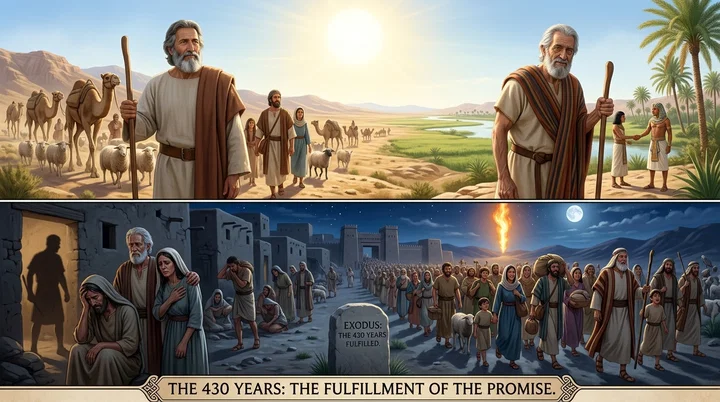
Israel leaves Egypt with silver, gold, and other possessions, fulfilling the promised great substance.
- Exodus 12:40-41
Now the sojourning of the children of Israel, who dwelt in Egypt, was four hundred and thirty years.
Israel’s departure from Egypt at the end of the foretold 430 years fulfills the promise.
- Acts 7:6-7
And God spake on this wise, That his seed should sojourn in a strange land; and that they should bring them into bondage, and entreat them evil four hundred years.
Stephen recalls the foretold bondage, God’s judgment, and Israel’s deliverance.
- Exodus 3:7-8
And the LORD said, I have surely seen the affliction of my people which are in Egypt, and have heard their cry by reason of their taskmasters; for I know their sorrows;
God promises to deliver Israel from Egyptian oppression and bring them to Canaan.
- Exodus 3:22
But every woman shall borrow of her neighbour, and of her that sojourneth in her house, jewels of silver, and jewels of gold, and raiment: and ye shall put them upon your sons, and upon your daughters; and ye shall spoil the Egyptians.
Israel leaves Egypt with valuables after God judges the nation.
- Acts 7:17
But when the time of the promise drew nigh, which God had sworn to Abraham, the people grew and multiplied in Egypt,
The promised time to Abraham drew near as Israel grew in Egypt.
- Genesis 12:2
And I will make of thee a great nation, and I will bless thee, and make thy name great; and thou shalt be a blessing:
God’s promise to make Abraham a great nation underlies Israel’s later deliverance.
- Exodus 2:24
And God heard their groaning, and God remembered his covenant with Abraham, with Isaac, and with Jacob.
God remembers his covenant with Abraham, Isaac, and Jacob amid Israel’s oppression.
- Hebrews 11:13-16
These all died in faith, not having received the promises, but having seen them afar off, and were persuaded of them, and embraced them, and confessed that they were strangers and pilgrims on the earth.
Abraham and the faithful died without receiving the promises and sought a better country.
- Exodus 12:29-32
And it came to pass, that at midnight the LORD smote all the firstborn in the land of Egypt, from the firstborn of Pharaoh that sat on his throne unto the firstborn of the captive that was in the dungeon; and all the firstborn of cattle.
The final plague judged Egypt and moved Pharaoh to release Israel with their possessions.
- Genesis 50:24
And Joseph said unto his brethren, I die: and God will surely visit you, and bring you out of this land unto the land which he sware to Abraham, to Isaac, and to Jacob.
Joseph foretold God’s deliverance of Israel from Egypt.
- Genesis 17:8
And I will give unto thee, and to thy seed after thee, the land wherein thou art a stranger, all the land of Canaan, for an everlasting possession; and I will be their God.
Both affirm the covenant promise of land as an everlasting possession.
- Exodus 7:1-5
And the LORD said unto Moses, See, I have made thee a god to Pharaoh: and Aaron thy brother shall be thy prophet.
God’s judgments on Egypt bring Israel’s release.
- Genesis 15:4
And, behold, the word of the LORD came unto him, saying, This shall not be thine heir; but he that shall come forth out of thine own bowels shall be thine heir.
God promises Abraham an heir from his own body before foretold delay.
- Psalms 105:37
He brought them forth also with silver and gold: and there was not one feeble person among their tribes.
Israel leaves Egypt with silver and gold, fulfilling the promise of great substance.
- Joshua 21:43-44
And the LORD gave unto Israel all the land which he sware to give unto their fathers; and they possessed it, and dwelt therein.
Israel possesses the promised land and rests after God delivers its enemies into their hand.
- Jeremiah 34:18-19
And I will give the men that have transgressed my covenant, which have not performed the words of the covenant which they had made before me, when they cut the calf in twain, and passed between the parts thereof,
Both texts describe a covenant made by passing between divided animals.
- Exodus 11:2
Speak now in the ears of the people, and let every man borrow of his neighbour, and every woman of her neighbour, jewels of silver, and jewels of gold.
Israel asks the Egyptians for valuables before departing.
- Exodus 1:8-11
Now there arose up a new king over Egypt, which knew not Joseph.
Israel multiplied in Egypt, then the Egyptians began afflicting them.
- Jeremiah 25:11-12
And this whole land shall be a desolation, and an astonishment; and these nations shall serve the king of Babylon seventy years.
Both foretell years of bondage followed by judgment on the oppressing nation.
Commentary
Each commentary is drawn from primary sources: the writings of Ellen G. White and Adventist pioneers and periodicals. Each commentary is separate. Its own words are not a quotation; follow the references to read the source passages.
Ellen G. White
23 sources
God showed Abraham beforehand that his descendants would serve as bondmen in Egypt for four hundred years before they would possess Canaan, and that He would judge that nation and bring them out with great wealth afterward.SG3 229.1ST Apr 1, 1880DA 31.2–3PP 282.2PP 282.1 The revelation came in vision through great darkness, foretelling long servile bondage and oppression to an idolatrous nation so that the promised land would not come immediately.PP 137.1–21SP 93.1ST Mar 27, 1879RH Apr 29, 1875 The appointed judgment fell when God visited Egypt with plagues and fearful displays of power greater than their gods, and Israel departed on the very day appointed despite Pharaoh's power.SG3 229.1ST Apr 1, 1880DA 31.2–3PP 282.18T 207.1–2 They came out carrying the promised substance, including silver, gold, and clothing obtained from the Egyptians, and Pharaoh and his army were destroyed in the Red Sea when they pursued.SG3 229.1ST Apr 1, 1880PP 282.1ST Dec 9, 1913Ms 10, 1903, par. 15 The bondage was allowed because of transgression, unfaithfulness, and idolatry, yet God did not forsake His covenant, but when they humbled themselves, cried for deliverance, and promised to obey, He brought them forth as His peculiar treasure.ST Jan 22, 1880ST Apr 8, 18751SP 215.2RH Apr 29, 1875SG3 297.1–2
Revelation to Abraham
God showed Abraham beforehand in vision what would happen to his descendants, revealing in figure through a great darkness that his posterity would become bondmen to an idolatrous nation, Egypt.ST Mar 27, 1879RH Apr 29, 1875 The promise belongs to the prophecy that his descendants would suffer before they were established in Canaan, so that possession of the promised land would not come immediately.PP 137.1–21SP 93.1 It declared that they would endure a long, servile bondage and oppression in Egypt.PP 137.1–21SP 93.1
It foretold that God would judge the nation they served and that afterward they would come out with great substance and wealth.SG3 229.1ST Apr 1, 1880PP 282.2PP 282.11SP 205.1 That judging of Egypt was accomplished by plagues and fearful judgments, and the coming out with wealth was accomplished when Israel departed carrying possessions, including silver, gold, and clothing obtained from the Egyptians.SG3 229.1ST Apr 1, 1880 Its citation alongside the account of the departure binds the prediction directly to the Exodus.PP 282.2PP 282.1
The prophecy was given about four hundred years before its fulfillment in Israel's deliverance from Egypt.1SP 205.1ST Mar 27, 1879 It specified an appointed time of service, affliction, and sojourning of four hundred years, stated elsewhere as nearly four hundred years, before deliverance would come.DA 31.2–3PP 282.11SP 205.1ST Dec 9, 19138T 207.1–2 When the time came, Pharaoh's power and empire could not prevent fulfillment, for Israel came out on the very day God had appointed.DA 31.2–3ST Dec 9, 1913 He visited Egypt with fearful judgments and brought Israel forth by a mighty display of power, showing that He rules over the universe and is greater than the Egyptians' gods, and He destroyed Pharaoh and his army in the Red Sea when they pursued Israel.8T 207.1–2Ms 10, 1903, par. 15 His leading them away from the direct route to Canaan at that time also showed His compassion alongside His judgment.PP 282.1
The same timing measured the Amorites, whom God spared for more than four hundred years until their iniquity was full.SLP 318.1 When they hardened themselves in sin and made war on His people, their probation ended and judgment came.SLP 318.1
Judgment and Deliverance
The promise assured Israel that God remembered His covenant and that deliverance would come after their long suffering in captivity, and its setting alongside the account of their departure binds the prediction directly to the Exodus.PP 282.2PP 267.2–3 It foretold that God would judge the nation that enslaved Abraham's descendants and afterward bring them out with great wealth and substance.PP 282.2PP 267.2–3
That judgment was fulfilled when God visited Egypt with plagues and fearful judgments, judging the Egyptians by a mighty display of power.SG3 229.1ST Apr 1, 18808T 207.1–2Ms 10, 1903, par. 15 By those acts He showed that He rules over the universe and is greater than the Egyptians' gods.8T 207.1–2 Israel's departure from Egypt completed the prophecy after the foretold time of service, affliction and sojourning of four hundred years.DA 31.2–3PP 282.1ST Dec 9, 1913PP 281.4 Neither Pharaoh's power nor his empire could prevent its fulfillment at the appointed time, and Israel came out on the very day God had appointed.DA 31.2–3ST Dec 9, 1913
The deliverance included bringing Israel forth and destroying Pharaoh and his army in the Red Sea when they pursued Israel.Ms 10, 1903, par. 15 At the same time God's leading them away from the direct route to Canaan showed His compassion alongside His judgment.PP 282.1 Coming out with great substance was fulfilled when the Israelites departed carrying away the promised wealth and possessions.SG3 229.1ST Apr 1, 1880ST Dec 9, 1913PP 281.4 Those goods included silver, gold, and clothing obtained from the Egyptians.SG3 229.1ST Apr 1, 1880
Cause and Covenant Mercy
The bondage in Egypt was because of transgression of God's law and was punishment for apostasy.ST Jan 22, 1880ST Apr 8, 1875RH Apr 29, 1875 Unfaithfulness, intermarriage with other nations, and the resulting idolatry explain why God allowed them to go into Egypt to become bondmen to an idolatrous nation.1SP 215.2 Famine brought Abraham's descendants into Egypt to preserve their lives, and God did not forsake them because of His covenant with Abraham.SG3 297.1–2 He allowed them to suffer oppression so they would turn to Him, choose His righteous and merciful rule, and obey His requirements.SG3 297.1–2
When they humbled themselves before God, acknowledged His dealings, and cried earnestly for deliverance from the oppressive yoke of the Egyptians, their cries reached heaven.ST Jan 22, 1880ST Apr 8, 1875RH Apr 29, 1875 They promised to serve God and be obedient to His law if He would break off the yoke of bondage.RH Apr 29, 1875 God answered in a wonderful manner by bringing Israel forth from Egypt and taking them to Himself in covenant as His peculiar treasure.ST Jan 22, 1880ST Apr 8, 1875RH Apr 29, 1875
The promise to Abraham that God would bring them out and break the oppressive yoke was recalled by the elders to encourage the Hebrews to trust God.ST Mar 4, 18801SP 214.1–215.1SG3 240.2–242.1 Many struggled to believe because of their suffering and lost hope under oppression.ST Mar 4, 18801SP 214.1–215.1SG3 240.2–242.1 The Egyptians mocked the expectation of deliverance.1SP 214.1–215.1
Sources
Pioneers and periodicals
127 sources
God spoke to Abraham to promise that the nation that would enslave his descendants, which was Egypt, would be judged for its oppression and that his descendants would afterward come out delivered with great wealth and possessions.ST Aug 9, 1910ST Aug 7, 1901ST Aug 7, 1901ST Jun 4, 1885 The judgment was redemption with a stretched-out arm in plague after plague throughout Egypt while Goshen was spared, culminating in the death of the firstborn, and the substance was silver, gold and clothing given by the Egyptians as payment for long harsh slavery, which later furnished the tabernacle.ST Jun 10, 1908RH Aug 15, 1865RH Jan 24, 1856ST Nov 23, 1904ST Jul 13, 1915 The promise was sealed as a blood covenant in which God alone passed between the divided victims as smoking furnace and burning lamp, pledging His own life to fulfill it, and it was fulfilled on the very appointed day when Israel left Egypt under Moses after more than four hundred years.RH Sep 14, 1916ST Dec 12, 1916RH Nov 19, 1908RH Dec 25, 1900RH Jun 5, 1900 Because Abraham died without receiving the land, the covenant points beyond earthly Canaan to an everlasting inheritance to be received beyond death and the resurrection, when Abraham and Christ as the Seed and all who are Christ's inherit the whole world made new.ST Jun 29, 1882ST Oct 11, 1899ST Nov 11, 1908RH Dec 11, 1866RH Dec 18, 1855
Covenant Setting and Occasion
God spoke this to Abraham, the father of the faithful, on the occasion when He showed him the unnumbered stars of the firmament and declared So shall thy seed be.ST Aug 9, 1910 He who sees the end from the beginning there foresaw and foretold the sojournings of Abraham's descendants and their bondage, that He would judge the nation they served, and that afterward they would come out with great substance.ST Aug 9, 1910 The four hundred years of affliction and service include not only Egypt but the whole pilgrimage from the day Abraham entered Palestine to the deliverance from Egyptian bondage, leaving only 215 years actually spent in Egypt and 215 years spent by Abraham and his posterity in Canaan, reckoned as 25 years from Abraham's entry at age 75 to Isaac's birth plus 60 years to Jacob's birth plus 130 years to Jacob's entry into Egypt, subtracted from the 430 years from the promise to the giving of the law on Sinai.ST Aug 9, 1910
After Abraham suggested Eliezer his steward as the promised seed, God refused and promised one who would come forth from Abraham's own body, then revealed the long delay in which his seed would be strangers in a land not theirs and would serve and be afflicted four hundred years.GSAM 42.1 While this would unfold, Abraham himself would go to his fathers in peace and be buried in a good old age before the fulfillment, dying without receiving the land.GSAM 42.1ST Jun 29, 1882RH Dec 11, 1866ST Mar 2, 1915 His descendants would not receive it in his lifetime but would first live as strangers in another land and serve its people, and their later deliverance belongs to the history of his natural descendants who came to serve God in Canaan.RH Dec 11, 1866ST Mar 2, 1915 Because Abraham received none of the land in his lifetime, the inheritance is shown to be not temporary or for his lifetime but a forever, everlasting possession to be received in the future, and their possession of Canaan rested on God's covenant with Abraham, not on a new covenant made at Sinai.ST Jun 29, 1882ST Mar 2, 1915
The word belongs to the covenant about the land of promise made after the promise of an heir and after Abraham's victory over the five kings, before Israel became a nation, whose fulfillment God later recalled as though it were only yesterday after 1,323 years.ST Mar 31, 1914RH Oct 25, 1853ST Mar 31, 1914ST Aug 7, 1901 It was spoken by the Lord to Abraham after He covenanted to give Abraham and his seed forever all the land he saw northward, southward, eastward and westward, when He was about to confirm that covenant concerning the land of promise.ST Jun 29, 1882RH Jun 2, 1859 Within Genesis it stands in the Abraham section, chapters 12-20, after his call, his sojourn in Egypt and his whole experience with Lot, and before circumcision, his doubting God in the experience with Hagar, Sodom, Isaac, the closing scenes of his life and death, coming after the nations section and before the Isaac section.ST Aug 9, 1905 The covenant was confirmed by the smoking furnace and burning lamp passing between the divided animals and birds.RH Oct 25, 1853
The covenant was ratified in the Hebrew manner over dead victims, illustrating the Hebrew method of making a covenant.RH Dec 14, 1911 Abraham killed the sacrifice and divided an heifer, she-goat, ram, turtledove and pigeon, and though God did not come at once he waited through the weary day and drove away the fowls that came to devour the sacrifice.ST Nov 8, 1899 At evening he suffered beforehand the agonies of the Egyptian bondage foretold to his seed under a horror of great darkness, which with the smoking furnace foreshadowed the iron furnace of bitter servitude in Egypt where brief prosperity is followed by long and terrible oppression.ST Nov 8, 1899RH Dec 17, 1861 Then a smoking furnace and burning lamp as symbols of the divine presence passed between the pieces and consumed them, revealed under the symbol of a burning lamp and a smoking furnace four hundred years before the Exodus.RH Oct 25, 1853ST Nov 23, 1904 The promise and communion with God given before the great darkness fell strengthened him for the trial, and God remained with him in the darkness, so that true faith doing its part and waiting for God's time lays hold not of appearance but of the Word.ST Nov 8, 1899
Only God passed between the divided animals, represented by cloud, smoke and fire, while Abraham watched, showing that God alone undertook to fulfill the promise.ST May 28, 1896 By having Abraham divide an heifer, she-goat, ram, turtledove and pigeon and by passing between the pieces, God made a blood-covenant with Abraham, pledging His own life to the fulfillment of every promise made to Abraham, so that nothing promised could fail any more than the Lord could cease to exist.RH Jun 5, 1900 By that act over the sacrifices cut in two God entered the blood-covenant, the most solemn covenant known to man, and became blood-brother to Abraham, a relation outranking every other relation in life, teaching Christ's blood-relationship and blood-brotherhood with men by taking flesh and blood like man's as man's blood-relative and nearest of kin.RH Dec 25, 1900 Yet it was a sign of God's promise rather than a covenant requiring both parties to pledge themselves.ST May 28, 1896
The Speaker who talked with Abram concerning his heir and his inheritance in an audible voice before the time of Christ was the Lord Jesus Christ, the Voice of the eternal Father, the Speaker of the words the prophets uttered.ST Jul 16, 1902 It was given to Abraham as a prophet of the Lord in visions of God's glory in which many things concerning his posterity were revealed to him.RH Aug 3, 1916 It belongs to God's repeated and enlarged promise to Abraham, given for his encouragement, and to one of the times the Lord appeared to Abraham, Isaac and Jacob to make and confirm the special promise, giving a Scripture reason why they were called to live as pilgrims and strangers in a strange land.ST Sep 25, 1901ST Dec 15, 1898 It belongs to the story of God's call to Abram and his sojourn and trials of faith, showing God's overruling providence through repeated lessons by which Abraham grew gradually toward fullness of faith, and to God's providential dealings with the family of Abraham as chosen progenitor of the promised Seed against the enemy's attempt to thwart God's plan by destroying the nation of the Seed in Egypt.ST Jan 2, 1912ST Their time in Egypt in cruel servitude was part of that providence while they waited for the promised land.RH Mar 9, 1869
Through human weakness and temporary lack of faith Abraham tried to accomplish by his own means what God had promised to do.ST Sep 23, 1913 He struggled to trust the promise of an heir and tried to fulfill it through Hagar, a human plan that led to bondage and trouble.ST Sep 28, 1915 That experience is compared with the old and new covenants.ST Sep 23, 1913
Judgment on Oppressing Nation
God would judge the nation whom Abraham's descendants would serve, after they had served and been afflicted there, so their oppression would not go unjudged.ST Aug 7, 1901ST Aug 7, 1901ST Jun 4, 1885ST Oct 21, 1880 That nation is identified as Egypt, which enslaved Israel and would itself come under judgment before Israel left with great substance, wealth and possessions.ST Aug 7, 1901ST Aug 7, 1901RH Aug 3, 1916ST Oct 21, 1880 The prophecy gave advance notice of both the affliction and the deliverance, foretelling bondage in Egypt and release from it after the prophesied period of service.ST Aug 7, 1901ST Jun 4, 1885RH Aug 3, 1916ST Oct 21, 1880
The judging was redemption with judgment, redemption with a stretched-out arm and with great judgments as done to Egypt.RH Jan 24, 1856 It was executed in plague after plague on man and beast throughout Egypt while Goshen was spared, when God remembered His covenant with Abraham, Isaac and Jacob and stretched forth His arm to save His heritage from the furnace of affliction.ST Nov 23, 1904ST Jul 13, 1915ST May 14, 1894 The judgments on Egypt culminated in the death of the firstborn, after which Pharaoh released Israel and the promise made four hundred years before was fulfilled.ST Nov 23, 1904ST Jul 13, 1915ST May 14, 1894
The bondage was not God's will but the result of their own apostasy and transgression of God's law under an idolatrous nation, showing that sin in all its phases tends to distress and bondage.ST Jan 22, 1880ST Apr 8, 1875RH Apr 29, 1875ST Nov 23, 1904ST Nov 27, 1901 God knew beforehand that Abraham's posterity would bring affliction on themselves by apostasy, and only long and rigorous service to their heathen masters would cause them to return to the God of their fathers.ST Jan 22, 1880ST Nov 23, 1904ST Nov 27, 1901 When they humbled themselves, acknowledged God's dealings, promised to serve God and be obedient to His law, and cried earnestly for deliverance from the oppressive yoke, God answered their prayers in a wonderful manner, broke the yoke, brought them out of Egypt, took them to Himself as His peculiar treasured people, and renewed the covenant made with their fathers.ST Jan 22, 1880ST Apr 8, 1875RH Apr 29, 1875ST Nov 27, 1901
The delay before possession was because the iniquity of the Amorites was not yet full.RH Feb 21, 1854RH Dec 17, 1861ST Aug 14, 1893ST Oct 9, 1879RH Sep 4, 1860 God would not dispossess the Canaanites, bad as they were, until their cup of iniquity ran over and, like those before the Flood, the imagination of their heart was only evil continually.RH Feb 21, 1854ST Aug 14, 1893RH Sep 4, 1860 He gave the nations of the land four hundred years of merciful hope, sending His servants to sojourn among them to win them to the right way, but they gave themselves up to pagan abominations with Satan ruling through the flesh until at last they filled up their cup, so that destroying them became necessary to destroy the sin and blotting them from the earth was a blessing to future generations.RH Dec 17, 1861ST Aug 14, 1893ST Oct 9, 1879RH Sep 4, 1860ST Feb 7, 1911 This long delay proves love and mercy lead all God's dealings with men rather than cruelty and delight in slaughter.RH Sep 4, 1860
The Amorites having to reach the full measure of accumulated iniquity before Israel could take their land illustrates that God keeps account of nations and churches, and that judgment comes when their allotted time of mercy ends.ST Jul 11, 1916ST Nov 17, 1914ST Nov 11, 1897 The promise is presented as an example of God's rule among the nations, a principle also shown in His dealings with the nations under Babylon.ST Nov 17, 1914ST Nov 11, 1897 It applies to God's use of faithful Israel to execute judgment on nations whose iniquity had become full.ST Oct 28, 1897ST Jul 11, 1916 God waited four hundred years before bringing war upon the Amorites, until their iniquity was full.ST Jul 11, 1916ST Nov 17, 1914ST Nov 11, 1897
The terrible judgment inflicted on Pharaoh and the deliverance of Israel fulfilled the foretold judgment and coming out, with Canaan of all the earth reserved by God as His heritage and the abode of His chosen people, the bounds of the peoples set according to the number of the children of Israel while the Canaanites were there only as tenants at will until the time of the promise should come.RH Jan 20, 1863 That judgment and deliverance served as virtual notice to the nations of Canaan to submit or leave territory to which Israel had a prior claim announced for hundreds of years, with the miracles of the exodus giving sufficient proof that resistance to Israel and Israel's God would be impious and futile.RH Jan 20, 1863
God undertook the judgment and deliverance to free oppressed laborers by asserting only their right to quit and go elsewhere, not by demanding higher wages, a share of profits, or shorter hours.ST Nov 23, 1904 Extended famine had driven Jacob and his family from their own land into Egypt, where Joseph had preceded them after being sold through the cruelty of his brethren, and there they were obliged to work land owned by others until dependency descended into most tyrannical slavery.ST Nov 23, 1904 God sustained at terrible cost to the employer only the right to quit and go elsewhere, with violence used only in defense of that right and with no assertion of a right to hold the work on their own terms or hinder others from taking their places, pressing past the Red Sea without bridge or boat while pursuing government troops were determined to break the strike, and through the starvation of the desert toward the promised land.ST Nov 23, 1904 The purpose was to bring them back to the land bequeathed to them hundreds of years before, where their own family labor would be reunited with their own landed capital and they would be free, with the proper union of labor with capital.ST Nov 23, 1904
The first recovery from Egyptian bondage happened for examples and was written for admonition upon whom the ends of the world are come.RH Jan 24, 1856 God fixed an appointed period for Israel's bondage and recovery from Egypt, ending with judgment on the nation they served and their coming out with great substance, and that fixed time for deliverance is the pattern for the recovery of the remnant in the last days from under the indignation, when the indignation ceases, the yoke is broken off, and the remnant is recovered after the manner of the former recovery.RH Jan 24, 1856RH Jul 30, 1867 In like manner the remnant is redeemed when God sets His hand again the second time to recover them from the hand of the wicked, the terrible Papal oppressor.RH Jan 24, 1856RH Jul 30, 1867 That second judging is the judgment that sits when the dominion of the little horn, the Papacy, is taken away to consume and destroy it unto the end, in answer to the cry of the trodden-down martyrs under the fifth seal for God to judge and avenge their blood on them that dwell on the earth.RH Jan 24, 1856
Coming Out with Great Substance
After the period of service and affliction God would judge the nation that enslaved Abraham's descendants and bring them out delivered with great substance, wealth and possessions.ST Aug 7, 1901ST Aug 7, 1901ST Jun 4, 1885ST Oct 21, 1880 The prophecy gave advance notice of the affliction and the deliverance, including four hundred years of servitude made known to Abraham, concerning bondage in Egypt and release when the appointed time came.ST Aug 7, 1901ST Jun 4, 1885ST Oct 21, 1880ST May 9, 1878
The substance was silver, gold and clothing obtained from the Egyptians as Israel departed after God's judgments fell upon Egypt.ST Apr 1, 1880ST Feb 4, 1889 That departure fulfilled the promise made to Abraham more than four hundred years earlier.ST Apr 1, 1880ST Jun 10, 1908ST Feb 4, 1889
What Israel took was not borrowed by deception nor taken as a loan, but gifts God required from the Egyptians as payment, reward and recompense for long, harsh and bitter slavery and service rendered in bondage.RH Aug 15, 1865ST Apr 26, 1877RH Nov 14, 1871
The abundant gold, silver, fine goods and other materials brought out of Egypt enabled Israel at Sinai to give freely toward building the tabernacle, supplying in part the materials freely given for it.ST Jun 10, 1908ST Jun 10, 1908
Timing and Chronology
God works by definite appointed time, with power specially manifested at the set hour, and He declares the time of future events beforehand while those concerned still live.ST Nov 29, 1899RH Feb 5, 1914RH Feb 18, 1902 In solemn covenant with Abraham He foretold that his seed would be strangers in a land not theirs and would serve and be afflicted four hundred years, would be judged and delivered, and would afterward leave with abundant possessions.RH Mar 7, 1912ST Nov 29, 1899RH Feb 5, 1914 That four hundred years is a fixed period in His purpose and plan, and as the time of the promise drew near He began preparing the means to fulfill it, so that Egypt's apparent power could not prevent the promised outcome.RH Mar 7, 1912RH Feb 5, 1914 The advance telling proves His warnings have reason and purpose and come to pass, and that heeding them brings escape from calamity and shelter in the refuge provided.RH Feb 21, 1907
The four hundred years of being strangers, serving, and being afflicted began about thirty years after the promise, when Isaac was about five and Ishmael the son of the bondwoman through jealousy mocked or persecuted Isaac the son of the freewoman, and ended at the exodus.RH Jan 2, 1913ST Apr 20, 1888ST Nov 28, 1895 It is reckoned from Isaac's weaning, when that mockery which is described as persecution took place, to the going out of Egypt.RH Jan 2, 1913ST Nov 28, 1895 Thus about one hundred eighty-five years of the affliction took place in Canaan and nearby countries, while Israel were still sojourners in a land that was not theirs.ST Apr 20, 1888 The passage places the four hundred years of oppression and sojourn thirty years after Abraham's call from Ur of the Chaldees.ST Aug 25, 1898 The dates given for that span are from B.C. 1892 at the weaning of Isaac to B.C. 1491 at the going out of Egypt.RH Jan 2, 1913
The four hundred years of affliction and service include not only Egypt but the whole pilgrimage from the day Abraham entered Palestine to the deliverance from Egyptian bondage.ST Aug 9, 1910 The four hundred thirty years from the promise to the giving of the law on Sinai included about two hundred fifteen years before the family went down to Egypt and about two hundred fifteen years in Egypt.ST Aug 9, 1910ST Apr 20, 1888 That is reckoned as twenty-five years from Abraham's entry at age seventy-five to Isaac's birth plus sixty years to Jacob's birth plus one hundred thirty years to Jacob's entry into Egypt, subtracted from the four hundred thirty years.ST Aug 9, 1910 Their departure from Egypt came four hundred thirty years after entry, with servitude beginning about thirty years after arrival.RH Feb 17, 1874
In the fourth generation they would come back to Canaan to possess the earthly land whose boundaries were specified, distinct from the larger promise of the world as an inheritance.ST Nov 11, 1930ST Sep 13, 1910 On that reckoning a generation there has been counted as one hundred years.ST Sep 13, 1910ST Feb 7, 1906 The mention of the four hundred years and fourth generation is also used only as an example in considering how long a generation may be, not to establish a fixed length, and fixing from it a set length for the generation that sees the signs of Christ's coming is vain speculation.ST Sep 9, 1913ST Feb 7, 1906 The fourth generation is counted from Israel's entrance into Egypt to its return to Canaan, not as four hundred years with each generation lasting one hundred years, as illustrated by the lineage from Zerah through Zabdi and Carmi to Achan.RH Jan 2, 1913
Fulfillment in the Exodus
Centuries later the prophecy was fulfilled when God sent plagues on Egypt and delivered Israel under Moses and settled them in the land, despite the apparent impossibility of escape and the power of Egypt.RH Sep 14, 1916ST Dec 12, 1916RH Nov 19, 1908 The promise of judgment on the enslaving nation and departure afterward with great wealth and substance was fulfilled as God brought Israel out of bondage at the appointed time.ST Dec 12, 1916RH Nov 19, 1908RH Aug 3, 1916ST Jun 6, 1906 They came out on the very day God had appointed, on the selfsame day 430 years later, when deliverance looked hopeless and impossible.ST Dec 9, 1913RH Sep 14, 1916ST Dec 12, 1916RH Aug 3, 1916 Pharaoh's empire and refusal could not prevent the fulfillment, for in opposing God's people he opposed God's word.ST Dec 9, 1913RH Sep 14, 1916
At fulfillment six hundred thousand men besides women and children were under cruel taskmasters after the family had been brought into bondage for generations.RH Jan 2, 1913RH Aug 23, 1864 Close to three million bond people left on foot at night with flocks, herds and cattle as an immense assemblage. Egypt had been sorely punished and deeply humbled, and Pharaoh's word broke their fetters. They set out toward Succoth and then circled toward the Red Sea and Sinai under Moses as leader and under the angel of God who went before the camp. One account places the departure under Pharaoh Menepta after Rameses died, hundreds of years after the promise to Abraham that they would come out of the land where they had sojourned.ST Aug 11, 1909
When the time of the promise drew nigh God raised up Moses to deliver the people from cruel bondage.ST Jan 17, 1906RH Feb 5, 1914 He was called to the special mission of leading them out in fulfillment of the promise, sent empowered by the Spirit with miraculous signs and power in attestation of his mission, with the promise to teach him what to say.RH Aug 1, 1871ST Jun 13, 1878ST Feb 7, 1884 The elders used the promise to encourage the Hebrews to trust that God would bring them out, though many struggled to believe because of suffering.ST Mar 4, 1880 The prophecy thus became the basis of the mighty movement that gave liberty to a nation of slaves.ST Jan 17, 1906
This promise had been taught to Moses in childhood by his mother together with the story of Adam and his fall, of Enoch, of Noah and the results of sin at the flood, of Abraham, Isaac and Jacob, and of Joseph's and Pharaoh's dreams.RH Jan 9, 1913 It became a shield to him that all the worldly grandeur, riches and outward show of Egypt could not make him forget.RH Jan 9, 1913 It led him to choose rather to suffer affliction with the people of God than to enjoy the pleasures of sin for a season, and to esteem the reproach of Christ greater riches than the treasures in Egypt because he looked to the recompense of the reward.RH Jan 9, 1913
Joseph believed the prophecy and showed faith in its fulfillment by charging his posterity to carry his bones to Canaan when they left Egypt at the appointed time.ST Jan 17, 1906 He repeated the former promise that God would visit Israel and bring them up out of Egypt to the land sworn to Abraham, to Isaac and to Jacob.ST Jan 17, 1906ST Oct 30, 1901 The mighty movement of deliverance culminated in the organization of the church in the wilderness, which by divine appointment became the depository of God's law and the teacher of the way of salvation in the Mosaic dispensation.ST Jan 17, 1906 That deliverance was when God brought Israel out to give them His Sabbath, His law and Himself, and that giving did not make the Sabbath Jewish but it continues as the Sabbath of the Lord.RH Mar 3, 1863
God's pledged deliverance was certain and its means did not depend on any person's willingness to act.ST Mar 23, 1882 His declared purpose for Israel's deliverance could not be stopped despite opposition.RH Mar 20, 1913 By the time Israel was in the wilderness nearly a generation later, God had already led the people out of Egypt and was continuing to lead them toward Canaan.RH Mar 18, 1909 The horrors of bondage after the deaths of Abraham, Isaac and Jacob were midnight darkness that was the fulness of time for the promise to be fulfilled, and when the clock of time struck the hour of deliverance the Son of God as the Angel of Jehovah appeared to Moses at Horeb to uphold him in the crisis, continuing in charge of His Father's plans to bless the world.ST Jun 10, 1908
Inheritance and Future Hope
The verse belongs to the covenant concerning the land of promise, whose boundaries and time of possession were specified, with the return fixed for the fourth generation after the appointed term of service in Egypt.ST Nov 11, 1930ST Jul 22, 1913ST Nov 4, 1886RH Mar 3, 1853 That land promised to Abraham's descendants stretched from the river Euphrates to the river of Egypt, dispossessing certain named nations stronger than themselves, and its extent as predicted in Genesis 15 is recorded as reached in Solomon's reign.ST Jul 22, 1913ST Jul 22, 1913 It concerns earthly Canaan, distinct from the larger promise of the world as an inheritance.ST Nov 11, 1930 Prediction and fulfillment stand centuries apart, with four hundred years passing from about thirty years after the first promise before deliverance came, so there could be no human collusion.ST Jul 22, 1913
Because Abraham himself would die in peace in good old age without receiving it, and his seed would first be strangers in a land not theirs and serve and be afflicted four hundred years, the inheritance was not temporary or for his lifetime but a forever, everlasting possession to be received in the future.ST Jun 29, 1882RH Dec 11, 1866RH Dec 18, 1855ST Feb 20, 1896 The promise to Abraham and his seed of the land forever was not a merely temporary possession of Canaan in his lifetime, but a future possession yet to be realized after death and beyond the resurrection, when Abraham and Christ as the Seed and all who are Christ's inherit the whole world and the earth made new.ST Jun 29, 1882RH Dec 18, 1855 The promise was not exhausted by past events: its fulfillment lies beyond the resurrection and reaches the new-earth state, confirmed by God with an oath as a sure ground of hope taught in Paul's writings.ST Sep 17, 1874 Together with the promise that they would return to Canaan only after four generations, it shows Abraham would die before receiving the promised land and that his descendants would not inherit it for at least four hundred years, a delay raising whether he understood it would come after the resurrection.ST Feb 20, 1896ST Aug 19, 1897
Abraham's descendants would endure affliction and oppression before possessing the promised land, and Abraham's offering of Isaac taught him that death and resurrection would take place before his seed received the inheritance.ST Jun 2, 1881 His faith that God could raise Isaac from the dead taught him that death and resurrection would precede his seed's inheritance, so the promise pointed beyond temporal blessings to the life to come. Because he believed God's promise of a personal inheritance despite dying before his descendants entered the land, he also believed in the resurrection and looked for the heavenly city as the ultimate fulfillment of that promised inheritance.RH Sep 4, 1866
The promised inheritance reaches beyond Canaan to include the whole world restored to its Eden beauty by God's creative power and renewed by God.ST Oct 11, 1899ST Oct 4, 1899 The pledge to redeem the posterity from bondage in Egypt and return them to Canaan is part of a larger covenant promise to Abraham's seed that includes not only Canaan but the whole earth.ST Nov 11, 1908 The land's peaceful possession after enemies were driven out or destroyed as God had sworn was the rest promised to God's people and given through Joshua, and its antitype will be enjoyed when they are delivered from their enemies and can serve God without fear.RH Mar 3, 1853ST Nov 4, 1886 Israel's entrance into that country promised more than four hundred years earlier serves as a type of the faithful entering the redeemed home in the new earth.RH Mar 18, 1909
The covenant with Abraham is included in the everlasting covenant in Christ, whose promise is life, salvation, and the kingdom through Jesus Christ, and the blessing of the covenant that the serving nation would be judged and they would come out delivered extends to Abraham's seed and heirs according to the promise.ST Feb 1, 1899ST Jan 28, 1903 It is God's own heavenly everlasting covenant made and confirmed with Abraham before Hagar was heard of, the covenant of God's promise to Abraham and to his Seed which is Christ, the covenant of righteousness by faith, confirmed in Christ when Abraham believed and it was counted to him for righteousness.RH Jun 5, 1900 The promise includes that in Abraham all families of the earth be blessed, that to his Seed would be given the land of promise, and that his seed should be as the stars of heaven, pledged by a blood covenant over the divided heifer, she-goat, ram, turtledove and pigeon by which God pledged His own life so nothing promised could fail any more than the Lord could cease to exist.RH Jun 5, 1900 Confirmed there by the sacrifice of Christ Himself and confirmed again when God interposed and swore by Himself, it is doubly confirmed so it can never be disannulled nor added to, containing in itself all that ever has been or can be given, so that whoever has it has everything in heaven and earth to eternity, and if ye be Christ's ye are Abraham's seed and heirs according to the promise.RH Jan 9, 1900
God's pledged word that the posterity would be redeemed from bondage and returned to Canaan had to be fulfilled when deliverance came no matter how low their moral condition, because God must keep His own word even though they were semi-heathens below His standard of morals.ST Nov 11, 1908 Yet the return was not unconditional; before they could be taken there they had to be made acquainted with their heavenly Benefactor.ST Nov 11, 1908 Their possession of Canaan rested on God's covenant with Abraham concerning his natural descendants who came to serve God in Canaan, not on a new covenant made at Sinai.ST Mar 2, 1915 Canaan of all the earth was reserved by God as His heritage and the abode of His chosen people, with the bounds of the peoples set according to the number of Israel, while the Canaanites were there only as tenants at will until the time of the promise when the iniquity of the Amorites was full.RH Jan 20, 1863 The promises also concern the spiritual seed, so all sharing Abraham's faith, Jew or Gentile, have equal title, distinct from the promise of Egyptian bondage to his literal descendants traced by Stephen in connection with the people growing and multiplying in Egypt.ST Sep 9, 1889RH Feb 25, 1858
When those descendants went to Egypt and became associated with heathen worship, they largely forgot the significance of the early offerings and lost knowledge of God and Christ, and true to the promise of love to redeem them God redeemed them from bondage and at once re-established the service of offerings to propagate faith in the atonement work of Christ.RH Jul 27, 1916 The covenant promise concerning Canaan drew near to fulfillment at the time of the Exodus from Egypt.ST Mar 11, 1897 Nehemiah 9 says the promise that the descendants would possess the land was fulfilled, and the chapter also records that Abraham believed God and it was counted to him for righteousness.ST Jan 29, 1894
Assurance and Later Application
The four hundred years were completed when Israel was in Egypt under a king who did not know Joseph and refused to let them go.RH Sep 14, 1916 Pharaoh's refusal did not decide the outcome, because in opposing God's people he was opposing God's word, so God took the matter in hand and sent plague after plague until the death of the firstborn made the Egyptians fear they were all dead men, showing He would have destroyed every Egyptian to free Israel.RH Sep 14, 1916 Israel left on the exact appointed day, when deliverance looked impossible, and that exact fulfillment proves God's word is certain.RH Sep 14, 1916ST Jan 17, 1884ST Oct 6, 1909 Therefore even when it grows dark and finishing God's work looks hopeless, the same God who delivered Israel from Pharaoh's army will deliver His people now and finish His work and bring it to its promised end.RH Sep 14, 1916ST Jan 17, 1884 That leading out at the very hour the promise came due reveals His love, mercy and willingness to forgive, giving ground for faith and confidence in the living Word when moral defeat, error and loss of hope threaten.ST Oct 6, 1909
The promise foretold the time when oppression would end, that God would judge the enslaving nation and bring His people out with great wealth.ST Mar 18, 1889RH Nov 29, 1853 It assured Abraham's descendants that God had not forgotten them even when bondage grew worse and their situation seemed hopeless, and it consoled Abraham himself with certainty of their eventual release.ST Mar 18, 1889RH Nov 29, 1853 Their deliverance displayed God's power and glory.ST Mar 18, 1889 Yet the long time with dreadful suffering and no sign of interference tried weak faith, tempting those who pondered the promise to say there is no God, or that God had forgotten His promise and forsaken His chosen ones.RH Apr 14, 1859
True faith does its part and waits for God's time, laying hold not of appearance but of the Word.ST Nov 8, 1899 Abraham killed the sacrifice and divided the pieces, and though God did not come at once he waited through the weary day and drove away the fowls that came to devour it.ST Nov 8, 1899ST Jun 29, 1876ST Aug 21, 1879 At evening he suffered beforehand the agonies of the Egyptian bondage foretold to his seed, and only when it was dark did God come.ST Nov 8, 1899 That promise and communion strengthened him for the trial in the great darkness, and God remained with him in it. His patient watch shows that the promised outcome comes in God's appointed time and that waiting faithfully is part of receiving the reward, and it shows the work required of his children to make a sound conversion and unreserved surrender of self and all to God and then keep that surrender watched and unbroken instead of breaking vows and taking back piece by piece what was given.ST Jun 29, 1876ST Aug 21, 1879
Hardship in Egypt would not be the end, for after God judged the nation they served His people would come out with great wealth.ST Mar 20, 1884 That outcome is encouragement to endure present trials patiently, trusting that suffering will pass and God can bring good after it.ST Mar 20, 1884
God never leaves His people in darkness about important events affecting them but reveals them beforehand to those walking with Him.RH Jun 3, 1873RH Feb 18, 1902RH Feb 21, 1907 He told Abraham beforehand that his descendants would sojourn and be afflicted four hundred years, that He would judge the nation they served, and that afterward they would come out with great substance and possessions.ST Nov 28, 1895RH Jun 3, 1873RH Feb 21, 1907 Israel could have known when deliverance was near by holding to the promise made to Abraham and renewed to Isaac and Jacob, reckoned from Isaac's weaning when Ishmael's mockery, described as persecution, began.ST Nov 28, 1895 Their release fulfilled what had been foretold, proving God's warnings have reason and purpose and come to pass, so that heeding them brings escape from calamity and shelter in the refuge provided.RH Feb 18, 1902RH Feb 21, 1907 The message in Egypt was the same everlasting Gospel, the power of God unto salvation to believers who grasp it, based on definite prophetic time for the deliverance of God's people and demanding faith in God's word of grace and in the setting He gave it.
God brought the whole family of His chosen people into Egyptian bondage for many generations until they numbered 600,000 men besides women and children because one brother was sold.RH Aug 23, 1864 That dealing shows a far greater reward or punishment is due for wholesale traffic in human flesh and blood of both black and white.RH Aug 23, 1864
The oppression of Egypt is compared with Dutch rule over the people of Netherlands-India.RH Oct 25, 1906 As God judged the oppressing nation and afterward brought Israel out with great substance, so the oppressed there are described as prepared for a final deliverance if they accept it.RH Oct 25, 1906
Sources