Exodus 2:16
Now the priest of Midian had seven daughters: and they came and drew water, and filled the troughs to water their father’s flock.
Translations
American King James Version, King James Version, KJV Cambridge Paragraph Bible, Revised Version, American Standard Version
Now the priest of Midian had seven daughters: and they came and drew water, and filled the troughs to water their father’s flock.
Now the priest of Midian had seven daughters: and they came and drew water, and filled the troughs to water their father's flock.
And to a priest of Midian [are] seven daughters, and they come and draw, and fill the troughs, to water the flock of their father,
And the priest of Midian had seven daughters; and they came and drew [ water], and filled the troughs, to water their father's flock.
Now, the priest of Midian, had seven daughters,—and they came and drew and filled the troughs, to water their fathers flock.
Berean Standard Bible, Majority Standard Bible
Now the priest of Midian had seven daughters, and they came to draw water and fill the troughs to water their father’s flock.
Now the priest of Midian had seven daughters. They came and drew water, and filled the troughs to water their father’s flock.
Now the priest of Midian had seven daughters: and they came to get water for their father's flock.
And the Priest of Midian had seue daughters, which came and drewe water, and filled the troghes, for to water their fathers sheepe.
Douay-Rheims (Challoner revision)
And the priest of Madian had seven daughters, who came to draw water: and when the troughs were filled, desired to water their father’s flocks.
Pictures
Cross-references
- Acts 7:20-29
In which time Moses was born, and was exceeding fair, and nourished up in his father’s house three months:
same early history reproduced by Stephen
- Genesis 24:11-20
And he made his camels to kneel down without the city by a well of water at the time of the evening, even the time that women go out to draw water.
Abraham’s servant meets Rebekah at a well while seeking a wife for Isaac.
- Genesis 29:1-12
Then Jacob went on his journey, and came into the land of the people of the east.
Jacob meets Rachel at a well while seeking his relatives.
Commentary
Each commentary is drawn from primary sources: the writings of Ellen G. White and Adventist pioneers and periodicals. Each commentary is separate. Its own words are not a quotation; follow the references to read the source passages.
Ellen G. White
5 sources
After his flight from Egypt, God directed Moses to Midian, where he found a home with Jethro.ST Feb 19, 1880PP 247.2 Jethro was the priest and prince of Midian, a worshiper of God.ST Feb 19, 18801SP 167.1SG3 185.1–2PP 247.2 He had seven daughters who tended his flock, coming to draw water and fill the troughs to water it.1SP 167.1SG3 185.1–2 Moses married one of Jethro's daughters.ST Feb 19, 1880SG3 185.1–2PP 247.2 He remained there forty years in the service of his father-in-law as keeper of his flocks, taking over their care.ST Feb 19, 18801SP 167.1SG3 185.1–2PP 247.2
The verse introduces Moses taking up the humble work of a tender of sheep for Jethro after his training in Egypt as a mighty statesman and leader of armies, where he had not learned the lessons essential for true greatness.Ms 14, 1896, par. 11 In keeping the flocks, watering and guarding the sheep and lambs, his sympathies were called out and he learned to care with the tenderest care for every living thing, recognizing that although sheep cannot complain of mistreatment with their voice their attitude shows it, and that God cares for all the creatures He has made.Ms 14, 1896, par. 11 This lowly service taught what it means to be a true shepherd in place of a harsh, overbearing spirit, and by it Moses learned to be a tender shepherd for Israel.Ms 14, 1896, par. 11
Sources
Pioneers and periodicals
14 sources
Moses fled to Midian at about forty years of age after his too early attempt to deliver Israel in his own strength, a lonely exile fleeing for his life from the wrath of an offended king because God's time to deliver had not yet come.ST Jan 28, 1913RH Feb 4, 1873 There at the village water source where women and girls gathered to draw water and fill the troughs he found a home with Jethro the priest of Midian, became a shepherd and keeper of his father-in-law's flocks, and married one of his daughters.ST Feb 19, 1880ST Nov 27, 1901ST May 19, 1898 His forty years keeping sheep in Midian was postgraduate training in the desert that prepared him to lead God's people out of Egypt.ST Feb 19, 1880ST Jan 28, 1913 Those tardy years of weary waiting curbed and disappointed his eager spirit and taught him humility, faith, self-denial, patience and reliance on God rather than human strength, developing the caretaking, self-forgetfulness and tender concern that fitted him to bear with long forbearance toward a murmuring, rebellious people.RH Feb 4, 1873RH May 2, 1865ST Nov 27, 1901RH Nov 18, 1873 Jethro as a worshiper of the true God outside the called nation proves God had His witnesses scattered through the nations, and Moses as one of the men of the hour whom the Lord raised up, called and fitted proves each person has a special place designated in the eternal plan of heaven to work for God where he is stationed.RH Oct 19, 1916ST Apr 2, 1912
Place in Exodus Story
The verse belongs to the first, mainly historical division of Exodus in chapters 1-18, and within that to chapters 1-4 which relate the birth and upbringing of Moses until he is called to be the deliverer of his people. It belongs to the account of God's call to the kingdoms of earth in Exodus 1 to 12, when Egypt ruled the world in might and power and skill and wisdom in statecraft.ST Nov 14, 1906 Egypt then deified its annually overflowing and fertilizing river and worshiped the sun that joined with the river in producing food and from whom its kings received their title.ST Nov 14, 1906 The few descendants of the nomadic patriarch Abraham had sought supplies from Egypt's granaries after Joseph the captive slave had taught Pharaoh how to store grain in plenteous years to become rich in famine and had instituted Egypt's easy rental and tax land-law, and as long as his time as prime minister and his memory were honored among Egypt's rulers Egypt prospered and flourished and the people in Egypt knew no oppression.ST Nov 14, 1906
It stands where Israel endured long slavery surrounded by polytheism, idolatry and licentiousness, when Israel had well-nigh lost the knowledge of God and His laws and Sabbath observance was difficult if not entirely impossible for a people sunken in slavery.ST Feb 28, 1906 It stands where the time of the promise sworn to Abraham drew nigh and Moses was being qualified and commissioned by Jehovah to make the people know the statutes of God and His laws.ST Feb 28, 1906 That work brought Pharaoh's reprimand because Moses made the people rest from their work, and stringent measures to crush out Sabbath observance.ST Feb 28, 1906 The verse belongs to the general series of events in Exodus 1-14 that would not be expected to obtain direct mention in the historical records of Egypt, since nothing was ever registered on the public monuments except successes and triumphs.RH Apr 23, 1908
The verse belongs to the true early history of Moses recorded in Exodus 2, including his hiding three months by his parents, his adoption by Pharaoh's daughter, and his flight into the land of Midian.ST Apr 13, 1904 This history is accurate and reliable, not fable or myth, and the same account is largely reproduced in Acts 7.ST Apr 13, 1904 It is part of the account of events following Moses' flight to Midian at about forty years of age. That flight followed his too early attempt to deliver the Israelites in his own strength because of his education and position in Egypt.ST Jan 28, 1913 It shows Moses as a lonely exile fleeing for his life from the wrath of an offended king because God's time to deliver Israel had not yet come.RH Feb 4, 1873
It places Moses in Midian after his flight from Egypt, where he finds a home with Jethro, the priest of Midian.ST Feb 19, 1880 In that chapter he became a shepherd and keeper of his father-in-law's flocks, serving there for forty years, and married one of Jethro's daughters.ST Feb 19, 1880ST Nov 27, 1901 It places him, after his flight to Midian, at a village water source, where women and girls gathered to draw water and fill the troughs.ST May 19, 1898 The well served both practical needs and as a place where people met and exchanged news.ST May 19, 1898
Preparation and Broader Lessons
After a too-early attempt to deliver the Israelites in his own strength because of his education and position in Egypt, Moses fled to the land of Midian.ST Jan 28, 1913 There he learned to keep sheep for forty years in postgraduate training in the desert before God's call to deliver Israel from Egypt, and this time tending a flock prepared him to lead God's people.ST Feb 19, 1880ST Jan 28, 1913 In that setting he found a home with Jethro the priest of Midian, served as keeper of his father-in-law's flocks, and married one of his daughters.ST Feb 19, 1880
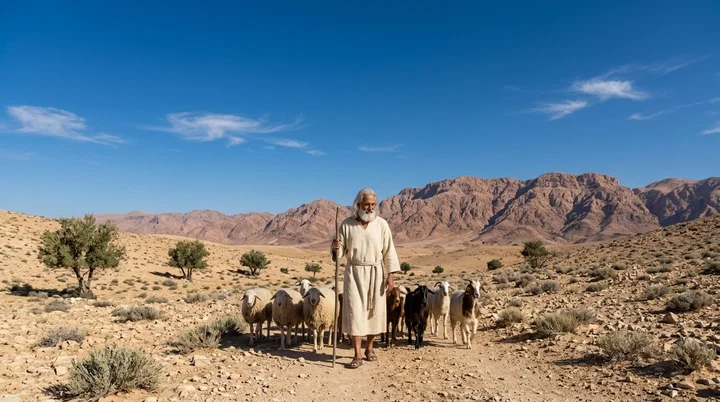
He was a lonely exile fleeing for his life from the wrath of an offended king because God's time to deliver Israel had not yet come.RH Feb 4, 1873 In that secluded spot, clad in a shepherd's humble garb, he led Jethro's flocks forty long years while his suffering people still groaned beneath the oppressor's yoke.RH Feb 4, 1873 Those tardy years of weary waiting curbed and disappointed his eager spirit, but God who sees the end from the beginning used them as the training needed to fit His chosen servant for his high and holy mission as deliverer.RH Feb 4, 1873 That patient endurance of exile in Midian prepared him for his later work in the Exodus of Israel from Egypt and the trials of the wilderness.RH Feb 4, 1873RH May 2, 1865
The humble work developed caretaking, self-forgetfulness, and tender concern for the flock, preparing him to care for Israel with compassion and patience.ST Nov 27, 1901 In tending the flocks in the desert Moses gained just the experience needed to afterward lead God's murmuring, rebellious people as a tender, patient shepherd with long forbearance.RH Feb 4, 1873ST Nov 27, 1901 The exile taught him humility and how to walk with God as part of a longer training in humility, faith, self-denial, hardship, patience, and obedience, for he had to learn to rely on God rather than human strength or wisdom before he could lead others.ST Nov 27, 1901RH Nov 18, 1873 That life of unwearied labor, patient waiting, and steady, earnest aim is the lesson for all who would gain true success.RH Feb 4, 1873
Jethro the priest of Midian was a worshiper of the true God outside the called nation, and Moses found a place in his home when he fled from Egypt.ST Apr 2, 1912 This proves that not all of God's true people were found in that nation, for God had His witnesses scattered everywhere through the nations.ST Apr 2, 1912 Moses was one of the men of the hour whom the Lord raised up to fill a certain important place in His work and great plan, specially called and fitted for the particular occasion.RH Oct 19, 1916 His calling proves that each person has his place in the eternal plan of heaven and a special place designated on earth where to work for God in cooperation with Christ for the salvation of souls, so that every fully surrendered believer, however humble and lowly, is just as truly called and stationed by God right where he is for a purpose.RH Oct 19, 1916
Sources