Genesis 24:11
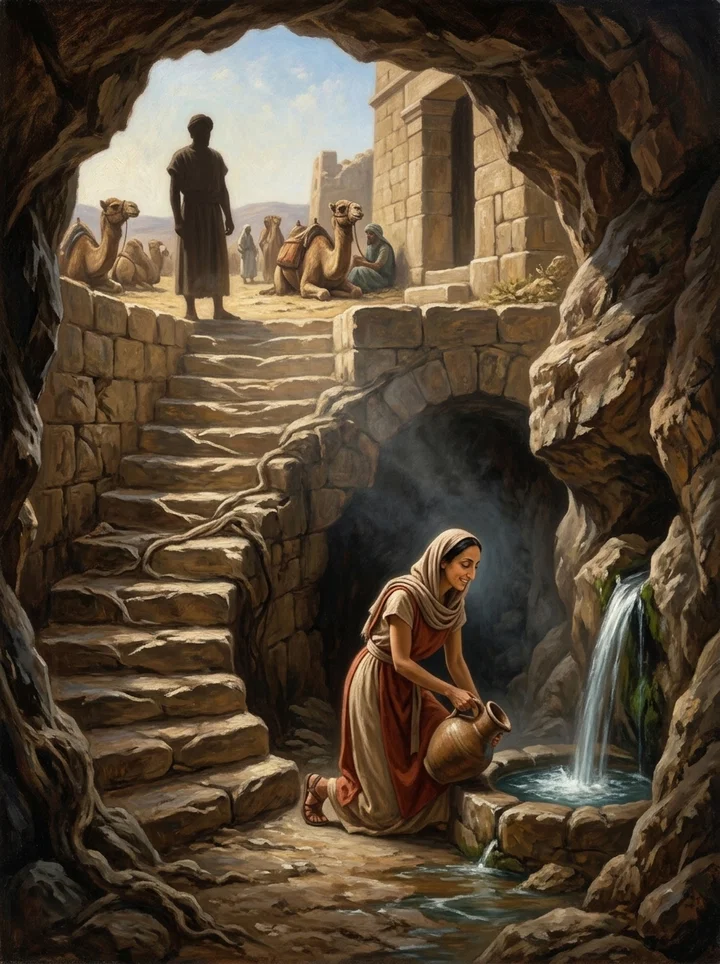
And he made his camels to kneel down without the city by a well of water at the time of the evening, even the time that women go out to draw water.
Translations
American King James Version, King James Version, KJV Cambridge Paragraph Bible
And he made his camels to kneel down without the city by a well of water at the time of the evening, even the time that women go out to draw water.
And he made his camels to kneel down without the city by a well of water, at the time of the evening, the time when women go out to draw water:
Revised Version, American Standard Version
And he made the camels to kneel down without the city by the well of water at the time of evening, the time that women go out to draw water.
and he causeth the camels to kneel at the outside of the city, at the well of water, at even-time, at the time of the coming out of the women who draw water.
And he made the camels kneel down outside the city by a well of water, at the time of the evening, when the women came out to draw [ water].
And he made the camels kneel down outside the city, against the well of water,—at the time of evening, at the time of the coming forth of the women that drew water,
Berean Standard Bible, Majority Standard Bible
As evening approached, he made the camels kneel down near the well outside the town at the time when the women went out to draw water.
He made the camels kneel down outside the city by the well of water at the time of evening, the time that women go out to draw water.
And he made the camels take their rest outside the town by the water-spring in the evening, at the time when the women came to get water.
And he made his camels to lye downe without the citie by a well of water, at euentide about the time that the women come out to draw water.
Douay-Rheims (Challoner revision)
And when he had made the camels lie down without the town near a well of water in the evening, at the time when women are wont to come out to draw water, he said:
Pictures
Cross-references
- Genesis 24:18-20
And she said, Drink, my lord: and she hasted, and let down her pitcher upon her hand, and gave him drink.
Rebekah gives the servant and his camels water at the well.
- Genesis 29:2
And he looked, and behold a well in the field, and, lo, there were three flocks of sheep lying by it; for out of that well they watered the flocks: and a great stone was upon the well’s mouth.
Jacob, like Abraham’s servant, arrives at a well.
- Genesis 24:27
And he said, Blessed be the LORD God of my master Abraham, who hath not left destitute my master of his mercy and his truth: I being in the way, the LORD led me to the house of my master’s brethren.
The servant blesses the Lord for leading him on his journey.
- Genesis 25:20
And Isaac was forty years old when he took Rebekah to wife, the daughter of Bethuel the Syrian of Padan-aram, the sister to Laban the Syrian.
Records Isaac’s age when he married Rebekah.
- Genesis 24:42-48
And I came this day unto the well, and said, O LORD God of my master Abraham, if now thou do prosper my way which I go:
The servant recounts how God guided him to Rebekah at the well.
- Genesis 24:31
And he said, Come in, thou blessed of the LORD; wherefore standest thou without? for I have prepared the house, and room for the camels.
Laban welcomes Eliezer as blessed of the Lord.
- Genesis 24:67
And Isaac brought her into his mother Sarah’s tent, and took Rebekah, and she became his wife; and he loved her: and Isaac was comforted after his mother’s death.
Completes the account of Isaac and Rebekah’s marriage and happiness.
- Genesis 24:51
Behold, Rebekah is before thee, take her, and go, and let her be thy master’s son’s wife, as the LORD hath spoken.
family sees God's hand and gives Rebekah
Commentary
Each commentary is drawn from primary sources: the writings of Ellen G. White and Adventist pioneers and periodicals. Each commentary is separate. Its own words are not a quotation; follow the references to read the source passages.
Ellen G. White
9 sources
The verse places Abraham's servant with his camels outside the city, identified as Nahor by Haran, beside a well of water in the evening, at the time when the women go out to draw water.PP 171.3PP 172.1 The servant had halted there while seeking God's guidance in choosing a wife for Isaac, and the setting gave him opportunity to meet the local women.PP 171.3PP 172.1 At that well outside the city where people gathered, he watched Rebekah's courteous conduct and received the evidence he had asked God to give him in choosing Isaac's wife.1SP 102.1 It describes Abraham's messenger arriving at a well with attendants and camels bearing rich gifts, in contrast to Jacob, who later arrived at a well as a lone, foot-sore traveler with only his staff.PP 188.2
The verse belongs to the account of Abraham arranging a suitable wife for Isaac through his experienced, God-fearing servant's mission.SG3 112.3CE 228.1–230.1ST Apr 10, 1879SG3 112.1–21SP 104.3 That account teaches parents to guide their children's affections toward a suitable companion and to instruct them to respect parental authority rather than leave their affections entirely unrestrained, as part of raising them to a life of obedience.SG3 112.3ST Apr 10, 1879
That account presents Isaac as an example for children who profess to fear God, in trusting God to direct him in obtaining a wife, deferring to his father's judgment, accepting the choice made by his God-fearing father's servant, and seeking God's direction with parental guidance, which led to a happy marriage.CE 228.1–230.1SG3 112.1–21SP 104.3
Sources
Pioneers and periodicals
16 sources
Abraham's trusted servant made his camels kneel outside the city by a well in the evening at the hour when women came out to draw water, and that quiet pastoral setting opened his prayer and meeting with Rebekah.ST Jan 14, 1886ST Sep 15, 1898RH Jun 2, 1851 He had come to Mesopotamia, to Haran among Abraham's kindred, to find a wife for Isaac, and he returned with Rebekah.ST Jan 14, 1886ST Feb 19, 1894ST Feb 17, 1914 Arriving at sunset he prayed for guidance in his delicate task by the sign that the chosen maiden would give him drink when asked and also draw for his camels, and Rebekah's gracious doing of both filled him with thanksgiving as proof of God's leading, which even Bethuel and Laban recognized so they dared not refuse.ST Jan 9, 1912ST Feb 17, 1914 It was the closing step of God's progressive dealings with Abraham from his call onward, after a quarter century of waiting for the promised son, to keep the godly line separate from the ungodly through which the Deliverer would come, with the promises extending from Abraham to Isaac and on to Jacob.ST Dec 20, 1910ST Aug 3, 1915STST Jan 14, 1913 Abraham's arranging of the marriage and Isaac's acceptance of his father's judgment show loving parental guidance of children's affections and honor to parents under the fifth commandment, already binding in patriarchal life long before Sinai.ST Apr 10, 1879ST Jul 9, 1874
Evening Well Setting
Abraham's servant made his camels to kneel down without the city by a well of water in the evening, at the customary time when women went out to draw water.ST Jan 14, 1886ST Sep 15, 1898RH Jun 2, 1851ST May 19, 1898RH Feb 22, 1912 He had come to Haran in Padan-Aram to find a wife for Isaac among Abraham's kindred, and he arrived at sunset.ST Jan 14, 1886ST Feb 17, 1914 There by the well he prayed for God to guide him in the delicate task, and the setting leads directly into that prayer and into his meeting with Rebekah.ST Sep 15, 1898ST Feb 17, 1914 Her gracious courtesy and deference in giving him drink when asked and also drawing for his camels fulfilled the very tokens prayed for, filling him with joy and thanksgiving as proof of God's leading, which her father Bethuel and her brother Laban also recognized so that they dared not refuse the marriage.ST Feb 17, 1914
Its mention of evening shows that evening was a recognized time of day.RH Jun 2, 1851 The well was a customary gathering place where people could meet and learn local news.ST May 19, 1898 The scene reflects the continuing practice of women carrying water from a town's fountain to their homes.ST May 19, 1898 It presents the quiet, pastoral character of ancient Oriental life among the patriarchs, with the camels and the women coming to draw water.ST Jan 14, 1886RH Feb 22, 1912 The account is a true story and record of ancient Oriental life from which readers may learn.ST Jan 14, 1886
The verse belongs to the servant's arrival in Padan-Aram.ST Oct 6, 1898 That arrival took place about one hundred years before Jacob arrived there.ST Oct 6, 1898 The two arrivals form a parallel to be compared.ST Oct 6, 1898
Providential Purpose and Leading
The kneeling of the camels by the well belongs to the journey to Mesopotamia, to Haran, to find a wife for Isaac among Abraham's kindred.ST Jan 14, 1886ST Feb 19, 1894ST Feb 17, 1914 That mission succeeds, and the servant returns with Rebekah.ST Feb 19, 1894 It is the closing step of God's progressive dealings with Abraham, the father of the faithful, from his call onward.ST Dec 20, 1910 It shows Abraham having come to fully trust God when he sent his tried servant, and it is to be read keeping the Promised Seed in mind amid God's providential care and lessons in the school of faith.ST Dec 20, 1910
After waiting a full quarter of a century for the promised son, and after that son had come to manhood, Abraham faced the perplexity of securing for Isaac a wife as nearly as possible in the godly line.ST Aug 3, 1915 The aim was to prevent amalgamation of the godly seed with the ungodly and its pollution.ST Aug 3, 1915 The organized godly line was to be kept separate, as the line through which the Deliverer would come into the human family.ST Aug 3, 1915 The verse thus falls within God's providential dealings with Abraham's chosen family as the family of the progenitor of the Seed.ST In that place it shows the promises given to Abraham extending to Isaac and then on to Jacob.STST Jan 14, 1913
The servant sent on this errand was trusted and tried.ST Dec 20, 1910ST Jan 9, 1912 He was marked by piety, unselfishness, and faithfulness.ST Jan 9, 1912 The Lord guided him as he faithfully went on his way.ST Jan 9, 1912
Arriving at sunset, he prayed for God to guide him in the delicate task.ST Feb 17, 1914 He asked for the specific sign that the chosen maiden would give him water when asked and also draw water for his camels.ST Feb 17, 1914 Rebekah's gracious courtesy and deference in doing both fulfilled the very tokens prayed for.ST Feb 17, 1914 This filled him with joy and thanksgiving as proof of God's leading.ST Feb 17, 1914 Her father Bethuel and her brother Laban also recognized the leading, so they dared not refuse the marriage.ST Feb 17, 1914
Marriage and Parental Obedience
The evening kneeling of the camels by the well belongs to Abraham's course in arranging a suitable marriage for Isaac, and that course presents parental guidance of children's affections and respect for parental authority as part of raising children to a life of obedience.ST Apr 10, 1879 Its outcome shows Isaac accepting his father's judgment in choosing a wife, and his obedience grew from training that taught him to love obedience. Abraham's parental authority was loving, not selfish or arbitrary, and sought his children's welfare and happiness.
Isaac's deference to his father in the matter of his marriage, shown through the whole account of Genesis 24:1-67, is honor to parents in obedience to the fifth commandment.ST Jul 9, 1874 That obedience proves the fifth commandment was not new at Sinai but was already controlling God's servants in patriarchal domestic life.ST Jul 9, 1874 The marriage of Isaac and Rebekah secured in this way stands as a simple yet romantic example of marriage, an institution established by God and exalted in Scripture.ST Apr 5, 1905
Sources