Exodus 27:12
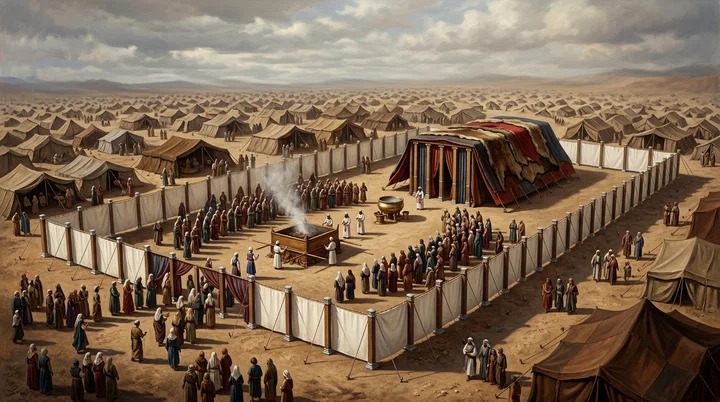
And for the breadth of the court on the west side shall be hangings of fifty cubits: their pillars ten, and their sockets ten.
Translations
American King James Version, King James Version, KJV Cambridge Paragraph Bible, Webster Bible, Revised Version
And for the breadth of the court on the west side shall be hangings of fifty cubits: their pillars ten, and their sockets ten.
And for the breadth of the court on the west side shall be hangings of fifty cubits; their pillars ten, and their sockets ten.
'And [for] the breadth of the court at the west side [are] hangings of fifty cubits, their pillars ten, and their sockets ten.
— And the breadth of the court on the west side, hangings of fifty cubits; their pillars ten, and their bases ten.
And, the breadth of the court on the west side, hangings fifty cubits,—their pillars ten, and their sockets ten.
Berean Standard Bible, Majority Standard Bible
The curtains on the west side of the courtyard shall be fifty cubits wide, with ten posts and ten bases.
For the width of the court on the west side shall be hangings of fifty cubits; their pillars ten, and their sockets ten.
And for the open space on the west side, the hangings are to be fifty cubits wide, with ten pillars and ten bases;
And the breadth of the court on the Westside shall haue curtaines of fiftie cubites, with their ten pillars and their ten sockets.
Douay-Rheims (Challoner revision)
But in the breadth of the court, that looketh to the west, there shall be hangings of fifty cubits, and ten pillars, and as many sockets.
Pictures
Cross-references
- Hebrews 8:5
Who serve unto the example and shadow of heavenly things, as Moses was admonished of God when he was about to make the tabernacle: for, See, saith he, that thou make all things according to the pattern shewed to thee in the mount.
The earthly sanctuary was made according to the heavenly pattern.
- Exodus 38:9-20
And he made the court: on the south side southward the hangings of the court were of fine twined linen, an hundred cubits:
Repeats the court measurements.
- Acts 7:44
Our fathers had the tabernacle of witness in the wilderness, as he had appointed, speaking unto Moses, that he should make it according to the fashion that he had seen.
The wilderness tabernacle was made according to the pattern shown to Moses.
- Exodus 25:8-9
And let them make me a sanctuary; that I may dwell among them.
God gives instructions for building the sanctuary according to a pattern.
- Numbers 4:31-32
And this is the charge of their burden, according to all their service in the tabernacle of the congregation; the boards of the tabernacle, and the bars thereof, and the pillars thereof, and sockets thereof,
pillars and sockets of the court
- Exodus 40:28-33
And he set up the hanging at the door of the tabernacle.
records setting up the court
- Exodus 26
Moreover thou shalt make the tabernacle with ten curtains of fine twined linen, and blue, and purple, and scarlet: with cherubims of cunning work shalt thou make them.
The verse belongs to the tabernacle instructions.
- Exodus 38:27
And of the hundred talents of silver were cast the sockets of the sanctuary, and the sockets of the vail; an hundred sockets of the hundred talents, a talent for a socket.
weight of silver sockets
- Hebrews 9:1-5
Then verily the first covenant had also ordinances of divine service, and a worldly sanctuary.
Summarizes the sanctuary and its furnishings.
- Hebrews 9:8-9
The Holy Ghost this signifying, that the way into the holiest of all was not yet made manifest, while as the first tabernacle was yet standing:
earthly service is a shadow lesson of heavenly things
- Hebrews 9:23-24
It was therefore necessary that the patterns of things in the heavens should be purified with these; but the heavenly things themselves with better sacrifices than these.
earthly building teaches the heavenly temple
Commentary
Each commentary is drawn from primary sources: the writings of Ellen G. White and Adventist pioneers and periodicals. Each commentary is separate. Its own words are not a quotation; follow the references to read the source passages.
Ellen G. White
1 source
The measurement for the west side of the court, with its fifty cubits of hangings and its ten pillars and ten sockets, belonged to the exact specifications God gave to Moses for building the tabernacle.Ms 97, 1899, par. 3–4 Those directions were not left to human invention but were divinely prescribed down to dimensions and supports.Ms 97, 1899, par. 3–4 The skill required to carry them out shows that wisdom and ability for practical work come from God.Ms 97, 1899, par. 3–4 Such craftsmanship is a gift entrusted for His glory and is to be employed in His service.Ms 97, 1899, par. 3–4
Sources
Pioneers and periodicals
23 sources
The west end of the court was fifty cubits across, closed by hangings of that length hung on ten pillars set in ten sockets.ST May 1, 1901RH Aug 4, 1863ST Jan 24, 1911 It was part of the full and exact directions God gave to Moses in the mount for making the sanctuary, its furniture and its services.ST Oct 29, 1894ST Feb 17, 1890 The court itself was one hundred cubits long by fifty cubits broad, five cubits high, with its pillars five cubits apart except on the east where a twenty-cubit gate stood opposite the west side, and with the tabernacle placed toward the west leaving the altar of burnt offerings in the larger open space at the east.ST Nov 14, 1892RH Jan 6, 1853ST Mar 25, 1897 The enclosure was fine-twined linen hung from brass pillars set in brass sockets by silver hooks and fillets, though those who held it to be otherwise described it as brass pillars set in silver sockets.ST May 1, 1901RH Aug 4, 1863ST Nov 14, 1892ST May 1, 1901 It was made strictly after the divine pattern, not left to human devising, so that God might dwell among His people, and as a shadow and object-lesson of the heavenly sanctuary where Christ ministers and of the way of salvation through Him.ST Oct 29, 1894ST Jan 24, 1911ST Feb 17, 1890ST Jun 26, 1907ST Jun 19, 1907
Court Construction and Layout
The verse belongs to the minute and explicit instructions in Exodus 25 to 31, extending through chapter 40, which God gave to Moses in the mount for building the sanctuary, making its furniture, and preparing its services.ST Oct 29, 1894ST Feb 17, 1890ST Mar 10, 1898 Those directions were given when he was called to receive the tables after the people asked him to receive further directions, and they stand chronologically after Exodus 19-32 and before the building and setting up in Exodus 33-40.ST Apr 15, 1886ST Dec 10, 1896 They give the full description of the sanctuary and its furnishings through the end of Exodus.ST Mar 10, 1898
The verse specifies the breadth of the court on the west side as hangings of fifty cubits, with their ten pillars and their ten sockets.ST May 1, 1901ST Jan 24, 1911ST Jun 26, 1907 It describes the west end as fifty cubits across, matching the stated width of the court.ST Nov 14, 1892RH Jan 6, 1853RH Sep 19, 1912 The curtains there were part of the enclosure around the sacred tent.RH Aug 4, 1863
The court was one hundred cubits long by fifty cubits broad, a double square of seventy-five by one hundred fifty feet enclosing the tabernacle.ST Nov 14, 1892RH Jan 6, 1853ST Mar 25, 1897ST May 1, 1901RH Mar 1, 1870 It was five cubits, or about nine feet, high, with pillars set five cubits apart continuous except on the east.ST Nov 14, 1892RH Jan 6, 1853ST May 1, 1901RH Mar 1, 1870 On the east was a twenty-cubit gate closed with curtains of blue, purple, scarlet and fine-twined linen.ST Nov 14, 1892ST Mar 25, 1897ST May 1, 1901 That east gate lay opposite the fifty-cubit west side and corresponded to the door of the tabernacle at the east end in both the sanctuary Moses built and the temple Solomon built.ST May 1, 1901 The tabernacle stood nearer the west end leaving thirty feet of open space there, while the larger open space at the east held the altar of burnt offerings.ST Nov 14, 1892ST May 1, 1901
The enclosure was hangings of fine-twined linen suspended from brass pillars five cubits high set in brass sockets, with silver hooks and fillets stretching the curtains between the posts.ST Nov 14, 1892RH Sep 19, 1912ST Jun 20, 1911 The boundary curtains were fine linen, seven and one-half feet high, stretched between brass posts and fastened to silver hooks.ST May 1, 1901 It is also described as brass pillars set in silver sockets five cubits apart holding a curtain of fine twined linen five cubits wide, with the gate twenty cubits wide on the east side.ST May 1, 1901ST May 1, 1901
Divine Pattern and Purpose
The west-side hangings belong to the minute directions for the sanctuary built in the days of Moses, which was to be made exactly according to the pattern shown in the mount and not left to human fancy as to how or how large it should be.ST Oct 29, 1894ST Feb 17, 1890ST Jun 26, 1907 Chosen men were endowed with wisdom to carry out that pattern, the directions were not to be disregarded under penalty of death, and sanctuary means a sacred or holy place.ST Feb 17, 1890 The court detail itself belongs to the earthly sanctuary constructed after God's directions to Moses, serving as a pattern pointing to the heavenly sanctuary and its service.ST Jun 26, 1907ST May 16, 1878 It is part of the instructions for the habitation where God would dwell among His people, with the court one hundred cubits long by fifty cubits broad and five cubits, about nine feet, high.ST May 16, 1878RH Mar 1, 1870
God commanded Israel to build the sanctuary so He might dwell among them and manifest His presence as the habitation where the priests could minister in His presence.ST Jun 19, 1907RH Mar 1, 1870RH Jan 4, 1870 Its object was that God might dwell among Israel, with His glory remaining there till driven away by persistent sinning, and with Israel's worship centering there as the earthly center where the worship of the true God centered.ST Feb 17, 1890ST Jun 19, 1907ST Jun 19, 1907 The wilderness tabernacle was the earthly center of worship whose services revolved around the Most Holy Place, where God's law rested beneath the mercy seat.ST Jun 19, 1907 The sanctuary and its service as set forth in the tabernacle among Israel and later in the temple is the object-lesson let down upon earth, given as a divine pattern to be a teaching object lesson about God's plan of salvation and a place for God to dwell among Israel.
The earthly construction and its service was a pattern, shadow and type of the heavenly sanctuary and temple of God in heaven, where Jesus now ministers as High Priest and Minister.ST Jan 24, 1911ST Jun 26, 1907ST Jun 19, 1907 The tabernacle was built for ministry involving sacrifices and offerings, and its sanctuary typified the heavenly temple where Jesus now ministers.ST Jan 24, 1911 Study of the earthly lesson enables understanding of the heavenly reality and Christ's priestly service therein, giving enlightenment concerning God's dealings with men and clearer views of the Saviour and His work in behalf of men.ST Jun 19, 1907 It proves the heavenly temple consists of two holy places, for the sanctuary made like the pattern shown in the mount consisted of two holy places and is a pattern of the heavenly temple.RH Jan 4, 1870 It gives the exact pattern of the atonement work accomplished in two kinds of service by different persons at different times in separate apartments for the errors of the people, as set forth in the full description in Exodus 25 through the end of Exodus.ST Mar 10, 1898
As a teaching object-lesson let down upon earth it sets forth God's plan of government and how He deals with those who have sought to dethrone Him by sin. As Priest upon the throne, still King in dealing with sinners, He sets forth in the provision of the sanctuary the plan devised from eternity for salvation from sin. God made His purpose known to His people because His people are so intimately related to the sanctuary that they cooperate with God in His work through Christ in the sanctuary, divine and human cooperating at every step, that He may dwell among them. As part of those instructions it reveals God's way and His power and glory, and study of it gives enlightenment concerning God's dealings with men and clearer views of the Saviour and His work in behalf of men.ST Jun 19, 1907 It is not written in vain or without purpose but is profitable for doctrine, for reproof, for correction, for instruction in righteousness to make the man of God perfect, and was written for learning that through patience and comfort of the Scriptures hope may be had.ST Jun 19, 1907 It belongs to the instruction about God's sanctuary and calls for examination of one's attitude of heart toward God's sanctuary.RH Jan 27, 1916
The instruction belongs to the ceremonial laws and ordinances given in addition to the Ten Commandments, given through Moses after the people asked him to receive God's further directions.ST Apr 15, 1886 It belongs to the description of the worldly sanctuary connected with the first covenant and its ordinances of divine service, and the ministration belonging to that covenant and sanctuary was a ministration of death.ST Aug 5, 1889 Its fine-twined linen represents the righteousness of the saints, and that righteousness is obtained only by having Christ, who is made unto believers wisdom, and righteousness, and sanctification, and redemption, and whose name is THE LORD OUR RIGHTEOUSNESS.ST Mar 25, 1897
Sources