Hebrews 9:1
Then verily the first covenant had also ordinances of divine service, and a worldly sanctuary.
Translations
Then truly the first covenant had also ordinances of divine service, and a worldly sanctuary.
King James Version, KJV Cambridge Paragraph Bible, Webster Bible
Then verily the first covenant had also ordinances of divine service, and a worldly sanctuary.
Revised Version, American Standard Version
Now even the first covenant had ordinances of divine service, and its sanctuary, a sanctuary of this world.
It had, indeed, then (even the first tabernacle) ordinances of service, also a worldly sanctuary,
The first therefore also indeed had ordinances of service, and the sanctuary, a worldly one.
[Even] the first, indeed, therefore, used to have righteous appointments of divine service, even the holy ritual well arranged.
Now the first covenant had regulations for worship and also an earthly sanctuary.
Now even the first covenant had regulations for worship and also an earthly sanctuary.
Now indeed even the first covenant had ordinances of divine service and an earthly sanctuary.
Now the first agreement had its rules of worship, and a holy order.
Then the first Testament had also ordinances of religion, and a worldly Sanctuarie.
Douay-Rheims (Challoner revision)
The former indeed had also justifications of divine service, and a worldly sanctuary.
Pictures
Cross-references 20 of 107
- Hebrews 8:1-5
Now of the things which we have spoken this is the sum: We have such an high priest, who is set on the right hand of the throne of the Majesty in the heavens;
Christ ministers in heaven’s true sanctuary, contrasted with the earthly sanctuary’s pattern.
- Hebrews 9:23-24
It was therefore necessary that the patterns of things in the heavens should be purified with these; but the heavenly things themselves with better sacrifices than these.
Contrasts the earthly sanctuary as a pattern with the heavenly sanctuary Christ enters and ministers in.
- Exodus 25:8
And let them make me a sanctuary; that I may dwell among them.
God directs Israel to make a sanctuary for him to dwell among them.
- Hebrews 8:5
Who serve unto the example and shadow of heavenly things, as Moses was admonished of God when he was about to make the tabernacle: for, See, saith he, that thou make all things according to the pattern shewed to thee in the mount.
Earthly sanctuary service followed a pattern of heavenly things.
- Leviticus 16
And the LORD spake unto Moses after the death of the two sons of Aaron, when they offered before the LORD, and died;
Describes the annual Day of Atonement service in the earthly sanctuary.
- Hebrews 9:11-12
But Christ being come an high priest of good things to come, by a greater and more perfect tabernacle, not made with hands, that is to say, not of this building;
Connects Christ’s sacrifice and entrance into the heavenly sanctuary to the earthly figures.
- Revelation 11:19
And the temple of God was opened in heaven, and there was seen in his temple the ark of his testament: and there were lightnings, and voices, and thunderings, and an earthquake, and great hail.
The heavenly temple opens, revealing the ark of the covenant within it.
- Exodus 25:40
And look that thou make them after their pattern, which was shewed thee in the mount.
Moses is told to make the sanctuary and its furnishings according to the shown pattern.
- Hebrews 10:1
For the law having a shadow of good things to come, and not the very image of the things, can never with those sacrifices which they offered year by year continually make the comers thereunto perfect.
The law’s sacrifices were shadows of coming good things, fulfilled in Christ’s effective sacrifice.
- Hebrews 9:24
For Christ is not entered into the holy places made with hands, which are the figures of the true; but into heaven itself, now to appear in the presence of God for us:
Heaven is the true sanctuary, of which the earthly holy places were figures.
- Hebrews 9:8
The Holy Ghost this signifying, that the way into the holiest of all was not yet made manifest, while as the first tabernacle was yet standing:
The standing first tabernacle signified that access to the heavenly holy places was not yet open.
- Hebrews 9:6-7
Now when these things were thus ordained, the priests went always into the first tabernacle, accomplishing the service of God.
Describes the priests’ regular and yearly services in the sanctuary’s two apartments.
- Hebrews 8:6-7
But now hath he obtained a more excellent ministry, by how much also he is the mediator of a better covenant, which was established upon better promises.
Contrasts the first covenant with Christ’s better covenant and ministry.
- Exodus 25:22
And there I will meet with thee, and I will commune with thee from above the mercy seat, from between the two cherubims which are upon the ark of the testimony, of all things which I will give thee in commandment unto the children of Israel.
God says he will meet and commune with Moses at the tabernacle.
- Exodus 26:33
And thou shalt hang up the vail under the taches, that thou mayest bring in thither within the vail the ark of the testimony: and the vail shall divide unto you between the holy place and the most holy.
Describes the veil dividing the sanctuary’s holy place from the most holy place.
- Exodus 25:9
According to all that I shew thee, after the pattern of the tabernacle, and the pattern of all the instruments thereof, even so shall ye make it.
Moses was instructed to make the earthly sanctuary according to God’s pattern.
- Hebrews 9:10
Which stood only in meats and drinks, and divers washings, and carnal ordinances, imposed on them until the time of reformation.
Lists the first covenant’s temporary food, drink, washing, and bodily regulations.
- Hebrews 9:15
And for this cause he is the mediator of the new testament, that by means of death, for the redemption of the transgressions that were under the first testament, they which are called might receive the promise of eternal inheritance.
Christ mediates the new covenant, redeeming transgressions under the first covenant.
- Colossians 2:14-17
Blotting out the handwriting of ordinances that was against us, which was contrary to us, and took it out of the way, nailing it to his cross;
Ceremonial ordinances and observances were shadows, ended by Christ’s death.
- Galatians 4:24-26
Which things are an allegory: for these are the two covenants; the one from the mount Sinai, which gendereth to bondage, which is Agar.
Contrasts the Sinai covenant with the covenant represented by Jerusalem above.
Commentary
Each commentary is drawn from primary sources: the writings of Ellen G. White and Adventist pioneers and periodicals. Each commentary is separate. Its own words are not a quotation; follow the references to read the source passages.
Ellen G. White
18 sources
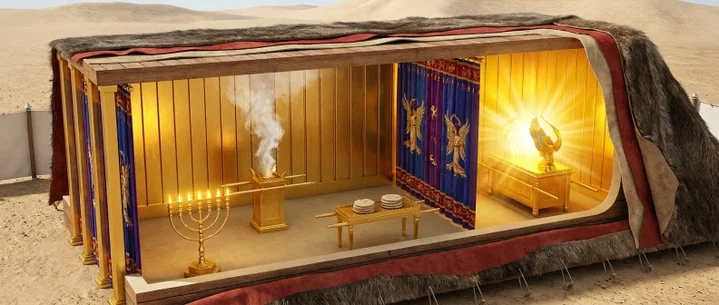
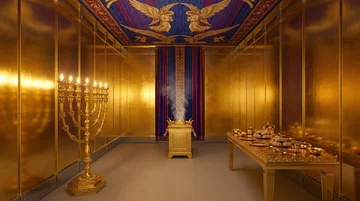
The first covenant was given divinely appointed rules for worship centered in a sanctuary on earth.GC88 411.1–412.3RH Nov 8, 1915GC 410.3–411.1 That sanctuary was the movable tabernacle God commanded Moses to build as His dwelling among Israel, with an outer court and two rooms, the holy place and the most holy place, later preserved in Solomon's temple until its destruction in A.D. 70.GC88 411.1–412.3RH Nov 8, 1915GC 410.3–411.1RH Nov 8, 19154RED 125.2–127.1 The word also points to another sanctuary belonging to the new covenant, the true temple in heaven established by the Lord where Christ ministers as great High Priest.RH Nov 8, 1915GC 412.4–413.2 The earthly tabernacle with its two apartments, veil, lampstand, table of showbread, altar of incense, and ark with the law, manna, Aaron's rod, and cherubim shadowing the mercy seat was patterned after and represents that heavenly temple and its furnishings.GC88 411.1–412.3WLF 18.3–4RH Nov 8, 1915RH Jul 21, 1851CET 91.2–3 As the priest once offered incense before the hidden mercy seat, God's people are now to direct their prayers by faith to Christ their unseen Mediator before the ark in heaven, where the law remains unchanged with the Sabbath commandment shining brightest.ExVEGW 15.3–17.1SG4 8.34RED 125.2–127.1
Earthly Sanctuary Described
The first covenant had divinely appointed ordinances of worship and an earthly sanctuary.GC88 411.1–412.3RH Nov 8, 1915GC 410.3–411.1WLF 18.3–4RH Nov 8, 1915 That sanctuary was made in two parts, the first called the sanctuary and after the second veil the tabernacle called the holiest of all.GC 410.3–411.1WLF 18.3–4RH Nov 8, 1915RH Jul 21, 1851 It was not the earth itself.GC88 411.1–412.3GC 410.3–411.1
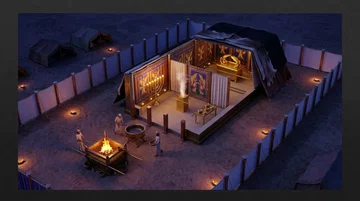
It was the movable tabernacle God commanded Moses to build as His dwelling among Israel during the wilderness journey.GC88 411.1–412.3RH Nov 8, 1915GC 411.2–412.3 Though portable, it was richly made with gold-plated boards, silver sockets and decorated coverings.RH Nov 8, 1915 It had an outer court with the burnt-offering altar, and two rooms — the holy place and the most holy place — separated by a veil, with another veil at the entrance to the first room.GC88 411.1–412.3RH Nov 8, 1915GC 411.2–412.3
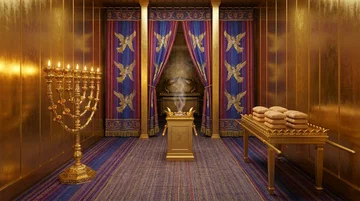
Its furnishings in the first room were the lampstand or candlestick and the table with the showbread, with the altar of incense or golden censer.GC88 411.1–412.3RH Nov 8, 1915SG1 158.1SG4 8.3 After the second veil was the ark of the covenant overlaid round about with gold, containing the law or tables of the covenant, with the golden pot that had manna and Aaron's rod that budded inside.GC88 411.1–412.3RH Nov 8, 1915SG1 158.1Lt 253, 1903, par. 17 Above it were the cherubim of glory shadowing the mercy seat or cover, where God's glory appeared between the cherubim.RH Nov 8, 1915SG4 8.3Lt 253, 1903, par. 17GC 411.2–412.3
After Israel settled in Canaan Solomon's temple replaced the tabernacle and preserved its proportions, arrangement and furnishings.GC88 411.1–412.3RH Nov 8, 1915GC 411.2–412.3 As God's dwelling in Jerusalem priests served there amid symbolic ceremonies where incense and worshipers' prayers rose to God and animal blood flowed as a type of Christ's blood, with God's glory manifested above the mercy seat.4RED 125.2–127.1GC 411.2–412.3 It was the only earthly sanctuary described in the Bible and, except when it lay in ruins in Daniel's time, it continued until the Romans destroyed it in A.D. 70, when its temple worship ended.GC88 411.1–412.3RH Nov 8, 19154RED 125.2–127.1GC 411.2–412.3
Heavenly Sanctuary Revealed
The word also in the verse points beyond the first covenant to another sanctuary belonging to the new covenant in heaven.RH Nov 8, 1915GC 412.4–413.2 That heavenly sanctuary was established by the Lord and was not built by Moses.RH Nov 8, 1915GC 412.4–413.2 While earthly priests served in the first sanctuary, Christ ministers there as the great High Priest at God's right hand.RH Nov 8, 1915GC 412.4–413.2
The earthly sanctuary with its two apartments and furnishings was patterned after and represents that real temple in the holy city in heaven.WLF 18.3–4RH Jul 21, 1851SG1 158.1ExVEGW 15.3–17.1EW 213.2–214.1 The heavenly temple therefore has corresponding holy and most holy places and furnishings.WLF 18.3–4SG1 158.1ExVEGW 15.3–17.1EW 213.2–214.1LSEGW 100.1–3 It is entered through a door to a first veil into the holy place, and through a second veil into the holy of holies.RH Jul 21, 1851CET 91.2–3ExVEGW 15.3–17.1 The holy place contains the altar of incense, the candlestick with seven lamps, and the table with showbread.WLF 18.3–4RH Jul 21, 1851CET 91.2–3SG1 158.1ExVEGW 15.3–17.1
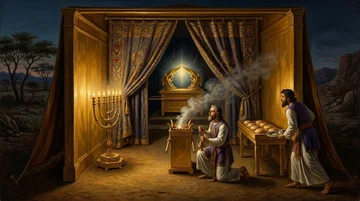
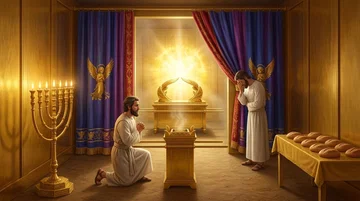
The holy of holies contains an ark overlaid with purest gold, with a cherub on each end with wings spread out and faces turned toward each other and downward.CET 91.2–3ExVEGW 15.3–17.1 A golden censer stands between them, and above the ark is exceeding bright glory as the throne where God dwells.CET 91.2–3ExVEGW 15.3–17.1 Inside the ark are the golden pot of manna, Aaron's rod that budded, and the tables of stone.ExVEGW 15.3–17.1 Jesus ministers there by the ark, standing by it before the mercy seat between the cherubim.CET 91.2–3SG1 158.1ExVEGW 15.3–17.1LSEGW 100.1–3 As the saints' prayers come up to Him the incense smokes and He offers their prayers with the smoke of the incense to the Father.CET 91.2–3SG1 158.1ExVEGW 15.3–17.1LSEGW 100.1–3
Worship and Obedience
The earthly sanctuary had two apartments in which the priest offered incense before the hidden mercy seat, while God's glory appeared there and could fill both apartments.SG4 8.3 That service represents God's people directing their prayers by faith to Christ, their unseen Mediator before the mercy seat in the heavenly sanctuary, and claiming the benefits of His mediation.SG4 8.3 The temple in Jerusalem was that earthly sanctuary where God made His dwelling, priests served amid symbolic ceremonies, incense and worshipers' prayers rose to God, animal blood flowed as a type of Christ's blood, and God's glory was manifested above the mercy seat.4RED 125.2–127.1 These services and symbols continued for ages, but the temple and its worship were to end when Jerusalem was destroyed.4RED 125.2–127.1
The ordinances of the first covenant point to a real temple in heaven with the same two apartments and furniture.ExVEGW 15.3–17.1 The heavenly Holy Place is entered through a first veil and contains the altar of incense, the candlestick with seven lamps, and the table of shewbread, while the Holy of Holies is entered through a second veil and contains the golden ark covered with purest gold, with a cherub on each end with wings spread over it and faces turned toward each other and downward, a golden censer between them, and exceeding bright glory above as the throne where God dwells.ExVEGW 15.3–17.1 Inside the ark are the golden pot of manna, Aaron's rod that budded, and the tables of stone folded together like a book with the ten commandments written by the finger of God, four on one table and six on the other, with the fourth, the Sabbath commandment, shining brightest with a halo of glory.ExVEGW 15.3–17.1 Jesus ministers by the ark in the Holiest, and as the saints' prayers come up to Him the incense smokes and He offers their prayers with the smoke to the Father.ExVEGW 15.3–17.1 The law in the heavenly ark reads the same as given at Sinai, But the seventh day is the Sabbath of the Lord thy God, proving God has not changed the Sabbath and it was not nailed to the cross.ExVEGW 15.3–17.1
The sacredness of the sanctuary teaches Christians to regard with reverence the place where God meets His people, for God gave order to its worship and set it above what is merely temporal.5T 491.2 The sanctuary of the first covenant includes the ark containing the law of God, the cover of the ark which is the mercy seat, the angels at either end of the ark, and other things connected with the heavenly sanctuary and with the great day of atonement.Lt 253, 1903, par. 17 About these are mysteries of heaven about which much could be said but which remain closed and undescribed.Lt 253, 1903, par. 17
Sources
Pioneers and periodicals
135 sources
The first covenant had divinely appointed rules for worship and an earthly sanctuary.RH May 14, 1867RH Feb 5, 1867ST May 17, 1877 The word worldly means earthly and made by human hands, in contrast with the heavenly sanctuary made by the Lord.RH Jun 21, 1864RH Dec 24, 1908RH Jan 9, 1855 The word also shows the new or second covenant has ordinances of worship and a sanctuary as well as the old.ST Dec 5, 1892ST Jan 27, 1890 That sanctuary was the tabernacle Moses built in the wilderness exactly by the pattern shown on the mount, God's dwelling among His people and center of worship, later continued in the temples of Solomon, Zerubbabel, and Herod.ST May 17, 1877RH Aug 21, 1856RH Jan 6, 1853ST May 20, 1880RH Dec 24, 1908 It was a figure, shadow, pattern, and copy of the true tabernacle in heaven which the Lord pitched and not man, where Christ now ministers as High Priest with His own blood in holy places corresponding to its two apartments.RH Feb 5, 1867ST Dec 5, 1892RH Sep 2, 1852LDT 179.2RH Jun 21, 1864
Words and Wording
Hebrews 9:1 means the first covenant included divinely appointed rules for worship and an earthly sanctuary.RH May 14, 1867RH Feb 5, 1867ST May 17, 1877RH Sep 21, 1905RH May 13, 1862 That sanctuary had two apartments, with the first containing the lampstand, the table and the bread where priests served daily, and the inner apartment containing the ark and its sacred objects where only the high priest entered once a year.RH May 14, 1867RH Sep 21, 1905 The ark held the Ten Commandments as the standard of righteousness and served as the earthly pattern for the heavenly sanctuary where Jesus ministers.RH Feb 5, 1867RH Sep 21, 1905 This sanctuary was the tabernacle Moses built in the wilderness of Sinai, later represented by the temples of Solomon, Zerubbabel, and Herod, serving until the time of Christ.ST May 17, 1877ST Dec 5, 1892 Its priestly work was service to God by offering blood for the priests themselves and for the errors of the people.RH Sep 21, 1905 Its vessels and priestly ministry belonged to this covenant, whose ordinances consisted of foods, drinks, washings, and other physical regulations imposed only until the time of reformation, distinct from the Ten Commandments.RH May 13, 1862
The word worldly means earthly, marking a contrast with the second covenant whose sanctuary is heavenly, made by the Lord rather than by human hands, with a more excellent service and High Priest.RH Jun 21, 1864RH Jul 26, 1870RH Jan 20, 1853 It was the Jewish center of worship from the wilderness tabernacle through the two temples until Christ came and the second temple was destroyed in A.D. 70, after which no sanctuary has existed on earth.RH Dec 24, 1908 It was built by Moses at God's express command in exact accordance with the pattern shown on the mount, with a first apartment called the holy containing the candlestick and table of showbread and a second apartment beyond the second veil called the Holiest of all.RH Jan 9, 1855 That earthly building pitched by man was God's recognized sanctuary until the new covenant was introduced by the Messiah, a figure for the time then present and a pattern of the true tabernacle.RH Jan 9, 1855RH Jan 20, 1853 There gifts and sacrifices were offered that could not make the conscience perfect, and foods, drinks, washings, and carnal ordinances stood only until the time of reformation, when the earthly gave place not to the earth but to the greater and more perfect tabernacle not made with hands which the Lord pitched, where Christ entered by His own blood to appear in the presence of God.RH Jan 9, 1855 The earth never became that sanctuary, is never called the sanctuary in Scripture, is cursed and unholy and only God's footstool, while the new-covenant sanctuary is in heaven, and the word sanctuary never means the earth.RH Jan 9, 1855 When Christ died the veil was torn and God no longer had a sanctuary on earth, the earthly sanctuary and its service remaining a type of the sanctuary in heaven and its service.
The word also shows that the new or second covenant has ordinances of divine service and a sanctuary as well as the old, with Christ ministering as high priest in the literal heavenly sanctuary, the true tabernacle built by God of which the earthly was a pattern.ST Dec 5, 1892ST Jan 27, 1890ST Dec 8, 1881 The Mosaic sanctuary and its worship ordinances belonged to the first covenant and therefore have a counterpart under the new covenant, the earthly belonging to the first and the heavenly to the new.ST Dec 8, 1881RH Oct 2, 1856 By speaking of a first covenant with a sanctuary and service, the verse implies a second or new covenant that also has a sanctuary and ordinances of divine service.ST May 27, 1880 The earthly sanctuary was temporary and served as a type, pattern, figure, and shadow of the true sanctuary from which it was erected, the antitype being found by identifying what the earthly truly figured.RH Oct 2, 1856ST May 27, 1880 The first covenant, its worldly sanctuary, and the Jewish church were allotted only 490 years of the 2,300 years at the end of which the sanctuary is to be cleansed, and when those years ended the confirmation of the new covenant was finished, the old covenant passed away, the services of the worldly sanctuary ceased forever, and the Jewish church ceased to have pre-eminence; since 1,810 years still remained, that cleansing must apply to the sanctuary of the second covenant.ST May 27, 1880 Those who reckoned the portion as 400 years held that at their close Christ completed His earthly ministry and confirmed the new covenant, with 1,810 years then remaining to the cleansing.RH Oct 2, 1856
The word translated sanctuary comes from the Greek hagion, the same sanctuary terminology rendered sanctuary, holy place, Holiest of all, and holiest in Hebrews.RH Jan 23, 1855 In Hebrews 9:1 it stands in the accusative singular and is correctly translated sanctuary, spoken of the tabernacle or temple.RH Oct 5, 1916RH Oct 5, 1916 It belongs to the New Testament pattern where hagion in the singular and hagia or hagion in the plural all mean sanctuary, in contrast to Hebrews 9:2 where the plural hagia means the first apartment, the holy place, and Hebrews 9:3 where hagia hagion means the second apartment, the holiest of all.RH Oct 5, 1916 Hebrews is the only book in the New Testament using the word sanctuary, teaching that Christ our High Priest ministers in the heavenly sanctuary in both apartments as was performed in the typical sanctuary.RH Oct 5, 1916
The sanctuary included the tabernacle with its two rooms, courtyard, and vessels used in its service, the place where God set His name, showed His glory, and met with the high priest.RH Sep 2, 1852 During the period when the ordained tabernacle existed, that tabernacle with its holy and most holy compartments and their sacred furnishings constituted the Lord's sanctuary.RH Aug 4, 1863 Its holy things were joined to the tabernacle, just as the holy things of the new covenant are joined to Christ's greater, heavenly tabernacle, together forming the Sanctuary.RH Sep 30, 1852 It was the tabernacle God commanded Moses to build as His dwelling among Israel in the wilderness journey, portable yet richly made with gold-plated boards, silver sockets, and decorated coverings, having an outer court with the burnt-offering altar and two rooms, the holy place and the most holy place, separated by a veil with another veil at the entrance to the first room.RH Nov 8, 1915 Its walls were upright boards heavily plated with purest gold, and its veils and ceiling curtain were of beautifully arranged varied colors inwrought with threads of gold and silver in cherubim to represent the angelic host connected with the work of the heavenly sanctuary as ministering angels to the saints upon the earth.ST Mar 21, 1911 Built by Moses with its furniture, priesthood, service, and history through tabernacle and temple until the destruction of the temple in A.D. 70, this worldly sanctuary and its service are connected to the heavenly sanctuary and the service there, proceeding from type to antitype and from shadow to substance.ST Nov 26, 1894
Sanctuary Identity and History
The sanctuary of the first covenant was the tabernacle built by Moses in the wilderness of Sinai exactly according to the pattern shown on the mount, later continued in the temples of Solomon, Zerubbabel, and Herod until the time of Christ.ST May 17, 1877RH Jan 6, 1853ST May 20, 1880ST Dec 8, 1881 Its ordinances of divine service belonged to that tabernacle, which had two parts, the first called the sanctuary holding the candlestick and the table with the shewbread, and the tabernacle beyond the second veil called the Holiest of all holding the golden censer and the gold-covered ark with the golden pot of manna, Aaron's rod that budded, and the tables of the covenant, with the cherubim of glory shadowing the mercy-seat above it.RH Jan 6, 1853ST May 20, 1880ST Dec 8, 1881RH Apr 6, 1869 It was the earthly, temporary pattern of the true sanctuary, not the ultimate reality, and the sanctuary of the new covenant is that heavenly tabernacle which replaced the earthly type.RH Apr 6, 1869
It was God's dwelling among His people and the recognized center of worship from Sinai to Christ, where He recorded His name and dwelt through visible glory, built about 1500 years before Christ and serving Israel for 1,520 years.RH Aug 21, 1856ST Mar 20, 1879ST Mar 25, 1889RH Sep 20, 1864 The same basic form of worship was transferred from the wilderness tabernacle to the temple, with holy place and most holy place and their corresponding furnishings together forming the worldly sanctuary, meaning the earthly sanctuary.RH Dec 24, 1908ST Mar 20, 1879RH Sep 20, 1864 It was the only earthly sanctuary described in the Bible, later replaced by Solomon's temple which kept its proportions and furnishings, and it existed until the Romans destroyed it except for the time it lay in ruins in Daniel's day.RH Nov 8, 1915
Its services drew to a close at Christ's death when the veil was torn and the house was left desolate, and the temple was burned and demolished by Roman soldiers under Titus in A.D. 70 on the same yearly day as Solomon's temple had been destroyed by the Babylonians about 650 years earlier.RH Aug 21, 1856 No sanctuary has existed on earth since the second temple was destroyed, and it was never to be rebuilt.RH Nov 8, 1915RH Dec 24, 1908 When Christ died God no longer had a sanctuary on earth, for the earthly sanctuary and its service were a type of the sanctuary in heaven and its service where Christ officiates as high priest in the true tabernacle which the Lord pitched.RH Nov 3, 1863
It was not the land of Canaan, Jerusalem, Mount Zion, Judah, the earth, the church, or the people, for the church in prophecy is the host, distinct from the sanctuary.RH Jan 6, 1853RH Apr 6, 1869RH Dec 15, 1868RH Mar 1, 1870 The earth never became the sanctuary of the new covenant, is never called the sanctuary in Scripture, is cursed and unholy and only God's footstool, while the new-covenant sanctuary is the greater and more perfect tabernacle not made with hands which the Lord pitched and not man.RH Jan 9, 1855 The word sanctuary occurs 142 times in the Old Testament and in almost every instance refers to this tabernacle-temple building.RH Feb 11, 1858ST May 20, 1880RH Aug 4, 1863 Its first intimation was given in the song Moses sang after deliverance from Egypt, when he said he would prepare God an habitation, and the word sanctuary itself first occurs in that same song, after God delivered Israel from Egyptian bondage in fulfillment of the promise that He would surely visit them and bring them out.RH Feb 11, 1858
The earthly sanctuary Daniel knew was the temple of God in old Jerusalem, and this understanding agrees with Paul's description.ST Nov 27, 1879RH Mar 10, 1874ST Aug 15, 1878ST Oct 22, 1874 Only 490 years of the 2,300 days pertain to that earthly sanctuary, embracing its closing period, with the transition to the heavenly sanctuary of the new covenant standing in close proximity to the end of those 490 days and the rest covering the entire history of ministration in the heavenly sanctuary and ending with its cleansing.ST Nov 27, 1879RH Mar 10, 1874 The description in Exodus 25 and following provides the definite basis for identifying the sanctuary of that covenant, the tabernacle built by Moses according to God's directions with holy place, most holy place, and vessels, which was the sanctuary during the period from Sinai to Christ.ST Dec 8, 1881
Apartments and Sacred Furnishings
The first covenant's earthly sanctuary was a tabernacle made with two parts divided by veils, the first called the sanctuary or holy place and the second beyond the second veil called the holiest of all or Most Holy Place.RH May 14, 1867RH Sep 21, 1905RH Jan 6, 1853RH Feb 11, 1858ST Jun 4, 1885 Its two apartments of holy and most holy with their corresponding furnishings together were the worldly sanctuary, meaning the earthly sanctuary, whose pattern was shown to Moses and which continued as the Jewish center of worship from the wilderness through the temples until A.D. 70.RH May 14, 1867RH Sep 21, 1905RH Dec 24, 1908 The first room held the lampstand, table and bread with daily priestly service, while the inner apartment held the ark and its sacred objects entered by the high priest alone once a year.RH May 14, 1867RH Jan 6, 1853RH Feb 11, 1858ST Jun 4, 1885RH Jan 24, 1856 The ordinances of divine service belonged to that tabernacle, and identifying what was recognized in times past as the sanctuary teaches what the sanctuary now is after the contrast of the old and new covenants.RH Jan 6, 1853RH Feb 11, 1858RH Dec 24, 1908
The first room held three pieces of furniture, the seven-branched golden candlestick, the table for the showbread, and the altar of incense.RH May 14, 1867RH Sep 21, 1905RH Jan 6, 1853RH Feb 11, 1858ST Jun 4, 1885 It was called the sanctuary, where priests performed daily services and offered sacrifices and where service to God was done by offering blood for the priests themselves and for the errors of the people.RH May 14, 1867RH Sep 21, 1905RH Jan 24, 1856 The candlestick with seven lamps, the table with the shewbread, and the altar of incense stood within the Holy Place entered through the door to the first veil.RH Jul 21, 1851RH Jan 6, 1853RH Feb 11, 1858
The second room beyond the second veil held the gold-covered ark of the covenant overlaid round about with gold, with the golden censer and with the cherubim of glory shadowing the mercy-seat above it.RH May 14, 1867RH Sep 21, 1905RH Jan 6, 1853RH Feb 11, 1858ST Jun 4, 1885 Within the ark were the golden pot with manna, Aaron's rod that budded, and the tables of the covenant.RH Jan 6, 1853RH Feb 11, 1858RH Mar 10, 1874 It was a chest containing the two tables of stone engraved with the Ten Commandments, serving as the earthly pattern for the heavenly sanctuary where Jesus ministers.RH Feb 5, 1867RH Sep 21, 1905ST Oct 22, 1874
The ark held God's commandments as the rule of human life, the standard of righteousness and foundation of government, with the mercy-seat resting upon it.RH Feb 5, 1867RH Sep 21, 1905ST Oct 22, 1874RH May 27, 1852RH Mar 10, 1874 The mercy-seat represented where mercy and pardon are found through Christ's blood for transgression of the law, with justice and mercy meeting at God's throne.ST Oct 22, 1874RH May 27, 1852 The tables of stone bearing the Lord's Ten Commandments were among the sacred things associated with the first covenant but were not themselves the first covenant that vanished away.RH Feb 5, 1867ST Dec 23, 1897RH Mar 10, 1874
Though portable, the tabernacle was richly made as a literal tent by God's command according to the pattern shown to Moses at Mount Sinai, with gold-plated boards, silver sockets, and decorated coverings.RH Nov 8, 1915ST Oct 23, 1884RH Aug 6, 1908 It had an outer court with the burnt-offering altar, a veil at the entrance to the first room, and veils and ceiling curtains of varied colors inwrought with gold and silver threads in cherubim dividing the holy place and most holy place.RH Nov 8, 1915ST Apr 17, 1901RH Sep 19, 1912 Its tabernacle and furnishings were copies of things in heaven, a type of the heavenly sanctuary where God and Christ dwell among the angels.RH Jul 21, 1851ST Oct 23, 1884RH Sep 19, 1912 The court represented work done on earth, while the work in the first and second apartments represented work done in heaven.RH Jul 21, 1851RH Sep 19, 1912
Priestly Ministry and Services
The first covenant's earthly sanctuary had two apartments with a divided ministration, the common or under priests serving daily in the first apartment in behalf of sinners who confessed sins by offering of blood at the entrance, offering blood for themselves and for the errors, that is the ignorance, of the people.RH May 14, 1867RH Jan 24, 1856RH Aug 31, 1916RH Sep 21, 1905ST Oct 21, 1880 That first room was called the sanctuary or holy place, where priests performed daily services and offered sacrifices throughout the year, but that did not close the work for the sinner.RH Jan 24, 1856RH Sep 21, 1905ST Nov 23, 1904 Beyond the veil was the holy of holies or second, inner apartment containing the ark and its sacred objects with the symbol of God's presence above the mercy-seat, entered by the high priest alone once a year to present sacrificial blood before the mercy seat.RH May 14, 1867RH Jan 24, 1856RH Sep 21, 1905ST Oct 21, 1880RH Jan 20, 1874 This whole system was built after the pattern God showed Moses on Mount Sinai when the law of the ten commandments was given, intended to direct the faith of Israel toward a permanent plan of salvation as the foreshadowing, figure and shadow of Christ's work as priest for the world in the heavenly sanctuary built by the Lord himself, signifying that the way into the holiest of all was not yet clearly set forth until the better service through Christ was established by the gift of his life and the offering of his blood for sin.RH Aug 31, 1916
That ministration formed one complete round covering a period of one year and closing with a special service on the tenth day of the seventh month, called the cleansing of the sanctuary and the Day of Atonement for putting away sin.RH Sep 21, 1905ST Oct 21, 1880ST Nov 23, 1904RH May 18, 1869RH Jan 20, 1874 At the end of each ceremonial year the high priest took up the work and took all the sins brought to the sanctuary during the year into the second apartment before the ark of ten commandments, where atonement was completed, and so far completed the final work of atonement that he could carry the sins out to the door of the sanctuary and confess them on the head of the scapegoat, which then bore them out of the assembly into an uninhabited wilderness.RH Sep 21, 1905 That yearly entrance was the year's final day and the sanctuary's most important service, closing the yearly round of service, and when the high priest left the sanctuary Israel's work was finished, with no judgment afterward.RH May 18, 1869RH Jan 20, 1874 The short one-year period allowed each high priest to complete the entire round and thus shadow forth the complete priestly service of Christ, whose priesthood is unchangeable as regards continuance, after the order of Melchizedek with no predecessor and no successor, unlike the Levitical priests chosen from Levi while Christ came from Judah.ST Nov 23, 1904 This earthly service was a type of Christ's ministry in the heavenly sanctuary, where his work for his people must be carried out, and the high priest's atonement typified Christ's great atonement, identified with the judgment.RH May 18, 1869
Through the sin-offerings the sins of the people were removed and borne by the priest to the sanctuary through the blood or the flesh of the offering, so sins were transferred first to the offering and then to the sanctuary and lodged there through the year until the final service for their removal.ST Nov 23, 1904 Through the whole year the people brought victims to the door of the sanctuary, confessed their sins over them, and after the victims were slain the blood containing the confessed sins was taken into the sanctuary, so confessed sins were conveyed from the people into the sanctuary by the victim's blood or flesh through the priest.ST Nov 23, 1904ST Mar 11, 1875ST Dec 17, 1894 Penitents confessed their sins, which were represented as entering the sanctuary through the victim's blood and the priest's ministry, and atonement was made and sins were put away in figure.RH Oct 15, 1901 The sanctuary was made unclean by the sins of Israel borne in by the priest their representative, and was cleansed by the priest with blood, for almost all things are by the law purged with blood and without shedding of blood is no remission.ST Oct 25, 1883 The dedicating of the covenant was done once, outside the sanctuary, by sprinkling blood on the book and the people, while the cleansing of the sanctuary was done every year, inside the sanctuary, by the high priest alone with the blood of the goat slain as a sin offering for himself and for the errors of the people, sprinkling the mercy-seat in the most holy and the altar and tabernacle and vessels of the ministry to make atonement and cleanse and hallow from the uncleanness of Israel.ST Oct 25, 1883 In the antitype, when sins are confessed they are borne into the true tabernacle by Christ as great High Priest and Advocate, who pleads the merits of his precious blood in behalf of the sinner, where those sins go before to judgment, and during this time the sins of God's people are conveyed by faith in the blood of Jesus into the heavenly sanctuary until the day of atonement or judgment, when the heavenly sanctuary will be cleansed by the blood of the Lamb of God.ST Mar 11, 1875ST Dec 17, 1894
Its ordinances of worship belonged to the ceremonial law, not the moral law, and consisted of foods, drinks, washings, and other physical or carnal bodily regulations imposed only until the time of reformation.RH May 13, 1862RH Mar 21, 1865RH Mar 1, 1864 The sanctuary's vessels and priestly ministry belong to this covenant, whose following description of sanctuary vessels and priestly service leads to the summary in verse 10 of food, drink, washings, and bodily regulations, and those ceremonies were done away at the cross when the former covenant's arrangements gave way to the new.RH May 13, 1862RH Mar 21, 1865 These were carnal ordinances involving such things as meats, drinks, and washings, connected with the priesthood, and they were not part of the ten commandments, which contain no priesthood or such ordinances.RH Mar 1, 1864 The ordinances are ceremonial laws, written by Moses on parchment and distinct from the Ten Commandments, which were engraved by God on stone, so the ceremonial laws could be described as a handwritten record, unlike the stone tablets of the moral law, and they are not the moral law, which remains the foundation of reformation.ST Jan 20, 1881RH Jun 14, 1864 The sanctuary is described in Exodus 25-27 and 30, and its principal worship ordinances are described in Exodus 29:38-42 and Leviticus 4 and 16, and these ordinances concerned sin and help explain why the first covenant's ministry was called a ministry of death.ST Aug 5, 1889
Its two rooms, furnishings, and services were ordained as figures of greater realities: the earthly holy places represented God's sanctuary in heaven, and the repeated priestly ministry pointed to Christ's ministry there.ST Jan 13, 1914ST Feb 7, 1906 Its sacrifices, incense, showbread, and priesthood were types and shadows pointing to Christ's death, righteousness, and glory as the true High Priest and the fulfillment of the promised good things, and the ceremonies helped point to the Redeemer, though the full gospel meaning was not clear to everyone under the old covenant.ST Jan 13, 1914 The blood offered there did not itself take away sin, and animal sacrifices could not take away sin or make the worshiper's conscience perfect, but those services were types that pointed forward to Christ's work, and their meaning was realized through faith in him.ST Jan 27, 1890RH Jul 18, 1854ST Feb 7, 1906 Pardon came through Christ's promised sacrifice as Mediator of the new covenant, and those who offered the prescribed sacrifices showed their faith in him, so the ordinances were connected with the first covenant, while forgiveness was secured through the new covenant.ST Jan 27, 1890 The earthly sanctuary's services ended when Jesus, the true sacrifice, died on the cross, and afterward, during the gospel age, forgiveness of sins is ministered through Christ's work in heaven, since the former earthly sanctuary was an exact pattern of the heavenly sanctuary where Christ ministers.
Earthly Type Heavenly Reality
The earthly sanctuary made with hands was a figure, shadow, pattern and copy of the true tabernacle in heaven which the Lord pitched and not man, built by Moses from the pattern shown to him on the mount.RH Feb 5, 1867RH Sep 2, 1852LDT 179.2ST Jun 26, 1901ST Oct 22, 1874 It belonged to this world and to the first covenant, with its tabernacle and two rooms, its courtyard, altar and vessels, its ark holding the Ten Commandments, as the place where God set His name, showed His glory and met with the high priest, serving as a figure for its own time.RH Feb 5, 1867RH Sep 2, 1852ST Mar 25, 1889 The wilderness tabernacle and the later Jerusalem temple were alike figures of the heavenly sanctuary, and the priests' sacrifices pictured Christ's work as High Priest.LDT 179.2ST Mar 25, 1889
The sanctuary of the new covenant is that heavenly temple, the literal true tabernacle built by God, where Christ ministers as High Priest with His own blood.ST Dec 5, 1892RH Sep 2, 1852RH Jun 21, 1864ST Mar 25, 1889RH Apr 6, 1869 The word also shows the second covenant has a sanctuary and ordinances of worship as well as the first, but worldly meaning earthly marks the contrast, for its sanctuary is heavenly, made by the Lord rather than by human hands, and its service is more excellent.ST Dec 5, 1892RH Jun 21, 1864RH Apr 6, 1869 It has holy places corresponding to the earthly two apartments, with the tabernacle Moses built described in Hebrews 9:2-5 serving as the pattern of the true sanctuary in heaven which replaced the earthly type.RH Sep 2, 1852RH Apr 6, 1869 There Christ is the antitype of the Levitical priesthood as well as of Melchizedek, presenting His blood before the mercy seat and offering Himself once for all, unlike the repeated animal sacrifices.ST Mar 25, 1889RH Apr 6, 1869
The earthly sanctuary itself with its services and its typical dispensation belonged only to the first covenant and was temporary, giving way with the introduction of the new covenant to the real sanctuary of God.ST Aug 15, 1878RH Apr 6, 1869RH Aug 13, 1857 Its rites of foods, drinks, washings and other carnal bodily regulations belonged to the ceremonial law, not the moral law, imposed only until the time of reformation, and its daily and yearly services prefigured Christ's work in both heavenly holy places.ST Aug 15, 1878RH Mar 21, 1865ST May 27, 1880 When the confirmation of the new covenant was finished the old covenant passed away, the services of the worldly sanctuary ceased forever, and the Jewish church ceased to have pre-eminence above any other people.RH Mar 21, 1865ST May 27, 1880 The earthly sanctuary's services ended when Jesus the true sacrifice died on the cross and began the reality through the great Sacrifice, and afterward during the gospel age forgiveness of sins is ministered through Christ's work in the heavenly sanctuary of which the earthly was an exact pattern.RH Aug 13, 1857ST May 27, 1880 Only 490 years of the 2,300 years at the end of which the sanctuary is to be cleansed were allotted to the first covenant, its worldly sanctuary and the Jewish church, leaving 1,810 years still to run, so that cleansing must apply to the sanctuary of the second covenant.ST May 27, 1880
Covenant Law and Ordinances
The fact that the first covenant had regulations for worship and an earthly sanctuary did not make those regulations the covenant itself, any more than having the tables of stone made the tables the covenant that vanished away.RH May 13, 1862ST Dec 23, 1897ST Dec 23, 1897 The vessels of the sanctuary, the priestly ministry, the ceremonies of divine service and the earthly sanctuary belonged to that covenant and were adapted to it and comprehended in its dispensation, but they were distinct from the Ten Commandments.RH May 13, 1862RH Mar 21, 1865RH Jun 14, 1864RH Oct 8, 1857 They were the ceremonial system of the former dispensation through which sinful people could approach God, described as foods and drinks and washings and other physical, bodily regulations imposed only until the time of reformation.RH May 13, 1862RH Mar 21, 1865RH Jun 14, 1864RH Feb 17, 1852 Those ceremonies and arrangements gave way to the new at the cross, and their change gave place to the ordinances of the Christian church without abolishing God's moral constitution.RH Mar 21, 1865RH Jun 14, 1864RH Feb 17, 1852
The first or old covenant is the Sinaitic or Horeb covenant made with Israel at Sinai, a mutual agreement in which God promised blessing if Israel obeyed His voice and His law and Israel pledged obedience in order to be a peculiar holy nation.ST Mar 25, 1889RH Apr 16, 1861RH May 2, 1865 It was made before the people heard the commandments, was later written and then dedicated or ratified with sacrificial blood, and it included a mediator, a system of worship rituals, and an earthly sanctuary.RH Apr 16, 1861RH Jun 26, 1900RH Feb 14, 1854RH May 2, 1865 That added typical system with its wilderness tabernacle and later Jerusalem temple continued while that system was in force, and Christ took it away to establish the second.ST Mar 25, 1889RH Feb 14, 1854RH May 2, 1865 It could not reward those under it because its conditions were broken by all and the blood of bulls and goats could not take away sin, so a better covenant established on better promises bringing forgiveness became necessary.RH Apr 16, 1861 The covenant made with Abraham and renewed with Israel is understood as the old covenant, with the ceremonial law added at Sinai, not as a separate covenant from the Abrahamic covenant nor as making the Abrahamic covenant the new covenant.RH Jan 28, 1902
The Ten Commandments stated the conditions of that agreement and were its basis and the terms to which it related, but they were not themselves the agreement.RH Jun 26, 1900RH Mar 8, 1906RH Jan 1851 The moral law engraved by God on stone remains distinct from the ceremonial law written by Moses on parchment, the one a handwritten record of ordinances and the other the stone tablets of the enduring law.ST Jan 20, 1881RH Jan 1851RH Feb 17, 1852 To say that the first covenant was abolished therefore does not mean that the commandments were abolished.RH Apr 12, 1860 The chapter speaks of the law in the singular, showing one law rather than a law of Moses distinct from a law of God.RH Aug 5, 1851
Ministration means the act of performing service, not the words written and engraven in stones, so the Levitical priesthood's service in the earthly sanctuary was the ministration of the first covenant, distinct from the Ten Commandments as its terms.RH Mar 8, 1906RH Jan 1851 Hebrews 7, 8, 9 and 10 together give the full comparison of the ministrations of the two covenants, with Christ's more excellent ministry fulfilling the ministration of the second covenant as substance fulfills shadow.RH Mar 8, 1906RH Jan 1851 What was abolished in Christ was the typical service or ministration of condemnation and the veil on Israel, not the law which Christ did not destroy.RH Mar 8, 1906
Animal sacrifices could not take away sin or give life or make anyone perfect, so forgiveness was never a benefit of the first covenant alone.ST Jan 27, 1890RH Dec 21, 1869ST Oct 10, 1906 Pardon came through Christ's promised sacrifice as Mediator of the new covenant, and those who offered the prescribed sacrifices showed their faith in Him and acknowledged that they deserved death for breaking the law they had promised to keep.ST Jan 27, 1890ST Jan 27, 1890 Its services were typical and depended on human performance, pointing beyond themselves to Christ's work as High Priest in the heavenly sanctuary pleading for those for whom He died, which alone brings remission and is necessary to salvation.ST Oct 10, 1906RH Nov 21, 1854 Thus even the people of God who lived during the Old Testament period must still be acted upon by Christ as priest, can have redemption only through His blood, and can have their sins blotted out only through His priestly work, since salvation in both testaments comes through faith in Christ, then looked for as to come and now looked to as come and coming again.RH Dec 21, 1869
The same moral law underlies both covenants, on stone under the first and on the heart under the second, remaining the foundation of the divine government and the foundation of reformation.RH Mar 8, 1906RH Jan 1851RH Jun 14, 1864 The moral law was kept in the ark in the sanctuary's most holy place beneath the mercy seat, where the ceremonial system provided for approach to the broken law through atoning sacrifices and where blood sprinkled represented pardon for the penitent while the impenitent faced destruction.ST Aug 10, 1882ST Sep 21, 1876RH Oct 7, 1873 That earthly sanctuary with its ark of testimony was a figure or pattern of the real temple sanctuary in heaven, where the ark containing God's commandments is joined to the mercy seat where pardon is found through Christ's blood for breaking the law.ST Aug 10, 1882RH Dec 8, 1874RH Oct 7, 1873 That same ark is in heaven as late as the sounding of the seventh trumpet, which proves the whole code of moral precepts remains in force and is not abolished, with special point to the Sabbath, while under the first sin was removed only in figure and under the new in fact.RH Mar 8, 1906RH Dec 8, 1874
Prophecy Cleansing and Judgment
The sanctuary to be cleansed at the end of the 2,300 days is the heavenly sanctuary of the new covenant, not the earth, not the land of Canaan, not Mount Zion, not the church, and not the long-destroyed earthly sanctuary of the first covenant.RH Jun 9, 1851ST May 27, 1880RH Jan 9, 1855 The first covenant made at Sinai had divinely appointed ordinances of worship and an earthly sanctuary, the wilderness tabernacle and later Jerusalem temple built by Moses as figure, shadow, pattern and copy of the true tabernacle which the Lord pitched, and by speaking of a first it implies a second or new covenant that also has a sanctuary and ministry.ST Mar 25, 1889RH Oct 2, 1856RH Jun 9, 1851ST May 27, 1880 That earthly type has been replaced in the gospel dispensation by the true sanctuary in heaven where Christ ministers as High Priest with His own blood, the only thing that can now properly be called God's sanctuary, and because the 2,300 days reach down into the gospel dispensation to 1844 their cleansing must apply to this heavenly sanctuary as the antitype of the earthly cleansing service.ST Mar 25, 1889RH Jun 9, 1851ST May 27, 1880RH Sep 2, 1851 Only 490 years of the 2,300 belonged to the first covenant, its worldly sanctuary, and the Jewish church, at whose close Christ finished confirming the new covenant, the old passed away, its services ceased forever and the Jewish church ceased to have preeminence, leaving 1,810 years still to run to the cleansing of the sanctuary of the second covenant.RH Oct 2, 1856ST May 27, 1880 Those who reckoned the division as 400 years to the close of Christ's earthly ministry taught the same substance, that 1,810 years later the sanctuary was to be cleansed.RH Oct 2, 1856
That cleansing began in the autumn of 1844, on October 22, on the tenth day of the seventh month, when the 2,300-day prophecy reached its end.RH Sep 2, 1851RH Nov 1850ST Dec 21, 1915ST Mar 25, 1897 At that time Christ passed within the second veil into the most holy place and changed from daily ministration in the first apartment, carried on since His ascension, to the antitypical Day of Atonement in the second, closing the door on the daily ministration and opening the door into the holiest where the Ten Commandments are seen.RH Nov 1850ST Mar 25, 1897RH Apr 28, 1853 The earthly distinction between the holy place where priests ministered through the year and the most holy entered alone by the high priest on the day of atonement when confessed sins were typically carried out and laid on the scapegoat is the perfect guide to the substance of Christ's twofold priesthood as Minister of the heavenly sanctuary.RH Jun 9, 1851ST Mar 25, 1897 The prophetic day-for-a-year rule does not measure the type itself and gives no exact duration for Christ's ministry in the most holy, which is identified as the brief period ending with the close of human probation.RH Apr 28, 1853
Cleansing is the high priest's concluding work by blood, not by fire, removing sin and iniquity and purifying the heavenly things themselves with better sacrifice, even Christ who appeared once to put away sin by the sacrifice of Himself, since without shedding of blood is no remission.ST Dec 12, 1916RH Apr 5, 1864ST Apr 20, 1904 It is the antitype of the atonement with the slain goat, the sin offering for the people, the final blotting out of the confessed sins of those who by confession, repentance and faith placed their burden upon the sanctuary and its atoning blood and maintained confidence steadfast unto the end.ST Dec 12, 1916RH Feb 26, 1867 It must be finished before the Second Advent, bringing Christ's mediatorial work and the mystery of God to an end and finishing the plan of salvation, while intercession restrains wrath.ST May 20, 1875RH Feb 26, 1867RH Apr 28, 1853 Its presence proves the end is at the doors, though its duration is brief and indefinite.RH Apr 28, 1853
It is a judgment work, typified by the earthly high priest's atonement for the sanctuary and for Israel on the year's final day, completing the service before the ark where God's law lay beneath the mercy-seat and ending in a judgment that acquitted those who had accepted mercy and remained faithful.RH May 18, 1869ST Jan 3, 1911RH Sep 14, 1869ST Jul 24, 1893 In the heavenly sanctuary Christ cleanses by His atoning blood through the blotting out of His people's sins, acquitting them and determining their share in the first resurrection and exemption from the second death, while those who do not take part retain their sins and are cut off, and when He leaves the sanctuary their work is finished with no judgment afterward.RH May 18, 1869ST Jan 3, 1911RH Sep 14, 1869 This is presented as the most solemn period for the Christian church, when the plan of salvation approaches its conclusion and the third angel warns against worshiping the beast and his image.RH Jul 28, 1868RH Sep 2, 1851 When finished, sins are laid on Azazel, Satan the originator of sin represented by the scapegoat bearing them away by the priest's placing of the people's sins after cleansing, who bears them into the bottomless pit and not Christ.RH May 9, 1871
The anointing of the most holy at the close of the seventy weeks was the anointing of the heavenly sanctuary and its vessels preparatory to Christ's ministration there after His ascension, marking the transition when the earthly pattern was superseded by the heavenly even as the Levitical priesthood gave place to the order of Melchisedec.RH Mar 2, 1852RH May 8, 1856ST Mar 26, 1912 As the anointing of the earthly holy of holies came before the sin offering was presented before the mercy-seat, so Christ had to enter the heavenly sanctuary before carrying out the work represented by that service, Himself also anointed by the Holy Spirit when He began His ministry.RH May 8, 1856ST Mar 26, 1912 Christ ministered in the first apartment until 1844 before entering the most holy to do the antitypical day-of-atonement work of cleansing, and the time in the most holy may span several prophetic days.RH Nov 1850ST Mar 25, 1897RH Apr 28, 1853
Gospel Lessons and Application
The sanctuary was built so that God might dwell among his people and join them together again in loving fellowship after sin had estranged them, and to reach that fellowship a round of preparatory service was established.ST Jun 27, 1911ST Nov 23, 1904RH Jul 27, 1916 The first arrangement had divinely appointed rules for worship and an earthly sanctuary administered by priests compassed with infirmity, whose ministration serves unto the example and shadow of heavenly things and was given by most definite and explicit instruction.RH Sep 2, 1851ST Jun 27, 1911ST Nov 23, 1904 Its ministration consisted of two divisions, daily service at the altar of burnt offering and in the holy place including the morning and evening burnt offering, the offering of sweet incense on the golden altar, and special offerings for individuals, and yearly service in the most holy place culminating in the Day of Atonement when the sanctuary was cleansed of sins brought into it through the priests' ministry.ST Jun 27, 1911ST Nov 23, 1904RH Jul 27, 1916 That cleansing service was a type of the real work that removes and blots out sin, and with Hebrews 8 it proves the sanctuary to be cleansed at the termination of the 2300 days in the autumn of 1844 is in heaven where Jesus ministers as high priest, so the present time is the day of atonement when the third angel warns against worshiping the beast and his image and receiving his mark and proclaims the commandments of God of which the Sabbath is the crowning testimony.RH Sep 2, 1851ST Jun 27, 1911ST Nov 23, 1904 As Israel in every sense was a typical people, all these ordinances have a typical meaning requiring spiritual application, with blood offered for the sinner's need pointing to the great plan of atonement work to be accomplished through Jesus.ST Jun 27, 1911RH Jul 27, 1916 Christ's healing of a man with leprosy showed that he fully endorsed those ordinances, and the sanctuary and its services teach the scriptural truth about worship as an antidote to the claim that Christ is contained in a priest-controlled earthly object.ST Mar 10, 1890RH May 21, 1908
The New Testament presents in concise form matters described at greater length in the Old Testament, without contradicting it, and this teaching on the sanctuary and its cleansing belongs to chapters 8 and 9.ST Jan 16, 1907 The wilderness sanctuary service held everything essential to life and salvation through Jesus Christ and is part of the oracles of God committed to the Jews, proving the Jews knew Jesus is the Messiah.ST Feb 25, 1897 The daily and yearly works done by the priests in the worldly sanctuary had no power in themselves and could not forgive sin, yet they were the appointed means to teach the way to God and to give the knowledge of salvation and eternal life through the Lord and Saviour.ST Feb 25, 1897
There is still a literal sanctuary, God's holy dwelling-place, the glorious antitype above belonging to this present dispensation, and plain declarations show it still exists and must be believed in and reverenced in obedience to the command to reverence God's sanctuary.RH Dec 11, 1855RH Jan 12, 1864 The sanctuary now being cleansed is not the people of God but the sanctuary described in Hebrews 8 and 9.RH Dec 11, 1855 For ages it has been lost from sight entirely, people generally have no idea of any such object, and even when the teaching of Hebrews is brought before the mind most refuse to believe in the existence of any such place, and those who do not believe in its existence cannot reverence it.RH Jan 12, 1864
Ancient Israel's worship took place in a richly appointed sanctuary and had sacred ordinances, and that service pointed forward to the Christian gospel ministry.RH May 30, 1912 Jesus' grace makes even a humble house of prayer a sanctuary, so a simple church is not less holy because it lacks the grandeur and treasures of the ancient sanctuary.RH May 30, 1912 The earthly sanctuary and its typical service is one of three biblical temples: alongside the heavenly temple where Christ intercedes and the human body where God's Spirit rules, the earthly sanctuary teaches how to receive divine help from heaven so that God may dwell continually with people.ST Oct 29, 1912
The first arrangement had rules for divine worship and a sanctuary belonging to the earthly, typical dispensation, and the Ezekiel sanctuary was offered under that covenant on conditions Israel failed to meet, so it was not built as described.RH Sep 11, 1856 Its ordinances of divine service consisted of animal sacrifices that belonged only to the time then present and served as a shadow pointing forward to the only effectual offering, that of Jesus Christ.ST Oct 1, 1896 Those sacrifices ended with Christ's once-for-all offering, so the thousands of sheep and oxen connected with a sanctuary can never be renewed literally, for to renew them would make Christ's offering of none effect, build again the things destroyed, and return from sunlight to shadow.ST Oct 1, 1896 The proposal that the Mosaic rites and sanctuary services would be restored in a future age is therefore to be rejected.RH Sep 11, 1856ST Oct 1, 1896RH Oct 9, 1856
Sources