Exodus 29:4
And Aaron and his sons thou shalt bring unto the door of the tabernacle of the congregation, and shalt wash them with water.
Translations
And Aaron and his sons you shall bring to the door of the tabernacle of the congregation, and shall wash them with water.
King James Version, KJV Cambridge Paragraph Bible
And Aaron and his sons thou shalt bring unto the door of the tabernacle of the congregation, and shalt wash them with water.
And Aaron and his sons thou shalt bring to the door of the tabernacle of the congregation, and shalt wash them with water.
Revised Version, American Standard Version
And Aaron and his sons thou shalt bring unto the door of the tent of meeting, and shalt wash them with water.
'And Aaron and his sons thou dost bring near unto the opening of the tent of meeting, and hast bathed them with water;
And Aaron and his sons thou shalt bring near the entrance of the tent of meeting, and shalt bathe them with water.
And Aaron and his sons, shalt thou bring near, unto the opening of the tent of meeting,—and shalt bathe them in water.
Berean Standard Bible, Majority Standard Bible
Then present Aaron and his sons at the entrance to the Tent of Meeting and wash them with water.
You shall bring Aaron and his sons to the door of the Tent of Meeting, and shall wash them with water.
And let Aaron and his sons come to the door of the Tent of meeting, and there let them be washed with water.
And shalt bring Aaron and his sonnes vnto the doore of the Tabernacle of the Congregation, and wash them with water.
Douay-Rheims (Challoner revision)
And thou shalt bring Aaron and his sons to the door of the tabernacle of the testimony. And when thou hast washed the father and his sons with water,
Pictures
Cross-references
- Leviticus 8:6
And Moses brought Aaron and his sons, and washed them with water.
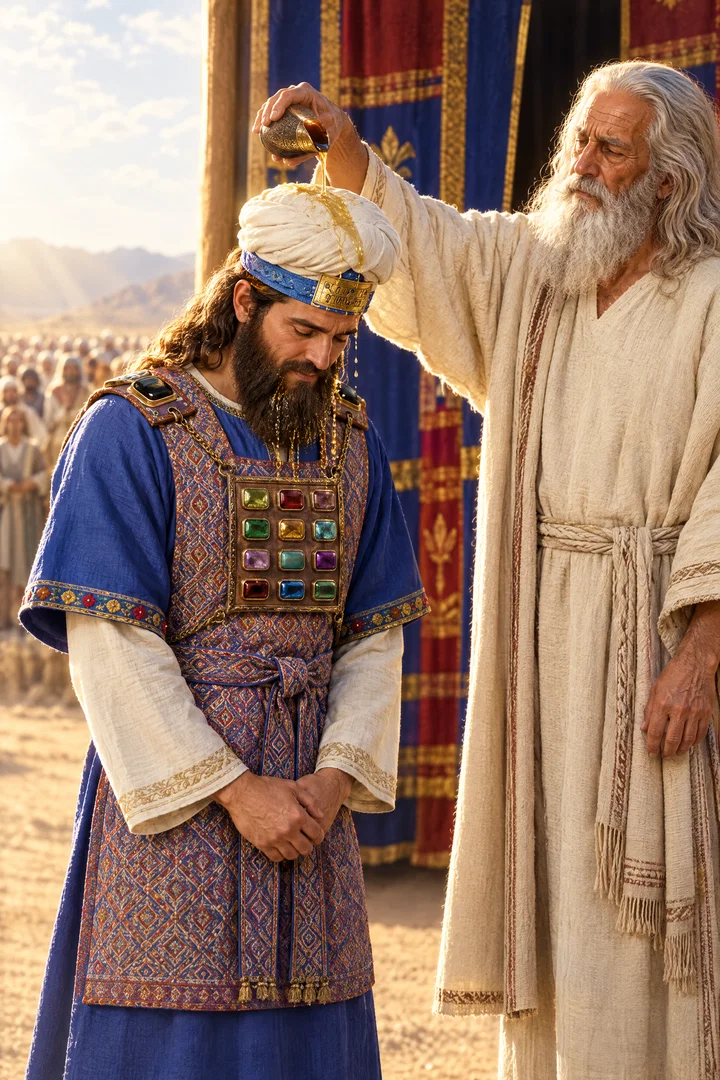
Moses washes Aaron and his sons during their consecration.
- Exodus 28:1
And take thou unto thee Aaron thy brother, and his sons with him, from among the children of Israel, that he may minister unto me in the priest’s office, even Aaron, Nadab and Abihu, Eleazar and Ithamar, Aaron’s sons.
Aaron and his sons are chosen for priestly service.
- Leviticus 9:1-6
And it came to pass on the eighth day, that Moses called Aaron and his sons, and the elders of Israel;
Aaron’s consecration is followed by his first priestly offering before the LORD.
- Exodus 30:19-20
For Aaron and his sons shall wash their hands and their feet thereat:
Both describe washing with water before entering to minister.
- Exodus 29:20
Then shalt thou kill the ram, and take of his blood, and put it upon the tip of the right ear of Aaron, and upon the tip of the right ear of his sons, and upon the thumb of their right hand, and upon the great toe of their right foot, and sprinkle the blood upon the altar round about.
both part of same consecration ceremony
- Exodus 28:41
And thou shalt put them upon Aaron thy brother, and his sons with him; and shalt anoint them, and consecrate them, and sanctify them, that they may minister unto me in the priest’s office.
Anointing and consecrating the priests.
- Numbers 3:1-13
These also are the generations of Aaron and Moses in the day that the LORD spake with Moses in mount Sinai.
The passage connects Aaron’s priestly role with the Levites’ service to God.
- Hebrews 9:10
Which stood only in meats and drinks, and divers washings, and carnal ordinances, imposed on them until the time of reformation.
Both describe ceremonial washings under the law.
- Exodus 28:2
And thou shalt make holy garments for Aaron thy brother for glory and for beauty.
Priestly garments are described alongside the consecration services.
- Isaiah 52:11
Depart ye, depart ye, go ye out from thence, touch no unclean thing; go ye out of the midst of her; be ye clean, that bear the vessels of the LORD.
Both require those serving with the Lord’s vessels to be clean.
- Titus 3:5
Not by works of righteousness which we have done, but according to his mercy he saved us, by the washing of regeneration, and renewing of the Holy Ghost;
Regeneration is described as a washing.
- Hebrews 8:1-5
Now of the things which we have spoken this is the sum: We have such an high priest, who is set on the right hand of the throne of the Majesty in the heavens;
Contrasts the earthly priestly ministry with Christ’s heavenly ministry.
- Hebrews 9:11
But Christ being come an high priest of good things to come, by a greater and more perfect tabernacle, not made with hands, that is to say, not of this building;
Connects the ancient sanctuary with Christ’s ministry in the greater sanctuary.
- Hebrews 9:14
How much more shall the blood of Christ, who through the eternal Spirit offered himself without spot to God, purge your conscience from dead works to serve the living God?
Christ’s offering cleanses the conscience.
- Ephesians 5:26
That he might sanctify and cleanse it with the washing of water by the word,
The Word cleanses and sanctifies Christ’s people.
- Hebrews 7:11
If therefore perfection were by the Levitical priesthood, ( for under it the people received the law,) what further need was there that another priest should rise after the order of Melchisedec, and not be called after the order of Aaron?
The verse contrasts the Levitical priesthood with another priestly order, while Exodus describes its sanctuary ministry.
Commentary
Each commentary is drawn from primary sources: the writings of Ellen G. White and Adventist pioneers and periodicals. Each commentary is separate. Its own words are not a quotation; follow the references to read the source passages.
Ellen G. White
1 source
Exodus 29:4 stands among the instructions that set forth God's covenant with those He seeks to save.Ms 92, 1899, par. 10–12 Those same instructions set forth the terms of salvation.Ms 92, 1899, par. 10–12 They also provide the education of greatest value.Ms 92, 1899, par. 10–12
Sources
Pioneers and periodicals
24 sources
The verse directs the first step in the seven-day consecration of Aaron and his sons for the priesthood, that they be brought to the entrance of the tabernacle and washed all over with water by Moses before being clothed and anointed.ST Jan 29, 1908RH Dec 16, 1862ST Nov 14, 1892 It belongs to the detailed instructions for the tabernacle and its service given to Moses during his forty days and nights on Sinai, to be carried out exactly so God might dwell among His people, and the door named is the entrance at the east end marked by five pillars of shittim wood overlaid with gold.ST Mar 25, 1889RH Feb 11, 1858ST Jun 26, 1907 That earthly sanctuary service set forth on earth God's plan for salvation from sin, with types and shadows whose substance is found in the new dispensation where Jesus now ministers in the heavenly temple.ST Jan 24, 1911 Its sacrifices and washings could not really take away sin but pointed to Christ the Lamb of God, and passed away when He died once for all to put away sin by His own sacrifice.ST Jan 24, 1911ST Jul 8, 1886 The required washing teaches the cleansing required of God's people before serving Him, that they present their bodies holy and acceptable to God, cleansed from sin by Christ in the washing of regeneration by the Word, and kept physically clean as a religious duty.RH Dec 16, 1862RH Dec 24, 1867RH Nov 3, 1868ST May 1, 1901
Setting and Consecration Rite
Exodus 29:4 falls within the detailed instructions concerning the tabernacle, its furnishings, and its sanctuary service given to Moses during his forty days and nights on the mountain on Sinai.ST Mar 25, 1889RH Dec 31, 1861 Those instructions are the explicit directions given in the mount in Exodus 25 to 31 for the wilderness sanctuary, extended in the description of the tabernacle in Exodus 25 to 40.ST Jun 26, 1907 They were given after Israel's covenant was ratified and concerned worship whose object was to bring people into harmony with God's holy law.ST Mar 25, 1889
Those directions for the sanctuary and its service were to be carried out explicitly and were followed exactly by the people in building a dwelling-place in the wilderness so that God might dwell among them.ST Feb 13, 1912ST Jun 26, 1907 They form the minute account of the tabernacle erected by Moses in Exodus 25-31.RH Feb 11, 1858 The sanctuary thus established was God's dwelling place among His people.ST Jun 4, 1885
The setting is after Israel's deliverance from Egyptian bondage with a mighty hand, when a people unfitted by hundreds of years of slavery to comprehend God's great salvation needed a great, multiple object-lesson by various forms and rites comprehending the great plan of salvation. The sanctuary was a portable structure built from the free-will offerings of the children of Israel that God might dwell among them, built by workmen specially endowed by God according to a divine pattern given to Moses in the mount. It was later built and inaugurated, with God's glory showing His acceptance of the people's repentance, and that portable tabernacle was later replaced by Solomon's temple.ST Jun 19, 1907ST Jan 31, 1911
The sanctuary generally means the building, the inner tabernacle, erected by Israel at the command of God in the wilderness, in which the worship of God upon the earth centered.ST Jun 19, 1907 All earthly worship and service revolved around the holy of holies where the law of God rested with the mercy-seat over it.ST Jun 19, 1907 The priesthood was ordained to minister in the sanctuary before the ark containing the law, and before the tables of the law in the Most Holy Place of the typical sanctuary.RH Dec 31, 1861RH Dec 12, 1854
The door of the tabernacle of the congregation where Aaron and his sons were to be brought was the entrance at the east end, marked by five pillars of shittim wood overlaid with gold.RH Feb 11, 1858 The verse directs that they be brought to that tabernacle entrance and washed all over with water by Moses as the first step in consecrating them as priests.ST Nov 14, 1892ST Jul 8, 1930RH Dec 24, 1867 That washing was part of the ceremony for the consecration of the priests and part of their seven-day consecration before serving as priests in the earthly sanctuary.ST Jan 29, 1908ST Jul 8, 1930RH Mar 8, 1870
The washing came before being clothed, including linen garments, and before the blood anointing, requiring physical cleanliness before beginning to minister unto God.RH Dec 16, 1862RH Dec 24, 1867 Consecration required putting away all defilement from those who would approach into the presence of God.ST Nov 12, 1894 The priests left their shoes in the court and entered the sanctuary barefoot, lest particles of dust desecrate the holy place, and washed their hands and their feet before ministering in the tabernacle or at the altar of burnt offering.ST Nov 12, 1894
The priestly service was committed to Aaron and his sons as part of the religious system and its appointed roles for Israel's worship, distinct from the laws governing civil affairs.ST Mar 3, 1914ST Sep 3, 1896 Priestly rites were not for others to perform unless the Lord especially directed them.ST Mar 3, 1914 That Levitical ministration Moses commenced, setting apart the Levitical order of priesthood to minister before the ark, carried forward through the entire Old Testament period.RH Dec 12, 1854
Type and Fulfillment in Christ
Exodus 29:4 belongs to the laws given through Moses after the people asked that Moses receive God's further words for them, set out in writing after the moral law in Exodus 19-30 and found in Exodus 25-30.ST Apr 15, 1886ST May 6, 1875ST Jul 8, 1886 Those Mosaic instructions include ceremonial laws and rules concerning offerings and sacrifices, ordinances having reference to flesh and animal offerings, with ceremonial requirements and washings imposed until the time of reformation.ST Apr 15, 1886ST Jul 8, 1886 They belong to the added instruction God gave through Moses after He Himself spoke the Ten Commandments to the people.ST Jul 8, 1886
Those laws reveal types and shadows whose substance is found in the new dispensation. God's instructions for preparing the sanctuary and its services, of which the washing of Aaron and his sons is one step in that preparation, set forth on earth His plan for salvation from sin. The description of the ancient tabernacle and its priests, whose service involved sacrifices and offerings, typified the heavenly temple where Jesus now ministers.ST Jan 24, 1911
Those animal offerings could not really take away sin, but pointed to Christ, the Lamb of God who takes away the sin of the world, who bore sins in His own body on the tree and appeared to put away sin by the sacrifice of Himself, whose flesh and blood must be partaken for eternal life.ST Jul 8, 1886 That sanctuary service with its sacrifices and offerings passed away when Christ died once for all.ST Jan 24, 1911 They found their fulfillment in the body of Christ and were abolished in His flesh, so they were not to be continued after Christ suffered.ST Jul 8, 1886
Cleansing Lesson for Believers
Aaron and his sons had to be brought to the entrance of the meeting tent and washed with water and clothed in linen garments, so that physical cleanliness came before beginning to minister to God.RH Dec 16, 1862RH Nov 3, 1868 That washing illustrates the cleansing required of God's people, as Israel received other cleansing instructions alongside this one.RH Nov 3, 1868 The lesson drawn is to present the body holy and acceptable to God and not conformed to the world, and to live by cleansing truths and not fall away from them.RH Dec 16, 1862RH Nov 3, 1868
The washing is also a lesson in personal cleanliness as a religious duty.RH Dec 24, 1867 Bathing removes perspiration from the skin and supports health.RH Dec 24, 1867 That bodily cleansing is joined to living by cleansing truths, including health reform, and not falling away from them.RH Nov 3, 1868
When chosen for the priesthood they were washed all over with water by Moses, and this washing symbolized cleansing through Christ.ST May 1, 1901 The new birth is a washing of regeneration, and God's people are cleansed from sin by the Word.ST May 1, 1901 The same consecration required of the high priest was also required of the leper being cleansed, showing that the humblest child of God is to be as devoted and consecrated as Christ.
Sources