Exodus 29:5
And thou shalt take the garments, and put upon Aaron the coat, and the robe of the ephod, and the ephod, and the breastplate, and gird him with the curious girdle of the ephod:
Translations
And you shall take the garments, and put on Aaron the coat, and the robe of the ephod, and the ephod, and the breastplate, and gird him with the curious girdle of the ephod:
King James Version, KJV Cambridge Paragraph Bible
And thou shalt take the garments, and put upon Aaron the coat, and the robe of the ephod, and the ephod, and the breastplate, and gird him with the curious girdle of the ephod:
And thou shalt take the garments, and put upon Aaron, the coat, and the robe of the ephod, and the ephod, and the breast-plate, and gird him with the curious girdle of the ephod:
And thou shalt take the garments, and put upon Aaron the coat, and the robe of the ephod, and the ephod, and the breastplate, and gird him with the cunningly woven band of the ephod:
And thou shalt take the garments, and put upon Aaron the coat, and the robe of the ephod, and the ephod, and the breastplate, and gird him with the skilfully woven band of the ephod;
and thou hast taken the garments, and hast clothed Aaron with the coat, and the upper robe of the ephod, and the ephod, and the breastplate, and hast girded him with the girdle of the ephod,
And thou shalt take the garments, and clothe Aaron with the vest, and the cloak of the ephod, and the ephod, and the breastplate, and shalt gird him with the girdle of the ephod.
And thou shalt take the garments and clothe Aaron—with the tunic, and with the robe of the ephod, and with the ephod, and with the breastpiece,—and shalt gird him with the curious band of the ephod;
Berean Standard Bible, Majority Standard Bible
Take the garments and clothe Aaron with the tunic, the robe of the ephod, the ephod itself, and the breastplate. Fasten the ephod on him with its woven waistband.
You shall take the garments, and put on Aaron the tunic, the robe of the ephod, the ephod, and the breastplate, and clothe him with the skillfully woven band of the ephod.
Take the robes, and put the coat and the dress and the ephod and the priest's bag on Aaron; put the band of needlework round him,
Also thou shalt take the garments, and put vpon Aaron the tunicle, and the robe of the Ephod, and the Ephod, and the brest plate, and shalt close them to him with the broidred garde of the Ephod.
Douay-Rheims (Challoner revision)
Thou shalt clothe Aaron with his vestments, that is, with the linen garment and the tunick, and the ephod and the rational, which thou shalt gird with the girdle.
Pictures
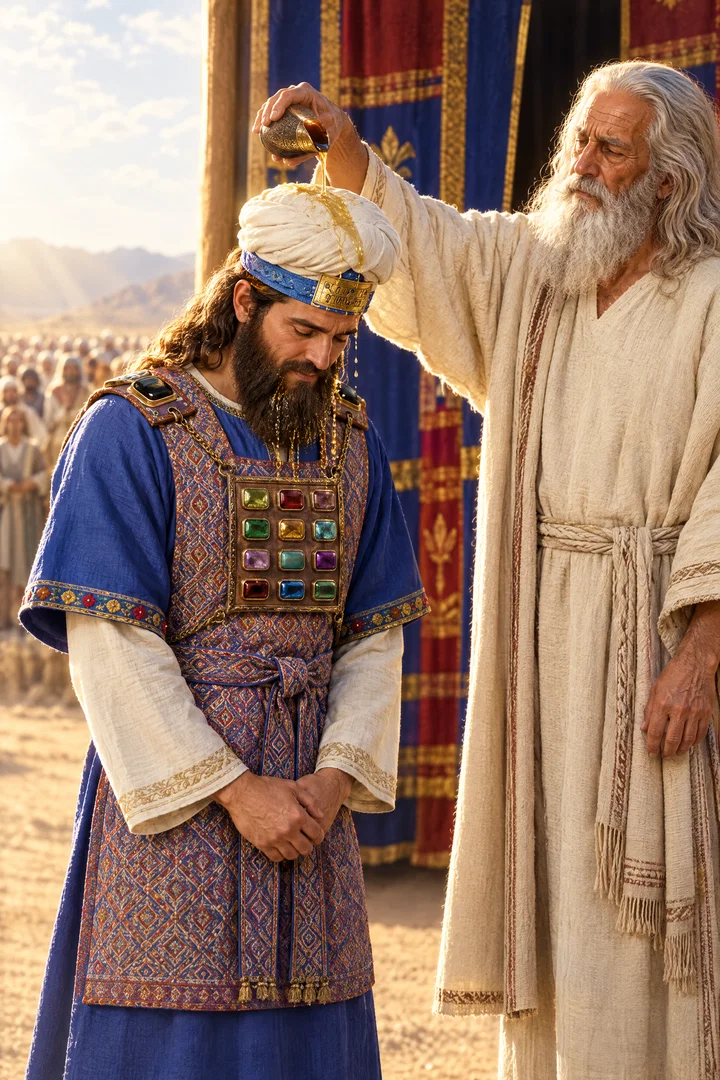
Cross-references
- Exodus 28:1
And take thou unto thee Aaron thy brother, and his sons with him, from among the children of Israel, that he may minister unto me in the priest’s office, even Aaron, Nadab and Abihu, Eleazar and Ithamar, Aaron’s sons.
Aaron and his sons were appointed to priestly service.
- Leviticus 8:7-9
And he put upon him the coat, and girded him with the girdle, and clothed him with the robe, and put the ephod upon him, and he girded him with the curious girdle of the ephod, and bound it unto him therewith.
Moses clothes Aaron in the priestly garments during his consecration.
- Hebrews 8:1-2
Now of the things which we have spoken this is the sum: We have such an high priest, who is set on the right hand of the throne of the Majesty in the heavens;
Christ ministers as High Priest in the true heavenly sanctuary, foreshadowed by the earthly one.
- Exodus 28:4
And these are the garments which they shall make; a breastplate, and an ephod, and a robe, and a broidered coat, a mitre, and a girdle: and they shall make holy garments for Aaron thy brother, and his sons, that he may minister unto me in the priest’s office.
Lists the sacred garments Aaron wears in his consecration.
- Leviticus 9
And it came to pass on the eighth day, that Moses called Aaron and his sons, and the elders of Israel;
Aaron and his sons begin priestly service at the sanctuary.
- Hebrews 8:5
Who serve unto the example and shadow of heavenly things, as Moses was admonished of God when he was about to make the tabernacle: for, See, saith he, that thou make all things according to the pattern shewed to thee in the mount.
Earthly priestly service follows the pattern shown to Moses on the mount.
- Exodus 25:8-9
And let them make me a sanctuary; that I may dwell among them.
The sanctuary and its furnishings are made according to God’s pattern for dwelling among Israel.
- Exodus 39:1-5
And of the blue, and purple, and scarlet, they made cloths of service, to do service in the holy place, and made the holy garments for Aaron; as the LORD commanded Moses.
Records the making of Aaron’s ephod and its girdle.
- Exodus 28:41
And thou shalt put them upon Aaron thy brother, and his sons with him; and shalt anoint them, and consecrate them, and sanctify them, that they may minister unto me in the priest’s office.
Commands their anointing and consecration.
- Exodus 40
And the LORD spake unto Moses, saying,
Recounts the tabernacle being set up and filled with God’s glory.
- Exodus 30:19-20
For Aaron and his sons shall wash their hands and their feet thereat:
Requires washing before ministering in the sanctuary.
- Exodus 35:19
The cloths of service, to do service in the holy place, the holy garments for Aaron the priest, and the garments of his sons, to minister in the priest’s office.
Lists the holy garments made for Aaron and his sons for priestly service.
- Leviticus 16
And the LORD spake unto Moses after the death of the two sons of Aaron, when they offered before the LORD, and died;
Describes the ceremonies for cleansing the sanctuary.
- Hebrews 7
For this Melchisedec, king of Salem, priest of the most high God, who met Abraham returning from the slaughter of the kings, and blessed him;
Summarizes the priestly order associated with the sanctuary ministry.
Commentary
Each commentary is drawn from primary sources: the writings of Ellen G. White and Adventist pioneers and periodicals. Each commentary is separate. Its own words are not a quotation; follow the references to read the source passages.
Pioneers and periodicals
26 sources
The verse directs Moses to clothe Aaron in the coat, the robe of the ephod, the ephod, and the breastplate in that order, and to fasten him with the skillfully woven band of the ephod.ST Jun 10, 1908ST Feb 17, 1890ST Nov 12, 1894 It belongs to the seven-day rite by which Aaron and his sons were washed, clothed, anointed, and offered for to set them apart to serve as priests by the Lord's command.ST Jan 29, 1908ST Mar 3, 1914ST Jul 8, 1930 It is a ceremonial regulation given through Moses and written in the law of ordinances, not part of what God spoke from heaven and wrote on the two tables of stone to which He added no more.ST May 6, 1875ST Apr 15, 1886 Those garments and that earthly order were an object lesson of God's plan for dealing with sin, serving unto the shadow of heavenly things and pointing to the true tabernacle where Jesus now ministers.ST Jan 24, 1911ST Jun 26, 1907 The Levitical service so appointed could only exhibit guilt and death and its sacrifices could take away no sin, while Christ as great High Priest died once for all and now ministers before God to offer pardon and save to the uttermost all who come to God through Him.RH Mar 8, 1870ST Mar 10, 1898RH Dec 12, 1854
Wording and Setting
The verse commands taking the garments and putting upon Aaron the coat, and the robe of the ephod, and the ephod, and the breastplate, and girding him with the curious girdle of the ephod, in that prescribed set order.ST Jun 10, 1908ST Feb 17, 1890ST Nov 12, 1894ST Mar 11, 1886RH Dec 31, 1861 It gives part of the precise instructions for dressing Aaron as priest and high priest for service in the sanctuary before the ark, belonging to the ministry of the Levitical priesthood performed in the earthly sanctuary.ST Feb 17, 1890ST Nov 12, 1894ST Mar 11, 1886RH Dec 31, 1861RH Mar 8, 1870 It belongs to the ceremony of consecration and ordination by which Aaron and his sons were set apart to serve as priests, when the garments described in Exodus 28 were put upon Aaron.ST Jan 29, 1908ST Nov 12, 1894ST Mar 3, 1914 That consecration was a seven-day rite establishing their priesthood with sacrifices and anointing by the Lord's command, and its rites of priestly service were not for anyone else to perform unless the Lord especially directed it.ST Mar 3, 1914ST Jul 8, 1930ST Sep 30, 1889
These instructions were given to Moses on the mount during his forty days there in thick darkness.RH Dec 31, 1861ST Apr 15, 1886 They were given after Israel's covenant was ratified and after the people stood afar off asking Moses to hear God for them, and before the sanctuary was built and set up.ST Mar 25, 1889ST Apr 15, 1886ST Dec 10, 1896 They belong to the forty-day revelation in Exodus 24:9 to 31:18, within the chiefly legislative division of Exodus in chapters 19-40 where the ransomed people were bound to Jehovah by solemn covenant and given legal ordinances and a system of legal ordinances for their guidance.
The verse is part of the minute, detailed description of the tabernacle in Exodus 25-31 and Exodus 25-40, the portable inner tabernacle erected in the wilderness at God's command that God might dwell among his people.RH Feb 11, 1858ST Jun 19, 1907ST Jun 26, 1907ST Jun 4, 1885 After God brought Israel from Egyptian bondage across the Red Sea to Sinai, the people wrought exactly according to the divine pattern shown in the mount, with free-will offerings of the children of Israel and specially endowed workmen.ST Jun 26, 1907 This was because hundreds of years of long slavery had unfitted them to comprehend God's great salvation and the character He required. That portable sanctuary, generally meant by the word sanctuary, was later replaced when Solomon built the temple, and in both buildings earthly worship centered on the holy of holies where the law of God rested with the mercy-seat over it.ST Jun 19, 1907
The precise, costly, and beautiful workmanship of the high priest's special dress, befitting his exalted station and appointed in accordance with his office, shows God's care for the details of worship and that the sanctuary and its priesthood and priestly service were arranged by God's instruction, not human choice.ST Mar 25, 1889ST Feb 17, 1890ST Nov 12, 1894 Studying these carefully detailed plans and services gives instruction, though the full reasons for the exactness and costly materials may not be understood.ST Jun 10, 1908ST Nov 12, 1894 The priests were first cleansed with water and then clothed in specially prepared garments.RH Dec 8, 1910 Aaron's high-priestly clothing was distinguished from the other priests by the breastplate, which held the Urim and Thummim, and the priests' garments of pure white linen signified the purity of their character and work.RH Dec 8, 1910
Typology and Teaching
The clothing of Aaron in its prescribed order belongs to the detailed instructions for preparing the sanctuary service, forming part of the earthly object lesson through which God revealed his plan for dealing with sin and bringing salvation, a service joining divine work with the cooperation of the people.ST Jun 26, 1907 Those explicit directions for the sanctuary and its priesthood were given to Moses in the mount, and after God brought Israel out of Egypt across the Red Sea to Sinai the people in the wilderness wrought exactly according to Exodus 25 to 31 to fashion a dwelling-place that God might dwell among them.ST Jun 26, 1907 That marvelously beautiful structure described in Exodus 25-40 was given after deliverance from Egyptian bondage because hundreds of years of slavery had unfitted Israel to comprehend God's great salvation and the character He required, and it was built from free-will offerings with a divine pattern and specially endowed workmen as a great multiple object-lesson by various forms and rites comprehending the plan of salvation.ST Jun 26, 1907 So appointed, the earthly sanctuary and its priests served unto the shadow of heavenly things, as object lessons pointing to the Lamb of God and His power to forgive sin, transform character, and deliver from burden.ST Jun 26, 1907
The sanctuary thus built for ministry involving sacrifices and offerings typified the heavenly temple where Jesus now ministers, and its service ended when Christ died once for all.ST Jan 24, 1911 It foreshadowed the true tabernacle which the Lord pitched and not man.ST Jan 24, 1911ST Jun 26, 1907 The dressing of Aaron belongs to the ministry of the Levitical priesthood performed in that earthly sanctuary, whose full description from Exodus 25 to the end of the book gives the exact form of the two kinds of atoning service performed for the errors of the people.RH Mar 8, 1870ST Mar 10, 1898 That order was set apart to minister before the ark containing the law in the most holy place of the typical sanctuary while it should continue.RH Dec 12, 1854
That ministration could only exhibit the guilt, condemnation, and death of sinful Israel under the holy law, with no promise of pardon in itself.RH Dec 12, 1854 Its sacrifices could take away no sin but could only point penitent sinners forward to the great Sacrifice to be offered for the sins of men.RH Dec 12, 1854 In contrast, Christ the life-giving Spirit and great High Priest died for the human family and now ministers in the heavenly sanctuary before the ark of God's testament to offer pardon, hope, and salvation and to save to the uttermost all who come to God through Him.RH Dec 12, 1854 The clothing and consecration of Aaron for priestly service included sacrifices in which consecration blood touched the right ears, right thumbs, and right great toes of Aaron and his sons, marking ears, hands, and feet as devoted to God's service.ST Dec 10, 1912 Unleavened bread in that ceremony represented sincerity and truth, the priests' bearing of the sacrifice's right shoulder pictured their duty to bear the people's burdens, and anointing oil and blood represented the Holy Spirit and Christ's blood, which qualify God's servants for holy work.ST Dec 10, 1912
Law and Application
Exodus 29:5 gives a ceremonial instruction in the law given through Moses, directing that Aaron be dressed in the garments of the priesthood, and it shows that the law of Moses included ceremonial regulations as well as moral commandments. It belongs to the law of ordinances, which was written out after the moral law when the record reached the time of Moses.ST May 6, 1875 It was not part of what God spoke directly from heaven to the assembly and wrote on the two tables of stone, to which He added no more, but part of the precepts, statutes, and laws commanded by the hand of Moses and recorded chiefly in Exodus 25-30 and Leviticus.ST Apr 15, 1886ST Jul 8, 1886 That instruction was given through Moses during the forty days in the mount in thick darkness, after the people stood afar off and asked Moses to hear God for them.ST Apr 15, 1886 It stands among the many burdensome ceremonies and carnal ordinances imposed until the time of reformation, a yoke which neither the fathers nor their children were able to bear, distinct from the ten commandments.ST Apr 15, 1886
It belongs to a separate set of laws God gave to regulate the worship of Israel, distinct from the set He gave in Exodus 21 to 23 for civil government.ST Sep 3, 1896 It shows that religion and civil government have essentially different purposes and must operate on entirely separate lines, with any commingling producing discord detrimental to both.ST Sep 3, 1896 Civil government is a temporary arrangement of force made necessary by sin to control men and regulate their relations toward each other in this life only, while true Gospel religion is designed to persuade men to be reconciled to God and bring them back to Him.ST Sep 3, 1896 In directing the dressing of Aaron in priestly garments as he was set apart for sacred service, the verse illustrates sanctification as setting a person apart for a holy or religious use.RH Jul 26, 1864
Its directions establishing Aaron and his sons as priests and prescribing the rites of priestly service show that these rites were not for anyone else to perform unless the Lord especially directed it.ST Mar 3, 1914 The order for putting the priestly garments on Aaron was the coat, the ephod robe, the ephod, and the breastplate, followed by fastening the ephod's skillfully woven sash. These same offerings and consecration were required for the cleansed leper, showing that even the humblest child of God must be as devoted and consecrated as Christ.
Sources