Exodus 3:13
And Moses said unto God, Behold, when I come unto the children of Israel, and shall say unto them, The God of your fathers hath sent me unto you; and they shall say to me, What is his name? what shall I say unto them?
Translations
And Moses said to God, Behold, when I come to the children of Israel, and shall say to them, The God of your fathers has sent me to you; and they shall say to me, What is his name? what shall I say to them?
King James Version, KJV Cambridge Paragraph Bible, Revised Version
And Moses said unto God, Behold, when I come unto the children of Israel, and shall say unto them, The God of your fathers hath sent me unto you; and they shall say to me, What is his name? what shall I say unto them?
And Moses said to God, Behold, when I come to the children of Israel, and shall say to them, The God of your fathers hath sent me to you; and they shall say to me, What is his name? What shall I say to them?
And Moses said unto God, Behold, when I come unto the children of Israel, and shall say unto them, The God of your fathers hath sent me unto you; and they shall say to me, What is his name? What shall I say unto them?
And Moses saith unto God, 'Lo, I am coming unto the sons of Israel, and have said to them, The God of your fathers hath sent me unto you, and they have said to me, What [is] His name? what do I say unto them?'
And Moses said to God, Behold, [ when] I come unto the children of Israel, and shall say unto them, The God of your fathers hath sent me unto you; and they shall say, What is his name? what shall I say unto them?
And Moses said unto God—Lo! as surely as, I, go in unto the sons of Israel, and say unto them, The God of your fathers, hath sent me unto you, So surely will they say unto me—What is his name? What shall I say unto them?
Berean Standard Bible, Majority Standard Bible
Then Moses asked God, “Suppose I go to the Israelites and say to them, ‘ The God of your fathers has sent me to you,’ and they ask me, ‘ What is His name?’ What should I tell them?”
Moses said to God, “ Behold, when I come to the children of Israel, and tell them, ‘ The God of your fathers has sent me to you,’ and they ask me, ‘ What is his name?’ what should I tell them?”
And Moses said to God, When I come to the children of Israel and say to them, The God of your fathers has sent me to you: and they say to me, What is his name? what am I to say to them?
Then Moses said vnto God, Behold, when I shall come vnto the children of Israel, and shall say vnto them, The God of your fathers hath sent me vnto you: if they say vnto me, What is his Name? what shall I say vnto them?
Douay-Rheims (Challoner revision)
Moses said to God: Lo, I shall go to the children of Israel, and say to them: The God of your fathers hath sent me to you. If they should say to me: What is his name? what shall I say to them?
Pictures
Cross-references
- John 8:58
Jesus said unto them, Verily, verily, I say unto you, Before Abraham was, I am.
Christ declares himself the I Am, identifying himself with the God who sent Moses.
- Genesis 28:13
And, behold, the LORD stood above it, and said, I am the LORD God of Abraham thy father, and the God of Isaac: the land whereon thou liest, to thee will I give it, and to thy seed;
God identifies himself as the God of Abraham and Isaac.
- Exodus 6:3
And I appeared unto Abraham, unto Isaac, and unto Jacob, by the name of God Almighty, but by my name JEHOVAH was I not known to them.
Identifies the name by which God appeared to the patriarchs.
- Acts 7:30-34
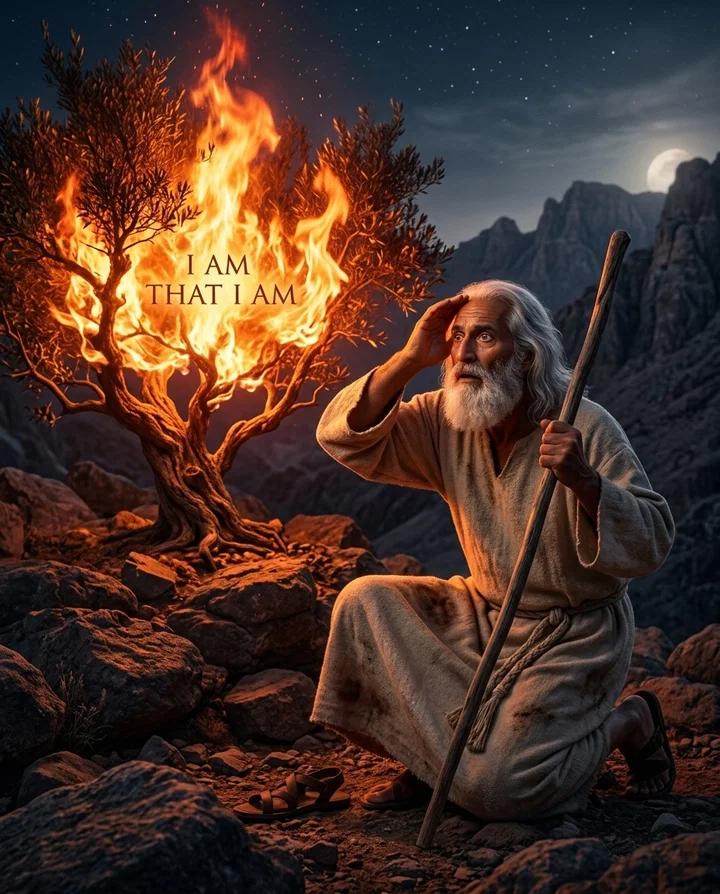
And when forty years were expired, there appeared to him in the wilderness of mount Sina an angel of the Lord in a flame of fire in a bush.
Recounts Moses’ call at the burning bush.
- Exodus 3:3-4
And Moses said, I will now turn aside, and see this great sight, why the bush is not burnt.
Moses turns aside to see the burning bush, and God responds.
- Exodus 3:6
Moreover he said, I am the God of thy father, the God of Abraham, the God of Isaac, and the God of Jacob. And Moses hid his face; for he was afraid to look upon God.
Both identify God by the patriarchs’ names and titles.
- John 13:19
Now I tell you before it come, that, when it is come to pass, ye may believe that I am he.
identifies I Am with Jesus
- Revelation 1:4
John to the seven churches which are in Asia: Grace be unto you, and peace, from him which is, and which was, and which is to come; and from the seven Spirits which are before his throne;
Both describe God as the eternal One.
- John 6:35
And Jesus said unto them, I am the bread of life: he that cometh to me shall never hunger; and he that believeth on me shall never thirst.
Jesus unfolds I AM as the Bread of Life.
- John 14:6
Jesus saith unto him, I am the way, the truth, and the life: no man cometh unto the Father, but by me.
Jesus unfolds I AM as the way, the truth, and the life.
- Exodus 6:6
Wherefore say unto the children of Israel, I am the LORD, and I will bring you out from under the burdens of the Egyptians, and I will rid you out of their bondage, and I will redeem you with a stretched out arm, and with great judgments:
God’s identity is made known through deliverance from Egypt.
- John 8:12
Then spake Jesus again unto them, saying, I am the light of the world: he that followeth me shall not walk in darkness, but shall have the light of life.
Jesus unfolds “I AM” as the light of the world.
- Isaiah 45:3
And I will give thee the treasures of darkness, and hidden riches of secret places, that thou mayest know that I, the LORD, which call thee by thy name, am the God of Israel.
Both identify the LORD as Israel’s God by name.
- John 11:25
Jesus said unto her, I am the resurrection, and the life: he that believeth in me, though he were dead, yet shall he live:
Jesus unfolds “I AM” as the Resurrection and the Life.
- Exodus 5:2
And Pharaoh said, Who is the LORD, that I should obey his voice to let Israel go? I know not the LORD, neither will I let Israel go.
Pharaoh asks who the Lord is and refuses to obey Him.
Commentary
Each commentary is drawn from primary sources: the writings of Ellen G. White and Adventist pioneers and periodicals. Each commentary is separate. Its own words are not a quotation; follow the references to read the source passages.
Ellen G. White
5 sources
Moses asks this question at Horeb, the mountain of God, while keeping the flocks of Jethro in retirement where God was training him as a spiritual shepherd of Israel.1SP 168.2–169.1 He asks after God appears in the burning bush and commissions him to go to Pharaoh to bring Israel out of Egypt to a good land flowing with milk and honey.1SP 168.2–169.1 He asks after God promises to be with him, with the token that Israel shall serve God upon that mountain.1SP 168.2–169.1SG3 188.1–190.1
The question comes when the time has fully come for Moses to exchange the shepherd's staff for the rod of God to be made powerful in signs and wonders for delivering Israel from oppression and preserving them when pursued by enemies.1SP 168.2–169.1SG3 188.1–190.1 Before this, Moses had tried to do the work by force and might, killing an Egyptian who was fighting with an Israelite and hiding him in the sand and expecting Israel to recognize him as their deliverer, but he was not ready.Ms 8a, 1891, par. 25–27 God then sent him away for forty years to act as a keeper of sheep in the rocks and mountains and desert, hunting with patience for stray sheep, until he learned to be a tender, patient, loving, faithful shepherd.Ms 8a, 1891, par. 25–27
Moses shrank from standing before Pharaoh in God's name to demand Israel's release because he expected deliverance by warfare with himself as general at the head of Israel, not by God's own mighty power magnified before Israel and the Egyptians to teach that there is a living God with power to save and to destroy.SG3 188.1–190.1 The Pharaoh he must face is not the one who decreed his death, for that king is dead and another reigns.SG3 188.1–190.1 In asking what to say when the children of Israel ask for his name, Moses anticipates that the Israelites, many of whom knew little of God, will ask which God sent him because they are marked by blindness and unbelief.PP 252.4–253.1Ms 45, 1890, par. 11–13
God answers by revealing himself to Moses as Jehovah, as I AM THAT I AM, telling him to say that I AM sent him, and then commands him to go and deliver the children of Israel because now, being prepared to lead Israel, he has the education needed for the special work.PP 252.4–253.1Ms 8a, 1891, par. 25–27Ms 45, 1890, par. 11–13
Sources
Pioneers and periodicals
22 sources
At Horeb God commissioned Moses to deliver Israel from Egypt, and Moses anticipated that Israel would ask the name of the God of their fathers who sent him because after long slavery among Egypt's many deities they needed to know who He was.RH May 11, 1869ST May 14, 1894ST Dec 19, 1916ST Dec 21, 1888 God answered that I AM sent him, the Lord the God of Abraham, Isaac, and Jacob, which is His name forever and His memorial to all generations.ST May 14, 1894RH May 1, 1855ST Dec 21, 1888 I AM THAT I AM denotes self-existence, independence, and eternal ever-living being, the source of all light, power, and blessing.ST Dec 19, 1916RH May 1, 1855ST Feb 13, 1893 In the Bible sense a name expresses the leading characteristics of the one it identifies, and this name is God's pledge of every good thing, filled out by the promises to mean light, wisdom, sanctification, redemption, life, and love.ST Jul 12, 1910ST Nov 27, 1901ST Feb 13, 1893RH Dec 2, 1915 The speaker at the bush was Christ, the divine Son who existed before Abraham, led Israel out, and unfolds the same I AM as the Way, the Truth, the Life, the Light of the world, the Good Shepherd, and the Bread of Life.RH Aug 10, 1905ST Mar 30, 1915
Setting and Question
Exodus 3:13 belongs to God's commission of Moses at Horeb to deliver Israel, where He manifested His presence in the burning bush that burned without being consumed and warned Moses to approach reverently because the ground was holy.RH May 11, 1869ST Oct 21, 1930ST Apr 13, 1904 The account is a real event, the same call to deliver Israel later rehearsed by Stephen.ST Apr 13, 1904 When the Lord saw that Moses turned aside to see why the bush was not burnt, He revealed Himself to Moses there.ST Oct 21, 1930
The call came at the end of forty years of schooling in the wilderness tending sheep in Midian after his flight from Egypt.ST Jan 24, 1911ST Jan 28, 1913 Moses had understood himself to be the deliverer and had attempted a self-sent mission in his own sufficiency, relying on his education in all the learning of the Egyptians and his knowledge of warfare, and had met utter failure.ST Jan 24, 1911 After that failed human plan for delivering Israel by his own strength and ability, God trained him by keeping sheep in Midian to fit him to lead God's flock toward Canaan, so that when God called him he no longer felt self-sufficient but felt utterly insufficient.ST Jan 24, 1911ST Jan 28, 1913
Its wider setting three and one-half millenniums ago was Egypt ruling the world as the greatest of kingdoms, acknowledged for might and power and skill and wisdom in statecraft.ST Nov 14, 1906 Egypt deified its annually overflowing and fertilizing river as a god and worshiped the sun that joined with the river in producing food, with its kings receiving their title as representatives of the sun-god upon the throne of men.ST Nov 14, 1906 At that time the few descendants of the nomadic patriarch Abraham sought supplies from her granaries, and Joseph, a captive slave of the same people, had taught Pharaoh to store grain in plenteous years to become rich in famine, had instituted a just land-law with easy rental and taxes, and as prime minister had brought prosperity and freedom from oppression as long as his memory was honored and his laws governed.ST Nov 14, 1906
Moses anticipates telling the children of Israel that the God of their fathers has sent him and their asking what His name is, asking what name he should give to identify the sender.ST Feb 26, 1880ST May 14, 1894ST Dec 21, 1888ST Mar 30, 1915 The question matters because they had grown up among Egypt's many deities, so Moses needed to identify which God had commissioned him as the God of Abraham, Isaac, and Jacob.ST Feb 26, 1880ST Dec 19, 1916ST Dec 21, 1888 After hundreds of years of slavery they had been unfitted to comprehend God's great salvation and the character He required.
Their asking for the name was an honest inquiry into God's identity, like Pharaoh's question Who is the Lord.RH Feb 12, 1901 The difference was that Pharaoh used his ignorance to exalt himself and refuse the knowledge of God.RH Feb 12, 1901 God provided the answer I AM THAT I AM and sent it into Egypt so that people there could know Him.RH Feb 12, 1901
Meaning of God's Name
When Moses asked what name to give Israel for the One who sent him, God told him to say that I AM had sent him, identifying Himself as the Lord, the God of Abraham, Isaac, and Jacob.ST Feb 26, 1880ST May 14, 1894ST Dec 21, 1888 The answer I AM THAT I AM, meaning I am that which I am, was declared to be His name forever and His memorial to all generations.RH May 1, 1855ST Dec 21, 1888ST Jul 12, 1910 That phrase alone was not the full name, but joined with the God of Abraham, Isaac, and Jacob it forms the combined revelation declared to be His name forever and His memorial to all generations.RH May 1, 1855
I AM THAT I AM denotes self-existence and independence, eternal, ever-living being.ST Dec 19, 1916RH May 1, 1855RH Dec 2, 1915 He is the self-existent I Am, the living God who would fulfill the promise made to Abraham and his descendants.ST Dec 19, 1916 He is the source of all light, power, and blessing.RH Dec 2, 1915
In the Bible sense a name is a word or series of words that definitely and exactly expresses the leading characteristics of the one identified.ST Jul 12, 1910 That principle was so instilled into the ancients that children's names were meant to express character as nearly as possible, and when character changed the name was also changed, as Jacob became Israel and Abram became Abraham.ST Jul 12, 1910 Apart from identifying Him as the God of their fathers, Moses could describe Him no further at that point.ST Nov 27, 1901
From Abraham forward until the end of His covenant relation with the Hebrews, God took to Himself local, national, and family names.RH Dec 31, 1861 Before choosing Abraham He bore no such name, but from that time He called Himself the God of Abraham, of Isaac, and of Jacob, the God of the Hebrews, and the God of Israel.RH Dec 31, 1861 This belonged to His setting apart or sanctifying of the Hebrews unto Himself when all other nations had given themselves to idolatry, bringing Israel out of Egypt to be their God and joining Himself to them at Sinai in solemn espousal.RH Dec 31, 1861
The name by which He was known to Abraham, Isaac, and Jacob was God Almighty, meaning omnipotence or ability to do all things.RH May 1, 1855 That points to the work of creating heaven and earth and all things in them.RH May 1, 1855 So the work of creation is contained both in the seal of God's law and in the name of God, and the seal of the living God is the Father's name.RH May 1, 1855
The speaker at the bush is Christ, the divine Son existing before Abraham's day, who met Moses at the burning bush and led Israel out of Egypt.RH Aug 10, 1905ST Mar 30, 1915 His name is I AM, the same divine name Jesus claims for Himself.RH Aug 10, 1905ST Mar 30, 1915 Jesus unfolds it in His sayings as the Way, the Truth, the Life, the Light of the world, the Resurrection, the Door, the Good Shepherd, the True Vine, the Bread of Life, the Water of Life, and the Bright and Morning Star.RH Aug 10, 1905
The wondrous name I AM denotes eternal being and is God's pledge of every good thing, with all fullness found in it.ST Feb 13, 1893 Filled out with the promises of God's word it means light and knowledge and wisdom and sanctification and redemption and life and love.ST Feb 13, 1893 Jesus lived and died and lived again so that all these things might be possible, giving free access to the riches of grace given in the Name.ST Feb 13, 1893 To those who receive and believe in Him He will be a God of power, love, and compassion, a Friend, Saviour, and mighty, wonder-working God.RH Dec 2, 1915
The name was later made known through Israel's experience of God's mighty deliverance from Egypt and His provision in the wilderness, giving the people personal knowledge of Him.ST Nov 27, 1901 The exchange means Christ's presence with His people is continuous, always I am with you.ST May 8, 1901 He is as verily present by His Spirit today with those who do His will as He was with the children of Israel in the wilderness in the pillar of cloud.ST May 8, 1901
Call and Present Application
Moses' call was direct and impressive, coming from the voice of God speaking to him at the burning bush. It did not come from the counsel of Jethro nor from the suffering condition of Israel in Egypt. That voice laid hold of his conscience with an unyielding grip until he surrendered to obey the heavenly calling. Unmistakable evidence was given on the spot that the call was from God and that he was not being misled. Though he was slow to accept God's word without a test, God willingly placed Himself under test by visible signs to prove His word and to satisfy His servant.ST May 1, 1901
His question about what to say shows sincere humility and a felt insufficiency for the duty laid upon him.ST Jan 24, 1911RH Mar 9, 1916 That humility does not excuse him from carrying the duty out.RH Mar 9, 1916 The call came at the end of forty years of schooling in the wilderness tending sheep after his flight to Midian.ST Jan 24, 1911 He had understood that he was to be the deliverer of God's people and had attempted a self-sent mission in his own sufficiency, with Egyptian education and knowledge of warfare, and had met utter failure.ST Jan 24, 1911 When God called him he no longer felt self-sufficient but felt utterly insufficient, and God fitted him by training in keeping sheep to lead God's flock out toward Canaan.ST Jan 24, 1911 Yet his God-given mission was successful where the self-sent mission had failed.ST Jan 24, 1911
When Moses turned aside in the desert to see why the bush was not burnt, the Lord saw that he turned aside and revealed Himself with a definite program for that hour for the relief of His oppressed nation.ST Oct 21, 1930 This shows that God does not leave His children to grope in darkness without knowledge of what is to come.ST Oct 21, 1930 He informs them through the prophetic word of coming developments and the outcome of the present situation.ST Oct 21, 1930 So turning aside today to note what His word says gives God's program for this time.ST Oct 21, 1930
At the deliverance God redeemed Israel with a mighty hand after hundreds of years of slavery had unfitted them to comprehend His great salvation and the character He required. He then gave them the sanctuary as a great multiple object-lesson which by various forms and rites would teach the great plan of salvation. From Abraham forward until the end of His covenant relation with the Hebrew race He had taken to Himself local, national, and family names, calling Himself the God of Abraham, of Isaac, and of Jacob, the God of the Hebrews, and the God of Israel, whereas before choosing Abraham He bore no such name.RH Dec 31, 1861 This naming belongs to His setting apart or sanctifying of the Hebrews unto Himself because all other nations had given themselves to idolatry, bringing Israel out of Egypt to be their God and joining Himself to them at Sinai in solemn espousal.RH Dec 31, 1861 The Sabbath hallowed for mankind at creation was then given to Israel as the most expressive sign that He who thus sanctified them was indeed the living God.RH Dec 31, 1861
Sources