Exodus 5:2
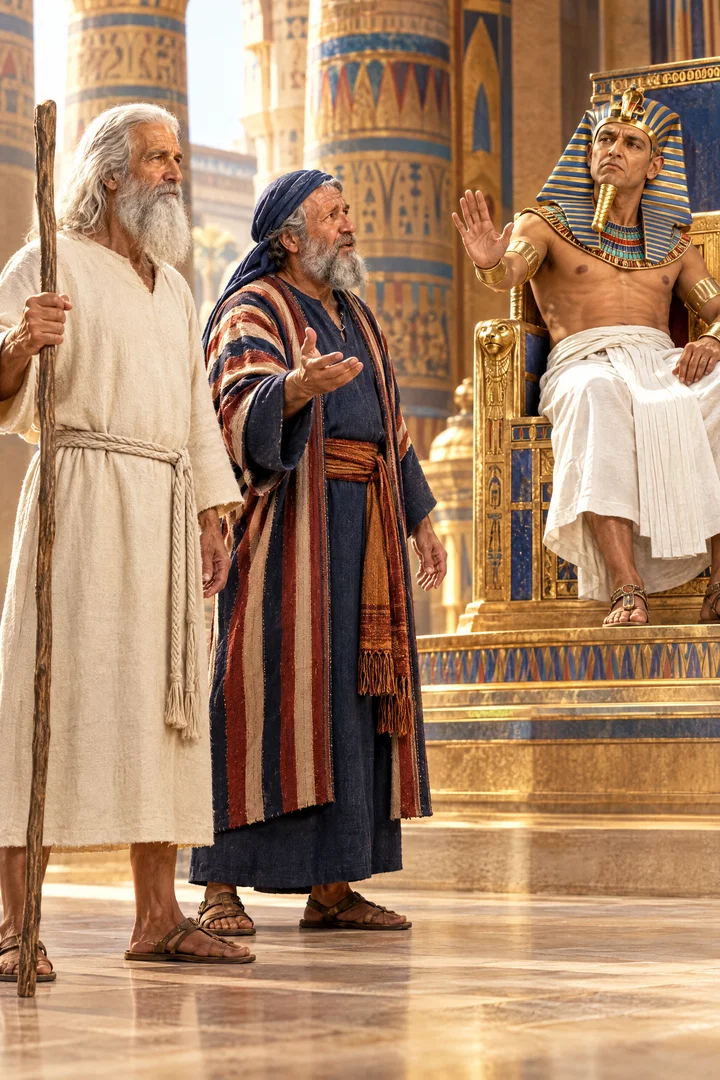
And Pharaoh said, Who is the LORD, that I should obey his voice to let Israel go? I know not the LORD, neither will I let Israel go.
Translations
American King James Version, King James Version, Webster Bible
And Pharaoh said, Who is the LORD, that I should obey his voice to let Israel go? I know not the LORD, neither will I let Israel go.
And Pharaoh said, Who is the Lord, that I should obey his voice to let Israel go? I know not the Lord, neither will I let Israel go.
And Pharaoh said, Who is the LORD, that I should hearken unto his voice to let Israel go? I know not the LORD, and moreover I will not let Israel go.
And Pharaoh said, Who is Jehovah, that I should hearken unto his voice to let Israel go? I know not Jehovah, and moreover I will not let Israel go.
and Pharaoh saith, 'Who [is] Jehovah, that I hearken to His voice, to send Israel away? I have not known Jehovah, and Israel also I do not send away.'
And Pharaoh said, Who is Jehovah, to whose voice I am to hearken to let Israel go? I do not know Jehovah, neither will I let Israel go.
Then said Pharaoh, Who is Yahweh that I should hearken to his voice, to let Israel go? I know not Yahweh, and certainly. Israel, will I not let go!
Berean Standard Bible, Majority Standard Bible
But Pharaoh replied, “ Who is the LORD that I should obey His voice and let Israel go? I do not know the LORD, and I will not let Israel go.”
Pharaoh said, “ Who is the LORD, that I should listen to his voice to let Israel go? I don’t know the LORD, and moreover I will not let Israel go.”
And Pharaoh said, Who is the Lord, to whose voice I am to give ear and let Israel go? I have no knowledge of the Lord and I will not let Israel go.
And Pharaoh saide, Who is the Lord, that I should heare his voyce, and let Israel go? I knowe not the Lord, neither will I let Israel goe.
Douay-Rheims (Challoner revision)
But he answered: Who is the Lord, that I should hear his voice, and let Israel go? I know not the Lord, neither will I let Israel go.
Pictures
Cross-references 20 of 41
- Exodus 7:10-13
And Moses and Aaron went in unto Pharaoh, and they did so as the LORD had commanded: and Aaron cast down his rod before Pharaoh, and before his servants, and it became a serpent.
Aaron’s rod swallows the magicians’ rods, yet Pharaoh remains defiant.
- Exodus 12:29-31
And it came to pass, that at midnight the LORD smote all the firstborn in the land of Egypt, from the firstborn of Pharaoh that sat on his throne unto the firstborn of the captive that was in the dungeon; and all the firstborn of cattle.
The death of the firstborn humbled Pharaoh and led him to release Israel.
- Exodus 4:22-23
And thou shalt say unto Pharaoh, Thus saith the LORD, Israel is my son, even my firstborn:
God calls Israel his firstborn son and commands Pharaoh to let them go.
- Exodus 7:3-5
And I will harden Pharaoh’s heart, and multiply my signs and my wonders in the land of Egypt.
God answers Pharaoh’s refusal with signs and judgments that reveal his power.
- Exodus 9:27-28
And Pharaoh sent, and called for Moses and Aaron, and said unto them, I have sinned this time: the LORD is righteous, and I and my people are wicked.
Pharaoh confesses and pleads for relief, but his humility proves temporary.
- Exodus 9:16
And in very deed for this cause have I raised thee up, for to shew in thee my power; and that my name may be declared throughout all the earth.
God displays his power in Pharaoh so his name will be known throughout the earth.
- Exodus 8:1
And the LORD spake unto Moses, Go unto Pharaoh, and say unto him, Thus saith the LORD, Let my people go, that they may serve me.
The Lord repeats the demand to let Israel go and serve him.
- Exodus 14:27-28
And Moses stretched forth his hand over the sea, and the sea returned to his strength when the morning appeared; and the Egyptians fled against it; and the LORD overthrew the Egyptians in the midst of the sea.
The LORD destroys Pharaoh’s army in the sea after Pharaoh refused to let Israel go.
- Romans 9:17-18
For the scripture saith unto Pharaoh, Even for this same purpose have I raised thee up, that I might shew my power in thee, and that my name might be declared throughout all the earth.
Pharaoh defied God, and God hardened him to display divine power.
- Exodus 12:31-32
And he called for Moses and Aaron by night, and said, Rise up, and get you forth from among my people, both ye and the children of Israel; and go, serve the LORD, as ye have said.
Pharaoh reverses his refusal, releasing Israel and asking for a blessing.
- Exodus 8:19
Then the magicians said unto Pharaoh, This is the finger of God: and Pharaoh’s heart was hardened, and he hearkened not unto them; as the LORD had said.
The magicians acknowledge God’s power, but Pharaoh persists.
- Exodus 8:8-15
Then Pharaoh called for Moses and Aaron, and said, Intreat the LORD, that he may take away the frogs from me, and from my people; and I will let the people go, that they may do sacrifice unto the LORD.
Pharaoh pleads for relief, then hardens his heart when the plague ends.
- Exodus 20:2
I am the LORD thy God, which have brought thee out of the land of Egypt, out of the house of bondage.
The Lord identifies himself as Israel’s deliverer and calls them to obey.
- Daniel 3:15
Now if ye be ready that at what time ye hear the sound of the cornet, flute, harp, sackbut, psaltery, and dulcimer, and all kinds of musick, ye fall down and worship the image which I have made; well: but if ye worship not, ye shall be cast the same hour into the midst of a burning fiery furnace; and who is that God that shall deliver you out of my hands?
Nebuchadnezzar mocks God as Pharaoh did, then acknowledges His power to deliver.
- Exodus 7:20
And Moses and Aaron did so, as the LORD commanded; and he lifted up the rod, and smote the waters that were in the river, in the sight of Pharaoh, and in the sight of his servants; and all the waters that were in the river were turned to blood.
miracle answering Pharaoh's defiance
- Genesis 15:13-14
And he said unto Abram, Know of a surety that thy seed shall be a stranger in a land that is not theirs, and shall serve them; and they shall afflict them four hundred years;
God foretells Israel’s affliction and deliverance from the nation that enslaves them.
- Acts 4:19
But Peter and John answered and said unto them, Whether it be right in the sight of God to hearken unto you more than unto God, judge ye.
Both reject rulers’ demands when they conflict with obedience to God.
- Exodus 4:21
And the LORD said unto Moses, When thou goest to return into Egypt, see that thou do all those wonders before Pharaoh, which I have put in thine hand: but I will harden his heart, that he shall not let the people go.
God tells Moses that Pharaoh’s heart will be hardened.
- Exodus 7:5
And the Egyptians shall know that I am the LORD, when I stretch forth mine hand upon Egypt, and bring out the children of Israel from among them.
God’s acts against Egypt would make the Egyptians know him.
- Deuteronomy 4:34-35
Or hath God assayed to go and take him a nation from the midst of another nation, by temptations, by signs, and by wonders, and by war, and by a mighty hand, and by a stretched out arm, and by great terrors, according to all that the LORD your God did for you in Egypt before your eyes?
The exodus revealed the LORD as God, with none besides him.
Commentary
Each commentary is drawn from primary sources: the writings of Ellen G. White and Adventist pioneers and periodicals. Each commentary is separate. Its own words are not a quotation; follow the references to read the source passages.
Ellen G. White
49 sources
Pharaoh's question was a defiant refusal to recognize God's authority and obey His command to release Israel from bondage after a modest request to go worship Him in the wilderness.SG3 197.11SP 177.1–180.1ST Apr 1, 1880Ms 3, 1885, par. 10–11DA 51.2–3 His claim not to know the Lord was not lack of opportunity, but pretended ignorance expressing hatred, unbelief and open rebellion against the living God.Ms 15, 1894, par. 6GC 268.3–269.3Lt 31, 1891, par. 4–6GC88 269.2–3PP 333.1 God purposed to compel that proud ruler to know that His voice must be obeyed and that He is above all gods, preserving Pharaoh's life so his stubbornness would multiply evidences of divine power and magnify His name before Egypt and the nations.SG3 197.11SP 177.1–180.11SP 212.2–4 Through judgments timed beforehand that nature obeyed, Pharaoh was humbled again and again to confess and beg for intercession, and after the slaying of the firstborn his pride broke and he bowed and entreated Israel to go serve their God.ST Apr 1, 1880SG3 246.11SP 217.11SP 219.1SG3 244.1 Those who now resist the light given them and question why they should obey follow that same path of hardening until unable to discern right from wrong, and will likewise answer to God in judgment.Ms 3, 1885, par. 10–11Lt 31, 1891, par. 4–6Ms 3, 1895, par. 26–28Lt 6, 1896, par. 22STMW6 26.1
Words and Historical Setting
The demand answered here was modest, only that Israel be allowed to travel three days into the wilderness to sacrifice and worship God.SG3 197.11SP 177.1–180.1 It came as Moses and Aaron brought God's message to Pharaoh, at the same time Israel believed God had visited them and bowed in worship.PP 257.1
Pharaoh's question claimed not to know the Lord and defiantly refused to recognize His authority and obey His command to release Israel from bondage.ST Apr 1, 1880Ms 3, 1885, par. 10–11DA 51.2–3Ms 104, 1900, par. 4–7ST Mar 4, 1880 His words were proud and open denial of the living God, rejecting the Lord's right to command and refusing to let Israel go.ST Apr 1, 1880Ms 3, 1885, par. 10–11DA 51.2–3ST Mar 4, 1880GC88 274.2–276.4
He despised Israel because of their lowly condition as slaves, yet God had already called oppressed Israel His son and firstborn.Ms 58, 1896, par. 5–7 The setting was Israel's cruel bondage in Egypt, where efforts to observe the Sabbath and seek deliverance brought harsher labor demands.2MR 228.2–3Ms 16, 1890, par. 69–72PP 257.5–258.2 Pharaoh treated their worship as idleness and a threat to his rule, while God was calling Israel out so they could keep His Sabbath.2MR 228.2–3PP 257.5–258.2
Pharaoh's boast that Israel's God could not deliver them echoed Egyptian scorn that pointed to Israel as mere slaves and to Egypt's food, raiment, riches and prosperity as proof their gods had prospered them.1SP 214.1–215.1PP 259.2–260.1ST Mar 4, 1880 It crushed the hope of many Israelites, who contrasted their burdened slave lives and hunted and slain male children with the wealth of worshipers of wood and stone images and of sun, moon and stars.1SP 214.1–215.1 They questioned why a just and merciful God above all gods did not free them and exalt them, and deliverance seemed impossible under a tyrannical king confident in his own power and in Egypt's gods to keep them enslaved, oppress them, and destroy their lives.1SP 214.1–215.1PP 259.2–260.1ST Mar 4, 1880
Defiance Rather Than Ignorance
Pharaoh's question who the Lord is was not ignorance of the true God or lack of opportunity to know Him, for he knew of God but only pretended not to know Jehovah.Ms 15, 1894, par. 6PP 333.11SP 184.1–3 His claim expressed indifference to the evidence of God's power, hatred, and defiance of that power and refusal of His command.Ms 15, 1894, par. 6Lt 31, 1891, par. 4–6PP 333.1 God had sent him warning and mercy, and Moses and Aaron told him Jehovah would convince him that He is more powerful than all gods.Lt 31, 1891, par. 4–61SP 184.1–3 His answer was therefore open denial of the living God and defiance of divine authority, an example of atheism and a spirit of unbelief and rebellion.GC 268.3–269.3GC88 269.2–3
The Lord whom he refused to acknowledge is the I AM, Jesus Christ, who was present in the pillar of cloud.Ms 15, 1894, par. 6 The power displayed through signs and miracles showed the Lord ruled above the gods of the nations, wise men, and magicians.Lt 31, 1891, par. 4–6 Evidence of His power was likewise given to idolatrous nations so they could know the true and living God, but they rejected that light and turned to idols.Lt 31, 1891, par. 4–6ST Nov 4, 1880 God would yet do greater wonders that would leave Pharaoh without excuse and stand as lasting memorials of His care and power for Israel.1SP 184.1–3
Each refusal to receive the light deepened his stubbornness, and rejecting heaven's light hardened his heart and made him less able to recognize right and wrong.Ms 3, 1885, par. 10–11Ms 15, 1894, par. 6Lt 31, 1891, par. 4–6 His refusal persisted despite witnessing God's power in the miracles and judgments, and his determined pride and rejection brought further judgments.Ms 3, 1885, par. 10–11Lt 31, 1891, par. 4–6 God did not force him to resist.Ms 15, 1894, par. 6
God's Purpose to Be Known
Pharaoh's defiant question followed a very modest request, that Israel be allowed to go only three days' journey into the wilderness to sacrifice and worship God, which he haughtily refused while professing to be entirely ignorant of Israel's God and denying any duty to obey His voice to let Israel go.SG3 197.11SP 177.1–180.1 The answer to that refusal was God's fixed purpose to let Pharaoh learn that His voice is to be obeyed, that He is above all, and that He will compel even proud rulers to bow to His authority.SG3 197.11SP 177.1–180.1 Moses and Aaron told him that Jehovah would convince him that He is more powerful than all gods, and after Pharaoh required brick without straw Moses declared that God would compel him to yield to His claims and acknowledge His authority as supreme ruler.1SP 184.1–31SP 212.2–4
Pharaoh despised Israel because of their lowly condition as slaves, yet God had already called oppressed Israel His son and firstborn, and His scornful refusal did not prevent God from taking up their cause, for His message would accomplish its purpose in their deliverance.Ms 58, 1896, par. 5–7 God would yet do greater wonders that would leave Pharaoh without excuse and stand as lasting memorials of His care and power for Israel.1SP 184.1–3 God's providence overruled events to place such a rebellious tyrant on the throne at the time of deliverance, preserving his life though by his crimes he had justly forfeited mercy, so that his stubbornness would multiply evidences of divine power for the good of His people and magnify His name before the Egyptians and those afterward living on earth.1SP 212.2–4 A more merciful king yielding sooner would not have exposed what this course exposed, that God hates idolatry and will punish cruelty and oppression.1SP 212.2–4
The time had come for God to answer the prayers of His oppressed people and bring them from Egypt with such mighty displays of power that the Egyptians would be compelled to acknowledge that the God of the Hebrews whom they despised is above all gods.1SP 212.2–4 That display would punish their idolatry and proud boasting in mercies supposedly received from senseless gods, and would glorify His own name so that other nations would hear of His power and tremble.1SP 212.2–4 His people, by witnessing His miraculous works, would fully turn from idolatry to pure worship.1SP 212.2–4
God allowed events to unfold so that Pharaoh's tyrannical spirit and tyranny would become clear and be exposed more fully, even as his boast that Israel's God could not deliver them discouraged many Israelites amid bondage and weakened faith.ST Mar 4, 1880PP 260.2 This exposure gave Israel a clearer view of God's justice, power, and love and a fuller view of God Himself, so they would have reason to leave Egypt and choose to serve Him.ST Mar 4, 1880PP 260.2 Pharaoh's stubborn resistance insulted God and brought Egypt under judgment in which nature cooperated with God and the land was laid desolate.Lt 209, 1899, par. 233MR 344.2–3 Displays of God's power are meant to make those who defy God tremble before Him and silence their proud challenge to His authority.1SP 83.1ST Mar 13, 1879SG3 81.1–3
Judgments That Humbled Pharaoh
Each plague was announced beforehand with its time stated, so its coming could not be dismissed as chance, and by this forewarning it was shown that the whole earth stands under the command of the God of the Hebrews and that thunder, hail and storm obey His voice.1SP 217.1SG3 244.1 This was seen in the murrain that struck dead the cattle of the Egyptians while the cattle of the Hebrews were preserved alive, and in the boils that broke out on man and beast from which even the magicians could not shield themselves.SG3 244.1 When the frogs came the magicians by their enchantments could bring frogs up but could not stay the plague or take them away, and Pharaoh, who had professed to be wholly ignorant of God and had gloried haughtily over Moses and Aaron because his magicians could make the same things appear, was somewhat humbled and began to know something about that God.1SP 186.1–3 He then asked Moses and Aaron to entreat the Lord to remove the frogs, and Moses answered his former boasting by asking him where his glorying over God's servants now was and where was the power of his magicians to remove the plague, so that he might know there is none like the Lord God.1SP 186.1–3 During the plague of hail mingled with fire, with lightnings and thunder, that same defiant king was humbled to confess his own sin and to declare the Lord righteous and himself and his people wicked, and to beg Moses to intercede with God that the thunder and lightning might cease.1SP 217.1SG3 244.1
Yet his yielding lasted only while he suffered, for he persisted in refusal despite witnessing God's power in miracles and judgments, and after each plague passed he grew stubborn and rebelled again.Ms 3, 1885, par. 10–11Ms 104, 1900, par. 4–7 By experience he learned that the Lord has power to create or to destroy, since evidence of that power was set before idolatrous nations so they might know the true and living God, though they turned from that light to idols.ST Nov 4, 1880 In rejecting heaven's light his heart was hardened until he became less able to recognize right and wrong, as happens to those who set their own ideas above God's plainly stated will.Ms 3, 1885, par. 10–11
The plagues came closer and more severe until the most dreadful plague of all, while the Egyptians ridiculed the blood on Israelite doorposts during preparation for that dreadful night.1SP 219.1 Then the firstborn were slain from the king upon his throne down to the lowliest servant, and wailing filled all Egypt.SG3 246.11SP 219.1 Pharaoh remembered his boast that he did not know the Lord and would not let Israel go, and his pride and anger were humbled.SG3 246.11SP 219.1PP 279.4 He went in haste with his counselors and rulers to Goshen and bowed before Moses and Aaron and commanded them to go and serve their God with flocks and herds as they had requested, and implored them to leave for fear all Egypt would be as dead men, thus showing by sending Israel away that God's judgments had overturned his defiance.ST Apr 1, 1880SG3 246.11SP 219.1 He also entreated Moses to bless him, thinking that a blessing from God's servant would protect him from the further effects of the plague.SG3 246.11SP 219.1
Prophetic Pattern of Defiance
Pharaoh's refusal to obey was open denial of the living God and defiance of divine authority.GC 268.3–269.3 That defiance supplies the pattern for the atheism and unbelief of the nation represented by Egypt in prophecy, which would likewise deny God's existence and reject His claims.GC 268.3–269.3 His words echo the blasphemous defiance of those who deny God and reject His law.GC88 274.2–276.4
The priest's challenge to God during the French Revolution echoes Pharaoh's words, expressing the same bold denial and rejection of God.GC 273.3–274.3 Pharaoh claimed not to know Jehovah and rejected His authority in refusing to obey.GC 273.3–274.3 His refusal to obey the Lord's word and release Israel is compared with the king of Persia's refusal to obey God's word, as evil influence opposed God's purpose.11MR 98.3–99.3
Warning for Readers Today
Asking who the Lord is does not excuse disobedience, for those who receive God's word and privileges but refuse to obey it will likewise answer to God and will be judged.Ms 3, 1895, par. 26–28 Those who resist the light God has given and will not humble their hearts follow Pharaoh's same path, questioning the Lord's authority and refusing obedience.Lt 6, 1896, par. 22STMW6 26.1 When God's warning calls for obedience and separation from the world, people may reject its force and inwardly ask, like Pharaoh, why they should obey the Lord, while conscience recognizes the truth and the heart remains attached to worldly interests.Ms 3, 1885, par. 19
The same proud refusal is seen in those whose desire for money leads them to disregard the fear of God and betray others.Lt 13, 1900, par. 4–5 It is seen also in those who reject His instruction and act as though they do not recognize His authority or owe Him service.Lt 42, 1907, par. 24–27 It is seen further in those who claim their powers as their own and pretend to be free and independent while refusing to obey Him, which places them on Satan's side and rejects the ransom God provided, since the claim to autonomy is an illusion because sinful people become Satan's slaves.Ms 96, 1898, par. 28–29
Defiant refusal to know the Lord or obey His voice is repeated by unconverted relatives and friends who are bound to Satan and will not be converted to Jesus.ST Nov 26, 1894 It means cherishing pride, envy, and hatred, and misjudging and persecuting family members who serve Jesus while longing for their conversion is breaking their hearts.ST Nov 26, 1894 It means continually creating contention because some love Jesus and they do not, and being amazed and exasperated by the happiness of those who accepted Jesus until wanting to destroy them like Cain.ST Nov 26, 1894 It means padlocking the door of the heart against Jesus who in grace and truth again and again knocks seeking admission.ST Nov 26, 1894 The same defiance was repeated by the Jewish leaders who could not distinguish the voice of the true Shepherd from the voice of a stranger and who rejected the word of God for tradition, strengthening one another in resistance to His cautions and reproofs.RH Apr 2, 1901 The same voice is speaking to men and women today, and God warns against falling into that same error of stubborn resistance to truth, for those who refuse to bow will not stand amid the perils of the last days.RH Apr 2, 1901
The question Who is the Lord, as refusal to recognize or serve God, applies to people who lack faith in God, who must instead be converted and serve Him faithfully.Lt 94a, 1909, par. 15 Pharaoh's refusal is an example of the terrible mistake of expecting salvation to be carried out without interested effort.Ms 15, 1894, par. 12 His words describe those who reject a call to obey God when the Sabbath is presented, and such refusal does not remove the duty to proclaim God's commandments: the message must be given plainly, while each person remains free to choose.Ms 16, 1890, par. 69–72 Those who place their own ideas above God's plainly stated will follow Pharaoh's same course of rejecting heaven's light until hardened and less able to recognize right and wrong.Ms 3, 1885, par. 10–11Lt 31, 1891, par. 4–6 His question and refusal expressed defiance, not lack of evidence, for God had sent him warning and mercy and then displayed His power through signs and miracles showing the Lord ruled above the gods of the nations, wise men, and magicians, yet determined pride and rejection deepened stubbornness and brought further judgments, illustrating how resisting and rejecting light leads to greater darkness.Ms 3, 1885, par. 10–11Lt 31, 1891, par. 4–6
Sources
Pioneers and periodicals
88 sources
Pharaoh's question was proud defiant refusal to recognize Jehovah's authority and obey His voice to release Israel, though the request to go serve Him was reasonable and obedience would have brought blessing.ST Mar 4, 1880ST Jan 24, 1911ST Apr 22, 1913 It turns on the name Jehovah, not a generic title, the covenant memorial name of the self-existent great I AM, full of personal meaning and pledge of faithfulness to meet human need.ST Nov 14, 1906ST Jan 20, 1909 His claim not to know the Lord told the truth about his spiritually darkened condition, for men cannot know the unseen Ruler unless God makes Himself known, but his fault was exalting ignorance into scorn, refusing offered knowledge and failing to humble himself when he could have honestly inquired.ST Nov 14, 1906RH Feb 12, 1901ST Oct 28, 1908 That refusal was the first step in hardening, as he made his own heart stubborn and then God hardened it by withdrawing His Spirit after rejected warnings, leaving him to yield under suffering and harden anew until destruction.ST Feb 4, 1913ST Apr 22, 1913 The demand to let Israel go was a call to rest from slave labor and keep Sabbath and worship God in freedom, which Pharaoh met by withholding straw and requiring the full tale of bricks, and his defiance was answered by plagues striking what Egypt worshiped until pride was humbled, a pattern of infidelity and deism still repeated by the carnal heart that refuses to yield and serve the Deliverer.ST Aug 1, 1911ST Apr 28, 1909ST Apr 18, 1878RH Sep 17, 1861
Words and Historical Setting
The question turns on the name Jehovah, not the generic title Lord.ST Nov 14, 1906ST Jan 20, 1909 Jehovah is the covenant and memorial name of the God of Israel, full of personal meaning that reveals God Himself.ST Nov 14, 1906 It means the self-existent God and the great I AM, and it stands as a promise-filled pledge of faithfulness on which faith can rely according to promises and human need. Moses came to Pharaoh with a message from that Jehovah, and Pharaoh had no knowledge of Him.ST Nov 14, 1906ST Dec 28, 1888
Pharaoh knew many gods and lords but did not know Jehovah as the distinctive name of the one true God and only Lord.ST Dec 28, 1888 He held his kingship as representative of the sun-god upon the throne of men, called the lord, in a land that deified its river because its annual overflow fertilized the land and brought abundance, and worshiped the sun because sun joined with river in producing food.ST Nov 14, 1906ST Dec 28, 1888 Homage went to the Apis and the ibis and the beetle more than to the Creator, so far had idolatry turned him from God.ST Nov 14, 1906RH May 6, 1909 He could have known God, and God gave him the chance to know and recognize Him, but like other heathen he did not want to retain God in knowledge.ST Dec 28, 1888
The setting is Egypt when it ruled the world about three and one-half millenniums ago as the greatest kingdom of earth, acknowledged for might and power and skill and wisdom in statecraft.ST Nov 14, 1906 Egyptian monarchs used forced labor, and Egyptian public records commemorated successes and triumphs rather than disasters or setbacks, so such events would not be expected to be mentioned there.ST Nov 14, 1906RH Apr 23, 1908 Israel were the few descendants of the nomadic patriarch Abraham who had sought supplies from Egypt's granaries, and after brief prosperity there they suffered long bitter servitude in the iron furnace of Egypt, foreshadowed to Abraham by horror of great darkness and the smoking furnace.ST Nov 14, 1906RH Dec 17, 1861 While the memory of Joseph lived and his laws governed, the country flourished and knew no oppression, for Joseph as captive slave become prime minister had taught Pharaoh how to store grain in plenteous years to become rich in famine and had instituted a land-law whose combined rental and taxes were easy for the people.ST Nov 14, 1906
Rameses II was identified as the Pharaoh who required enlargement of the treasure cities of Pithom and Rameses, subjected Israelites to hard labor making bricks, had them beaten by taskmasters, and denied religious privileges until rebellion grew more intense.RH Mar 18, 1858ST Aug 11, 1909 That refusal to know the Lord and to let Israel go to keep their feast reports a real conflict over worship, as seen also when an enslaved Aramaean people settled about Tapanhes faced great opposition from the governor when seeking to celebrate a four days' feast at the beginning of their year.RH Mar 18, 1858ST Aug 11, 1909 Exodus chapters 1 to 18 tell this history of Israel growing more and mightier than the Egyptians, enduring bitter bondage and oppression, then experiencing great deliverance and becoming a nation with thorough organization, efficient leadership, a complete code of laws, and an established form of worship.RH Jan 20, 1916 It belongs with the life of Moses as chosen leader of Israel from rescue from Egyptian malice in infancy through wonderful experiences leading Israel.RH Jan 20, 1916
Under hard Egyptian bondage Israel had become lax in observing the seventh-day Sabbath, and preparation for deliverance was a call to return to observance of the Sabbath of the Lord.RH Oct 29, 1914 Long slavery had left them unable to grasp the greatness of God's salvation and the character He required. Pharaoh's boast that their God could not deliver them discouraged many Israelites, who saw their own suffering and Egypt's prosperity as evidence that God had abandoned them.ST Mar 4, 1880 God allowed events to unfold so Pharaoh's tyranny would become clear and His own power would be displayed, giving Israel a fuller view of God and reason to leave Egypt and serve Him.ST Mar 4, 1880
Moses and Aaron brought the word of the Lord God of Israel to let His people go to hold a feast to Him in the wilderness, and Pharaoh answered by denying knowledge of the Lord, denying duty to obey His voice, and refusing to let Israel go.ST Dec 28, 1888ST Aug 27, 1912 They went by divine command with the rod of God, demanding attention and in the name of the great I AM rebuking the cruelty and oppression of a profligate king.ST Feb 14, 1884ST Dec 28, 1888 Moses stood with only Aaron beside him against Egypt, the most enlightened nation of the world at that time, one man against the world, correct when the world was wrong.RH Apr 21, 1863 His confrontation troubled Egypt with unwelcome truth and warned a ruler of the consequences of resisting God.ST May 11, 1891ST Mar 19, 1885 The verse recalls Egypt's former power and Pharaoh's challenge to the God who created the universe and heard Israel's cry for help before intervening to prevent destruction.ST Aug 27, 1912
Nature of Pharaoh's Defiance
Pharaoh's words were proud defiant refusal to recognize Jehovah's authority, to acknowledge Him, or to accept duty to obey His voice to let Israel go.ST Mar 4, 1880ST Jan 24, 1911RH Mar 2, 1916RH Dec 17, 1872 The request to go serve Him in the wilderness with a simple feast apart from Egypt was reasonable, coming after Israel had enriched Egypt for years, and had he yielded great blessing would have come to him in becoming more open to truth and in partial emancipation from the fearful system of idolatry holding him in thrall.ST Apr 22, 1913ST Nov 14, 1906 Instead he pressed heavier burdens on Israel.ST Nov 14, 1906
His question expressed contempt, scorn and belittling of the God of his slaves, regarding Jehovah as no Egyptian god, an attempt to make righteousness appear mean and insignificant when enemies of truth fail by fair contention.RH Mar 25, 1909RH Mar 2, 1916ST Aug 8, 1906ST Aug 8, 1906 It broke the moral law against profanity, showing that law already existed before Sinai.ST Dec 17, 1902 He did not know the power above Egypt and its gods that he defied, and that attempt brought great disaster until his land was laid waste by plagues and death in every house.RH Mar 25, 1909RH Mar 2, 1916ST Aug 8, 1906
His claim not to know the Lord told the exact truth about his spiritually darkened condition, for he had no knowledge of Jehovah the covenant name.ST Nov 14, 1906 All heathen nations had lost knowledge of Jehovah while Israel alone retained it as keeper of law and light to the world, with the Sabbath as the sign by which they could know He sanctifies them standing alone between them and heathen ignorance.ST Feb 25, 1886ST May 13, 1889 All begin without knowledge, and men cannot be expected to recognize or obey an unseen heavenly Ruler unless God makes Himself known, so ignorance alone was not blameworthy and made refusal from his earthly position understandable.RH Feb 12, 1901ST Oct 28, 1908 His fault was treating that ignorance as reason for self-exaltation, failing to humble himself, refusing offered knowledge and not retaining God, when the question could have been honest inquiry like Moses' question about God's name answered by I AM THAT I AM.RH Feb 12, 1901RH Dec 17, 1872 Those convinced by truth who afterward let pride refuse obedience place themselves in danger of destruction.RH Dec 17, 1872
The verse was the first step in hardening, in ignoring Jehovah and repelling His claim to let Israel go.RH Apr 1, 1862 Such ignoring and repelling is the common way sinners give themselves to stubborn resistance, not from God who never impels men to thrust away His claims, but from the devil or from the foul depths of the sinner's own heart.RH Apr 1, 1862 Pharaoh made his heart stubborn and hardened his own heart, and God later hardened it by withdrawing His Spirit after warnings and softening influence were rejected.ST Feb 4, 1913ST Apr 22, 1913 God in much long-suffering withheld immediate vengeance and made him stand to show mighty power in him, not creating and rearing him to rebel but leaving man free and responsible, until His Spirit left him and his host was doomed.ST Feb 4, 1913RH Nov 10, 1859 By that defiance he hated the Lord, rebelled against righteous laws, and became a confirmed enemy, a vessel of wrath fitted to destruction.RH Nov 10, 1859
Jehovah in kindness still sought to save both king and people and wrought miracles before Pharaoh to make Himself known.ST Feb 4, 1913ST Nov 14, 1906 Pharaoh demanded a sign on his own terms, and when Aaron's rod became a serpent and swallowed the magicians' rods the evidence favored Israel's God.ST Mar 10, 1881 Open rebellion was then confirmed when his wise men, sorcerers and servants seemed to copy and duplicate the signs, and his heart was made obstinate.ST Jul 3, 1879RH Nov 26, 1857ST Nov 14, 1906 He sought contrary evidence from the magicians and favored the weaker case because selfish desire inclined him to resist, showing unfairness and lack of truth's spirit.ST Mar 10, 1881ST Oct 7, 1875 So prejudice and self-interest prefer weak objections over strong evidence and mistake defending desires for sincere search for truth.ST Oct 7, 1875
Sabbath and Worship Conflict
The demand to let Israel go to serve God was a call to rest from slave labor, literally to keep Sabbath.ST Apr 28, 1909RH Oct 29, 1914ST Nov 8, 1899 Moses and Aaron in Egypt were teaching Israel to turn from work and to rest, preaching the Sabbath to a people who had neglected it under the taskmasters and had become lax in seventh-day observance under hard bondage.ST Aug 1, 1911RH Oct 29, 1914ST Nov 8, 1899 That preparation for deliverance made resting from brickmaking the first required service, later confirmed by the manna.RH Oct 29, 1914ST Nov 8, 1899 The Sabbath stood as memorial of God's name as Creator and supreme Ruler and as the sign by which Israel could know that He is the Lord who sanctifies them, standing alone between Israel and heathen ignorance.ST Aug 22, 1911ST May 13, 1889 Pharaoh denied that Creator and supreme Ruler, rejected the Lord's authority, and refused release or keeping of God's rest day.ST Apr 28, 1909ST Aug 22, 1911ST May 13, 1889 Israel alone among the nations cared to know Jehovah and was therefore made keeper of His law and of the knowledge of His works to men, while all the heathen nations had lost that knowledge.ST May 13, 1889
Pharaoh answered that teaching by accusing Moses and Aaron of hindering the people from works and commanding that vain words not be regarded.RH Mar 25, 1909ST Jun 16, 1887 When Israel expressed desire to worship God, he greatly increased labor, withholding straw while requiring gathering of stubble and demanding the fixed daily number of bricks so that no day could be kept.ST Aug 1, 1911RH Mar 25, 1909ST Aug 22, 1911 As servants in Egypt Israel was thus not allowed to keep the Sabbath, being largely prevented by rigorous servitude from practically observing God's law even if they had wished.ST Aug 1, 1911ST Oct 11, 1883RH May 16, 1854 That attempt at Sabbath observance was answered with added hardship, and Israel murmured and complained bitterly under the increased burden.ST Mar 7, 1906ST Mar 31, 1898 When the people sought freedom to serve God, Pharaoh punished them for that desire, and his refusal in contempt for God and His law by a blind-hearted idolatrous king continued until his land was laid waste by plagues and death in every house and Israel was delivered only by direct miraculous intervention.RH Mar 25, 1909ST Mar 31, 1898
Acceptable worship includes obeying His law, so the conflict was over the right to worship the true God as Creator and to keep His commandments, particularly the Sabbath.RH Mar 25, 1909ST Oct 11, 1883 The clash exposed the LORD against Egyptian sun-worship, which had contaminated Israel toward sun-worship and Sunday-keeping.ST Nov 8, 1899 If liberty means not being subject to the law of God, Israel had that liberty in Egypt to the heart's content, yet God calls their condition the house of bondage.ST Oct 11, 1883 He brought them out to a land flowing with milk and honey that they might enjoy the privilege of obeying and serving Him, speaking His law audibly to the whole multitude and giving it in indestructible form to free them from its condemnation and to prove the law not antagonistic to liberty.ST Oct 11, 1883 His demand through Moses and Aaron obliged religious liberty to worship God, not merely civil rights or temporal privileges, without denying liberty to the Egyptians to worship what and how they pleased.ST Dec 20, 1905ST Jun 16, 1887
Moses was right not to yield to Pharaoh's contrary law and authority, because to obey it would have violated God's law and opposed God's command.ST Feb 25, 1889ST Feb 16, 1882 God vindicated Moses in refusing to obey and put Pharaoh to confusion.ST Feb 25, 1889 Rulers' laws must not be obeyed when they require disobedience to God, and the same principle makes it right to work on Sunday despite human Sunday laws.ST Feb 25, 1889ST Feb 16, 1882 Deliberately refusing to keep the Sabbath after time to understand and consider God's command challenges the Lawgiver as Pharaoh did, and such Sabbath-breaking is a serious offense against God and His government and a last-day test of loyalty answered with the same defiant refusal.RH Jul 28, 1910ST Jun 11, 1874RH Dec 16, 1862 That profanity before Sinai shows the moral law against profanity already existed in patriarchal times.ST Dec 17, 1902
God's Answer in Judgments
The defiant question was answered by judgments that struck the waters turned to blood and the frogs, lice and flies. Those plagues fell upon things worshiped by Egypt or connected with its worship, to expose its gods as vanity and to prove the God of Israel true. Ten plagues of wrath were poured out until the proud heart was humbled to plead for prayer, and after the death of the firstborn pride was broken so that Israel was sent away.ST Apr 1, 1880RH Sep 29, 1863 At the beginning the whole power of Egypt stood against an oppressed and bound people refusing release, while at the end mighty creative work brought them in triumph beyond the Red Sea with Egypt's host overthrown as never before.ST Nov 15, 1883ST Jan 30, 1912 Open opposition to God backed by supporters ends in destruction while obedience survives, for Israel was delivered through the sea and Pharaoh and his host were destroyed, and his resistance met with poor success.ST Nov 15, 1883
God first dealt with Pharaoh in kindness and then by mighty miracles showing Egypt's gods powerless, giving him opportunity to know and recognize Jehovah.ST Feb 4, 1913ST Dec 28, 1888 Through Moses and Aaron the effort was to teach Pharaoh and the Egyptians that Jehovah was God, the distinctive name of the one true God above the many lords including the sun-god called the lord.ST Dec 28, 1888ST Oct 27, 1898 Evidence of power to create or destroy was given to idolatrous nations so they might know the true living God, but they rejected the light and turned to idols, and Pharaoh like other heathen did not wish to retain God in knowledge though he could have known Him.ST Nov 4, 1880ST Dec 28, 1888 Had he obeyed, God's name would have been made known through the earth without humiliation and defeat, but continued hardening until the Spirit departed left him and his host doomed, and judgments at last forced acknowledgment of power.ST Feb 4, 1913ST Dec 28, 1888ST Oct 27, 1898 That same proud defiance still continues on earth, and displays of power are meant to make defiers tremble and silence them, with earthquakes, volcanoes and fiery eruptions bearing special marks of power for that purpose.ST Mar 13, 1879RH May 17, 1906
The refusal began a weary years-long warfare between the God of Israel and Pharaoh over who would prove stronger, after Israel was sent back to burdens to serve Pharaoh instead of being released.RH Sep 29, 1863 In that warfare God delivered His people toward Canaan and overthrew Pharaoh and his soldiers in the sea, after which Moses and the children sang a song of deliverance.RH Sep 29, 1863 The same warfare has continued hundreds of years between God and the beast and will end the same way when God proves victor.RH Sep 29, 1863 Then the beast and his worshipers will be cast into the lake of fire burning with brimstone, and those who overcome and refuse his mark will sing Alleluia because the Lord God omnipotent reigns.RH Sep 29, 1863
Prophetic and Historical Parallels
Pharaoh's denial supplies the image of Egypt as infidelity and darkness, for his refusal to know Jehovah and to obey the command to release Israel was atheism, a proud rejection of the living God's existence, authority and claims.ST Apr 22, 1903RH Jan 15, 1901RH Jan 14, 1862 That same defiance was repeated by revolutionary France, which formally repudiated God and the Bible and its institutions and sank into idolatry by deifying human passions and reason.RH Jan 15, 1901RH Jan 14, 1862ST Jun 8, 1904 There self was virtually worshiped, whatever a man thought right was held right, and the people were declared sovereign and God, a public sentiment spread by popular literature and shown when blasphemous raillery against God and the Bible was loudly cheered.RH Jan 14, 1862 This sameness of unbelief, self-worship and refusal to submit is why France is spiritually Egypt, bringing spiritual bondage and persecution upon lovers of the Word until vast numbers fled like Israel from Egypt.ST Apr 22, 1903RH Jan 14, 1862
The same defiant spirit belonged to Babylon's first kingdom, whose rulers under Nimrod rejected Jehovah's authority and refused obedience, consolidating nations under human rule and establishing opposition to God.ST Apr 16, 1896 The confrontation also stands beside Elijah standing before apostate Israel's king, for like Moses before Pharaoh he could speak as Jehovah's messenger and declare that coming calamity was by his word.RH Dec 4, 1913 Pharaoh was tested by God's ever-present message for that age, given both to the oppressor and to oppressed Israel, and his rejection meant death as acceptance would have meant life.ST His resistance to every entreaty of merciful light when importuned to let Israel go is the pattern for the unconverted at the end, who resist until no more sinners can be led to repentance, when light is withdrawn, the righteous are called out as Noah was called into the ark and Lot was hastened out of Sodom, and destruction visits the doomed left behind.ST
The hardened grasp illustrates the selfish love of slavery, holding slaves with a firm Pharaoh-like grasp and with mighty men and counsellors strengthening itself against God by explaining judgments as natural causes.RH May 1, 1866 Suffering under each visitation brought temporary consent to release, but removal of suffering brought renewed hardening with each stroke more severe, until the slaying of the firstborn forced release followed by regret, and even if compelled to release the principles remained unchanged and the freed were made to feel oppressive power, showing hardened hearts awaiting further judgment.RH May 1, 1866 That stubborn defiance is repeated when clergy-driven civil power takes away legal land rights and drives God's people into wilderness exile for present truth, reversing intended liberty by manifesto, and it must be answered with punishment until men recognize that the earth is the Lord's and the fulness thereof.RH Apr 18, 1912 Idolatrous Egyptians persecuting Hebrews who worshiped the true God proves that he that is born after the flesh persecutes him that is born after the Spirit and that the wicked persecute the righteous, beginning with Pharaoh and the Egyptians opposing Moses in the name of the Lord, followed by Korah, Dathan and Abiram and then by almost all Israel opposing him.RH Jun 8, 1916RH Mar 10, 1868
Pharaoh's scorn for Moses is the same scorn now aimed at Sabbath Adventists, to be borne nobly, gladly, joyfully, courageously and bravely with Job's moral courage for only a little while.RH Jul 24, 1860 Such scorn does not last, for Pharaoh's opinions changed when his passage through the Red Sea was suddenly obstructed, just as all scorners will change when they cry for the rocks and mountains to cover them.RH Jul 24, 1860
Warning and Application Today
This defiance is the first expression of infidelity and deism, asking who the LORD is that His voice should be obeyed and refusing obedience to Him, and that same unbelieving spirit has continued in the world ever since.ST Apr 18, 1878RH Sep 17, 1861 It is the pattern of all who deny God's authority and refuse to worship or serve Him.ST Apr 18, 1878 Like Pharaoh, the carnal selfish heart resists God's claim to obedience, asks who the Lord is, and refuses to yield its service to Him.ST Aug 27, 1902 The answer to that resistance is to yield to God and leave the selfishness that enslaves and leads to death, following Jesus Christ as the Deliverer from sin.ST Aug 27, 1902
Possessing much truth in theory and holding it firmly is no different from Pharaoh when evil is cherished in the inmost heart and the searching light of God's word is dreaded.ST Jan 7, 1889 Such resistance is serving gods of one's own devising.ST Jan 7, 1889 Proud and impious refusal to obey God's voice comes from cherishing low views of God as one altogether like man, instead of seeing Him as the infinite, personal, great, just, holy, true, merciful, condescending and compassionate Creator on His throne with the creature at His footstool.ST Mar 17, 1887 Such low views drag morality down to their own level and lead to idolatry, bowing down to a golden calf at the very feet of science.ST Mar 17, 1887
That same defiant unbelief asking who the Lord is to require obedience and claiming not to know Him lives on in the New Theology, though in more polite form, rejecting God's voice and authority.RH Jul 20, 1911 It lowers God, Christ, Scripture, sin and salvation, takes away the consciousness of sin and darkens faith in the Lord Jesus Christ.RH Jul 20, 1911 It leaves men stranded and shipwrecked amid the ruins of their own theories because it has no power to regenerate.RH Jul 20, 1911 Against it God calls to return to the simple story of the cross, to Christ as the only Saviour and to the Word as the only divine revelation, through whose divine energy alone the heart is changed, believers are saved, and error is overthrown.RH Jul 20, 1911 That same spirit is spoken by those who shut eyes from seeing and close ears from hearing the law and the testimony, or who hear it but do not do it.RH Sep 26, 1854 Their blasphemy and wrong against God's law and government will not always remain, but wrongs will soon be redressed, loftiness bowed down and haughtiness made low, and the Lord alone exalted.RH Sep 26, 1854 Persistent wickedness and blasphemy may come to speak as though men need neither know nor obey Him and do not fear Him.RH Aug 28, 1866
Refusal to know the Lord or obey His voice is repeated by unconverted relatives and friends who are bound to Satan and will not be converted.ST Nov 26, 1894 It cherishes pride, envy and hatred, misjudges and persecutes serving family while breaking their hearts, continually contends because some love Jesus, is amazed and exasperated by their happiness until wanting to destroy them like Cain, and padlocks the heart against Jesus knocking again and again in grace and truth seeking admission.ST Nov 26, 1894 The same defiance hardens the heart against divine power and was repeated by Jewish leaders who could not distinguish the true Shepherd from strangers and who rejected God's word for tradition, strengthening one another in resistance to cautions and reproofs.RH Apr 2, 1901 The same voice speaks today, warning against stubborn resistance to truth, for those who refuse to bow will not stand amid the perils of the last days.RH Apr 2, 1901 Those convinced by truth who fail to humble themselves, yield briefly under God's displays of power and then let pride harden the heart to refuse obedience, place themselves in danger of destruction.RH Dec 17, 1872
Pharaoh's insolent and haughty answer reveals a selfish, cruel, vindictive nature utterly regardless of human life, upon which kindness had no softening effect. His profession not to know the Lord expresses the same ingratitude as not knowing Joseph, caring nothing for past deliverance, and shows a willful man without mercy in himself, unable to appreciate it in others and mistaking kindness for weakness. By that defiance he hated the LORD, rebelled against righteous laws, and became a confirmed enemy, a vessel of wrath fitted to destruction.RH Nov 10, 1859 His refusal began a pattern of presumptuously rejecting authority, breaking promises, resisting deliverance, and sending Israel back to burdens to serve him instead.RH Nov 10, 1859ST Mar 18, 1903 Being raised up to show power in him did not mean being created to rebel, but meant that after rebellion, in much long-suffering, immediate vengeance was withheld and he was made to stand, leaving man free and responsible.RH Nov 10, 1859
Saying Who is the Lord is acting as though God has no claim.ST Sep 6, 1883 Claiming poverty or debt as reason to withhold tithe likewise places other obligations above God and owes more to man than to God.ST Sep 6, 1883 Pharaoh stands among examples of those who wronged God by refusing to let His people go, though the charge of robbing God reaches much nearer home.RH Jul 22, 1873
Moses delivering Jehovah's message endured ridicule, threats and command to stay away because he saw the invisible God rather than king and armies.ST Sep 22, 1914 The Egyptians saw no material sign of the God he served, but trust in Jehovah gave courage to stand.ST Sep 22, 1914 With only Aaron beside him against the most enlightened nation, one man against the world, he shows God's people as salt and light even when despised.RH Apr 21, 1863 Though such faithfulness looks unfashionable and draws contempt, he was correct and the world was wrong.RH Apr 21, 1863
Sources