Translations
American King James Version, Webster Bible
And the LORD spoke to Moses, saying,
King James Version, Revised Version
And the LORD spake unto Moses, saying,
And the Lord spake unto Moses, saying,
And Jehovah spake unto Moses, saying,
And Jehovah speaketh unto Moses, saying,
And Jehovah spoke to Moses, saying,
Then spake Yahweh unto Moses, saying—
Berean Standard Bible, Majority Standard Bible
And the LORD said to Moses,
The LORD spoke to Moses, saying,
And the Lord said to Moses,
Also the Lord spake vnto Moses, saying,
Douay-Rheims (Challoner revision)
And the Lord spoke to Moses, saying:
Pictures
Cross-references
- Hebrews 8:5
Who serve unto the example and shadow of heavenly things, as Moses was admonished of God when he was about to make the tabernacle: for, See, saith he, that thou make all things according to the pattern shewed to thee in the mount.
The earthly sanctuary follows the divine pattern shown to Moses on the mount.
- Acts 7:44
Our fathers had the tabernacle of witness in the wilderness, as he had appointed, speaking unto Moses, that he should make it according to the fashion that he had seen.
The wilderness tabernacle was made according to the pattern God showed Moses.
- Exodus 31:1-11
And the LORD spake unto Moses, saying,
God’s Spirit equips the sanctuary builders.
- Hebrews 9:23-24
It was therefore necessary that the patterns of things in the heavens should be purified with these; but the heavenly things themselves with better sacrifices than these.
The earthly sanctuary and its service are a type of Christ’s ministry in heaven.
- Hebrews 9:11
But Christ being come an high priest of good things to come, by a greater and more perfect tabernacle, not made with hands, that is to say, not of this building;
Christ ministers in the greater sanctuary typified by the earthly one.
- Revelation 15:2
And I saw as it were a sea of glass mingled with fire: and them that had gotten the victory over the beast, and over his image, and over his mark, and over the number of his name, stand on the sea of glass, having the harps of God.
The sea of glass is compared with the laver.
- Leviticus 4:1
And the LORD spake unto Moses, saying,
Introduces ordinances governing divine service and sin offerings.
Commentary
Each commentary is drawn from primary sources: the writings of Ellen G. White and Adventist pioneers and periodicals. Each commentary is separate. Its own words are not a quotation; follow the references to read the source passages.
Ellen G. White
2 sources
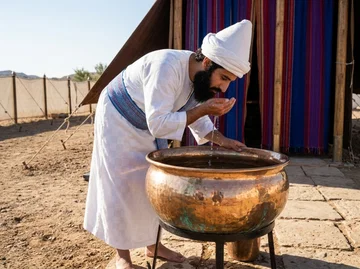
And the LORD spake unto Moses, saying, introduces the divine instruction requiring the priests to wash their hands and feet at the laver before entering God's presence to minister in the sanctuary.GW92 162.2Lt 26, 1900, par. 5–9 The laver was placed between the altar and the congregation, so this washing was performed openly in full view of the people.GW92 162.2 The required washing taught that every impurity must be put away and that only those who are clean may draw near to God in service.GW92 162.2Lt 26, 1900, par. 5–9 God is so holy that neglect or refusal to meet this condition for approaching Him brought the penalty of death.GW92 162.2 The same principle calls for cleanliness in personal habits and surroundings as the outward evidence of a reformed and holy life.Lt 26, 1900, par. 5–9
Sources
Pioneers and periodicals
22 sources
The Lord spoke these words to Moses alone on the mount during the forty days when he received the pattern of the tabernacle and its furniture exactly as God directed.ST Oct 29, 1894ST Apr 15, 1886ST Jul 8, 1886 The saying introduces His instruction for the laver set in the court between the tabernacle and the altar of burnt offering, where Aaron and his sons were required to wash their hands and feet before entering the sanctuary or ministering at the altar.RH Sep 19, 1912RH Oct 10, 1871ST Jul 8, 1930 It belongs to the daily ministration in the holy place that served as an example and shadow of the ministry Christ now carries on as High Priest in the heavenly temple.ST Jan 24, 1911ST Jun 26, 1907RH Mar 28, 1854 It stands among the ceremonial washings and carnal ordinances imposed through Moses until the time of reformation, distinct from the Ten Commandments which God spoke and wrote on stone and to which He added no more.ST Apr 15, 1886ST Jul 8, 1886RH Jun 10, 1862 The required washing shows that cleanliness is closely connected with acceptable worship and reflects God's purity, a teaching that remains under the Christian dispensation because God's character does not change.RH Oct 10, 1871
Setting at Sinai
Exodus 30:17 stands in the chiefly legislative second division of Exodus, chapters 19-40, among the detailed instructions for the construction of the tabernacle and its furniture given to Moses with the tables of stone during forty days in Mount Sinai after the Ten Commandments and accompanying statutes were proclaimed and ratified over the book of the covenant to bind the ransomed people to Jehovah as a peculiar treasure, a kingdom of priests, and a holy nation. It belongs to the minute description of the worldly sanctuary built in the days of Moses in Exodus 25 to 40, also reckoned as Exodus 25 to 31 and as the completion of the directions in Exodus 29 through 34.ST Oct 29, 1894ST Feb 13, 1912ST Mar 25, 1889ST Jan 31, 1911 Those instructions were spoken to Moses on the mount during forty days and nights in the presence of Divinity after the covenant with Israel had been made and ratified, when Moses was called into close relationship with God.ST Mar 25, 1889ST Jan 31, 1911 In that holy interview he received the Ten Words on two tables of stone written and graven by the finger of God, and he was to make the sanctuary and all its instruments of service exactly according to the pattern shown him in the mount.ST Oct 29, 1894ST Mar 25, 1889ST Jan 31, 1911
The word came from the Lord to Moses alone on the mount during those forty days after the people withdrew and stood afar off, as further instruction after the Ten Commandments had been spoken directly from heaven to the whole assembly.ST Apr 15, 1886ST Jul 8, 1886 Its setting therefore testifies to God's personal presence on Mount Sinai with His angels in His dealings with Israel as a holy nation where He gave Israel His law.RH Dec 24, 1861 The passage places the directions for the sanctuary, its furnishings, and the priesthood in Exodus 25-31 within Moses' forty days on Sinai, and at the close of this instruction God again enjoined the Sabbath.RH Dec 31, 1861 It shows how particular God was in that which pertained to His worship, and the object of all the worship, services, and remedies to which it belongs is to bring men into harmony with the holy law of God.ST Mar 25, 1889
Sanctuary and Its Services
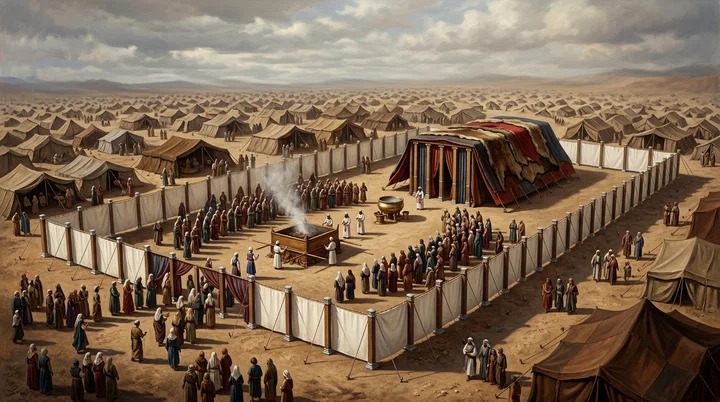
Exodus 30:17 belongs to God's command in the wilderness for erecting the sanctuary where earthly worship centered, afterward replaced in that place by Solomon's temple.ST Jun 19, 1907 The tabernacle ordered there was a richly furnished, portable sanctuary with two apartments, the holy place and the most holy place separated by a curtain, where God manifested His presence above the ark between the cherubim.RH Aug 4, 1863ST Jun 19, 1907 All earthly worship and service revolved around the holy of holies where the law of God rested with the mercy-seat over it.ST Jun 19, 1907
The sanctuary was a marvelously beautiful dwelling place God asked Israel to make from free-will offerings so He might dwell among them and reveal His love.ST Jul 8, 1930 It was built by specially endowed workmen according to the divine pattern given to Moses in the mount. God's Spirit was given to Bezalel, Oholiab, and other devoted workers so the sanctuary could be built properly, showing that He blesses consecrated workers in material tasks as well as spiritual ones.ST Jan 27, 1909
These building and service instructions made God's plan of salvation from sin visible on earth as a great multiple object-lesson by forms and rites of His government and His work as king and priest. They were given after the deliverance from Egyptian bondage to a people unfitted by slavery to comprehend His salvation and required character. God made His purpose known to His people because they were to take part in the sanctuary work, cooperating with Him through Christ.
The sanctuary and its ministry involving sacrifices and offerings were designed according to God's instructions as a pattern pointing to the great temple in heaven where Jesus now ministers as High Priest.ST Jan 24, 1911ST Jun 26, 1907 Those earthly services passed away when Christ died once for all.ST Jan 24, 1911 The verse introduces instruction about the daily ministration in the holy place, showing that burning sweet incense on the golden altar of incense every morning when the high priest dressed the lamps and every evening when he lighted them was part of that earthly work.RH Mar 28, 1854 This daily earthly work served unto the example and shadow of heavenly things, so the work carried on on earth makes known the work carried on in the heavenly sanctuary.RH Mar 28, 1854
The verse introduces God's instructions for the laver, placed in the court of the portable sanctuary between the tabernacle and the altar, alongside the altar of burnt offering.RH Sep 19, 1912ST Jul 8, 1930 In Exodus 30:17-21 the priests were required to wash their hands and feet with its water, after putting on clean linen garments, before entering the sanctuary to serve or approaching the altar to minister, on penalty of death.RH Sep 19, 1912RH Oct 10, 1871 The washing taught the need for cleansing before entering God's service and was connected with being born of water and the Spirit.RH Sep 19, 1912 The washing shows that cleanliness was closely connected with acceptable worship and reflects God's purity, and its teaching remains relevant under the Christian dispensation because God's character and moral teachings do not change, giving Christians no license to defile body or soul.RH Oct 10, 1871 The ark, covered by the mercy seat and overshadowed by cherubim, stood in the most holy place and contained the law of God.ST Jul 8, 1930
The laver where the priests cleansed themselves is linked with the sea of glass as a picture of cleansing, in which God's children as a royal priesthood are washed by the Word and cleansed through the depths of God's power and grace.ST Jan 24, 1911 The ritual handwashing from these instructions continued in modified synagogue practice, where an attendant poured water on the rabbi's hands, as a mechanical remnant of the old system that had failed to point people toward the better heavenly way.RH Jan 12, 1911
Law and Moral Application
The verse is part of the laws God gave through Moses, included in the law of Moses along with moral, civil, health, and ceremonial laws, statutes, and judgments. Those laws include regulations about offerings, sacrifices, and types that reveal the substance of the new dispensation through the shadows of the old. It belongs to the precepts, statutes, and laws commanded by the hand of Moses and recorded chiefly in Exodus 25-30 and Leviticus, distinct from the Ten Commandments which God spoke, wrote on stone, and to which He added no more.ST Apr 15, 1886ST Jul 8, 1886 It was spoken to Moses alone on the mount during forty days after the people withdrew and stood afar off, as further instruction after the Ten Commandments had been spoken directly from heaven to the whole assembly.ST Apr 15, 1886ST Jul 8, 1886
It is among the burdensome ceremonies and carnal ordinances having reference to flesh and sacrificial offerings, including diverse washings, imposed until the time of reformation.ST Apr 15, 1886ST Jul 8, 1886 They were a yoke neither the fathers nor their children were able to bear.ST Apr 15, 1886 Those offerings could not really take away sin, but were abolished in His flesh when they found their fulfillment in the body and sacrifice of Christ.ST Jul 8, 1886 These ceremonial directions for tabernacle worship, including the washing of priests in Exodus 30:17-21, belong with rites tied to Israel's national and typical system, whose duration ended when Christ fulfilled their purpose.RH Jun 10, 1862 They are distinct from the creation Sabbath, which is not a type and continues without end.RH Jun 10, 1862
The chapter is among the directions establishing that priestly rites belonged to Aaron and his sons, and others were not to perform them unless the Lord specially directed them.ST Mar 3, 1914 The verse is part of God's command to Moses in the wilderness for erecting the inner tabernacle sanctuary told in Exodus 25 to 40, the building where worship upon the earth centered, afterward replaced in that place by Solomon's temple.ST Jun 19, 1907 That portable sanctuary had two apartments, the holy place and the most holy place separated by a curtain, with the laver in the court alongside the altar of burnt offering.ST Jul 8, 1930 All earthly worship and service revolved around the holy of holies as center, where the ark covered by the mercy seat and overshadowed by cherubim stood and contained the law of God, with the mercy seat over it.ST Jun 19, 1907ST Jan 27, 1909ST Jul 8, 1930 God gave His Spirit to Bezalel, Oholiab, and other devoted workers so the sanctuary could be built properly, showing that He blesses consecrated workers in material tasks as well as spiritual ones.ST Jan 27, 1909
Exodus 30:17-21 describes God's instructions to Moses for the laver between the tabernacle and the altar, whose water the priests were to use to wash before putting on their clean linen garments and entering the sanctuary to serve or approaching the altar to minister, on penalty of death.RH Oct 10, 1871 The washing shows that cleanliness was closely connected with acceptable worship and reflects God's purity.RH Oct 10, 1871 Its teaching remains relevant under the Christian dispensation because God's character and moral teachings do not change, giving Christians no license to defile body or soul.RH Oct 10, 1871
Sources