Exodus 32:17
And when Joshua heard the noise of the people as they shouted, he said unto Moses, There is a noise of war in the camp.
Translations
American King James Version, Webster Bible
And when Joshua heard the noise of the people as they shouted, he said to Moses, There is a noise of war in the camp.
King James Version, KJV Cambridge Paragraph Bible, Revised Version, American Standard Version
And when Joshua heard the noise of the people as they shouted, he said unto Moses, There is a noise of war in the camp.
And Joshua heareth the voice of the people in their shouting, and saith unto Moses, 'A noise of battle in the camp!'
And Joshua heard the noise of the people as they shouted, and said to Moses, There is a shout of war in the camp.
And Joshua heard the noise of the people as they shouted,—so he said unto Moses—The noise of war, in the camp!
Berean Standard Bible, Majority Standard Bible
When Joshua heard the sound of the people shouting, he said to Moses, “ The sound of war is in the camp.”
When Joshua heard the noise of the people as they shouted, he said to Moses, “There is the noise of war in the camp.”
Now when the noise and the voices of the people came to the ears of Joshua, he said to Moses, There is a noise of war in the tents.
And when Ioshua heard the noyse of the people, as they shouted, he said vnto Moses, There is a noyse of warre in the hoste.
Douay-Rheims (Challoner revision)
And Josue hearing the noise of the people shouting, said to Moses: The noise of battle is heard in the camp.
Pictures
Cross-references
- Exodus 32:1-6
And when the people saw that Moses delayed to come down out of the mount, the people gathered themselves together unto Aaron, and said unto him, Up, make us gods, which shall go before us; for as for this Moses, the man that brought us up out of the land of Egypt, we wot not what is become of him.
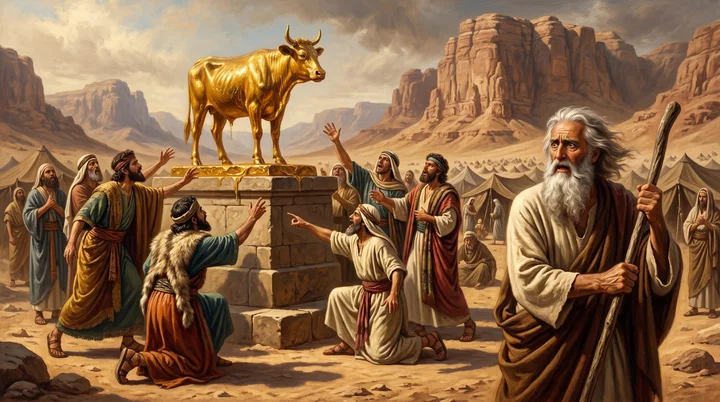
The calf-worship episode sets the scene for Joshua’s remark.
- Exodus 32:26
Then Moses stood in the gate of the camp, and said, Who is on the LORD’s side? let him come unto me. And all the sons of Levi gathered themselves together unto him.
After the tumult, Moses calls the people to take the LORD’s side.
- Psalms 106:19-23
They made a calf in Horeb, and worshipped the molten image.
Retells the golden calf episode and Moses’ intercession to avert Israel’s destruction.
- Exodus 32:7-8
And the LORD said unto Moses, Go, get thee down; for thy people, which thou broughtest out of the land of Egypt, have corrupted themselves:
God tells Moses that Israel has corrupted itself through worship of the golden calf.
- Numbers 13:25-31
And they returned from searching of the land after forty days.
Israel’s unbelieving response to the spies’ report brings judgment.
- Exodus 24:3-7
And Moses came and told the people all the words of the LORD, and all the judgments: and all the people answered with one voice, and said, All the words which the LORD hath said will we do.
Israel’s promise at Sinai precedes its apostasy.
Commentary
Each commentary is drawn from primary sources: the writings of Ellen G. White and Adventist pioneers and periodicals. Each commentary is separate. Its own words are not a quotation; follow the references to read the source passages.
Ellen G. White
18 sources
As Moses came down from the mount bearing the two tables written by God on both sides, Joshua heard the shouting from the camp below and with a soldier's first thought took it for the noise of war.1SP 247.1–248.1SG3 278.2–279.1PP 315.2–3 Moses knew better that it was neither the cry of victory nor the cry of defeat, but singing and revelry.1SP 247.1–248.1Ms 13, 1906, par. 21–24 It was excited, boisterous, drunken shouting and dancing around the calf in idolatrous celebration after the manner of Egypt, wholly unlike reverent worship and revealing utter corruption and breach of the covenant.1SP 247.1–248.1SG3 278.2–279.1RH Jul 29, 1873 The revelry broke out while Moses was away forty days in the mount receiving God's written law, when the people grew discontented at his delay and, led by the impatient mixed multitude, demanded an image to go before them and turned back to Egyptian idolatry despite the miracles in Egypt and at the Red Sea and the glory revealed on Sinai.PP 315.2–3Ms 58, 1900, par. 23–25PP 335.1–2Ms 92, 1900, par. 22–25 Aaron, left in charge, failed to stand for the right and yielded to the demand, and his compliance emboldened the people to greater sin.Ms 13, 1906, par. 21–24RH Feb 4, 1909 By this open defiance Satan sought to cause Israel's ruin and extinction, but he was defeated, for God gave opportunity to repent and take the Lord's side, cutting off only those who stubbornly persisted while mercifully pardoning the humbled, and the tables broken beneath the mount testified that as they had broken the covenant God had broken it with them.Ms 117, 1909, par. 15–22PP 335.1–23T 342.13T 298.1
The Shout Heard Descending
As Moses came down from the mount with Joshua, carrying the two tables of testimony written by God on both sides, Joshua heard the shouting of the people in the camp below, while the cloud of divine presence still rested on the peak in view of the camp.SG3 278.2–279.1PP 315.2–3 His first thought, as a soldier, was that the uproar was an enemy attack, and he mistook the excited shouting for the noise of war in the camp.1SP 247.1–248.1PP 319.3–320.4ST May 20, 1880 Moses recognized the sound correctly as singing and revelry around the idol, not battle.1SP 247.1–248.1PP 319.3–320.4ST May 20, 1880 It was neither the cry of victory nor the cry of defeat.Ms 13, 1906, par. 21–24
The noise was excited, boisterous shouting with singing and dancing in idolatrous celebration around the calf.1SP 247.1–248.1SG3 278.2–279.1ST May 20, 1880 It was drunken revelry connected with idolatry and breaking of the covenant, in imitation of Egyptian idolatrous feasts and idol-worshipers.SG3 278.2–279.1RH Jul 29, 1873 It was wholly unlike reverent and reverential worship of God, and it revealed the corruption and degradation of Israel in making an idol and sacrificing to it.1SP 247.1–248.1SG3 278.2–279.13T 298.1
The shout heard on the descent sets the scene for Moses' arrival to see the calf and the dancing.Ms 13, 1906, par. 21–24 Though warned that the people had corrupted themselves, coming directly from the presence of God's glory he was still in a measure unprepared and was overwhelmed by the dreadful exhibition.SG3 278.2–279.1 In utter discouragement and wrath at their great sin before God he cast the tables out of his hands and broke them beneath the mount.SG3 278.2–279.1
Apostasy, Failure, and Mercy
The shout Joshua heard rose while Moses was away communing with God, spending forty days in the mount receiving the stone tablets with God's written law for His covenant people who had pledged obedience, while Israel waited below at the very foot of Sinai.PP 335.1–2Ms 92, 1900, par. 22–25Ms 156, 1905 When Moses did not return, the people became discontented and unbelieving, failed to meditate on the law they had heard and to prepare their hearts, and became careless, inattentive and lawless.PP 315.2–3Ms 58, 1900, par. 23–25 They were led by the impatient mixed multitude determined to wait no longer for Moses whether to go forward to the promised land flowing with milk and honey or back to Egypt, and feeling helpless without their leader they desired some image to represent God and to go before them in place of Moses.PP 315.2–3 At the suggestion of those who had practiced it they turned back in their hearts to the idolatry of Egypt and made and worshiped a calf in imitation of the ox or calf regarded as a symbol of deity.PP 315.2–3 Thus they represented the glory of the invisible God by the similitude of an ox despite having been given no manner of similitude of God, despite the prohibition of any material representation, despite the mighty miracles in Egypt and at the Red Sea designed to establish faith in Him as the invisible, all-powerful Helper, and despite the pillar of cloud and fire and the revealing of His glory on Sinai.PP 315.2–3
Satan carried forward at Sinai the same work of overthrowing God's law begun in heaven, exciting doubt, apostasy and rebellion until Israel denied loyalty to Jehovah, demanded gods of gold, and bowed in open defiance of the law's commands in adoration before a golden image when Moses came from the awful presence of divine glory.PP 335.1–2 By this daring insult and blasphemy Satan planned to cause their ruin, believing God would divorce them and devote them to destruction as utterly degraded and lost to privilege, blessing and solemn pledges, and thus secure extinction of the seed of Abraham that was to preserve knowledge of the living God and through whom the true Seed was to come to conquer Satan, but Satan was defeated.PP 335.1–2 Aaron, left in charge as appointed guardian and magistrate, failed to lead the people through temptation, yielded to their demand for gods, joined their plans and with calm assurance carried them out.Ms 13, 1906, par. 21–24RH Feb 4, 1909Ms 92, 1900, par. 22–25 His weakness showed he did not bear the burden of the work as Moses did, who truly felt its greatness and weakness and had God continually as counselor, even though Aaron claimed God had spoken by him as well as by Moses and that no extra helpers were needed.SG4 19.2 He should have faithfully done his duty, stood for the right irrespective of consequences, maintained allegiance, cited the perils of Sinai and reminded them of their solemn covenant, which could have checked the evil, but his compliance emboldened them to greater sin than had entered their minds, that first permission let idolatry take hold and required stern, decisive action, and he would have been slain if Moses had not interceded for him.Ms 13, 1906, par. 21–24RH Feb 4, 1909RP 45.1Ms 92, 1900, par. 22–25
In the calf apostasy the people divided into two parties, one serving apostasy and one called to serve God.Ms 117, 1909, par. 15–22 God would not arbitrarily destroy the guilty but gave opportunity to repent, return and place themselves on the Lord's side, and judgment was promptly carried out.Ms 117, 1909, par. 15–22 Those who stubbornly persisted in rebellion and ranged themselves on Satan's side were cut off, while the humbled and repentant people were mercifully pardoned and sinful Israel was not destroyed, and the history stands as perpetual testimony to the guilt and punishment of idolatry and to the justice and long-suffering mercy of God.PP 335.1–2 The broken tablets represent the people's breach of covenant, as they had broken it God had broken it with them.3T 298.1 After the transgression Moses pleaded with God on their behalf, and the worship of the golden calf with its broken ranks, missing numbers and displeasure of God should have left a lasting warning, but repeated offenses showed failure to learn when again overcome by temptation.3T 342.1GW92 33.1–34.3
Sources
Pioneers and periodicals
45 sources
As Moses came down from the mount with the tables of stone and Joshua with him, Joshua heard the shouting in the camp below and took it for the sound of battle.ST Oct 29, 1894RH Dec 9, 1852RH Aug 19, 1852 Moses with practiced ear set him right that it was no cry of victory or defeat but singing and revelry around the golden calf.ST Jul 16, 1902RH Dec 9, 1852RH Oct 7, 1862RH Jun 13, 1854 The people had broken their covenant almost at once after Sinai, making with their own hands a graven image against the first precept while Moses was absent receiving the law and instruction for the sanctuary.RH Nov 13, 1856RH Oct 8, 1872RH Jan 12, 1911ST Sep 23, 1913 Aaron had yielded to their demand for gods to lead them, and Moses in righteous anger broke the tables at the foot of the mount when he saw the idolatry.RH Aug 19, 1852ST Mar 31, 1909ST Oct 8, 1885ST Nov 30, 1904 For that disobedience the Lord would have destroyed Israel, but at Moses' pleading He spared those who repented and restored them, while three thousand leaders who persisted were cut off, showing that sin under God is pardoned to the penitent yet surely punished.RH Nov 13, 1856RH Jan 7, 1862ST Jan 10, 1906
Setting at Sinai
The verse stands in the account of Israel's worship of the golden calf in Exodus 32:1-35, while Moses was absent on the mountain receiving God's law on tables of stone and instruction concerning the sanctuary.RH Oct 8, 1872ST Jan 31, 1911ST Jul 30, 1902RH Apr 28, 1874 It belongs to the movement in Exodus 32 to 34 in which Moses came down after forty days with God with the Ten Words on tables of stone, found the people in shameless idolatry turning the glory of God into the likeness of a four-footed beast, and then interceded for them.ST Jan 31, 1911 It is part of the account of Israel's idolatry at Sinai after deliverance from Egypt and while Moses was away communing with God, with the people demanding gods and Aaron their appointed guardian yielding to them.RH Oct 8, 1872RH Apr 28, 1874
That apostasy came very soon after Sinai, within forty days after God spoke to them despite the visible signs of His presence and the awful and glorious display.ST Jan 27, 1909RH Jan 8, 1857RH Jan 7, 1862 Within a few weeks, in less than forty days, and immediately after coming out of Egypt and covenanting to do all the Lord commanded, Israel broke the covenant before Moses came down from the mount with the tables of the covenant.RH Nov 13, 1856RH Jan 12, 1911RH Jan 8, 1857ST Jul 10, 1901 They turned from their solemn promise to obey to worshiping the Egyptian sun-god Apis and rebelled despite the miracles they had witnessed.RH Jan 7, 1862ST Jul 10, 1901
The people broke their part of the covenant with God by making a golden calf and worshiping the works of their own hands, a graven image.RH Nov 13, 1856RH Jan 12, 1911ST Sep 23, 1913RH Jan 8, 1857 This was their first breach concerning the Ten Commandments and against the first precept.RH Nov 13, 1856ST Sep 23, 1913 Aaron had part in the tragedy while the people were camped at Sinai during Moses' absence, yielding to their murmuring demand for gods to take the place of their Creator and to serve as their leader toward the promised land.ST Mar 31, 1909ST Nov 30, 1904 When Moses returned Aaron tried to evade responsibility for what had happened, and his deed and its result stand as grave lessons and solemn warnings.ST Mar 31, 1909ST Nov 30, 1904
Moses was coming down from the mount bearing the two stone tablets with Joshua in serious converse with him, stopping within hearing of the tumult below.RH Aug 19, 1852ST Oct 8, 1885RH Jun 13, 1854 Joshua heard the shouting in the camp and mistook it for the noise of battle, and Moses with practiced ear corrected him.RH Aug 19, 1852RH Jun 13, 1854 In righteous anger at the dancing around the golden calf and the blasphemous worship, Moses cast the tables at his feet at the foot of the mount and rushed into the camp, calling those on the Lord's side to him; the revelations in Exodus 32 to 34 then teach that people must yield their hearts so the divine finger may engrave the holy law there.RH Aug 19, 1852ST Oct 8, 1885ST Apr 9, 1902RH Jun 13, 1854 The book in which the verse stands means going out and refers to the departure of Israel from Egypt, continuing the story from comfortable settlement in Egypt in Genesis to growth into a people mightier than the Egyptians, bitter bondage and oppression, great deliverance, and becoming a nation with thorough organization, efficient leadership, a complete code of laws, and an established form of worship.RH Jan 20, 1916 The verse stands in the worship portion of the book and in the life of Moses from his rescue from Egyptian malice in infancy through his experiences as the chosen leader of Israel.RH Jan 20, 1916
Noise Mistaken for War
As he descended, Joshua heard the shouting of the people in the camp and mistook it for the noise of war in the camp.ST Oct 29, 1894RH Dec 9, 1852RH Aug 19, 1852RH Mar 17, 1863ST Jan 2, 1907 The mistake belonged to Israel's disobedience soon after the giving of the law at Sinai, when Moses was coming down and would see the people dancing around the golden calf and call those on the Lord's side to him, and the people were already in the midst of idolatry.RH Aug 19, 1852RH Mar 17, 1863RH Mar 3, 1853 Moses, with practiced ear, corrected him that the sound was singing, not the cry of victors in pursuit nor the shriek of the defeated fleeing in fear.RH Oct 7, 1862RH Jun 13, 1854
The shouting came from worship and celebration around the golden calf, not from victory or defeat in battle.ST May 20, 1880ST Jul 16, 1902RH Dec 9, 1852ST Jan 29, 1908 It was the noise of false worship, for the people had substituted something else for the worship of God and called it God, deifying the carnality and lust of the human heart in place of Jehovah.ST Jul 16, 1902ST Jan 29, 1908 At Sinai they longed for the old nature worship of the Egyptian sun-god Apis, loving its sensuousness and licentiousness, and the golden calf was the exaltation of low, lustful nature worship.ST Jul 16, 1902 They sat down to eat and drink in gluttony and rose up to wanton, naked, lewd orgies, yet this sun-god feast was called a feast to Jehovah, an awful backsliding and blasphemy standing just before the revelation of God's anger and Moses' plea for Israel.ST Jul 16, 1902ST Jan 29, 1908
Moses bearing the tables of the law and Joshua in serious converse with him were descending the distant slope and stopped when they came within hearing of the tumult below, turning anxious eyes to the white tents far down in the valley, where Joshua mistook the confused murmur for fighting and the sound of battle.RH Jun 13, 1854 The noise was the wild and blasphemous revel of a naked, intoxicated multitude dancing and shouting and singing in bacchanalian frenzy around the golden calf right at the foot of Sinai where a month before they had heard thunders and trumpet and voice and had seen lightning and glory, in contrast to what was passing on the top of the mountain between Jehovah and Moses.RH Jun 13, 1854 As he drew near and saw the revelry and blasphemous worship, he cast the tables at his feet and rushed into the camp.RH Jun 13, 1854 The phrase a shout in the camp also describes a joyful shout during a worship meeting.RH Nov 27, 1866
Covenant Pardon and Judgment
For this disobedience the Lord thought to disinherit Israel and destroy them for breaking the covenant immediately after coming out of Egypt by worshiping the works of their own hands against the first precept, but Moses pleaded for them and the Lord repented of the evil He thought to do for their fathers' sakes and saved all that repented.RH Nov 13, 1856RH Jan 7, 1862 The apostasy came during the first forty days Moses was away, when the people turned to idolatry and rebelled despite the miracles they had witnessed, and they were restored to the Lord through Moses after his intercession.RH Nov 13, 1856RH Jan 7, 1862 After the golden-calf rebellion God was angry with the people and at first refused to go with them, until Moses pleaded and God promised that His presence would go with Moses and give him rest.ST Nov 4, 1886
Through that pleading pardon was offered to all Israel that day through the new covenant kingdom of grace, as pardon had been offered to Adam in Eden on the day of his transgression.ST Jun 16, 1914 The kingdom of grace originally established on the day of Adam's fall was reestablished in the nation of Israel on the day of their transgression at Sinai, so that pardon came to all Israel that day through the kingdom of grace.ST Jun 16, 1914 The sequence stands in Exodus 32 to 34, where Moses came down after forty days with God receiving the Ten Words on tables of stone and instruction concerning the sanctuary, and found the people in shameless idolatry turning the glory of God into the likeness of a four-footed beast.ST Jan 31, 1911 The breaking of the tables was symbolical of Israel's transgression, followed by plea for the people, punishment, return, second writing of the commandments on stone, and the glory of God reflected in Moses.ST Jan 31, 1911
Judgment was promptly carried out upon those who had sinned against the light they had received at Sinai with dancing and singing in heathen practices around the idol, and three thousand leaders in the rebellion were destroyed.ST Jan 10, 1906 Those who persisted in rebellion were cut off after opportunity to repent, and the judgment left broken ranks and missing people in a swift and notable punishment.ST Sep 9, 1880ST May 23, 1911 Yet Israel failed to learn from it or remain obedient, and later returned to murmuring and rebellion.ST Sep 9, 1880 Sin under the theocracy was met with summary punishment, yet God was no less merciful then than now, and that punishment of sin shows that sin will surely be punished in this age as well.ST Jan 2, 1901
The golden calf was a human invention that brought idolatry, disaster, and death, and an invented form of worship could not serve as a substitute for the God of Israel.RH May 25, 1876ST Jun 6, 1916 By contrast the brazen serpent was appointed by God and brought forgiveness, healing, and life when seen through faith.ST Jun 6, 1916 The rebellion also included violating the Sabbath in the midst of turning to idolatry despite witnessed miracles.RH Jan 7, 1862
Warnings for God's People
The account teaches that people serve God through love and not through fear or compulsion, for within forty days after God spoke at Sinai amid visible signs of His presence Israel turned back toward Egypt and worshiped the calf because the law was on stone tablets but not in their hearts.ST Jan 27, 1909 People must therefore yield their hearts to God so that the divine finger may engrave the holy law there, since the breaking of the first tables shows what follows when the heart is not yielded.ST Jan 27, 1909ST Apr 9, 1902
The giving of the law, the apostasy, and the intercession are recorded so that people will not become careless or indifferent, thinking it makes no great difference if they do not exactly fulfill God's requirements.RH Dec 2, 1909 This applies especially to observing as the Sabbath the day God plainly specified instead of substituting a day of man's invention, because in the Judgment all will be judged by the standard of God's Word.RH Dec 2, 1909
The evil could have been checked and prevented if Aaron had stood for the right irrespective of consequences and unswervingly maintained his allegiance to God.RH Feb 4, 1909 He should have cited the people to the perils of Sinai and reminded them of their solemn covenant to obey God's law, but instead his compliance with their desires and the calm assurance with which he carried out their plans emboldened them to go to greater lengths in sin than had before entered their minds.RH Feb 4, 1909 The account thus warns against apostasy through weak leadership, for Aaron yielded toward it while Moses stood firmly against it and did not remain silent when the people rebelled.RH Mar 5, 1908RH Jun 14, 1906 Fear of being called arbitrary must not lead God's people to follow a few into apostasy, and neither large numbers nor even the high priest's leadership could make calf worship right, while Moses and the few who stood with him were right to oppose it.RH Mar 5, 1908ST Jun 25, 1912
The people's turning to the calf while Moses was away underscores the need for leadership among God's people.RH Mar 7, 1907 Their turning from honoring Jehovah to worshiping the golden calf shows fickle instability in changing allegiance between God and false worship.RH Apr 28, 1863 Joshua's mistaking of the shouting around the calf for the noise of war illustrates that people can celebrate idolatry and still imagine they have true religion.RH Apr 28, 1863RH Mar 24, 1859
The golden-calf episode condemns turning from God's law to idolatry through greed and conquest as a return to calf worship and a rejection of the command not to steal. The people's idolatry while waiting in the valley violated the divine law written on the stone tablets, and Joshua's presence in the camp hearing the shouting and mistaking it for war belongs to that violation and its consequences.ST Jan 2, 1907ST Jan 2, 1907 Wrongdoing brought punishment, illustrating that sin brings retribution, and though judgment left broken ranks and missing people, Israel failed to learn from it or remain obedient but later returned to murmuring and rebellion.ST Sep 9, 1880ST Jan 2, 1907
Sources