Exodus 32:16
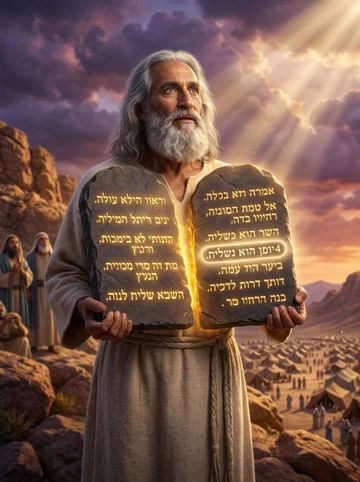
And the tables were the work of God, and the writing was the writing of God, graven upon the tables.
Translations
And the tables were the work of God, and the writing was the writing of God, graven on the tables.
King James Version, KJV Cambridge Paragraph Bible, Webster Bible, Revised Version, American Standard Version
And the tables were the work of God, and the writing was the writing of God, graven upon the tables.
and the tables are the work of God, and the writing is the writing of God, graven on the tables.
And the tables [ were] God's work, and the writing was God's writing, engraven on the tables.
Now as for, the tables, the work of God, they were,—and, as for the writing, the writing of God, it was, graven upon the tables.
Berean Standard Bible, Majority Standard Bible, World English Bible
The tablets were the work of God, and the writing was the writing of God, engraved on the tablets.
The stones were the work of God, and the writing was the writing of God, cut on the stones.
And these Tables were the worke of God, and this writing was the writing of God grauen in the Tables.
Douay-Rheims (Challoner revision)
And made by the work of God: the writing also of God was graven in the tables.
Pictures

Cross-references 20 of 56
- Exodus 31:18
And he gave unto Moses, when he had made an end of communing with him upon mount Sinai, two tables of testimony, tables of stone, written with the finger of God.
Both describe the stone tablets as written by God’s finger.
- Exodus 24:12
And the LORD said unto Moses, Come up to me into the mount, and be there: and I will give thee tables of stone, and a law, and commandments which I have written; that thou mayest teach them.
God promises Moses stone tablets bearing his written law.
- Deuteronomy 10:4
And he wrote on the tables, according to the first writing, the ten commandments, which the LORD spake unto you in the mount out of the midst of the fire in the day of the assembly: and the LORD gave them unto me.
God writes the same commandments on the replacement tablets.
- Deuteronomy 5:22
These words the LORD spake unto all your assembly in the mount out of the midst of the fire, of the cloud, and of the thick darkness, with a great voice: and he added no more. And he wrote them in two tables of stone, and delivered them unto me.
God speaks the commandments and writes them on two stone tablets.
- Deuteronomy 4:13
And he declared unto you his covenant, which he commanded you to perform, even ten commandments; and he wrote them upon two tables of stone.
God wrote the Ten Commandments on two stone tablets as his covenant.
- Exodus 34:28
And he was there with the LORD forty days and forty nights; he did neither eat bread, nor drink water. And he wrote upon the tables the words of the covenant, the ten commandments.
Identifies the covenant words written on the tablets as the Ten Commandments.
- Exodus 20:1-17
And God spake all these words, saying,
The passage records the commandments God spoke and engraved on the tablets, including the Sabbath commandment.
- Exodus 34:1
And the LORD said unto Moses, Hew thee two tables of stone like unto the first: and I will write upon these tables the words that were in the first tables, which thou brakest.
God promises to write the words from the first tablets on replacement stone tablets.
- Deuteronomy 9:10
And the LORD delivered unto me two tables of stone written with the finger of God; and on them was written according to all the words, which the LORD spake with you in the mount out of the midst of the fire in the day of the assembly.
Both describe God writing the covenant words on the stone tablets.
- Exodus 32:1-6
And when the people saw that Moses delayed to come down out of the mount, the people gathered themselves together unto Aaron, and said unto him, Up, make us gods, which shall go before us; for as for this Moses, the man that brought us up out of the land of Egypt, we wot not what is become of him.
Israel makes and worships the golden calf while Moses is away.
- 2 Corinthians 3:7
But if the ministration of death, written and engraven in stones, was glorious, so that the children of Israel could not stedfastly behold the face of Moses for the glory of his countenance; which glory was to be done away:
The commandments engraved on stone are called the ministration of death.
- Exodus 25:16
And thou shalt put into the ark the testimony which I shall give thee.
The ark is made to hold the testimony—the tablets of the covenant.
- Deuteronomy 33:2
And he said, The LORD came from Sinai, and rose up from Seir unto them; he shined forth from mount Paran, and he came with ten thousands of saints: from his right hand went a fiery law for them.
The fiery law went forth from God’s hand at Sinai.
- Exodus 25:21
And thou shalt put the mercy seat above upon the ark; and in the ark thou shalt put the testimony that I shall give thee.
God commands that the testimony be placed inside the ark.
- Psalms 111:7-8
The works of his hands are verity and judgment; all his commandments are sure.
God’s commandments are his works and stand fast forever.
- Matthew 5:17-18
Think not that I am come to destroy the law, or the prophets: I am not come to destroy, but to fulfil.
Christ upholds God’s law and says not the smallest part will pass away.
- Revelation 11:19
And the temple of God was opened in heaven, and there was seen in his temple the ark of his testament: and there were lightnings, and voices, and thunderings, and an earthquake, and great hail.
The heavenly ark contains the testimony represented by the tablets of God’s writing.
- Hebrews 9:4
Which had the golden censer, and the ark of the covenant overlaid round about with gold, where in was the golden pot that had manna, and Aaron’s rod that budded, and the tables of the covenant;
The ark contains the tables of the covenant.
- Deuteronomy 10:2
And I will write on the tables the words that were in the first tables which thou brakest, and thou shalt put them in the ark.
God writes the same commandments on the second tablets.
- 1 Kings 8:9
There was nothing in the ark save the two tables of stone, which Moses put there at Horeb, when the LORD made a covenant with the children of Israel, when they came out of the land of Egypt.
The ark contained the two stone tablets Moses received.
Commentary
Each commentary is drawn from primary sources: the writings of Ellen G. White and Adventist pioneers and periodicals. Each commentary is separate. Its own words are not a quotation; follow the references to read the source passages.
Ellen G. White
16 sources
The tables were the work of God Himself, and the writing engraved upon them was His own writing done by His own finger, in contrast to the calf which was merely the work of human hands with no power to save or harm.1SP 247.1–248.1SG3 278.2–279.1PP 314.1 They were the two tables of the testimony, written on both sides and bearing the Ten Commandments, the law and commandments given to Moses to teach Israel.SG3 278.2–279.1PP 314.1Ms 58, 1900, par. 23–25 As the embodiment of His will and the symbol of His authority they represent the divine law, to be sacredly enshrined in the sanctuary as the visible center where He would abide as King and God, and because His character is unchanged that law retains its authority.PP 314.1GC 433Ms 92, 1900, par. 22–25 Moses received them during forty days with God in the cloud on the mount to commit to Israel as His covenant people, while the impatient people refused to wait and turned back in heart to Egypt to demand an image to go before them in his place.PP 315.2–3PP 335.1–2 When he came near and saw the calf and the heathen riot of shouting and dancing, he by divine direction purposely cast the tables from his hands and broke them beneath the mount in the sight of all, signifying that as Israel by open defiance and worship of a golden image had broken their solemn covenant so recently pledged, so God had broken His covenant with them.SG3 278.2–279.1PP 319.3–320.4RH Jul 29, 18733T 298.1ST May 20, 1880
Divine Tablets at Sinai
The tables were stone, and both the tables and the engraved writing upon them were the work of God Himself, done by His own finger.1SP 247.1–248.1PP 314.1Ms 58, 1900, par. 23–25PP 335.1–2 They stood in direct contrast to the calf, which was the work of human hands and had no power to save or to harm.1SP 247.1–248.1 They were the two tables of the testimony, written upon both sides.SG3 278.2–279.1 What was engraved on them was the decalogue or Ten Commandments, the law and commandments given to Moses to teach Israel.SG3 278.2–279.1PP 314.1Ms 58, 1900, par. 23–253T 298.1
As the embodiment of His will and the symbol of His authority they represent the divine law.PP 314.1GC 433 They were to be sacredly enshrined in the sanctuary when made, that it might be the visible center of the nation's worship, where He would abide among Israel as their King and their God.PP 314.1 Because His character is unchanged the law retains its authority and cannot be transgressed under claim of sanctification.BS 57.2 Their divine authorship itself establishes God's authority.Ms 92, 1900, par. 22–25
Moses received them during forty days with God in the cloud on the mount, His law written down to be committed to Israel as His covenant people.PP 315.2–3PP 335.1–2 Israel meanwhile was left to meditate on the law of God already heard and to prepare their hearts to receive further revelation.PP 315.2–3 Instead of using the time to gain clearer understanding of God's requirements and humble their hearts, the people became careless, inattentive and lawless.PP 315.2–3
While Moses communed with God the impatient mixed multitude were determined to wait no longer for him, whether to go forward to Canaan or back to Egypt.PP 315.2–3 Feeling helpless without their leader, the people turned back in heart to Egypt.PP 315.2–3 They desired an image to represent God and to go before them in Moses's place.PP 315.2–3 While God was writing above, demand rose below for other gods.PP 335.1–2
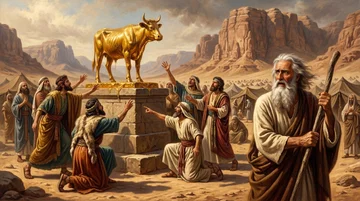
At the suggestion of those who had practiced it they returned to Egyptian superstition and made and worshiped a calf after the ox or calf regarded as a symbol of deity in Egypt.PP 315.2–3 They did this though God had given no manner of similitude of Himself and had prohibited any material representation.PP 315.2–3 The miracles in Egypt and at the Red Sea had been designed to establish faith in Him as the invisible, all-powerful Helper and only true God, and desire for visible manifestation had been granted in the pillar of cloud and fire and in the revealing of His glory on Sinai, with the cloud still before them.PP 315.2–3 To represent the glory of the invisible God by the similitude of an ox was turning back in heart to Egypt.PP 315.2–3 At the same time Satan was at the foot of Sinai carrying forward the same work of overthrowing God's law he had begun in heaven, stirring doubt, apostasy and rebellion until Israel denied loyalty to Jehovah and demanded gods of gold.PP 335.1–2
In Moses's absence Aaron showed weakness by yielding to the demand and making the calf.SG4 19.2 By joining the people in idolatry he failed to uphold God's authority established by the divine authorship of the tables.Ms 92, 1900, par. 22–25 He also failed to cite to the people the solemn covenant they had made at Sinai to obey, given amid the perils of Sinai, which should have been used to check the apostasy.RH Feb 4, 1909 Moses felt his own weakness and felt the greatness of the work committed to him as no other man had felt it, and God was ever his counselor, while Aaron and Miriam thought they bore the burden of the work as well as Moses because they had been chosen to aid him and the Lord had spoken by them as well as by Moses.SG4 19.2
Breaking the Covenant Tables
Moses came down from the mount bearing the tables of the testimony with Joshua at his side, fresh from the presence of God's glory, and together they heard a shout in the camp that was not the sound of war but of singing.SG3 278.2–279.1PP 319.3–320.4ST May 20, 1880 As he drew near he saw the calf and the people shouting and dancing around the idol in heathen riot, an excited revelry in imitation of idolatrous Egyptian feasts and wholly unlike reverential worship of God.SG3 278.2–279.1PP 319.3–320.4ST May 20, 1880 Though warned that the people had corrupted themselves, he was unprepared for such degradation, and coming straight from God's glory he was overwhelmed and his anger grew hot at the sight.SG3 278.2–279.1PP 319.3–320.4
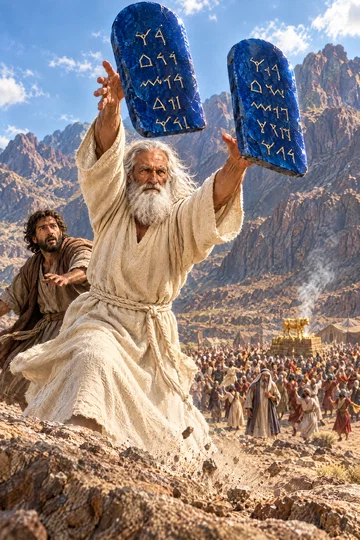
In utter discouragement and wrath at Israel's great sin, and to show his abhorrence of the crime, he cast the tables from his hands and broke them beneath the mount.SG3 278.2–279.1PP 319.3–320.4ST May 20, 1880 This was done purposely and by divine direction, in the sight of all the people.SG3 278.2–279.1PP 319.3–320.4ST May 20, 1880 He then burned the calf, ground it to powder, scattered it upon the water, and made the children of Israel drink it.SG3 278.2–279.1
The breaking of the sacred tables of the law, the work of God with the writing of God graven upon them, signified that as Israel had broken their covenant with God, so God had broken His covenant with them.PP 319.3–320.4RH Jul 29, 18733T 298.1ST May 20, 1880 By open defiance in the adoration of a golden image, in daring insult and blasphemy, they had broken the solemn covenant so recently pledged at Sinai to obey, given amid the perils of Sinai.PP 319.3–320.4RH Jul 29, 18733T 298.1RH Feb 4, 1909 Their destruction declared that breach complete.RH Jul 29, 18733T 298.1
God would not arbitrarily destroy Israel but gave them a chance.Ms 117, 1909, par. 15–22 The swift judgment that followed maintained His law and prevented persistent rebellion from spreading and bringing greater ruin. Those cut off were only those who refused the opportunity to repent. The punishment was mercy toward Israel, toward the wider world, and even toward the transgressors themselves, since to spare them would have prolonged their evil course unto further corruption, conflict, and destruction.
Sources
Pioneers and periodicals
113 sources
The tables and the writing graven upon them were both the work of God Himself, cut in stone by miracle with His own finger and not merely delivered through Moses.ST Oct 19, 1888ST Jul 22, 1908 The writing was the Ten Commandments, which God Himself spoke aloud from heaven and added no more, then wrote on both sides of the tables so they formed a complete whole.ST Dec 9, 1908ST Nov 5, 1894RH Mar 19, 1857ST Mar 10, 1890ST Apr 15, 1886 This direct manner of giving was designed to mark a plain distinction between the moral law and the other law, engraved in enduring rock to show it is immutable, unchangeable and perpetually binding and not to be blotted out or nailed to the cross.ST May 20, 1875ST Jun 2, 1881ST Mar 20, 1879 The Sabbath shares fully in that honor, spoken by His voice, written by His finger, kept in the ark and standing in the very heart of the law as moral and permanent and not a temporary shadow.ST Mar 10, 1890ST Mar 4, 1889ST Dec 7, 1915RH Jul 4, 1912RH Jul 1, 1873 Given at the close of forty days in the mount, the tables were thrown down and broken in sight of the calf-worshiping people to signify that Israel had broken its covenant, yet God wrote the same words again on second tables hewn by Moses.RH Jul 29, 1873ST May 20, 1880ST Dec 9, 1908RH Oct 8, 1872
Tables and Writing Described
Both the stone tables themselves and the writing graven upon them were the work of God Himself.ST Oct 19, 1888ST Jul 22, 1908ST Nov 15, 1910RH Jan 29, 1861 He engraved the Ten Commandments upon stone with His own finger directly by miracle, and He did this twice, not by setting a divine original before Moses for Moses to transcribe and not merely by delivering the law through Moses.ST Oct 19, 1888ST Nov 15, 1910ST May 20, 1875 What is said of Moses writing the words of the Lord refers to his writing them, including the commandments, in the book of the covenant that he read to the people, which does not deny that God also wrote them on stone.ST Oct 19, 1888 The one who wrote upon the tables in Exodus 34:28 is the Lord, not Moses, and the Lord's promise to write upon the second tables the words that were in the first confirms that God Himself did the writing.ST Oct 19, 1888
The writing was upon both sides of the tables, on the one side and on the other, covering the entire surface so that the commandments formed a complete whole with no room for addition.ST Dec 9, 1908ST Jul 22, 1908ST Mar 11, 1889RH Dec 9, 1852 The two tables of testimony given to Moses on Mount Sinai after forty days and forty nights contained the law and commandments God had spoken.ST Jan 14, 1886 The tables were literal, tangible stone carried in Moses's hand, not merely in his mind in a spiritual sense, and not the work of Moses.ST The plain language proves a literal, tangible work of God, confirmed because Moses threw the stones down and broke them, and it refutes spiritualizing the account into something else not stated.ST This shows God is a spiritual being who is still a substantial being who does substantial work, for the commandments did not merely come into the thought of Moses through spiritual communion and then get cut by the hand of Moses, but God really came down upon Sinai and gave the law, keeping a real connection between heaven and earth, and to spiritualize the writing away covers up the law so men will not give allegiance to their Creator.STST
The first tables were wholly prepared by God, while the second tables were hewn by Moses and then written upon by God with the same words that were in the first, after Moses broke the first at the foot of the mount when he saw the golden calf and the people's idolatry.ST Dec 9, 1908RH Jun 26, 1900ST Jan 14, 1886RH Apr 22, 1862RH Dec 9, 1852 Israel received a written copy only after the covenant had been ratified, and the commandments written by God on the tablets were the law to which that covenant related, not the old covenant itself.RH Jun 26, 1900 Preparing the second tables taught Moses valuable lessons and illustrates that people must yield their hearts to God so the divine finger can engrave the holy law there.ST Apr 9, 1902 The tables are commonly pictured with the commandments on one side only so artists can show both tables and place the commandments where they can be read, but the Scriptural manner of writing on both sides stands, and the difference is immaterial to the law itself.ST Dec 9, 1908
The engraving was cut into enduring rock, not written in ink and not merely drawn, so it could not be erased or blotted out or treated as changeable human or ceremonial writing.RH May 28, 1901ST May 17, 1877 The durable stone tablets served to preserve the words of the law for future generations.ST May 17, 1877 The verse stands in the book of Exodus, whose name comes from the Greek and means the going out, referring to the departure of Israel from Egypt.RH Jan 20, 1916 Genesis closes with the family of Israel comfortable and prosperous in Egypt, and Exodus opens with that same family grown more and mightier than the Egyptians in bitter bondage and oppression, then relates in detail their great deliverance and how they became a nation with thorough organization, efficient leadership, a complete code of laws, and an established form of worship.RH Jan 20, 1916 The book is divided into history, laws, and worship, and centers on the life of Moses from his rescue from Egyptian malice in infancy through his experiences as the chosen leader of Israel.RH Jan 20, 1916
Golden Calf Setting
The verse belongs to the fearful record of idolatry and backsliding that came very soon after the awful and glorious display at Sinai, when Moses received the tables from God at the close of forty days and nights in the mount in the presence of Divinity.ST Mar 25, 1889ST Jan 29, 1908 Those forty days were spent receiving the law and the instructions about the sanctuary recorded in Exodus 25 to 31, beginning with how particular God was in what pertained to His worship, after the covenant with Israel had been made and ratified.ST Mar 25, 1889 It was God's own direct work in an object-lesson given after redeeming Israel from Egypt, for their slavery had unfitted them to comprehend His salvation and the character He required, so He commanded them to make Him a sanctuary that He might dwell among them, showed Moses the divine pattern in the mount for the marvelously beautiful structure, and specially endowed His workmen to build it.ST Mar 25, 1889 It is part of the record of God's personal presence at Sinai when He gave Israel His law, and the tables were renewed after Israel worshiped the golden calf.RH Oct 8, 1872RH Dec 24, 1861 What follows is the revelation of God's anger and the wonderful plea of Moses for Israel, though the people had witnessed God's deliverance from Egypt and yet made and worshiped a calf, replacing God's prescribed worship with their own invention.RH Oct 8, 1872ST Jan 29, 1908
The worship of the golden calf was simply substituting something else for the worship of God and calling it God.ST Jul 16, 1902 It was not any devout conception of God as a person but the worship of the carnality of the human heart, deifying that lust and putting that false god in place of Jehovah while calling its worship the worship of the true God.ST Jul 16, 1902 At Sinai Israel longed for the old Egyptian nature worship of the sun-god Apis, loving its sensuousness and licentiousness, and the golden calf was the exaltation of low, lustful nature worship.ST Jul 16, 1902ST Jan 29, 1908 The people sat down to eat and drink in gluttony and rose up to wanton, naked, lewd orgies, yet this sun-god feast was called a feast to Jehovah, which was awful backsliding and awful blasphemy.ST Jul 16, 1902
The golden calf stands for a human invention rather than something God appointed, and replacing God with an image was a sinful form of worship.RH May 25, 1876ST Jun 6, 1916 It brought idolatry, disaster, and death, just as replacing God's appointed way with a human alternative does not make that alternative acceptable.RH May 25, 1876ST Jun 6, 1916 Within forty days of making the covenant Israel broke its pledged allegiance and its solemn promise to obey, turning quickly to worship Apis and the calf even though the covenant concerned the Ten Commandments.RH Jan 12, 1911RH Jan 8, 1857ST Sep 23, 1913ST Jul 10, 1901 The episode in Exodus 32:1-35 shows the people's fickleness, praising Jehovah at one time and worshiping an idol at another.ST Jul 30, 1902RH Apr 28, 1863
While Moses was away on the mount communing with God, the people demanded other gods, and Aaron yielded to them and made a calf.ST Nov 30, 1904 Aaron then tried to evade responsibility for making the calf, claiming that it had simply come out of the fire.ST Nov 30, 1904 The account illustrates the refusal to acknowledge and confess one's own wrongdoing.ST Nov 30, 1904 The law written by God on stone stood in contrast to the people's turning to the golden calf and turning back to Egypt; had they received that law into their hearts, they would not have apostatized or worshiped the calf.ST Jan 27, 1909RH Mar 5, 1908 Their failure shows that fear or compulsion does not bring faithful service to God, for people serve Him through love, and God's written law stands in contrast to human unfaithfulness.ST Jan 27, 1909RH Mar 5, 1908
God as Sole Author
God Himself made the first tables and engraved the Ten Commandments upon them before calling Moses up to receive them, so Moses had no part in their authorship even as God's agent.ST Oct 19, 1888ST Sep 2, 1875ST Sep 30, 1886ST Aug 21, 1879RH Oct 16, 1900 The stone tablets and the writing engraved on them were the work of God, the writing being God's own and not that of Moses or any other person or human messenger, identifying the commandments on the tablets as directly and personally inscribed by God.ST Sep 30, 1886ST Aug 21, 1879RH Oct 16, 1900RH Mar 6, 1900 Moses writing the words of the Lord refers to his writing them, including the Ten Commandments, in the book of the covenant that he read to the people, which does not deny that God also wrote them on stone.ST Oct 19, 1888 The he who wrote upon the tables in Exodus 34:28 is the Lord, not Moses, and the Lord's promise to write upon the second tables the words that were in the first confirms that God Himself did the writing.ST Oct 19, 1888
No other part of the Bible was given in this manner, for all the rest was written by the hands of men, but this law was too holy and important and too holy and glorious to be spoken through men or angels or taken down by any sinful human hand.ST May 6, 1875RH Jul 4, 1912 It is the only document in the handwriting of Jehovah, uttered by His own voice amid grandeur and twice written by His own finger and engraved in stone, and its engraving on enduring stone indicates its unchangeable and imperishable nature and singles out and honors the Ten Commandments above all other precepts.ST May 6, 1875RH Jul 4, 1912 In a differing view, written with the finger of God means only an inscription miraculously made and does not expressly assert that the tables were miraculously engraved.ST Oct 19, 1888 Taken together with the statements that Moses wrote, that view holds that a divine original was miraculously set before Moses, like the handwriting on the wall in Daniel, which Moses then transcribed upon the tables.ST Oct 19, 1888
In another differing linkage, both the stone tablets and the writing on them were God's work, yet the verse is joined with Exodus 34:28 where Moses is understood to be the one who wrote the words of the covenant on the tablets.RH Dec 23, 1852 The identification of both the stone tablets and their writing as God's work is raised as evidence in asking what was written on the first tablets and whether the second tablets were an exact copy.RH Mar 31, 1863
Writing Is Ten Commandments
The writing graven upon the tables was the Ten Commandments, also called the testimony, the covenant, the testament, the law and commandments, and the rule of life given to Moses to be obeyed.ST Nov 5, 1894ST Apr 25, 1906RH Nov 25, 1852ST Aug 5, 1889RH Apr 30, 1857 God spoke them in the hearing of the people and wrote them with His finger on two tables of stone, and the stone tablets and their engraved writing were thereby emphatically identified as the law of Jehovah, the covenant law.ST Apr 25, 1906RH Mar 19, 1857RH Nov 25, 1852RH Apr 30, 1857ST Apr 15, 1886 As God's law the Decalogue was distinguished from the ceremonial regulations and from the law of Moses written in a book, placed in the ark, and given special honor.ST Nov 5, 1894ST Apr 25, 1906RH Apr 30, 1857 Its holiness and spiritual character reveal sin but cannot justify those who break it.ST Nov 5, 1894
God Himself spoke all ten commandments aloud from heaven amid grandeur and added no more, then wrote them with His own finger, so the commandments are limited to what He spoke and wrote as recorded in Exodus 20:3-17.RH Mar 19, 1857ST Mar 10, 1890ST Apr 15, 1886ST Jan 25, 1910RH May 26, 1853 The writing was the same words God spoke aloud from Mount Sinai and later wrote again on replacement tablets, after speaking them in an audible voice and engraving them on tables of enduring rock as a distinct code by itself apart from all other laws.ST Apr 15, 1886ST Jan 25, 1910RH May 26, 1853 By so speaking and writing all ten Himself He classed the fourth commandment together with the nine moral precepts in a way none can deny, proving He made no mistake and that the Sabbath shares their sacred moral character founded on love.ST Mar 10, 1890RH Apr 28, 1874 After Moses broke the first tablets God wrote the law again on a second set, so the Sabbath shared with the other commandments the honor of being proclaimed by God and written by Him.RH Apr 28, 1874
The tables Moses received at the close of forty days and forty nights in the mount were God's voice expressed in Ten Words on tables of stone, containing the law and commandments God had spoken.ST Jan 14, 1886ST Jan 31, 1911 They were written on both sides, and when Moses came down and found Israel in shameless idolatry turning the glory of God into the likeness of a four-footed beast and saw the golden calf, he broke them at the foot of the mount in just indignation to symbolize Israel's transgression.ST Jan 14, 1886ST Jan 31, 1911 God then had Moses hew two tables like the first so He could write upon them the same words that were in the first tables, and after Moses' heart-breaking plea for the people, their punishment, and his return, God wrote the commandments a second time on stone.ST Jan 14, 1886ST Jan 31, 1911
The divine law on the tables defines God's law and includes the commandment against stealing, in contrast to national conquest and the desire to take land.RH Nov 26, 1857 Its transgression makes the sinner liable to death.RH Nov 26, 1857
Moral Law Set Apart
The direct way the tables were given was meant to draw a sharp line between the moral law and the other law, showing the Decalogue to be God's own law and not a law originated or spoken by Moses.ST May 20, 1875ST Jun 2, 1881RH May 13, 1862 The commandments given through Moses came from God, for both the tablets and the engraved writing upon them were His work.ST Jun 2, 1881RH May 13, 1862 This was done twice, with God Himself engraving the Ten Commandments on stone with His own finger.ST May 20, 1875ST Mar 20, 1879
The Decalogue was spoken by God with His own voice from heaven, written twice with His own finger, engraved upon enduring stone, and placed in the ark in the most holy place.ST Mar 20, 1879ST May 20, 1908RH Oct 21, 1851RH Feb 3, 1916RH Jan 12, 1905 By contrast the other law was spoken by Moses to the people, written by Moses' own hand in a book of parchment, and put at the side of the ark.ST Mar 20, 1879RH Jan 12, 1905RH May 13, 1862 Thus there is one law on tables of stone and another in a book, one law written and spoken by God and another written and spoken by Moses, one relating to moral duties and the other to ceremonial ordinances.ST Mar 20, 1879RH Oct 21, 1851 The enduring rock tablets were preserved in the holy ark in the most sacred room of the sanctuary, which further marks their distinct and separated status.ST May 20, 1908RH Feb 3, 1916RH Jan 12, 1905
The engraving in stone signifies that the commandments are immutable, unchangeable, imperishable, and perpetually binding on humanity.RH Oct 21, 1851ST May 6, 1875ST Apr 15, 1886ST Apr 6, 1915RH Feb 1851 They are a transcript of a holy and righteous character, too holy and important to be written by sinful men, so that no other part of Scripture was given in this manner as the only document in Jehovah's handwriting.ST May 6, 1875ST Apr 6, 1915 These moral principles existed before sin and remain through the age of sin and throughout eternity, unlike temporary outward observances that could be blotted out.RH Oct 21, 1851ST Apr 6, 1915RH Feb 1851 Their divine authorship singles out and honors the Ten Commandments above all other precepts and connects their origin with the claim that they stand forever.ST May 6, 1875RH Feb 1851
Words engraved in stone cannot be blotted out, and it would not be proper to speak of nailing a law engraved in stone to the cross. Therefore the handwriting of ordinances blotted out and nailed to the cross has no connection with the Ten Commandments, which were engraved by God on stone and not written as book ordinances that could be removed in that way. Those who held the differing view taught instead that the Ten Commandments are the only handwriting God ever made, so the handwriting of ordinances blotted out and taken out of the way and nailed to the cross is specifically the Ten Commandments insofar as they were ordinances.RH Mar 4, 1873
The law whose transgression required atonement is identified as the Ten Commandments, God's law kept in the ark of the testimony.RH Jun 2, 1859RH Nov 2, 1911RH Jan 13, 1852 Its ministration changed, but the law itself was neither changed nor abolished.RH Jun 2, 1859RH Nov 2, 1911RH Jan 13, 1852 Hence a change in priesthood or in the ministry that carried the law into effect does not mean that God or His law changed or was abolished.RH Jun 2, 1859RH Nov 2, 1911RH Jan 13, 1852
The Ten Commandments on the tables of stone are the only thing ever engraven in stones.RH Oct 4, 1864RH Sep 6, 1864RH Sep 6, 1864 Joshua's stones were different, for they were covered with plaster and bore a copy of the law of Moses written on the plaster and not engraved in the stones themselves.RH Oct 4, 1864RH Sep 6, 1864 The glory on Moses' face that kept Israel from steadfastly beholding his countenance shone when he came down from Sinai with the two tables of testimony in his hand, forty years before Joshua set up rough unhewn altar stones on Mount Ebal.RH Sep 6, 1864RH Sep 6, 1864 This proves that the ministration written and engraven in stones is the Sinai tables and not Joshua's stones.RH Oct 4, 1864RH Sep 6, 1864RH Sep 6, 1864
The law was written by the finger of God, and Christ, who is one with the Father and through whom all things were made, had a part in its giving.RH Oct 14, 1915 Christ did not destroy or change the law, and God's unchanging law remains in force.RH Oct 14, 1915
Enduring Law and Sabbath
God Himself spoke all ten commandments and wrote them with His own finger and added no more, thereby classing the fourth commandment together with the nine moral precepts in a way none can deny.ST Mar 10, 1890 This proves He made no mistake, and the Sabbath commandment is not different in character from the rest but shares their sacred and moral character, founded on love and placed in the very heart of the Decalogue to guard its claims against perversion.ST Mar 10, 1890
The ten commandments were uttered by God's own voice and engraved by God's own finger on tablets of stone, twice written, because they were too holy and glorious to be spoken through men or angels or taken down by any human hand.RH Jul 4, 1912 The stone tablets were deposited inside the ark of incorruptible wood overlaid within and without with gold, under the overshadowing cherubim and the divine presence, unlike laws of a temporary polity and shadowy ritual which were spoken to Moses alone, written by the hand of Moses, and placed beside the ark as less sacred and ready to be removed.RH Jul 4, 1912 The fourth commandment fully shared in all these honors, prefaced by the same solemnities with thunders and lightnings, articulated by the divine voice, engraved by the divine finger, and kept in the sacred ark.RH Jul 4, 1912RH Jul 1, 1873 Its place in the moral law proves it does not belong with temporary types and shadows such as the new moon, passover, and other feasts, but with principles founded in nature that are applicable in every age and are eternal and unchanging, moral and permanent and not a Jewish rite belonging to a covenant to decay and vanish away.RH Jul 4, 1912RH Jul 1, 1873
The law so engraved by God in enduring stone and promulgated from heaven with His own voice amid grandeur, power, and glory such as earth had never before witnessed has the Sabbath law in its very heart, making up about one-third of its matter.ST Mar 10, 1890ST Mar 4, 1889 It was placed in the center by design so that three immutable precepts guarding the worship and holiness of God stand on one side of it and six equally immutable precepts guarding duty to fellow men stand on the other side before unholy hands can reach it.ST Mar 4, 1889 The Sabbath commandment's name and character were engraved on them by the same hand that made the universe.ST Dec 7, 1915 After Moses broke the first tablets, God wrote the law again on a second set, with the same commandments and none added or removed.RH Apr 28, 1874RH Mar 26, 1872 Thus the Sabbath shared with the other commandments the honor of being proclaimed by God and written by Him, given for all nations and not only for the Jews.RH Apr 28, 1874RH Mar 26, 1872
The Ten Commandments written on stone by God are a transcript of His holy and righteous character.ST Apr 6, 1915 They express moral principles rooted in humanity's relations to God and to one another, obligations arising from human nature which existed before sin and before the fall, proclaimed and written before any part of the Bible was written.ST Apr 6, 1915RH Nov 25, 1852 Together they constituted one law, the one law by which God governed the world with no other law beside it, the supreme constitution of the Creator, superior to ritual and ceremonial laws and enduring.RH Mar 20, 1856RH Nov 25, 1852RH Mar 26, 1872 That written law is perfect, and it was within Christ's heart when He came to confirm the new covenant, so that in ratifying the covenant He planted its eternal perpetuity in minds, magnifying it and making it honorable and teaching that not one jot or tittle would pass from it, governing moral relationships through the age of sin and throughout eternity and remaining binding to the end of time, unlike ordinances written by Moses in the book of the law which could be blotted out as a temporary set of outward observances.ST Apr 6, 1915RH Mar 20, 1856RH Nov 25, 1852 The tables do not originate the law, which is coeval with human nature and older than creation and was first engraven on the heart by the finger of God, then well-nigh effaced by rebellion, then in some measure reinscribed and shown by inward light.ST May 22, 1884 The stone writing is that same eternal law given in outward form on account of darkness and corruption and because they were slow of understanding, commanding the fathers to teach it to their children through all succeeding generations so the law becomes known to those who know not God.ST May 22, 1884
Sanctuary Covenant and Judgment
The tables of God's law rested in the holy of holies beneath the mercy-seat in the inner tabernacle erected by Israel in the wilderness at God's command in the account of Exodus 25 to 40, and afterward in Solomon's temple that took the place of the portable tabernacle, so that all earthly worship and service centered and revolved around them.ST Jun 19, 1907ST Mar 25, 1889RH Feb 3, 1916STRH Jan 6, 1853 They were two tables of stone containing the holy law, the Ten Commandments also called God's testament, given to Moses to conclude his forty days and nights in the presence of Divinity on the mount after the covenant with Israel had been made and ratified and after the instructions concerning the sanctuary in Exodus 25 to 31 beginning with how particular God was in what pertained to His worship.ST Mar 25, 1889RH Jan 6, 1853ST Dec 29, 1909 They were engraved on enduring rock by God's own fingers and preserved in the holy ark of incorruptible wood overlaid with gold in the most sacred room of the sanctuary under the cherubim and the Shekinah.RH Feb 3, 1916STST Dec 29, 1909 All worship, all services, and all remedies have as their object to bring men into harmony with that holy law.ST Mar 25, 1889
The earthly sanctuary and its service were a figure of the heavenly sanctuary, so the ark and the law it contained point to their heavenly counterparts.ST Sep 4, 1879ST Jun 26, 1907 The Ten Commandments are the testimony of God placed in the most holy place of the sanctuary, and that same testimony is in the heavenly temple, where it holds good throughout the gospel dispensation even till the sounding of the seventh and last trumpet.ST Sep 4, 1879ST Jun 26, 1907 The law is also righteousness and the foundation of God's throne.ST Jun 26, 1907
When Moses came down carrying the tables of the testimony with Joshua after being in the presence of God's glory, he saw Israel shouting and dancing around the idol in heathen worship.RH Jul 29, 1873ST May 20, 1880 He threw the tables of stone down by divine direction and purposely broke them in the sight of the people to signify that they had broken the covenant so recently made with God and that God had broken the covenant with them.RH Jul 29, 1873ST May 20, 1880 His breaking of the tables in just indignation when he found Israel in shameless idolatry turning the glory of God into the likeness of a four-footed beast symbolized Israel's transgression.ST Jan 31, 1911RH Oct 7, 1862RH Mar 17, 1863 This act showed his deep sense of the purity of God's worship and, though he acted in anger, he did not sin.RH Oct 7, 1862 After his heart-breaking plea for the people, their punishment, and his return, God wrote the commandments a second time on stone.ST Jan 31, 1911
Before Moses came down with the tables of the covenant, Israel broke the first precept by worshiping the works of their own hands.RH Nov 13, 1856RH Jan 7, 1862 At that time the Lord thought to disinherit them and intended to destroy the people, but when Moses pleaded for them the Lord repented of the evil He thought to do, for their fathers' sakes and for the sake of His name among the nations, and saved all that repented.RH Nov 13, 1856RH Jan 7, 1862 This proves God's dealing with Israel was ever to bless when obedient and punish when disobedient, and that the condition did not cease, and the people were restored by the Lord through Moses.RH Nov 13, 1856 During the forty days Moses was in the mount he had been instructed in the complete system of pardon and atonement for sin and its final removal from the universe.ST Jun 16, 1914 He pleaded that pardon be offered to Israel that same day through the new covenant kingdom of grace, as pardon had been offered to Adam on the day of his transgression, and the request was granted, so the kingdom of grace first established on the day of Adam's fall was reestablished in Israel on the day of transgression at Sinai and pardon was offered to all Israel that day.ST Jun 16, 1914
The idolatry was a crisis because the people sinned against great light after hearing God's law at Sinai, unlike when they were emerging from Egypt's darkness, turning from their pledged allegiance to God.ST Jan 10, 1906 Three thousand leaders in the rebellion were destroyed.ST Jan 10, 1906 The judgment that followed maintained God's law and prevented persistent rebellion from spreading and bringing greater ruin, and those cut off were those who refused the opportunity to repent. The swift punishment was an act of mercy toward Israel, the wider world, and even the transgressors, since sparing them would have prolonged their evil course and led to further corruption, conflict, and destruction.
The loss of the tablets would be especially troubling because they are a work of God that wicked people might not be allowed to destroy, though there is no proof that they survived the temple's destruction. The tablets could be broken and the written record could be erased, but the law and its truth would remain steadfast, for destroying the record of sin cannot remove sin, because sin is in the sinner.RH Sep 30, 1902 The law on the tables was the solemn covenant Israel had made at Sinai to obey, given amid the perils of Sinai that Aaron should have cited to the people to check the apostasy.RH Feb 4, 1909
Lessons for Obedience Today
The engraved Decalogue is the law that defines sin, reveals sin in its holiness and spiritual character yet cannot justify its breakers, and stands as the standard by which actions are judged good or evil.ST Nov 5, 1894ST Jul 24, 1907ST Nov 3, 1909RH Jun 9, 1853RH Nov 26, 1857 It is the law whose transgression required atonement, so that a change in priesthood does not mean God or His law changed, and whose breaking makes the sinner liable to death.RH Jun 2, 1859RH Nov 26, 1857 All worship, all services, and all remedies have as their object to bring men into harmony with that holy law given at the close of forty days and nights in the mount after the covenant was made and ratified and after the sanctuary instructions of Exodus 25 to 31.ST Mar 25, 1889 That law, spoken at Horeb and written by His own finger, is the perfect constitution of His universal and eternal kingdom, and obedience to it prepares the heart to obey any command He gives.ST Aug 27, 1912
The written law is perfect, the one law by which He governed the world with no other beside it, and it was within Christ's heart when He came to confirm the new covenant, planting its eternal perpetuity in minds in ratifying the covenant with Israel and Judah, magnifying it and making it honorable so that not one jot or tittle would pass.RH Mar 20, 1856 Preparing the second tables, hewn by Moses after the first were made wholly by God, taught valuable lessons and illustrates that people must yield their hearts to God so the divine finger can engrave the holy law there.ST Apr 9, 1902 God's requirements must be fulfilled exactly, for people will be judged by the standard of His Word including His plainly specified Sabbath day.RH Dec 2, 1909 None of the commandments may be set aside to preserve a human custom, for they are the authoritative summary of religion and morality written by God Himself.ST Jun 11, 1874
Even a majority with the high priest at its head could not make calf worship right, and Moses with a few others was right to stand apart, for religious truth is not made right by numbers and God's work is accomplished by His Spirit, not by human might or power.ST Jun 25, 1912 Israel's failure while Moses was away forty days shows the need for a God-appointed leader.RH Mar 7, 1907 Moses did not remain silent in the apostasy at Sinai but acted against the rebellion.RH Jun 14, 1906 It is inconsistent to break one commandment while condemning another's breach of a different one, especially to condemn violation of the ninth while continually violating the fourth.RH Jun 9, 1853 The judgment for calf worship should have left a lasting warning, but the people failed to learn from it and rebelled again.ST Sep 9, 1880
God honored His distinct code by every means that would appeal to men, engraving the Ten Commandments on enduring rock after speaking them in audible voice, marking them off as a code by itself apart from all other laws.ST Jan 25, 1910 That law He committed to Israel for the world, for His people as priests of the nations to keep and to teach.ST Jan 25, 1910 This honor of writing by God's own finger belonged to all the commandments, while the Sabbath commandment had an additional distinction.RH Mar 17, 1863 The law was given to His chosen people in more perfect knowledge by writing its heads on two tables of stone because they were slow of understanding, with fathers commanded to teach it to children through succeeding generations so it becomes known to those who know not God.ST May 22, 1884
The tables of testimony in Moses' hand at Sinai, God's work and God's writing, bore the testimony given to Moses, identified with the Ten Commandments later written again on replacement tablets and placed in the ark.ST Sep 23, 1886RH Oct 9, 1900 They mark the Decalogue as directly from God rather than written by Moses or an angel.ST Feb 4, 1886 He did not trust man to give His holy law but promulgated it from heaven with His own voice amid grandeur, power, and glory such as earth had never before witnessed, engraving it in enduring stone with His own finger and thereby establishing its great importance, sacred authority, and enduring character.ST Mar 4, 1889ST Jul 15, 1913 That engraved law has the Sabbath law in its very heart and center by design, making up about one-third of its matter, so that three immutable precepts guarding the worship and holiness of God stand on one side of it and six equally immutable precepts guarding duty to fellow men stand on the other before unholy hands can reach it.ST Mar 4, 1889
Sources