Exodus 32:18
And he said, It is not the voice of them that shout for mastery, neither is it the voice of them that cry for being overcome: but the noise of them that sing do I hear.
Translations
American King James Version, King James Version, KJV Cambridge Paragraph Bible, Webster Bible, Revised Version
And he said, It is not the voice of them that shout for mastery, neither is it the voice of them that cry for being overcome: but the noise of them that sing do I hear.
And he said, It is not the voice of them that shout for mastery, neither is it the voice of them that cry for being overcome; but the noise of them that sing do I hear.
and he saith, 'It is not the voice of the crying of might, nor is it the voice of the crying of weakness — a voice of singing I am hearing.'
And he said, It is not the sound of a shout of victory, neither is it the sound of a shout of defeat: it is the noise of alternate singing I hear.
But he said—Not the noise of the cry of heroism, nor yet the noise of the cry of defeat,—the noise of alternate song, do I hear.
Berean Standard Bible, Majority Standard Bible
But Moses replied:
“It is neither the cry of victory nor the cry of defeat;
I hear the sound of singing!”He said, “It isn’t the voice of those who shout for victory. It is not the voice of those who cry for being overcome; but the noise of those who sing that I hear.”
And Moses said, It is not the voice of men who are overcoming in the fight, or the cry of those who have been overcome; it is the sound of songs which comes to my ear.
Who answered, It is not the noyse of them that haue the victorie, nor the noyse of them that are ouercome: but I do heare ye noyse of singing.
Douay-Rheims (Challoner revision)
But he answered: It is not the cry of men encouraging to fight, nor the shout of men compelling to flee: but I hear the voice of singers.
Pictures
Cross-references
- Exodus 32:1-6
And when the people saw that Moses delayed to come down out of the mount, the people gathered themselves together unto Aaron, and said unto him, Up, make us gods, which shall go before us; for as for this Moses, the man that brought us up out of the land of Egypt, we wot not what is become of him.
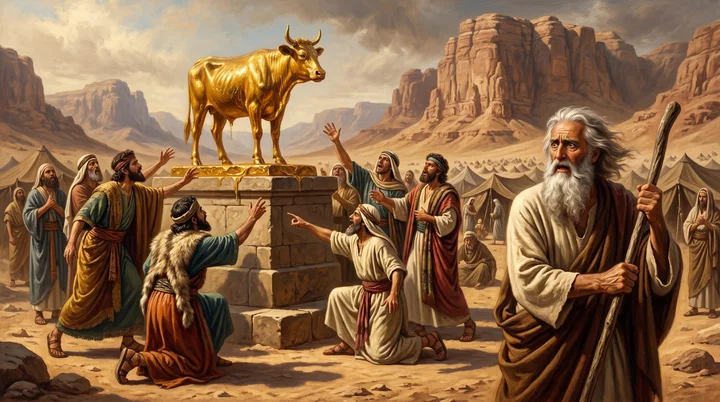
The people sing while worshiping the golden calf.
- Psalms 106:19-20
They made a calf in Horeb, and worshipped the molten image.
Recalls Israel making and worshiping the calf at Horeb.
- Exodus 32:7
And the LORD said unto Moses, Go, get thee down; for thy people, which thou broughtest out of the land of Egypt, have corrupted themselves:
God tells Moses that Israel has corrupted itself.
Commentary
Each commentary is drawn from primary sources: the writings of Ellen G. White and Adventist pioneers and periodicals. Each commentary is separate. Its own words are not a quotation; follow the references to read the source passages.
Ellen G. White
15 sources
Coming down from the mount with the tables of the testimony, Joshua the soldier mistook the shouting in the camp for war, but Moses corrected him that the sound was neither the shout of victory nor the cry of defeat in battle, but the noise of singing.1SP 247.1–248.1SG3 278.2–279.1Ms 13, 1906, par. 21–24PP 319.3–320.4ST May 20, 1880 That singing was the excited revelry, dancing and celebration of the people around the golden calf in breach of the covenant, a heathen riot in imitation of the idolatrous feasts of Egypt and wholly unlike solemn worship of God.1SP 247.1–248.1SG3 278.2–279.1Ms 13, 1906, par. 21–24PP 319.3–320.4ST May 20, 1880 The apostasy broke out while Moses was absent on the mountain receiving the law, when the discontented people lost faith, grew lawless under the murmuring mixed multitude, and demanded a visible image to represent God and go before them in Moses's place despite the prohibition of any material likeness and the manifestations already granted them in Egypt, at the Red Sea, in the pillar of cloud and fire, and in the glory on Sinai.PP 315.2–3Ms 58, 1900, par. 23–25PP 335.1–2 Aaron, left as guardian, betrayed his trust by yielding to their pressure and making the calf, when courage to stand for the right, maintain allegiance to God, and remind them of the perils of Sinai and their solemn covenant could have prevented the apostasy, and his compliance emboldened them to greater sin; Moses, though warned that the people had corrupted themselves, was still unprepared for the degradation, and in hot anger broke the tables beneath the mount to signify that as Israel had broken their covenant, so God had broken His covenant with them.SG3 278.2–279.1PP 319.3–320.4RH Feb 4, 1909RP 45.1 In this God tested Moses and gave the people opportunity to return rather than destroying them arbitrarily, so that those who stubbornly sided with rebellion were cut off while the humbled and repentant were pardoned, leaving the episode as a warning against apostasy and repeated rebellion.Ms 117, 1909, par. 15–22PP 335.1–2
The Noise Explained
The sound from the camp was neither the shout of those crying out in mastery and victory nor the cry of those overcome and defeated in battle, but the noise of singing.1SP 247.1–248.1SG3 278.2–279.1Ms 13, 1906, par. 21–24PP 319.3–320.4 Moses spoke these words to correct Joshua as the two came down from the mount bearing the tables of the testimony, when the uproar was first heard.SG3 278.2–279.1PP 319.3–320.4ST May 20, 1880 Joshua, as a soldier, first judged the shouting to mean war and an attack by enemies upon the camp, but Moses judged truly that it was not combat.SG3 278.2–279.1PP 319.3–320.4ST May 20, 1880
As they drew nearer the sound proved to be revelry and singing, the excited shouting, dancing, and celebration of the people around the golden calf in idolatrous worship.1SP 247.1–248.1SG3 278.2–279.1Ms 13, 1906, par. 21–24PP 319.3–320.4 Their singing was part of their sinful celebration and breach of the covenant, the idolatrous revelry of Israel's apostasy at Sinai.1SP 247.1–248.1Ms 13, 1906, par. 21–24RH Jul 29, 1873 That shouting and dancing was a heathen riot in imitation of the idolatrous feasts and idol worship of Egypt.SG3 278.2–279.1PP 319.3–320.4ST May 20, 1880 It was wholly unlike the solemn and reverent worship of God.SG3 278.2–279.1PP 319.3–320.4ST May 20, 1880
Israel's Rebellion at Sinai
Exodus 32:18 belongs to Israel's golden-calf idolatry, apostasy and rebellion at Sinai while Moses was absent on the mountain in the cloud of darkness and divine glory receiving the law.PP 315.2–3PP 335.1–23T 342.1Ms 156, 1905 During that waiting Israel had time to meditate upon the law they had heard and to prepare for further revelation, but the episode shows their defiance of the law and their broken pledge of loyalty.PP 315.2–3PP 335.1–2 It serves as a warning about apostasy and repeated rebellion.3T 342.1Ms 156, 1905
When the people saw that Moses did not come down they became discontented, lost faith, and their unbelief appeared in a marked manner.PP 315.2–3Ms 58, 1900, par. 23–25 They became careless, inattentive and lawless, led by the impatient and murmuring mixed multitude who wanted to go forward to Canaan or back to Egypt without waiting for Moses.PP 315.2–3 Feeling helpless without their leader, the people desired and demanded a visible image to represent God and to go before them in Moses's place.PP 315.2–3 At the suggestion of those practiced in Egyptian worship they made and worshiped a calf after the ox or calf regarded by Egyptians as a symbol of deity, demanding gods of gold and worshiping an image while God was giving Moses the law.PP 315.2–3PP 335.1–2
This was done although God had given no similitude of himself and had prohibited any material representation.PP 315.2–3 The miracles in Egypt and at the Red Sea were designed to establish faith in him as the invisible, all-powerful Helper and only true God.PP 315.2–3 Desire for visible manifestation had been granted in the pillar of cloud and fire, in the revealing of his glory on Sinai, and in the cloud of the Presence still before them.PP 315.2–3 Aaron, left in charge as guardian of the people, yielded to their pressure, betrayed his trust, and by compliance with their idolatrous plans made the calf.RH Feb 4, 1909Ms 92, 1900, par. 22–25 He allowed the first departure from God's commands, which opened the way for idolatry and a course of wrongdoing that could not be stopped without decisive action, and he was spared only through Moses' intercession.RP 45.1Ms 92, 1900, par. 22–25
Aaron could have prevented the apostasy if he had had courage to stand for the right irrespective of consequences, if he had unswervingly maintained his own allegiance to God, if he had cited the people to the perils of Sinai, and if he had reminded them of their solemn covenant to obey the law.RH Feb 4, 1909 Instead his compliance with their desires and the calm assurance with which he carried out their plans emboldened them to go to greater lengths in sin than had before entered their minds.RH Feb 4, 1909 Moses had been warned that the people had corrupted themselves, made an idol, and sacrificed to it, and had just come from the presence of God's glory, yet he was still unprepared for the degradation he witnessed.SG3 278.2–279.1PP 319.3–320.4 Overwhelmed in utter discouragement with his anger hot because of Israel's great sin, he threw down the tables of stone and broke them beneath the mount in sight of all to signify that as Israel had broken their covenant with God, so God had broken his covenant with them.SG3 278.2–279.1PP 319.3–320.4
In this account God tested Moses and gave the people an opportunity to return to him rather than arbitrarily destroying them.Ms 117, 1909, par. 15–22 Judgment followed because the people persisted in rebellion. Those who stubbornly sided with rebellion were cut off, while the humbled and repentant were pardoned.PP 335.1–2 The people should have remembered God's displeasure and learned from their failure, but they did not.3T 342.1
Sources
Pioneers and periodicals
41 sources
As Moses came down from the mount with Joshua bearing the tables, Joshua mistook the tumult in the camp for battle, and Moses corrected him that it was neither the shout of victors for mastery nor the cry of the defeated being overcome, but the noise of singing.RH Dec 9, 1852RH Aug 19, 1852 That singing was the drunken, excited shouting and dancing of the people in bacchanalian revelry around the golden calf Aaron had made during Moses' long absence.ST Aug 16, 1910RH Aug 19, 1852ST Mar 31, 1909ST Dec 5, 1895 It was Israel's first breach of the covenant after coming out of Egypt, less than forty days after God spoke at Sinai, when after promising to do all the Lord commanded they broke the first precept by making and worshiping a graven image.ST Aug 16, 1910RH Nov 13, 1856ST Jan 27, 1909RH Jan 12, 1911 Drawing near and seeing the apostasy, Moses in righteous anger broke the two stone tablets at the foot of the mount, and the Lord thought to destroy the disobedient people but at Moses' pleading spared all that repented while judgment still fell on persistent rebellion.RH Nov 13, 1856RH Jan 7, 1862ST Oct 8, 1885RH Apr 28, 1874RH Oct 7, 1862 The apostasy came because Aaron as guardian and high priest yielded to the people's demands and excused himself instead of standing for the right, warning God's people not to follow weak leadership into idolatry but to stand firmly as Moses did even when all join in the wrong.RH Feb 4, 1909RH Mar 5, 1908ST Nov 30, 1904ST Jun 25, 1912
Descent and Sound Heard
As Moses came down from the mount with Joshua bearing the tables, Joshua mistook the tumult in the camp for fighting.RH Dec 9, 1852RH Aug 19, 1852RH Dec 24, 1861ST Jan 10, 1906 Moses corrected him that the noise was not the shout of victors for mastery nor the cry of the defeated being overcome, but the noise of singing.RH Dec 9, 1852RH Aug 19, 1852RH Dec 24, 1861ST Jun 26, 1907 The singing came from the people gathered around the golden calf they had made, heard as he returned to find Israel in idolatry.RH Dec 9, 1852RH Aug 19, 1852ST Jan 10, 1906 It was heard while the people were dancing around the calf, within the wilderness setting in which the sanctuary was established.RH Aug 19, 1852ST Jun 26, 1907
The sense of the singing is that of those beginning a wine banquet, identifying it as drunken revelry during Israel's idolatry.ST Dec 5, 1895 Intemperance thus helped produce this departure from God, and can lead on to carnal gratification and shameful conduct.ST Dec 5, 1895
Joyful sacred singing with the Lord present can likewise be described as a shout in the camp.RH Nov 27, 1866 Such true worship song is thereby distinguished from battle cries of victory or defeat.RH Nov 27, 1866
Idolatrous Revelry Described
The singing was the excited shouting, dancing and celebration of the people gathered around the golden calf, or bull, which they had demanded and Aaron had made for them during Moses' long absence on the mount, part of the full account of Exodus 32:1-35 when Moses coming down found Israel in idolatry.ST Aug 16, 1910RH Aug 19, 1852ST Jan 31, 1911ST Jul 30, 1902 That chapter presents Aaron as helping Israel make an idol while camped at Sinai after deliverance from Egypt, a manufactured image meant to replace their Creator and lead them to the promised land, a grave tragedy and solemn warning.ST Mar 31, 1909 The people had lost faith and demanded gods, and Aaron yielded to their pressure and betrayed the trust given to him as guardian of the people.
The feast was called worship to Jehovah, but it accompanied the worship of a false god with sensuous, lewd revelry, and to call it worship of the true God was blasphemy.ST Jul 16, 1902
The calf that was worshiped was the representative of the Egyptian sun-god Apis, the symbol of Egyptian sun worship and of the worship of the elements of reproduction.ST Aug 16, 1910ST Jul 10, 1901ST Jan 29, 1908 With undraped bodies singing and dancing with idolatrous glee, the people showed how deep-rooted their Egyptian idolatry still was, turning so quickly from their solemn promise to obey within scarce forty days of receiving the law at Sinai.ST Aug 16, 1910ST Jul 10, 1901 It was a fearful record of idolatry and backsliding soon after the awful and glorious display at Sinai, followed by the revelation of God's anger and Moses' plea for Israel.ST Jan 29, 1908
The sound was the confused murmur of a wild and blasphemous revel, an intoxicated, naked multitude dancing and shouting and singing in bacchanalian frenzy around the golden calf at the foot of Sinai and hailing it as God.ST May 20, 1880RH Jun 13, 1854 It was a scene of heathenism imitating the idolatrous feasts and idol worship of Egypt, wholly unlike the solemn and reverent worship of God.ST May 20, 1880RH Jun 13, 1854 It stood in stark contrast to the communion between Jehovah and Moses passing on the top of the mountain, and drawing near and seeing the revelry exposed the idolatry and led at once to breaking the tables, destroying the idol, and executing judgment.RH Jun 13, 1854
Zeal, devotion and sacrifice did not make this invented religion true worship.RH Oct 8, 1872ST Jun 6, 1916 The people may sing and feel religious while worshiping an idol, but such worship does not make their sin acceptable to God, even when joined by all.RH Oct 8, 1872RH Mar 24, 1859 The golden calf could not serve as an acceptable substitute for the God of Israel, for unlike the God-appointed brazen serpent it had no merit because God had not appointed it, and the human invention brought idolatry, disaster and death.RH May 25, 1876ST Jun 6, 1916
Covenant Broken and Answered
The singing was heard at Israel's first breach of the covenant after coming out of Egypt, less than forty days after God spoke at Sinai while the sign of cloud and fire accompanied them and while Moses was in the mount receiving the law and the instructions concerning the sanctuary and its services.ST Aug 16, 1910RH Nov 13, 1856ST Jan 27, 1909RH Jan 8, 1857RH Jan 7, 1862 After covenanting to do all the Lord commanded, even before Moses came down with the tables of the covenant, the people broke their promise and the first precept by turning back toward Egypt and making and worshiping the works of their own hands, a graven image and golden calf.RH Nov 13, 1856ST Jan 27, 1909RH Jan 12, 1911RH Jan 8, 1857ST Sep 23, 1913 They turned from their solemn promise to obey with startling quickness, within forty days and in less than forty days of receiving the law, to worship Apis, an Egyptian sun-god.RH Jan 8, 1857ST Jul 10, 1901
Drawing near and seeing the revelry exposed the apostasy, and in righteous anger and distress over the idolatry Moses broke the two stone tablets at the foot of the mount when he found the people had made a golden calf and were worshiping before it.ST Oct 8, 1885RH Apr 28, 1874RH Oct 7, 1862RH Jun 13, 1854 The Lord thought to disinherit and destroy them for disobedience, but Moses pleaded for them and for pardon for the rest, and for the sake of the fathers and of His name among the nations He repented of the evil He thought to do, spared them, and saved all that repented.RH Nov 13, 1856RH Jan 7, 1862RH Apr 28, 1874 Judgment still followed because the people persisted in rebellion, with the leading idolaters slain before pardon was sought for the rest.RH Apr 28, 1874
Within this intercession in Exodus 32:11-35 Moses pleaded that pardon through the new covenant kingdom of grace be offered to Israel on the day of transgression at Sinai as it had been offered to Adam in Eden on the day of his transgression, and God granted the request so that the kingdom of grace first established at Adam's fall was reestablished in the nation of Israel that day with pardon offered to all Israel.ST Jun 16, 1914 Their sin put in doubt whether God could carry out His purpose to dwell among them in the sanctuary, led by God's command to three thousand impenitent and defiant ones being slain by the sword, caused the tabernacle of the congregation to be removed from the midst of the camp, and showed God cannot live in the midst of sin because to sin God is a consuming fire, until through intercession Israel repented and God forgave so He could dwell among them again.ST Aug 16, 1910 The episode means God's dealing with Israel was ever to bless when obedient and to punish when disobedient, a condition still in force, showing that violating God's law brings punishment.RH Nov 13, 1856ST Jan 2, 1907
Law Sanctuary and Sabbath
The verse stands within the directions for building and the description of the marvelously beautiful sanctuary in Exodus 25-40, given after deliverance from Egyptian bondage with a mighty hand. Slavery had unfitted the people to comprehend God's great salvation and the character He required, so God gave a great multiple object-lesson comprehending the plan of salvation by various forms and rites. He asked free-will offerings so they might make Him a sanctuary that He might dwell among them, and He specially endowed workmen to build it after the divine pattern shown to Moses in the mount. It records Moses identifying the sound from the camp as singing rather than cries of victory or defeat, in the wilderness setting in which the sanctuary was established.ST Jun 26, 1907
The episode belongs to Israel's idolatry less than forty days after God spoke at Sinai, while the sign of cloud and fire accompanied them.ST Jan 27, 1909 It teaches that people serve God through love and not through fear or compulsion.ST Jan 27, 1909 Had Israel received God's law in their hearts as well as on stone, they would not have turned back toward Egypt or worshiped the golden calf.ST Jan 27, 1909
It belongs to the moment when Moses came down and found the people had made a golden calf and were worshiping before it, and in distress over that idolatry he broke the tables of stone bearing God's law.RH Apr 28, 1874 After the leading idolaters were slain and Moses asked pardon for the rest, God told Moses to hew a second set of tables and wrote the law again for the people.RH Apr 28, 1874 Thus the Sabbath with the other commandments was once proclaimed by God's voice and twice written by His finger on stone.RH Apr 28, 1874
The account describes Israel's first forty days of rebellion while Moses was away, when the people turned to idolatry and God intended to destroy them but spared them after Moses interceded for the sake of His name among the nations.RH Jan 7, 1862 That rebellion included a general violation of the Sabbath.RH Jan 7, 1862
The apostasy with Moses' intercession after God gave the law at Sinai, in which Moses recognized the sound as singing and not the cries of people winning or losing a battle, warns against treating God's requirements as unimportant.RH Dec 2, 1909 That includes replacing the Sabbath day God specified with a humanly chosen day.RH Dec 2, 1909 God's Word is the standard by which all are judged.RH Dec 2, 1909
Warnings for Later Readers
Exodus 32:18 belongs to Israel's idolatry while Moses was delayed on the mountain, when the people lost faith and demanded gods and Aaron as guardian of the people yielded to their pressure and made the golden calf, betraying the trust given to him.ST Nov 30, 1904 As Israel's high priest and Moses' representative he should have opposed their plans, but his failure helped bring sin and ruin, and he later humbled himself in true penitence.ST Aug 31, 1882 He tried to avoid responsibility for what had happened and excused his part by blaming the people.ST Aug 31, 1882ST Nov 30, 1904 His compliance with their desires and the calm assurance with which he carried out their plans emboldened them to go to greater lengths in sin than had before entered their minds.RH Feb 4, 1909
That apostasy could have been prevented if he had had courage to stand for the right irrespective of consequences, if he had unswervingly maintained his own allegiance to God, if he had cited the people to the perils of Sinai, and if he had reminded them of their solemn covenant with God to obey His law.RH Feb 4, 1909 The golden-calf apostasy is a warning against following weak leadership into apostasy, teaching that God's people must stand firmly against such a course as Moses did.RH Mar 5, 1908 That worship was wrong even though all Israel with its high priest joined in it, while Moses and a few others stood apart.ST Jun 25, 1912 When Moses came down and heard singing from the people gathered around the calf, he recognized the sound as singing and not the noise of victory or defeat, and his example is that of not remaining silent when apostasy breaks out.ST Jun 25, 1912RH Jun 14, 1906
The verse distinguishes the sound from the camp as singing rather than the shouting of victory or defeat, and it belongs to the account of Israel worshiping the golden calf as an example of turning to idolatry and abandoning God's law. That worship of the calf is the religion that still retains vitality, meaning the worship of gold as the mainspring of human energy where what a thing will fetch in the market outweighs its intrinsic value, buying and selling crushes every noble feeling, the ledger becomes the Bible and the counting-house the church, and the rising generation is taught to revere only money-getting, while faith and self-sacrifice are dead.RH Aug 25, 1874 The chapter presents Aaron helping Israel make an idol during Moses' long absence on Mount Sinai while the people were camped there after deliverance from Egypt, with a manufactured image meant to replace their Creator and lead them to the promised land, recording a grave tragedy and giving solemn warnings.ST Mar 31, 1909 The identification of the sound as singing and not the cries of victory or defeat serves as an example of Israel's fickleness and instability in turning from worship of Jehovah to the calf.RH Apr 28, 1863 It is part of the golden-calf apostasy at Sinai, one of the episodes whose swift punishment Moses later recalls as a warning about Israel's future and as a fearful record of backsliding.RH Apr 28, 1863ST May 23, 1911
Sources