Exodus 40:30
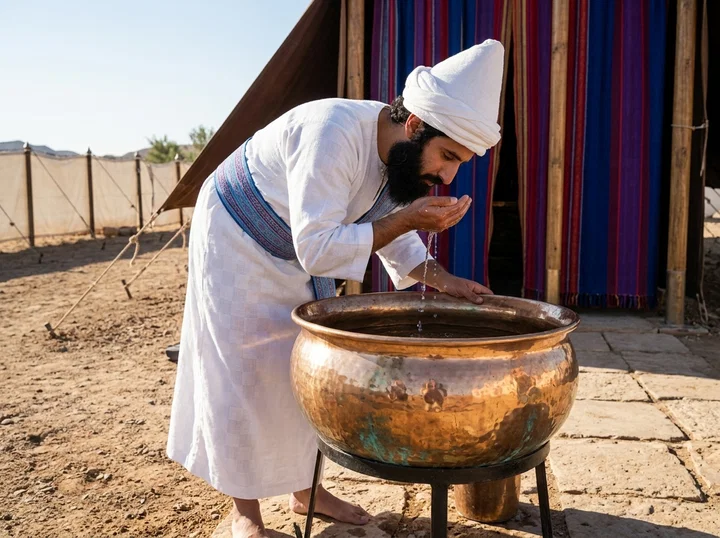
And he set the laver between the tent of the congregation and the altar, and put water there, to wash withal.
Translations
American King James Version, Webster Bible
And he set the laver between the tent of the congregation and the altar, and put water there, to wash with.
King James Version, KJV Cambridge Paragraph Bible
And he set the laver between the tent of the congregation and the altar, and put water there, to wash withal.
And he set the laver between the tent of meeting and the altar, and put water therein, to wash withal.
And he set the laver between the tent of meeting and the altar, and put water therein, wherewith to wash.
And he putteth the laver between the tent of meeting and the altar, and putteth water there for washing,
And he set the laver between the tent of meeting and the altar, and put water in it for washing.
And he put the laver, between the tent of meeting, and the altar,—and put therein water for bathing;
Berean Standard Bible, Majority Standard Bible
He placed the basin between the Tent of Meeting and the altar and put water in it for washing;
He set the basin between the Tent of Meeting and the altar, and put water therein, with which to wash.
And between the altar and the Tent of meeting he put the vessel with water in it for washing.
Likewise he set the Lauer betweene the Tabernacle of the Congregation and the Altar, and powred water therein to wash with.
Douay-Rheims (Challoner revision)
And he set the laver between the tabernacle of the testimony and the altar, filling it with water.
Pictures
Cross-references
- Exodus 30:18-21
Thou shalt also make a laver of brass, and his foot also of brass, to wash withal: and thou shalt put it between the tabernacle of the congregation and the altar, and thou shalt put water therein.
Specifies the laver’s washing requirements and warns of death if they are neglected.
- Hebrews 9:1-5
Then verily the first covenant had also ordinances of divine service, and a worldly sanctuary.
Hebrews gives an inspired synopsis of the sanctuary described in Exodus.
- Hebrews 8:5
Who serve unto the example and shadow of heavenly things, as Moses was admonished of God when he was about to make the tabernacle: for, See, saith he, that thou make all things according to the pattern shewed to thee in the mount.
earthly serves as shadow of heavenly things
- Exodus 38:8
And he made the laver of brass, and the foot of it of brass, of the lookingglasses of the women assembling, which assembled at the door of the tabernacle of the congregation.
Describes the laver’s construction.
- Exodus 40:11
And thou shalt anoint the laver and his foot, and sanctify it.
The laver is anointed and set apart as holy.
- Exodus 40:7
And thou shalt set the laver between the tent of the congregation and the altar, and shalt put water therein.
The laver’s placement and water are specified in the tabernacle setup.
- Hebrews 9:21-24
Moreover he sprinkled with blood both the tabernacle, and all the vessels of the ministry.
The earthly tabernacle and its services pointed to the heavenly sanctuary.
- Exodus 40:34
Then a cloud covered the tent of the congregation, and the glory of the LORD filled the tabernacle.
God’s glory fills the completed tabernacle.
Commentary
Each commentary is drawn from primary sources: the writings of Ellen G. White and Adventist pioneers and periodicals. Each commentary is separate. Its own words are not a quotation; follow the references to read the source passages.
Ellen G. White
3 sources
The laver stood in the court between the altar and the entrance to the tent of meeting and held water for washing.GW92 162.2GW92 308.21SP 348.3 The priests washed their hands and feet there before entering God's presence in the tabernacle.GW92 162.21SP 348.3 That washing removed every particle of dust and impurity.GW92 162.21SP 348.3 It was part of the special preparation required before entering the place where God's glory was revealed.1SP 348.3
Failure to meet this condition of washing would bring death.GW92 162.21SP 348.3 This ordered arrangement was meant to impress people with God's majesty and holiness and with the purity He requires of those who serve Him.GW92 162.2GW92 308.2 The order of the tabernacle also revealed God's character and desires to the surrounding nations.GW92 308.2
Sources
Pioneers and periodicals
17 sources
The laver was set outside before the door of the tabernacle, between the tent of the congregation and the altar of burnt offering in the court enclosed by curtains of fine twined linen, holding water there for washing.RH Feb 11, 1858ST May 20, 1880RH Aug 21, 1856 It was put in place when the tabernacle was reared up in the first month of the second year after Israel left Egypt, as Moses arranged all the furniture as commanded until the cloud covered the tent and the glory of the Lord filled the tabernacle.RH Feb 11, 1858RH Aug 21, 1856 The tabernacle was God's dwelling place among His people and the center of their worship, given because bondage in Egypt had unfitted them to comprehend His salvation, as a great object-lesson of the plan of salvation built from free-will offerings by a divine pattern.ST Jun 19, 1907ST Jun 4, 1885ST Jul 8, 1930 That earthly sanctuary with its furnishings was made exactly as directed in the mount and served as type and shadow of heavenly things, its rites pointing to the coming Messiah and His power to forgive sin until the sacrifice of Christ.ST Jan 27, 1909ST Jan 31, 1911ST Dec 10, 1896 It belongs to the laws God gave to regulate worship, separate from the laws for civil government, setting apart what is holy from what is common and showing that advancement in the divine life requires obeying God in all things exactly right.RH Jul 16, 1861ST Sep 3, 1896RH Dec 31, 1857
Placement and Historical Setting
The laver was set outside before the door of the tabernacle, between the tent of the congregation and the altar of burnt offering.RH Feb 11, 1858RH Aug 21, 1856RH Aug 4, 1863RH Mar 1, 1870 The altar and the laver stood together in the court enclosed by curtains of fine twined linen around the whole.RH Feb 11, 1858ST May 20, 1880RH Aug 21, 1856RH Aug 4, 1863 Water was put there in the laver for the priests' use.RH Mar 1, 1870 It belonged to the ceremonial arrangement of the earthly sanctuary, in which the ark containing God's law was placed in the most holy place.
It was put in its place when the tabernacle was reared up in the second year after Israel departed from Egypt, in the first month on the first day of the month.RH Feb 11, 1858RH Aug 21, 1856 Moses then spread the tent over the tabernacle and arranged all the furniture as the Lord commanded.RH Feb 11, 1858RH Aug 21, 1856 He put the testimony into the ark with the mercy seat upon it, set up the veil, placed the table of showbread and the golden candlestick in the first apartment and lighted the lamps, put the golden altar of incense before the veil and burned sweet incense, and offered the burnt offering and the meat offering on the altar before the door.RH Feb 11, 1858 After this setting in order, the cloud covered the tent of the congregation and the glory of the Lord filled the tabernacle.RH Feb 11, 1858RH Aug 21, 1856
The laver and the other furnishings were made and placed as God directed, according to the instructions given to Moses in the mount in Exodus 25-31.ST Jan 27, 1909ST Dec 10, 1896 The completed building received His blessing and glory.ST Jan 27, 1909 That manifestation of God's glory at the building and inauguration of the sanctuary showed that He accepted the people's repentance.ST Jan 31, 1911
Sanctuary Purpose and Foreshadowing
The verse belongs to the account of the wilderness tabernacle that God commanded Israel to build as His dwelling place among His people.ST Jun 19, 1907ST Jun 4, 1885 That tabernacle was the center of Israel's worship, and its services centered on the holy of holies, where the law of God rested beneath the mercy seat.ST Jun 19, 1907
The sanctuary was given after God redeemed Israel from Egyptian bondage, because hundreds of years of slavery had unfitted them to comprehend His great salvation and the character He required. It was therefore a great multiple object-lesson comprehending the plan of salvation in various forms and rites. It was built from the free-will offerings of the children of Israel, which God instructed Moses to ask for, so that God might dwell among them to reveal His great love more fully.ST Jul 8, 1930 It was made from a divine pattern given by God to Moses in the mount, by workmen specially endowed by God for the work. In this it carried forward the unfolding plan of redemption previously shown in the simple service when the father of each family acted as priest and mediator in offering a lamb for sin upon an altar of rough stones.ST Jul 8, 1930
It stands within the complete description of the sanctuary and its furnishings from Exodus 25 to the end of Exodus, which followed God's instructions to Moses in the mount in Exodus 25-31.ST Dec 10, 1896ST Mar 10, 1898 That description sets forth a structure with sides and one end of upright boards closely joined in silver sockets, held by outer bars through rings.ST Mar 10, 1898 It was roofed with curtains reaching to the ground, closed at the east by hangings of fine-twined linen, and divided by another curtain into two apartments with the outer twice as large as the inner.ST Mar 10, 1898 Its inner walls were overlaid with fine gold shining with brilliancy.ST Mar 10, 1898
That earthly, worldly sanctuary first pitched in the wilderness was built exactly according to the directions given on Mount Sinai as a movable dwelling for God to dwell with men.ST Jun 26, 1907 With its furnishings it was typical and served unto the shadow of heavenly things, foreshadowing the true tabernacle which the Lord pitched and not man.ST Jun 26, 1907 Its ceremonial system taught how atonement could be made for transgression of God's law, whose ark was placed in the most holy place. Its rites and ceremonies pointed to the coming Messiah and His power to forgive sin and transform character, as shadows tracing the substance of the new dispensation.ST Jun 26, 1907 Its typical service centered true worship until the sacrifice of Christ, when the veil was rent and it passed away entirely and forever.ST Jun 26, 1907
Law Holiness and Obedience
The setting of the laver between the tent and the altar belongs to the law of Moses commanded through Moses in Horeb, to the body of law set forth in Exodus 20 to 40 and Leviticus to be remembered in the last days. It stands there with all the civil regulations, sacrifices and offerings, moral precepts, and health and ceremonial laws, with the Ten Commandments included under the statutes and judgments. It is not only a rule of conduct but one of the laws of offerings, sacrifices, and types whose shadows trace the substance of the new dispensation. Within that law it belongs to the distinct set of laws God gave to regulate Israel's worship, separate from the laws in Exodus 21-23 given for their civil government.ST Sep 3, 1896 That division shows that civil government and religion have essentially different purposes and must go side by side on entirely separate lines without commingling, since civil government is ordained only to control men and regulate their relations toward each other in this life while true religion is designed to bring men back to God.ST Sep 3, 1896 It also belongs to the distinction between what God has sanctified and what is common, for the sanctuary was set apart as holy so the priests could not use it as they pleased or as their own houses.RH Jul 16, 1861
Exodus 40 records the tabernacle being set up before the command in Leviticus 24 to set out the showbread every Sabbath was given, so it does not establish that the setup occurred on a Sabbath.ST Jul 17, 1879 The erecting of the tabernacle at Mount Sinai near the land of Canaan required that Israel wait until the commandments were given, that the tabernacle be set up exactly right, and that the people be marshalled in perfect order before they could go up to possess the good land and subdue their enemies.RH Dec 31, 1857 This means that God is jealous and particular and the way is strait, so advancement in the divine life requires obeying God in all things and moving just right.RH Dec 31, 1857 Since the earthly Canaan was merely a type of the heavenly Canaan, even greater particularity and a strait testimony with wisdom from above are required now in preparing to enter heaven, until reaching the place of not counting even life dear.RH Dec 31, 1857
Sources