Exodus 40:7
And thou shalt set the laver between the tent of the congregation and the altar, and shalt put water therein.
Translations
And you shall set the laver between the tent of the congregation and the altar, and shall put water therein.
King James Version, KJV Cambridge Paragraph Bible
And thou shalt set the laver between the tent of the congregation and the altar, and shalt put water therein.
And thou shalt set the laver between the tent of the congregation and the altar, and shalt put water in it.
Revised Version, American Standard Version
And thou shalt set the laver between the tent of meeting and the altar, and shalt put water therein.
and hast put the laver between the tent of meeting and the altar, and hast put water there.
And thou shalt set the laver between the tent of meeting and the altar, and shalt put water in it.
and thou shalt place the laver between the tent of meeting, and the altar, and shalt put therein water,
Berean Standard Bible, Majority Standard Bible
And place the basin between the Tent of Meeting and the altar, and put water in it.
You shall set the basin between the Tent of Meeting and the altar, and shall put water therein.
And let the washing-vessel, with water in it, be put between the Tent of meeting and the altar.
And thou shalt set the Lauer betweene the Tabernacle of the Congregation and the Altar, and put water therein.
Douay-Rheims (Challoner revision)
The laver between the altar and the tabernacle, and thou shalt fill it with water.
Pictures
Cross-references
- Hebrews 8:5
Who serve unto the example and shadow of heavenly things, as Moses was admonished of God when he was about to make the tabernacle: for, See, saith he, that thou make all things according to the pattern shewed to thee in the mount.
The earthly sanctuary service was a pattern of Christ’s heavenly ministry.
- Hebrews 9:1-5
Then verily the first covenant had also ordinances of divine service, and a worldly sanctuary.
Describes the earthly sanctuary and its furnishings.
- Exodus 30:18-21
Thou shalt also make a laver of brass, and his foot also of brass, to wash withal: and thou shalt put it between the tabernacle of the congregation and the altar, and thou shalt put water therein.
Describes the laver, its water, and its use by the priests.
- Exodus 38:8
And he made the laver of brass, and the foot of it of brass, of the lookingglasses of the women assembling, which assembled at the door of the tabernacle of the congregation.
Identifies the laver among the tabernacle furnishings.
- Hebrews 9:8-9
The Holy Ghost this signifying, that the way into the holiest of all was not yet made manifest, while as the first tabernacle was yet standing:
The earthly sanctuary service is described as a figure with significance for the present.
- Exodus 39:32-43
Thus was all the work of the tabernacle of the tent of the congregation finished: and the children of Israel did according to all that the LORD commanded Moses, so did they.
Lists the completed tabernacle and its furnishings, including the laver.
Commentary
Each commentary is drawn from primary sources: the writings of Ellen G. White and Adventist pioneers and periodicals. Each commentary is separate. Its own words are not a quotation; follow the references to read the source passages.
Pioneers and periodicals
23 sources
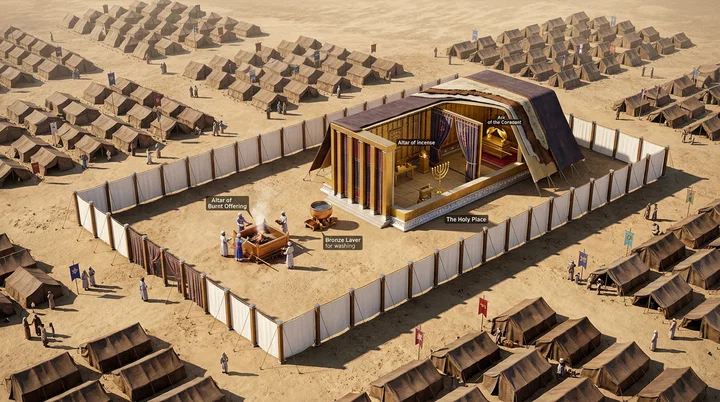
The command directed that a bronze basin filled with water for the priests' use be placed in the court before the entrance of the meeting tent, between that tent and the altar of burnt offering.RH Feb 11, 1858ST Sep 17, 1902RH Aug 21, 1856ST May 20, 1880ST Feb 17, 1890 It belongs to the account of Moses rearing up the wilderness tabernacle in Sinai on the first day of the first month in the second year after the departure from Egypt, arranging its furnishings exactly according to the divine pattern, after which the cloud covered the tent and the glory of the Lord filled it as God's dwelling place among Israel and the center of worship under the typical system.RH Apr 13, 1876RH Feb 11, 1858RH Aug 21, 1856ST Dec 10, 1896 That water-filled basin was part of the divinely prescribed rites and services that were object lessons in spiritual truth, revealing God's great love, unfolding the plan of redemption, teaching how sinners may approach God, and pointing forward to atonement.ST Sep 17, 1902ST Jul 8, 1930RH Jul 8, 1852 The movable wilderness sanctuary thus described, summarized in Hebrews 9:1-5, was typical of and foreshadowed the true tabernacle which the Lord pitched and not man, and its ceremonial ordinances of types and shadows with their Levitical priesthood found their purpose fulfilled in Christ's ministry in the heavenly sanctuary.ST Jun 4, 1885RH Jul 8, 1852ST Jun 26, 1907RH Jun 10, 1862 The sanctuary so erected was sanctified and set apart for holy use before its service began, and could not be used as a common house.RH Jul 16, 1861ST Oct 25, 1905
Laver Placement and History
Exodus 40:7 belongs to the account of Moses erecting the wilderness tabernacle and arranging its sacred furnishings, and the completed sanctuary became God's dwelling place among Israel and the center of their worship under the typical system.RH Apr 13, 1876 The laver commanded there was a brazen vessel holding water for the priests' use, set between the tent of meeting and the altar of burnt offering before the tabernacle entrance and filled with water.ST Sep 17, 1902ST May 20, 1880RH Aug 4, 1863RH Jan 6, 1853 It was part of the divinely prescribed arrangement for worship in the sanctuary courtyard, whose rites and services were object lessons in spiritual truths.ST Sep 17, 1902ST Feb 17, 1890
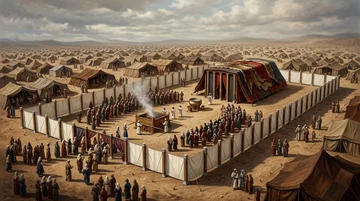
It stood outside before the door of the tabernacle within the court enclosed with curtains of fine twined linen erected around the whole.RH Feb 11, 1858RH Aug 21, 1856 It was put in place when Moses reared up the tabernacle in the wilderness of Sinai in the second year after Israel departed from Egypt, on the first day of the first month.RH Feb 11, 1858RH Aug 21, 1856 At that time he arranged the ark, mercy-seat, vail, table of shewbread, candlestick with its lighted lamps, altar of incense, and altar of burnt offering as commanded and offered the burnt offering and meat offering on the altar before the door, after which the cloud covered the tent of the congregation and the glory of the Lord filled the tabernacle.RH Feb 11, 1858RH Aug 21, 1856
The structure was marvelously beautiful, made from free-will offerings exactly according to the divine pattern given to Moses in the mount in Exodus 25-31, with its dimensions, material, and furnishings, by workmen specially endowed by God, after Israel's deliverance from Egyptian bondage with a mighty hand.ST Dec 10, 1896ST Jun 26, 1907 Hundreds of years of slavery had unfitted Israel to comprehend God's great salvation and the character He required, so God gave this fuller system with a great multiple object-lesson. From Eden to the Exodus the approach to God was simple, with the father of each family acting as priest and mediator by offering a lamb for sin upon an altar of rough stones.ST Jul 8, 1930
The setting up of the completed tabernacle before its appointed priestly service began brought blessing and glory upon the congregation, and God's glory manifested there showed His acceptance of the people's repentance.ST Jan 27, 1909ST Jan 31, 1911ST Nov 19, 1894 The fact that Moses set up the tabernacle and placed its furniture on the first day of the first month does not prove that Abib 1 was the weekly Sabbath, because the command to set out the showbread every Sabbath was given later than the setting up.ST Jul 17, 1879ST Jul 17, 1879
Sanctuary Teaching and Fulfillment
The water-filled laver standing in the courtyard between the tent of meeting and the altar of burnt offering was part of the divinely prescribed arrangement for worship given after the deliverance from Egypt with a mighty hand.ST Sep 17, 1902ST Jul 8, 1930 Because centuries of slavery had unfitted Israel to grasp God's great salvation and the character He required, He gave a great multiple object-lesson by various forms and rites comprehending the great plan of salvation. From Eden to the Exodus approach to God had been simple, with the father of each family acting as priest and mediator by offering a lamb for sin upon an altar of rough stones, but this fuller system revealed more fully His great love and unfolded the plan of redemption.ST Jul 8, 1930 Its rites and services were object lessons in spiritual truths teaching how sinners could approach God and pointing forward to atonement.ST Sep 17, 1902 The sanctuary was built from free-will offerings of all that would be used in it at God's request that they make Him a sanctuary that He might dwell among them, marvelously beautiful, its pattern divine and given to Moses in the mount, by workmen specially endowed by God, with the laver and its service standing in the court surrounding the portable structure together with the altar of burnt offering outside the two apartments separated by a curtain.ST Jul 8, 1930
That wilderness sanctuary is described completely in Exodus 25-31 and 35-40 and summarized in Hebrews 9:1-5, with its dimensions, material, and furnishings made exactly according to the directions given to Moses in the mount.ST Jun 4, 1885ST Jun 26, 1907 It was God's movable dwelling-place among men in the wilderness built after the deliverance from Egypt so that He might dwell among them, and it remained so through the time of the judges, Samuel, Saul, and David.ST Jun 4, 1885ST Jun 26, 1907 Solomon afterward built the temple after the same pattern, and from its dedication when the glory of the Lord filled the house it was God's dwelling-place among Israel.ST Jun 4, 1885 The movable worldly sanctuary was typical of and foreshadowed the true tabernacle which the Lord pitched and not man.ST Jun 26, 1907
These ceremonial ordinances belonged to the Jewish system of types and shadows whose shadows trace the substance of the new dispensation and whose purpose was fulfilled in Christ.RH Jun 10, 1862 The ark containing God's law was placed in the tabernacle's Most Holy Place where the Levitical priesthood ministered before it, and that ministry was a temporary pattern of Christ's ministry in the heavenly sanctuary, not an abolition of the law.RH Jul 8, 1852 The verse is part of the law of Moses set forth in Exodus 20 to 40 and Leviticus that is to be remembered in the last days, standing together with the moral, civil, health, and conduct laws including the Ten Commandments with the statutes and judgments commanded in Horeb. It belongs among the laws revealing offerings, sacrifices, and types, all included in the law of Moses.
The verse belongs to the third division of Exodus dealing with worship, giving part of the established form of worship set up for Israel after their deliverance from Egypt as they became a nation with thorough organization, efficient leadership, and a complete code of laws.RH Jan 20, 1916 The book containing it means going out, referring to the departure of Israel from Egypt.RH Jan 20, 1916 It belongs to a separate set of laws God gave to regulate worship, distinct from the set He gave for civil government in Exodus 21 to 23.ST Sep 3, 1896 Civil government and religion are therefore two systems with essentially different purposes that must operate on entirely separate lines, civil government being a temporary arrangement of force to control men and regulate their relations to each other in this life, and true Gospel religion being designed to bring men back to God by persuasion.ST Sep 3, 1896
The sanctuary God commanded Israel to make so He might dwell among them was sanctified and set apart for holy use before its service began, with its building instructions and particulars including the placing of the laver.RH Jul 16, 1861ST Oct 25, 1905 The priests could not use it as they would their own houses.RH Jul 16, 1861
Sources