Ezekiel 16:12
And I put a jewel on thy forehead, and earrings in thine ears, and a beautiful crown upon thine head.
Translations
And I put a jewel on your forehead, and earrings in your ears, and a beautiful crown on your head.
King James Version, KJV Cambridge Paragraph Bible
And I put a jewel on thy forehead, and earrings in thine ears, and a beautiful crown upon thine head.
And I put a jewel on thy forehead, and ear-rings in thy ears, and a beautiful crown upon thy head.
And I put a ring upon thy nose, and earrings in thine ears, and a beautiful crown upon thine head.
And I put a ring upon thy nose, and ear-rings in thine ears, and a beautiful crown upon thy head.
And I give a ring for thy nose, And rings for thine ears, And a crown of beauty on thy head.
and I put a ring on thy nose, and earrings in thine ears, and a beautiful crown upon thy head.
And put a nose-jewel upon thy nose, And earrings in thine ears, And a crown of adorning, upon thy head.
Berean Standard Bible, Majority Standard Bible
I put a ring in your nose, earrings on your ears, and a beautiful crown upon your head.
I put a ring on your nose, earrings in your ears, and a beautiful crown on your head.
And I put a ring in your nose and ear-rings in your ears and a beautiful crown on your head.
And I put a frontlet vpon thy face, and earings in thine eares, and a beautifull crowne vpon thine head.
Douay-Rheims (Challoner revision)
And I put a jewel upon thy forehead and earrings in thy ears, and a beautiful crown upon thy head.
Pictures
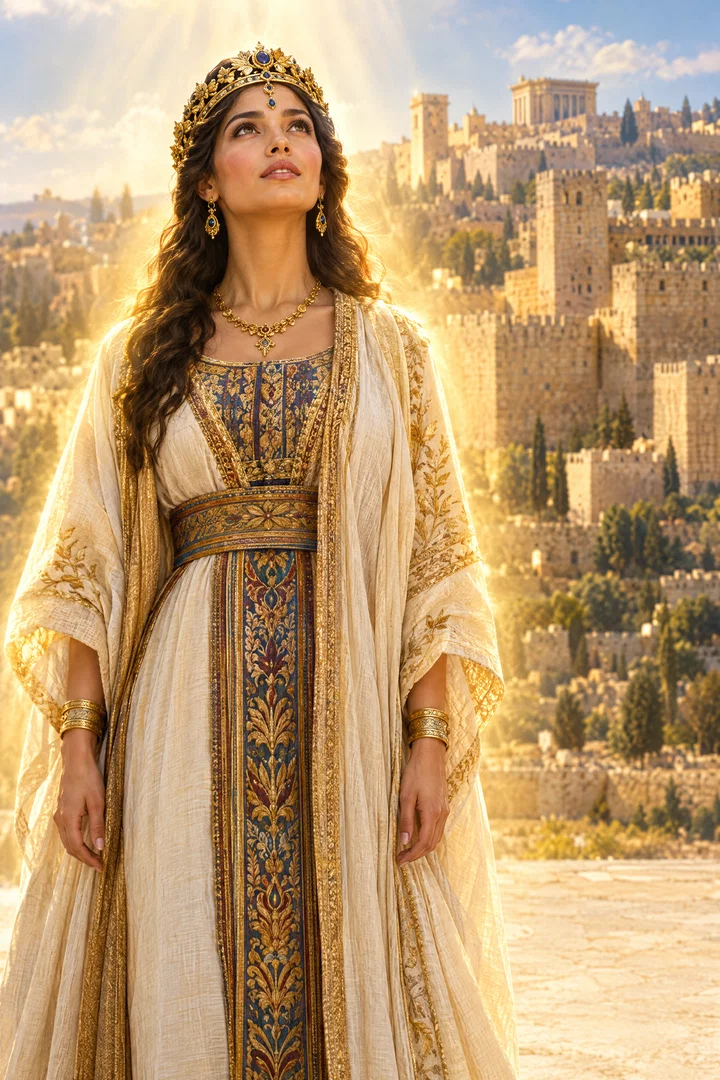
Cross-references
- Isaiah 61:10
I will greatly rejoice in the LORD, my soul shall be joyful in my God; for he hath clothed me with the garments of salvation, he hath covered me with the robe of righteousness, as a bridegroom decketh himself with ornaments, and as a bride adorneth herself with her jewels.
God adorns His people with salvation and righteousness, using a bride’s adornment as an image.
- Ezekiel 16:8
Now when I passed by thee, and looked upon thee, behold, thy time was the time of love; and I spread my skirt over thee, and covered thy nakedness: yea, I sware unto thee, and entered into a covenant with thee, saith the Lord GOD, and thou becamest mine.
The Lord’s covenant with Jerusalem is portrayed as a marriage.
- Jeremiah 2:32
Can a maid forget her ornaments, or a bride her attire? yet my people have forgotten me days without number.
Uses a bride’s adornment as an image.
- Isaiah 54:5
For thy Maker is thine husband; the LORD of hosts is his name; and thy Redeemer the Holy One of Israel; The God of the whole earth shall he be called.
Names the Lord as Jerusalem’s husband.
Commentary
Each commentary is drawn from primary sources: the writings of Ellen G. White and Adventist pioneers and periodicals. Each commentary is separate. Its own words are not a quotation; follow the references to read the source passages.
Pioneers and periodicals
17 sources
The Lord adorned Jerusalem as His covenant bride with gifts of affection to display her beauty as His own.RH Feb 14, 1856ST May 4, 1904RH Oct 7, 1851 Her surpassing loveliness and honor came wholly from Him, for He made her lovely with His own beauty, grace, righteousness and holiness.ST So also the pardoned sinner after repentance is honored and covered with Christ's perfect righteousness, his beauty coming from God's comeliness and not his own merit. The city portrayed as a woman stands for the professed church, and an immoral woman for a corrupt and apostate church, so Jerusalem espoused to the Lord and then turned harlot by seeking the friendship of the world, joining herself to the nations and their gods, and entering unlawful union with earthly powers.ST Jun 29, 1876RH Feb 20, 1855RH Feb 20, 1855RH Oct 19, 1869ST Aug 30, 1905 Her fall was a moral fall and rejection by God, as with the Babylon of Revelation 17, with her destruction deferred for a considerable time after she had fallen.ST Jun 29, 1876RH Feb 21, 1854RH Mar 6, 1855RH Feb 10, 1874
Setting and Marriage Imagery
Ezekiel 16:12 falls within the first twenty chapters of Ezekiel, given through Ezekiel among the captives in Babylonia by the river Chebar while Jeremiah was prophesying in Jerusalem.ST Jul 25, 1911 The chapter's marriage language portrays the Lord making a covenant with His people so that they became His, which they afterward broke by trusting in another.RH Feb 14, 1856 That covenant union does not describe the marriage of the Lamb at the end.RH Feb 14, 1856 Marriage then was accompanied by customs and ceremony such as betrothal, the bride's move from her father's house to her husband's, solemn covenants, feasts, and the presence of friends.ST May 4, 1904
In the allegory Jerusalem is the wife and the people are her children.RH Oct 7, 1851 The jewel on the forehead, the earrings in the ears, and the beautiful crown upon the head are gifts and tokens of affection adorning Jerusalem.RH Oct 7, 1851 They display her beauty as the Lord's bride.RH Oct 7, 1851
Beauty Bestowed by God
The jewel on the forehead, the earrings in the ears, and the beautiful crown upon the head are figures of the spiritual beauty that God Himself bestowed upon His church.ST That adorning signifies the grace and loveliness with which He clothes His people, making them surpassingly lovely with His own beauty.ST Their righteousness and holiness and life are derived from Him, and the beauty and honor they bear are gifts of His majesty.ST
The same adorning belongs also to the pardoned individual whom God honors and beautifies. After godly sorrow and repentance for guilt, He covers such a one with the robe of Christ's perfect righteousness. The beauty then seen is not of personal merit but comes from God's own comeliness put upon the forgiven sinner.
Harlot Church and Babylon
The combined figure of a city and a woman stands for a church, for the professed people of God, with a woman denoting the church and a lewd or immoral woman denoting a corrupt, apostate church.RH Feb 20, 1855RH Oct 19, 1869ST Aug 30, 1905 The jewel on the forehead with the earrings and beautiful crown belongs to that symbolic portrayal of unfaithfulness, in which the chosen people, the Jews, are shown by their city Jerusalem as a lewd woman playing the harlot with many lovers when they apostatized from God.RH Feb 20, 1855RH Oct 19, 1869 This use of a woman for a church bears directly on the woman and harlot of Revelation 17, identifying her as an ecclesiastical body, a professedly religious and corrupted body rather than earthly civil power in the abstract.RH Feb 21, 1854RH Feb 10, 1874
The Jewish church, represented by Jerusalem, was espoused to the Lord and then became a harlot in the same manner as the Babylon of Revelation, by apostatizing from God and seeking the friendship of the world and entering unlawful union with the kings of the earth.ST Jun 29, 1876RH Feb 20, 1855ST Jun 11, 1896 That unfaithfulness meant joining herself to the surrounding nations and to Babylon itself, worshiping their gods, and rejecting God's precepts after forsaking God her husband.ST Jun 29, 1876RH Oct 19, 1869ST Jun 11, 1896 Because the church is lawfully married to God alone, unlawful union of His church with the world is fornication and adultery, and the covenant relationship set forth with its adornment makes union with the world spiritual adultery and unfaithfulness to God.ST Jan 8, 1902 Israel's backsliding, idolatry, and conformity to the world are so described as adultery, and Israel's history in this chapter serves as a prototype for the apostate church that rejects God's message and seeks the support of earthly powers instead of the Lord.ST Oct 1, 1894ST Jan 8, 1902
Her fall illustrates the fall of Babylon, for the Jewish church espoused to the Lord became unfaithful to Him and her fall was her moral fall and her rejection by God.ST Jun 29, 1876RH Mar 6, 1855 That fall was not her immediate destruction, since her destruction was deferred for a considerable period after she had fallen and been rejected, with destruction coming later after rejection.ST Jun 29, 1876RH Mar 6, 1855
Sources