Ezekiel 16:13
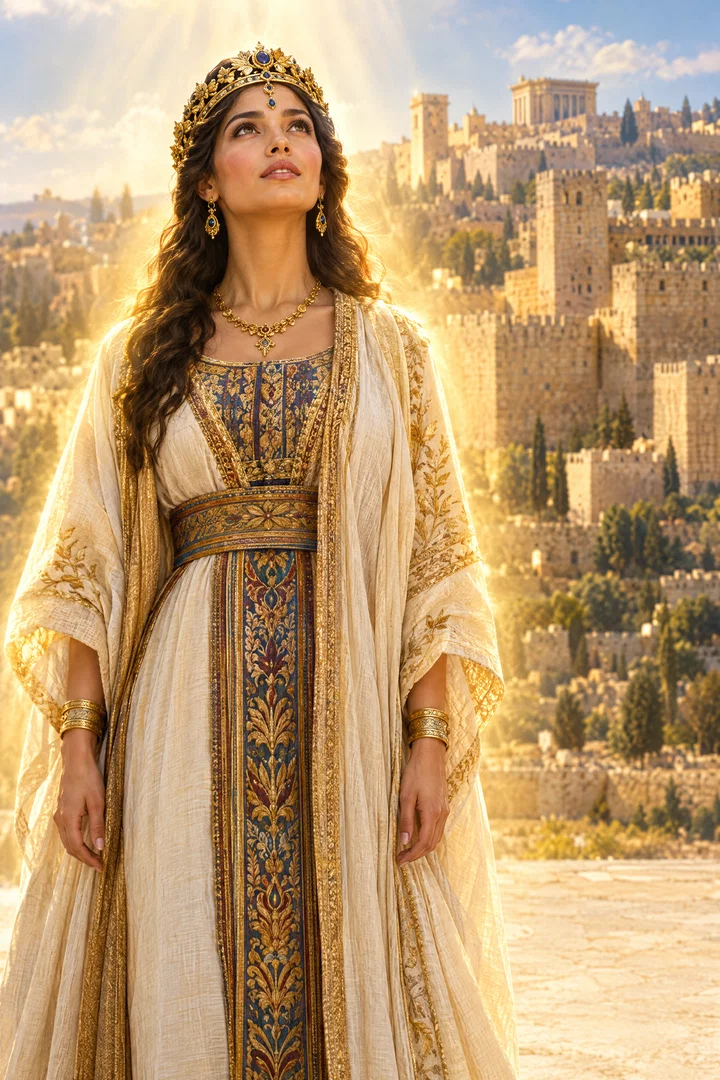
Thus wast thou decked with gold and silver; and thy raiment was of fine linen, and silk, and broidered work; thou didst eat fine flour, and honey, and oil: and thou wast exceeding beautiful, and thou didst prosper into a kingdom.
Translations
Thus were you decked with gold and silver; and your raiment was of fine linen, and silk, and broidered work; you did eat fine flour, and honey, and oil: and you were exceeding beautiful, and you did prosper into a kingdom.
King James Version, KJV Cambridge Paragraph Bible, Webster Bible
Thus wast thou decked with gold and silver; and thy raiment was of fine linen, and silk, and broidered work; thou didst eat fine flour, and honey, and oil: and thou wast exceeding beautiful, and thou didst prosper into a kingdom.
Thus wast thou decked with gold and silver; and thy raiment was of fine linen, and silk, and broidered work; thou didst eat fine flour, and honey, and oil: and thou wast exceeding beautiful, and thou didst prosper unto royal estate.
Thus wast thou decked with gold and silver; and thy raiment was of fine linen, and silk, and broidered work; thou didst eat fine flour, and honey, and oil; and thou wast exceeding beautiful, and thou didst prosper unto royal estate.
And thou dost put on gold and silver, And thy clothing [is] fine linen, And figured silk and embroidery, Fine flour, and honey, and oil thou hast eaten, And thou art very very beautiful, And dost go prosperously to the kingdom.
Thus wast thou decked with gold and silver, and thy raiment was byssus, and silk, and embroidered work. Thou didst eat fine flour, and honey, and oil; and thou becamest exceedingly beautiful, and thou didst prosper into a kingdom.
Thus wast thou adorned with gold and silver, And thy raiment was of fine linen and silk and embroidered work, Fine flour and honey and oil, didst thou eat,— And so thou becamest exceedingly beautiful, And didst attain unto royalty.
Berean Standard Bible, Majority Standard Bible
So you were adorned with gold and silver, and your clothing was made of fine linen, silk, and embroidered cloth. You ate fine flour, honey, and oil. You became very beautiful and rose to be queen.
Thus you were decked with gold and silver. Your clothing was of fine linen, silk, and embroidered work. You ate fine flour, honey, and oil. You were exceedingly beautiful, and you prospered to royal estate.
So you were made beautiful with gold and silver; and your clothing was of the best linen and silk and needlework; your food was the best meal and honey and oil: and you were very beautiful.
Thus wast thou deckt with gold and siluer, and thy rayment was of fine linen, and silke, and broydred worke: thou didest eate fine floure, and honie and oyle, and thou wast very beautifull, and thou didest grow vp into a kingdome.
Douay-Rheims (Challoner revision)
And thou wast adorned with gold, and silver, and wast clothed with fine linen, and embroidered work, and many colours: thou didst eat fine hour, and honey, and oil, and wast made exceeding beautiful: and wast advanced to be a queen.
Pictures
Cross-references
- Jeremiah 3
They say, If a man put away his wife, and she go from him, and become another man’s, shall he return unto her again? shall not that land be greatly polluted? but thou hast played the harlot with many lovers; yet return again to me, saith the LORD.
Named as another record of Israel’s past used as a prototype.
- 2 Corinthians 11:2
For I am jealous over you with godly jealousy: for I have espoused you to one husband, that I may present you as a chaste virgin to Christ.
The church is promised to Christ as a chaste bride.
- Hosea 2:19-20
And I will betroth thee unto me for ever; yea, I will betroth thee unto me in righteousness, and in judgment, and in lovingkindness, and in mercies.
The Lord promises to restore Israel through a renewed betrothal covenant.
- Jeremiah 2:20
For of old time I have broken thy yoke, and burst thy bands; and thou saidst, I will not transgress; when upon every high hill and under every green tree thou wanderest, playing the harlot.
Both texts portray Jerusalem as unfaithful to God.
- Jeremiah 3:14
Turn, O backsliding children, saith the LORD; for I am married unto you: and I will take you one of a city, and two of a family, and I will bring you to Zion:
God describes His bond with Israel as marriage.
- Ezekiel 16:8
Now when I passed by thee, and looked upon thee, behold, thy time was the time of love; and I spread my skirt over thee, and covered thy nakedness: yea, I sware unto thee, and entered into a covenant with thee, saith the Lord GOD, and thou becamest mine.
God enters a covenant with Israel and claims her as his own.
- Isaiah 61:10
I will greatly rejoice in the LORD, my soul shall be joyful in my God; for he hath clothed me with the garments of salvation, he hath covered me with the robe of righteousness, as a bridegroom decketh himself with ornaments, and as a bride adorneth herself with her jewels.
Uses the imagery of a bride adorned for her wedding.
- Isaiah 54:5
For thy Maker is thine husband; the LORD of hosts is his name; and thy Redeemer the Holy One of Israel; The God of the whole earth shall he be called.
Names the Lord as Israel’s husband.
- Ezekiel 16:21
That thou hast slain my children, and delivered them to cause them to pass through the fire for them?
The slain children are Jerusalem’s people.
- Ezekiel 16:60-62
Nevertheless I will remember my covenant with thee in the days of thy youth, and I will establish unto thee an everlasting covenant.
Jerusalem is restored to the Lord under an everlasting covenant.
- Jeremiah 2:32
Can a maid forget her ornaments, or a bride her attire? yet my people have forgotten me days without number.
Recalls a bride’s adornment and marriage imagery.
- Jeremiah 3:6
The LORD said also unto me in the days of Josiah the king, Hast thou seen that which backsliding Israel hath done? she is gone up upon every high mountain and under every green tree, and there hath played the harlot.
Both describe Israel’s unfaithfulness to God as adultery.
- Jeremiah 3:20
Surely as a wife treacherously departeth from her husband, so have ye dealt treacherously with me, O house of Israel, saith the LORD.
Israel’s treachery toward God is compared to a wife’s betrayal.
- Ezekiel 23
The word of the LORD came again unto me, saying,
Both portray Judah and Israel’s sins through the figure of lewd women.
- Revelation 17:3-6
So he carried me away in the spirit into the wilderness: and I saw a woman sit upon a scarlet coloured beast, full of names of blasphemy, having seven heads and ten horns.
The richly adorned woman represents the church’s alliance with earthly rulers and its apostasy.
- Ezekiel 16:36
Thus saith the Lord GOD; Because thy filthiness was poured out, and thy nakedness discovered through thy whoredoms with thy lovers, and with all the idols of thy abominations, and by the blood of thy children, which thou didst give unto them;
The wife represents Jerusalem, and her children represent its people.
- Hosea 2:2
Plead with your mother, plead: for she is not my wife, neither am I her husband: let her therefore put away her whoredoms out of her sight, and her adulteries from between her breasts;
Israel’s covenant unfaithfulness is described as adultery.
- Ezekiel 16:32
But as a wife that committeth adultery, which taketh strangers instead of her husband!
Israel is condemned as an unfaithful wife.
- Ezekiel 16:2
Son of man, cause Jerusalem to know her abominations,
Introduces the allegory that exposes Jerusalem’s abominations.
Commentary
Each commentary is drawn from primary sources: the writings of Ellen G. White and Adventist pioneers and periodicals. Each commentary is separate. Its own words are not a quotation; follow the references to read the source passages.
Ellen G. White
2 sources
Thus she was decked with gold and silver, and her raiment was of fine linen and silk and broidered work, and she ate fine flour and honey and oil, and she was made exceeding beautiful and prospered into a kingdom through the gifts and beauty God bestowed on her.GC88 381.1–382.1GC 381.1–382.1 Her beauty was perfect through His comeliness and splendor put upon her.GC88 381.1–382.1GC 381.1–382.1 Her renown spread among the nations because of that beauty.GC88 381.1–382.1
She then trusted in her own beauty and was unfaithful to God, turning away from Him.GC88 381.1–382.1GC 381.1–382.1 The verse belongs to the setting of God's covenant with Israel, illustrating His covenant love for His people and their later departure from Him.GC88 381.1–382.1GC 381.1–382.1 Its picture of prosperity serves as a warning that God's people become unfaithful when they let worldly love replace devotion to Him.GC 381.1–382.1
Sources
Pioneers and periodicals
21 sources
Ezekiel 16:13 belongs to a marriage allegory in which Jerusalem is the wife and her people are her children, and her gold and silver, fine clothing, rich food and rise to a kingdom are the gifts and beauty God himself placed upon her in covenant, not qualities she produced herself.STRH Oct 7, 1851ST May 4, 1904RH Feb 14, 1856 That adorning makes beautiful with spiritual character and righteousness and holiness and life, and for the individual it is the covering of sin by Christ's perfect righteousness received with grace after godly sorrow and repentance.ST Having thus prospered while belonging to the Lord, she broke the covenant and turned to another, abandoning her husband God for foreign powers and their gods and ways, which stands as the prototype of a church that leaves God to seek the support of earthly powers.RH Oct 19, 1869ST Jun 11, 1896RH Feb 14, 1856ST Oct 1, 1894 Such departure is spiritual adultery, for a woman is a church and a lewd woman is a corrupt fallen church, so union of God's church with the world in unlawful union with the kings of the earth is fornication that mixes heaven with earth and righteousness with sin.RH Feb 20, 1855RH Feb 10, 1874ST Aug 30, 1905ST Mar 23, 1915 In this light the harlot Babylon is not civil government or abstract evil but a corrupt professedly religious body distinct from the kings yet unlawfully joined to them, and as with the Jewish church her fall was rejection by God while her destruction was deferred for a time.ST Jun 29, 1876RH Feb 20, 1855ST Jun 29, 1876RH Feb 21, 1854RH Mar 6, 1855
Covenant Beauty Bestowed
Ezekiel 16:8-14 sets the verse within a marriage description, where marriage involves a covenant and formal customs including the bride's passage from her father's house to her husband's house.ST May 4, 1904 In that allegory the beautiful and prospering Jerusalem is the wife and the people of the land are her children.RH Oct 7, 1851 The clothing and adornment, the admiration of her beauty, and her prosperity begin the account of the Lord's covenant relationship with Jerusalem, which is afterward broken and ultimately restored under an everlasting covenant.RH Oct 7, 1851
The gold and silver, fine clothing, rich food of fine flour and honey and oil, and royal prosperity express gifts and beauty that God placed upon His church, including spiritual character, righteousness, holiness, and life.ST He clothes His people in fine garments and adorns them with ornaments, making them beautiful and prosperous.ST That beauty comes from Him and not from qualities she produced for herself.ST The verse therefore depicts former adornment, abundance, beauty, and rise to kingdom prosperity as gifts received while the Lord had made the people His, before they broke the covenant and turned to another.RH Feb 14, 1856
For the individual, being adorned and made beautiful represents receiving heaven's light and Christ's perfect righteousness. This covering of sin and pardon comes with God's grace, and godly sorrow and repentance for guilt precede it. So also the church at Rome was adorned with beauty and prosperity that God had given her.RH Feb 13, 1900 Her faith clothed her with salvation and the Lord's righteousness, and God's power and godliness were displayed before the nations.RH Feb 13, 1900 Her renown spread throughout the world because the beauty was God's gift and not her own merit.RH Feb 13, 1900
Apostasy and Babylon Symbol
Ezekiel 16:13 stands within a strong parable concerning the apostasy of Judah and Israel.ST Nov 17, 1909 The chapter portrays their sins under the figure of a lewd woman, with the adornment and prosperity in the verse forming part of that portrayal.ST Nov 17, 1909ST Aug 19, 1913
A woman is the symbol of a church, and a harlot or lewd woman is the symbol of a corrupt, fallen, apostate church.RH Feb 20, 1855RH Feb 10, 1874ST Aug 30, 1905 That meaning is used to identify Babylon as the professed church united with the world and as an ecclesiastical body.RH Feb 20, 1855RH Feb 10, 1874 The harlot Babylon of Revelation is therefore not the earthly power of human government or an abstract evil, but a corrupt professedly religious body, distinct from the kings of the earth though unlawfully united with them.RH Feb 21, 1854
The Jewish church, once espoused to the Lord, became a harlot in the same manner as the professed Christian church, by seeking the friendship of the world in unlawful union and connection with the kings of the earth.ST Jun 29, 1876RH Feb 20, 1855 When joined to God His church is richly adorned and flourishing, but union of His church with the world is fornication and adultery.ST Mar 23, 1915 Israel's departure from God and conformity to the world was spiritual adultery, mixing heaven with earth and righteousness with sin in unfaithfulness to God.ST Mar 23, 1915ST Jan 8, 1902
Jerusalem, representing God's chosen people, prospered and became beautiful through gifts of gold, silver, fine clothing, and rich food.RH Oct 19, 1869 She then turned from God to foreign powers and their ways, worshiping the surrounding nations' gods, abandoning her husband God and joining herself to Babylon.RH Oct 19, 1869ST Jun 11, 1896 This record of Israel's past serves as a prototype for a church that turns from God and seeks the support of earthly powers.ST Jun 11, 1896ST Oct 1, 1894
The fall of the Jewish church as a harlot illustrates the moral fall of Babylon.ST Jun 29, 1876 Her fall was her rejection by God, not her destruction, for her destruction was deferred for a considerable period after her rejection.ST Jun 29, 1876RH Mar 6, 1855 The fine clothing, gold, silver, and precious ornaments, first described as beauty and prosperity received as gifts, become figures for the church's reliance on its own adornment and attractiveness as it seeks earthly alliances, symbols of self-trust and entanglement with worldly power.RH Feb 13, 1900
Sources