Ezekiel 18:2
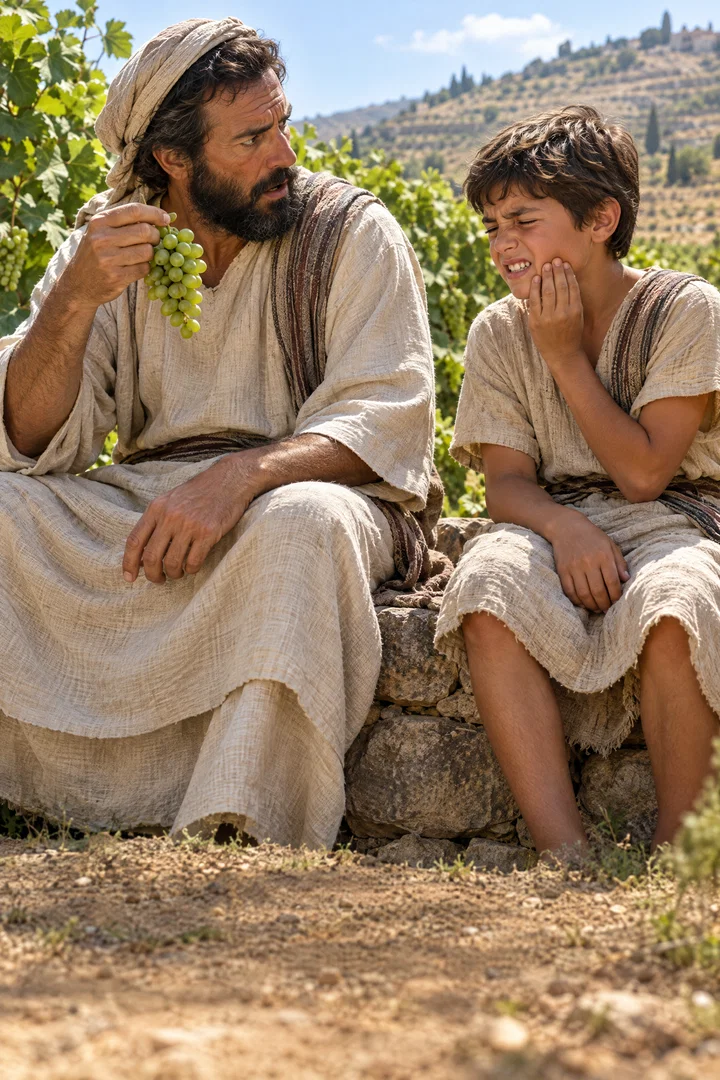
What mean ye, that ye use this proverb concerning the land of Israel, saying, The fathers have eaten sour grapes, and the children’s teeth are set on edge?
Translations
What mean you, that you use this proverb concerning the land of Israel, saying, The fathers have eaten sour grapes, and the children’s teeth are set on edge?
King James Version, KJV Cambridge Paragraph Bible, Revised Version, American Standard Version
What mean ye, that ye use this proverb concerning the land of Israel, saying, The fathers have eaten sour grapes, and the children’s teeth are set on edge?
What mean ye, that ye use this proverb concerning the land of Israel, saying, The fathers have eaten sour grapes, and the children's teeth are set on edge?
'What — to you, ye — using this simile Concerning the ground of Israel, saying: Fathers do eat unripe fruit, And the sons' teeth are blunted?
What mean ye, ye who use this proverb of the land of Israel, saying, [ The] fathers eat sour grapes, and the children's teeth are set on edge?
What occasion have ye, to be using this proverb, concerning the soil of Israel, saying, —Fathers eat sour grapes, And the children’s teeth are blunted?
Berean Standard Bible, Majority Standard Bible
“ What do you people mean by quoting this proverb about the land of Israel:
‘ The fathers have eaten sour grapes,
and the teeth of the children are set on edge’?“ What do you mean, that you use this proverb concerning the land of Israel, saying,
‘ The fathers have eaten sour grapes,
and the children’s teeth are set on edge’?Why do you make use of this saying about the land of Israel, The fathers have been tasting bitter grapes and the children's teeth are on edge?
What meane ye that ye speake this prouerbe, concerning the land of Israel, saying, The fathers haue eaten sowre grapes, and the childrens teeth are set on edge?
Douay-Rheims (Challoner revision)
That you use among you this parable as a proverb in the land of Israel, saying: The fathers have eaten sour grapes, and the teeth of the children are set on edge.
Pictures
Cross-references
- Ezekiel 18:20
The soul that sinneth, it shall die. The son shall not bear the iniquity of the father, neither shall the father bear the iniquity of the son: the righteousness of the righteous shall be upon him, and the wickedness of the wicked shall be upon him.
Each person bears responsibility for their own sin, not a parent’s guilt.
- Jeremiah 31:29-30
In those days they shall say no more, The fathers have eaten a sour grape, and the children’s teeth are set on edge.
Repeats the sour-grapes proverb and says each person answers for their own iniquity.
- Exodus 20:5
Thou shalt not bow down thyself to them, nor serve them: for I the LORD thy God am a jealous God, visiting the iniquity of the fathers upon the children unto the third and fourth generation of them that hate me;
Iniquity is described as reaching later generations, while Ezekiel emphasizes personal guilt.
- Galatians 6:7
Be not deceived; God is not mocked: for whatsoever a man soweth, that shall he also reap.
Each person reaps according to what they sow.
- Ezekiel 33:10-20
Therefore, O thou son of man, speak unto the house of Israel; Thus ye speak, saying, If our transgressions and our sins be upon us, and we pine away in them, how should we then live?
Both chapters reject inherited blame and call each person to account for their own conduct.
- Ezekiel 18:30-32
Therefore I will judge you, O house of Israel, every one according to his ways, saith the Lord GOD. Repent, and turn yourselves from all your transgressions; so iniquity shall not be your ruin.
Calls each person to turn from transgression and live.
- Romans 2:6
Who will render to every man according to his deeds:
States that God renders to each person according to their works.
- 2 Corinthians 5:10
For we must all appear before the judgment seat of Christ; that every one may receive the things done in his body, according to that he hath done, whether it be good or bad.
Connects individual deeds with each person’s judgment.
Commentary
Each commentary is drawn from primary sources: the writings of Ellen G. White and Adventist pioneers and periodicals. Each commentary is separate. Its own words are not a quotation; follow the references to read the source passages.
Ellen G. White
6 sources
The question exposes and forbids the proverb then current in Israel that children suffer for their fathers' sins, rejecting inherited blame as an excuse for personal conduct and for refusing repentance.Lt 254, 1908, par. 9–10Ms 79, 1901, par. 24–26Ms 75, 1895, par. 6–8 Its context declares that every soul belongs to God, that the soul who sins shall die, and that the one who acts justly and keeps His judgments shall live.Lt 254, 1908, par. 9–10Ms 79, 1901, par. 24–26Ms 75, 1895, par. 6–8 The son shall not bear the iniquity of the father, nor the father bear the iniquity of the son.Ms 75, 1895, par. 6–8
Children who have reached years of accountability are responsible for their own actions and must cooperate with God in working out their own salvation.Ms 75, 1895, par. 6–8 When parents' commands conflict with God's commands, children must obey God as heavenly Father, Owner, Creator and Redeemer, even if punished or cast out for it, while still respecting parents and not hating them.Ms 75, 1895, par. 6–8 When underage children are compelled to transgress what is plainly prescribed by the commandments, the sin is charged to the parents who cause them to transgress.Ms 75, 1895, par. 6–8
Righteous living means walking in God's statutes and judgments, not oppressing others, restoring the pledge, not spoiling by violence, giving bread to the hungry, covering the naked with a garment, not lending on usury, withdrawing the hand from iniquity, and executing true judgment between people.Ms 75, 1895, par. 6–8 If the wicked turns from his wickedness and keeps God's statutes and does what is lawful and right, he shall surely live and his transgressions shall not be mentioned against him, for God has no pleasure in the death of the wicked but desires that he turn and live.Ms 75, 1895, par. 6–8 In another sense, a father's habits of dissipation, dissolute recklessness and intemperance bring consequences upon his child, so that in looking upon the child he sees the result of his own unsanctified life.Ms 2, 1875, par. 36–38
Seeing that result should lead to candid conviction producing deep penitence and thorough reform, strict temperance in eating and drinking, cleansing of the heart fountain so that the streams are pure, and a hard battle to overcome self and learn self-control not in one's own strength but as a conqueror in the name of Jesus through His merits, lest there follow a bitter wretched life in this world and condemnation when judgment sits and each is judged from the books.Ms 2, 1875, par. 36–38 The chapter shows that the Lord will speak the same whether people will hear or will refuse, calling for faithful work at all times and in all places with full capability, tact and ingenuity, so that no one is left without a clear message about sin and accountability.Lt 65, 1896, par. 7–8Lt 102a, 1896, par. 6–7 The verse means messages of reproof and warning come to God's people, to mothers, to fathers and to the children of Israel, so that they do not move blindly.Lt 65, 1896, par. 7–8 Those who hear and take heed with patience and a generous, teachable spirit will receive the Lord's blessing, while those who turn from God's light and act unjustly will face His judgment.Lt 65, 1896, par. 7–8Lt 102a, 1896, par. 6–7
Sources
Pioneers and periodicals
15 sources
The verse takes up a common saying in Israel that children suffer for the wrongdoing of their fathers, as if the children's teeth ache because their fathers ate sour fruit.RH Aug 10, 1916ST Sep 20, 1883 It rejects that saying as a rule of guilt and condemnation, for no one is condemned by God for a father's sins, but each person stands or falls by whether his own life meets God's requirements.RH Feb 21, 1854RH Jul 4, 1854ST Dec 2, 1886 God's ways are equal in this, giving death to the sinner who remains impenitent and life to the sinner who turns and does what is lawful and right, so that even the child of a wicked father lives if he himself turns from evil.RH Jul 4, 1854ST May 21, 1902ST Oct 1, 1896 Yet the saying holds as an observed truth of life, since what parents were is reproduced in their children through inherited traits and consequences, as when a father's excess in drink brings illness and impairment upon later generations.ST Sep 20, 1883ST Dec 16, 1897ST Aug 19, 1897ST May 26, 1909
Proverb's Meaning and Setting
Israel used a common saying that laid the children's suffering on their fathers' wrongdoing, picturing fathers eating sour grapes while the children's teeth ached.RH Aug 10, 1916ST Sep 20, 1883 Applied to bodily life, a father's physical excess, especially heavy drinking, damages descendants so that illness and other impairments appear in later generations, the penalty following as surely as harvest follows sowing.ST Sep 20, 1883
The verse stands at the head of the Lord's word defining the just man.ST May 21, 1902 A man is just and does what is lawful and right when he oppresses none, restores the pledge, feeds the hungry and clothes the naked, has not given forth upon usury nor taken any increase, has withdrawn his hand from iniquity, executes true judgment between man and man, and walks in God's statutes and keeps His judgments to deal truly.ST May 21, 1902 Such a just man shall surely live.ST May 21, 1902 Taking usury from a brother is therefore plainly forbidden by Scripture and contrary to righteousness.ST May 21, 1902
The chapter exposes how the priests of Israel had been carried away by pagan apostasy into violating God's law and profaning His Sabbath day.ST That apostasy was sun-worship, which brought Sunday as its worship day in place of the Sabbath of Jehovah.ST This proves paganism was the first division of apostate Babylon, operating through empires to compel false worship and persecute true worshipers.ST
Personal Accountability Before God
The saying is rejected as a rule of guilt and condemnation, for no one bears God's condemnation for a father's sins.ST Dec 2, 1886 Another person's disobedience may bring trouble or bring human condemnation, but it cannot make a person sin or bring God's condemnation without that person's own consent.ST Dec 2, 1886 God judges each person by whether that person's own life is consistent with His requirements, and each person's destiny depends on his own acts.ST Dec 2, 1886
Under the gospel dispensation the saying would no longer describe Israel's responsibility, for each person dies for his or her own iniquity.RH Feb 21, 1854 It was an appendage given for Israel's particular circumstances, with reference to the Canaanites, rather than a continuing rule of personal responsibility.RH Feb 21, 1854 God's ways are equal in giving the penalty of death to the impenitent sinner and giving life to the penitent, even when that person's father was wicked, so no one is condemned simply for a parent's sin.RH Jul 4, 1854 His dealings with people respond to their conduct as a general principle of His working among humanity, so that wickedness brings judgment while turning from evil affects the judgment He has announced.ST Oct 1, 1896
The house of Israel complained of inequality because the wicked who turn from iniquity are placed on an equal footing with the righteous and their transgressions are remembered no more.RH Dec 20, 1864 In answer it is declared that if a righteous man turns from righteousness and commits iniquity his former righteousness shall not be remembered and he shall die.RH Dec 20, 1864 The declaration that the sinning soul shall die is not fulfilled by temporal death, which comes through Adam to all and cannot be escaped even by law-keeping, but requires the second death.RH Dec 20, 1864 This implies two deaths, for the man dies in his iniquity in temporal death yet must still die for the iniquity he died in, which can happen only if he is raised to life to die a second time.RH Dec 20, 1864 The saying has been taken to be reversed by Christ, though that is a strange way to explain it.RH Oct 17, 1865
Inherited Effects on Children
The sour-grapes saying expresses the observed truth that what parents were is reproduced in their children through inherited traits and consequences, which raises the question whether such inheritance is unavoidable and fair.ST May 26, 1909 A father's physical excess, especially heavy drinking, can damage his descendants, with illness and other impairments appearing in later generations as surely as harvest follows sowing.ST Sep 20, 1883 A parent's temporary physical and mental disorder from alcohol can become a fixed, lasting and often hopeless condition in the child, so that families of drunkards supply many people to insane asylums.ST Dec 16, 1897ST Aug 19, 1897
Parents who neglect their duty to discipline and care for their children contribute to their children's rebellion and sinfulness.ST Aug 2, 1877 Malicious, sour talk at the table sets children's teeth on edge, illustrating how parents' words and actions shape their children's habits and character for later life.RH Jun 24, 1875
Sources