Jeremiah 31:29
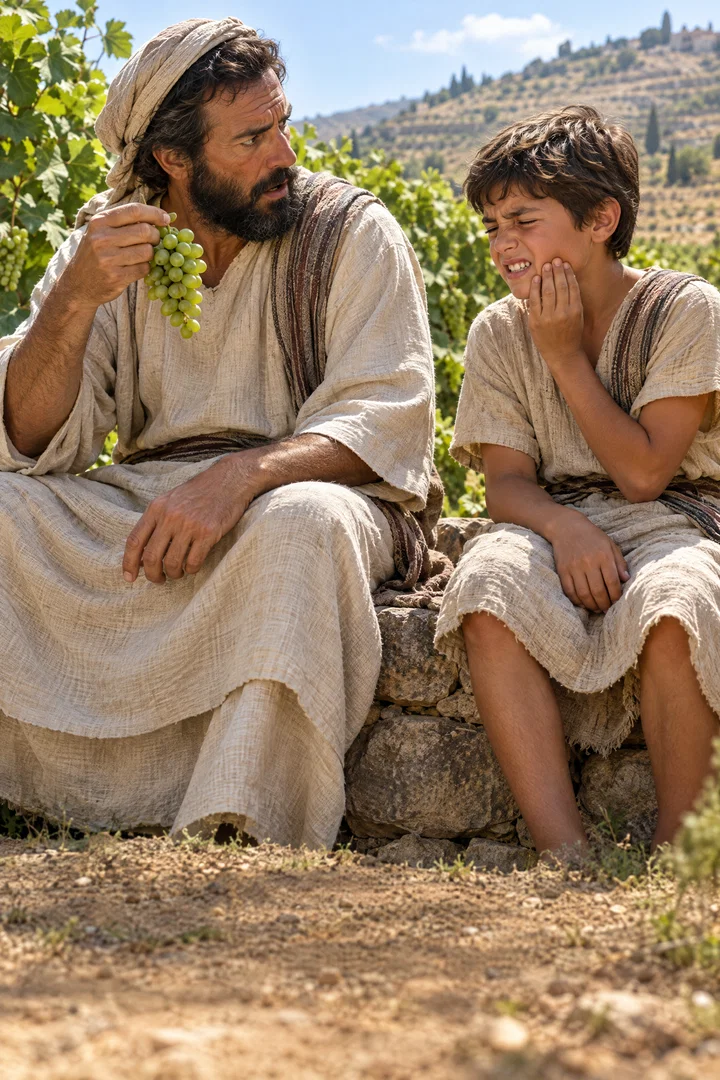
In those days they shall say no more, The fathers have eaten a sour grape, and the children’s teeth are set on edge.
Translations
American King James Version, King James Version
In those days they shall say no more, The fathers have eaten a sour grape, and the children’s teeth are set on edge.
In those days they shall say no more,
The fathers have eaten a sour grape,
And the children’s teeth are set on edge.In those days they shall say no more, The fathers have eaten a sour grape, and the children's teeth are set on edge.
Revised Version, American Standard Version
In those days they shall say no more, The fathers have eaten sour grapes, and the children’s teeth are set on edge.
In those days they do not say any more: Fathers have eaten unripe fruit, And the sons' teeth are blunted.
In those days they shall say no more, The fathers have eaten sour grapes, and the children's teeth are set on edge:
In those days, shall they say no more, Fathers, did eat sour grapes,—And, children’s teeth, are blunted!
Berean Standard Bible, Majority Standard Bible
“ In those days, it will no longer be said:
‘ The fathers have eaten sour grapes,
and the teeth of the children are set on edge.’“ In those days they will say no more,
“‘ The fathers have eaten sour grapes,
and the children’s teeth are set on edge.’In those days they will no longer say, The fathers have been tasting bitter grapes and the children's teeth are put on edge.
In those dayes shall they say no more, The fathers haue eaten a sowre grape, and the childrens teeth are set on edge.
Douay-Rheims (Challoner revision)
In those days they shall say no more: The fathers have eaten a sour grape, and the teeth of the children are set on edge.
Pictures
Cross-references
- Hebrews 8:10
For this is the covenant that I will make with the house of Israel after those days, saith the Lord; I will put my laws into their mind, and write them in their hearts: and I will be to them a God, and they shall be to me a people:
Promises God’s law written in the heart under the new covenant.
- Ezekiel 18:20
The soul that sinneth, it shall die. The son shall not bear the iniquity of the father, neither shall the father bear the iniquity of the son: the righteousness of the righteous shall be upon him, and the wickedness of the wicked shall be upon him.
Each person bears responsibility and consequences for their own sin, not a parent’s.
- Hebrews 9:15
And for this cause he is the mediator of the new testament, that by means of death, for the redemption of the transgressions that were under the first testament, they which are called might receive the promise of eternal inheritance.
Christ mediates the new covenant through his death, redeeming transgressions under the first covenant.
- Ezekiel 18:2-4
What mean ye, that ye use this proverb concerning the land of Israel, saying, The fathers have eaten sour grapes, and the children’s teeth are set on edge?
Also rejects the proverb that children bear their fathers’ guilt.
- Exodus 20:5
Thou shalt not bow down thyself to them, nor serve them: for I the LORD thy God am a jealous God, visiting the iniquity of the fathers upon the children unto the third and fourth generation of them that hate me;
Contrasts consequences extending to generations with the proverb’s cessation.
- Jeremiah 31:33
But this shall be the covenant that I will make with the house of Israel; After those days, saith the LORD, I will put my law in their inward parts, and write it in their hearts; and will be their God, and they shall be my people.
The new covenant promise explains when the proverb will no longer apply.
- Hebrews 10:9
Then said he, Lo, I come to do thy will, O God. He taketh away the first, that he may establish the second.
Establishing the new covenant ends the inherited consequences of the former order.
- Ezekiel 18:19
Yet say ye, Why? doth not the son bear the iniquity of the father? When the son hath done that which is lawful and right, and hath kept all my statutes, and hath done them, he shall surely live.
shows the same error the Jews had fallen into
- Numbers 14:18
The LORD is longsuffering, and of great mercy, forgiving iniquity and transgression, and by no means clearing the guilty, visiting the iniquity of the fathers upon the children unto the third and fourth generation.
Contrasts inherited consequences with Jeremiah’s promise that children will no longer bear their fathers’ guilt.
- John 9:2
And his disciples asked him, saying, Master, who did sin, this man, or his parents, that he was born blind?
The disciples assume the man’s blindness reflects his parents’ sin.
- Galatians 6:7
Be not deceived; God is not mocked: for whatsoever a man soweth, that shall he also reap.
Each person reaps according to their own deeds.
- Ezekiel 16:60-63
Nevertheless I will remember my covenant with thee in the days of thy youth, and I will establish unto thee an everlasting covenant.
Both describe God’s covenant promise in the days of restoration.
- Exodus 19
In the third month, when the children of Israel were gone forth out of the land of Egypt, the same day came they into the wilderness of Sinai.
Identifies the covenant made at Mount Sinai.
- Matthew 26:26-29
And as they were eating, Jesus took bread, and blessed it, and brake it, and gave it to the disciples, and said, Take, eat; this is my body.
Identifies the introduction of the new covenant.
- Romans 2:6
Who will render to every man according to his deeds:
Says God repays each person according to their works.
- Hebrews 13:20
Now the God of peace, that brought again from the dead our Lord Jesus, that great shepherd of the sheep, through the blood of the everlasting covenant,
identifies the new covenant as everlasting
- Ezekiel 11:19
And I will give them one heart, and I will put a new spirit within you; and I will take the stony heart out of their flesh, and will give them an heart of flesh:
Both describe God’s promise of inward renewal with a new spirit.
- 2 Corinthians 5:10
For we must all appear before the judgment seat of Christ; that every one may receive the things done in his body, according to that he hath done, whether it be good or bad.
Each person receives according to what they have done.
Commentary
Each commentary is drawn from primary sources: the writings of Ellen G. White and Adventist pioneers and periodicals. Each commentary is separate. Its own words are not a quotation; follow the references to read the source passages.
Ellen G. White
1 source
Jeremiah 31 belongs to the record written immediately after Jeremiah's exchange of letters with the elders of Israel in Babylonian captivity, gathering together all that had been revealed about the restoration of Israel.RH Mar 21, 1907 The chapter gives the sure promise of return from captivity and plain testimony that seventy years would be accomplished in the desolations of Jerusalem.RH Mar 21, 1907 More than sixty years later, in the first year of Darius the Mede, Daniel prayerfully studied this testimony in the books and understood it.RH Mar 21, 1907
Sources
Pioneers and periodicals
25 sources
The sour-grape saying meant that children suffered for their fathers' wrongs, as when the parents' sins brought a captivity their children shared though not guilty of those sins.RH Mar 10, 1868ST May 26, 1909 In those days it will be said no more, for no one is held guilty for a father's sin but each dies for his own wrong and stands acquitted or condemned by his own acts.RH Mar 19, 1857RH Mar 10, 1868RH Aug 20, 1901 Yet the bodily and moral effects of a father's course still pass to his children, so the warning of the second commandment remains true as long as sin is transmitted from father to son.RH Aug 20, 1901RH May 16, 1865ST Sep 20, 1883 The promise belongs to the new covenant with Israel and Judah, in which God writes His law in the heart and forgives and forgets sin through Christ's blood.ST Dec 14, 1904RH Apr 30, 1872ST Apr 22, 1913 That covenant was established and ratified through Christ and is available now, not deferred to a future age nor limited to the natural descendants of Jacob.RH Feb 7, 1856ST May 12, 1881RH Feb 7, 1856
Proverb's Words and Setting
The sour-grape saying meant that children suffered for their fathers' sins, as when the parents' sins brought the bondage of the captivity which their children shared though not guilty of those sins.RH Mar 10, 1868ST May 26, 1909 It voiced a complaint of apparent unfairness, raising whether children must reflect their parents' character and inherit undesirable traits from them.ST May 26, 1909 Wild grapes set the eater's teeth on edge, picturing the poisonous, noxious fruit borne by false vines in contrast to Christ as the True Vine from whom alone true life comes.ST Mar 11, 1897
The passage stands in a part of Jeremiah that is not in chronological order because the chapters were gathered from manuscript rolls into book form out of order.ST Jul 29, 1913ST Oct 27, 1909 In chronological order it comes after Jeremiah 24 and 29 and 30 and before Jeremiah 27 and 28, and it is read with Jeremiah 30.ST Jul 29, 1913ST Oct 27, 1909 That displacement makes no change in teaching since the chapter itself makes its time clear.ST Oct 27, 1909 It belongs to the record of Jeremiah's experiences in Judah amid false prophets, utter repudiation of God's law and the principles of righteousness, and persecutions of the prophet himself, left to show the awful enormity of sin and its sure consequences, and it stands among the Messianic prophecies in Jeremiah 22-39 that look through the restoration from Babylon to the more glorious restoration under Christ Jesus our Lord.ST Jul 29, 1913ST Oct 27, 1909
The chapter was written immediately after the exchange of letters with the elders in Babylonian captivity, recording what had been revealed about the restoration of Israel.RH Mar 21, 1907 It gives the sure promise of return from captivity and plain testimony about the seventy years to be accomplished in the desolations of Jerusalem.RH Mar 21, 1907 Those books Daniel prayerfully studied more than sixty years later in the first year of Darius the Mede and understood.RH Mar 21, 1907
Individual Accountability and Inherited Consequences
In those days the sour-grape proverb will be said no more, for children are not held guilty or responsible for their fathers' sins, but each person dies for and bears the consequence of his or her own iniquity.RH Mar 19, 1857RH Mar 10, 1868RH Aug 20, 1901RH Feb 21, 1854ST May 21, 1912 Each is acquitted or condemned according to his or her own acts, and the saying that children suffer for what parents did, as when parents' sins brought the bondage of captivity which their children shared though not guilty of those sins, gives place to personal bearing of sin.RH Mar 10, 1868ST May 21, 1912ST Dec 2, 1886 This rejects the thought that literal children would be killed for their mother's sins, as in the case of Jezebel.RH Mar 19, 1857
The verse records a proverb that men say, not what God says, expressing the false idea that children bear the guilt and punishment due for their fathers' sins, an error already corrected under the old covenant by the declaration that the soul that sins dies and the son does not bear the iniquity of the father.RH May 16, 1865 The saying about sour grapes was an appendage given for Israel's particular circumstances, especially in relation to the Canaanites, and is null under the gospel dispensation.RH Feb 21, 1854 Yet the verse does not abolish what is taught in the second commandment, that the physical and moral effects of the fathers' vices are visited upon the children, a principle as true under the gospel as before so long as sin is transmitted from father to son.RH May 16, 1865
Adam's descendants inherit evil tendencies acquired by Adam and Eve, while also inheriting good traits from God, and these inherited effects can be greatly overcome through a good environment and associations, alongside God's mercy to those who love Him and keep His commandments.RH Aug 20, 1901 The consequences of a father's excess can fall on his children and become evident in a later generation even when the father appears to escape immediate harm, as with habitual drunkenness whose effects contribute to illness and other disorders in descendants, the penalty following as surely as harvest follows sowing.ST Sep 20, 1883 The worst mental harm from alcohol does not stop with the drinker but is inherited by his children, for the temporary insanity alcohol produces in the parent becomes a fixed and often hopeless mental and lasting condition in the child and in later generations.ST Dec 16, 1897ST Aug 19, 1897 Hence the greatest number of inmates in insane asylums come from families of drunkards, and this transmission accounts for much of the recent increase in insanity.ST Aug 19, 1897
Another person's wrongdoing may bring trouble or human condemnation, but it cannot make someone sin or bring God's condemnation without that person's own consent, for salvation and accountability before God are personal, not inherited or imposed collectively.ST May 21, 1912ST Dec 2, 1886 The proverb will no longer apply when God writes His law fully in human hearts, physically as well as spiritually, pointing to divine power that can help people overcome the effects of inherited disease as they vigorously cultivate health.ST May 22, 1901
New Covenant Promise and Fulfillment
Jeremiah 31:29 belongs to the chapter that announces the new covenant made with the houses of Israel and Judah, under which God writes His law in the heart and forgives sins and remembers them no more through Christ's blood.ST Dec 14, 1904 The chapter reaches forward to the days of restoration under Christ, looking through the restoration from Babylon to the more glorious restoration under Christ Jesus.ST Jul 18, 1911ST Oct 27, 1909 In that restoration the faithful remnant of literal Israel serves as a type of Israel under the new covenant, and the return to Zion with songs and everlasting joy following the fall of Babylon is altogether a type for the gospel dispensation.ST Jul 18, 1911ST Apr 23, 1896 Its members are not mere formal worshipers but have God's law written in heart and spirit, and in different figures the chapter repeatedly tells of the coming of Christ.ST Jul 18, 1911
The new covenant concerns the same law as the old covenant, for the Lord promises to put His moral law in people's hearts and minds.RH Apr 30, 1872ST Apr 22, 1913 That law written on the heart includes the Ten Commandments and the seventh-day Sabbath, and God writes it in the minds of those who submit to His law and give their hearts to Him.RH Apr 30, 1872ST Apr 22, 1913 It is called new only because it was last ratified, yet it is the everlasting covenant for all ages by which the saved enter harmony with God's government through willing, glad obedience to His law.ST Apr 22, 1913 The covenant promised to Israel and Judah was established through Christ and is available now, bringing forgiveness through His mediation as High Priest, and it was fulfilled and ratified through Christ before the apostles turned to the Gentiles, not deferred to a future age nor limited to the natural descendants of Jacob.RH Feb 7, 1856ST May 12, 1881RH Feb 7, 1856
It was confirmed with many during the last week of the seventy weeks cut off upon Daniel's people, beginning with Christ's preaching to the lost sheep of the house of Israel and continuing through the apostles' preaching beginning at Jerusalem because prophecy and promise required the word to be spoken first to them.RH Feb 7, 1856 It belongs to Israelites as children of the prophets and of the covenant to whom pertain the covenants and promises, its ministry covers even those who transgressed under the first covenant, while also extending beyond them to bless all kindreds of the earth.RH Feb 7, 1856 The time when men say the proverb no more comes when God, after watching over Israel and Judah to pluck up and break down and destroy, watches over them to build and plant.RH May 16, 1865 The passage in Jeremiah 31:18-30 prophesies the same events as Ezekiel 36:24-38 and points to the same time, fulfilled to living Israel in the commencement of the day of the Lord before the resurrection of the just, at the time of Israel coming into the land of the covenant of peace when God gathers and cleanses them, gives a new heart and puts a new spirit within them, and they dwell in the land given to their fathers.RH Jan 29, 1857
Sources