Translations
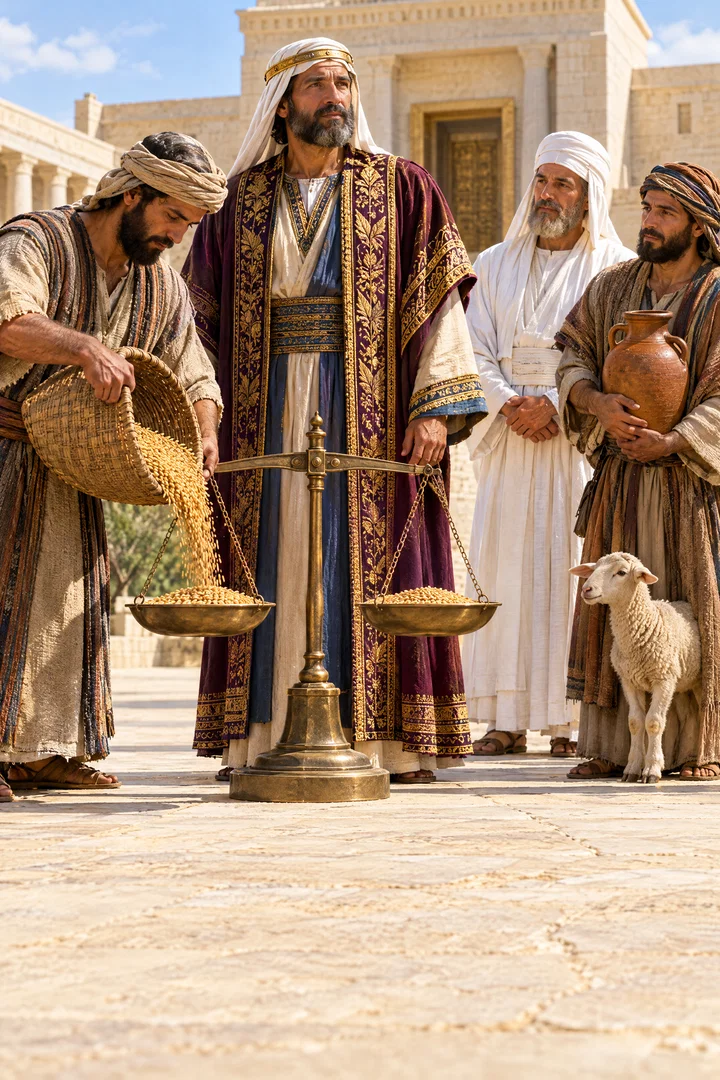
You shall have just balances, and a just ephah, and a just bath.
King James Version, KJV Cambridge Paragraph Bible, Webster Bible, Revised Version, American Standard Version, Darby Translation
Ye shall have just balances, and a just ephah, and a just bath.
Just balances, and a just ephah, and a just bath — ye have.
Balances of righteousness, and an ephah of righteousness, and A bath of righteousness, have ye:
Berean Standard Bible, Majority Standard Bible
You must use honest scales, a just ephah, and a just bath.
“ You shall have just balances, a just ephah, and a just bath.
Have true scales and a true ephah and a true bath.
Ye shall haue iust balances, and a true Ephah, and a true Bath.
Douay-Rheims (Challoner revision)
You shall have just balances, and a just ephi, and a just bate.
Pictures
Cross-references
- Leviticus 19:35-36
Ye shall do no unrighteousness in judgment, in meteyard, in weight, or in measure.
Commands accurate measures and weights.
- Deuteronomy 25:15
But thou shalt have a perfect and just weight, a perfect and just measure shalt thou have: that thy days may be lengthened in the land which the LORD thy God giveth thee.
Both require just weights and measures, linked with long life in the land.
- Amos 8:4-7
Hear this, O ye that swallow up the needy, even to make the poor of the land to fail,
Shows merchants cheating with a small ephah and a large shekel.
Commentary
Each commentary is drawn from primary sources: the writings of Ellen G. White and Adventist pioneers and periodicals. Each commentary is separate. Its own words are not a quotation; follow the references to read the source passages.
Pioneers and periodicals
27 sources
Ezekiel 45:10 commands honest balances and measures, for God is a God of order who requires fairness in all weighing and measuring, the ephah being the common dry measure of about a bushel.ST May 24, 1883ST Aug 9, 1910RH Aug 24, 1916 It stands within the extended vision of Ezekiel 36 to 48, especially chapters 40 to 48, of another sanctuary with its pattern, offerings, city, division of the land, and the glory of God's dwelling among His people.ST Oct 1, 1896ST Feb 22, 1910ST Sep 3, 1902 It was part of God's conditional offer to captive Israel to restore the twelve tribes, bring them back to Palestine, establish the sanctuary, and give healing life to land and earth, if they would be ashamed of their sins, put away iniquity, and yield fully to Him.ST Aug 12, 1875RH Jan 20, 1853ST Oct 21, 1908 Because Israel was unwilling and did not meet the conditions, the glorious temple and city were never built, only about forty thousand returned and only a lesser temple was erected under Zerubbabel.ST Nov 24, 1909ST Dec 1, 1914ST Sep 20, 1910 That sanctuary will never be built literally, since its thousands of animal sacrifices belonged to the time before Christ met the type in His once-for-all offering, and in its spiritual aspect it will be grandly realized in the New City and the new heaven and new earth for the true Israel of God.ST Oct 1, 1896ST Oct 21, 1908ST Feb 27, 1907ST Nov 24, 1909ST Aug 9, 1910
Command and Sanctuary Setting
Ezekiel 45:10 commands honest balances and just ephah and just bath, requiring honesty in weighing and measuring.ST May 24, 1883ST Aug 9, 1910RH Aug 24, 1916 God is a God of order who demands accurate weights and measures.RH Aug 24, 1916 The ephah was the common measure of quantity, holding about one bushel or thirty-five litres, and it was to be of accurate size.ST May 24, 1883 Faithful use of just weights and measures would prolong Israel's days in the land God gave them.ST May 24, 1883 This instruction about honest, accurate measures belongs to the instructions for the sanctuary and its service.ST Aug 9, 1910
The verse belongs to the detailed description in Ezekiel 36 to 48, especially chapters 40 to 48, of another sanctuary whose pattern was given to offer to Israel, with its offerings, ceremonies, rites, glory, city, and division of the land.ST Oct 1, 1896ST Feb 22, 1910ST Jan 31, 1911RH Nov 3, 1863 It sets forth restoration to glorious life in Palestine and the glory with which God would invest the land, the city, and the sanctuary in the salvation of Israel.ST Oct 1, 1896ST Jan 31, 1911 The temple shown taught that God's presence would dwell among His people.ST Sep 3, 1902 The passage contains allusions to the Sabbath of the Lord and to the festivals of the Hebrews.RH Jan 21, 1862
The vision is introduced in Ezekiel 40 by a man with the appearance of brass holding a line of flax and a measuring reed and measuring the temple and city of God.ST Aug 2, 1910 That vision covers the same period and represents the same purposes of God toward Jerusalem as the vision of the man with the measuring line measuring Jerusalem in Zechariah 2, so the two are counterparts to be studied together.ST Aug 2, 1910 The verse was given concerning the future of Jerusalem on condition that God's people put aside sins and come up to the full measure of children of God.ST Aug 2, 1910
The sanctuary vision in Ezekiel 40-48 depicts the peaceful condition of the Messiah's kingdom.ST May 21, 1902 That kingdom would have been established gradually on this present earth if the Jews had yielded to God, with the sanctuary built, the marshes and deserts and salt lands healed by the water of life, and wild beasts grown mild under the power of righteousness so the smallest infant would be safe.ST May 21, 1902
Conditional Offer Forfeited
The instruction belonged to a sanctuary shown to Israel while in captivity at Babylon, offered on condition that the people be ashamed of their sins and put away their iniquities.ST Aug 12, 1875RH Jan 20, 1853ST Nov 24, 1909 It was part of a conditional offer to bring back the twelve tribes, establish the sanctuary among them, give city and temple with a new division of the land, resurrect their righteous dead, subject enemies far and near, and spread healing life upon Palestine and the earth, with fulfillment depending on their returning wholeheartedly, putting away wickedness, and yielding fully to God as warned in Ezekiel 43:7-11.RH Jan 20, 1853ST Oct 21, 1908ST Sep 20, 1910 The detailed arrangements for sanctuary, city, land, ceremonies, rites and offerings in Ezekiel 40-48, and indeed the prophecy from Ezekiel 36 to the close of the book, would have been literally fulfilled if Israel had met God's conditions and returned from captivity wholeheartedly.ST Oct 21, 1908ST Feb 22, 1910ST Feb 27, 1907 Because they were unwilling and remained apostate, these chapters stand in their spiritual aspect as prophecy of greater things God will do for His people through Christ.ST Oct 21, 1908ST Feb 27, 1907
Had Israel met the repeated conditions for blessing after the Babylonian exile, the requirement of honest balances, ephah and bath would have been fulfilled in fullest literal detail as part of the offered temple with its attendant sacrifices.ST Aug 12, 1875ST Aug 2, 1905 That fulfillment belonged to the Mosaic dispensation while the Levitical priesthood and its ordinances were in force, with offerings made by the sons of Levi.ST Aug 12, 1875ST Apr 9, 1896 It was part of God's plan for Jerusalem as it would have been built if Israel had answered the calls to leave Babylon and done its part.ST Aug 2, 1905RH Feb 7, 1907ST Apr 9, 1896
Because Israel refused to repent, was not ashamed, and did not put away iniquities, the glorious temple and city were never built and the offered glory was never inherited.ST Nov 24, 1909ST Sep 20, 1910ST Apr 20, 1915 Only about forty thousand returned from Babylon, so the promises were not realized in their fullness.ST Sep 21, 1915ST Apr 20, 1915 What was erected by Zerubbabel under Ezra was only a lesser, inferior temple bearing a shadow of its greatness, so the sanctuary described there with its regulations received only a partial, diminished realization.ST Nov 24, 1909ST Dec 1, 1914ST Sep 20, 1910
No Rebuilding, Greater Fulfillment
The sanctuary of Ezekiel 40 to 48 was never built and will never be built literally as a sanctuary-building plan, and its literal fulfillment will never take place, for it does not describe a future sanctuary to be ordained again.ST Aug 12, 1875ST May 16, 1911ST Aug 26, 1913ST Aug 1, 1911 Its promise depended on Israel repenting, being ashamed of sins, putting away iniquities and wickedness, returning wholeheartedly and yielding fully to God, and the people did not meet that condition, with only about forty thousand returning and only a lesser temple erected.ST Aug 12, 1875ST Aug 26, 1913ST Aug 1, 1911 What would have been fulfilled in fullest literal detail during the Mosaic dispensation while the Levitical priesthood and its ordinances were in force, with offerings made by the sons of Levi, therefore does not describe the age to come.ST Aug 12, 1875ST Aug 1, 1911
It will not be fulfilled literally because its sacrifices of thousands of sheep and oxen applied before Christ when the types met their antitype, and to renew them now would make the offering of Christ once for all of none effect, annul His sacrifice, build again things destroyed, and return from sunlight to shadow.ST Oct 1, 1896ST Nov 24, 1909ST Aug 9, 1910ST Aug 2, 1899ST Aug 26, 1913 The offerings of the past were for the time then present shadowing forth the only effectual offering of Jesus Christ, who fulfilled all sacrifices by dying on the cross, so offering sacrifices now cannot continue without making void Christ's sacrifice.ST Oct 1, 1896ST Nov 24, 1909ST Sep 20, 1910 The vision was provisional and conditional on the people being ashamed of their iniquities and returning to God, and because the people remained apostate and were not ashamed and did not put away iniquities, the sanctuary and its promises were only partly realized in the temple built by Zerubbabel with a shadow of its greatness, and can never be built and restored as God designed.ST Nov 24, 1909ST Aug 9, 1910ST Sep 20, 1910 The conditional prophecy running from Ezekiel 36 onward warned Israel and pleaded with them to turn to Him, promising resurrection of their righteous dead, subjection of enemies far and near, a new temple, a new division of the land, and the life and healing power of God upon Palestine and the earth as never before, with no such city or sanctuary standing today, and Israel's failure to meet the conditions means its fulfillment is associated with the glorious new earth.ST Oct 1, 1896ST Sep 20, 1910ST Aug 2, 1899
In their spiritual aspect these chapters stand as prophecy of greater things God will do for His people through Christ, to be grandly realized wherein it failed for old earthly Jerusalem in the New City awaiting the true Israel of God.ST Oct 21, 1908ST Feb 27, 1907ST Aug 2, 1910 Because Israel was unwilling to return from captivity wholeheartedly, to recognize sin, to forsake sin, to put aside sins and come up to the full measure of children of God, the promised restoration, rebuilding, temple and prosperity were not fulfilled for them or were realized only in a diminished form, but God will fulfill His promises to His people in Christ, in the new heaven and new earth when God restores by His mighty power.ST Oct 21, 1908ST Feb 27, 1907ST Aug 2, 1910 The description of the sanctuary and division of the land that promised Israel a restored and glorious life in Palestine will be fulfilled on a greater scale with some details changed, and only faintly typical of what will take place in the new heavens and new earth, though not under the local conditions of Ezekiel's day, including events connected with Christ's second coming.ST Sep 20, 1910ST Jan 31, 1911 The vision in which a man with the appearance of brass holds a line of flax and a measuring reed and measures the temple and city of God covers the same period and represents the same purposes of God toward Jerusalem as the vision of the man with the measuring line measuring Jerusalem in Zechariah 2, and the two are counterparts to be studied together, the verse having been given concerning the future of Jerusalem on condition of obedience.ST Aug 2, 1910
God's purposes toward wicked nations and toward true Israel remain the same though times and surroundings change, with true Israel redeemed to a more glorious inheritance, the earth made new.ST Aug 2, 1905 Gog and Magog represent the northern nations punished in part in this world before and at the coming of Christ and in full at the end of the 1,000 years.ST Aug 2, 1905
Sources