Ezra 7:8
And he came to Jerusalem in the fifth month, which was in the seventh year of the king.
Translations
American King James Version, King James Version, KJV Cambridge Paragraph Bible, Webster Bible, Revised Version, American Standard Version, Darby Translation
And he came to Jerusalem in the fifth month, which was in the seventh year of the king.
And he cometh in to Jerusalem in the fifth month, that [is in] the seventh year of the king,
And he entered Jerusalem, in the fifth month,—the same, was the seventh year of the king.
Berean Standard Bible, Majority Standard Bible
Ezra arrived in Jerusalem in the fifth month of the seventh year of the king.
He came to Jerusalem in the fifth month, which was in the seventh year of the king.
And he came to Jerusalem in the fifth month, in the seventh year of the king's rule.
And hee came to Ierusalem in the fift moneth, which was in the seuenth yeere of the King.
Douay-Rheims (Challoner revision)
And they came to Jerusalem in the fifth month, in the seventh year of the king.
Pictures
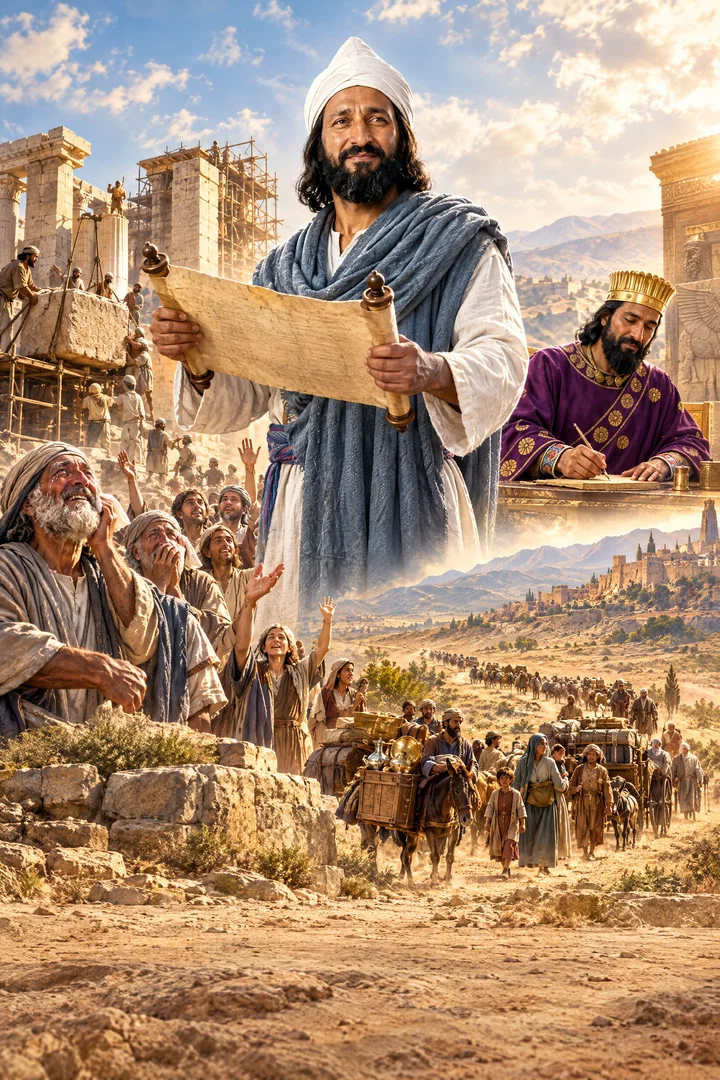
Cross-references
- Daniel 9:25
Know therefore and understand, that from the going forth of the commandment to restore and to build Jerusalem unto the Messiah the Prince shall be seven weeks, and threescore and two weeks: the street shall be built again, and the wall, even in troublous times.
The decree dated in Ezra marks the starting point for restoring Jerusalem and the prophetic period.
- Ezra 1:1-4
Now in the first year of Cyrus king of Persia, that the word of the LORD by the mouth of Jeremiah might be fulfilled, the LORD stirred up the spirit of Cyrus king of Persia, that he made a proclamation throughout all his kingdom, and put it also in writing, saying,
Cyrus’s decree began the restoration process by authorizing the temple’s rebuilding and the return to Jerusalem.
- Ezra 7:12-13
Artaxerxes, king of kings, unto Ezra the priest, a scribe of the law of the God of heaven, perfect peace, and at such a time.
Artaxerxes’ decree authorizes Ezra and others to return to Jerusalem.
- Nehemiah 2:1
And it came to pass in the month Nisan, in the twentieth year of Artaxerxes the king, that wine was before him: and I took up the wine, and gave it unto the king. Now I had not been beforetime sad in his presence.
The dates help establish Artaxerxes’ accession and the regnal-year calendar.
- Ezra 8:31-32
Then we departed from the river of Ahava on the twelfth day of the first month, to go unto Jerusalem: and the hand of our God was upon us, and he delivered us from the hand of the enemy, and of such as lay in wait by the way.
Describes Ezra’s company traveling from Babylon to Jerusalem and arriving there.
- Ezra 6:14
And the elders of the Jews builded, and they prospered through the prophesying of Haggai the prophet and Zechariah the son of Iddo. And they builded, and finished it, according to the commandment of the God of Israel, and according to the commandment of Cyrus, and Darius, and Artaxerxes king of Persia.
Names Artaxerxes’ decree among the commands to rebuild Jerusalem.
- Jeremiah 29:10
For thus saith the LORD, That after seventy years be accomplished at Babylon I will visit you, and perform my good word toward you, in causing you to return to this place.
Promises the return after seventy years in Babylon.
- Ezra 7:21-22
And I, even I Artaxerxes the king, do make a decree to all the treasurers which are beyond the river, that whatsoever Ezra the priest, the scribe of the law of the God of heaven, shall require of you, it be done speedily,
The treasurers’ notification is used to date when the decree took effect.
- Ezra 7:25-26
And thou, Ezra, after the wisdom of thy God, that is in thine hand, set magistrates and judges, which may judge all the people that are beyond the river, all such as know the laws of thy God; and teach ye them that know them not.
The decree authorized Ezra to appoint judges and enforce the law.
- Ezra 6:1-12
Then Darius the king made a decree, and search was made in the house of the rolls, where the treasures were laid up in Babylon.
Records the earlier decree to rebuild and restore the temple in Jerusalem.
- Ezra 7:28
And hath extended mercy unto me before the king, and his counsellors, and before all the king’s mighty princes. And I was strengthened as the hand of the LORD my God was upon me, and I gathered together out of Israel chief men to go up with me.
Ezra gathers leaders to accompany him on the journey.
Commentary
Each commentary is drawn from primary sources: the writings of Ellen G. White and Adventist pioneers and periodicals. Each commentary is separate. Its own words are not a quotation; follow the references to read the source passages.
Ellen G. White
13 sources
Ezra left Babylon on the first day of the first month and reached Jerusalem in the fifth month of the seventh year of King Artaxerxes I, four months later, by God's good hand upon him.Lt 100, 1907, par. 2–3ST Mar 30, 1876LSEGW 57.3–58.1 He led a considerable company back to join their brethren, to give the dispersed Jews another opportunity to serve God in their own land and to revive the study of His word and restore the city.PK 609.4RH Jan 23, 1908Lt 98, 1907, par. 2PK 602.3 The decree for Jerusalem's restoration went forth in that seventh year, dated to 457 B.C., and that date is the starting point for reckoning the 2,300 years of Daniel 8:14 and the seventy weeks.LS 48.4–5ST May 2, 1878CET 49.2 Subtracting 457 from 2,300 leaves 1843 for the close of the period, but because the decree was issued near the close of 457 B.C. the period reaches to the fall of 1844, from which starting date the specifications of the seventy weeks are fulfilled.LS 48.4–5ST May 2, 1878CET 49.2ST Mar 30, 1876LS 185.2–3
Journey and Historical Context
Ezra began the journey from Babylon on the first day of the first month and came to Jerusalem in the fifth month, in the seventh year of King Artaxerxes I, four months later, according to the good hand of God upon him.Lt 100, 1907, par. 2–3LSEGW 57.3–58.14SP 494.2–3PK 609.4RH Jan 23, 1908 The seventh year named is the seventh year of the Persian king's reign, the year of the decree authorizing the return.ST Mar 30, 1876LSEGW 57.3–58.14SP 494.2–3
The return brought the Jews dispersed from the Babylonian captivity another opportunity to serve God in their own country.Lt 98, 1907, par. 2 It gave the dispersed people of Judah opportunity to help restore Zion and the holy city.Lt 98, 1907, par. 2 It was part of God's purpose to restore Israel to its land.PK 602.3
Ezra led a considerable group back to assist their brethren under his spiritual care.PK 609.4RH Jan 23, 1908PK 602.3 His work on arrival was to revive the study of God's word and to help restore the city, the holy city and Jerusalem.PK 609.4RH Jan 23, 1908 The king granted Ezra's request, with gifts for the temple and authority to carry out his plans, because he trusted Ezra and was impressed by his faith in God's care for Israel.PK 609.4 The arrival came several years after the events in Esther, when Mordecai's rise to favor at the Medo-Persian court helped make the return possible.RH Jan 23, 1908PK 602.3
Prophetic Time Calculation
The decree for the restoration of Jerusalem found in Ezra 7 went forth in the seventh year of Artaxerxes, dated to 457 B.C., and that date is the starting point for reckoning the 2,300 years of Daniel 8:14 and the seventy weeks.LS 48.4–5ST May 2, 1878CET 49.2ST Mar 30, 1876LS 185.2–3 Subtracting 457 from 2,300 leaves 1843 for the close of the period, which was calculated to terminate in 1843 with the coming of the Lord.LS 48.4–5CET 49.2 Because the decree was issued near the end or close of 457 B.C. rather than at the beginning of that year, the 2,300-year period reaches the fall of 1844 rather than the end of 1843.ST May 2, 1878ST Mar 30, 1876LS 185.2–31T 52.2–53.2LSEGW 57.3–58.1 The prophetic specifications of the seventy weeks are fulfilled when counted from this starting date.4SP 494.2–3
Sources
Pioneers and periodicals
105 sources
He came to Jerusalem in the fifth month, Ab or August, in the seventh year of Artaxerxes Longimanus, which is 457 B.C., leading the second return of about 7,000 people from Babylon to restore Zion.RH Feb 22, 1870RH Mar 2, 1876ST Dec 19, 1892
The seventh-year decree preserved with that arrival was not temple-building only like those of Cyrus and Darius, but the third and completing charter fully restoring Jerusalem's civil and religious life, government, worship and law.RH Sep 13, 1870ST Mar 11, 1889ST Nov 1, 1877ST Jun 26, 1907ST Mar 26, 1912
It is the commandment to restore and build Jerusalem of Daniel 9:25, beginning the seventy weeks of 490 years cut off from the 2300 days of Daniel 8:14, reckoned by a day for a year.ST Jan 24, 1878ST Oct 4, 1899ST Feb 23, 1882ST Jun 26, 1907ST Nov 7, 1916
The period is counted not from Ezra's departure in spring but from the going forth of the decree in operation at his arrival and its delivery to the officers beyond the river in summer-autumn 457 B.C.RH Mar 12, 1901RH Apr 18, 1912ST Sep 16, 1886RH Sep 18, 1900
From autumn 457, sixty-nine weeks or 483 years reach to Messiah's baptism in autumn A.D. 27, the midst of the last week to His cutting off in spring A.D. 31, the whole seventy weeks to the going of the gospel to the Gentiles in A.D. 34, and the full 2300 years to the cleansing of the heavenly sanctuary and beginning of the investigative judgment on October 22, 1844.ST Mar 30, 1876ST Jun 5, 1879ST Mar 27, 1879RH Oct 8, 1903RH Oct 27, 1904
Words and Calendar Date
He came to Jerusalem in the fifth month of the seventh year of King Artaxerxes.RH Feb 22, 1870RH Mar 2, 1876ST Oct 4, 1899ST Feb 23, 1882 That date identifies the year of the written decree given to Ezra, which authorized the restoration of Jerusalem and its civil and religious affairs.RH Feb 22, 1870RH Mar 2, 1876ST Feb 23, 1882RH Jul 28, 1863 This decree stands thirteen years before Nehemiah's verbal permission and is the decree from which the seventy weeks and the 2300 days are dated.RH Feb 22, 1870RH Mar 2, 1876ST Oct 4, 1899ST Feb 23, 1882
The fifth month is Ab, roughly August, in the last part of summer and in autumn reckoning.RH Apr 9, 1908ST Mar 26, 1912RH Apr 18, 1912ST Nov 29, 1910ST Sep 18, 1901 Ab is the fifth month of the sacred year.RH Apr 9, 1908ST Nov 29, 1910ST Oct 31, 1906 The fifth Jewish month corresponded roughly to August, so the arrival fell in the last part of summer.ST Mar 26, 1912RH Apr 18, 1912ST Sep 18, 1901
Ab came after Nisan, the first month, in the king's regnal calendar.RH Apr 9, 1908RH Feb 22, 1912ST Mar 26, 1912RH Apr 9, 1908 The journey ran from the first month to the fifth, beginning from Babylon on the first day of Nisan and reaching Jerusalem in Ab.RH Apr 9, 1908RH Apr 18, 1912RH May 1, 1866RH Apr 18, 1912 That first month was April in spring, and the fifth was July-August, with Nisan in March-April.ST Mar 26, 1912RH Apr 18, 1912RH Apr 18, 1912
The seventh year is 457 B.C.ST Oct 4, 1899ST Feb 23, 1882RH Sep 13, 1870RH Jul 28, 1863RH Mar 12, 1901 It is also expressed as 457-456 B.C. and as 456 1/2 B.C. because part of the year had passed when the arrival and the putting of the decree into operation occurred.ST Oct 4, 1899ST Feb 23, 1882RH Jul 28, 1863RH Mar 12, 1901RH Apr 30, 1901 That year marks the beginning of the 2,300 prophetic year-days and the setting of the decree that is the fulfillment of the command to restore and rebuild Jerusalem.ST Oct 4, 1899ST Feb 23, 1882RH Apr 30, 1901
That seventh year ran from summer or autumn 458 B.C. to summer or autumn 457 B.C.RH Apr 9, 1908RH Feb 22, 1912RH Apr 18, 1912RH Dec 23, 1852 From the proposed start of the reign in 464-463 B.C. the decree year is dated to 458-457 B.C.RH Apr 9, 1908RH Dec 23, 1852 Since the first and fifth months fell within that same regnal year, the verse supports reckoning the king's regnal years from autumn to autumn.RH Apr 9, 1908RH Apr 18, 1912RH Apr 18, 1912
Artaxerxes acceded between late July and early November, about the summer of 464 B.C.RH Apr 9, 1908RH Feb 22, 1912ST Mar 26, 1912 Read with Ezra 7:7-9 and Nehemiah 1:1 and 2:1, the combined order of months in his regnal years places his coming to the throne after midsummer, between August and November.RH Apr 9, 1908RH Feb 22, 1912 His first year is therefore dated to 464 B.C. and his seventh to 457 B.C., a reckoning fixed by astronomy and Ptolemy's Canon proved by more than twenty eclipses, reckoned from the undisputed eclipse in the seventh year of Cambyses in 523 B.C. through one more year of Cambyses, thirty-six years of Darius, and twenty-one years of Xerxes.RH Jul 9, 1908ST Apr 15, 1880
The decree authorizing the journey was issued earlier in that seventh year, shortly before Ezra left Babylon.RH Apr 9, 1908RH May 1, 1866 It was probably given around January 457 B.C., or around the end of 458 or beginning of 457 B.C., and around January or spring 458-457 B.C.RH Apr 9, 1908 Since he set out in the first month and arrived in the fifth, the issuing in spring is distinguished from the public commencement when he arrived and began carrying it out.RH May 1, 1866RH May 1, 1866
Historical Setting and Journey
The king in whose seventh year Ezra arrived was Artaxerxes Longimanus, son of Xerxes, who is the Ahasuerus of the book of Esther, and he reigned forty-one years from B.C. 465 or 464 to 423 B.C.ST Jan 22, 1880RH Jul 16, 1901ST Oct 18, 1899 His seventh year was B.C. 457, the year in which Ezra received his commission for the restoration of Jerusalem.ST Jan 22, 1880RH Jul 16, 1901 That arrival was the second return from Babylon, when Ezra led about 7,000 people with a large company from Persia to Palestine to assist in restoring Zion.ST Feb 18, 1886RH Dec 10, 1908 It was a later return nearly eighty years after the opening events of the restoration, bringing another company to Jerusalem under the king's decree to rebuild the city and restore the Jewish commonwealth.ST Dec 19, 1892
It came seventy-nine years after Zerubbabel led back 52,000 captives and rebuilt the temple with a portion of the dwellings.RH Jul 21, 1868 Thirteen years later, in the king's twentieth year, in December B.C. 444, Nehemiah learned that Jerusalem's wall and gates remained in ruins and then guided the third return to rebuild the walls and finish what Ezra had begun.ST May 14, 1902RH Jul 23, 1857ST Oct 18, 1899RH Jul 21, 1868 The work begun under Ezra's written decree was not completed until that twentieth year, yet the seventy weeks are dated from the issuing of the decree for the accomplishment of the work, not from its completion, so the thirteen years spent building do not change their end.RH Feb 22, 1870RH Jul 23, 1857 Because Ezra's work was taken up with reforming intermarriage, restoring and regulating worship, and bringing the people back to obedience to God's word, the wall's construction was neglected for thirteen more years until Nehemiah's time.ST Feb 18, 1886
The story of Esther falls between Ezra 7 and 8, roughly sixty years after the first return and forty years after the temple's completion.ST Sep 20, 1899 This was several years after the events in Esther, when Mordecai's rise at the Medo-Persian court helped make it possible for the people to return, and Ezra led a considerable group back to assist their brethren under his spiritual care.RH Jan 23, 1908 On his arrival he began the thorough restoration of the Jewish church and state after a time when the Scriptures were lost, the people were ignorant of the law, worship was neglected, and church and state were in disorder and confusion.RH Oct 20, 1874 He restored the Scriptures, instructed the people in the law, brought the worship of God into due order, appointed magistrates and judges, commenced the building of the wall, and worked a full reformation as priest, skillful scribe in the law of God, and president of the Sanhedrim, so that he is esteemed as another Moses and the second founder of the Jewish church and state.RH Aug 20, 1914ST Feb 18, 1886RH Oct 20, 1874
In the mission to restore God's law and worship, Ezra sought and received the king's lawful authority rather than acting independently, though God's hand was upon him.RH Aug 28, 1860 He arrived by the good hand of God when the decree restoring Jerusalem went into effect.RH Aug 28, 1860RH Aug 20, 1914 The passage belongs to the days of Ezra and Nehemiah and to Babylonian life in the time when Israel had dealings with Babylon and the ancient lands adjoining Israel.ST Mar 10, 1909 It comes after the close of the history of the kingdom of Judah in 2 Kings 25, with its laying waste of Jerusalem and despoiling of the temple, slaying of captives at Riblah, capture of Zedekiah the last king, appointment and murder of Gedaliah, flight of the remnant to Egypt, and kind treatment of Jehoiachin in Babylon, and after the beginning of the return in Ezra 1-5, and discoveries in those lands confirm its narrative and give information about life then.ST Jun 10, 1913ST Mar 10, 1909
Decree Recorded With Arrival
Ezra 7 preserves the full text of the decree in Aramaic, the language then used at Babylon, given in its original Chaldaic or Eastern Aramaic form.RH Sep 13, 1870ST Nov 1, 1877 It is the original document by which Ezra was authorized to go up to Jerusalem and to restore and build the city.RH Sep 13, 1870ST Nov 1, 1877 The decree was issued by the Persian emperor Artaxerxes Longimanus in 457 B.C. authorizing Ezra to go with as many of the people as chose to go with him.ST Nov 1, 1877ST Mar 26, 1912
The grant gave unlimited treasure to beautify the house of God, to procure offerings for its service, and to do whatever else seemed good to him.ST Nov 1, 1877RH Dec 24, 1861 It ordered worship, exempted the priests from tax, and provided for courts and justice under the law of Moses.ST Nov 1, 1877RH Dec 24, 1861 It empowered Ezra to ordain laws, to restore the Levitical law, to set magistrates and judges, to appoint officers to punish offenders, and to execute punishment even unto death.ST Nov 1, 1877RH Dec 24, 1861ST Mar 26, 1912 By this authority the Jewish civil and ecclesiastical state, with its civil and religious order and constitution, was restored according to the law of God and the ancient customs of the people, not merely the temple rebuilt.RH Sep 13, 1870ST Nov 1, 1877ST Feb 23, 1882
Unlike the decree through Cyrus, which only gave permission to rebuild the temple, and the decree through Darius, which only confirmed Cyrus, the decree in Ezra 7 is a complete charter for the full restoration of Jerusalem.ST Mar 11, 1889ST Nov 1, 1877ST Dec 19, 1892 Restore means full reestablishment of the religion, polity, policy, government, life and worship of the Jewish people as a nation, not temple building only.ST Nov 1, 1877ST Feb 23, 1882ST Dec 19, 1892 The decrees of Cyrus and Darius were too limited to meet that specification, but the decree in Ezra 7 was as broad and ample as could be given without granting entire independence and fully met it.ST Mar 11, 1889RH Dec 24, 1861ST Dec 19, 1892 The seventy weeks could not begin until this point, and from this point they must date.ST Mar 11, 1889ST Dec 19, 1892
It is the third and completing part of the threefold command to restore and build Jerusalem, fuller in scope and greater in power than the first two, supplying what was lacking to make the commandment full and complete.ST Mar 11, 1889ST Jun 26, 1907ST Mar 26, 1912 Together with the decree of Cyrus in 536 B.C. and the decree of Darius in 519 B.C., given also as 520 B.C., it makes up the complete commandment of the God of Israel, which was not complete till filled out by this most important and fullest installment.ST Jun 26, 1907RH Feb 7, 1907RH Oct 11, 1915ST Jan 14, 1897 It covers all contained in the earlier partial decrees and adds much more, granting not only rebuilding of temple and city but restoration of government.ST Mar 26, 1912ST Jan 14, 1897 This completed commandment marks the commencement of the seventy weeks and therefore of the 2300 days, reckoned by the rule that a day in symbolic prophecy represents a literal year.ST Mar 11, 1889ST Jun 26, 1907
The arrival marks a revival in carrying out the decree at the end of its seventy-nine-year span, from the first installment with Cyrus in his first year in 536 B.C. for the return and rebuilding of the temple, in the year he was left sole monarch and the seventy years captivity closed, to Artaxerxes' seventh year in 457 B.C. when the great decree was completed.RH Feb 7, 1907ST Aug 18, 1881 Ezra 7 records the decree's third and final portion, and Ezra 8 follows Ezra and his company on their journey from Babylon to Jerusalem with it.RH Feb 7, 1907 The written decree given to Ezra, which authorized restoration of Jerusalem and its civic and religious affairs, is dated thirteen years before Nehemiah's verbal permission and is distinguished from it as the decree from which Daniel's weeks are dated.RH Feb 22, 1870
Prophetic Starting Point
The decree dated by the arrival in the fifth month of the seventh year is the commandment to restore and build Jerusalem of Daniel 9:25, and it fulfills the specifications of that prophecy.ST Oct 4, 1899ST Feb 23, 1882RH Apr 30, 1901RH Jan 7, 1858 That commandment starts the seventy weeks, understood as 490 years, which are the first part cut off from the 2300 days of Daniel 8:14.LS 48.4–5ST Jan 24, 1878ST Oct 4, 1899ST Feb 23, 1882RH Apr 30, 1901 The seventh year is 457 B.C., giving the starting date for the 2300 years.LS 48.4–5ST Jan 24, 1878ST Oct 4, 1899ST Feb 23, 1882RH Apr 30, 1901 The decree recorded in Ezra 7 authorized the restoration of the Jewish state and of Jerusalem's civil and religious order, and unlike the earlier decrees it provided for the religious and political life of the nation.ST Feb 23, 1882RH Apr 30, 1901
No other decree fits the prophecy's conditions concerning the Messiah, His crucifixion, and the covenant confirmed for one week, so reckoning must begin here and not with Cyrus or Darius.RH Feb 14, 1854RH Dec 8, 1874RH Feb 14, 1854 The decrees of Cyrus and of Darius provided only for building the temple and were too limited to meet the specification.ST Dec 19, 1892 Restore means full reestablishment of the religion, polity, and policy of the Jewish people as a nation, not temple building only.ST Dec 19, 1892 The decree in Ezra 7 was as broad and ample as could be given without granting entire independence and fully met it.ST Dec 19, 1892 The seventy weeks could not begin until this point, and from this point they must date, and with them the twenty-three hundred days of which they are the first part.ST Dec 19, 1892
The prophetic period did not begin when Ezra set out from Babylon in spring but when the decree was put into operation and the restoration work actually commenced at Jerusalem.RH Mar 12, 1901RH May 1, 1866RH Jan 14, 1858ST Jul 18, 1911 The journey's arrival date is distinct from the later start of the actual restoration work.RH Mar 12, 1901 Since Ezra set out in the first month and arrived in the fifth, the decree being issued in spring is distinguished from its public commencement when Ezra arrived and began carrying it out.RH May 1, 1866 That commencement is placed in the fifth month, in the seventh month, in the middle of the year, or in autumn after arrival, settling, and preparation for the seventh-month feast.RH May 1, 1866RH Jan 14, 1858ST Jul 18, 1911ST Apr 15, 1880 The work of building the street and wall in troublous times did not commence until autumn of that year, and reckoning of the first seven weeks or forty-nine years can only commence with that commencement.ST Apr 15, 1880
Because the decree was addressed to officials beyond the Euphrates and in Palestine, it could not take effect to restore and rebuild Jerusalem until Ezra reached that region.ST Sep 16, 1886RH Sep 18, 1900ST Feb 1, 1899 Its effective going forth is therefore dated to Ezra's arrival and delivery of the commission to the king's officers in summer-autumn 457 B.C.RH Apr 18, 1912ST Sep 16, 1886RH Sep 18, 1900RH May 16, 1912ST Feb 1, 1899 The arrival places its effective beginning around the middle of 457 B.C., about 456 1/2 years before Christ, because part of that year had already passed.ST Sep 16, 1886RH Oct 27, 1904RH Aug 3, 1916RH Sep 18, 1900ST Mar 3, 1909 That autumn date marks the start of the 483-year period leading to Jesus' anointing and manifestation at His baptism, and of the seventy weeks reaching to the autumn of A.D. 34.ST Mar 3, 1909RH May 16, 1912
In symbolic prophecy a day represents a literal year, so the 2300 days and seventy weeks are reckoned as 2300 years and 490 years from 457 B.C.ST Jun 26, 1907ST Nov 7, 1916RH Aug 3, 1916ST Mar 25, 1897RH Jan 21, 1873 This completed commandment, taken with Cyrus in 536 B.C. and Darius in 519 B.C., constitutes the full and complete commandment to restore and build Jerusalem, being fuller in scope and greater in power than the first two and supplying what was lacking.ST Jun 26, 1907 That date is the common commencement of the seventy weeks as the first 490 years of the 2300 days, reckoned by the year-day principle to end in 1844.ST Nov 7, 1916RH Oct 27, 1904ST Mar 25, 1897RH Jan 21, 1873 The sanctuary already existed when that prophetic period beginning with the decree went forth.RH Jan 20, 1853
Endpoints and Chronological Proof
Subtracting 457 from 2300 left 1843 for the close of the period in the early reckoning.LS 48.4–5ST Jan 24, 1878 Because the decree went forth near the end of 457, after six to seven months of that year had already passed before it took effect at the arrival in the fifth month, the full 2300 years run past the anniversary into autumn 1844.ST May 2, 1878ST Mar 30, 1876LS 185.2–3ST Jun 5, 1879RH Dec 1, 1904 That endpoint falls in the autumn time of the midnight cry when the virgins arose to meet the Bridegroom, on the tenth day of the seventh month by the Karaite calendar, October 22.RH Dec 1, 1904RH Mar 20, 1856
From autumn 457 B.C. sixty-nine weeks or 483 years reach to Messiah the Prince at Christ's baptism and anointing with the Holy Spirit for the beginning of His ministry in autumn A.D. 27, with the lost months carrying the endpoint from A.D. 26 into A.D. 27.ST Mar 27, 1879RH Sep 28, 1905ST Feb 18, 1913RH Aug 24, 1916RH Mar 12, 1901 The date is counted as 456 1/2 because half the year had passed when the decree went into effect, and the actual beginning for reckoning is the commencement of the restoration work in autumn after arrival and not merely the issuance or the arrival itself.RH Oct 27, 1904RH Mar 12, 1901 The full seventy weeks reach to A.D. 34, when the word was scattered and preached everywhere to the Gentile world and Israel's special privileges expired, leaving 1810 years of the 2300 days from A.D. 34 to 1844.RH Oct 27, 1904RH Jun 2, 1874RH Dec 17, 1908 The midst of the last week reaches three and a half years after the fall of A.D. 27 to spring A.D. 31, when Christ was cut off and His death brought sacrifices to their intended end.RH Sep 16, 1902RH Jun 2, 1874RH Dec 17, 1908
The first seven weeks or forty-nine years, allotted to building street and wall in troublous times, run from the commencement of the work about the seventh month in autumn 457 to 408 B.C. when street and wall were finished.RH Jan 14, 1858ST Jun 26, 1907RH Dec 10, 1908RH Dec 17, 1908 That completion is placed in Nehemiah's final recorded reform forty-nine years later, in B.C. 409 in the fifteenth year of Darius Nothus in the last chapter of his book, with the full establishment of the Jewish polity.RH Jan 14, 1858ST Apr 15, 1880RH Dec 17, 1908 The 457 B.C. date is fixed by Ptolemy's Canon and should not be changed without evidence the Canon is inaccurate.ST Jun 26, 1907ST Oct 25, 1883RH Oct 13, 1863 It is proved by more than twenty eclipses, reckoned from the undisputed eclipse in the seventh year of Cambyses in B.C. 523, through one more year of Cambyses, thirty-six years of Darius, and twenty-one years of Xerxes to Artaxerxes' first year in 464 B.C., and by New Testament chronology and seven historical facts fixing when John began to preach six months before Jesus entered upon His ministry.RH Jan 14, 1858ST Jun 26, 1907ST Apr 15, 1880RH Jun 17, 1915RH Oct 27, 1904
The sixty-nine prophetic weeks of 483 years from 457 B.C. bring the expected time of Messiah's appearing and cutting off for the sins of the people to about A.D. 26 or 27, whose correctness has never been disputed by the Jewish people.ST Feb 18, 1913ST Jun 30, 1914 That period of 490 years marks the close of the Jewish dispensation and the beginning of the Gentile or Christian dispensation.RH Nov 3, 1874RH Dec 17, 1908 The 490 years do not reach Jerusalem's destruction in A.D. 70.RH Apr 9, 1908
Fulfillment and Present Application
The command to restore and rebuild Jerusalem went forth in 457 B.C., dated also as 457-456 B.C., and that date begins the 2,300 prophetic days reckoned as so many literal years.RH Oct 8, 1903RH Feb 21, 1907RH Nov 18, 1909RH Apr 10, 1916ST Nov 23, 1904 Because the decree was addressed to officials beyond the Euphrates and in Palestine, it could not take effect until Ezra reached that region, so its effective going forth is placed at his arrival in Jerusalem in the fifth month of the seventh year, about the middle of 457 B.C. or 456 1/2 years before Christ.RH Feb 21, 1907RH Sep 18, 1900RH Apr 10, 1916 Counted from that arrival, the 2,300 years end in A.D. 1844, marking the cleansing of the heavenly sanctuary.RH Oct 8, 1903RH Feb 21, 1907RH Sep 18, 1900RH Nov 18, 1909ST Nov 23, 1904 That cleansing is the beginning of the investigative judgment and of Christ's priestly ministry in the holy of holies in the heavenly temple on the antitypical Day of Atonement, when the hour of God's judgment is reached.RH Feb 21, 1907RH Sep 18, 1900RH Apr 10, 1916
That autumn 1844 endpoint, reached by counting 2,300 years with a day representing a year in symbolic prophecy from the autumn of 457 B.C. when Ezra came with a company empowered to enact laws from Persia to Palestine and carried the commandment into effect, marks the beginning of the proclamation of heaven's last gospel message in the threefold message of Revelation 14.ST Nov 7, 1916RH Apr 10, 1916RH Dec 17, 1908 The divisions of that period are all counted from that arrival: 49 years to the complete rebuilding of Jerusalem and full establishment of the Jewish polity, 483 years to Messiah the Prince in the fall of A.D. 27 when the time is fulfilled, three and a half years more to A.D. 31 when Christ was cut off in the midst of the last week of the seventy, and three and a half years more to A.D. 34 when the seventy weeks cut off upon the Jewish people terminated and their special privileges expired and the gospel went to the Gentiles.RH Apr 10, 1916RH Dec 17, 1908 There remain 1,810 years allotted especially to the Gentile world until the proclamation that the hour of His judgment is come.ST Nov 7, 1916RH Dec 17, 1908 With that close in 1844 definite prophetic time ended and the closing work of Christ's ministry began.ST Apr 8, 1903
The arrival in the fifth month of the seventh year anchors the chronology of the seven weeks of Daniel 9:25, whose starting point is fixed at 457 B.C.ST May 11, 1876RH Jan 30, 1879ST Aug 8, 1878 From 457 B.C. the sixty-nine weeks, 483 prophetic days understood as 483 years, reach to Christ in A.D. 27 when He began His ministry, and that fulfillment confirms the reckoning of the prophetic days as years.ST May 11, 1876ST Aug 8, 1878 Counted from that command, 453 years had passed, leaving 30 years of the 483 until the Messiah would be anointed, and since Israelites were not set apart for ministry before age thirty, the Messiah had already been born.ST Mar 15, 1910 Jerusalem was thus fully restored under this decree in 457 B.C., 130 years after Ezekiel's prophecy in 587 B.C.ST May 9, 1878
Because the seventy weeks foreshow the age of the restored Jewish church, how long it was to continue and when to cease and be abolished, their computation must begin from the date when its thorough restoration began.RH Oct 20, 1874 That coming by royal commission began the restoration after Scriptures were lost, the people were ignorant of the law, worship was neglected, and church and state were in disorder and confusion.RH Oct 20, 1874 On arrival Ezra restored the Scriptures, instructed the people in the law, brought the worship of God into due order, and worked a full reformation as long as his commission lasted, continuing afterward as priest, skillful scribe in the law of God, and president of the Sanhedrim, so that he is esteemed as another Moses and the second founder of the Jewish church and state.RH Oct 20, 1874
Sources