Daniel 9:25
Know therefore and understand, that from the going forth of the commandment to restore and to build Jerusalem unto the Messiah the Prince shall be seven weeks, and threescore and two weeks: the street shall be built again, and the wall, even in troublous times.
Translations
Know therefore and understand, that from the going forth of the commandment to restore and to build Jerusalem to the Messiah the Prince shall be seven weeks, and three score and two weeks: the street shall be built again, and the wall, even in troublous times.
King James Version, KJV Cambridge Paragraph Bible
Know therefore and understand, that from the going forth of the commandment to restore and to build Jerusalem unto the Messiah the Prince shall be seven weeks, and threescore and two weeks: the street shall be built again, and the wall, even in troublous times.
Know therefore and understand, that from the going forth of the commandment to restore and to build Jerusalem to the Messiah the Prince shall be seven weeks, and sixty and two weeks: the street shall be built again, and the wall, even in troublous times.
Know therefore and discern, that from the going forth of the commandment to restore and to build Jerusalem unto the anointed one, the prince, shall be seven weeks: and threescore and two weeks, it shall be built again, with street and moat, even in troublous times.
Know therefore and discern, that from the going forth of the commandment to restore and to build Jerusalem unto the anointed one, the prince, shall be seven weeks, and threescore and two weeks: it shall be built again, with street and moat, even in troublous times.
And thou dost know, and dost consider wisely, from the going forth of the word to restore and to build Jerusalem till Messiah the Leader [is] seven weeks, and sixty and two weeks: the broad place hath been built again, and the rampart, even in the distress of the times.
Know therefore and understand: From the going forth of the word to restore and to build Jerusalem unto Messiah, the Prince, are seven weeks, and sixty-two weeks. The street and the moat shall be built again, even in troublous times.
Thou must know, then, and understand: From the going forth of the word to restore and to build Jerusalem—unto the Anointed One, the Prince, [shall be] seven weeks, and sixty-two weeks,—the broadway and the wall, shall again be built, even in the end of the times.
Know and understand this: From the issuance of the decree to restore and rebuild Jerusalem, until the Messiah, the Prince, there will be seven weeks and sixty-two weeks. It will be rebuilt with streets and a trench, but in times of distress.
Know and understand this: From the issuance of the decree to restore and rebuild Jerusalem until the Messiah, the Prince, there will be seven weeks and sixty-two weeks. It will be rebuilt with streets and a trench, but in times of distress.
“ Know therefore and discern that from the going out of the commandment to restore and build Jerusalem to the Anointed One, the prince, will be seven weeks and sixty-two weeks. It will be built again, with street and moat, even in troubled times.
Have then the certain knowledge that from the going out of the word for the building again of Jerusalem till the coming of a prince, on whom the holy oil has been put, will be seven weeks: in sixty-two weeks its building will be complete, with square and earthwork.
Knowe therefore and vnderstande, that from the going foorth of the commandement to bring againe the people, and to builde Ierusalem, vnto Messiah the prince, shall be seuen weekes and threescore and two weekes, and the streete shalbe built againe, and the wall euen in a troublous time.
Douay-Rheims (Challoner revision)
Know thou therefore, and take notice: that from the going forth of the word, to build up Jerusalem again, unto Christ the prince, there shall be seven weeks, and sixty-two weeks: and the street shall be built again, and the walls in straitness of times.
Pictures
Cross-references 20 of 88
- Ezra 7:11-26
Now this is the copy of the letter that the king Artaxerxes gave unto Ezra the priest, the scribe, even a scribe of the words of the commandments of the LORD, and of his statutes to Israel.
Artaxerxes’ decree to Ezra supplies the starting point for the prophetic timeline.
- Daniel 8:14
And he said unto me, Unto two thousand and three hundred days; then shall the sanctuary be cleansed.
The seventy weeks are treated as the first part of the 2300 days.
- Mark 1:15
And saying, The time is fulfilled, and the kingdom of God is at hand: repent ye, and believe the gospel.
Jesus announces that the appointed prophetic time is fulfilled and calls people to repent.
- Ezra 7:7-8
And there went up some of the children of Israel, and of the priests, and the Levites, and the singers, and the porters, and the Nethinims, unto Jerusalem, in the seventh year of Artaxerxes the king.
Dates Artaxerxes’ decree to his seventh year, identified as 457 B.C.
- Ezra 6:14
And the elders of the Jews builded, and they prospered through the prophesying of Haggai the prophet and Zechariah the son of Iddo. And they builded, and finished it, according to the commandment of the God of Israel, and according to the commandment of Cyrus, and Darius, and Artaxerxes king of Persia.
Identifies the Persian decrees forming the command to restore Jerusalem.
- Ezra 1:1-4
Now in the first year of Cyrus king of Persia, that the word of the LORD by the mouth of Jeremiah might be fulfilled, the LORD stirred up the spirit of Cyrus king of Persia, that he made a proclamation throughout all his kingdom, and put it also in writing, saying,
Cyrus’s decree authorizes the exiles’ return and Jerusalem’s restoration.
- Nehemiah 2:1-8
And it came to pass in the month Nisan, in the twentieth year of Artaxerxes the king, that wine was before him: and I took up the wine, and gave it unto the king. Now I had not been beforetime sad in his presence.
Artaxerxes’ commission to Nehemiah is a proposed starting point for the prophetic chronology.
- John 1:41
He first findeth his own brother Simon, and saith unto him, We have found the Messias, which is, being interpreted, the Christ.
Identifies Messiah as the Anointed One.
- Acts 10:38
How God anointed Jesus of Nazareth with the Holy Ghost and with power: who went about doing good, and healing all that were oppressed of the devil; for God was with him.
God anointed Jesus with the Holy Spirit and power, identifying him as the Messiah.
- Ezra 6:1-12
Then Darius the king made a decree, and search was made in the house of the rolls, where the treasures were laid up in Babylon.
Darius confirms Cyrus’s temple decree, a command considered in the restoration chronology.
- Luke 3:21-22
Now when all the people were baptized, it came to pass, that Jesus also being baptized, and praying, the heaven was opened,
Jesus’ baptism and the Holy Spirit’s descent mark his anointing at the predicted time.
- Ezra 7:9
For upon the first day of the first month began he to go up from Babylon, and on the first day of the fifth month came he to Jerusalem, according to the good hand of his God upon him.
Ezra’s arrival date helps establish when Artaxerxes’ decree took effect and rebuilding could begin.
- Ezra 9:9
For we were bondmen; yet our God hath not forsaken us in our bondage, but hath extended mercy unto us in the sight of the kings of Persia, to give us a reviving, to set up the house of our God, and to repair the desolations thereof, and to give us a wall in Judah and in Jerusalem.
Ezra describes God granting the rebuilding and protection of Jerusalem under Persian favor.
- Luke 4:18-21
The Spirit of the Lord is upon me, because he hath anointed me to preach the gospel to the poor; he hath sent me to heal the brokenhearted, to preach deliverance to the captives, and recovering of sight to the blind, to set at liberty them that are bruised,
Jesus identifies his Spirit-anointed mission as the fulfillment of prophecy about the Messiah.
- Isaiah 44:28
That saith of Cyrus, He is my shepherd, and shall perform all my pleasure: even saying to Jerusalem, Thou shalt be built; and to the temple, Thy foundation shall be laid.
Names Cyrus as God’s agent in rebuilding Jerusalem.
- Genesis 49:10
The sceptre shall not depart from Judah, nor a lawgiver from between his feet, until Shiloh come; and unto him shall the gathering of the people be.
Shiloh from Judah is identified as the Messiah whose appearing is timed.
- Numbers 14:34
After the number of the days in which ye searched the land, even forty days, each day for a year, shall ye bear your iniquities, even forty years, and ye shall know my breach of promise.
Each prophetic day represents a year, so Daniel’s seventy weeks span 490 years.
- Nehemiah 1:3
And they said unto me, The remnant that are left of the captivity there in the province are in great affliction and reproach: the wall of Jerusalem also is broken down, and the gates thereof are burned with fire.
Reports Jerusalem’s broken wall and burned gates before its rebuilding.
- Ezra 7:25-26
And thou, Ezra, after the wisdom of thy God, that is in thine hand, set magistrates and judges, which may judge all the people that are beyond the river, all such as know the laws of thy God; and teach ye them that know them not.
Artaxerxes’ decree authorized judges and the restoration of Jewish civil order.
- Daniel 9:2-3
In the first year of his reign I Daniel understood by books the number of the years, whereof the word of the LORD came to Jeremiah the prophet, that he would accomplish seventy years in the desolations of Jerusalem.
Daniel understands Jeremiah’s prophecy about Jerusalem’s desolation and begins praying as the captivity nears its end.
Commentary part 1 of 2
Each commentary is drawn from primary sources: the writings of Ellen G. White and Adventist pioneers and periodicals. Each commentary is separate. Its own words are not a quotation; follow the references to read the source passages.
Ellen G. White
62 sources
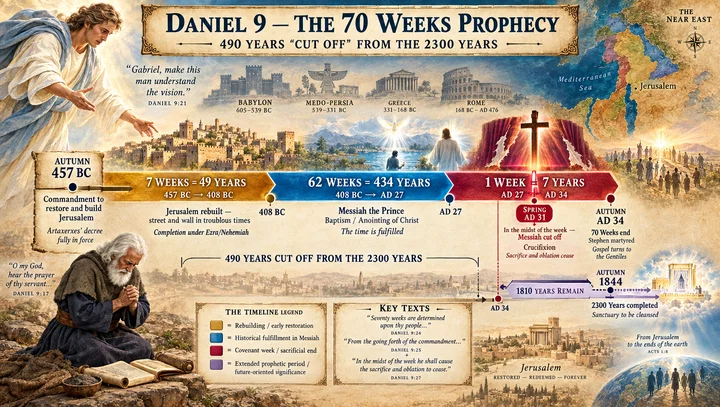
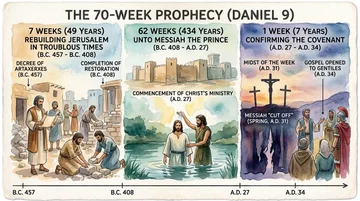
From the order to restore and rebuild Jerusalem to the Anointed Prince are sixty-nine prophetic weeks, divided into seven weeks or forty-nine years for rebuilding the street and wall in troublous times, followed by sixty-two weeks or four hundred thirty-four years, making four hundred eighty-three years in all.LS 47.2–48.3GC 325.2–326.34SP 493.2–494.1 In this reckoning each prophetic day stands for a year.PK 698.1DA 232.5–233.2GC88 328.3 The order is the decree completed by Artaxerxes in his seventh year and recorded in Ezra 7, the third and final decree in which Cyrus began the work, Darius continued it, and Artaxerxes finished it, taking effect in the autumn of 457 B.C.LS 47.2–48.3GC 687.44SP 494.2–3GC88 326.2LS 48.4–5 Messiah the Prince is Jesus Christ, the Anointed One, and the four hundred eighty-three years reach to the autumn of A.D. 27, when He was baptized in the Jordan, anointed with the Holy Spirit, and proclaimed that the time was fulfilled.4SP 493.2–494.1PK 698.1DA 232.5–233.2GC88 327.1GC 327.1–328.2 The seventy weeks are four hundred ninety years specially allotted to the Jews and Jerusalem, cut off from the 2300 years and beginning together with them, running through Christ's ministry to A.D. 34 when the gospel went to the Gentiles, leaving the remainder of the 2300 years to reach to the autumn of 1844.LS 47.2–48.3GC 325.2–326.34SP 493.1GC88 681.1–682.14SP 494.2–3
Prayer Setting and Occasion
The command to restore and rebuild Jerusalem that begins the seventy-week period was made known by Gabriel in direct answer to Daniel's earnest prayer with fasting, sackcloth and ashes, tears, affliction of soul, confession of Israel's sin, and pleading for pardon, restoration, and Jerusalem after the seventy years of desolation.PK 556.3Ms 138, 1899, par. 26–31Ms 93, 1900, par. 27 His plea was heard for God's own name and mercy's sake, showing that rebellious Israel was taken back into favor, Jerusalem was given another probation, and the way was opened for the building of a second temple.Ms 138, 1899, par. 26–31 The communication came to Daniel in vision through ministering angels sent with the message from God.Ms 93, 1900, par. 27 It forms part of the angel's explanation of the time left unexplained in Daniel's earlier vision, connecting the seventy-week period with what Daniel had previously seen and with the 2300 days.GC88 325.1–2RH Mar 21, 1907
It was given while Israel was in captivity with the temple destroyed and the temple service suspended.4MR 122.1–123.1 Religion had centered in the ceremonies of the sacrificial system, with outward forms made all-important while the spirit of true worship was lost, the services corrupted with heathen traditions, and the sacrificial rites performed without looking beyond the shadow to the substance or discerning Christ as the true offering for the sins of men.4MR 122.1–123.1 The Lord brought captivity and suspended the temple ritual to purge principles and practice from heathenism, to revive heart service, and to reveal the spiritual when the outward glory was removed.4MR 122.1–123.1 In the land of captivity, as the people turned to the Lord with repentance in humiliation and distress with no outward representation of His presence, the bright beams of the Sun of Righteousness shone into minds and hearts, and visions were given unfolding the overthrow of the oppressors of God's people, the coming of the Redeemer, and the establishment of the everlasting kingdom.4MR 122.1–123.1 Like the rest of Daniel's prophecies, it was not fully understood even by Daniel and was to remain sealed until the time of the end.PK 547.1
Wording and Time Divisions
The period to Messiah the Prince is divided into seven weeks and threescore and two weeks, together sixty-nine weeks or 483 years.LS 47.2–48.3GC 325.2–326.34SP 493.2–494.1PK 698.1GC88 325.1–2 The seven weeks are 49 years allotted for completing the rebuilding of the street and wall of Jerusalem, and the following threescore and two weeks are 434 years.LS 47.2–48.3GC 325.2–326.34SP 493.2–494.1GC88 328.3 The city with its street and wall was to be built again even in troublous times.LS 47.2–48.3GC 325.2–326.3GC88 325.1–2
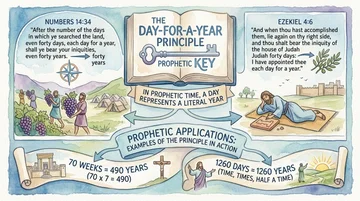
In this reckoning a prophetic day represents a year, so the weeks are counted as years.PK 698.1DA 232.5–233.2GC88 328.3GC 688.4–5 The sixty-nine prophetic weeks are thus 483 years, the seven weeks 49 years, and the sixty-two weeks 434 years.PK 698.1DA 232.5–233.2GC88 328.3 This year-day measure is one of the great periods given with the design that it should be studied and in the end fully understood.GC 688.4–5
Messiah means Anointed One.4SP 493.2–494.1GC88 327.1GC 327.1–328.2 Messiah the Prince is Jesus Christ, the promised Prince who faced temptation in the wilderness as evidence that He truly came.ST Jul 22, 18864RED 127.22SP 395.2 His anointing by the Holy Spirit at His baptism by John is the endpoint of the sixty-nine weeks.4SP 493.2–494.1GC88 327.1GC 327.1–328.2
The seventy weeks are 490 years specially allotted to the Jewish people and Jerusalem.GC 325.2–326.34SP 493.1GC88 326.1 They are cut off from the 2300-year period of Daniel 8:14, being its first 490 years.LS 47.2–48.3GC 325.2–326.34SP 493.1GC88 326.1 Both periods therefore commence together with the commandment to restore and to build Jerusalem, so that locating that commandment gives the beginning of the great 2300-year period.LS 47.2–48.3GC 325.2–326.3GC88 326.1GC88 328.2CET 48.1
Decree Date and Reckoning
The going forth of the commandment to restore and to build Jerusalem is the decree recorded in Ezra 7, completed by Artaxerxes Longimanus in his seventh year in 457 B.C. as the third and final decree.4SP 494.2–3GC88 326.2LS 48.4–5RH Jan 30, 1908 The acts of Cyrus, Darius, and Artaxerxes count as one decree, in which Cyrus began the work, Darius continued it, and Artaxerxes completed it.4SP 494.2–3GC88 326.2 That completion is linked with Ezra's return to Jerusalem and with Nehemiah's later completion of the city walls.RH Jan 30, 1908
The decree took effect in the autumn of 457 B.C., not at the beginning of the year.PK 698.1DA 232.5–233.2GC 410.1–2GC88 409.1–410.1 Historical and chronological facts point unmistakably to 457 B.C. as the proper time to begin reckoning the prophetic periods of Daniel 8 and 9.LS 47.2–48.3GC 687.4 Locating the date of that commandment gives the beginning of the great 2300-year period, since the seventy weeks are the first 490 years of the 2300 days and the two periods commence together.LS 47.2–48.34SP 493.1GC88 326.1 From that starting point the seven weeks are 49 years in which the street and wall of Jerusalem would be completed, and the seven weeks with the threescore and two weeks together are sixty-nine weeks or 483 prophetic years extending to Messiah the Prince.LS 47.2–48.3PK 698.1DA 232.5–233.2
Daniel 9 supplies the key for finding the commencement of the 2300-year period introduced in Daniel 8.4SP 493.1LS 44.2GC88 326.1 The command to restore and rebuild Jerusalem is the starting point for the seventy weeks, or 490 years, which are cut off from the 2300-year period and specially assigned to the Jews.4SP 493.1GC88 326.1 Finding the date of the command therefore establishes and anchors the reckoning of the longer prophetic period.LS 47.2–48.34SP 493.1GC88 326.1
Fulfillment in Messiah's Coming
The sixty-nine weeks reach to Messiah the Prince, running from the command to restore and rebuild Jerusalem through seven weeks and sixty-two weeks together, or 483 prophetic years in which a day stands for a year.PK 698.1DA 232.5–233.2GC 410.1–2GC88 409.1–410.1GC88 328.3 That decree of Artaxerxes Longimanus took effect in the autumn of 457 B.C., and 483 years from that autumn reached to the autumn of A.D. 27.PK 698.1DA 232.5–233.2GC 410.1–2GC88 409.1–410.14SP 495.1 This was exactly fulfilled when Jesus, after His baptism by John in the Jordan, received the anointing of the Holy Spirit.DA 232.5–233.2GC 410.1–2GC88 409.1–410.1GC 346.4–348.1GC88 346.4–347.2 Anointed at His baptism in that year, He soon began His ministry and proclaimed that the time was fulfilled.PK 698.1DA 232.5–233.2GC 410.1–2
The seventy weeks are 490 years specially allotted to the Jewish people and Jerusalem, cut off from the 2300-year period of Daniel 8:14 so that both periods begin together with the command to restore Jerusalem.GC 325.2–326.3GC 410.1–2GC88 328.2CET 48.1 With this reckoning from autumn 457 B.C. all the events foretold in the explanation of that period harmonize and were unquestionably fulfilled at the appointed time in accordance with the predictions.GC 325.2–326.3GC 410.1–2GC 323.2–324.2GC88 323.2GC88 326.2 The specifications concerning the seventy weeks were thus fulfilled, with the time limits they set met by the appointed events.GC 325.2–326.3GC 323.2–324.2GC88 323.24SP 494.2–3GC88 326.2
The final week began in A.D. 27 when Jesus began His ministry, and its midpoint fell in A.D. 31 when He was crucified.GC88 681.1–682.14SP 494.2–3CET 48.1 The whole seventy weeks end in A.D. 34, when the apostles turned and the gospel went to the Gentiles.GC88 681.1–682.14SP 494.2–3GC88 328.2CET 48.1 Because the seventy weeks are cut off from the 2300 days, 1810 years remain, extending from A.D. 34 to 1844 for the cleansing of the sanctuary.GC 410.1–2GC88 328.2GC88 328.3CET 48.1 Counting the 2300 years from the autumn start in 457 B.C. places their end in the autumn of 1844 rather than 1843.GC88 681.1–682.14SP 495.1GC 398.3–4 This discovery in the summer of 1844, midway between the time when the 2300 days had first been thought to end and the autumn to which they were afterward found to extend, led to the proclamation of the message, Behold, the Bridegroom cometh.GC 398.3–4
The prophecy belongs to the period Gabriel revealed extending to the coming of Christ and the advent of the world's Redeemer.GC 352.3DA 98.4BS 41.3DA 233.3–234.2 It marks the time of the Messiah's coming, fixing the time fulfilled for Messiah the Prince and the kingdom of God at hand, and it points out the time of Christ's anointing by the Holy Spirit, His death, and the giving of the gospel to the Gentiles.GC 352.3GC88 377.3–378.2DA 233.3–234.2GC 377.3–378.2 The same prophecy directly foretold the death of the Messiah.GC 352.3GC88 377.3–378.2GC 377.3–378.2 As the end of that period drew near, Zacharias was moved to pray for the Messiah's advent, and Gabriel then announced that the prophecy was being fulfilled.DA 98.4
Preaching Neglect and Expectation
The seventy-week prophecy fixed the time of Christ's first advent and grounded the preaching of that time, forming the basis of Christ's own message that the time was fulfilled and the kingdom of God was at hand.GC 345.1–4GC88 344.4–345.3GC88 351.1–352.3 The disciples took up that proclamation on the foundation of the sixty-nine weeks reaching to Messiah the Prince.GC 345.1–4GC88 344.4–345.3GC88 351.1–352.3 That same seventy-week period belongs to the 2300-day period, whose approaching end was later proclaimed as the time of judgment and the ushering in of the everlasting kingdom.GC 351.1
The disciples delivered the right time message at the right time in fulfillment of God's will to give it, for the end of the seventy weeks was the appointed time for the kingdom.GC 352.3 Yet their hope for an earthly kingdom and empire centered at Jerusalem and ruling from Jerusalem over the earth blinded them to its meaning.GC 345.1–4GC88 344.4–345.3 They did not understand that the same scripture also foretold the Messiah's death, and adherence to popular error about an earthly kingdom kept them from seeing the foretold suffering and death, so even the true message brought disappointment.GC 345.1–4GC88 351.1–352.3GC 352.3
The prophecy specified the time of the Messiah's advent so plainly and pointed so unmistakably to the time of His coming that Israel's leaders, who had been entrusted with the prophecies, had enough light to recognize that His coming was near and to announce it to the people.GC88 312.2–313.1GC 313.1–315.24SP 196.3–197.1 Their failure came not from lack of prophetic light but from sinful neglect.GC 313.1–315.24SP 196.3–197.1 Devotion to worldly things and neglect of God's Word darkened understanding, while pride and unbelief led to rejecting Him, though the prophecy also directly foretold the Messiah's death.GC88 377.3–378.2GC 377.3–378.2 The Jewish people and their rabbis resisted studying it, and the rabbis even pronounced a curse on anyone who tried to calculate the time.GC 377.3–378.2 Earnest and humble study of Daniel 9:24-27 would have enabled recognition of the time and manner of Christ's first appearing and the time of visitation.Ms 41a, 1896, par. 33
The leaders misread the prophecies by applying to the first coming the promised glory and power belonging to the second coming.Ms 41a, 1896, par. 3320MR 241.5–242.2 They expected a temporal prince and looked for the Messiah's arrival to usher in an era of national glory.DA 133.2–320MR 241.5–242.2 Humble study would have shown that Christ met the prophetic specifications of what the Messiah would be.20MR 241.5–242.2 By the time John began preaching, that prophetic period was nearly ended, and expectation of national glory was widespread.DA 133.2–3
Not all were blind, for pious Jews believed the prophetic time had arrived and waited for the Messiah.2SP 41.2 The light telling when the Messiah should appear was given to the pure and simple in the nation who were willing to receive it, who waited to catch the first gleams of knowledge of His coming and searched the Scriptures earnestly to know the time.Ms 27, 1898, par. 1 The wise men had studied prophecy and knew that the predicted time for Messiah to come was at hand.ST Sep 27, 1877 The priests and rulers, lofty in their own estimation, were unprepared to understand this teaching about Christ's coming.Ms 27, 1898, par. 1 By the time Jesus spoke, the period of waiting for His advent had expired, and the scribes knew this from prophetic history and the prophets' declarations.ST Apr 11, 1878
As part of Daniel 9:24-27, the verse makes known the exact time of the first advent of Christ as Messiah the Prince.PK 699.3–700.2 It stands among the many prophecies of the Saviour's coming that kept alive hope from the days of Enoch and led the Hebrews to live in constant expectancy as strangers and pilgrims, with many dying in faith without receiving the promises.PK 699.3–700.2 Even after the exact time was revealed, its message was not rightly interpreted by everyone, faith grew dim, and the words of the prophets were uncomprehended.DA 31.2–3PK 699.3–700.2 The hour for Christ's coming had been determined in heaven's council, and when the fullness of the time came God sent forth His Son to redeem those under the law.PK 699.3–700.2
Study Duty and Redemption
Daniel 9:25 is one of the great prophetic periods actually given by the Holy Spirit with the design that it should be studied and in the end fully understood.GC 688.4–5 In it a prophetic day stands for a year, and together with the other leading periods of Daniel and John it expires about the middle of the nineteenth century.GC 688.4–5 To devote time and labor to determine its commencing and closing dates is reverent duty and not presumptuous folly or heresy.GC 688.4–5 The error made over its expiration lay not in the chronology but in mistaking the nature of the events to occur when the period expired.GC 688.4–5
It is sure prophecy of the coming Messiah and evidence that Christ truly came.Ms 13, 1873, par. 5–6 The coming One foretold is Christ, who faced the test of temptation in the wilderness.Ms 13, 1873, par. 5–6
It reveals God's purpose to carry forward the grand work of redemption through Messiah the Prince, made known by Gabriel to Daniel in answer to fervent prayer.11MR 101.2–3 God graciously makes it known through chosen agencies so that men may learn of the reconciliation for iniquity and the everlasting righteousness the Messiah brought in through His sacrifice.11MR 101.2–3 The cross of Calvary is the great center, and this truth acted upon makes Christ's sacrifice effectual.11MR 101.2–3 It is the same redemption of which Moses and Elijah and Christ spoke at His transfiguration.11MR 101.2–3 By the humiliation of the cross He brings everlasting deliverance to all who walk after Him and give positive evidence by separation from the world that they follow Him.11MR 101.2–3 All who endure to the end, holding the beginning of their confidence firm, will be saved with eternal righteousness, while those who depart from the principles that give character to the truth need converting as verily as the hardened sinner.11MR 101.2–3
Sources
Pioneers and periodicals
394 sources
The command to restore and rebuild Jerusalem marks the starting point from which seven weeks and sixty-two weeks are counted to Messiah the Prince, with street and wall to be built again in troublous times.RH Apr 18, 1912ST Feb 25, 1886RH Jun 22, 1905ST Jul 2, 1885 That command is God's command carried into effect by Persia through Cyrus, Darius and Artaxerxes together, going forth in fullness only in the seventh year of Artaxerxes Longimanus in 457 B.C. recorded in Ezra 7, which alone restored civil, judicial and religious government and not merely the temple.RH Apr 18, 1912RH Jul 15, 1873ST Aug 31, 1915RH Apr 4, 1854 By the day for a year reckoning of Numbers 14:34 and Ezekiel 4:4-6, the sixty-nine weeks are 483 years reaching to autumn A.D. 27, when Jesus was anointed with the Holy Spirit at baptism and publicly manifested as Messiah the Prince to begin ministry.RH Oct 11, 1915ST Mar 14, 1878RH Feb 20, 1900ST Jun 12, 1907RH Feb 27, 1908 The first seven weeks or 49 years were allotted to restoring the city and polity amid opposition to 408 B.C., and the seventy weeks are cut off from the 2300 days as their first 490 years, so that both periods beginning in 457 B.C. bring the longer period to autumn 1844 for cleansing of the heavenly sanctuary.RH Dec 23, 1852RH Apr 18, 1912RH Feb 20, 1900ST Feb 23, 1882 That exact fulfillment to baptism and to crucifixion in the midst of the seventieth week proves Jesus of Nazareth is the predicted Messiah, while the close of the 490 years allotted to Daniel's people in autumn A.D. 34 ended Jewish national probation and turned the gospel fully to the Gentiles.ST Feb 25, 1886RH Nov 13, 1856ST Jan 24, 1906RH Apr 17, 1855
Vision Context and Purpose
Gabriel returned to supply the unexplained time portion of the vision of Daniel 8, giving skill and understanding to seal that vision and serving as the key to the whole prophecy.RH Dec 23, 1852RH Jan 21, 1858ST May 13, 1880RH Dec 23, 1852RH Aug 4, 1868 He did not repeat the ram, the goat, or the little horn already explained, but supplied the prophetic time Daniel had not understood.RH Dec 23, 1852RH Aug 4, 1868RH May 26, 1853 The seventy weeks are cut off from the 2300 days or years, are the first 490 days or years of that longer period, commence together with it from the same starting point, and provide the main pillar for reckoning it.RH Dec 23, 1852RH Jan 21, 1858ST May 13, 1880RH Dec 23, 1852RH Jul 21, 1863 This connection corrects linking the end of the seventy-year captivity to the cleansing of the sanctuary, marks the beginning of the seventy weeks at the command to restore and rebuild Jerusalem, and fixes intermediate dates of Messiah's first advent and crucifixion.RH Dec 23, 1852RH Jul 21, 1863RH Feb 7, 1907RH May 26, 1853RH Aug 23, 1870
The visions of Daniel 8 and Daniel 9 were given only months apart in B.C. 538, in the third and last year of Belshazzar coinciding with the first year of Darius after Babylon was conquered.ST Dec 24, 1894ST Mar 11, 1889RH Dec 20, 1870 Instruction in the first year of Darius came four years before Daniel 10 in the third year of Cyrus in B.C. 534.RH Dec 20, 1870 Whether modern research makes the interval fifteen years or the same year does not materially affect the interpretation.ST Dec 24, 1894ST Mar 11, 1889RH May 12, 1910 The vision was given when the Jews were captives under beginning Medo-Persian rule requiring restoration beyond a temple-only decree.ST Dec 24, 1894STRH Apr 30, 1901
The message was given in answer to earnest prayer, confession and supplication about the evening oblation after studying Jeremiah's seventy years for Jerusalem's desolation, while pleading for his people, return and the desolate sanctuary as Babylon passed away and Medo-Persia came into view.RH Jan 12, 1864RH May 26, 1853STST Apr 9, 1912RH Jan 10, 1856 His words were heard from the beginning, and Gabriel, whom he had seen in the vision at the beginning, was sent with more definite light to explain the matter and the vision.RH Jan 12, 1864RH Feb 7, 1907RH May 26, 1853 Gabriel was delayed three weeks by resistance in influencing the Persian king.RH Jan 12, 1864 The revelation answers prayer by revealing world history and Messiah's coming and connects God's word and prophet with deliverance from Babylonian bondage within one generation.RH Feb 7, 1907STST Apr 9, 1912
The prediction was already in existence by 160 B.C.ST Aug 20, 1912 Its detailed predictions had been fulfilled literally through Porphyry's time, and its fulfillment was still continuing. No further explanation of the verse's specific wording or time periods is given beyond completing Daniel 8's vision.RH Aug 23, 1870
Commandment Meaning Explained
The going forth of the commandment to restore and to build Jerusalem is the starting point for reckoning both the seventy weeks and the 2300 days or years, and the verse calls for knowing and understanding that date.RH Apr 18, 1912ST Feb 25, 1886RH Oct 11, 1915RH Feb 20, 1900 The command had not yet been given when spoken so its end could not yet be known, and seven weeks and threescore and two weeks are measured from it unto Messiah the Prince.RH Oct 11, 1915RH May 2, 1865RH Mar 18, 1858 The beginning is at the command going forth, not at Daniel receiving the message, not at Jeremiah's prophecy, not at completion of the work, and not at the end of the captivity which began in 606 B.C. and ended with Cyrus in 536 B.C.RH May 2, 1865RH Mar 18, 1858RH Jan 7, 1858
The commandment is God's prophetic command carried into effect as one legal threefold act of the Persian Empire through Cyrus, Darius and Artaxerxes together, not going forth in fullness until the last king acted.RH Apr 18, 1912ST Mar 11, 1889ST May 11, 1876RH Dec 24, 1861 Cyrus in 536 B.C. permitted return and rebuilding of the temple but said nothing about the city, and Darius in 520 B.C. or 519 B.C. renewed and funded the temple work when enemies hindered it and did not meet the conditions.ST Aug 31, 1915ST Mar 11, 1889ST May 11, 1876RH Dec 24, 1861 Artaxerxes in 457 B.C. completed the restoration by restoring civil, political, judicial and religious administration, God's law, magistrates and judges, privileges, authority for walls and the city, and provision for government, worship and national needs, linked with Ezra's return and Nehemiah's later completion of walls.RH Apr 18, 1912ST Aug 31, 1915RH Apr 4, 1854ST May 11, 1876RH Dec 24, 1861
The effective decree meeting the prophecy is that given to Ezra by Artaxerxes Longimanus in his seventh year, recorded in Ezra 7 and Ezra 7:11-26, not Nehemiah's later verbal permission.RH Jul 15, 1873RH Apr 4, 1854RH Mar 21, 1854RH Dec 23, 1852ST May 17, 1877 Ezra's decree authorized more than temple worship including civil rule, judges, governors, treasure, supplies and license to fortify, so he understood a wall had been granted and began building amid incursions until hindered.RH Jul 15, 1873RH Apr 25, 1854RH Dec 23, 1852RH Nov 7, 1907RH Jul 15, 1873 Nehemiah in the twentieth year thirteen years later obtained only a confirmation with letters for travel and timber and perfected the work, and the rebuilding did not have to follow immediately.RH Jul 15, 1873RH Apr 4, 1854RH Mar 21, 1854RH Dec 23, 1852RH Jul 15, 1873
Restore requires more than rebuilding physical structures, temple and worship; it means bringing the Jewish state back from Babylonian desolation to its civil, political, judicial, social and ecclesiastical order under Moses's law, by return of the people, restoring worship, laws, judges, officers, government and national life, recommencement of offerings, and rebuilding street and wall, undoing what Nebuchadnezzar had done.RH Mar 2, 1876RH Jan 7, 1858RH Jul 21, 1863RH Dec 24, 1861 The seventh-year decree alone among four considered contains the needed features with power of life and death, banishment, confiscation and imprisonment, giving full freedom with government authority and even power to levy taxes and the death sentence, making the Jews a people and city under their own government.ST Apr 15, 1880RH Nov 7, 1907RH Mar 2, 1876 Reckoning from Artaxerxes' command fits the stated beginning and ending points in the days of Christ more closely than other schemes.ST Mar 26, 1912RH Dec 24, 1861 The decree must be dated so 490 years reach the specified events, the first two edicts are excluded because they would not reach even Jesus' birth, a decree merely allowing self-defense does not meet the description, and completion of rebuilding and arrival of Messiah plus events at the beginning, middle and end of the seventieth week test a proposed start, making Artaxerxes' reign-start date decisive.RH Jan 7, 1858RH Jul 21, 1863RH Apr 9, 1908RH Nov 19, 1857RH Oct 4, 1870
The commandment goes forth from God but is made known through His instrument the Persian monarch.RH Nov 7, 1907 The seven times seven speaks of the recurring jubilee year when debts were released, slavery ended and inheritance restored as a picture of restoration.RH Nov 7, 1907 The rebuilding was accomplished through the prophesying of Haggai and Zechariah, Isaiah's words about Jerusalem being built are spoken by the Lord not Cyrus, the restoration began under Cyrus as preparation for Christ's coming, and the 483 years from the beginning of B.C. 457 were completed at the beginning of A.D. 27 coinciding with baptism when being about thirty the Spirit's descent manifested Him as Anointed.ST May 31, 1910RH Nov 7, 1907RH Feb 21, 1907ST May 9, 1878
The verse's date and identity of the command are subjects requiring explanation.RH Oct 13, 1863 Whether Ezra's seventh-year decree fully meets the wording remains a question for examination though reckoned from 457 B.C. it harmonizes with end events, its starting date and season must be established through historical chronology of Artaxerxes' seventh year according to Ezra 7 rather than assumed, raising whether Ezra's or Nehemiah's commission marks the beginning.RH Mar 18, 1858RH Jan 7, 1858RH Oct 13, 1863RH Jan 7, 1858 The command is dated from its going forth not from when it later takes effect, not from when Cyrus first received it or his first regnal year, and sealing until the end concerns words and book as well as times.RH May 2, 1865RH Mar 18, 1858
Decree Date Established
The effective decree is the one given to Ezra by Artaxerxes Longimanus in his seventh year, recorded in Ezra 7.RH Apr 18, 1912RH Feb 20, 1900RH Jul 15, 1873 It is dated to 457 B.C., also reckoned as 456 1/2 B.C., and as 457-458 B.C. from summer 458 to summer 457.RH Apr 18, 1912RH Feb 20, 1900RH Jul 15, 1873ST Aug 31, 1915 It stands 79 years after the seventy years captivity from B.C. 606 to B.C. 536, and is distinct from the command at Daniel's supplication in B.C. 538.RH Apr 18, 1912RH Jul 15, 1873ST Aug 31, 1915 It was announced about 538 years before Christ, and in one statement is spoken of as in the fifth year of Artaxerxes in 457 B.C.RH Jul 15, 1873ST Aug 31, 1915 It was made in spring but went into effect in autumn about the middle of the year, in the seventh month around the Day of Atonement, when Ezra arrived in the fifth month and delivered his commissions, though its exact date within days cannot be determined.RH Apr 18, 1912RH Feb 20, 1900RH Jul 15, 1873
Reckoned by Olympiads and years of Rome, the seventh year fell in the second and third years of the eightieth Olympiad and the 295th or 296th year of the city, continuing to the second year of the 202nd Olympiad and the 785th year of the city at the crucifixion, making 489 or 490 years precisely.RH Jul 15, 1873 Greek Olympiad chronology confirms the decree to Ezra in the seventh year.RH Jul 15, 1873RH May 2, 1912
The going forth is dated to autumn 457 B.C., when work beginning no earlier than the seventh month is counted, not Ezra's departure in spring, because the period is allotted to the work itself.RH Dec 10, 1908RH Jul 28, 1863ST Apr 1, 1886ST Jul 18, 1911 The decree was formally delivered and published in autumn, Ezra having arrived in the fifth month after a five-month journey with worship first, and preparation time being needed before construction began.RH Dec 10, 1908RH Jul 28, 1863ST Apr 1, 1886ST Jul 18, 1911 Because six months of 457 B.C. had passed, the full periods carry six months into 1844, leaving 456 1/2 years to A.D. 1 and about 26 1/2 years into A.D. 27 to make exactly 483 years, with years counted autumn to autumn.RH Dec 10, 1908ST Apr 1, 1886ST Jul 18, 1911ST Sep 20, 1910 The 49 years are reckoned thence in the same autumn-to-autumn way.RH Dec 10, 1908RH Jul 28, 1863
A calculation dates the 483 years from about January 457 B.C. to about January A.D. 27, including 457 years before Christ and 26 complete years after A.D. 1 with remaining days in A.D. 27 completing days missing from 457 B.C.RH Apr 16, 1908 Exact January dates need not be pressed, since a month or two uncertainty does not alter fulfillment.RH Apr 16, 1908
The date 457 B.C. for the seventh year is certain by Ptolemy's Canon verified by more than twenty eclipses and astronomical observations in the Almagest and by Olympiads arriving at the same result.RH Jul 28, 1863RH Dec 23, 1852RH Oct 11, 1915RH Feb 17, 1853ST Apr 15, 1880 It is established by reckoning backward from the astronomically dated eclipse in Cambyses' seventh year in 523 B.C. through one more year of Cambyses, thirty-six years of Darius and twenty-one years of Xerxes, making Artaxerxes' first year 464 B.C. and his forty-one-year reign 464-423 B.C. with accession in 464-463 B.C.RH Jan 14, 1858RH Dec 23, 1852RH Oct 11, 1915ST Apr 15, 1880 It cannot be moved without disproving those calculations, and shifting the endpoint requires first overturning the canon or eclipse calculations.RH Dec 23, 1852RH Oct 11, 1915RH Feb 17, 1853ST Apr 15, 1880 His reign is placed from 464 B.C. by records, eclipses and regnal calculations.RH Jan 14, 1858RH Jul 28, 1863RH Dec 23, 1852RH Oct 11, 1915
Simply subtracting 457 from 2300 leaves 1843 as first calculated end.RH Dec 1850ST Jan 24, 1878ST Apr 7, 1881 Because the period began after the start of 457 B.C. its count must include that elapsed fraction, and with correction for the fraction already passed and absence of a year zero the close comes in autumn 1844.RH Dec 1850RH Feb 1851ST Apr 7, 1881RH Jun 20, 1854 Counting only full calendar years would incorrectly place completion in 1843.RH Dec 1850ST Jan 24, 1878ST Apr 7, 1881 Because part of 457 had passed when the command took effect, that fraction brings the 2300 days to the tenth day of the seventh month in autumn 1844 when the midnight cry was given at midnight of the prophetic day, with the going forth in autumn 457 reckoned as 457 full years before Christ plus 1843 full years after Christ from the first day of 457 to the first day of 1844 and autumn to autumn.RH Dec 1850ST Jan 24, 1878RH Feb 1851RH Jun 20, 1854 The command took effect in 456 B.C. in one reckoning and serves as the shared starting point for the seventy weeks and the 2,300-year period.RH Dec 1850ST Jan 24, 1878ST Jul 9, 1894
Rejected Starting Dates
Other reckonings fail and must not be used for the going forth of the commandment to restore and to build Jerusalem.RH Jul 15, 1873ST Mar 11, 1889RH Feb 22, 1870RH Feb 22, 1870RH Apr 28, 1853 From Cyrus to the nativity is about 530 years, from the twentieth year of Artaxerxes Longimanus to the death of Christ is 476 or 477 years, and from the twentieth of Artaxerxes Mnemon to the destruction by the Romans is about 450 years.RH Jul 15, 1873 The Bible margin date of 529 B.C. is inconsistent with reaching the crucifixion and with the chronology of Artaxerxes, while the complete decree belongs in the seventh year of Artaxerxes in 457 B.C.ST Mar 11, 1889 The twentieth year in 444 B.C. is rejected because counting to its end in A.D. 47 finds no marking event, and the period should not be counted from 458 B.C. through A.D. 39.RH Feb 22, 1870RH Feb 22, 1870 It is not dated from the end of the seventy years servitude more than 530 years before Christ, for sixty-nine weeks from there would end more than forty years before even the birth of Christ and would fall almost 120 years short of the Roman destruction, while the remaining one week of seven years cannot stretch almost forty years to that destruction.RH Apr 28, 1853
Of four decrees considered — the first year of Cyrus B.C. 536, the third year of Darius Hystaspes B.C. 518, the seventh of Artaxerxes Longimanus B.C. 457, and the twentieth of the same Artaxerxes B.C. 444 — the commission to Ezra alone contains the needed features while the first, second and fourth do not.RH Nov 7, 1907RH Jan 21, 1858 The decrees of Cyrus and Darius were preparatory steps relating to rebuilding the temple and confirming work already doing, only seventeen years apart, while those of Artaxerxes relate to the condition of Judah and Jerusalem.RH Nov 7, 1907 Dating 483 or 490 years from either Cyrus or Darius would not reach even Christ's birth, and the edict of Cyrus was issued more than 490 years before the beginning of the Christian era.RH Apr 9, 1908 Although Cyrus allowed Jerusalem and its temple to be built, dating the 483 years from it ends 53 years before Christ's birth, so it cannot be the command specified.RH Jan 7, 1858 The decree of Darius in B.C. 519 or 518 cannot be that commandment because it was only a confirmation of Cyrus, and 483 years from it terminate thirty-six years before the birth of the Saviour instead of extending to the beginning of His public ministry.
Nehemiah's commission in the twentieth year thirteen years later in 445-444 B.C. was a continuation and confirmation of the former edict rather than a new decree or beginning, perfecting work begun under Ezra.ST Apr 22, 1880RH Jul 15, 1873RH Dec 24, 1861 Reckoning 483 years from 444 B.C. reaches A.D. 39-40, thirteen years too late after baptism in A.D. 27 and after crucifixion, resurrection and ascension, misplacing the troublous building time and the end of the seventy weeks and deranging the ministry, crucifixion and opening to the Gentiles.ST Apr 22, 1880RH Dec 23, 1852RH Jul 15, 1873 Since the seventy weeks equal 490 years, reckoning from 458-457 B.C. they could not end later than A.D. 34, while reckoning from 445-444 B.C. they could not end earlier than A.D. 46-47.RH Dec 23, 1852 The seven weeks or forty-nine years allotted to rebuilding the city and its wall fit the restoration period under Ezra, and Nehemiah's later verbal or personal permission to repair walls was not the decree or the full rebuilding described.ST Feb 23, 1882 That later decree restored no separate starting point because it confirmed the earlier one, and it does not fit the meaning or harmonize the dates, but would misplace the final week relative to the crucifixion and Messiah's arrival.RH Dec 23, 1852RH Dec 24, 1861
One position holds that sixty-nine prophetic weeks or 483 years run from the command of King Cyrus to rebuild Jerusalem to Messiah the Prince, precisely fulfilled at Christ's appearance in Galilee when the time was fully ripe.ST Jul 5, 1910 In that reckoning the seventy weeks are given a definite historical commencement here stated as B.C. 446, from which the periods are reckoned, so that starting them in B.C. 446 puts the crucifixion in A.D. 37.RH Oct 10, 1854RH Oct 10, 1854 But A.D. means the year of the vulgar era reckoned from the commencement of the common era at Julian Period 4714, not the year of Christ's age from His actual birth.RH Oct 10, 1854 Christ was born six years before the vulgar era in B.C. 6 and was crucified in A.D. 28 in His thirty-fourth year, not in His thirty-seventh year and not in A.D. 37.RH Oct 10, 1854
The seventy weeks may not be moved forward thirteen years, for they are part of the 2300 days and the connection is clear evidence.RH Dec 15, 1868RH Oct 30, 1855 Nor are they shifted into the future to follow a future restoration of the Jews, for the rebuilding refers to Jerusalem in the decree's ancient historical setting, not to the establishment of the New Jerusalem in the new earth.ST Jan 8, 1902 Nor are the sixty-nine weeks cited as weeks of days beginning with a future command to rebuild Jerusalem and ending at the second advent with a specific date and hour, for the verse is not warrant for setting the day or hour of Christ's coming.ST Apr 16, 1896 The weeks treated as consecutive years counted from any of the four Persian edicts do not bring their end near Jerusalem's destruction by Rome in A.D. 70.RH Apr 9, 1908 The command cannot be dated to A.D. 70 or treated as fulfilled by Titus, who destroyed Jerusalem instead of restoring it.RH Mar 20, 1856 Darius is Darius Hystaspes and Artaxerxes who issued the last two decrees is Artaxerxes Longimanus, and 490 years from either of those Artaxerxes decrees would not reach the destruction in A.D. 70.RH Apr 9, 1908
Year-Day Time Reckoning
The word rendered determined means literally cut off or divided, and the seventy weeks are cut off from the 2300 days of Daniel 8:14 because there is no other period from which they can be taken.RH Dec 23, 1852RH Jan 21, 1858ST May 13, 1880 They are the first 490 days or years of that longer period, commencing together from the same starting point, and they must not be separated to different starts.RH Jan 21, 1858ST May 13, 1880ST Feb 25, 1886 They provide the key and main pillar for reckoning the 2300 years, and finding their date gives the starting point for the 2300 years.RH Dec 23, 1852RH Apr 18, 1912 The verse marks the span from the command to restore and rebuild Jerusalem to Messiah the Prince as seven weeks and sixty-two weeks, during which street and wall are rebuilt in troubled times, and the period is divided into seven weeks, sixty-two weeks, and one week, together seventy weeks or 490 years allotted to the Jewish people.RH Dec 23, 1852ST Feb 25, 1886 Identifying when the command went forth therefore establishes the starting point, and the command completed by Artaxerxes to Ezra in his seventh year in 457 B.C., authorizing civil and religious restoration, is that start, with Cyrus, Darius, and Artaxerxes together forming one command.RH Apr 18, 1912ST Feb 25, 1886
In symbolic time a day stands for a year as in Numbers 14:34 and Ezekiel 4:4-6, so the weeks are prophetic weeks of years understood by Jews and Christians as weeks of years.RH Feb 20, 1900ST Jun 12, 1907RH Jan 20, 1916 Seven weeks are 49 years, sixty-two weeks are 434 years, together 483 days counted as 483 literal years divided as 49 plus 434, and seventy weeks are 490 years divided into seven, sixty-two and one week.RH Feb 20, 1900RH Jan 20, 1916RH Dec 3, 1908ST They cannot be literal weeks of days because that span would not reach Messiah, and exact fulfillment in 490 years proves other predicted days extend over as many literal years.RH Feb 27, 1908RH Jan 20, 1916 Prophetic time is not made indefinite by a day being as a thousand years, week denotes a group of seven matching Hebrew shabua and Greek hebdomos, and Sabbath could designate a week.RH Jan 20, 1916 Counting from the decree issued in 457 B.C., with allowance for its having been issued after the year began, the 483 years end in autumn A.D. 27 when Christ's ministry began, and taking 456 1/2 B.C. from 483 leaves 26 1/2 years A.D., or A.D. 27, the date of Christ's baptism when God introduced His Son.RH Feb 20, 1900ST Jun 12, 1907ST This agrees with Jesus being about thirty at baptism because the Christian era through early chronologers' mistake did not begin until He was about four, and His declaration that the time was fulfilled referred to this prophecy.ST Jun 12, 1907ST
In an early view the seventy sevens run from Artaxerxes' decree 457 years before Christ unto Christ's death 33 years after birth, making exactly 490 years fulfilled in A.D. 33, which proves days stand for years.SMV 25.1RH Jan 31, 1856 Counting 1,810 remaining years brings the 2300-year period to A.D. 1843 by that reckoning ending seventy weeks in A.D. 33, and to 1843 in the Jewish calendar corresponding to 1844 common.SMV 25.1GSAM 88.3–89.3 Part of the seventy weeks measures to Christ's death, and when its 490 years end at Christ's death the related 2300-day prophecy ends in 1843.GSAM 110.3–111.1 The seventy weeks as 490 prophetic days reaching to Josephus are connected with the fourth monarchy and Roman destruction without detailing the command or Messiah.ST Feb 4, 1889
Weeks mean seven-year periods with the city rebuilt in troubled times. After sixty-nine periods and before another seven-year period has ended Messiah is cut off followed by destruction of city and temple, during the final seven years Messiah establishes a covenant with many and halfway brings sacrifice and offering to an end, and the city's desolation lasts for a decreed period whose timing is not precisely specified. The seven weeks and sixty-two weeks are weeks of years rather than ordinary weeks, and calculation from them predicting the elect taken to heaven by 1896 is speculative date-setting leading to delusion.ST Sep 24, 1894
The years are not 360-day years, since that reckoning was known defective and long abandoned at Babylon and Eastern nations had reckoned at least 365 days for centuries before Daniel, so 365-day reckoning is likely basis.RH Apr 9, 1908 Fulfillment can be determined without proving exact length since difference over 490 years is only about 120 days.RH Apr 9, 1908 Each prophetic day stands for a literal year, a rule established in connection with this explanation, and fulfillment after exactly 483 years confirms both that reckoning and the decree's date.ST Aug 8, 1878ST May 11, 1876ST Aug 8, 1878 Gabriel's explanation treats each day as a year supplying the rule for Daniel's days, the seventy weeks reaching Messiah were fulfilled as 490 years by the day-for-a-year principle in symbolic prophecy and provide the starting point for the 2300 days so identifying their beginning helps establish when the longer period ends and when to look for Messiah.ST Aug 8, 1878ST Mar 2, 1882RH Oct 11, 1915 The command went forth through Artaxerxes in 457 B.C.; the 483 prophetic days represent 483 years and reach Christ in A.D. 27, exactly fulfilling the period.LDT 42.2ST Aug 8, 1878ST May 11, 1876 From 457 B.C. the sixty-nine weeks or 483 years extend to the baptism of Christ in A.D. 27 as Messiah the Prince, and the whole seventy weeks extend to A.D. 34 when Stephen was martyred and the gospel went to the Gentiles, after which Jerusalem was destroyed by the Romans in A.D. 70.RH Oct 11, 1915
The seventy weeks commence at the same time as the 2300 days, and the 1260 days and 2300 days are likewise so many years by the same reckoning.ST Dec 3, 1874RH Jan 21, 1873 Exact time depends on chronology accuracy, and the verse's prophetic chronology depends on the accuracy of the chronology used to calculate its dates.ST Dec 3, 1874RH Jan 21, 1873 Prophetic periods are as much subject of investigation and preaching of definite time as any Scripture with warning men on that evidence a duty bringing satisfaction even in disappointment as with Nineveh.RH Jan 21, 1873 Some prophetic times have been revealed so the Father's reservation of certain times does not mean all are unknowable, and the verse's date can be established.ST Jan 24, 1878
Rebuilding Amid Trouble
The first seven weeks are forty-nine years allotted to restoring Jerusalem, its street and wall and moat and Jewish state, in troublous times with anxiety and difficulty, running from 457 B.C. and ending in 408 B.C. with Nehemiah's final reformation in the fifteenth year of Darius Nothus and fourth year of Joiada's priesthood.LS 47.2–48.3RH Feb 20, 1900ST Feb 23, 1882RH May 1, 1900 The work of Ezra and Nehemiah in restoring religious and civil institutions lasted those forty-nine years after the commission, with walls and gates restored under Nehemiah amid opposition but accomplished, and the next four hundred thirty-four years extend from that restoration to Messiah's public ministry.LS 47.2–48.3ST Feb 23, 1882STST Apr 23, 1896 Those who held the autumn reckoning placed the close exactly forty-nine years after Ezra's autumn arrival, in 409 B.C. in the fifteenth year of Darius Nothus, when restoration of church and state was fully finished in Nehemiah's last act of reformation recorded at the end of his book.ST Apr 15, 1880RH Jan 14, 1858RH Sep 13, 1870 Counting from Ezra's 457 B.C. decree, they ended when Jerusalem's church and state were fully restored through Nehemiah 13:23-31.ST Apr 15, 1880RH Jan 14, 1858RH Sep 13, 1870
Restore means to bring back or rebuild, just as captives are caused to return so the ruined city including streets and wall is restored amid difficult times.RH Jun 4, 1857RH Feb 18, 1873RH Jan 9, 1872 The verse sets a period from the command unto Messiah the Prince and foretells that street and wall would be built again in troubled times.RH Jun 22, 1905ST Jul 2, 1885ST Apr 23, 1896RH Jun 4, 1857RH Jan 9, 1872 The rebuilding was accomplished despite great difficulties, showing difficult circumstances were no reason to delay the work God called for.RH Jun 22, 1905ST Jul 2, 1885ST Apr 23, 1896 The period to Messiah is divided into seven and sixty-two weeks, giving the first seven the distinct purpose of restoring Jerusalem and its polity.RH Feb 22, 1870RH Apr 2, 1908RH Jan 10, 1854 Ezra and Nehemiah together fulfill the verse, with Ezra's work from his 457 B.C. arrival continuing through Nehemiah's governorship and later reforms spanning somewhat more than forty-five years, placing completion in the latter part of the first forty-nine-year period probably near its end, and the first seven extending to wall completion.RH Feb 22, 1870RH Apr 2, 1908RH Jan 10, 1854 The rebuilding took place in troubled times marked by repeated enemy opposition and continuing foreign subjection, and the count begins with the actual start of rebuilding in autumn after preparation, not with Ezra's departure from Babylon or his arrival in the fifth month.RH Feb 22, 1870RH Apr 2, 1908
Nehemiah's fifty-two-day work cannot supply the forty-nine-year period.RH Jan 14, 1858RH Mar 21, 1854RH Jul 28, 1863ST Apr 22, 1880 Walls and gates had already been built after the return and were then broken down by neighboring nations between the seventh and twentieth years of Artaxerxes, so rebuilding was already under way when Nehemiah arrived.RH Jan 14, 1858RH Jul 28, 1863RH Dec 29, 1859 His report of broken walls and burned gates concerns damage to works built under Ezra, when the remnant was in affliction and reproach, not Nebuchadnezzar's earlier destruction one hundred forty-four years before.RH Jan 14, 1858RH Mar 21, 1854 The verse does not require the wall to be built immediately after the decree, only that its building occur in troublous times, and Nehemiah completed under the same decree what Ezra had begun.RH Mar 21, 1854RH Jul 28, 1863 The rebuilding took place amid tumult, difficulty and opposition as shown in Ezra and Nehemiah, teaching that trouble does not stop God's work and that God gives courage and providence to move it forward.RH Jan 21, 1915ST Jul 2, 1885ST Mar 26, 1902 Those troubles began when the returned Jews started rebuilding, when Samaritans first offered to join concealing an effort to gain power in Judah, and after refusal hindered the builders and paid officials at the Persian court to delay funds and obstruct the work through Cyrus.RH Jan 21, 1915ST Mar 26, 1902
Jerusalem's rebuilding including its wall in troubled times took place amid enemy opposition and intimidation yet was completed because the people were willing to work and God helped them, rolling away reproach.RH Jun 17, 1902ST May 14, 1902ST Feb 25, 1886 The foretold building was fulfilled when the few Jews with faith to confess sin, seek God and embrace the free privilege of returning carried out the arduous rebuilding sustained by God, while the whole were slow to believe and refused to return, standing as a lesson of faith for those awaiting final deliverance.RH Jun 17, 1902RH Feb 17, 1874 Streets and wall were rebuilt as fulfilled in Nehemiah's work, when enemies plotted attack but the people kept watch, armed themselves and continued, and the rebuilding was completed while enemies remained active as foretold.ST May 14, 1902ST Feb 25, 1886RH Dec 24, 1914 The work was organized so workers covered the whole wall together, finishing in fifty-two days while diligently working and guarding against danger, and after temple and worship were restored the wall still remained to be built.ST May 14, 1902RH Dec 24, 1914 The rebuilding falls within the first division of the twenty-three hundred years.RH Jun 25, 1908ST Mar 26, 1902 Thirteen years after the last portion of the decree went forth slow progress made completion within prophesied time seem impossible, yet God's word stands sure through people who rise to fulfill it, and Jerusalem was rebuilt amid opposition that hindered but never stopped it.RH Jun 25, 1908ST Mar 26, 1902
Messiah Prince Appears
The command to restore and rebuild Jerusalem fixes the beginning of the reckoning, and the first divisions are seven weeks and threescore and two weeks unto Messiah the Prince, with street and wall built again in troublous times.ST Feb 23, 1882RH Apr 30, 1901ST Nov 1, 1877RH Sep 6, 1870ST Mar 26, 1912 The seven weeks run to Jerusalem fully rebuilt and then sixty-two weeks more run to Messiah, totaling sixty-nine weeks or 483 years from edict to Messiah.ST Feb 23, 1882ST Nov 1, 1877RH Sep 6, 1870ST Mar 26, 1912ST Feb 7, 1884 The divisions and their events are milestones testing the correct start and fulfillment, Jerusalem restored at seven weeks and Messiah appearing at sixty-nine weeks.ST Feb 23, 1882RH Apr 30, 1901ST Nov 1, 1877 It is a special period beginning with a future event and extending to Messiah's appearing and also reaching to His being cut off, with sixty-nine in all until Messiah connecting with the Saviour's preaching about time after baptism.ST Feb 23, 1882RH Apr 30, 1901ST Feb 7, 1884
Messiah is the Hebrew equivalent of the Greek Christ, meaning Anointed or Anointed One.RH Oct 11, 1915ST Aug 31, 1915RH Feb 27, 1908RH May 1, 1900RH Jun 17, 1915 Jesus of Nazareth became the Anointed not at birth, circumcision, or first temple appearance, but at baptism on Jordan in A.D. 27 in autumn when God anointed Him with the Holy Ghost like a dove after the custom of anointing kings, with a voice declaring the beloved Son.RH Oct 11, 1915ST Mar 14, 1878ST Aug 31, 1915RH May 1, 1900RH Jun 17, 1915 Thereupon He was publicly manifested as Messiah the Prince, began ministry preaching the kingdom in Galilee, and announced time fulfilled.RH Oct 11, 1915ST Mar 14, 1878RH Feb 27, 1908RH May 1, 1900RH Jun 17, 1915 The period extends to baptism not merely birth, the end of sixty-nine weeks is that anointing and manifestation, the only definite prophetic time marking the first coming, ending at public appearance not birth.ST Mar 14, 1878ST Aug 31, 1915RH Feb 27, 1908RH May 1, 1900RH Jun 17, 1915 The coming of Messiah the Prince meaning the Anointed One is marked at the end of seven and sixty-two weeks, sixty-nine weeks of years.GSAM 58.4ST Oct 25, 1883ST Jul 29, 1913 The sixty-nine weeks reach to baptism and manifestation and beginning of public ministry distinct from seventy-week measurement, and the verse conveys an angelic announcement that Messiah was to come.GSAM 58.4ST Oct 25, 1883ST Jul 29, 1913
Counting 483 full years from autumn 457 B.C. or 456 1/2 B.C. reaches autumn A.D. 27 when Christ was baptized, anointed and manifested and began ministry, connected with John's ministry near A.D. 27 and baptism in fall.RH Oct 11, 1915ST Mar 14, 1878RH Feb 20, 1900ST Jun 12, 1907 Reckoned backward from A.D. 27 reaches B.C. 457.RH Oct 11, 1915RH Feb 20, 1900ST Jun 12, 1907RH Feb 27, 1908 John began in Tiberius's fifteenth year reckoned from joint elevation with Augustus in August A.D. 12, Christ six months younger began about six months later at thirty, the year fixed by Tiberius's fifteenth year making A.D. 27 just 483 years from the command though prophecy establishes year not exact month because year is the unit.ST Mar 14, 1878RH Feb 20, 1900ST Jun 12, 1907 The threescore and two weeks are 434 literal years, sixty-two times seven, counted from end of seven weeks in 408 B.C. to fall A.D. 27.ST Aug 31, 1915RH Oct 4, 1870 At that date Messiah was revealed when at thirty He was baptized and anointed with Spirit and power and declared at Nazareth the scripture about Spirit anointing Him fulfilled that day.ST Aug 31, 1915 Seven weeks or 49 years reach completion of building and sixty-nine weeks or 483 years extend to Messiah meaning either birth or commencement of ministry in one variant.RH Oct 4, 1870
The period from decree to Messiah is sixty-nine prophetic weeks or 483 years beginning in 457 B.C. and reaching spring A.D. 27 when Jesus was baptized and anointed, Messiah being Hebrew for anointed corresponding to Greek Christ before which He was not yet Anointed in this sense.ST Mar 4, 1886ST May 11, 1876RH Sep 28, 1905ST Jul 16, 1902 Sixty-nine weeks run from command in 457 to anointing and ministry in fall A.D. 27 with remaining seventieth week in Daniel 9:27, and seven plus sixty-two weeks ending autumn A.D. 27 identify Messiah's appearing and mission.ST Mar 4, 1886ST May 11, 1876RH Sep 28, 1905ST Jul 16, 1902 Variant calculations place the 483 years to A.D. 26 when Christ was baptized and anointed and began ministry at predicted time.ST Feb 18, 1913RH Apr 4, 1854RH Mar 1851RH Dec 23, 1852RH Sep 10, 1857 Others place them to spring A.D. 27 from 456 1/2 B.C., to A.D. 26 or A.D. 26-27 when publicly acknowledged as Son and declaring time fulfilled, while other chronologies place end in A.D. 26 at John's baptism or A.D. 29 or 30.RH Oct 3, 1912RH Apr 4, 1854RH Mar 1851RH Dec 23, 1852RH Sep 10, 1857 They also mark beginning of the 2300-day period.RH Mar 1851RH Dec 23, 1852RH Sep 10, 1857
Jesus was about thirty at baptism because the Christian era through early chronologers' mistake did not begin until He was about four.ST Jun 12, 1907ST Mar 15, 1910ST Mar 3, 1909ST Aug 31, 1915 Since Israelites were not set apart before thirty, with 453 years passed leaving 30 to anointing Messiah must already have been born, counting back thirty years from A.D. 27 locates birth and makes known time for forerunner's message.ST Jun 12, 1907ST Mar 15, 1910ST Mar 3, 1909GSAM 58.4 Messiah was to come from David's lineage anointed at about thirty so birth was thirty years before period's end with four-year fixing explaining how He was thirty as early as fall A.D. 27, and the verse concerns year not unknown weekday of birth.ST Jun 12, 1907ST Mar 3, 1909GSAM 58.4ST Aug 31, 1915 The sixty-nine weeks end at Messiah's announcement and manifestation at baptism in A.D. 27, not at the cross.ST Mar 26, 1912ST Mar 14, 1878RH May 1, 1900RH Mar 1851ST Oct 11, 1905 He then confirmed the covenant, His death by crucifixion at Passover came three and a half years later in spring A.D. 31 in midst of final seventieth week after preaching, causing sacrifice to cease by fulfilling what they represented and offering Himself for sin while apostles still confirmed covenant for remaining half week.ST Mar 14, 1878RH Feb 27, 1908RH May 1, 1900RH Mar 1851ST Oct 11, 1905
The cutting off after sixty-nine weeks is crucifixion as true Paschal Lamb, antitype of Egypt's lamb.ST Mar 14, 1878RH Feb 27, 1908RH May 1, 1900ST Oct 11, 1905 Anointed would be cut off not for Himself suffering for others as greater sacrifice to which animal sacrifices pointed.ST Mar 14, 1878RH Feb 27, 1908RH May 1, 1900 A week is seven years, Christ taught three and a half, disciples preached to Jews another three and a half, self-sacrifice at midpoint ended sacrifices as fulfilled symbols, after seven years gospel went to Gentiles, covenant ratified to both houses first.ST Mar 14, 1878RH May 1, 1900RH Mar 1851ST Oct 11, 1905 This establishes ministry lasting three and one-half years beginning at about thirty six months before first Passover ending at last Passover A.D. 31, placing birth around September not December 25.ST Mar 14, 1878RH May 1, 1900ST Oct 11, 1905 The sixty-nine weeks end at beginning of ministry and anointing not birth and not crucifixion which falls in middle of seventieth week.ST Mar 2, 1882RH Apr 9, 1908RH Sep 20, 1870ST Oct 25, 1883RH Mar 18, 1858 Sixty-two weeks end at coming with being cut off afterward not within them.RH Apr 2, 1908ST Mar 2, 1882RH Apr 9, 1908
Sources