Ezra 7:12
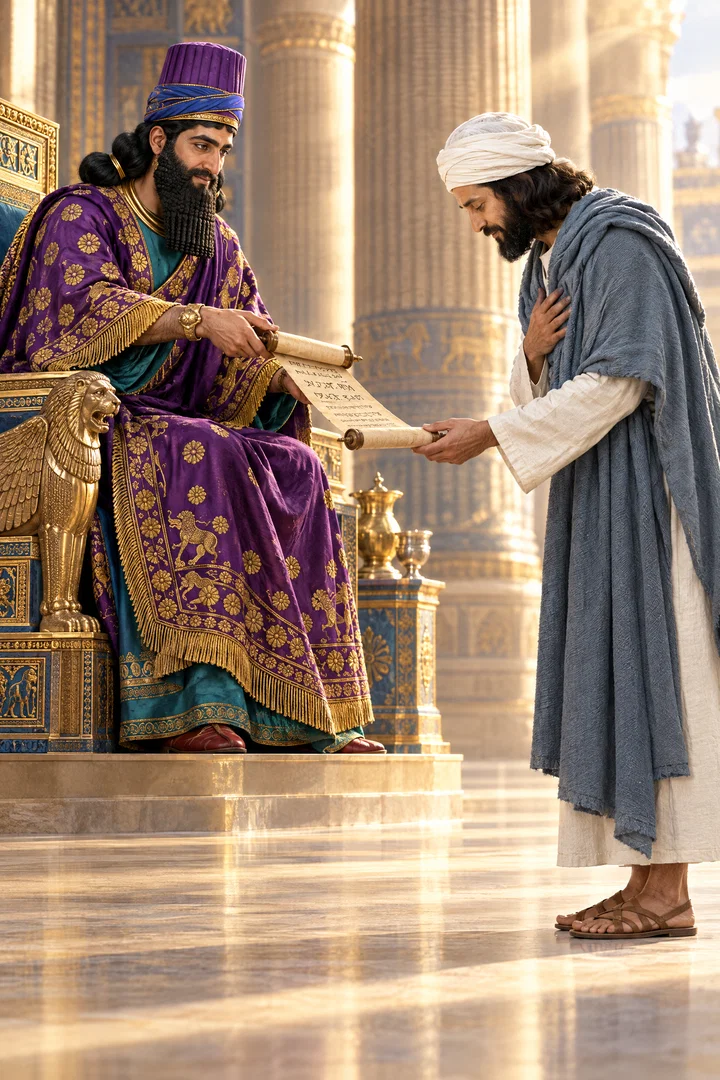
Artaxerxes, king of kings, unto Ezra the priest, a scribe of the law of the God of heaven, perfect peace, and at such a time.
Translations
Artaxerxes, king of kings, to Ezra the priest, a scribe of the law of the God of heaven, perfect peace, and at such a time.
King James Version, KJV Cambridge Paragraph Bible
Artaxerxes, king of kings, unto Ezra the priest, a scribe of the law of the God of heaven, perfect peace, and at such a time.
Artaxerxes, king of kings, To Ezra the priest, a scribe of the law of the God of heaven, perfect peace, and at such a time.
Artaxerxes, king of kings, unto Ezra the priest, the scribe of the law of the God of heaven, perfect and so forth,
Artaxerxes, king of kings, unto Ezra the priest, the scribe of the law of the God of heaven, perfect and so forth.
'Artaxerxes, king of kings, to Ezra the priest, a perfect scribe of the law of the God of heaven, and at such a time:
Artaxerxes, king of kings, to Ezra the priest, an accomplished scribe of the law of the God of the heavens, and so forth.
Artaxerxes, king of kings, Unto Ezra the priest, scribe of the law of the God of the heavens—To despatch and so forth.
Berean Standard Bible, Majority Standard Bible
Artaxerxes, king of kings.To Ezra the priest, the scribe of the Law of the God of heaven:Greetings.
Artaxerxes, king of kings,To Ezra the priest, the scribe of the law of the perfect God of heaven.Now
Artaxerxes, king of kings, to Ezra the priest, scribe of the law of the God of heaven, all peace;
ARTAHSHASHTE King of Kings to Ezra the Priest and perfite scribe of the Lawe of the God of heauen, and to Cheeneth.
Douay-Rheims (Challoner revision)
Artaxerxes king of kings to Esdras the priest, the most learned scribe of the law of the God of heaven, greeting.
Pictures

Cross-references 20 of 22
- Daniel 9:25
Know therefore and understand, that from the going forth of the commandment to restore and to build Jerusalem unto the Messiah the Prince shall be seven weeks, and threescore and two weeks: the street shall be built again, and the wall, even in troublous times.
The decree to restore Jerusalem marks the starting point of the prophetic periods.
- Ezra 6:14
And the elders of the Jews builded, and they prospered through the prophesying of Haggai the prophet and Zechariah the son of Iddo. And they builded, and finished it, according to the commandment of the God of Israel, and according to the commandment of Cyrus, and Darius, and Artaxerxes king of Persia.
The rebuilding follows the commands of Cyrus, Darius, and Artaxerxes, completed by Artaxerxes’ decree.
- Nehemiah 2:1-8
And it came to pass in the month Nisan, in the twentieth year of Artaxerxes the king, that wine was before him: and I took up the wine, and gave it unto the king. Now I had not been beforetime sad in his presence.
Artaxerxes’ commission to Nehemiah is a proposed starting point for Jerusalem’s restoration.
- Ezra 7:7
And there went up some of the children of Israel, and of the priests, and the Levites, and the singers, and the porters, and the Nethinims, unto Jerusalem, in the seventh year of Artaxerxes the king.
Dates the decree to Artaxerxes’ seventh year.
- Ezra 1:1-4
Now in the first year of Cyrus king of Persia, that the word of the LORD by the mouth of Jeremiah might be fulfilled, the LORD stirred up the spirit of Cyrus king of Persia, that he made a proclamation throughout all his kingdom, and put it also in writing, saying,
Cyrus’s first decree begins the restoration sequence completed by Artaxerxes’ decree.
- Ezra 7:25-26
And thou, Ezra, after the wisdom of thy God, that is in thine hand, set magistrates and judges, which may judge all the people that are beyond the river, all such as know the laws of thy God; and teach ye them that know them not.
The decree empowers Ezra to appoint judges and enforce God’s law.
- Ezra 7:8
And he came to Jerusalem in the fifth month, which was in the seventh year of the king.
Dates Ezra’s arrival in Jerusalem to Artaxerxes’ seventh year.
- Isaiah 44:28
That saith of Cyrus, He is my shepherd, and shall perform all my pleasure: even saying to Jerusalem, Thou shalt be built; and to the temple, Thy foundation shall be laid.
Foretells Cyrus’s role in rebuilding Jerusalem and the temple.
- Ezra 9:9
For we were bondmen; yet our God hath not forsaken us in our bondage, but hath extended mercy unto us in the sight of the kings of Persia, to give us a reviving, to set up the house of our God, and to repair the desolations thereof, and to give us a wall in Judah and in Jerusalem.
The king’s favor enabled Jerusalem’s restoration and repair.
- Ezra 6:1-12
Then Darius the king made a decree, and search was made in the house of the rolls, where the treasures were laid up in Babylon.
A Persian decree concerning Jerusalem’s restoration is renewed and enlarged by a later decree.
- Ezra 7:27-28
Blessed be the LORD God of our fathers, which hath put such a thing as this in the king’s heart, to beautify the house of the LORD which is in Jerusalem:
Ezra thanks God for moving the king to beautify the Jerusalem temple and strengthen him.
- Ezra 4:7-21
And in the days of Artaxerxes wrote Bishlam, Mithredath, Tabeel, and the rest of their companions, unto Artaxerxes king of Persia; and the writing of the letter was written in the Syrian tongue, and interpreted in the Syrian tongue.
Earlier Persian opposition hindered Jerusalem’s rebuilding before a later decree.
- Isaiah 45:13
I have raised him up in righteousness, and I will direct all his ways: he shall build my city, and he shall let go my captives, not for price nor reward, saith the LORD of hosts.
It foretells the command to rebuild Jerusalem.
- Jeremiah 29:10
For thus saith the LORD, That after seventy years be accomplished at Babylon I will visit you, and perform my good word toward you, in causing you to return to this place.
The promised return followed the seventy years of Babylonian exile.
- Ezra 7:20
And whatsoever more shall be needful for the house of thy God, which thou shalt have occasion to bestow, bestow it out of the king’s treasure house.
Temple expenses are provided from the royal treasury.
- Daniel 9:24
Seventy weeks are determined upon thy people and upon thy holy city, to finish the transgression, and to make an end of sins, and to make reconciliation for iniquity, and to bring in everlasting righteousness, and to seal up the vision and prophecy, and to anoint the most Holy.
The seventy weeks begin with Artaxerxes’ decree.
- Ezra 7:6
This Ezra went up from Babylon; and he was a ready scribe in the law of Moses, which the LORD God of Israel had given: and the king granted him all his request, according to the hand of the LORD his God upon him.
The king grants Ezra’s request to go to Jerusalem.
- Ezra 8:1
These are now the chief of their fathers, and this is the genealogy of them that went up with me from Babylon, in the reign of Artaxerxes the king.
It records those who went up with Ezra.
- Ezra 7:23
Whatsoever is commanded by the God of heaven, let it be diligently done for the house of the God of heaven: for why should there be wrath against the realm of the king and his sons?
command to diligently do God's will
- Ezra 1:2
Thus saith Cyrus king of Persia, The LORD God of heaven hath given me all the kingdoms of the earth; and he hath charged me to build him an house at Jerusalem, which is in Judah.
Contrasts Cyrus’s temple decree with Artaxerxes’ fuller decree.
Commentary
Each commentary is drawn from primary sources: the writings of Ellen G. White and Adventist pioneers and periodicals. Each commentary is separate. Its own words are not a quotation; follow the references to read the source passages.
Ellen G. White
18 sources
The greeting is from Artaxerxes Longimanus, king of Persia, to Ezra the priest and scribe of the law of the God of heaven, and it opens the third and final decree for restoring and building Jerusalem issued in his seventh year.RH Feb 6, 1908PK 610.1–611.1GC 325.2–326.3GC88 326.2RH Jan 30, 1908 The decree granted Ezra's request to lead a company back to Jerusalem, with liberal provision from the king's treasure-house for the temple service and authority as a representative of the Medo-Persian kingdom.RH Feb 6, 1908PK 610.1–611.1PK 609.4Lt 98, 1907, par. 2 Together with what Cyrus began and Darius carried forward, this decree completes the work so that their actions count as one commandment to restore and build Jerusalem.PK 610.1–611.1LS 48.4–5GC 325.2–326.3GC88 326.2 It took effect in the autumn of 457 B.C., the starting date from which the 2300 years of Daniel 8:14 are reckoned, so that subtracting 457 from 2300 leaves 1843 as William Miller plainly calculated before the disappointment when the Saviour did not come.ST May 2, 1878CET 49.2LS 48.4–5ST Mar 30, 1876 Because the decree went forth near the end of that year the period reaches to the fall of 1844, with the first 490 years extending to A.D. 34, Christ crucified in A.D. 31, and the remaining 1810 years then reaching to 1844.ST May 2, 1878ST Mar 30, 1876LS 185.2–3GC88 326.24SP 494.2–3
Decree's Setting and Terms
Artaxerxes, king of kings, is the king of Persia, identified as Artaxerxes Longimanus, in whose reign Ezra returned to Jerusalem.GC 325.2–326.3GC88 326.2RH Jan 30, 1908PK 607.1 His letter is addressed to Ezra the priest, a scribe of the law of the God of heaven.RH Feb 6, 1908PK 610.1–611.1PK 609.4RH Jan 30, 1908 That address recognizes Ezra's standing and learning, and marks him as appointed by God for special work.RH Feb 6, 1908PK 610.1–611.1RH Jan 30, 1908
The letter opens the third and final decree for the restoring and building of Jerusalem issued since the close of the seventy years captivity.PK 610.1–611.1PK 607.1 It was issued in Artaxerxes' seventh year, in its fullest form continuing and completing the work begun by Cyrus and carried forward by Darius, so that together their actions count as one commandment.PK 610.1–611.1GC 325.2–326.3GC88 326.24SP 494.2–3GC88 681.1–682.1 The decree is remarkable for its expressions regarding the God of heaven, whose habitation is in Jerusalem, for its recognition of Ezra's attainments, and for the royal confidence in his integrity and learning.RH Feb 6, 1908PK 610.1–611.1PK 609.4 God moved the king and his counselors to favor Ezra and to honor Israel's God.PK 610.1–611.1PK 609.4Lt 98, 1907, par. 2RH Jan 30, 1908
The decree granted Ezra's request to return, backed by liberality and provision from the king's treasure-house.PK 610.1–611.1PK 609.4 With gifts and abundant means for the temple service, it supplied the remnant people of God for their work.PK 610.1–611.1PK 609.4Lt 98, 1907, par. 2 It also gave Ezra authority as a representative of the Medo-Persian kingdom.PK 609.4
In this way the decree made it possible for the Jews to return to their own country after captivity in Babylon.Lt 98, 1907, par. 2PK 607.1 Ezra led a company back to Jerusalem to renew study of God's Word and to help restore the city and temple service.RH Feb 6, 1908PK 610.1–611.1RH Jan 30, 1908PK 607.1 Their return gave God's people another opportunity to serve Him and showed His forbearance toward them.Lt 98, 1907, par. 2
Prophecy's Starting Date
The decree to which this verse belongs was completed and took effect in 457 B.C., near the end and in the autumn of that year.ST May 2, 1878ST Mar 30, 1876GC 325.2–326.3LS 185.2–31T 52.2–53.2 Together with the earlier actions of Cyrus and Darius, this decree in its fullest form fulfills the commandment to restore and build Jerusalem from which the seventy weeks and the 2300-year period are reckoned.LS 48.4–5GC 325.2–326.3GC88 326.24SP 494.2–3 The kings' actions count as one commandment, the work begun by Cyrus and carried forward by Darius being continued and completed by Artaxerxes.GC 325.2–326.3GC88 326.24SP 494.2–3
That date is the starting point for reckoning the 2300 years of Daniel 8:14 in a calculation so simple and plain that even children could understand it.ST May 2, 1878CET 49.2LS 48.4–5LSEGW 57.3–58.1 Subtracting 457 from 2300 leaves 1843, which is how William Miller reached 1843 for the expected coming of the Lord.CET 49.2LS 48.4–5LS 185.2–3 The year passed and the Saviour had not come, bringing sad disappointment.CET 49.2LS 185.2–3LSEGW 57.3–58.1
Because the decree was issued near the end of 457 B.C. rather than at the beginning of the year, the 2300-year period reaches not the end of 1843 but the fall of 1844.ST May 2, 1878ST Mar 30, 1876LS 185.2–31T 52.2–53.2LSEGW 57.3–58.1 Counted from its effective date in the autumn of that year, the 2300 days end in the autumn of 1844.ST May 2, 1878ST Mar 30, 1876GC88 681.1–682.1 From the same starting date the specifications of the seventy weeks were fulfilled.GC88 326.24SP 494.2–3GC88 681.1–682.1GC88 409.1–410.1 The first 490 years extend to A.D. 34, with Christ's crucifixion in A.D. 31 in the final week, and the end of the period marked by the apostles turning to the Gentiles; the remaining 1810 years then reach to 1844.GC88 326.24SP 494.2–3GC88 681.1–682.1GC88 409.1–410.1
Sources
Pioneers and periodicals
90 sources
The verse opens the formal decree of Artaxerxes, king of kings, addressed directly to Ezra the priest and scribe of the law of the God of heaven with a greeting of perfect peace, whose full wording is preserved in Ezra 7:11-26.ST Feb 25, 1886RH Feb 22, 1870RH Mar 2, 1876STRH Jan 8, 1861 It was issued in the seventh year of Artaxerxes Longimanus, in the autumn of 457 B.C., after Ezra left Babylon in the spring and reached Jerusalem in the fifth month.ST May 2, 1878ST Feb 25, 1886RH Feb 22, 1870ST Jan 20, 1904 It is the going forth of the commandment to restore and to build Jerusalem foretold in Daniel 9:25, the third and final part of the commandment through Cyrus, Darius and Artaxerxes that alone restored the city, its law, government and walls, unlike the earlier decrees concerning the temple only.ST Feb 25, 1886STST Jan 24, 1878RH Apr 4, 1854 Its date marks the starting point of the seventy weeks and the 2300 days, with sixty-nine weeks or 483 years reaching Messiah the Prince at Christ's baptism in autumn A.D. 27, His being cut off in the midst of the seventieth week at the crucifixion in spring A.D. 31, and the full seventy weeks ending in autumn A.D. 34 with the turn to the Gentiles.ST Feb 25, 1886ST Jan 24, 1878ST Jan 20, 1904 The full 2300 years counted from 457 B.C. terminate in autumn 1844, pointing to the cleansing of the heavenly sanctuary and the investigative judgment announced by the first angel.ST May 2, 1878ST Jan 24, 1878ST Jan 20, 1904ST Feb 7, 1906RH Oct 8, 1903
Wording and Original Text
The verse is the opening of the formal letter, decree, commission and state document from Artaxerxes addressed directly to Ezra, whose full wording is preserved in Ezra 7:11-26 and in its fuller form in Ezra 7:12-26 in the very language in which it was issued.RH Feb 22, 1870RH Mar 2, 1876STRH Apr 4, 1854RH Jul 28, 1863 It is the written royal decree and royal message issued in Artaxerxes' seventh year, authorizing Ezra to go to Jerusalem with all willing Jews and to restore Jerusalem and regulate the affairs of the Jewish community, civil and religious, according to God's law and the people's customs.RH Feb 22, 1870RH Mar 2, 1876RH Jul 28, 1863RH Aug 31, 1916 It belongs to the account of Ezra's commission by the Persian king to lead Jewish exiles from Babylon to Jerusalem.RH Aug 31, 1916
The sender is named as Artaxerxes, king of kings, king of Persia, Artaxerxes Longimanus.ST Feb 25, 1886RH Dec 24, 1861ST Mar 4, 1886RH Mar 17, 1910ST May 11, 1876 The recipient is named as Ezra the priest, a scribe of the law of the God of heaven, marking his standing and learning and divine appointment and reflecting the king's favor toward him.RH Feb 6, 1908ST Feb 25, 1886ST Feb 23, 1882RH Feb 22, 1870RH Dec 24, 1861 The decree thus recognizes Ezra's learning and supports his return to Jerusalem to renew study of God's Word and help restore the city and temple service.RH Feb 6, 1908
It extends a greeting of perfect peace, opening with peace and showing that the decree was fittingly given in a peaceful season rather than during civil commotion or war.RH Jan 8, 1861RH Aug 31, 1916RH Jan 14, 1858 The passage in Ezra 7:12-26 is written not in Hebrew but in Chaldaic or Eastern Aramaic, also called Chaldee, a branch of Syriac, the language then used at Babylon and at the Persian court, because it copies the official Persian documents.ST Oct 25, 1883RH Sep 13, 1870ST Nov 1, 1877RH Jan 14, 1858ST May 17, 1877 It is therefore Ezra's original copy transferred into the record, preserved by inspiration as a full and accurate copy of the original document by which Ezra was authorized, before the narrative returns to Hebrew.ST Oct 25, 1883ST Nov 1, 1877RH Jan 14, 1858
The verse belongs to the days of Ezra and Nehemiah and reflects Babylonian life of that time, part of the Bible narrative confirmed by discoveries in ancient lands adjoining Israel that had dealings with that people.ST Mar 10, 1909
Historical Setting and Date
The decree was issued in the seventh year of Artaxerxes Longimanus and is dated to 457 B.C.ST Feb 25, 1886RH Feb 22, 1870STRH Apr 4, 1854 It is the complete restoration of the Jewish polity and not merely the rebuilding of the temple, and its date marks the beginning of the seventy weeks and the 2300-day prophetic period.ST Feb 25, 1886RH Mar 12, 1901 It is the written royal letter and decree addressed to Ezra as priest and scribe of the law of the God of heaven, authorizing him to restore Jerusalem and regulate the affairs of the Jewish community.RH Feb 22, 1870RH Apr 4, 1854RH Mar 12, 1901 It covers God's full purpose because it embraces the temple building and the restoration of the Jewish city and commonwealth, even to civil government, religious worship, trial of cases, and execution of the death penalty.STRH Mar 12, 1901 It is preserved in Ezra 7:12-26 in the very language in which it was issued.ST
That date is fixed by Bible chronology from Cyrus onward and by the canon of Ptolemy.RH Oct 13, 1863ST Oct 25, 1883 Artaxerxes began his reign in B.C. 464, so reckoning seven from 464 fixes the going forth of the commandment in B.C. 457.STST Apr 15, 1880 That reckoning is confirmed by eclipses, including the eclipse in the seventh year of Cambyses in B.C. 523, followed by one more year of Cambyses, thirty-six years of Darius, and twenty-one years of Xerxes, bringing the first year of Artaxerxes to B.C. 464 and his seventh year to B.C. 457.RH Mar 10, 1874ST Apr 15, 1880 This is contrasted with Nehemiah's first commission in the king's twentieth year, dated to 444 B.C.RH Jan 30, 1879
The decree is reckoned as going into effect in the autumn or middle or latter part of 457 B.C., near the end of that year and not at the beginning of the year.ST May 2, 1878ST Mar 30, 1876LS 185.2–3ST Jan 20, 1904RH Dec 1, 1904 Its reckoning does not start at Ezra's spring departure from Babylon, for Ezra left on the first day of the first month and arrived in Jerusalem on the first day of the fifth month.RH Dec 1, 1904ST Jul 18, 1911 The decree is dated to the fifth month by Jewish reckoning, when Ezra reached Jerusalem and the officials concerned were notified, and the work began at Jerusalem in the seventh month.ST Jan 20, 1904ST Jul 18, 1911 Because six months of that year had passed before the decree took effect, the 2300 full years reckoned from it run six months into the year 1844, reaching the fall of 1844 and the seventh month rather than the end of 1843.ST May 2, 1878ST Mar 30, 1876LS 185.2–3RH Dec 1, 1904
Artaxerxes Longimanus was son and successor of Xerxes the Ahasuerus of Esther, who succeeded Darius son of Hystaspes, the Persian king who was Darius's grandson.ST Oct 4, 1899RH Jan 20, 1853ST Jun 2, 1909ST Apr 23, 1902 The decree renews the decree of Cyrus as renewed by Darius and greatly enlarges it.ST Jun 2, 1909 The events of Esther fall chronologically between Ezra 6 and Ezra 7, in the fifty-eight years between Ezra 7 and Ezra 8 and about the middle of Xerxes's reign.ST Sep 20, 1899ST Apr 23, 1902 The decree came after the temple had been completed, so the sanctuary was already in existence when the 2300-day period began.RH Jan 20, 1853
Artaxerxes favored Ezra, recognized his standing and learning and appointment by God for special work, and granted his request.RH Feb 6, 1908RH Jan 30, 1908RH Aug 28, 1860 Although God's hand was upon Ezra as he went to restore the law and worship in Jerusalem, he sought the king's lawful authority rather than acting independently.RH Aug 28, 1860 Ezra was a Jewish priest and scribe who organized and led the return of another company to Jerusalem, and the decree supports his return to renew study of God's Word and help restore the city and temple service.RH Feb 6, 1908 The commission was given together with the king's seven chief counselors for Ezra's return to Jerusalem with all of his nation willing to go, with full authority to restore and settle the Jewish state and to reform the church and regulate and govern both according to their own laws. This extraordinary favor was obtained at the solicitation of Esther, then the best beloved of the king's concubines though not yet advanced to queen, who asked it on one of the days when Persian kings allowed their women to ask what boons they pleased, acting by the direction of Mordecai while still concealing her kindred and nation.
The verse shows God vindicating His own glory and supremacy when the kings and prophets and priests of Judah and Israel had completely failed.ST Mar 11, 1897 Even after the kingdom fell and the temple was destroyed, God compelled the proud despots of Persia, including Artaxerxes, to recognize Him as the only true God and sovereign Ruler of the universe.ST Mar 11, 1897 They were compelled to protect His people and to send the captives back from Babylon to rebuild the city and the temple at Jerusalem.ST Mar 11, 1897
Ezra's Commission and Powers
The decree empowered Ezra to go up to Jerusalem with all Jews willing to accompany him and there to restore the Jewish state in both its civil and ecclesiastical order according to the law of God and the ancient customs of the people.ST Feb 23, 1882RH Mar 2, 1876RH Apr 4, 1854RH Sep 13, 1870RH Jul 28, 1863 It was the third and final Persian decree concerning Jerusalem, granted upon Ezra's request to complete what the earlier decrees had left lacking, and it authorized him to regulate the affairs of the people, to order worship, to instruct in the law, and to work reformation in church and state.ST Feb 23, 1882RH Mar 2, 1876RH Sep 13, 1870RH Mar 12, 1901RH Jul 28, 1863 Its full wording is preserved in Ezra 7:12-26 in Aramaic, the language then used at Babylon, because it copies the official Persian document, and it alone meets the specifications of Daniel 9:25 for both restoring government and rebuilding the city.STRH Apr 4, 1854RH Sep 13, 1870RH Mar 12, 1901RH Jul 28, 1863
Unlike the decree of Cyrus in 536 B.C., which concerned the temple alone, and the decree of Darius in 519 B.C., which merely renewed that of Cyrus and furnished means to finish the temple, this decree embraced the temple building and the restoration of the Jewish city and commonwealth.STRH Dec 24, 1861ST Mar 26, 1912ST Mar 26, 1912ST Dec 19, 1892 It provided for beautifying the house of God, procuring offerings, drawing upon the public revenue from beyond the Euphrates, and exempting priests and Levites from tribute and taxes.STRH Dec 24, 1861ST Dec 19, 1892ST May 7, 1902RH Jul 15, 1873 It restored the civil and religious constitution by authorizing Ezra to appoint magistrates and judges, to establish courts and administer justice according to the law of Moses, to govern Jerusalem and levy taxes, and to try all cases with power to execute punishment even unto death, with fines, imprisonment, and banishment.STRH Dec 24, 1861ST Mar 26, 1912ST Mar 26, 1912ST Dec 19, 1892
Though the edict contains no express mention of repairing the walls, authority to build them is included in it, since dwelling safely in the city and carrying on the temple work against enemies required fortifications and the treasure could be spent for that purpose.ST May 7, 1902RH Jul 15, 1873RH Jul 23, 1857 The grant gave treasure from the king and his counselors with liberty to gather more, ordered the treasurers beyond the River to supply yearly up to one hundred talents of silver, one hundred measures of wheat, one hundred baths of wine, one hundred baths of oil, and salt without prescribed measure, with everything to be done according to the will of the God of heaven.RH Jul 15, 1873 Ezra began the walls under this authority but was hindered until Nehemiah renewed and finished the same work thirteen years later in the twentieth year of Artaxerxes, so the seventy weeks are reckoned from the issuing of this decree and not from the completion of the work.RH Jul 15, 1873RH Jul 23, 1857
The commission concerned Ezra's leadership of another company from Babylon to Jerusalem nearly eighty years after the first return under Cyrus, and Ezra reached Jerusalem in the fifth month of that year, when the officials concerned were notified.ST Jul 18, 1911ST Dec 19, 1892 By virtue of that commission he restored the Scriptures, instructed the people in the law, brought the worship of God into due order, and worked a full reformation in church and state, continuing afterward as priest, skillful scribe in the law of God, and president of the Sanhedrim.RH Oct 20, 1874 In the rebuilding of the temple Artaxerxes was among the kings who provided the needed resources before construction, so the work could be completed without debt.RH Jul 17, 1913 The chapter thus shows God's care for His people through decrees issued by Persian monarchs for building the temple and city of Jerusalem and for rebuilding and repairing the city, included among the Persian kings' decrees to restore Jerusalem.RH Sep 11, 1900ST Apr 16, 1912
Completed Prophetic Commandment
The decree that opens in this verse is the going forth of the commandment to restore and to build Jerusalem foretold in Daniel 9:25, issued in 457 B.C. as the starting point of the seventy weeks and of the 2300-day prophecy.ST Jan 24, 1878RH Apr 4, 1854RH Dec 1850RH Feb 17, 1853 It is dated to the seventh year of Artaxerxes and addressed to Ezra as priest and scribe of the law of the God of heaven, granting permission to restore and rebuild Jerusalem.RH Apr 4, 1854RH Dec 1850RH Feb 17, 1853 Its provisions for restoring Jerusalem's government and authorizing its construction show that it covered both restoring and rebuilding the city, supplying what was needed to restore the Jewish state.RH Apr 4, 1854 Counted from its going forth in autumn 457 B.C., its first 49 years reach the completion of Jerusalem's restoration, and its 483 years reach Jesus' baptism in autumn A.D. 27.
It is the third and final part of the threefold commandment issued through Cyrus, Darius and Artaxerxes, recorded in Ezra 6:14.ST Oct 25, 1883ST Mar 11, 1889ST Jan 20, 1904RH Apr 18, 1912 Together the three kings' acts form one commandment in three parts, rather than separate decrees by any one king alone, and the commandment was not complete until this decree was issued.ST Oct 25, 1883ST Jan 20, 1904 The part through Cyrus in Ezra 1 in 536 B.C. only gave permission to rebuild the temple, and the part through Darius in Ezra 6 in 519 B.C. only confirmed the decree of Cyrus, while the decree in Ezra 7 is a complete charter for the full restoration of Jerusalem.ST Mar 11, 1889ST Jan 20, 1904 This closing part in Ezra 7:12-26 is written in Chaldaic, the very language in which it was issued, showing it is Ezra's original copy transferred into the record.ST Oct 25, 1883ST It was published in the seventh year of Artaxerxes Longimanus, who began his reign in B.C. 464, so seven from 464 fixes its date in B.C. 457, the fifth month by Jewish reckoning and autumn by modern reckoning, and that date is the reckoning point from which the seventy weeks and the 2300 days must be counted.STST Mar 11, 1889ST Jan 20, 1904
Unlike the decree of Cyrus, which had to do with the temple alone, and the decree of Darius, which merely renewed the decree of Cyrus and provided means to finish the temple, this decree covers God's full purpose because it embraces the temple building and the restoration of the Jewish city and commonwealth.STRH Apr 30, 1901ST Dec 19, 1892 It begins the complete restoration of the Jewish polity, not merely the rebuilding of the temple, authorizing Ezra to restore Jerusalem and regulate the affairs of the Jewish people and to re-establish the Jewish nation's religious and political life.ST Feb 25, 1886RH Mar 2, 1876RH Apr 30, 1901 It gave authority broad enough to govern Jerusalem, levy taxes, restore the Levitical law among the people, appoint magistrates and judges with authority to try all cases and administer justice including fines, imprisonment, banishment and even the death sentence, and to use public revenue for the work.STST Mar 26, 1912ST Mar 26, 1912 It supplied what was lacking: full restoration of the city to its ancient privileges, re-establishment of God's law as the city's law, restoration of civil government and secular administration, authorization to rebuild its walls, and embellishment of the temple, fully reestablishing the religion, polity and policy of the Jewish nation in their own land without granting entire independence.RH Apr 30, 1901ST Mar 26, 1912ST Dec 19, 1892 It is thus the Persian Empire's legal establishment of God's prophetic commandment, meeting all the specifications of the prophecy to restore as well as to build.ST Mar 11, 1889ST Dec 19, 1892
It is one single decree that is expressly called a decree, addressed directly to Ezra, and whose original wording is preserved in full to the present time in Ezra 7:11-26.ST Apr 22, 1880RH Dec 27, 1853 The permission connected with Nehemiah in the twentieth year was only verbal and consisted of letters addressed not to Nehemiah but to the keeper of the king's forest and the governors beyond the river, whose wording was not preserved, and Nehemiah later needed only permission to go and complete the work with practical assistance from the king's officials.ST Apr 22, 1880RH Dec 27, 1853 The decree to Ezra is more complete than the later permission given to Nehemiah and includes all the specifications found in that permission, providing for ordered worship, exemption of priests from taxes, and establishment of courts and justice according to the law of Moses.RH Dec 24, 1861ST Apr 22, 1880 It was given thirteen years before the commission granted to Nehemiah, and Nehemiah's work was only a continuation and finishing of the work Ezra had already commenced under this decree, so the later decree in the twentieth year only confirmed it.RH Dec 24, 1861ST Apr 22, 1880 The seventy weeks date from the issuing of this decree, not from completion of the work, and reckoned from it the 483 years reach the Messiah and the 490 years reach their appointed end with perfect harmony in commencement, intermediate dates and termination.ST Apr 22, 1880ST Apr 22, 1880
The decrees of Cyrus in 536 B.C. and Darius in 519 B.C. are set aside as starting points because they fall many years short of the Christian era and concern the temple and temple-worship rather than the civil state and polity meant by restoring and building Jerusalem.ST Jul 25, 1878RH Jul 21, 1863RH Dec 8, 1874 Dating the seventy weeks from this commandment in 457 B.C. brings the sixty-nine weeks to Messiah the Prince at the commencement of Christ's public ministry and the seventieth week to His confirming the covenant, with His being cut off in the middle of the week in crucifixion causing sacrifice and oblation to cease.RH Jul 21, 1863ST Mar 2, 1882 Reckoning from Nehemiah's commission instead, dated to B.C. 445, places the Messiah's baptism, crucifixion, turning from the Jews to the Gentiles and proclamation of the new covenant years too late.RH Jun 4, 1857ST Apr 22, 1880ST Mar 2, 1882 Reckoning from 426 B.C. would end the first seven weeks in 377 B.C. with no restoration, the sixty-nine weeks in A.D. 58 too late for Christ's ministry, and the last week with crucifixion in A.D. 62 instead of A.D. 31.ST Mar 2, 1882 Nor would 490 years from either Artaxerxes edict reach Jerusalem's destruction in A.D. 70.ST Mar 2, 1882
Prophetic Periods Calculated
The decree to Ezra from Artaxerxes Longimanus, addressed to the priest and scribe of the law of God, begins the complete restoration of the Jewish polity and not merely the rebuilding of the temple.ST Feb 25, 1886RH Mar 12, 1901RH Feb 17, 1853 That decree is the commandment to restore and build Jerusalem, the third and final part together with the decrees of Cyrus in 536 B.C. and Darius in 519 B.C., and the commandment was not complete until this decree was issued, so its date is the date from which to count.RH Mar 12, 1901ST Jan 20, 1904 Its date is 457 B.C., in the king's seventh year, in the autumn, the fifth month by Jewish reckoning.RH Mar 12, 1901RH Feb 17, 1853ST Jan 20, 1904 That date marks the beginning of the seventy weeks, or 490 years, as the first part cut off from the 2300 days, and therefore for the whole 2300-day prophecy counted as years.ST Feb 25, 1886RH Feb 17, 1853 It alone meets the specifications of Daniel 9:25 for restoring Jerusalem, including civil government and religious worship.RH Mar 12, 1901ST Jan 20, 1904
Beginning in the autumn of B.C. 457, sixty-nine weeks or 483 prophetic days or 483 literal years reach to Messiah the Prince at the baptism or anointing of Christ in the autumn of A.D. 27.ST Jan 20, 1904ST Mar 27, 1879 The sixty-nine weeks amount to 483 years and reach the Messiah, Jesus Christ, manifested as Messiah at His baptism in the fall of A.D. 27 when He began preaching that the time was fulfilled.ST May 11, 1876ST Mar 27, 1879 That year is reckoned as 456 1/2 or 456 2/3 years before the Christian era because half the year had passed when the decree went into effect, so the period runs beyond A.D. 26 nearly half a year into A.D. 27.RH Oct 27, 1904RH Aug 3, 1916ST Mar 31, 1909 Fulfillment in exactly 483 years confirms the year-for-a-day reckoning of the prophetic days and the date assigned to the decree.ST May 11, 1876ST Aug 8, 1878
The seventieth week confirms the covenant, with Christ cut off in its midst at the crucifixion in spring A.D. 31, causing sacrifice and oblation to cease as antitype.ST Mar 27, 1879RH Oct 27, 1904RH Oct 4, 1870 Counting 490 years from the starting point reaches A.D. 34, when the scattered church preached everywhere to the Gentile world, marking the Jews' rejection, the turn to the Gentiles, and the proclamation of the new covenant.RH Oct 27, 1904ST Mar 31, 1909ST Jun 18, 1896 The full seventy weeks end in autumn A.D. 34 with loss of Jewish principality, following the crucifixion in spring A.D. 31 and three and a half years to autumn A.D. 34, which proves the autumn beginning in B.C. 457.ST Mar 27, 1879RH May 1, 1866 The period of 490 years also identifies when the Jews would cease to be God's specially chosen people and city and temple rejected, with Christ's atoning sacrifice ending the ceremonial system.RH Nov 3, 1874
The first seven weeks, or 49 years, allotted to Jerusalem's restoration in troubled times reach its completion in 408 B.C., forty-nine years after Ezra's decree.ST Mar 27, 1879RH Oct 4, 1870 Counted from the work's beginning in autumn 457 B.C., its first 49 years reach the completion of Jerusalem's restoration.ST Mar 27, 1879 Reckoned from 426 B.C. the first seven weeks would end in 377 B.C. with no corresponding completion, while the city's restoration was completed in 408 B.C.RH Oct 4, 1870
The full 2300 years counted from 457 B.C., or 1810 years beyond A.D. 34, terminate in 1844, in the autumn and seventh month.ST May 2, 1878ST Jan 20, 1904RH Oct 27, 1904 Subtracting 490 from 2300 leaves 1810 years which added to A.D. 34 reaches 1844, and the whole prophetic period beginning in autumn B.C. 457 extends to autumn 1844.ST Jan 20, 1904RH Oct 27, 1904 The sanctuary to be cleansed is the heavenly sanctuary, where Christ's closing high-priestly ministry and investigative judgment begin, including the beginning of Christ's closing work as high priest in 1844.ST Feb 7, 1906ST Mar 31, 1909 Its reckoning does not start at the beginning of 457 because six months of that year had passed before the decree took effect, so the 2300 full years run six months into 1844, fixing the midnight cry when the virgins arose on the tenth day of the seventh month.ST May 2, 1878RH Dec 1, 1904
The decree in Ezra 7:11-26 was issued in B.C. 457, at least eighty years after the vision was given to Daniel, and its date fixes the beginning of the 2300 prophetic days counted as literal years and of the seventy weeks allotted within them.ST Oct 25, 1905 The decree came after the temple had been completed, so the sanctuary was already in existence when the 2300-day period began.RH Jan 20, 1853 First reckoned carelessly by subtracting 457 from 2300, the period pointed to 1843 for the Lord's coming and ended in disappointment.LS 48.4–5ST Jan 24, 1878RH Aug 11, 1904 Reckoned with full years before and after Christ and with an autumn beginning, and with six months of 457 already passed, it points to autumn 1844 and the midnight cry.LS 185.2–3RH Dec 1, 1904RH May 1, 1866 Together with Daniel 8:14, Daniel 9:20-27 and Revelation 10, it establishes the 1838-44 advent movement as heaven-ordained.RH Aug 21, 1913
Doctrine and Application
The decree that opens with this greeting authorizes the restoration and rebuilding of Jerusalem in the seventh year of Artaxerxes Longimanus, dated to 457 B.C. in the autumn, and that date marks the beginning of the 2,300-year prophecy of Daniel 8:14, a day in symbolic prophecy representing a year.ST Feb 7, 1906RH Oct 8, 1903ST Nov 7, 1916ST Jan 9, 1893ST Nov 23, 1904 Counted as years the 2,300 years terminate in the autumn of A.D. 1844, 1810 years beyond A.D. 34 where the seventy weeks cut off from the 2300 days end, since the two periods begin together.ST Nov 7, 1916ST Jan 9, 1893ST Nov 23, 1904RH Dec 1, 1863 That focal point in 1844 marks the cleansing of the heavenly sanctuary, the beginning of Christ's closing work as high priest and of the atonement made in the most holy place.ST Feb 7, 1906RH Oct 8, 1903ST Nov 23, 1904RH Dec 1, 1863 It marks the investigative judgment announced by the first angel and the proclamation that God's judgment has come, with Heaven's last gospel message and the threefold message to the world.ST Nov 7, 1916ST Jan 9, 1893ST Nov 23, 1904RH Dec 1, 1863
The greeting identifies Ezra as priest and scribe of the law of the God of heaven, recognizing his standing and learning and the king's favor toward him.RH Feb 6, 1908 The decree supports his return to Jerusalem to renew study of God's Word and to help restore the city and temple service.RH Feb 6, 1908 The enactment shows the State using its legislative, executive and judicial proceedings and the public treasury to meet in whole or in part the expenses of the church in carrying on her public aggressive work.ST Nov 11, 1889 It shows the State acting to destroy public vice, crime, immorality and licentiousness and to promote morality, virtue and good order, and thus to protect and exalt the church, done with divine approval as a union of Church and State in which the State and its sphere exist for the sake of and to serve the interests of the church.ST Nov 11, 1889
The final decree leading to the rebuilding and restoration of Jerusalem was made known across the Persian Empire that favor had again been shown to God's people, sixty years after Zechariah's prophecy, so Jews scattered in distant lands including Egypt could learn of it and return to Palestine if they wished.RH Nov 12, 1903ST May 9, 1878 The return was delayed for seventy-nine years because of the people's unbelief and disobedience, though everything God had promised concerning their return was fulfilled on His part.RH Nov 12, 1903 The restoration was completed as fully as the people chose to respond to the provision made for them.RH Nov 12, 1903
The royal command to restore and rebuild Jerusalem is the starting point of Daniel's seventy weeks, a period of 490 years that identifies the time when the Jews would cease to be God's specially chosen people and the city and temple would be rejected.RH Nov 3, 1874RH Jul 15, 1873 It begins the prophetic timetable leading to Christ's atoning sacrifice and the end of the ceremonial system.RH Nov 3, 1874RH Jul 15, 1873 Reckoned from this seventh year the seventy weeks of years run to the death of Jesus Christ, who brings inconceivable benefits and is put to death not for Himself but for others, followed by loss of Jewish principality and priesthood, perpetual exile, and utter desolation of the city for murdering the Messiah.RH Nov 3, 1874RH Jul 15, 1873
Sources