Ezra 7:9
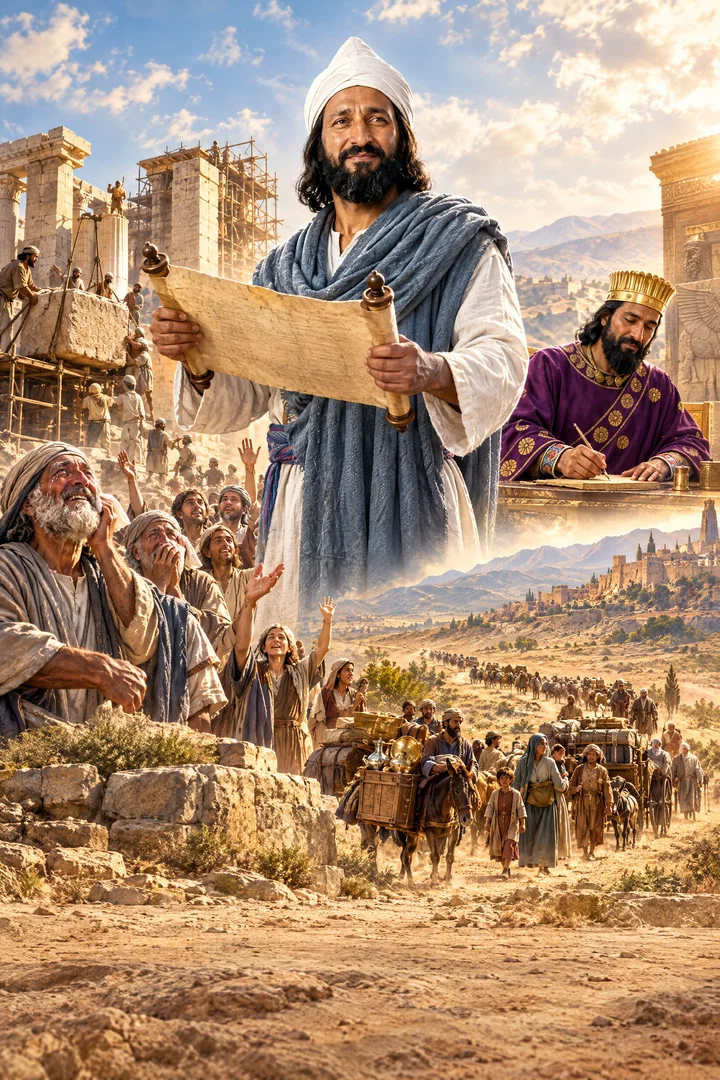
For upon the first day of the first month began he to go up from Babylon, and on the first day of the fifth month came he to Jerusalem, according to the good hand of his God upon him.
Translations
For on the first day of the first month began he to go up from Babylon, and on the first day of the fifth month came he to Jerusalem, according to the good hand of his God on him.
King James Version, KJV Cambridge Paragraph Bible, Revised Version
For upon the first day of the first month began he to go up from Babylon, and on the first day of the fifth month came he to Jerusalem, according to the good hand of his God upon him.
For upon the first day of the first month he began to go from Babylon, and on the first day of the fifth month he came to Jerusalem, according to the good hand of his God upon him.
For upon the first day of the first month began he to go up from Babylon; and on the first day of the fifth month came he to Jerusalem, according to the good hand of his God upon him.
for on the first of the month he hath founded the ascent from Babylon, and on the first of the fifth month he hath come in unto Jerusalem, according to the good hand of his God upon him,
For upon the first of the first month the project of going up from Babylon was determined on, and on the first of the fifth month he came to Jerusalem, according to the good hand of his God upon him.
For, on the first of the first month, was a beginning made of coming up from Babylon,—and, on the first of the fifth month, entered he into Jerusalem, according to the good hand of his God upon him.
Berean Standard Bible, Majority Standard Bible
He had begun the journey from Babylon on the first day of the first month, and he arrived in Jerusalem on the first day of the fifth month, for the gracious hand of his God was upon him.
For on the first day of the first month he began to go up from Babylon; and on the first day of the fifth month he came to Jerusalem, according to the good hand of his God on him.
For, starting his journey from Babylon on the first day of the first month, he came to Jerusalem on the first day of the fifth month, by the good help of his God.
For vpon the first day of the first moneth began he to goe vp from Babel, and on the first day of the fift moneth came he to Ierusalem, according to the good hande of his God that was vpon him.
Douay-Rheims (Challoner revision)
For upon the first day of the first month he began to go up from Babylon, and on the first day of the fifth month he came to Jerusalem according to the good hand of his God upon him.
Pictures
Cross-references 20 of 22
- Daniel 9:25
Know therefore and understand, that from the going forth of the commandment to restore and to build Jerusalem unto the Messiah the Prince shall be seven weeks, and threescore and two weeks: the street shall be built again, and the wall, even in troublous times.
The decree to restore Jerusalem marks the prophecy’s starting point.
- Ezra 1:1-4
Now in the first year of Cyrus king of Persia, that the word of the LORD by the mouth of Jeremiah might be fulfilled, the LORD stirred up the spirit of Cyrus king of Persia, that he made a proclamation throughout all his kingdom, and put it also in writing, saying,
Cyrus’s earlier decree began the return and temple rebuilding, later enlarged under Artaxerxes.
- Ezra 8:31
Then we departed from the river of Ahava on the twelfth day of the first month, to go unto Jerusalem: and the hand of our God was upon us, and he delivered us from the hand of the enemy, and of such as lay in wait by the way.
God’s hand protected the travelers and delivered them on their journey to Jerusalem.
- Ezra 7:1
Now after these things, in the reign of Artaxerxes king of Persia, Ezra the son of Seraiah, the son of Azariah, the son of Hilkiah,
Cited with Ezra 7:9 in connection with Artaxerxes’ decree.
- Ezra 7:13
I make a decree, that all they of the people of Israel, and of his priests and Levites, in my realm, which are minded of their own freewill to go up to Jerusalem, go with thee.
Both describe permission for a free return to Jerusalem.
- Ezra 7:28
And hath extended mercy unto me before the king, and his counsellors, and before all the king’s mighty princes. And I was strengthened as the hand of the LORD my God was upon me, and I gathered together out of Israel chief men to go up with me.
Ezra credits God’s strengthening hand for his journey to Jerusalem.
- Ezra 7:21-26
And I, even I Artaxerxes the king, do make a decree to all the treasurers which are beyond the river, that whatsoever Ezra the priest, the scribe of the law of the God of heaven, shall require of you, it be done speedily,
The royal decree authorizes Ezra’s work and sets its provisions into effect.
- Ezra 8:22
For I was ashamed to require of the king a band of soldiers and horsemen to help us against the enemy in the way: because we had spoken unto the king, saying, The hand of our God is upon all them for good that seek him; but his power and his wrath is against all them that forsake him.
God’s hand is for good toward those who seek him.
- Ezra 6:3-4
In the first year of Cyrus the king the same Cyrus the king made a decree concerning the house of God at Jerusalem, Let the house be builded, the place where they offered sacrifices, and let the foundations thereof be strongly laid; the height thereof threescore cubits, and the breadth thereof threescore cubits;
The earlier decree authorizes the temple’s rebuilding, which Ezra’s journey follows.
- Jeremiah 25:11-12
And this whole land shall be a desolation, and an astonishment; and these nations shall serve the king of Babylon seventy years.
The return follows the predicted seventy years of captivity.
- Jeremiah 29:10
For thus saith the LORD, That after seventy years be accomplished at Babylon I will visit you, and perform my good word toward you, in causing you to return to this place.
The seventy-year captivity ended with the people’s return.
- Ezra 7:24-26
Also we certify you, that touching any of the priests and Levites, singers, porters, Nethinims, or ministers of this house of God, it shall not be lawful to impose toll, tribute, or custom, upon them.
details provisions of same decree
- Isaiah 45:1-4
Thus saith the LORD to his anointed, to Cyrus, whose right hand I have holden, to subdue nations before him; and I will loose the loins of kings, to open before him the two leaved gates; and the gates shall not be shut;
God directs the return as part of his purpose for Israel.
- Nehemiah 2:18
Then I told them of the hand of my God which was good upon me; as also the king’s words that he had spoken unto me. And they said, Let us rise up and build. So they strengthened their hands for this good work.
Nehemiah’s later permission is contrasted with Ezra’s written decree.
- Exodus 12:41
And it came to pass at the end of the four hundred and thirty years, even the selfsame day it came to pass, that all the hosts of the LORD went out from the land of Egypt.
The return to Jerusalem is compared to a second going up out of Egypt.
- Isaiah 45:13
I have raised him up in righteousness, and I will direct all his ways: he shall build my city, and he shall let go my captives, not for price nor reward, saith the LORD of hosts.
Cyrus releases the captives and rebuilds Jerusalem.
- Daniel 9:24
Seventy weeks are determined upon thy people and upon thy holy city, to finish the transgression, and to make an end of sins, and to make reconciliation for iniquity, and to bring in everlasting righteousness, and to seal up the vision and prophecy, and to anoint the most Holy.
Gives the seventy-week period whose starting point is tied to the decree.
- Zechariah 2:6-7
Ho, ho, come forth, and flee from the land of the north, saith the LORD: for I have spread you abroad as the four winds of the heaven, saith the LORD.
The Jews in Babylon are invited to return to Jerusalem.
- Isaiah 44:26-28
That confirmeth the word of his servant, and performeth the counsel of his messengers; that saith to Jerusalem, Thou shalt be inhabited; and to the cities of Judah, Ye shall be built, and I will raise up the decayed places thereof:
God promises Jerusalem’s restoration, fulfilled as his people return.
- Nehemiah 13:6
But in all this time was not I at Jerusalem: for in the two and thirtieth year of Artaxerxes king of Babylon came I unto the king, and after certain days obtained I leave of the king:
The chronology is checked against Nehemiah’s account of his return to Jerusalem.
Commentary
Each commentary is drawn from primary sources: the writings of Ellen G. White and Adventist pioneers and periodicals. Each commentary is separate. Its own words are not a quotation; follow the references to read the source passages.
Ellen G. White
23 sources
Ezra began the ascent from Babylon on the first day of the first month and reached Jerusalem on the first day of the fifth month in the seventh year of Artaxerxes, a journey of about four months.ST May 2, 1878LSEGW 57.3–58.1 The decree that authorized that return was issued in 457 B.C. and went into effect in the autumn near the close of that year, providing the starting point for the seventy weeks leading to the Messiah and for the 2300 years of Daniel 8:14 reckoned to the fall of 1844.LS 48.4–5ST May 2, 1878ST Mar 30, 1876DA 232.5–233.24SP 494.2–3 His arrival in safety despite dangers along the way was evidence of the good hand of his God upon him in protecting care, prospering the journey and delivering the company from enemy and ambush.PK 617.2 Because Ezra trusted God to protect and provide for His people, God moved the king to favor him and to furnish abundant means and authorization for restoring Jerusalem and beautifying the house of the Lord.PK 610.1–611.1PK 609.4Lt 98, 1907, par. 2 That coming with several thousand men, women, and children, more than seventy years after the first return under Zerubbabel, gave the scattered people another opportunity to return to the land of promise and brought courage and hope to those laboring under trying difficulties.PK 611.2PK 617.2RH Feb 20, 1908
Journey to Jerusalem
Ezra began to go up from Babylon on the first day of the first month and came to Jerusalem on the first day of the fifth month, in the seventh year of Artaxerxes, a journey of about four months completed through God's favor and help upon him.ST May 2, 1878LSEGW 57.3–58.1PK 698.1PK 617.2 After beginning on the first day of the first month he tarried a few days at the river to complete every provision for the long journey and departed from the river on the twelfth day of the first month.PK 617.2 The company with him numbered several thousand in all, including women and children, necessitating slow progress.PK 617.2
His arrival took place over seventy years after the first company of exiles had returned with Zerubbabel and Joshua, when the temple had been finished and the walls of the city had been partially repaired yet much remained undone.RH Feb 20, 1908 At times the people had become disheartened and had well-nigh ceased effort to restore the city, and even during the years of comparative peace following the troublous times of Queen Esther little was done to uphold the wall.RH Feb 20, 1908 His coming with his company to Jerusalem brought courage and hope to many who had long labored under trying difficulties.RH Feb 20, 1908
The decree connected with the journey was the third issued since the close of the seventy years captivity, issued by Artaxerxes Longimanus for the restoring and building of Jerusalem.PK 610.1–611.1PK 611.2 It gave permission for all the people of Israel and the priests and Levites in the Medo-Persian realm who were willing of their own free will to go up to Jerusalem, with abundant provision, gifts for the temple, and authorization to carry out plans for Jerusalem.PK 610.1–611.1PK 611.2PK 609.4
Ezra trusted that God could protect and provide for His people, and his faith and integrity impressed the king, so God moved the king to favor Ezra and provide means for rebuilding the temple.PK 609.4Lt 98, 1907, par. 2 The return gave the scattered people another opportunity to return to the land tied to the promises to the house of Israel and to serve God in their own land, showing God's forbearance toward His wayward people.PK 611.2Lt 98, 1907, par. 2 It brought great rejoicing to those studying God's purposes for His people, and led Ezra to bless the Lord God of the fathers for putting it in the king's heart to beautify the house of the Lord in Jerusalem and for extending mercy to him before the king and his counselors and mighty princes.PK 611.2
Prophetic Starting Point
The chapter containing the verse identifies the decree of Artaxerxes as the command to restore and build Jerusalem.LS 48.4–5DA 232.5–233.24SP 494.2–3 That decree is the decree of Artaxerxes to restore and rebuild Jerusalem, going forth in 457 B.C.LS 48.4–5CET 49.2LS 185.2–3 It went into effect in the autumn, near the close of that year.ST May 2, 1878ST Mar 30, 1876LSEGW 57.3–58.1LS 185.2–31T 52.2–53.2 The verse's dating of the journey from Babylon to Jerusalem, begun on the first day of the first month and completed on the first day of the fifth month, helps establish when the decree took effect.ST May 2, 1878LSEGW 57.3–58.11T 52.2–53.2
That date begins the 2300 years of Daniel 8:14.LS 48.4–5CET 49.2LS 185.2–3 They were first reckoned by subtracting 457 from 2300 to terminate in 1843 with the coming of the Lord.LS 48.4–5CET 49.2LS 185.2–3 The calculation of prophetic time was so simple and plain that even children could understand it.CET 49.2LS 185.2–3 Yet the year entirely passed away without the Saviour coming, bringing sad disappointment.CET 49.2
Because the decree did not go forth at the beginning of 457 but near its close, the 2300-year period was reckoned to reach to the fall of 1844 rather than to the close of 1843.ST May 2, 1878ST Mar 30, 1876LSEGW 57.3–58.1LS 185.2–31T 52.2–53.2 The decree in Ezra 7 thus dated to 457 B.C. did not end in 1843 but reached the fall of 1844.ST May 2, 1878ST Mar 30, 1876LSEGW 57.3–58.1 The decree provides the starting point for the seventy weeks prophecy.4SP 494.2–3 It is the starting point for the prophetic time period leading to the Messiah, going into effect in the autumn of 457 B.C.PK 698.1DA 232.5–233.2
Good Hand of God
Ezra began to go up from Babylon on the first day of the first month and came to Jerusalem on the first day of the fifth month, in the seventh year of Artaxerxes, a journey of about four months whose safe completion was evidence of God's protecting care over the returning Jews despite the dangers along the way. After beginning on the first day of the first month he tarried a few days at the river to complete every provision for the long journey, and departed from the river on the twelfth day of the first month.PK 617.2 The company with him numbered several thousand in all, including women and children, necessitating slow progress.PK 617.2 The good hand of his God upon him meant preservation in safety on a prosperous journey, with deliverance from the hand of the enemy and from such as lay in wait by the way, their enemies being restrained from harming them.PK 617.2
The good hand of God upon him describes God going before a person and guiding his work, including by arranging practical help and resources through other people, by whose favor and help the four-month journey from Babylon to Jerusalem was completed.Ms 59, 1902, par. 62 That same favor and help accompanying the journey assures believers as they serve that God is with them, while their abilities remain gifts from Him and grow through use.Lt 22, 1897, par. 19 The same presence and support was with the speaker, enabling her to speak despite weakness.Lt 13, 1901, par. 5–6 The same sustaining care and favor that enabled the journey describes God's keeping power, strength, and blessing amid infirmities.2MR 253.5–254.3
The same favorable help and care is applied to work carried on through the day and begun in the early morning hours.Ms 21, 1911, par. 3 God's guidance of Ezra on his journey to Jerusalem applies to recognizing God's providence even in discouraging calamities rather than bemoaning them.Lt 269, 1902, par. 3 God's accompanying and guiding hand on a journey is seen in providing a home and in bringing her to America at that time, though she had wanted to remain in Australia.Lt 158, 1900, par. 19–20
Sources
Pioneers and periodicals
106 sources
Ezra began his ascent from Babylon on the first day of the first month and arrived at Jerusalem on the first day of the fifth month in the seventh year of Artaxerxes, a journey of about four months completed within the same regnal year under God's protecting care.ST Feb 23, 1882RH Sep 13, 1870 His safe arrival is ascribed to the good hand of his God upon him, whose providential favor, guidance and help carried the work forward and gave success despite dangers along the way.ST Feb 23, 1882RH Sep 13, 1870RH Jul 15, 1862RH Dec 5, 1865 The seventh chapter preserves the full decree he carried, issued in Eastern Aramaic, which completed the threefold commandment begun by Cyrus and confirmed by Darius and authorized the full restoration of the Jewish civil and religious state according to God's law.RH Mar 2, 1876ST Feb 23, 1882ST Mar 11, 1889ST Jun 26, 1907 That decree went forth in 457 B.C. and provides the date from which the seventy weeks of 490 years and the 2,300 days understood as years are reckoned together, with the reckoning counted from the autumn commencement of the work at Jerusalem after his arrival.RH Feb 22, 1870RH Mar 2, 1876ST Feb 23, 1882ST Mar 9, 1882RH May 1, 1866 Counted thus, sixty-nine weeks reach Messiah's anointing at baptism in A.D. 27, the midst of the seventieth week reaches His being cut off at the crucifixion in A.D. 31, the seventy weeks close upon the Jews in A.D. 34, and the 2,300 years reach autumn 1844 for the cleansing of the heavenly sanctuary and preliminary judgment.ST May 11, 1876RH Mar 10, 1874ST Mar 27, 1879RH Oct 27, 1904RH May 1, 1866
Journey Dates and Route
Ezra began to go up from Babylon on the first day of the first month and came to Jerusalem on the first day of the fifth month, in the seventh year of Artaxerxes, a journey of about four months made within the same regnal year.ST Feb 23, 1882RH Sep 13, 1870RH Apr 18, 1912RH Aug 31, 1916 His safe arrival is ascribed to the good hand of his God upon him, and the journey put the king's decree into effect as the authority for restoring the Jewish civil and religious community.ST May 2, 1878ST Feb 23, 1882RH Sep 13, 1870RH Apr 18, 1912 In the prophetic reckoning that decree is dated to 457 B.C. near the close of that year, so that the period reckoned from it reaches the fall of 1844 rather than the end of 1843.ST May 2, 1878ST Feb 23, 1882RH Sep 13, 1870
The first month was Nisan or Abib, nearly corresponding to April in spring, and the fifth month was Ab, nearly corresponding to August, so Ezra arrived in late summer.RH Apr 9, 1908ST Mar 26, 1912RH Apr 18, 1912RH May 1, 1866ST Sep 18, 1901 The journey therefore began in the first month in spring and ended in the fifth month in August within the same regnal year, showing with the order of months in Nehemiah that the regnal year ran autumn to autumn and that the seventh year extended from autumn 458 B.C. to autumn 457 B.C., with the journey beginning in spring 457 B.C.RH Apr 9, 1908ST Mar 26, 1912RH Apr 18, 1912 The order of Nisan and Ab in the seventh year, joined with the order of Chisleu and Nisan in the twentieth year, places the king's accession between late July and early November, about summer 464 B.C.RH Apr 9, 1908ST Mar 26, 1912 One account counts the same interval as five months from the first day of the first month to the first day of the fifth month.RH Dec 11, 1855
The word began refers to the start of the journey, and the phrase for the foundation of the going up can mean the beginning or basis of the expedition.ST Sep 18, 1901ST Jun 14, 1899 The king's decree which enabled the journey may have been issued at its start.ST Sep 18, 1901 Eleven days were spent in preparations such as reviewing the people, sending for Levites, and fasting and praying, and the company departed on the twelfth day of the first month.ST May 7, 1902
The king's decree enabling the journey was issued shortly before the departure, around January 457 B.C.RH Apr 9, 1908 It is likewise placed around the end of 458 to the beginning of 457 B.C., shortly before Nisan, and the time before the seventh-month feast was likely spent waiting, fasting, and preparing, so that public announcement and execution at Jerusalem and the restoration work began only after arrival, toward autumn.RH May 1, 1866ST Sep 18, 1901 The decree, being addressed to officials beyond the Euphrates, had no force in Palestine until published and executed after he arrived.RH May 1, 1866ST Sep 18, 1901
The return was a second colony or company, with a large number responding to the invitation to go with Ezra.ST Apr 19, 1883RH Jul 21, 1868 It came seventy-nine years after Zerubbabel led back 52,000 captives and rebuilt the temple with a portion of the dwellings after the city lay desolate half a century, and thirteen years before Nehemiah guided a third return in Artaxerxes' twentieth year, December 444 B.C., to rebuild the walls.ST Oct 18, 1899RH Jul 21, 1868 Ezra's coming was over seventy years after the first company returned with Zerubbabel and Joshua; by then the temple was finished and the walls partially repaired, yet much remained undone.RH Feb 20, 1908 The people were disheartened and had nearly ceased effort to restore the city, and little was done even in the comparative peace after the troublous times of Queen Esther, until the coming of Ezra and his company brought courage and hope to many who had long labored under trying difficulties.RH Feb 20, 1908
The period of Ezra's return provides a chronological reference for Esther, whose story falls in the intervening years.ST Sep 20, 1899 In that reckoning Esther's story is placed roughly sixty years after Ezra's return.ST Sep 20, 1899
God's Good Hand
Ezra began to go up from Babylon on the first day of the first month and came to Jerusalem on the first day of the fifth month, in the seventh year of Artaxerxes, a journey of about four months.ST Feb 23, 1882RH Sep 13, 1870RH Apr 18, 1912RH Aug 31, 1916 His safe arrival was the evidence of God's protecting care over the returning Jews, who reached Jerusalem safely despite the dangers along the way, by God's favor and help and good hand upon him.ST May 2, 1878ST Feb 23, 1882RH Sep 13, 1870RH Aug 31, 1916 That journey in 457 B.C. was made under the authority of Artaxerxes' decree to Ezra, which is preserved in writing as authority for restoring the Jewish civil and religious community and state and rebuilding Jerusalem.ST Feb 23, 1882RH Sep 13, 1870RH Apr 18, 1912 The decree completed the command to restore and build Jerusalem and was put into effect by the journey, and it is the starting point for the seventy weeks prophecy.ST Feb 23, 1882RH Sep 13, 1870RH Apr 18, 1912 Because that decree was issued near the end of 457 B.C., the 2,300-year period reckoned from it reaches to the fall of 1844 rather than to the end of 1843.ST May 2, 1878
The good hand of God upon Ezra means God's providential favor, support, guidance, and real help.RH Jul 15, 1862RH Dec 5, 1865ST May 27, 1889RH Aug 17, 1905RH Jan 16, 1913 It strengthened him to carry out his journey to Jerusalem and brought the work to success in about four months.RH Jul 15, 1862RH Dec 5, 1865 The same good hand carries His work and people forward continually, giving success to their labor, and to Him belongs the praise for what is accomplished.ST May 27, 1889RH Aug 17, 1905 God's sustaining care gives courage rather than fear when danger or opposition arises.RH Jul 15, 1862 That help is seen when means are provided, a building for the work is paid for, past debt is fully cleared and the mission stands free from debt with hopeful prospects, as in meetinghouse construction, in publishing work, and in confidence that God is with the work in Detroit.RH Dec 5, 1865ST May 27, 1889RH Aug 17, 1905RH Jan 16, 1913
To go with the good hand of God upon him means to be touched with new strength and vigor by the operation of His Spirit.RH Dec 2, 1873 That touch sustains health and strength under severe tax of early and late labors for many interests and for spiritual advancement.RH Dec 2, 1873 It is the blessing to seek for those who leave for important duties elsewhere, that they go with that same good hand upon them and in due time return to find the work well kept, friends all true, and a still greater measure of blessing awaiting.RH Dec 2, 1873
Decree Content and Authority
The seventh chapter preserves a full and accurate copy of the decree of Artaxerxes to Ezra, given in the original not in Hebrew but in Chaldaic or Eastern Aramaic then used at Babylon, and this portion of the decree Ezra carried with him from Babylon to Jerusalem.ST Nov 1, 1877RH Feb 7, 1907 The journey itself belongs to the history of the decree rather than to a life of Ezra for its own sake, falling in the seventh year of Artaxerxes as the last year of the decree's seventy-nine-year span.RH Feb 7, 1907
The decree in the seventh chapter is the third part of the threefold commandment to restore and build Jerusalem, completing the permission of Cyrus in 536 B.C. to rebuild the temple and its confirmation by Darius in 519 or 520 B.C.ST Mar 11, 1889ST Jun 26, 1907ST Dec 19, 1892ST Jan 14, 1897 Together they make up the commandment of the God of Israel, which was not full and complete until this fullest installment.ST Jun 26, 1907RH Oct 11, 1915ST Jan 14, 1897 It is fuller in scope and greater in powers than the first two, filling out what was lacking in them and forming a complete charter for the full restoration of Jerusalem.ST Mar 11, 1889ST Jun 26, 1907 Its going forth provides the date from which the seventy weeks and the 2,300 days are reckoned.ST Mar 11, 1889RH Oct 11, 1915
Unlike the earlier decrees that concerned chiefly the temple and its worship, this decree authorized full restoration of the Jewish civil and religious state as a theocracy according to God's law.RH Mar 2, 1876ST Feb 23, 1882RH Mar 12, 1901RH Dec 24, 1861ST Nov 1, 1877 It empowered Ezra to regulate affairs, beautify the house of God, draw unlimited treasure for offerings and whatever else seemed good, exempt the priesthood from taxes, ordain laws, set magistrates and judges, and execute punishment even unto death.RH Dec 24, 1861ST Nov 1, 1877 It provided what was needed to reestablish religion, polity, and policy and to restore the nation civil and ecclesiastical according to the law of God and ancient custom.ST Nov 1, 1877ST Dec 19, 1892 Under it rulers, priests, nobles, and people were still building when Nehemiah arrived thirteen years later.ST Nov 1, 1877
The work under the commission was a thorough restoration: restoring the lost Scriptures, instructing the ignorant in the law, ordering neglected worship, reforming church and state, and reestablishing religion, polity, and policy.ST Dec 19, 1892RH Oct 20, 1874 In this work Ezra stands as another Moses and second founder of the Jewish church and state, as priest, skillful scribe in the law of God, and president of the Sanhedrim, continuing after his commission ended with an equally zealous successor.RH Oct 20, 1874 His arrival marked the time when the decree took effect, when he restored the Jewish commonwealth, appointed magistrates and judges, and began rebuilding the wall.RH Aug 20, 1914GSAM 160.4–5 This beginning is the proper starting point for the seventy weeks, because that prophecy foreshows the age of the restored church of the Jews, how long it would continue and when it would cease.RH Oct 20, 1874
The work begun under Ezra's decree was not completed until Nehemiah went up in the twentieth year to finish what Ezra had begun.RH Jul 23, 1857 That finishing included repairing the temple and city, restoring the commonwealth, appointing magistrates and judges, and rebuilding the wall.RH Aug 20, 1914RH Dec 10, 1908GSAM 160.4–5 The seven weeks of years, forty-nine years, run from this beginning till city, wall, temple, and Jewish polity are fully restored.RH Dec 10, 1908
The decree traveled with Ezra and, being addressed to officials beyond the Euphrates and in Palestine, had no force there until he arrived and it was published and executed, so its going into effect is dated to his arrival and the commencement of work at Jerusalem.ST Sep 16, 1886ST Jul 18, 1911RH Sep 18, 1900 He set out on the first day of the first month and arrived on the first day of the fifth month, and only after reaching Jerusalem could he give orders for the city's restoration and its worship as the first and most important work.ST Sep 16, 1886ST Jul 18, 1911RH Dec 11, 1855 In this reckoning the effective beginning falls about the middle of 457 B.C., about 456 1/2 years before Christ.ST Sep 16, 1886RH Sep 18, 1900
Whether this decree is the commandment from which the seventy weeks are dated must be decided by what restoring and building Jerusalem includes and by whether seventy weeks from its promulgation reach the events specified.RH Jan 7, 1858 It fits both tests in restoration and rebuilding and in chronological periods, while the later decree in the twentieth year only confirmed it.RH Dec 24, 1861 The thirteen years spent rebuilding have no effect, because the period dates from issuing for accomplishment, not from completion, and reckoning from Ezra's decree places the crucifixion in the midst of the last week as predicted.RH Jul 23, 1857
This decree to Ezra, rather than the decrees of Cyrus or Darius or Nehemiah's later commission, is the correct starting date.RH Feb 22, 1870RH Jul 28, 1863ST Jul 25, 1878RH Dec 8, 1874 The earlier decrees concerned chiefly the temple and its worship, and their dates would not carry the seventy weeks to the Christian era.RH Sep 13, 1870 One discussion treats Ezra's decree and Nehemiah's commission as the two candidates and leaves the choice between them for further discussion, while noting that 490 years from either the seventh-year or twentieth-year decree would not reach Jerusalem's destruction in A.D. 70.RH Jul 21, 1863RH Sep 13, 1870 The temple had already been completed, so the sanctuary was in existence when the prophetic period began under this decree.RH Jan 20, 1853
Reign and Chronology Established
In the seventh year the first month Nisan came before the fifth month Ab within the same regnal year, marking the start of the going up from Babylon and the coming to Jerusalem.RH Feb 22, 1912RH Apr 9, 1908ST Mar 26, 1912RH Apr 18, 1912 Joined with the order of the ninth month Chisleu and the first month Nisan in the twentieth year, this proves the accession of Artaxerxes was sometime between the latter end of July and the former part of November, about the summer of 464 B.C., after midsummer.RH Feb 22, 1912RH Apr 9, 1908ST Mar 26, 1912 His regnal year ran from autumn to autumn, so his seventh year extended from the summer or autumn of 458 B.C. to the summer or autumn of 457 B.C., from autumn 458 to autumn 457.RH Feb 22, 1912RH Apr 18, 1912RH Apr 18, 1912 The journey therefore began in the first month in the spring of 457 B.C. and ended in the fifth month in August, within the same regnal year.RH Apr 18, 1912RH Apr 18, 1912
Artaxerxes Longimanus began to reign in B.C. 464 and reigned forty-one years, so his seventh year was B.C. 457.RH Jul 9, 1908ST Apr 15, 1880ST Jan 22, 1880 That date is fixed by undisputed history from an undisputed astronomical starting point and placed by the canon of Ptolemy.ST Jun 26, 1907ST Oct 25, 1883ST Apr 15, 1880 Its accuracy is demonstrated by the concurrent agreement of more than twenty eclipses.ST Jun 26, 1907ST Oct 25, 1883ST Apr 15, 1880
The starting point is a lunar eclipse in the seventh year of Cambyses in B.C. 523, with Cambyses reigning one year after, followed by Darius reigning thirty-six years and Xerxes reigning twenty-one years, bringing the first of Artaxerxes to B.C. 464 and his seventh to B.C. 457.ST Apr 15, 1880 Artaxerxes is Longimanus, son of Xerxes or Ahasuerus, who succeeded Darius.RH Jul 9, 1908ST Apr 23, 1902 He followed Cyrus, Cambyses, Smerdis, Darius Hystaspes, Xerxes, and the seven-month usurpation of Artabanus, and in the order of Persian kings he followed Darius Hystaspes and Xerxes.RH Jul 9, 1908ST Jun 2, 1909
The verse was written by Ezra the priest and belongs to the time of Artaxerxes Longimanus.ST Jun 2, 1909 It stands in the chapter where the decree of Cyrus, renewed by Darius, is renewed again and greatly enlarged.ST Jun 2, 1909 It shows the good hand of God upon Ezra and the Jews in going up from Babylon to Jerusalem and in prospering them in the building of the temple.ST Jun 2, 1909
Prophecy Starting Point Dated
The decree preserved in Ezra 7 went forth in the seventh year of Artaxerxes, dated to 457 B.C. near the close of that year.RH Feb 22, 1870RH Mar 2, 1876ST Feb 23, 1882ST Jan 24, 1878 It is the full command to restore and build Jerusalem that fulfills Daniel 9 and incorporates the earlier decrees of Cyrus and Darius.RH Mar 2, 1876ST Feb 23, 1882 Ezra's journey from Babylon to Jerusalem, begun on the first day of the first month and completed on the first day of the fifth month under God's favor, belongs to that 457 B.C. authorization to restore the Jewish civil and religious community.RH Feb 22, 1870ST Feb 23, 1882RH Sep 13, 1870 Its going forth provides the date from which the seventy weeks or 490 years and the 2,300 days understood as years are reckoned.ST Feb 23, 1882ST Jan 24, 1878
The seventy weeks are the first 490 years cut off from the 2,300 days, so the two periods commence together.ST Dec 3, 1874RH May 1, 1866RH Apr 10, 1916RH Jun 2, 1874RH Jan 21, 1873 The commandment in Ezra 7 begins both reckonings by the year-day principle in the seventh year of Artaxerxes, 457 before Christ.ST Dec 3, 1874RH May 1, 1866RH Jan 21, 1873 That common starting date carries the 2,300 years to 1844 and the seventy weeks to their fulfillment in Christ and the turn to the Gentiles.ST Dec 3, 1874RH Apr 10, 1916ST Mar 25, 1897RH Jun 2, 1874RH Jan 21, 1873
Counting 2,300 minus 457 left 1843 by careless reckoning, leading William Miller to conclude the period would end in 1843 for Christ's return.LS 48.4–5ST Jan 24, 1878RH Aug 11, 1904 That first reckoning placed the close of the 2,300 years at the end of 1843 for the coming of the Lord.LS 48.4–5LS 185.2–3RH Aug 11, 1904 Because the decree was issued near the end of 457 and full years require 457 full years before Christ and 1843 full years after, the period reaches the fall of 1844 rather than the end of 1843 or spring 1844.ST May 2, 1878ST Mar 30, 1876LS 185.2–3 The calculation remains so simple and plain that even children could understand it.LS 185.2–3
One explanation distinguishes issuance from execution: the decree was issued in 458 B.C., and Ezra set out in 457 B.C.RH Nov 12, 1901 The journey marks the decree's beginning to be carried out, with time afterward to settle and gather materials so that rebuilding work could begin in the seventh month of 457 B.C., the starting point used for the seventy weeks prophecy.RH Nov 12, 1901 Jerusalem's restoration under this decree came about 130 years after Ezekiel's prophecy in 587 B.C.ST May 9, 1878
Autumn Reckoning to 1844
The prophetic period is not reckoned from the spring departure from Babylon but from the actual commencement of the work at Jerusalem, which could not have been earlier than the seventh month in autumn 457 B.C. ST Mar 9, 1882RH Sep 20, 1870RH Jul 28, 1863RH Jan 21, 1858ST May 6, 1880 Ezra began the journey on the first day of the first month, Abib, and arrived on the first day of the fifth month, so the journey itself took several months and the decree issued in spring was publicly announced and executed only after arrival. ST Mar 9, 1882RH May 1, 1866RH Mar 31, 1868RH Sep 20, 1870 Time after the fifth-month arrival was needed for waiting, fasting, preparing, settling, gathering materials, and giving orders for restoration and worship, so the restoring and rebuilding began later, probably in the seventh month. RH May 1, 1866RH Mar 31, 1868RH Sep 20, 1870RH Dec 23, 1852RH Feb 22, 1870 The first seven weeks, or 49 years allotted to restoration in troublous times, therefore begin when that work actually begins at Jerusalem. RH Dec 23, 1852RH Feb 22, 1870
Six months of the year 457 B.C. had passed before the commandment to restore and build Jerusalem took effect, placing its effective beginning about the middle of the year. RH Dec 1, 1904RH Oct 27, 1904RH Sep 18, 1900RH Oct 3, 1912RH Jan 8, 1901 That later point is expressed as 456 1/2 B.C., or 456 1/2 years before Christ, fixed by the interval from the first day of the first month to the first day of the fifth month. RH Oct 27, 1904RH Aug 3, 1916RH Sep 18, 1900RH Oct 3, 1912 The seventy weeks and the twenty-three hundred full years must therefore be reckoned not from the beginning of 457 B.C. but from that later point in the year. RH Dec 1, 1904RH Oct 27, 1904 The decree traveled with Ezra and, being addressed to officials beyond the Euphrates and in Palestine, had no force there until he arrived. RH Sep 18, 1900
Whatever part of 457 had passed before the autumn reckoning began must pass in 1844 before the 2,300 years end. RH Sep 20, 1870RH Jul 28, 1863RH Jan 21, 1858ST May 6, 1880 The whole period therefore extends to the seventh month, autumn Jewish time, of 1844, running six months over into that year. RH Dec 1, 1904RH Sep 20, 1870RH May 1, 1866RH Jul 28, 1863 That autumn close reached to the tenth day of the seventh month, when the midnight cry began and the virgins went forth to meet the Bridegroom. RH Dec 1, 1904 A full 2,300 years requires 457 full years before Christ and 1843 full years after, so beginning on the first day of 457 it would end on the last day of 1843, but since the middle of the seventieth week ended in the first month in spring A.D. 31 at the crucifixion and the last three and a half years ended in the seventh month in autumn A.D. 34, the seventy weeks and the 2,300 years commenced in autumn B.C. 457 and the 2,300 years terminated in autumn 1844. RH May 1, 1866
Counted from autumn 457 B.C., 483 years reach autumn A.D. 27, 490 years reach autumn A.D. 34, and the 1,810 remaining years reach autumn 1844. RH Oct 27, 1904RH May 1, 1866RH Sep 16, 1902RH Dec 17, 1908 Counted as 456 1/2 B.C., sixty-nine weeks or 483 year-days reach Messiah the Prince anointed at baptism in A.D. 27, with the elapsed part of 457 carrying the time nearly half a year beyond the end of A.D. 26 into A.D. 27. RH Oct 27, 1904RH Aug 3, 1916RH Sep 16, 1902RH May 16, 1912 From the fall 457 B.C. going into effect, the divisions are 49 years to the complete rebuilding of Jerusalem and full establishment of the Jewish polity, 483 years to Messiah the Prince in fall A.D. 27, three and a half years more to Christ cut off in the middle of the last week in A.D. 31, three and a half years more to the end of the seventy weeks upon the Jewish people in A.D. 34 with the close of their special privileges and the going of the gospel to the Gentiles, leaving 1,810 years allotted especially to the Gentile world to fall 1844. RH Oct 27, 1904RH Dec 17, 1908 Twenty-three hundred years from 457 thus brings the cleansing of the sanctuary to 1844, with 490 years to the scattering and preaching everywhere in A.D. 34. RH Oct 27, 1904RH Aug 3, 1916
The Jewish fifth month falls in autumn by the modern calendar, so the royal commandment dated to 457 B.C. went into effect in the autumn. ST Jan 20, 1904 Ezra's arrival and commission are thus placed in late summer or autumn 457 B.C., supporting an autumn start for the 2,300 years rather than spring. ST Jan 20, 1904RH May 16, 1912 From autumn 457 B.C. to autumn A.D. 27 is the 483-year period leading to Christ's manifestation at His baptism, with 483 years reaching to the baptism or anointing of Messiah the Prince. ST Jan 20, 1904RH May 16, 1912
Its action dates the beginning of the 2,300 days, understood as 2,300 years with a prophetic day representing a year, to autumn B.C. 457, so its termination falls in autumn A.D. 1844. ST Nov 7, 1916 That termination marks the time for the climax of the advent movement foretold in Revelation 10 and the proclamation of the threefold message of Revelation 14. ST Nov 7, 1916
Fulfillment in Messiah and Judgment
Sixty-nine weeks, or 483 prophetic days reckoned as so many literal years, extend from 457 B.C. to Messiah the Prince.ST May 11, 1876RH Mar 10, 1874RH Nov 15, 1853ST Feb 18, 1913RH Aug 3, 1916 That term of 483 years reaches to Christ's baptism by John and anointing by the Holy Spirit in A.D. 26 or 27, when He entered upon His ministry declaring the time fulfilled.ST May 11, 1876RH Mar 10, 1874ST Mar 27, 1879ST Feb 18, 1913RH Aug 3, 1916 The period between the marginal dates of Ezra 7:7 and Luke 3:21 is exactly 483 years when the elapsed part of 457 B.C. carrying the time nearly half a year beyond the end of A.D. 26 into A.D. 27 is remembered.RH Aug 3, 1916 This fulfillment confirms both the day-for-a-year reckoning and the 457 B.C. starting date.ST May 11, 1876
Three and a half years more reach to the midst of the seventieth week in the first month in the spring of A.D. 31 at the crucifixion, when Messiah was cut off and caused sacrifice and oblation to cease.ST Mar 27, 1879RH May 1, 1866RH Jun 2, 1874RH Jul 23, 1857RH Dec 17, 1908 Three and a half years more end the last half-week in the seventh month in the autumn of A.D. 34, when the seventy weeks close upon the Jews.ST Mar 27, 1879RH Oct 27, 1904RH May 1, 1866RH Dec 17, 1908RH Dec 23, 1852 Then the apostles turned to the Gentiles with scattering and preaching everywhere, closing their special privileges as the chosen people.ST Mar 27, 1879RH Oct 27, 1904RH May 1, 1866RH Jun 2, 1874RH Dec 17, 1908 The first seven weeks, or 49 years, are allotted to restoration in troublous times, running from the commencement of Ezra's work to Nehemiah's final act of reformation till the city, wall, temple, and Jewish polity are fully restored.RH Feb 22, 1870RH Dec 10, 1908RH Dec 17, 1908
Since the seventy weeks are the first 490 years cut off from the 2,300 days of Daniel 8:14, Ezra's restoration date also dates the 2,300 days, which extend 1,810 remaining years to 1844.ST Mar 27, 1879ST Oct 21, 1880RH Nov 15, 1853ST Mar 30, 1876RH Jun 2, 1874 Dating the 2,300 days from the latter part of 457 B.C. brings their termination to the same point in 1844, in the autumn of that year.ST Oct 21, 1880ST Nov 7, 1916ST Mar 30, 1876RH Apr 10, 1916ST Mar 25, 1897 Then Christ passed from the holy place into the most holy place of the heavenly temple, the true tabernacle which the Lord pitched and not the typical sanctuary destroyed in A.D. 70, to begin the cleansing of the sanctuary.ST Mar 27, 1879ST Mar 30, 1876RH Apr 10, 1916ST Mar 25, 1897RH Jun 2, 1874 That is the antitypical Day of Atonement and preliminary judgment, the closing judgment work of Christ the great High Priest examining the heavenly records from Adam to the close of time to determine who have accepted Christ as Saviour and are thus entitled to a part with Him at His second coming.ST Oct 21, 1880ST Nov 7, 1916ST Mar 30, 1876RH Apr 10, 1916ST Mar 25, 1897 Its action marks the time for the climax of the advent movement foretold in Revelation 10 and the proclamation of the threefold message of Revelation 14, including the judgment-hour message of Revelation 14:7.ST Oct 21, 1880ST Nov 7, 1916RH Apr 10, 1916
That 490-year period fixes a precise point where eight events close the Jewish dispensation and usher in the Gentile or Christian dispensation, marking the time when the Jews would no longer be the special chosen people of God.RH Nov 3, 1874 Then their city and temple would be rejected and it would no longer be transgression to neglect their ceremonial ordinances or sin to put them away.RH Nov 3, 1874 Here also by Christ's atoning sacrifice reconciliation is made for iniquity and the everlasting righteousness of Christ appears, and thus vision and prophecy is sealed and the most holy is anointed.RH Nov 3, 1874 With this time given the Jews might have known the time of their visitation and hailed the first advent with joy, and their failure to search it left their house desolate.RH Nov 3, 1874 Only the decree to Ezra fits the prophecy's conditions concerning the Messiah, His crucifixion, and the confirmation of the covenant for one week, with prophetic events aligning with His baptism and ministry, His crucifixion, and the turn from the Jews to the Gentiles.RH Feb 14, 1854ST Mar 2, 1882
Application for Believers Today
Ezra did not act independently of the king but sought lawful authority from him, and the king granted his request, showing that the good hand of God upon a mission can accompany the use of civil authority and that the journey to Jerusalem took place under divine favor.RH Aug 28, 1860 God's sustaining care and good hand strengthened Ezra to carry out his journey to Jerusalem, and that same care gives courage rather than fear when danger or opposition arises.RH Jul 15, 1862 The good hand expresses God's providential favor, support, guidance, and real help that carries His work forward, gives courage to go on, and gives success, and the journey from Babylon to Jerusalem completed in about four months is attributed to it.RH Dec 5, 1865ST May 27, 1889RH Aug 17, 1905RH Jan 16, 1913 The same help is seen when money is provided, a building for the work is paid for, past debt is fully cleared, and the mission stands free from debt with hopeful prospects, and it is applied to the successful progress of meetinghouse construction, to confidence that God is with the work in Detroit, and to publishing work.RH Dec 5, 1865ST May 27, 1889RH Aug 17, 1905RH Jan 16, 1913 God's good hand guides a journey safely to its destination, and trust in His care and guidance belongs in entering a new field of labor and in praying for His prospering hand there.RH May 3, 1870 Going with the good hand upon him means being touched with new strength and vigor by the operation of God's Spirit to sustain health and strength under severe tax of early and late labors for many interests and for spiritual advancement, and it is the blessing to seek for those who leave for important duties elsewhere, that they go with that same hand upon them and in due time return to find the work well kept, friends all true, and a still greater measure of blessing awaiting.RH Dec 2, 1873
Wisdom caused Ezra's heart to glow with love for Zion, made him a beloved prophet and a ready scribe of the law, and gave him the honor of first leading out in the return from Babylon to Jerusalem.RH May 9, 1865 The journey begun from Babylon on the first day of the first month and reaching Jerusalem on the first day of the fifth month succeeded through God's gracious care, and it belongs to the later history of Ezra bringing another company of exiles to Jerusalem.ST Dec 19, 1892 That homeward return is a joyful deliverance from captivity, a further going up to the promised land that typifies the final deliverance of believers from the bondage of sin and death.ST Dec 19, 1892 The verse belongs to the Bible narrative of Babylonian life in the days of Ezra and Nehemiah, and discoveries in ancient lands adjoining Israel that had dealings with Israel confirm that narrative and supply information about its archaeology.ST Mar 10, 1909
Sources