Genesis 16:1
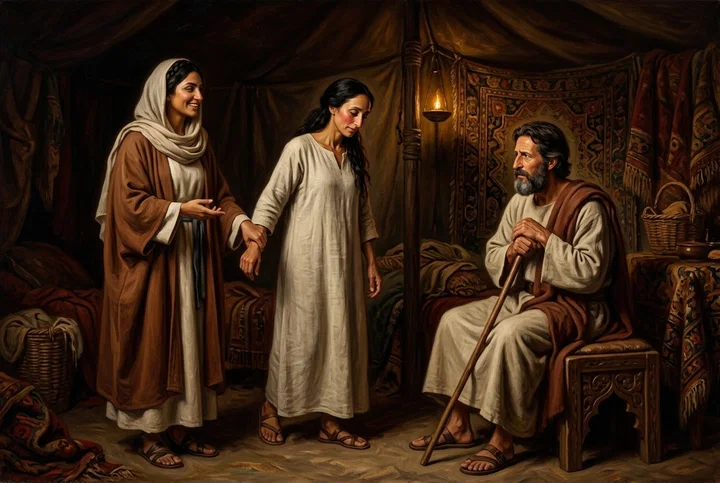
Now Sarai Abram’s wife bare him no children: and she had an handmaid, an Egyptian, whose name was Hagar.
Translations
Now Sarai Abram’s wife bore him no children: and she had an handmaid, an Egyptian, whose name was Hagar.
King James Version, Revised Version
Now Sarai Abram’s wife bare him no children: and she had an handmaid, an Egyptian, whose name was Hagar.
Now Sarai Abram’s wife bare him no children: and she had a handmaid, an Egyptian, whose name was Hagar.
Now Sarai, Abram's wife, bore him no children: and she had a handmaid, an Egyptian, whose name was Hagar.
Now Sarai, Abram’s wife, bare him no children: and she had a handmaid, an Egyptian, whose name was Hagar.
And Sarai, Abram's wife, hath not borne to him, and she hath an handmaid, an Egyptian, and her name [is] Hagar;
And Sarai Abram's wife did not bear him [ children]. And she had an Egyptian maidservant; and her name was Hagar.
But Sarai, Abram’s wife, had borne him no children,—she had, however, an Egyptian handmaid, whose name was Hagar.
Berean Standard Bible, Majority Standard Bible
Now Abram’s wife Sarai had borne him no children, but she had an Egyptian maidservant named Hagar.
Now Sarai, Abram’s wife, bore him no children. She had a servant, an Egyptian, whose name was Hagar.
Now Sarai, Abram's wife, had given him no children; and she had a servant, a woman of Egypt whose name was Hagar.
Nowe Sarai Abrams wife bare him no children, and she had a maide an Egyptian, Hagar by name.
Douay-Rheims (Challoner revision)
Now Sarai the wife of Abram, had brought forth no children; but having a handmaid, an Egyptian, named Agar,
Pictures
Cross-references 20 of 31
- Galatians 4:22-23
For it is written, that Abraham had two sons, the one by a bondmaid, the other by a freewoman.
Hagar and Sarah’s sons illustrate human effort versus God’s promise.
- Genesis 15:4-5
And, behold, the word of the LORD came unto him, saying, This shall not be thine heir; but he that shall come forth out of thine own bowels shall be thine heir.
God promises Abram an heir from his own body and descendants as numerous as the stars.
- Genesis 21:10
Wherefore she said unto Abraham, Cast out this bondwoman and her son: for the son of this bondwoman shall not be heir with my son, even with Isaac.
Sarah demands that Hagar and her son be cast out over the inheritance.
- Genesis 17:19
And God said, Sarah thy wife shall bear thee a son indeed; and thou shalt call his name Isaac: and I will establish my covenant with him for an everlasting covenant, and with his seed after him.
correction that Sarah herself bears promised child
- Genesis 25:6
But unto the sons of the concubines, which Abraham had, Abraham gave gifts, and sent them away from Isaac his son, while he yet lived, eastward, unto the east country.
Abraham’s concubines and their children illustrate patriarchal marriage practices.
- Galatians 4:24
Which things are an allegory: for these are the two covenants; the one from the mount Sinai, which gendereth to bondage, which is Agar.
Hagar represents the covenant that leads to bondage.
- Genesis 21:1-3
And the LORD visited Sarah as he had said, and the LORD did unto Sarah as he had spoken.
Sarah bore Isaac as God had promised.
- Hebrews 11:11
Through faith also Sara herself received strength to conceive seed, and was delivered of a child when she was past age, because she judged him faithful who had promised.
Sarah later trusted God’s promise and received strength to conceive.
- Genesis 15:5
And he brought him forth abroad, and said, Look now toward heaven, and tell the stars, if thou be able to number them: and he said unto him, So shall thy seed be.
The promise of descendants preceded Abram’s attempt to fulfill it through Hagar.
- Genesis 12:2-3
And I will make of thee a great nation, and I will bless thee, and make thy name great; and thou shalt be a blessing:
God promised Abram that his seed would bring blessing to all nations.
- Genesis 16:9
And the angel of the LORD said unto her, Return to thy mistress, and submit thyself under her hands.
The angel tells Hagar to return and submit to Sarai.
- Galatians 4:29
But as then he that was born after the flesh persecuted him that was born after the Spirit, even so it is now.
Ishmael, Hagar’s son, is contrasted with Isaac, the child of promise.
- Genesis 30:1
And when Rachel saw that she bare Jacob no children, Rachel envied her sister; and said unto Jacob, Give me children, or else I die.
Both describe family unhappiness in a patriarchal marriage.
- Genesis 15:2-3
And Abram said, Lord GOD, what wilt thou give me, seeing I go childless, and the steward of my house is this Eliezer of Damascus?
Both describe Abram seeking an heir because he has no children.
- Genesis 16:12
And he will be a wild man; his hand will be against every man, and every man’s hand against him; and he shall dwell in the presence of all his brethren.
Ishmael is described as living in conflict with others.
- Genesis 22:17-18
That in blessing I will bless thee, and in multiplying I will multiply thy seed as the stars of the heaven, and as the sand which is upon the sea shore; and thy seed shall possess the gate of his enemies;
God renews the promise of numerous descendants and blessing to all nations.
- Genesis 13:16
And I will make thy seed as the dust of the earth: so that if a man can number the dust of the earth, then shall thy seed also be numbered.
God promised Abram innumerable descendants while he was still childless.
- Genesis 16:11
And the angel of the LORD said unto her, Behold, thou art with child, and shalt bear a son, and shalt call his name Ishmael; because the LORD hath heard thy affliction.
Identifies the son Hagar bore.
- Genesis 16:15
And Hagar bare Abram a son: and Abram called his son’s name, which Hagar bare, Ishmael.
Ishmael is the son produced by the fleshly scheme.
- Genesis 21:14-19
And Abraham rose up early in the morning, and took bread, and a bottle of water, and gave it unto Hagar, putting it on her shoulder, and the child, and sent her away: and she departed, and wandered in the wilderness of Beer-sheba.
God sees Hagar and provides for her in the wilderness.
Commentary
Each commentary is drawn from primary sources: the writings of Ellen G. White and Adventist pioneers and periodicals. Each commentary is separate. Its own words are not a quotation; follow the references to read the source passages.
Ellen G. White
12 sources
Sarai had borne Abram no children, and she had an Egyptian handmaid whose name was Hagar.1SP 95.2–3ST Mar 27, 1879SG3 101.1–2 God's promise of a son through Sarah stood against her barrenness and old age, which she doubted could be overcome, though nothing is impossible to God's unlimited power.1SP 95.2–3ST Mar 27, 1879SG3 101.1–2 At Sarah's request Abraham took Hagar as a secondary wife to fulfill the promise through her, because both distrusted God's power and would not wait in confiding faith for Him to fulfill it in His own time and way.1SP 95.2–3ST Mar 27, 1879SG3 101.1–2PP 145.1SG3 103.2–104.2 In their restlessness they devised their own plan to secure the outcome, and this human arrangement brought sin, sorrow, misery, and lasting opposition to God's purposes.1SP 95.2–3Ms 8c, 1891, par. 13Lt 47, 1891, par. 3–52MR 336.1 Taking Hagar departed from God's order from the beginning of one wife for one man, for polygamy violates God's law and is contrary to His will, and it destroyed the peace and happiness of Abraham's household and harmed future generations.1SP 95.2–3ST Mar 27, 1879SG3 101.1–2PP 145.11SP 93.2–94.1
Setting and Failure of Faith
The verse sets the circumstance that Sarai had borne Abram no children and that she had an Egyptian handmaid whose name was Hagar.1SP 95.2–3ST Mar 27, 1879SG3 101.1–2PP 145.1PP 147.1 That childlessness became the occasion for a failure of faith, with Hagar's presence opening the way to a human expedient.1SP 95.2–3ST Mar 27, 1879SG3 101.1–2
God had promised a son through Sarah, yet Sarai remained barren, and Sarah doubted that she could bear a child in her old age.1SP 95.2–3ST Mar 27, 1879 Her inability did not make the promise impossible, for God's unlimited power could fulfill it despite her condition.1SP 95.2–3SG3 101.1–2
At Sarah's special request and proposal, entreated by her voice, Abraham took Hagar as his wife, as a secondary wife, supposing this would fulfill God's purpose.1SP 95.2–3PP 145.1 He did so because he distrusted God's power and thought the promise would be fulfilled through Hagar, and his lack of perfect trust led him to take her.1SP 95.2–3PP 147.1SG3 103.2–104.2SG3 108.2
In this they did not wait in confiding faith for God to fulfill the promise in His own time and in His own way.1SP 95.2–3ST Mar 27, 1879PP 145.1Lt 47, 1891, par. 3–5 The delay tested Abraham's faith, and God intended by it to prove firm faith and reliance on the promises, but Abraham failed to endure the test and failed that test.1SP 95.2–3PP 145.1 Both Abraham and Sarah lacked faith and perfect trust in God's power to fulfill His promise in His own way.1SP 95.2–3ST Mar 27, 1879SG3 101.1–2SG3 108.2
Growing restless while waiting for God's promise, they devised their own plan to bring it about and to secure the outcome by their own ideas, making their own arrangement instead of waiting in faith.Ms 8c, 1891, par. 13Lt 47, 1891, par. 3–52MR 336.1 This human plan and human arrangement brought sorrow and misery and sin upon themselves and upon Sarah and Abraham.1SP 95.2–3SG3 101.1–2Ms 8c, 1891, par. 132MR 336.1 It brought lasting opposition to God's purposes, whose full consequences Abraham did not foresee.Lt 47, 1891, par. 3–5
Marriage Order and Consequences
Taking Hagar as a secondary and additional wife departed from God's order established in the beginning of one wife for one man.PP 145.11SP 93.2–94.1 That union was polygamy, contrary to God's will and a violation of God's law and sin in every instance, never sanctioned by God in a single instance, even though it was widely accepted and practiced even by righteous men.PP 145.11SP 93.2–94.1 Sarah was Abraham's only true wife, and her rights as wife and mother were not to be shared with another.PP 147.1 The marriage relation is sacred, and its rights and happiness are to be carefully guarded even at great sacrifice, while polygamy damaged its sacredness and the peace of family life.PP 145.1PP 147.1
The marriage destroyed happiness and brought much unhappiness upon Abraham and upon Sarah, and greatly marred Abraham's peace and his household.1SP 95.2–3ST Mar 27, 1879SG3 101.1–2PP 145.11SP 93.2–94.1 It brought harm to his household and to future generations, bringing the righteous seed into connection with the ungodly.PP 145.1PP 173.5 Hagar's pride and conflict with Sarah led her to flee, and an angel comforted and reproved her and told her to return and submit to Sarah.ST Mar 27, 1879
Sources
Pioneers and periodicals
58 sources
Sarai, Abram's wife, had borne him no children after years of waiting, and she had an Egyptian handmaid named Hagar.RH Jun 5, 1900ST Apr 11, 1900RH May 29, 1900 After long delay Abraham and Sarah grew impatient and doubted that Sarah could bear in old age, so Sarah charged God with restraining her and devised the scheme for the heir to be born of another woman, and Abram listened to her instead of holding fast to the promise alone.ST Mar 27, 1879RH Jun 5, 1900ST Apr 11, 1900ST Sep 8, 1898ST Oct 1, 1902 Taking Hagar to obtain the promised child was a fleshly human effort to supplement God's promise by natural power and works, and taking her in addition to Sarah violated God's plan of one man and one woman and brought polygamy with its pride, jealousy, and heartache into the household.ST Aug 9, 1905RH Feb 3, 1852ST Sep 23, 1913ST Feb 28, 1906ST Sep 28, 1915 Hagar the bondwoman and Sarah the freewoman are the two covenants, with Ishmael born after the flesh through human planning into bondage under the covenant from Mount Sinai, in contrast to Isaac born through God's promise, power, and grace into freedom.RH May 29, 1900ST Dec 16, 1897ST Nov 21, 1900RH Jun 26, 1900ST Mar 1, 1905 Abraham should have waited patiently for God to fulfill the promise in His own time and way, surrendering both willing and doing to God, for salvation and justification rest wholly on God's promises received by faith alone.ST Apr 1, 1875ST Apr 11, 1900ST Apr 28, 1914
Verse Setting and Wording
Sarai, Abram's wife, had borne him no children, and she had an handmaid, an Egyptian, whose name was Hagar.RH Jun 5, 1900ST Apr 11, 1900RH May 29, 1900ST Dec 16, 1897ST Nov 21, 1900 The childlessness had continued after years of waiting for the promised seed.RH Jun 5, 1900 The verse thus states the household situation at the point Hagar comes into the story.RH Jun 5, 1900ST Apr 11, 1900RH May 29, 1900 Hagar may have been among the servants acquired in Egypt mentioned in Genesis 12:16.RH Oct 1, 1861
The verse stands after God renewed the promise that Abram's heir would be his own literal seed and not one by adoption, made covenant that his seed would possess the land, and counted Abram's belief for righteousness.ST Jan 29, 1894 It belongs to the account of God's progressive dealings with Abram, showing the lessons of faith through which he came to trust God fully.ST Dec 20, 1910 It belongs likewise to God's providential dealings with Abraham's family, whose line was chosen to carry forward the promised Seed, revealing Abram's character and the influence of worldly associations while keeping that Seed in view.ST Dec 20, 1910ST
The chapter here introduced is the account of the birth of Ishmael through Hagar, Sarai's jealousy, and the sending away of Hagar and her son.ST Jan 29, 1894 In that chapter God saw Hagar in distress and supplied her need.ST Nov 8, 1899 His seeing brought comfort and showed He had not forgotten her.ST Nov 8, 1899
Unbelief and Human Scheming
Sarai's barrenness tested faith in God's promise of a son, for after long waiting Abraham and Sarah grew impatient and tried by human devising to hasten and help fulfill the promise.ST Apr 11, 1900ST Oct 1, 1902ST Apr 28, 1914ST Jun 15, 1904 They doubted that Sarah could bear a child in old age and were blind to God's power to provide in His own way, failing to trust that He could give an heir from their own flesh and blood even after He had corrected the thought that the servant Eliezer would be the heir.ST Mar 27, 1879ST Apr 11, 1900ST Jun 15, 1904 What they devised was a work of their own, Sarah giving her Egyptian bondmaid Hagar to Abraham to bear the promised seed, a costly mistake of unbelief that brought years of trouble, bickering, jealousy and heartache while Isaac was still to be born later in accordance with God's plan.ST Oct 1, 1902ST Apr 28, 1914ST Jun 15, 1904 He had not yet learned to wait patiently for God's time, and God patiently bore with them until Abraham learned faith, separated from Lot, received Isaac from his barren wife, and proved faith in offering his only son Isaac.ST Apr 28, 1914ST Jun 15, 1904
In distrust Sarah invented the scheme that brought Hagar in, charging God with restraining her from bearing and refusing to fulfill His promise.RH Jun 5, 1900 She concluded motherhood was impossible for her and suggested the promise would be fulfilled if Abraham's heir were born of another woman, seeking by an invention of the natural mind and flesh to fulfill the promise herself.RH Jun 5, 1900ST Sep 8, 1898 Abram also swerved from trust in God's promise, listened to Sarah's foolish plea and joined the scheme of distrust and unbelief instead of holding fast to the promise alone and waiting patiently for God to fulfill it in His own time and way.ST Apr 1, 1875RH Jun 5, 1900ST Sep 8, 1898ST Aug 30, 1877 This showed he did not have implicit confidence that God would fulfill the promise of the promised seed in God's own way, and that astonishing weakness marred his life through the fall into polygamy and stumbled over the promise later embodied in Isaac.ST Aug 30, 1877 It was a failed test of faith and an unwise human plan to hasten fulfillment, producing Ishmael through Hagar but leaving Isaac, the son born to Abraham and Sarah his lawful wife, still to come, until the Lord later commanded that Hagar and Ishmael be sent away.ST Apr 1, 1875GSAM 42.2
Taking Hagar the Egyptian handmaid to obtain the promised child was a human, fleshly effort to supplement God's promise with natural power, wisdom and works.ST Sep 23, 1913ST Sep 28, 1915ST Apr 11, 1900RH Jul 8, 1915 It was an attempt through human weakness and temporary lack of faith to do for self in one's own way what God had promised to do, reserving the doing to self while permitting God to will, believing God while still believing their own works and wisdom must have a part in fulfilling His promise.ST Sep 23, 1913ST Feb 12, 1894 This was not God's plan, but imperfect faith and doubting, belonging to Abraham's experience of staggering and doubting God.ST Aug 9, 1905ST Sep 23, 1913ST Sep 28, 1915 Their striving to carry out God's purposes through human plans and ability, first supposing the heir would be the trusted servant and then supposing it must come through the maidservant, continued until God told them again that Sarah herself should bear the child of promise, which Abraham believed.RH Jul 8, 1915ST Feb 12, 1894
Hagar and Ishmael never needed to come into the family and never had any recognition in God's promise to give one promised son. If Sarai and Abram had believed God's promise and held fast to that alone, Ishmael would never have found a place and two sons would never have been born, for there was need of only one son, the son God had promised. Bringing Hagar in on the side came altogether from unbelief and distrust of God's covenant confirmed by oath, hiding the blessings and power already given, which if trusted would have given righteousness, everlasting salvation and the promised inheritance all in Christ.RH Jun 12, 1900
Through the arrangement Ishmael was born after the flesh and was regarded by Abraham as the promised son and heir.STST Jan 24, 1900ST Jan 24, 1900 Abraham took Hagar as concubine to obtain an heir by human means to solve what appeared to be a failure of God's promise, but this did not fulfill that promise.STST Jan 24, 1900ST Jan 24, 1900 God later corrected the mistake by declaring that Sarah herself would bear the promised son, in contrast with Ishmael's birth through the maidservant which later made him an illustration of birth after the flesh and of bondage, in contrast with Isaac, the promised son born to the free woman.STST Jan 24, 1900ST Feb 12, 1894
Hagar was the innocent victim of another person's unbelief, an Egyptian slave girl made to suffer through distrust of the fulfilment of God's Word.ST Sep 8, 1898 Unbelief cannot be confined to the one who harbors it, but makes others suffer for that sin.ST Sep 8, 1898 Her history was imperishably recorded because she was made to suffer through that distrust.ST Sep 8, 1898
Family Strife and Consequences
Taking Hagar brought polygamy and concubinage into Abraham's household, and Genesis 16 is set forth as an instance of the unhappiness such an arrangement causes in a family.RH Mar 1, 1870RH Mar 16, 1869ST Mar 27, 1907 Yielding to the popular practice of taking more than one wife instead of trusting God to fulfill the promise through Sarah, Abraham at Sarah's suggestion accepted Hagar as wife to hasten the promised son, contrary to God's plan of one man and one woman.RH Mar 16, 1869GSAM 42.2 That unwise human devising to help God keep His promise of a numerous seed was a costly mistake of unbelief, because Sarah was barren and Abraham could not see how God could give him an heir from his own flesh and blood even after the thought of Eliezer as heir had been corrected.GSAM 42.2ST Jun 15, 1904 It produced pride, jealousy, rivalry, bickering and heartache between Hagar and Sarah, with the strife characteristic of homes with a first wife and later concubines whose children were treated as belonging to the first wife, until Abraham eventually had to send Hagar and Ishmael away.RH Mar 1, 1870RH Mar 16, 1869ST Mar 27, 1907GSAM 42.2ST Jun 15, 1904 Isaac was afterward born to Sarah in her old age by miracle in accordance with God's own plan, as the son of Abraham and Sarah his lawful wife.RH Mar 16, 1869GSAM 42.2ST Jun 15, 1904
Hagar's pride and conflict with Sarah led her to flee, and an angel comforted and reproved her, directing her to return and submit to Sarah.ST Mar 27, 1879 The doubting scheme that gave Hagar to Abraham to bear Ishmael proved a great failure, bringing family trouble and gendering only to bondage and to the hindrance of God's cause in the earth.ST Oct 1, 1902 That failure issued in prolonged enmity between the descendants of Ishmael and those of Isaac.ST Oct 1, 1902 In the patriarchal order the family was the real unit of protection, widening from immediate relatives into clan and sub-tribe and tribe that quarreled among themselves yet united against a common foe.ST Jun 8, 1904 In that order many sons were desired for safety and strength, and this need explains polygamy and the different esteem in which different wives were held.ST Jun 8, 1904
Abraham's taking of Hagar because Sarah bore him no children began concubinage and was polygamy, wrong in God's sight then as now, a faithless blunder and sin done under felt pressure to secure an heir and not God's plan.ST Sep 10, 1894ST Apr 11, 1906ST Feb 4, 1903 Yet he was counted upright despite this sin because he was ignorant of its wrong and was right at heart and true to God in every test, even when the test called for sacrifices dearer than life.ST Sep 10, 1894ST Feb 4, 1903 God accepted him despite the error without thereby endorsing it, and his marriage to Hagar was a mistake that did not make polygamy right or cause his uprightness.ST Sep 10, 1894ST Apr 11, 1906 It was an incident in his life and not his object, bitterly repented of, and he served God with full purpose of heart and a heart perfect toward Him, being saved in spite of it and never because of it.ST Feb 4, 1903
The verse sets up Abraham's fall through polygamy by showing that he did not have implicit confidence that God would fulfill the promise of the promised seed in God's own way, so that hearing Sarah's foolish plea to take her handmaid he was led astray.ST Aug 30, 1877 That astonishing weakness marred the patriarch's life and stumbled over the promise later embodied in Isaac, bringing years of trouble and family difficulties as its direct result, yet God patiently bore with them until Abraham learned faith, separated from Lot, received Isaac from his barren wife, and proved faith in offering his only son Isaac.ST Aug 30, 1877ST Jun 15, 1904 The error was later canceled through God's grace and the terrible, soul-wringing test of offering Isaac as a burnt sacrifice, which gave opportunity to redeem the weakness and to perfect faith before the world and future generations by obedient work rather than mere belief, through which Abraham attained remarkable faith.ST Aug 30, 1877RH Apr 8, 1875 Trying before Isaac's birth to bring about God's promise through human effort was a work of the flesh, and this made the later test of his faith more severe.ST Jul 9, 1894
Marriage, Polygamy, and Slavery
God's plan for the family is one man and one woman joined in a sacred, indissoluble union established before the fall.RH Feb 3, 1852RH Nov 8, 1853ST Jun 10, 1875ST May 18, 1882RH Jan 21, 1875 Abraham's taking of Hagar in addition to Sarah, because Sarah bore no children, was a plain violation of that marriage institution.RH Feb 3, 1852RH Nov 8, 1853ST Jun 10, 1875ST May 18, 1882RH Jan 21, 1875 It was an act of polygamy, concubinage, disobedience and transgression, wrong in God's sight then as now.RH Feb 3, 1852ST Feb 28, 1906RH Nov 8, 1853ST Jun 10, 1875ST May 18, 1882 Such patriarchal violations did not remove, destroy, lessen or cancel the sacred character of marriage itself.RH Feb 3, 1852RH Nov 8, 1853ST Jun 10, 1875ST May 18, 1882RH Jan 21, 1875 Violation of the Sabbath would no more destroy the sacred character of the Sabbath than violation of marriage destroys marriage.RH Nov 8, 1853
Concubines were second-class wives, distinct from the first wife whose children inherited the property.ST May 27, 1908 Children in such homes were treated as belonging to the first wife, and the arrangement in Abraham's household with Sarah's childlessness and Hagar illustrates the trials and strife belonging to homes with a first wife and later concubines.ST Mar 27, 1907ST May 27, 1908 Abraham's taking of Hagar as the means to obtain a son by his own plan brought trouble into his family, and plural marriages repeatedly brought harm.ST Mar 9, 1915ST May 27, 1908 Hagar bore a bondman who could not inherit Abraham's promise, in contrast with God's power to fulfill His promise.ST Mar 9, 1915
Being a handmaid did not make Hagar chattel property.RH Oct 1, 1861 She may have been among the servants acquired in Egypt mentioned in Genesis 12:16, and after becoming Abraham's concubine she bore Ishmael, who was regarded as free and as an heir of Abraham's house.RH Oct 1, 1861 The later demand that Hagar and Ishmael be sent away concerned Isaac's inheritance, and Abraham sent them away rather than selling them as property.RH Oct 1, 1861 The transactions concerning Hagar give no essential proof that Abraham was a slaveholder beyond that he had menservants and maidservants, armed trained servants born in his house, was commanded to circumcise those born in his house or bought with money, and received menservants and womenservants from Abimelech.RH Mar 10, 1863 The chapter shows the Sabbath was in existence, kept and binding at least a month before the covenant made at Horeb, so Sabbath obligation did not originate with that covenant.RH Apr 2, 1872
Covenant Allegory and Bondage
The study of the two covenants must begin with this household history in Genesis 15, 16, 17, and 21:1-21, for the bondwoman Hagar and the freewoman Sarah are the two covenants identified in Galatians 4:21-30, and their sons as Abraham's sons represent the children of the two covenants.RH May 29, 1900RH Jun 26, 1900 The verse introduces the setting where that subject begins, with Sarai childless and with Hagar the Egyptian presented as Sarai's handmaid.RH May 29, 1900ST Nov 21, 1900 Hagar represents the covenant from Mount Sinai, which bears children into bondage, and the Jerusalem that then was, which is in bondage with her children.RH May 29, 1900ST Nov 21, 1900 Because she was a slave her child was a child of slavery, well picturing those who trust in their own works under the old covenant made at Sinai, whose promises of the people failed for lack of power and led only to bondage and trouble.ST Mar 1, 1905ST Sep 28, 1915
Ishmael's birth through the maidservant by Sarai's devised plan, when she wearied of waiting for God to fulfill His promise of a son and gave Hagar to Abraham as wife, illustrates birth after the flesh and dependence on human effort, distrust, and unbelief.ST Dec 16, 1897ST Jan 24, 1900RH Jul 24, 1900 That natural, fleshly birth by human planning stands in contrast with Isaac, born to the free woman Sarah by promise through God's power and grace into freedom.ST Dec 16, 1897ST Mar 1, 1905ST Jan 24, 1900RH Jul 24, 1900 Hagar's status as bondwoman and the child's natural birth place him on the side of human planning and effort, so that Ishmael represents the old covenant and its bondage, not a child born through God's promise and grace.ST Apr 29, 1908ST Nov 21, 1900 Because Hagar was a bond-servant Ishmael was born into bondage and was not the promised heir, while Isaac was later born free as the child of promise.ST Nov 21, 1900RH Jul 24, 1900
Hagar was brought in just as Sinai was brought in, only because unbelief hid the blessings and power already given in God's covenant confirmed by oath, which if trusted would have given righteousness, everlasting salvation, and the promised inheritance all in Christ.RH Jun 12, 1900 Hagar and Ishmael never needed to come into Abraham's family and never had any recognition in God's promise to give Abraham a son, for if Sarai and Abram had believed and held fast to that alone Ishmael would never have found a place and two sons would never have been born, since only the one promised son was needed.RH Jun 12, 1900 Israel's promising obedience at Sinai to earn righteousness and the inheritance corresponds to Sarah's scheme, with no need for two covenants and no recognition at all in God's promise of salvation to mankind.RH Jun 12, 1900
The Hagar arrangement figures salvation sought through human works, Abraham's effort to supplement God's promise with the power of the flesh, which leads to bondage rather than freedom.ST Apr 11, 1900 Abraham's attempt to obtain the promised heir through the handmaid illustrates trying to secure justification by one's own effort, while the promised heir came instead through God's power, teaching that justification and salvation rest wholly on God's promises through Jesus Christ.ST Apr 11, 1900 The birth through Hagar pictures human scheming to bring people into the nominal fold, for those endeavoring to save themselves by any scheme of men can never break their own bondage and can only bring converts into the same bondage, represented by earthly Jerusalem in bondage with her children through rejecting God and following her own way.ST Mar 19, 1912 In contrast Sarah the freewoman and her free children picture God's order where all saved through the Lord Jesus Christ by faith alone through promise and power are children of Sarah and children of Abraham and children of freedom, represented by the heavenly Jerusalem created and existing by the promise of God as mother of the children of faith.ST Mar 19, 1912
Faith, Patience, and Promise
Abraham should have waited patiently for God to fulfill the promise of a son in His own time and way instead of trying to bring about its fulfillment himself.ST Apr 1, 1875ST Apr 28, 1914 As time passed without the promised son, impatience during the long wait led him to rely on human strength and wisdom to accomplish what only God could do.ST Apr 28, 1914ST Jul 22, 1908 Under Sarai's influence he took Hagar as wife because he had not yet learned to wait patiently for God's time.ST Apr 1, 1875ST Apr 28, 1914 That act permitted God to will while reserving the doing to self, the work of a deceitful legal heart that chooses without letting God execute. Sinner and Christian alike must surrender both willing and doing to God, and full surrender begins the delightful life.
Because Sarai had borne no children, Abraham thought God's promise would be fulfilled through his own plan involving Hagar, Sarai's Egyptian bondservant. This was a test of faith that he failed.ST May 17, 1899 In yielding to Sarai's suggestion to take Hagar and entering into polygamy, he staggered rather than trusting God's promise.ST May 17, 1899 It was a costly mistake of unbelief.ST May 17, 1899
Through Hagar Abraham had his son Ishmael, from whom the Arabs descended.RH Jan 16, 1872 Those Arabs are Abraham's descendants according to the flesh just as truly as the Jews descended from Jacob, yet they are not reckoned as Israel entitled to the promises.RH Jan 16, 1872 The same is true of the descendants of Abraham by Keturah and the Edomites descended from Esau, Isaac's other son.RH Jan 16, 1872 Their exclusion shows that fleshly descent from Abraham does not decide who is Israel and who inherits the promises, but character, not lineage, decides.RH Jan 16, 1872
Sources