Genesis 13:7
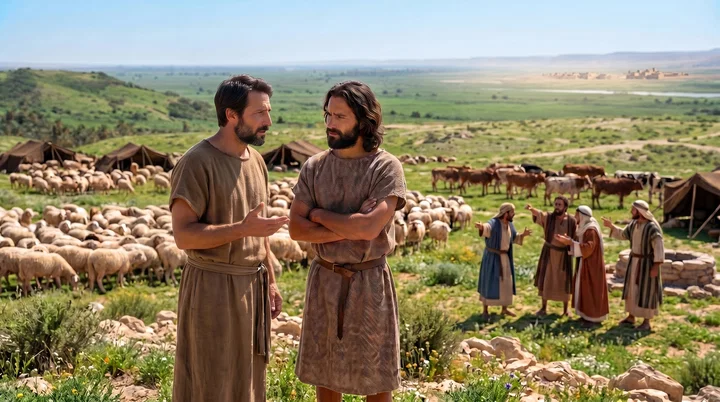
And there was a strife between the herdmen of Abram’s cattle and the herdmen of Lot’s cattle: and the Canaanite and the Perizzite dwelled then in the land.
Translations
And there was a strife between the herdsmen of Abram’s cattle and the herdsmen of Lot’s cattle: and the Canaanite and the Perizzite dwelled then in the land.
King James Version, KJV Cambridge Paragraph Bible, Revised Version
And there was a strife between the herdmen of Abram’s cattle and the herdmen of Lot’s cattle: and the Canaanite and the Perizzite dwelled then in the land.
And there was a strife between the herdmen of Abram's cattle and the herdmen of Lot's cattle: and the Canaanite and the Perizzite dwelt then in the land.
And there was a strife between the herdsmen of Abram’s cattle and the herdsmen of Lot’s cattle: and the Canaanite and the Perizzite dwelt then in the land.
and there is a strife between those feeding Abram's cattle and those feeding Lot's cattle; and the Canaanite and the Perizzite [are] then dwelling in the land.
And there was strife between the herdsmen of Abram's cattle and the herdsmen of Lot's cattle. And the Canaanite and the Perizzite were dwelling then in the land.
And there arose a strife betwixt the herdmen of Abram, and the herdmen of Lot. Now the Canaanite and the Perizzite, were then dwelling in the land.
Berean Standard Bible, Majority Standard Bible
And there was discord between the herdsmen of Abram and the herdsmen of Lot. At that time the Canaanites and the Perizzites were also living in the land.
There was strife between the herdsmen of Abram’s livestock and the herdsmen of Lot’s livestock. The Canaanites and the Perizzites lived in the land at that time.
And there was an argument between the keepers of Abram's cattle and the keepers of Lot's cattle: at that time the Canaanites and Perizzites were still living in the land.
Also there was debate betweene ye heardmen of Abrams cattell, and the heardmen of Lots cattell. (and the Canaanites and the Perizzites dwelled at that time in the land.)
Douay-Rheims (Challoner revision)
Whereupon also there arose a strife between the herdsmen of Abram and of Lot. And at that time the Chanaanite and the Pherezite dwelled in that country.
Pictures
Cross-references
- Genesis 19:16-29
And while he lingered, the men laid hold upon his hand, and upon the hand of his wife, and upon the hand of his two daughters; the LORD being merciful unto him: and they brought him forth, and set him without the city.
Lot leaves Sodom, contrasting with his earlier journey there.
- Genesis 13:14-17
And the LORD said unto Abram, after that Lot was separated from him, Lift up now thine eyes, and look from the place where thou art northward, and southward, and eastward, and westward:
God promises Abram the land and countless descendants.
- Genesis 12:4
So Abram departed, as the LORD had spoken unto him; and Lot went with him: and Abram was seventy and five years old when he departed out of Haran.
Abram departs as commanded but brings Lot with him.
- Acts 7:5
And he gave him none inheritance in it, no, not so much as to set his foot on: yet he promised that he would give it to him for a possession, and to his seed after him, when as yet he had no child.
Recounts God’s promise to Abraham and his seed concerning the land.
- 2 Peter 2:7-8
And delivered just Lot, vexed with the filthy conversation of the wicked:
Lot’s dwelling among the wicked vexed him and his family.
- Genesis 15:18-21
In the same day the LORD made a covenant with Abram, saying, Unto thy seed have I given this land, from the river of Egypt unto the great river, the river Euphrates:
The land promised to Abram’s seed includes the Canaanites and Perizzites already dwelling there.
- Genesis 15:1
After these things the word of the LORD came unto Abram in a vision, saying, Fear not, Abram: I am thy shield, and thy exceeding great reward.
Abraham’s trust in God’s promised reward explains his indifference to the choice of pasture.
Commentary
Each commentary is drawn from primary sources: the writings of Ellen G. White and Adventist pioneers and periodicals. Each commentary is separate. Its own words are not a quotation; follow the references to read the source passages.
Ellen G. White
2 sources
The strife between the herdsmen of Abram and the herdsmen of Lot arose because the grazing land was insufficient to support the large herds and flocks of both households together.Ms 115a, 1897, par. 6 Such contention over individual rights and preferences carries a grave danger, for it threatens households with being torn asunder and churches with division.PP 132.3 When believers quarrel in this way the cause of truth is made a byword and a reproach among the wicked who witness it.PP 132.3
Against that danger Abram answered with a noble, unselfish spirit that sought peace rather than advantage.PP 132.3Ms 115a, 1897, par. 6 He refused at all hazards to cling to personal right, choosing instead to propose terms of peace and to make sacrifice in order to glorify God, and God was pleased with him for it.PP 132.3Ms 115a, 1897, par. 6 His plea that there be no strife because they were brethren meant more than mere natural relationship.PP 132.3 It meant fellowship as worshipers of the true God, showing that the children of God throughout the world are one family to be governed by the same spirit of love and conciliation.PP 132.3
That spirit is uniform courtesy and willingness to do to others as one would wish to be done by.PP 132.3 It is kindly affection with brotherly love, in honor preferring one another, and looking not only on one's own things but also on the things of others, a course that would remove half the ills of life.PP 132.3 The opposite spirit of self-aggrandizement, which seeks its own, is the spirit of Satan.PP 132.3 By contrast, the heart in which the love of Christ is cherished possesses charity which does not seek its own.PP 132.3
Sources
Pioneers and periodicals
25 sources
After returning from Egypt toward Canaan and coming back to the old encampment between Bethel and Hai, the herdsmen of Abram and Lot quarreled because their flocks, herds and possessions had become so great that the land could not support them dwelling together on shared pasture and wells.ST Jan 20, 1887ST Aug 19, 1880ST Jul 31, 1901ST Jul 31, 1901ST Oct 17, 1900 The land was crowded all the more because the Canaanite and the Perizzite also dwelled there, the Canaanites in the lowlands and the Perizzites in the hills.ST Jul 31, 1901ST Jul 31, 1901 Strife between the households of God's servants before peoples who did not know Him set a poor example and could do great harm to their witness.RH Jan 7, 1915RH Apr 10, 1866ST Jul 31, 1901 Abram kept the quarrel from growing by seeking peace instead of asserting his right to the promised land, proposing separation and letting Lot choose where to settle.RH Apr 10, 1866ST Oct 3, 1878RH May 26, 1863 The account lays bare their contrasting characters, for Abraham was not selfish or grasping about the best pasturage because he did not seek his reward in this world, while Lot failed to restrain his herdsmen in ingratitude toward the one who had enabled him to prosper.ST Dec 20, 1910ST Sep 25, 1901RH May 26, 1863ST Jul 31, 1901
Setting and Cause of Strife
Genesis 13:7 belongs to the return from Egypt toward Canaan in slow stages through the Negeb, then more fertile than now, back to the old encampment between Bethel and Hai.ST Jan 20, 1887 At Bethel the Canaanite and the Perizzite also lived, and the flocks and herds of Abram and Lot increased until the land could not support their dwelling together, so they had to separate and move.ST Oct 17, 1900 It belongs to the Lot portion of Abraham's life, covering the whole experience with his nephew.ST Aug 9, 1905 That experience is summed up in the name Lot, which recalls the entire separation and brings to mind more of its contents than any other single word.ST Aug 9, 1905 It is the account of Lot's choice, Abram's unselfishness, and the consequences that followed, and specifically of Lot's going into Sodom to be compared with his going out.ST Jan 2, 1912ST Sep 1, 1898 Chapter 13 comes before the account of Abraham's victory over the five kings and the vision given to Abraham afterward.ST Aug 7, 1901
The strife arose because the households, flocks, herds, livestock and possessions of Abram and Lot had become very great, so that the land could not support them dwelling together.ST Aug 19, 1880ST Oct 3, 1878 Their herdsmen came into conflict over water and pasture, as shared wells and pasturage were limited and insufficient, making separation necessary.ST Aug 19, 1880ST Jan 20, 1887 Quarreling broke out between Abram's herdsmen and Lot's herdsmen as one result of their large flocks and herds, and the conflict led Abram to propose separation and offer Lot the choice of where to go.ST Jul 31, 1901ST Oct 3, 1878 The land was crowded for another reason also, that many other people lived there besides the companies of Abraham and Lot.ST Jul 31, 1901ST Jul 31, 1901 The Canaanites and the Perizzites were living in the land at that time, the Canaanites occupying the lowlands and the Perizzites occupying the mountains and hills, adding to the crowded conditions.ST Jul 31, 1901ST Jul 31, 1901ST Jul 31, 1901
The Canaanites and Perizzites had only recently established themselves in the land when Abram arrived. They were few and weak and did not prevent him from exercising authority or using Canaan as pasture land for his flocks and herds. These neighboring peoples were outside the covenant of promise and did not know God.RH Jan 7, 1915 Their work as herdsmen was secondary to making the true God known through life and testimony, so dispute while Canaanites and Perizzites lived in the land could damage witness to them.RH Jan 7, 1915
Example and Broader Teaching
The strife between the herdsmen took place while Canaanites and Perizzites dwelt in the land, and those peoples were outside the covenant of promise and did not know God.RH Jan 7, 1915 Quarreling between God's servants before such witnesses set a poor example and could have serious consequences for their testimony.RH Jan 7, 1915RH Apr 10, 1866ST Jul 31, 1901 The work of tending flocks and herds was secondary to making the true God known through life and testimony.RH Jan 7, 1915 Abram prudently kept the quarrel from growing by asking for peace instead of asserting his authority, though the land had been promised to him.RH Apr 10, 1866ST Jul 31, 1901 For the sake of peace he yielded his right, proposed separation, and gave Lot the choice of where to settle.RH Apr 10, 1866ST Oct 3, 1878RH May 26, 1863ST Jul 31, 1901
Abraham's great material and spiritual blessings did not make him selfish or greedy or jealous of his rights.ST Sep 25, 1901ST Jul 31, 1901 He was indifferent to choosing the best pasturage because he did not seek his reward in this world.ST Sep 25, 1901 The account reveals the contrasting characters of Abram and Lot and shows the influence of worldly associations.ST Dec 20, 1910ST Sep 25, 1901 Lot's failure to restrain his herdsmen was ingratitude toward Abram, who had enabled him to prosper.RH May 26, 1863 Lot's different disposition harmed his worldly ambitions and his family's welfare.ST Sep 25, 1901 Caring for a master's goods is proper, but turning that duty into strife is a counterfeit virtue.RH Aug 22, 1865
Abraham had continued to cling to Lot, and their separation marked a lesson learned in his experience.ST Jun 15, 1904 The chapter shows that Abram and Lot had great possessions, with their herdsmen in conflict over livestock while Canaanites and Perizzites also inhabited the land.RH Apr 5, 1870 Those great possessions help explain the attractions Lot and his family had to leave behind when escaping Sodom.RH Apr 5, 1870 The chapter belongs to God's providential dealings with Abraham's family as the chosen line through which the promised Seed would come.ST It belongs also to the larger promise to Abraham of an inheritance extending beyond earthly Canaan to the whole world and the restored new earth.ST Nov 11, 1930ST Jan 28, 1903 That inheritance comes through the righteousness of faith and not through law, is to be realized through Abraham's Seed, Christ, and those who belong to Christ by faith are Abraham's heirs according to the promise, while Abraham lived as a pilgrim awaiting its fulfillment.ST Nov 11, 1930ST Jan 28, 1903 The record of the separation of Abram and Lot after conflict arose between their herdsmen, while Canaanites and Perizzites lived in the land, stands among the historical accounts in Genesis whose accuracy is supported by ancient records and traditions.ST Dec 7, 1915
Sources