Genesis 12:4
So Abram departed, as the LORD had spoken unto him; and Lot went with him: and Abram was seventy and five years old when he departed out of Haran.
Translations
So Abram departed, as the LORD had spoken to him; and Lot went with him: and Abram was seventy and five years old when he departed out of Haran.
So Abram departed, as the LORD had spoken unto him; and Lot went with him: and Abram was seventy and five years old when he departed out of Haran.
So Abram departed, as the Lord had spoken unto him; and Lot went with him: and Abram was seventy and five years old when he departed out of Haran.
So Abram departed, as the LORD had spoken to him, and Lot went with him: and Abram was seventy and five years old when he departed from Haran.
So Abram went, as the LORD had spoken unto him; and Lot went with him: and Abram was seventy and five years old when he departed out of Haran.
So Abram went, as Jehovah had spoken unto him; and Lot went with him: and Abram was seventy and five years old when he departed out of Haran.
And Abram goeth on, as Jehovah hath spoken unto him, and Lot goeth with him, and Abram [is] a son of five and seventy years in his going out from Charan.
And Abram departed as Jehovah had said to him. And Lot went with him. And Abram was seventy-five years old when he departed out of Haran.
And Abram came on his way, according to that which Yahweh had spoken unto him, and Lot came with him,—now, Abram, was seventy-five years old, when he came forth out of Haran.
Berean Standard Bible, Majority Standard Bible
So Abram departed, as the LORD had directed him, and Lot went with him. Abram was seventy-five years old when he left Haran.
So Abram went, as the LORD had told him. Lot went with him. Abram was seventy-five years old when he departed from Haran.
So Abram went as the Lord had said to him, and Lot went with him: Abram was seventy-five years old when he went away from Haran.
So Abram departed, euen as ye Lord spake vnto him, and Lot went with him. (And Abram was seuentie and fiue yeere olde, when he departed out of Haran)
Douay-Rheims (Challoner revision)
So Abram went out as the Lord had commanded him, and Lot went with him: Abram was seventy-five years old when he went forth from Haran.
Pictures
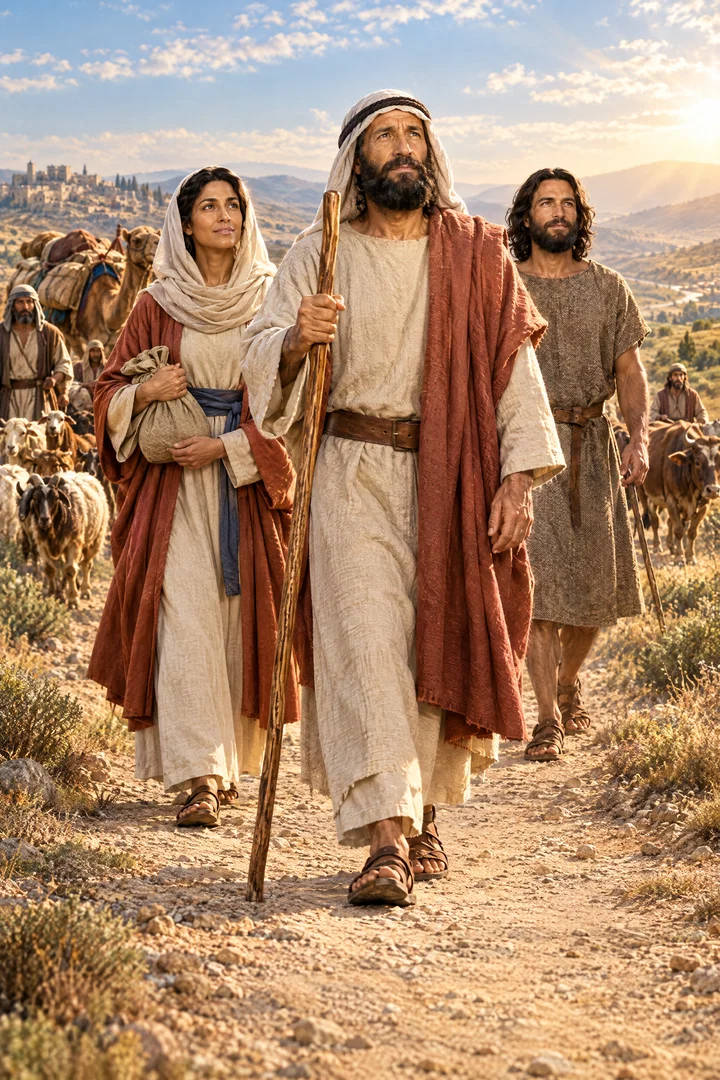
Cross-references 20 of 42
- Hebrews 11:8
By faith Abraham, when he was called to go out into a place which he should after receive for an inheritance, obeyed; and he went out, not knowing whither he went.
Abraham obeyed God’s call by faith, leaving without knowing his destination.
- Galatians 3:17
And this I say, that the covenant, that was confirmed before of God in Christ, the law, which was four hundred and thirty years after, cannot disannul, that it should make the promise of none effect.
The departure marks the beginning of the 430-year period leading to the giving of the law.
- Genesis 11:32
And the days of Terah were two hundred and five years: and Terah died in Haran.
Terah’s death is compared with Abram’s age at departure to establish the chronology.
- Acts 7:4
Then came he out of the land of the Chaldæans, and dwelt in Charran: and from thence, when his father was dead, he removed him into this land, wherein ye now dwell.
Both place Abram’s departure from Haran after his father’s death.
- Genesis 15:13
And he said unto Abram, Know of a surety that thy seed shall be a stranger in a land that is not theirs, and shall serve them; and they shall afflict them four hundred years;
The 400-year affliction is dated in relation to Abram’s departure.
- Genesis 21:5
And Abraham was an hundred years old, when his son Isaac was born unto him.
Isaac’s birth follows Abram’s departure by twenty-five years.
- Hebrews 11:13-16
These all died in faith, not having received the promises, but having seen them afar off, and were persuaded of them, and embraced them, and confessed that they were strangers and pilgrims on the earth.
Abram lived as a stranger, looking beyond earthly life toward a better heavenly home.
- Genesis 22:2
And he said, Take now thy son, thine only son Isaac, whom thou lovest, and get thee into the land of Moriah; and offer him there for a burnt offering upon one of the mountains which I will tell thee of.
Abraham again obeys a divine command, now facing the test of offering Isaac.
- Genesis 26:5
Because that Abraham obeyed my voice, and kept my charge, my commandments, my statutes, and my laws.
Abraham obeyed God’s voice and kept his commandments.
- James 2:23
And the scripture was fulfilled which saith, Abraham believed God, and it was imputed unto him for righteousness: and he was called the Friend of God.
Abraham’s departure showed the trusting faith counted to him as righteousness.
- Romans 4:13
For the promise, that he should be the heir of the world, was not to Abraham, or to his seed, through the law, but through the righteousness of faith.
God’s promise to Abraham was inheritance of the world.
- Genesis 13:12-13
Abram dwelled in the land of Canaan, and Lot dwelled in the cities of the plain, and pitched his tent toward Sodom.
Lot chooses the cities of the plain.
- Galatians 3:29
And if ye be Christ’s, then are ye Abraham’s seed, and heirs according to the promise.
Those who belong to Christ are Abraham’s seed and heirs of the promise.
- Hebrews 11:10
For he looked for a city which hath foundations, whose builder and maker is God.
Abraham looked beyond his departure for the city God builds.
- Genesis 12:10
And there was a famine in the land: and Abram went down into Egypt to sojourn there; for the famine was grievous in the land.
A famine struck Canaan after Abram arrived, leading him to sojourn in Egypt.
- Galatians 3:8
And the scripture, foreseeing that God would justify the heathen through faith, preached before the gospel unto Abraham, saying, In thee shall all nations be blessed.
The promise to Abraham that all nations would be blessed is identified as the gospel preached beforehand.
- Genesis 11:31
And Terah took Abram his son, and Lot the son of Haran his son’s son, and Sarai his daughter in law, his son Abram’s wife; and they went forth with them from Ur of the Chaldees, to go into the land of Canaan; and they came unto Haran, and dwelt there.
Terah’s party set out for Canaan and stopped to dwell in Haran.
- Genesis 11:26
And Terah lived seventy years, and begat Abram, Nahor, and Haran.
Terah’s sons’ birth record is reconciled with Abram’s age at departure.
- Acts 7:3
And said unto him, Get thee out of thy country, and from thy kindred, and come into the land which I shall shew thee.
God called Abram to leave his country and go to the land God would show him.
- Joshua 24:2
And Joshua said unto all the people, Thus saith the LORD God of Israel, Your fathers dwelt on the other side of the flood in old time, even Terah, the father of Abraham, and the father of Nachor: and they served other gods.
Abram left his idolatrous family and followed the LORD’s call.
Commentary
Each commentary is drawn from primary sources: the writings of Ellen G. White and Adventist pioneers and periodicals. Each commentary is separate. Its own words are not a quotation; follow the references to read the source passages.
Ellen G. White
20 sources
Abram at seventy-five years old departed out of Haran promptly and exactly as the Lord had spoken, leaving his country, kindred, father's house, home and friends, and Lot went with him.Lt 129, 1897, par. 8–104T 524.1–2Lt 56, 1897, par. 7 He went to a land he did not know without seeing the future opened before him, and the command was no small trial but a severe test of faith.Ms 26, 1905, par. 10–11Ms 19, 1886, par. 1–2Ms 19, 1886, par. 5–610MR 118.1 His departure rested on God's covenant promise to make of him a great nation, to bless all families of the earth in him, and to give Canaan to his descendants for an everlasting possession.Ms 26, 1905, par. 10–11Lt 129, 1897, par. 8–104T 524.1–2 His faith was not belief only but trust in God that produced fruits in obedience, and he was saved by faith in Christ imputed for righteousness just as sinners are saved today.8MR 356.2Ms 46, 1891, par. 5 The verse therefore teaches complete confidence in God's leading, trusting God and following duty even against inclination, and promptly changing surroundings and cutting loose from hindering associates when they are the worst spiritual enemies.Ms 19, 1886, par. 5–6Lt 248, 1905, par. 1–310MR 118.1
Leaving Haran in Obedience
Abram left Haran promptly and exactly as the Lord had spoken to him, going out from his country and from his kindred and from his father's house into a land God would show him, trusting the promise to make of him a great nation.Lt 129, 1897, par. 8–104T 524.1–2Lt 56, 1897, par. 7 He was seventy-five years old when the word came and he departed, leaving homeland, home and friends, and Lot went with him as his companion into a strange land as pilgrims and strangers.Lt 129, 1897, par. 8–104T 524.1–2Lt 56, 1897, par. 7Lt 129, 1897, par. 11–12 His departure placed him in different associations where Satan's snares could be broken.Lt 129, 1897, par. 11–12
He went to a land he did not know, with the future not opened before him, leaving country, home and father's house at the command of a God whom he scarcely knew, with a heart disposed to obey.Ms 19, 1886, par. 1–2Lt 162, 1903, par. 12Lt 179, 1903, par. 6–7 He did not first know whether the destination would be fertile, pleasant, or easy, whether he would have ease, or what influences would surround him.Ms 19, 1886, par. 5–610MR 118.1Ms 19, 1886, par. 17–19 Yet he grasped the meaning of God's will with sanctified intellect and living faith, pressing on in the narrow way while cultivating his capabilities and wisely employing his powers.Lt 162, 1903, par. 12 His move set him where he could influence others for good.Lt 179, 1903, par. 6–7
The Lord bade him leave because He knew how strong the temptations would be if he remained, to separate His servant from every species of idolatry and from his idolatrous countrymen and send him to a country God would tell him.Lt 248, 1905, par. 1–3PP 169.3 The call promised Canaan to him and his descendants as an everlasting possession.PP 169.3
The command to leave his country, kindred and father's house was no small trial but a severe, immeasurable test and trial of faith.Ms 26, 1905, par. 10–11Ms 19, 1886, par. 1–2 Through that test God revealed Himself to Abraham.Ms 26, 1905, par. 10–11Ms 19, 1886, par. 1–2
He departed in complete confidence that God was leading, guiding and protecting him wherever he went, though he had no outward evidence that the promise that his descendants would possess Canaan would be fulfilled.4T 524.1–2Ms 19, 1886, par. 5–610MR 118.1 When he came into that land he found the Canaanites there with all their idolatry to meet him, and he could see no possession he could claim as his own.Ms 19, 1886, par. 1–2 He had turned away from family home and ancestors' graves to set out toward the promised land as a stranger in the land of his inheritance, and the beginning brought perplexity, poverty, famine and hardship to test whether he would trust God under adverse circumstances.Ms 19, 1886, par. 1–2Ms 19, 1886, par. 17–19PP 147.2–148.1
Promise and Saving Faith
Abram left Haran because God had bound Himself by covenant promise to make of him a great nation, to bless all families of the earth in him, and to give Canaan to his descendants as an everlasting possession.Ms 26, 1905, par. 10–11Lt 129, 1897, par. 8–104T 524.1–2PP 169.3 At seventy-five years old he promptly and exactly obeyed the call to get out of his country and from his kindred and from his father's house into a land God would show him.Ms 26, 1905, par. 10–11Lt 129, 1897, par. 8–104T 524.1–2 He rested on that promise with no outward evidence that it would be fulfilled, trusting God to guide and protect him wherever he went.Ms 26, 1905, par. 10–114T 524.1–2
The command was a test and trial no one can measure, and through that test God revealed Himself to Abraham.Ms 26, 1905, par. 10–11Ms 19, 1886, par. 1–2 When Abraham came into that land and found the Canaanites there with all their idolatry and could see no possession he could claim as his own, God in his perplexity condescended to preach the gospel to him and show him the possession he should have for an eternal inheritance.Ms 26, 1905, par. 10–11Ms 19, 1886, par. 1–2
He did not receive the promised possessions in his lifetime but died in faith looking for a better country, that is, an heavenly.Ms 26, 1905, par. 10–11PP 169.3 Neither he nor his son nor his son's son received possession in the earth, and his sole possession in the land of promise was the rock-hewn tomb in the cave of Machpelah which he had to buy from the Canaanites for a burial-place.Ms 26, 1905, par. 10–11PP 169.3 Though he possessed great substance and used it to the glory of God and the good of his fellow men, he did not look upon this world as his home.Ms 26, 1905, par. 10–11PP 169.3
His departure was an act of trust, for the true faith of Abraham was not belief only but trust in God that produced fruits in obedience to what God spoke.8MR 356.2Ms 46, 1891, par. 5 He was saved by faith in Christ imputed for righteousness, just as sinners are saved by faith in Christ today.8MR 356.2Ms 46, 1891, par. 5 The voice that told him to leave his country was the same voice that later told him to offer his son as a sacrifice.Ms 46, 1891, par. 5
God called him with full sight of all the dangers around him, having chosen him as a witness to bear a message to many people, as His chosen representative to reveal His righteousness, electing him to become a member of the Lord's family.Ms 26, 1905, par. 10–11Ms 61, 1896, par. 5–7 His departure out of Haran begins the 430-year sojourning of the children of Israel that ends with the giving of the law at Sinai.PP 760.2–3 That 430 years includes the sojourning of Abraham, Isaac, and Jacob in Canaan, and the actual time spent in Egypt was only about 215 years.PP 760.2–3 The 400 years of affliction begin about thirty years later, about the time Ishmael persecuted Isaac.PP 760.2–3
Example and Call Today
Abram's obedience on leaving Haran became a pattern for worship on the way, for wherever he pitched his tent while traveling with his company as pilgrims and strangers, his first work was to build an altar and worship God with those traveling with him.Lt 56, 1897, par. 713MR 357.1 That example shows that faith is expressed through action and that honoring God and His worship comes first.13MR 357.1 His move in obedience to the Lord's direction for a country he did not know placed him where he could influence others for good.Lt 179, 1903, par. 6–7 It put him in different associations that could help him break Satan's snares.Lt 129, 1897, par. 11–12
His departure brought hardship, including poverty and famine, and tested whether he would trust God despite adverse circumstances.Ms 19, 1886, par. 17–19 His faith and confidence under those adverse circumstances eventually brought great possessions and, above all, God's blessing.Ms 19, 1886, par. 17–19 The departure shows complete confidence that God was leading him, though he left his country and friends without first knowing whether the destination would be fertile, pleasant, or easy.Ms 19, 1886, par. 5–610MR 118.1 It therefore teaches trusting God and following duty even when duty goes against inclination.Ms 19, 1886, par. 5–610MR 118.1
As Abraham was told to leave his own country and his father's home because of how strong the temptations would be if he remained, so God calls a person to leave country, home, and friends when those surroundings and associates are the worst spiritual enemies.Lt 248, 1905, par. 1–3 The call is to change surroundings and cut loose from associates promptly without waiting too long lest he become earth-bound, in order that, separated from hindering influences and from every species of idolatry, he can receive help to strengthen him in right resolve and obey in the strength of Him who paid the price of His own life for his soul's salvation.Lt 248, 1905, par. 1–3 Abraham grasped the meaning of God's will with sanctified intellect and living faith, pressing on in the narrow way while cultivating his capabilities and wisely employing his powers.Lt 162, 1903, par. 12 With his heart disposed by God to obey, at the command of a God whom he scarcely knew he left his country and his father's house for a land he did not know, proving that conscience is a safe guide only when God has control of the being and man keeps a conscience void of offense toward God and man.Lt 162, 1903, par. 12
God called Abraham out of Haran with full sight of all the dangers around him, electing him to become a member of the Lord's family.Ms 61, 1896, par. 5–7 In the same way every truly converted soul, and especially ministers, is called to sense responsibility as God's messenger, to never lose sight of mission, to come out from the world in speech and action, to maintain a separate holy character under discipline to Jesus Christ, and to be a representative of Christ in example by constantly learning and teaching the most solemn message ever given to mortals.Ms 61, 1896, par. 5–7 Abraham's faith in departing in obedience to God's word without seeing the future opened before him means moving out at God's command while trusting Him for what comes next.Ms 5, 1872, par. 17 It applies when a person is convicted about the Sabbath but fears how he will support himself and his family, calling him still to obey and trust.Ms 5, 1872, par. 17
Sources
Pioneers and periodicals
76 sources
Abram left Haran for Canaan in obedience to God's direction and command, Lot going with him, when Abram was seventy-five years old.ST Jul 8, 1913ST Jan 13, 1887ST Jan 22, 1894 His departure began the call and sojourn of the father of the faithful, from which the Hebrew nation sprang amid trials of faith and God's preserving of the promised Seed.ST Jan 2, 1912ST Jan 22, 1894ST Dec 29, 1909 It stands as the starting point of the 430 years of sojourning in Canaan and Egypt, reckoned as 215 years in each land to the Exodus and the giving of the law.RH Jan 2, 1913ST Aug 12, 1913 The call carried the gospel preached beforehand, that in Abram and his Seed, who is Christ, all families and nations of the earth would be blessed.RH Feb 25, 1858RH Nov 13, 1856ST Sep 25, 1901 It is the pattern of prompt, unquestioning obedience by faith, leaving country, kindred and father's house without knowing the outcome, trusting God with the future.ST Jul 8, 1913ST Apr 17, 1893ST Feb 11, 1913ST Apr 20, 1882
Words and Setting
So Abram departed just as the Lord had spoken to him, leaving Haran in obedience to divine direction and command.ST Jul 8, 1913ST Jan 13, 1887ST Jan 22, 1894ST Dec 29, 1909ST Feb 17, 1888 Lot went with him when he departed.ST Jul 8, 1913ST Jan 13, 1887ST Jan 22, 1894ST Dec 29, 1909ST Feb 17, 1888 Abram was seventy and five years old when he departed out of Haran for Canaan.ST Jul 8, 1913ST Jan 13, 1887ST Jan 22, 1894 His greatness consisted in obedience by faith.ST Sep 25, 1901
The departure belongs to the call of Abram and the beginning of his sojourn, marked by trials of faith and repeated evidence of God's providence.ST Jan 2, 1912ST Dec 29, 1909ST Dec 20, 1910 It begins the story of the father of the faithful and the generations that follow, in which God preserves the promised Seed and providentially deals with His children.ST Dec 29, 1909ST Dec 20, 1910ST It is the beginning of the Hebrew nation.ST Jan 22, 1894 It marks Abram's departure in obedience as the beginning of his sojourn in Canaan, and Abram is therefore included among those who sojourned in the promised land as in a foreign country.RH Jan 2, 1913 It is part of the unfolding story of Abram and Lot, with the influence of worldly associations on a good man among its lessons, and it begins the account of God's providential dealings with Abraham's family as the chosen ancestor of the promised Seed.ST Dec 20, 1910ST
Abram's native place was Ur of the Chaldees near the mouth of the Euphrates.ST Jan 13, 1887 Haran where he had dwelt before departing lay on the Belichus, a tributary of the Euphrates, about seventy-five miles northeast of Carchemish, and was the city of Nahor, who had gone ahead and built it.ST Jan 13, 1887RH Nov 9, 1905 His journey from Ur had stopped partway at Haran, after dwelling there and after his father Terah died there, before he continued toward Canaan and the land to be shown him in obedience to the call the Lord had given him in Ur, leaving with his nephew Lot to go on to that land.ST Jan 22, 1894ST Jan 13, 1887RH Jan 18, 1906 He had first been called in Ur of the Chaldees and then, after finding people in Haran willing to hear, proclaimed the true God there until his work was finished, leaving witnesses to the true God in both places.ST Jan 22, 1894 He received no blessing until he set out for Canaan and reached it, and the verse also marks the beginning of his journey from Haran toward the land God had promised.
The departure is pictured as a large nomadic migration, with flocks and people traveling alongside household goods and possessions, without horses.ST Jan 20, 1887 One account describes ten or fifteen hundred souls gathered in Haran by his message to come out into the country, united with him in his desire to lead an exodus from the cities after the death of Terah.RH Oct 22, 1903 Having disposed of family property and bidden kindred farewell, they went they knew not whither, guided by Jehovah, journeying toward the west across the Syrian desert, fording the Jordan, and pitching their tents in a fertile valley in Palestine.RH Oct 22, 1903
Time and Prophecy
Abram's departure from Haran begins the 430-year sojourning of Abraham and his descendants in Canaan and Egypt, ending with the Exodus and the giving of the law.RH Jan 2, 1913ST Aug 12, 1913ST Feb 4, 1889 That sojourn is reckoned as 215 years in Canaan from Abram's entrance to Jacob's entrance into Egypt, and 215 years more in Egypt for Jacob and his posterity.ST Aug 12, 1913ST Jan 21, 1913 The promise given in connection with his departure is the starting point from which Paul's 430 years are counted, placing the beginning of that period at God's dealings with Abram.ST Feb 4, 1889RH Oct 8, 1857 Abram is thus included among those who sojourned in the promised land as in a foreign country, becoming a wanderer in Canaan and Egypt after the covenant was made with him.RH Jan 2, 1913
The call and promise connected with the departure are dated to 1921 B.C., with Abram's birth dated to 1996 B.C. and the 430 years to the giving of the law ending in 1491 B.C.RH Jan 2, 1913 In another reckoning the departure for Canaan occurred in A.M. 2084, when Abram was seventy-five years old and Lot went with him in obedience to the Lord's direction.ST Aug 9, 1910ST Aug 25, 1898RH May 14, 1901 From that departure to Jacob's entrance into Egypt was 215 years, marking the first half of the sojourn before the Egyptian half began.ST Aug 9, 1910RH May 14, 1901 His entry into Canaan therefore opens the 215-year period Abraham and his descendants spent there before Jacob's family went down to Egypt.RH Jan 2, 1913ST Aug 9, 1910
The 400 years of affliction began later than the 430 years, about thirty years after the promise.ST Aug 12, 1913ST Jan 21, 1913 That later period began about the time Isaac was weaned, when Ishmael persecuted Isaac, and it ended when Israel left Egypt.ST Aug 12, 1913ST Jan 21, 1913 Abram left Haran after his father's death, so he was seventy-five when Terah died.ST Mar 26, 1885ST Mar 26, 1885 Since Terah died at 205, Abram was born when Terah was 130, not when Terah was 70.ST Mar 9, 1888ST Sep 22, 1898
Genesis 11:26 does not mean Abram was born when Terah was seventy, nor does listing Abram first mean he was the eldest son.ST Sep 22, 1898 Sons may be listed by importance rather than birth order, Abram being named first because of his later importance.ST Sep 22, 1898 Along with Genesis 12:2 and Genesis 21:5, the departure marks the beginning of a twenty-five-year wait from the promise to make Abram a great nation until Isaac's birth.RH Feb 12, 1861ST Apr 20, 1888ST Jun 4, 1885 The promise made when seventy-five-year-old Abram departed with Lot came twenty-five years before Isaac was born, so he was already an old man before the promised son arrived.RH Feb 12, 1861ST Apr 20, 1888ST Feb 17, 1914
Promise and Doctrine
The call carries the one gospel preached beforehand to Abraham, the good news of the kingdom in the promise that in him and his seed all families and nations of the earth would be blessed.RH Feb 25, 1858ST Sep 25, 1901 That seed is Christ, the singular Seed rather than natural descendants as such, and the same promise made to Abraham was renewed to Isaac and Jacob.RH Feb 25, 1858ST Sep 25, 1901 Abraham was chosen because he was righteous, and in the covenant he was promised innumerable descendants and that they with him would inherit the land forever for an everlasting possession.RH Feb 25, 1858RH Nov 13, 1856 That promise includes the entire earth and the city Abraham looked for, broad and comprehensive and pointing to the coming Messiah, and it will not be fully realized until the great multitude from all nations and kindreds and people and tongues inherit the new heaven and new earth.RH Feb 25, 1858RH Nov 13, 1856
The departure at seventy-five to a strange land began a new dispensation of faith, and his age did not prevent him from undertaking God's work.ST Sep 25, 1901RH Jul 14, 1904 His greatness consisted in obedience by faith.ST Sep 25, 1901RH Jul 14, 1904 The command to come out, with the later commands to walk through the land and to offer Isaac, came before the testimony that Abraham kept God's commandments and laws.RH Mar 25, 1858 Those three are not themselves the commandments and laws he kept but acts of obedience showing a law already in force, and keeping the ten commandments given on Sinai develops better character under the covenant of grace than keeping only those three specific commands.RH Mar 25, 1858
Abram and Shem were contemporaries within the genealogy's timeline, so Abram could have learned God's statutes and judgments through people of earlier generations.RH Feb 20, 1913 Abraham's family preserved the knowledge of God and passed it on to later generations.RH Feb 20, 1913RH Dec 10, 1861 The verse stands at the beginning of the Genesis 12 to 21 story in which human scheming to help God out through Hagar brings only bondage and trouble, in contrast to God's own fulfillment of His promise through Sarah bringing freedom.ST Sep 28, 1915
The record through verse 4 is historically accurate and true, inspired by the Creator of the universe rather than copied from Babylonian sources.ST Dec 7, 1915 It is the purest, least colored by extravagances, and nearest to the original form of primeval traditions common to all civilized nations of antiquity, pointing to a time when the human race occupied a common home and held a common faith and carried by early races wherever they wandered.ST Dec 7, 1915 Its accuracy is confirmed by the literature of ancient nations and by voices out of tombs of thirty centuries and by the monuments, reviving the credit and authority of the Bible against negative speculation and demolishing criticism of Genesis, and it is treated as substantially true history.ST Dec 7, 1915ST Nov 27, 1884 It is plain narrative to be followed as stated rather than supplemented with conjecture that contradicts it or reduced to a speculative theory about the westward movement of tribes, and the call marks the beginning of genuine history.ST Mar 10, 1887RH Jan 25, 1906RH Aug 12, 1909
Abram and those with him represented God's church as the called-out faithful centered in him, though some who joined him later fell away and ceased to share in that community.ST Apr 18, 1911ST Mar 1, 1910 His leaving his apostatizing kindred and friends set him apart from the world, yet he was right to obey God.RH Apr 21, 1863ST Apr 18, 1911 His journey represents the church's trials and the Christian's journey from conversion until death or Christ's second coming, when like Lot at God's call the Christian leaves the world of sin and flees the coming wrath.RH May 14, 1867
His act of faith was inspired by hope in the promised inheritance.ST Jul 14, 1898 Leaving country, kindred, and father's house, with father's house the hardest separation, he became a man without country, kindred, or home, a stranger and pilgrim leaving an earthly home that death and crowding make too small in order to do a greater work of strong character building at God's call.ST Jun 14, 1899 Going to Canaan, a foreign and dangerous land, he built altars and proclaimed the Lord's name, and he lived in tents rather than settling in a town.RH Nov 17, 1910 By so living and journeying as a sojourner he declared he sought a better, heavenly country and continuing city for which God has prepared a place and is not ashamed to be called their God, and though he died without receiving the promise of heirship to the world, that promise will be fulfilled when God raises the dead and brings His people into the promised land.ST Jun 14, 1899RH Nov 17, 1910ST Jul 14, 1898
Links to Scripture
Genesis 12:4 is the Genesis record of what Stephen describes in Acts 7:4, showing that Abram departed out of Haran for Canaan at seventy-five years old, with Lot going with him, after his father's death in Charran, so that Terah died when Abram was seventy-five.ST Mar 26, 1885ST Mar 26, 1885 Genesis 11:26 does not mean Abram was born when Terah was seventy, nor does naming Abram first mean he was the eldest son, since sons may be listed by importance rather than birth order. The departure supplies the chronological starting point for the 430 years Paul mentions, for adding those years to the year of Abram's departure places the beginning of the dispensation of law at God's dealings with Abram and its end at the giving of the law.RH Oct 8, 1857 In Ussher's chronology the call and departure at age seventy-five was in 1921 B.C., with Abraham's birth dated to 1996 B.C., and the 430 years to the giving of the law ended in 1491 B.C.
He obeyed the call by departing as the Lord had spoken, going out by faith alone to receive a place for an inheritance, not knowing where he was going.ST Jan 22, 1894ST Jun 14, 1883ST Jun 26, 1901 These movements belonged to God's progressive purpose, which did not depend on ceremonial rites or sacred places and began before the temple, the possession of the promised land, or circumcision.ST Jan 22, 1894ST Jun 14, 1883 He had first been called in Ur of the Chaldees and preached the truth of God there until the people refused to hear more, then finding people in Haran willing to hear he proclaimed the true God there until his work was finished and they refused to hear more.ST Jan 22, 1894ST Jan 22, 1894 Then he left, taking with him those who believed and leaving witnesses to the true God in both places, with Lot going with him at seventy-five years old.ST Jan 22, 1894ST Jan 22, 1894 When he reached Canaan the Lord appeared to him and promised that his descendants would possess the land.ST Jun 26, 1901
Genesis 12:1-4 shows Abraham went forth from the land of Babylon. In the conquest of Jerusalem the vessels of the temple were carried back to that same land from which Abraham had gone out. There they were placed in the idol temple at Babylon as tokens of triumph.
Faithful Obedience Applied
Abram's departure was prompt, unquestioning obedience by faith, going just as commanded without knowing or stopping to question why he should go.ST Apr 17, 1893ST Feb 19, 1902 He departed for a strange land without first asking about the journey, its conditions, consequences or outcome, taking the next step and leaving the future and results in God's care.ST Apr 17, 1893ST Jul 22, 1908ST Feb 19, 1902 He left home without knowing where he was going and without asking whether the new country would offer comfort or a good living, trusting that God would guide him safely.ST Feb 11, 1913ST Jul 22, 1908ST Mar 24, 1909 When famine soon struck, homesickness and hardship did not outweigh his conviction of duty, for obedience mattered more to him than property or even life.ST Feb 11, 1913 His departure began a life in which faith grew through obedience and further tests, showing that following God requires faith and sacrifice.ST Jul 8, 1913ST Jul 22, 1908ST Mar 24, 1909
His move was made after he was sure God had called him, a personal call from God and not pressure from others or promise of material support.ST Jul 24, 1901RH Jan 17, 1865 He trusted God to guide and sustain him when he left Haran at seventy-five to begin his mission in Canaan.ST Jul 24, 1901RH Jan 17, 1865 That obedience required sacrifice, leaving country, kindred, and father's house, with father's house the hardest separation.ST Jul 8, 1913ST Apr 20, 1882ST Jun 14, 1899 It meant leaving an idolatrous family and an earthly home made too small by death and crowding, facing opposition and ridicule from relatives for going away with no apparent object and without knowing where he was going.ST Apr 20, 1882ST Jun 14, 1899 His outward prospect was as dark as any faced by one who starts to obey God now, becoming a man without country, kindred, or home, a stranger and pilgrim for whom God has prepared a continuing city.ST Apr 20, 1882ST Jun 14, 1899
By going forward instead of drawing back he became the father of all the faithful and gained a place among the faithful.ST Apr 20, 1882 His course strengthens those who dare not venture out alone to obey unpopular truth, teaching that honor with God comes by willingness to be regarded as peculiar and by valuing God's approval above men's applause.ST Apr 20, 1882 His leaving his homeland stands as an example of a faithful person standing apart from the majority, who are often wrong in religion.ST Apr 20, 1882RH Sep 10, 1872 His example shows that faith steps out when God calls, leaving former home and familiar people and places for the land God has chosen, even to serve in distant lands.RH Jul 30, 1914RH Nov 30, 1911ST May 14, 1896 That experience developed the patience and faith needed to endure to the end, and his venture brought great blessing to him and to others.RH Jul 30, 1914ST Sep 17, 1896
His departure and wanderings reveal a remarkable inner life with heart-throbbings including the pangs of homesickness, yet trusting God through hardship.RH Nov 30, 1911ST Feb 4, 1913 His life among the peoples of Canaan demonstrated that God's people can remain faithful and live out the truth even amid difficult circumstances.RH May 30, 1912 He went as a missionary where God sent him to stay, to establish and maintain the true faith in Canaan as a center from which truth could reach the world.ST Jul 24, 1901ST May 8, 1901ST Feb 17, 1914 When famine came he did not return to his old home but went to Egypt until it passed, then returned to the place where God had put him.ST May 8, 1901 From that day the nations have derived benefits through the spread of Christianity, for the spiritual and mental and true physical uplift of the world comes through Christianity by the power of its Author and through the influence, teachings, and ministrations of Christians, and God does not put the instruments of His kingdom in the hands of those who know Him not.
He did not yet know how to work for the Lord in the new land of Palestine, but learned what to do after he went.RH May 21, 1914 In Haran he had gathered ten or fifteen hundred souls united in his desire to lead an exodus from the cities, and after disposing of property and bidding kindred farewell they went they knew not whither, guided by Jehovah across the Syrian desert, fording the Jordan and pitching tents in a fertile valley where he established an industrial school training not only children but heads of families, from which a nation developed.RH Oct 22, 1903 His leaving Haran and continuing toward Canaan marked movement beyond a halfway response, for his journey from Ur had stopped partway and he received no blessing until he set out for Canaan and reached it.RH Sep 19, 1912 His choice of the country marks him as the father of the faithful, in contrast with Lot's later choice of city life that brought financial and moral ruin to his family.RH May 18, 1905
Lot went with him at seventy-five from Haran, at first sharing a similar spirit of devoted piety that marked a pious beginning.ST Mar 24, 1909RH Jul 30, 1867 Yet Lot was a reminder of Chaldea and proved little help, showing God's plan for complete separation was better until they parted. Attracted by the fertility and beauty of the Jordan plain he went to dwell among the evil for worldly advantage, with part of his family perishing at the burning of Sodom and his daughters, infected with that city's depravity, debasing him by drunkenness and atrocious incest and becoming parents of a guilty and idolatrous race.RH Jul 30, 1867 So he remains a monument of the bitter fruits of plunging into evil society and the ruinous effects of improper companions.RH Jul 30, 1867 Abram's journey to the promised land made him an example of faith for the returning Jews called to leave the same region and for all to show like faith, illustrating that God chose him as agent for His work while remaining able to accomplish it without him.ST May 14, 1896ST Aug 17, 1904RH Apr 8, 1902 His journey represents the church's trials and the Christian's journey from conversion until death or Christ's second coming, in which like Lot at God's call the Christian leaves the world of sin and flees the coming wrath, going into an unknown country at His word without doubting His leading and leaving behind familiar companionship and safety to obey.ST May 14, 1896RH May 14, 1867
Sources