Genesis 16:7
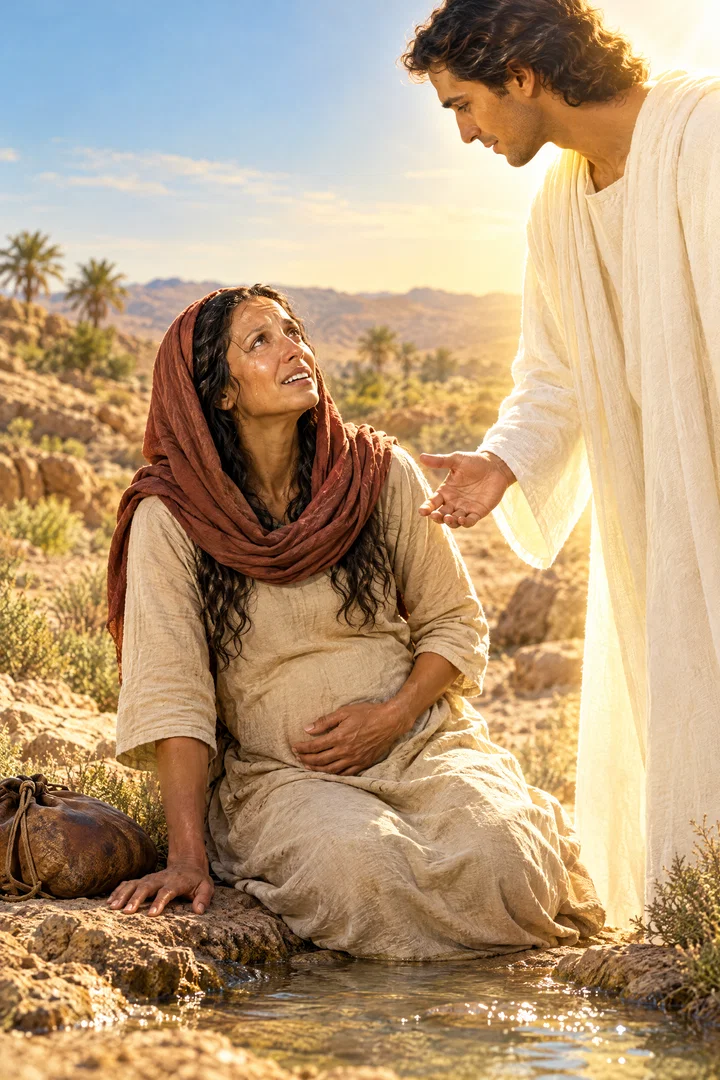
And the angel of the LORD found her by a fountain of water in the wilderness, by the fountain in the way to Shur.
Translations
American King James Version, King James Version, Webster Bible, Revised Version
And the angel of the LORD found her by a fountain of water in the wilderness, by the fountain in the way to Shur.
And the angel of the Lord found her by a fountain of water in the wilderness, by the fountain in the way to Shur.
And the angel of Jehovah found her by a fountain of water in the wilderness, by the fountain in the way to Shur.
And a messenger of Jehovah findeth her by the fountain of water in the wilderness, by the fountain in the way [to] Shur,
And the Angel of Jehovah found her by a spring of water in the wilderness, by the spring on the way to Shur.
And the messenger of Yahweh found her by the fountain of water in the desert,—by the fountain in the way to Shur.
Berean Standard Bible, Majority Standard Bible
Now the angel of the LORD found Hagar by a spring of water in the desert— the spring along the road to Shur.
The LORD’s angel found her by a fountain of water in the wilderness, by the fountain on the way to Shur.
And an angel of the Lord came to her by a fountain of water in the waste land, by the fountain on the way to Shur.
But the Angel of the Lord founde her beside a fountaine of water in the wildernesse by the fountaine in the way to Shur,
Douay-Rheims (Challoner revision)
And the angel of the Lord having found her, by a fountain of water in the wilderness, which is in the way to Sur in the desert,
Pictures
Cross-references
- Galatians 4:24-26
Which things are an allegory: for these are the two covenants; the one from the mount Sinai, which gendereth to bondage, which is Agar.
Hagar and Sarah represent the two covenants, bondage and freedom.
- Genesis 21:1-12
And the LORD visited Sarah as he had said, and the LORD did unto Sarah as he had spoken.
Isaac’s promised birth confirms the line distinct from Ishmael.
- Genesis 21:17-19
And God heard the voice of the lad; and the angel of God called to Hagar out of heaven, and said unto her, What aileth thee, Hagar? fear not; for God hath heard the voice of the lad where he is.
An angel comes to Hagar’s aid in the wilderness and provides water for her son.
- Genesis 17:19-21
And God said, Sarah thy wife shall bear thee a son indeed; and thou shalt call his name Isaac: and I will establish my covenant with him for an everlasting covenant, and with his seed after him.
God establishes the covenant through Sarah’s son Isaac, while blessing Ishmael separately.
Commentary
Each commentary is drawn from primary sources: the writings of Ellen G. White and Adventist pioneers and periodicals. Each commentary is separate. Its own words are not a quotation; follow the references to read the source passages.
Ellen G. White
4 sources
Hagar was alone in the desert beside a fountain when the angel of the Lord appeared to her in human form.PP 145.2–3 She had fled from Sarah after Abraham took Hagar as his wife through lack of faith in the promise of a son, amid unhappiness and Hagar's proud, boastful and haughty conduct toward Sarah in expecting to become mother of the promised great nation.1SP 95.2–3
The angel's meeting with the fugitive began God's response to her affliction, both comforting her and reproving her for her haughty conduct.PP 145.2–31SP 95.2–3ST Mar 27, 1879SG3 101.1–2 The angel directed her to return to her mistress Sarah and submit herself under her hands.PP 145.2–31SP 95.2–3ST Mar 27, 1879SG3 101.1–2 The encounter also gave her a promise concerning her descendants.PP 145.2–3
Sources
Pioneers and periodicals
29 sources
The angel of the Lord found Hagar pregnant and alone by a fountain of water in the wilderness on the road toward Shur after she had fled harsh treatment by Sarai.ST Apr 1, 1875ST Sep 8, 1898RH Jan 2, 1900 The One who found her was the Son of God, come to comfort her and supply her need, directing her to return to her mistress and submit herself while reproving her haughty conduct.ST Mar 27, 1879ST Mar 20, 1907ST Jun 3, 1908RH Aug 3, 1905 His finding her showed that God had not forgotten her when she thought she was driven out to die, for He sees those in loneliness and distress not to condemn them but to save them and give hope for the future.ST Nov 8, 1899ST Mar 23, 1915 Her flight grew out of Abram and Sarai doubting God's promise and devising a human plan by which Sarai gave Hagar to Abram and Ishmael was conceived.ST Apr 11, 1900ST Sep 23, 1913ST Apr 29, 1908 Hagar the bondwoman with her son born according to the flesh represents the covenant from Mount Sinai and human effort to fulfill God's promise, in contrast with Sarah the freewoman and Isaac born through God's promise and power.RH May 29, 1900ST Sep 23, 1913ST Mar 1, 1905RH Jun 26, 1900ST Apr 29, 1908
Hagar Found in Wilderness
The verse belongs to the account of Abram's sojourn and trials of faith together with Genesis 15 and Genesis 17, within the span from B.C. 2247 to B.C. 1872 running from Babel and the scattering of humanity through the genealogy and call of Abraham, showing constant and remarkable evidences of God's overruling providences and that Abraham did not come at once to fullness of faith but learned the lesson over and over.ST Jan 2, 1912 It concerns God's providential dealings with Abraham's family as the family chosen through Abraham the progenitor of the promised Seed, specifically the birth of Ishmael, Sarai's jealousy, and the sending away of Hagar and her son.STST Jan 29, 1894 It places Hagar in the wilderness by a fountain of water in the way to Shur, on the road toward Shur, after she fled from harsh treatment by Sarai while pregnant and without home or counsel.ST Apr 1, 1875ST Sep 8, 1898RH Jan 2, 1900 Abraham had sent her away after taking her as wife in distrust of God's promise, and the one who finds her addresses her as Sarai's maid and asks where she has come from and where she is going.ST Apr 1, 1875RH Jan 2, 1900
The angel of the LORD found her beside the fountain to comfort her, supply her need, and give comforting counsel and assurance, advising and directing her to return to her mistress and submit to her, and reproving her haughty conduct.ST Mar 27, 1879ST Mar 20, 1907RH Aug 3, 1905 Though she was wandering and not seeking God, God saw her there.ST Nov 4, 1930 Fleeing her difficult surroundings would not give her the change and happiness she sought, for she needed a change of heart rather than escape, since her contempt for Sarah had contributed to Sarah's harsh treatment and God permitted this hardship for her good.ST Mar 20, 1907RH Aug 3, 1905
The Angel who met Hagar in her distress is the Son of God, who met discouraged Hagar with comforting counsel and assurance and revealed divinity by a promise only God could make and fulfill, whom Hagar recognized as the God who sees her.ST Jun 3, 1908 He is a heavenly being of a distinct order existing before humanity, not the spirit of a dead person, and both good and evil angels minister to people. God's seeing Hagar when she thought she was driven out to die meant He had not forgotten her, and He sent by the angel a message of hope for her future that she would become the mother of a nation.ST Nov 8, 1899ST Mar 23, 1915 His seeing means He sees people in loneliness, distress, and trouble not to condemn them or to restrain evil by fear but to save them, so that when they yield to Him His presence means safety, making divine attention a source of hope and joy rather than fear and bringing comfort to every discouraged soul.ST Nov 8, 1899ST Mar 23, 1915
Human Unbelief and Consequences
Abram and Sarai doubted that God would fulfill His promise through themselves, and in temporary lack of faith and human weakness devised a human plan to bring about in their own way what God had promised.ST Apr 11, 1900ST Sep 23, 1913ST Aug 9, 1905 Sarai gave her bondwoman Hagar to Abram, and Hagar conceived Ishmael as Abraham's natural child, whose birth resulted from that human plan rather than from God's promise.ST Apr 11, 1900ST Apr 29, 1908 Abram shared responsibility for the arrangement, for it would not have been made if he had continued to believe God, and the Hagar experience stands associated with Abraham's doubt.ST Apr 11, 1900ST Aug 9, 1905 Ishmael's birth in this way illustrates human effort that cannot accomplish God's work or bring salvation.ST Sep 23, 1913ST Apr 29, 1908
Hagar then despised her mistress, and her contempt contributed to Sarah's harsh treatment that drove her away into the wilderness.ST Mar 20, 1907ST Apr 11, 1900 Fleeing her difficult surroundings would not give her the change and happiness she sought, for she needed a change of heart rather than escape.ST Mar 20, 1907RH Aug 3, 1905 God permitted this hardship for Hagar's good, to work that inward change.ST Mar 20, 1907 When found beside the fountain, she was asked where she had come from and where she was going, and was directed to return to Sarai and submit to her.ST Mar 20, 1907RH Aug 3, 1905
The account is a plain patriarchal violation of the marriage institution, which was made for man before the fall.RH Nov 8, 1853ST Jun 10, 1875RH Jan 21, 1875 It stands as an instance of the great unhappiness and harm caused when polygamy entered Abraham's family.RH Nov 8, 1853RH Mar 1, 1870 Such violation does not destroy or lessen the sacred character of marriage, just as any violation of the Sabbath in the patriarchal age would not destroy the sacred character of the Sabbath.RH Nov 8, 1853ST Jun 10, 1875RH Jan 21, 1875 The sanctity of marriage is not derived from the Decalogue, though the seventh commandment guards it.RH Nov 8, 1853
The account shows the Sabbath was in existence and was kept at least a month before the covenant made at Horeb, proving the obligation of the Sabbath did not originate with the covenant at Horeb.RH Apr 2, 1872 The angel's finding Hagar by the fountain of water in the wilderness on the way to Shur after she fled from her mistress does not prove the divine origin of slavery.RH Oct 13, 1859 It does not turn the angel of the LORD into a slave-catcher capturing a runaway to take her home to bondage, and the slave-catchers of the present day in no way resemble angels of the LORD.RH Oct 13, 1859 The later history overturns that use, for Hagar and her son were set free and were succored by the angel of the LORD who did not send them back to bondage, and Abraham gave gifts to the sons of the concubines and sent them away eastward from Isaac.RH Oct 13, 1859 The descendants of Ishmael the son of the Egyptian bondmaid continued free, while within a few generations all the other posterity of the patriarch was reduced to slavery in Egypt and then escaped with divine aid and encouragement.RH Oct 13, 1859 Their Egyptian masters had the firstborn in each household slain by the angel of the LORD as punishment for trying to keep them from getting away, and were overwhelmed and drowned in the Red Sea while pursuing the fugitives to recapture them.RH Oct 13, 1859
Covenant Symbol and Hope
The chapter belongs with Genesis 15 and Genesis 15:18 and Genesis 17 and Genesis 21 and Genesis 21:1-21 and Galatians 4:21-30, especially verse 24, as the place where the subject of the two covenants begins and must be studied.RH May 29, 1900RH Jun 26, 1900 The two covenants began in Abraham's family with his two sons by two women, Hagar the bondwoman and Sarah the freewoman, Hagar representing the covenant from Mount Sinai and Sarah representing the other covenant, and their two sons representing the children of the two covenants.RH May 29, 1900RH Jun 26, 1900 That history is compared with the old and new covenants, since Abraham tried through human weakness and temporary lack of faith to bring about in his own way what God had promised.RH May 29, 1900ST Sep 23, 1913 In this way the story of Hagar and Ishmael illustrates the two covenants and the distinction between the literal and the true Israel.ST Sep 23, 1913ST Jan 24, 1900
Sarah gave Hagar to Abraham and Hagar bore Ishmael, as an attempt to secure God's promised heir through a human arrangement.ST Mar 1, 1905ST Apr 29, 1908 This was an act of unbelief, relying on human effort to help fulfill God's promise, for Ishmael's birth resulted from a human plan rather than God's promise as Abraham's natural child through Hagar.ST Mar 1, 1905ST Apr 29, 1908 His birth illustrates human effort that cannot accomplish God's work or bring salvation.ST Mar 1, 1905ST Apr 29, 1908 Hagar's son represents birth according to the flesh and bondage, in contrast with Isaac, who was born through God's promise and power.ST Mar 1, 1905ST Apr 29, 1908
The son born of the handmaid Hagar, an Egyptian slave, was born into bondage and is presented as being in bondage.ST Mar 22, 1899 He is a type of those who seek justification by the law, in contrast with Isaac the child of promise whose birth depended on God's promise.ST Mar 22, 1899 Before Ishmael was born God had made clear to Abraham that the promised heir would be a freeborn son, not a servant, so that Hagar's children could not inherit the promise as freeborn heirs.ST Mar 22, 1899 Ishmael was Abraham's son and the Arabs came from him, yet they are not reckoned as Israel entitled to the promises, and the same exclusion applies to the children by Keturah and to the Edomites descended from Esau.RH Jan 16, 1872 Fleshly descent from Abraham therefore does not decide who is an Israelite entitled to the promises, but some other principle besides lineal descent decides.RH Jan 16, 1872
Sources