Genesis 16:6
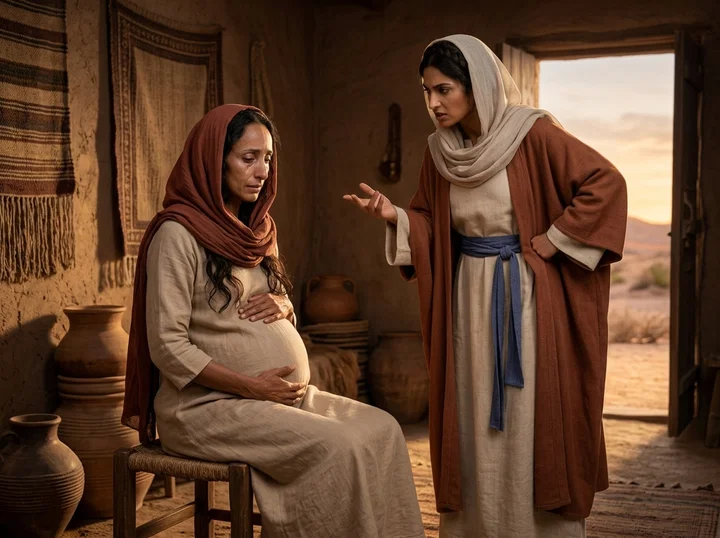
But Abram said unto Sarai, Behold, thy maid is in thy hand; do to her as it pleaseth thee. And when Sarai dealt hardly with her, she fled from her face.
Translations
But Abram said to Sarai, Behold, your maid is in your hand; do to her as it pleases you. And when Sarai dealt hardly with her, she fled from her face.
King James Version, KJV Cambridge Paragraph Bible
But Abram said unto Sarai, Behold, thy maid is in thy hand; do to her as it pleaseth thee. And when Sarai dealt hardly with her, she fled from her face.
But Abram said to Sarai, Behold, thy maid is in thy hand; do to her as it pleaseth thee. And when Sarai dealt hardly with her, she fled from her face.
Revised Version, American Standard Version
But Abram said unto Sarai, Behold, thy maid is in thy hand; do to her that which is good in thine eyes. And Sarai dealt hardly with her, and she fled from her face.
And Abram saith unto Sarai, 'Lo, thine handmaid [is] in thine hand, do to her that which is good in thine eyes;' and Sarai afflicted her, and she fleeth from her presence.
And Abram said to Sarai, Behold, thy maidservant is in thy hand: do to her what is good in thine eyes. And Sarai oppressed her; and she fled from her face.
And Abram said unto Sarai, Lo! thy handmaid, is in thy hand, do to her what is good in thine eyes. So Sarai humbled her, and she fled from her face.
Berean Standard Bible, Majority Standard Bible
“ Here,” said Abram, “ your servant is in your hands. Do whatever you want with her.” Then Sarai treated Hagar so harshly that she fled from her.
But Abram said to Sarai, “ Behold, your maid is in your hand. Do to her whatever is good in your eyes.” Sarai dealt harshly with her, and she fled from her face.
And Abram said, The woman is in your power; do with her whatever seems good to you. And Sarai was cruel to her, so that she went running away from her.
Then Abram saide to Sarai, Beholde, thy maide is in thine hand: doe with her as it pleaseth thee. Then Sarai dealt roughly with her: wherefore she fled from her.
Douay-Rheims (Challoner revision)
And Abram made answer, and said to her: Behold thy handmaid is in thy own hand, use her as it pleaseth thee. And when Sarai afflicted her, she ran away.
Pictures
Cross-references
- Galatians 4:22-24
For it is written, that Abraham had two sons, the one by a bondmaid, the other by a freewoman.
Hagar’s history is used as an allegory of the two covenants.
- Genesis 21:1-12
And the LORD visited Sarah as he had said, and the LORD did unto Sarah as he had spoken.
The later account confirms Isaac as the promised heir and recounts Hagar and Ishmael’s removal.
- Genesis 15:4-6
And, behold, the word of the LORD came unto him, saying, This shall not be thine heir; but he that shall come forth out of thine own bowels shall be thine heir.
God promised Abram an heir, and Abram believed before the Hagar arrangement.
- Genesis 17:18-19
And Abraham said unto God, O that Ishmael might live before thee!
God promises Sarah will bear the covenant son, setting aside Abraham’s plan for Ishmael.
- Genesis 30:1-24
And when Rachel saw that she bare Jacob no children, Rachel envied her sister; and said unto Jacob, Give me children, or else I die.
Both texts depict conflict among the patriarchs’ wives and household.
- Genesis 16:2
And Sarai said unto Abram, Behold now, the LORD hath restrained me from bearing: I pray thee, go in unto my maid; it may be that I may obtain children by her. And Abram hearkened to the voice of Sarai.
Sarai’s plan sought to fulfill the promise through Hagar.
- Genesis 16:13
And she called the name of the LORD that spake unto her, Thou God seest me: for she said, Have I also here looked after him that seeth me?
Hagar names God as the one who sees her.
- Galatians 4:22-23
For it is written, that Abraham had two sons, the one by a bondmaid, the other by a freewoman.
Contrasts the bondwoman’s son born after the flesh with the freewoman’s son by promise.
- Genesis 16:11-12
And the angel of the LORD said unto her, Behold, thou art with child, and shalt bear a son, and shalt call his name Ishmael; because the LORD hath heard thy affliction.
Hagar’s harsh treatment preceded the prophecy that her son would be a wild man.
- 1 Peter 3:6
Even as Sara obeyed Abraham, calling him lord: whose daughters ye are, as long as ye do well, and are not afraid with any amazement.
Sarah is presented as an example in the New Testament.
- Romans 9:7-8
Neither, because they are the seed of Abraham, are they all children: but, In Isaac shall thy seed be called.
Ishmael, born through a human scheme, is not counted as the promised seed.
- Genesis 17:1-7
And when Abram was ninety years old and nine, the LORD appeared to Abram, and said unto him, I am the Almighty God; walk before me, and be thou perfect.
God renews the covenant promise after Abram’s arrangement with Hagar.
Commentary
Each commentary is drawn from primary sources: the writings of Ellen G. White and Adventist pioneers and periodicals. Each commentary is separate. Its own words are not a quotation; follow the references to read the source passages.
Ellen G. White
5 sources
Genesis 16:6 belongs to Abraham and Sarah's failure to wait in confiding faith for the promised son and to endure the test of faith in God's unlimited power to fulfill the promise in His own way, and that distrust led them to bring Hagar into the marriage and brought unhappiness upon themselves.1SP 95.2–3SG3 101.1–2PP 147.1 Abraham had taken Hagar only at Sarah's special request, and when Sarah complained of Hagar's conduct and charged him with wrong, he answered in grief and perplexity that he would not have taken her except at Sarah's request.1SP 95.2–3 Instead of sending Hagar away, he left Hagar, his servant and wife, under Sarah's control and authority to deal with and treat as she wished, refusing to send her away because she was to be the mother of his child through whom he thought the promise would be fulfilled.PP 145.2–31SP 95.2–3SG3 101.1–2ST Mar 27, 1879
Hagar had become proud, boastful and contemptuous, carrying herself haughtily before Sarah and flattering herself that she would be the mother of the great nation promised to Abraham.PP 145.2–31SP 95.2–3SG3 101.1–2 Abraham was caught between Sarah's complaints about Hagar and Hagar's complaints of abuse from Sarah, torn between redressing Hagar and increasing the jealousy and unhappiness of Sarah, his first and much-loved wife, so the conflict made both Abraham and Sarah unhappy and left Sarah jealous and unhappy.1SP 95.2–3SG3 101.1–2ST Mar 27, 1879 When Sarah dealt harshly with Hagar, Hagar fled from her face, and the angel of God met the fugitive to comfort her and reprove her haughty conduct, bidding her return to her mistress and submit herself under her hands.PP 145.2–31SP 95.2–3SG3 101.1–2ST Mar 27, 1879
Sarah, as Abraham's only true wife, had the right to require Hagar her rival to be sent away, and the Lord did not reprove her for doing so, since no other person was entitled to share her rights as wife and mother.PP 147.1 The verse thus teaches that the marriage relation and the rights and happiness belonging to it must be carefully guarded, even at great sacrifice.PP 147.1
Sources
Pioneers and periodicals
35 sources
Abram left Hagar in Sarai's hand to deal with as she pleased rather than sending her away, and when Sarai oppressed her harshly Hagar fled from her face and household.ST Mar 27, 1879ST Nov 8, 1899ST Jan 29, 1894RH Apr 10, 1866 The harsh dealing followed Hagar's conceiving and then despising and making light of her mistress, after Sarai herself had given Hagar to Abram.ST Mar 20, 1907ST Apr 11, 1900ST Sep 8, 1898 Their course was faltering unbelief, doubting God's promise and trying in human weakness and scheming to bring it about by taking Hagar as wife.ST Jan 2, 1912ST Apr 11, 1900ST Sep 23, 1913ST Feb 28, 1906ST Sep 28, 1915 The history is where the two covenants begin, Hagar the bondwoman answering to the covenant from Mount Sinai and Sarah the freewoman answering to the other covenant, with Ishmael born after the flesh and not by promise.RH May 29, 1900RH Jun 26, 1900ST Apr 29, 1908ST Mar 22, 1899 The promised inheritance comes not by human planning or seeking justification by one's own efforts but through God's promise and righteousness by faith, and the unhappiness that followed shows plural marriage was a violation of the marriage institution and never worked for good.RH Feb 3, 1852RH Nov 8, 1853ST Apr 29, 1908ST Mar 22, 1899
Household Quarrel and Flight
Abram put Hagar back under Sarai's hand to deal with as she pleased, giving Sarai authority over her rather than sending her away.ST Mar 27, 1879RH Apr 10, 1866ST Apr 29, 1908RH Jul 3, 1900 Sarai then dealt harshly with her, afflicting and oppressing her, until Hagar fled from her face and out of the household.ST Nov 8, 1899ST Jan 29, 1894RH Mar 1, 1870ST Feb 1, 1905 The harsh dealing came after Hagar had conceived and then despised Sarai and made light of her, following Sarai's own act of giving her maid to Abram.ST Mar 20, 1907ST Apr 11, 1900ST Sep 8, 1898ST Mar 1, 1905RH Aug 3, 1905
When Sarai blamed Abram, he answered meekly and did not return anger for anger, though he could have reminded her the plan was her own giving, and by yielding Hagar into her hands he kept the quarrel from growing worse.RH Apr 10, 1866 Yet his course left him caught between Sarai's complaints on the one side and Hagar's complaints of mistreatment on the other, so that the strife brought unhappiness to himself and to Sarah.ST Mar 27, 1879
The verse belongs to Abraham's sojourn with its trials of faith and constant, remarkable evidences of God's overruling providence, pressing whether readers are children of Abraham, since Abraham had not at once come to fullness of faith and the lesson of faith comes over and over.ST Jan 2, 1912 It falls within the account of Abram's life that reveals his character and shows the influence of worldly associations upon a good man.ST Dec 20, 1910 It belongs also to God's providential dealings with Abraham's family in its chosen role as the family line through which the promised Seed would come.ST
In that line the chapter records the birth of Ishmael through Hagar whom Sarai gave to Abraham, with Sarai's jealousy toward Hagar and the sending away of Hagar and her son.ST Jan 29, 1894ST Jan 24, 1900 Ishmael's birth through Hagar did not fulfill God's promise of a son.ST Jan 24, 1900
Unbelief and the Covenants
Abram and Sarai did not continue to trust God's promise but in human weakness tried to bring it about by a human arrangement with Hagar, exposing unbelief and faltering, doubting faith.ST Jan 2, 1912ST Apr 11, 1900ST Sep 23, 1913ST Mar 1, 1905 Abraham had not at once come to fullness of faith, and the lesson of faith comes over and over in his sojourn and trials of faith under God's overruling providences, pressing whether readers are children of Abraham.ST Jan 2, 1912ST Sep 23, 1913 His taking Hagar as wife showed distrust in the promise, and the attempt to bring about the promised outcome by his own plan led to painful consequences and became part of the background to his later test.ST Apr 1, 1875
Sarai's proposal to have a child through her handmaid was human scheming, not God's plan, and Abram's taking Hagar as wife or concubine was disobedience, transgression, and an indiscreet act.ST Apr 1, 1875ST Feb 28, 1906ST Sep 28, 1915RH Jul 4, 1865 Abram accepted Sarai's arrangement with Hagar the bondwoman instead of continuing to trust God's promise, and after Hagar conceived and despised Sarai, Sarai treated her harshly and Hagar fled.ST Apr 11, 1900ST Mar 1, 1905 That failure to keep trusting God's promise led directly to the human arrangement and its painful consequences.ST Apr 11, 1900ST Mar 1, 1905
The plan proved unsatisfactory from the first step, bringing bondage, trouble, distress, and strife to the whole household, with plural marriage never working for good.ST Sep 28, 1915RH Jul 3, 1900ST May 27, 1908RH Jul 4, 1865 Abram put Hagar back into Sarai's hand and Sarai dealt so harshly with her that Hagar fled, proving that obtaining the promised seed through the bondwoman by the flesh brought strife with no peaceful and pleasant relation afterward even after the Lord told Hagar to return to her mistress and submit herself under her hands.RH Jul 3, 1900ST May 27, 1908 Abraham did not clearly see that having a concubine was wrong, but the family difficulties, trials, and cares that followed show God's people then as now needed spirituality to please God.ST May 27, 1908RH Jul 4, 1865
This history is where the subject of the two covenants begins in the family of Abraham.RH May 29, 1900RH Jun 26, 1900 Hagar the bondwoman mother represents the covenant from Mount Sinai and Sarah the freewoman mother represents the other covenant, and their two sons represent the children of the two covenants named in Galatians 4:24.RH May 29, 1900RH Jun 26, 1900 A true study must begin where the subject begins and study these two women together with Genesis 15, Genesis 17, and Genesis 21:1-21, reading Genesis 15, 16, 17, and 21:1-21 at least seven times to answer the covenant question.RH May 29, 1900RH Jun 26, 1900
Ishmael was the natural child of the flesh, born after the flesh and not by promise or by the Spirit, and his birth through Hagar did not fulfill God's promise of a son.ST Apr 29, 1908ST Mar 22, 1899ST Jan 24, 1900 He was the product of purely human wisdom, interfering, scheming, and planning to fulfill God's work, which could in no way glorify God, so he could not be the child of promise and child of grace.ST Apr 29, 1908ST Mar 22, 1899 Children of a slave woman are always born to bondage even when their father is a freeman, so Hagar the Egyptian slave woman in Sarai's hand could bring forth children only to bondage, while the promised heir was not a bond-servant even though born in his house, but a free-born son born of a freewoman by faith in the promise.ST Apr 29, 1908ST Mar 22, 1899
Abraham's attempt to obtain the promised heir through the handmaid illustrates that the inheritance comes not by human planning or seeking justification by one's own efforts, but through God's promise and righteousness by faith.ST Apr 29, 1908ST Mar 22, 1899 In Galatians 4 Hagar and her son represent bondage and those seeking justification by their own efforts, in contrast with the freewoman and the child of promise.ST Mar 22, 1899 The old covenant trusted as a covenant of salvation has no power to save because it is man's declaration that we will do and perform by human power and is bound to fail, so all who depend on themselves enter a covenant of bondage and are as Ishmael was, children of bondage.ST Apr 29, 1908ST Mar 22, 1899
The results of unbelief cannot be confined to the unbeliever.ST Sep 8, 1898ST Sep 8, 1898 Hagar was an Egyptian slave girl made to suffer for the unbelief of another, the innocent victim of distrust of the fulfillment of God's Word, driven from home and counsel at a critical period to wander wounded in heart in the desert, and her history was permanently recorded because of that suffering.ST Sep 8, 1898ST Sep 8, 1898 The oppression followed Hagar's making light of Sarah after conceiving and was the fruit of Sarah's own mistaken zeal in giving Hagar to Abraham to hasten God's promise, until Sarah oppressed Hagar and Hagar fled from the household with her only comfort the visit and comforting words of a messenger from God.ST Sep 8, 1898ST Sep 8, 1898 On the angel's advice she smothered her grief and returned to her mistress to suffer whatever fell to her lot, and the treatment she then received left its impress upon her child born soon after, who became a wild man with his hand against everyone and everyone's hand against him as the angel had predicted.ST Sep 8, 1898
Marriage, Israel and Character
The taking of Hagar brought a plain patriarchal violation of the marriage institution into Abraham's household, and the unhappiness that followed when Sarai dealt harshly and Hagar fled shows that polygamy and concubinage were wrong.RH Feb 3, 1852RH Nov 8, 1853RH Mar 1, 1870ST Jun 10, 1875ST May 18, 1882 That institution had been made for man before the fall, and its sacred character is not derived from the Decalogue, though the seventh commandment guards its sacredness.RH Feb 3, 1852RH Jan 21, 1875 Such conduct by the patriarchs is to be distinguished from the sanctity of the institution itself.ST Jun 10, 1875ST May 18, 1882RH Jan 21, 1875
A breach of marriage does not destroy or lessen its sacred character, just as a breach of the Sabbath in the patriarchal age would not destroy the sacred character of the Sabbath.RH Feb 3, 1852RH Nov 8, 1853ST Jun 10, 1875ST May 18, 1882RH Jan 21, 1875 The same history shows the Sabbath was already in existence and was kept and binding at least a month before the old covenant was made at Horeb, so the obligation of the Sabbath did not originate with the covenant at Horeb.RH Apr 2, 1872 Ishmael was Abraham's son and the ancestor of the Arabs, yet he and his descendants were not reckoned as entitled to the promises made to Israel.RH Jan 16, 1872 That exclusion of a fleshly line proves that mere lineal descent from Abraham does not make anyone part of true Israel, but some other principle besides lineal descent decides who are Israelites.RH Jan 16, 1872
Hagar's flight did not make her happier, because the problem was not merely her surroundings.ST Mar 20, 1907RH Aug 3, 1905 Her own wrong attitude contributed to the hardship, for after conceiving she despised her mistress and made light of her, and that contempt was the likely reason Sarai treated her harshly.ST Mar 20, 1907RH Aug 3, 1905RH Aug 3, 1905 She needed a change of heart and an experience of submission that fleeing could not give, and the Lord permitted Sarai's harshness for Hagar's sake.ST Mar 20, 1907RH Aug 3, 1905RH Aug 3, 1905
Trials and offenses can expose defects of character, and their effect depends in part on how a person responds to them.ST Mar 20, 1907 The account belongs to Abraham's sojourn and trials of faith, with constant and remarkable evidences of God's overruling providence, the lesson of faith coming over and over while Abraham had not at once come to fullness of faith, and it presses whether readers are children of Abraham.ST Jan 2, 1912 Though Hagar thought she had been driven into the wilderness to die, deprived of home and counsel at a critical period, God saw her to save and provided for her need, and His seeing her was a message of comfort and care, not condemnation, her only comfort being the visit and comforting words of a messenger from God.ST Nov 8, 1899ST Sep 8, 1898 On the angel's advice she smothered her grief and returned to her mistress to suffer whatever fell to her lot.ST Mar 20, 1907ST Sep 8, 1898
Sources