Genesis 21:17
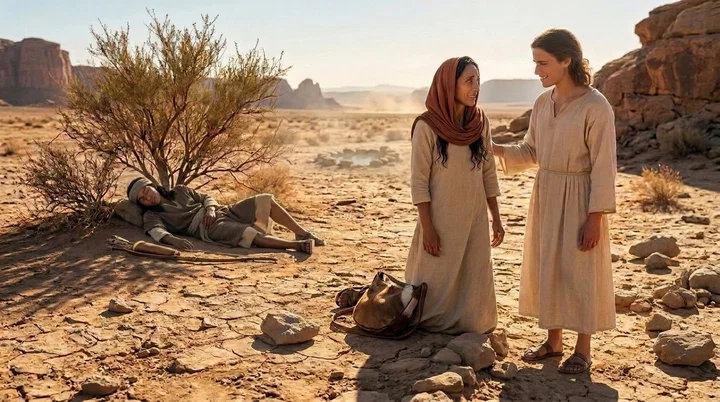
And God heard the voice of the lad; and the angel of God called to Hagar out of heaven, and said unto her, What aileth thee, Hagar? fear not; for God hath heard the voice of the lad where he is.
Translations
And God heard the voice of the lad; and the angel of God called to Hagar out of heaven, and said to her, What ails you, Hagar? fear not; for God has heard the voice of the lad where he is.
King James Version, KJV Cambridge Paragraph Bible, Revised Version, American Standard Version
And God heard the voice of the lad; and the angel of God called to Hagar out of heaven, and said unto her, What aileth thee, Hagar? fear not; for God hath heard the voice of the lad where he is.
And God heard the voice of the lad: and the angel of God called to Hagar out of heaven, and said to her, What aileth thee, Hagar? fear not; for God hath heard the voice of the lad where he is.
And God heareth the voice of the youth; and the messenger of God calleth unto Hagar from the heavens, and saith to her, 'What to thee, Hagar? fear not; for God hath hearkened unto the voice of the youth where he [is];
And God heard the voice of the lad. And the Angel of God called to Hagar from the heavens, and said to her, What [aileth] thee, Hagar? Fear not; for God hath heard the voice of the lad there, where he is.
And God heard the voice of the boy, and a messenger of God called unto Hagar out of the heavens; and said to her, What aileth thee, Hagar? Do not fear, for God hath hearkened unto the voice of the boy where he is.
Berean Standard Bible, Majority Standard Bible
Then God heard the voice of the boy, and the angel of God called to Hagar from heaven, “ What is wrong, Hagar? Do not be afraid, for God has heard the voice of the boy where he lies.
God heard the voice of the boy.The angel of God called to Hagar out of the sky, and said to her, “ What troubles you, Hagar? Don’t be afraid. For God has heard the voice of the boy where he is.
And the boy's cry came to the ears of God; and the angel of God said to Hagar from heaven, Hagar, why are you weeping? have no fear, for the child's cry has come to the ears of God.
Then God heard the voyce of ye childe, and the Angel of God called to Hagar from heauen, and said vnto her, What aileth thee, Hagar? feare not, for God hath heard the voyce of the childe where he is.
Douay-Rheims (Challoner revision)
And God heard the voice of the boy: and an angel of God called to Agar from heaven, saying: What art thou doing, Agar? fear not: for God hath heard the voice of the boy, from the place wherein he is.
Pictures
Cross-references
- Genesis 16:11
And the angel of the LORD said unto her, Behold, thou art with child, and shalt bear a son, and shalt call his name Ishmael; because the LORD hath heard thy affliction.
Ishmael’s name recalls that God heard Hagar’s affliction.
- Galatians 4:22-31
For it is written, that Abraham had two sons, the one by a bondmaid, the other by a freewoman.
Hagar and Sarah represent the two covenants and their children.
- Genesis 17:18
And Abraham said unto God, O that Ishmael might live before thee!
Abraham expresses concern for Ishmael, whom God hears and preserves.
- Genesis 21:11
And the thing was very grievous in Abraham’s sight because of his son.
Abraham grieved over sending Hagar and Ishmael away.
- Genesis 48:16
The Angel which redeemed me from all evil, bless the lads; and let my name be named on them, and the name of my fathers Abraham and Isaac; and let them grow into a multitude in the midst of the earth.
Jacob calls God the angel who redeemed him from evil.
Commentary
Each commentary is drawn from primary sources: the writings of Ellen G. White and Adventist pioneers and periodicals. Each commentary is separate. Its own words are not a quotation; follow the references to read the source passages.
Pioneers and periodicals
16 sources
God heard the cry of the exhausted lad where he was in his distress in the wilderness after he and Hagar were sent away, and had mercy on them there.ST Jan 2, 1912STSTST Sep 8, 1898ST Feb 12, 1894 The angel of God called to Hagar out of heaven, asking what troubled her and telling her not to fear because God had heard the boy, succoring them rather than sending them back to bondage.ST Jan 2, 1912STST He told her to lift up and care for the lad, promising to make him a great nation because he is Abraham's seed, and directed her to a nearby well whose water revived the child and kept them from perishing.STST Sep 8, 1898RH Sep 11, 1913ST Jan 16, 1907 The verse shows God as attentive to those in need and compassionately remembering them, so that distress over provision already at hand need not become fretful worry, and it shows angels commissioned to bring God's messages to men.STRH Sep 11, 1913ST Oct 1, 1896 Hagar the bondwoman and Ishmael her son stand for the covenant from Sinai and its children in bondage through human scheming, while Sarah the freewoman and Isaac her son stand for the other covenant and its children, for the promised Seed was to come through Isaac and not through Ishmael.RH May 29, 1900RH Jul 5, 1915ST Sep 28, 1915ST Jan 24, 1900
Wilderness Rescue Account
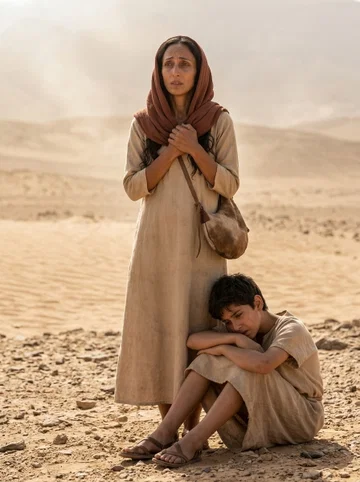
Hagar and Ishmael were sent away according to Sarah's word, and this sending belongs within Abraham's test of faith and obedience.ST Sep 8, 1898 It is the account of Hagar being sent away and then receiving God's mercy in the wilderness.ST Feb 12, 1894 God heard the voice and cry of the exhausted lad where he was in his distress in the wilderness.ST Jan 2, 1912STSTRH Oct 13, 1859ST Sep 8, 1898 He heard Ishmael's cry in his distress and responded to him, attending to those in need.RH Oct 13, 1859
The angel of God called to Hagar out of heaven, asking what troubled her.STST Sep 8, 1898 The angel was sent to comfort Hagar and reassure her, telling her not to fear because God had heard the voice of the boy where he was.ST Jan 2, 1912STSTST Sep 8, 1898 That help succored Hagar and her son in their need rather than returning them to bondage.RH Oct 13, 1859 God told her to lift up and care for the lad, promising to make him a great nation because he is Abraham's seed, and Ishmael afterward grew up in the wilderness as an archer and leader of wild tribes.ST
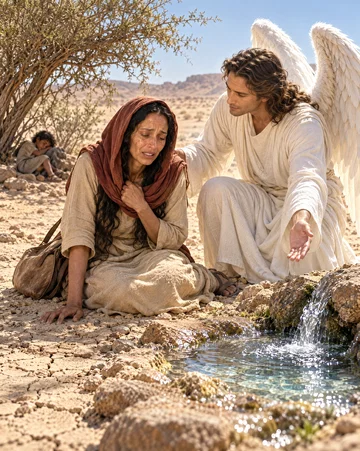
The angel then showed and directed Hagar to a well, and the water she drew revived the child and spared his life.ST Sep 8, 1898 Water was nearby and available to save her son, and that direction to water kept her and Ishmael from perishing in the desert.RH Sep 11, 1913ST Jan 16, 1907 Hagar had lost her way while traveling to an encampment intended to become her own, rather than being cast out without provision.ST Nov 15, 1910 Ishmael later received a large share of Abraham's property and rose to a high position among the Arab tribes.ST Nov 15, 1910
God's Care and Angels
God heard the boy's voice where he was in the wilderness and sent an angel to speak to Hagar, asking what troubled her and telling her not to fear.ST The hearing of Ishmael's cry in his distress shows attention to those in need.ST It is compassionate remembrance of Hagar and her son in their need, with reassurance given to the mother through the angel.STST Oct 1, 1896
The angel's delivery of God's message to Hagar shows that angels are commissioned to bring messages to people as part of their ministry on earth. God's hearing of Ishmael in the desert and sending of an angel by whom Hagar was saved along with her child is an example of such angelic ministry, and not communication with the dead. The angel's reassurance to Hagar came when water in a nearby well was available to save her son, so her distress did not need to become fretful worry.RH Sep 11, 1913
Covenant Allegory and Lessons
The history of Hagar and Abraham's two sons is the starting point for studying the two covenants.RH May 29, 1900 Hagar the bondwoman stands for the covenant from Sinai and Sarah the freewoman stands for the other covenant, while their sons stand for the children of those covenants.RH May 29, 1900 Ishmael born of the maidservant Hagar and Isaac born of the freewoman Sarah illustrate the two covenants, testaments, or dispensations, the two systems typical and antitypical, and the two peoples literal Israel and true Israel, or Jews and Gentiles, as representatives of the Lord and His work in two special periods of its development in the earth.ST Jan 24, 1900
The promised Seed was to come through Isaac, not through Abraham's other son Ishmael.RH Jul 5, 1915 Ishmael's birth came through human scheming and led to bondage and trouble rather than fulfilling God's promise through Sarah.ST Sep 28, 1915 The history shows the unhappiness that polygamy brought into Abraham's family.RH Mar 1, 1870
Sources